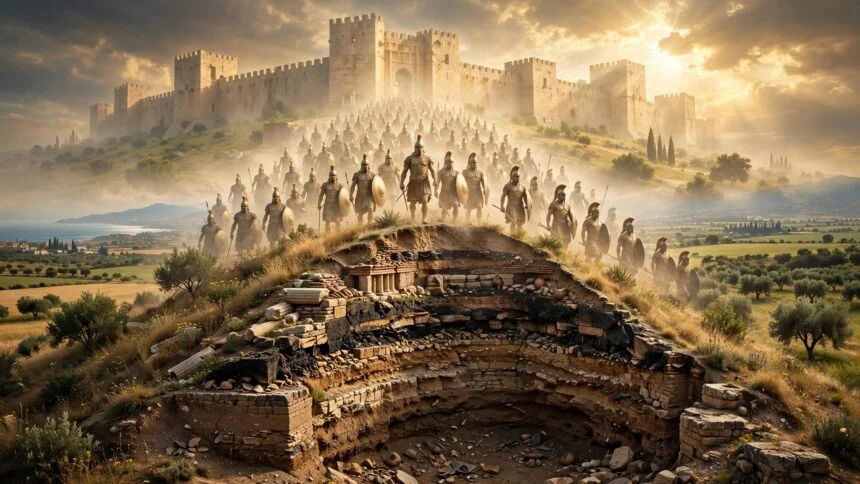



The Greeks did not believe the gods had always existed.
This is the first and most important thing to understand about Greek mythology, and it is the thing that distinguishes the Greek cosmological account from every other major ancient account of divine origins, making it both the most structurally ambitious and the most theologically honest of them all. The gods of Olympus are not eternal. They are the product of a process: the process by which the undifferentiated void organized itself into the structured cosmos through a sequence of generations of divine beings whose conflicts and unions and transformations at each stage produced the organized world that the subsequent stage inhabited.
The Greek cosmos has a history. The gods are part of that history. The organized world the Olympian gods govern is not the world as it always was, but the world as it became, through the sequence of events Hesiod’s Theogony, composed in the eighth century BCE, preserved as a cosmological argument about the relationship between order and chaos, between the organized and the unorganized, between the world as it now stands and the void it came from.
To read the Greek genealogy of the gods purely as a family tree, a chart of who was born from whom, is to read it at its most superficial level. The genealogy is a cosmological argument: each generation of divine beings represents a stage in the organized cosmos’s development, each conflict between generations represents a transition from one cosmological order to another, and the outcome of each transition determines the character of the world that the next stage produces. The family tree is the map of how the world became what it is, drawn in the medium of the divine beings whose natures and whose conflicts were the medium through which the cosmic organization occurred.
This is that map, read at the depth it was designed to be read.
Before the Gods | The Primordial Condition
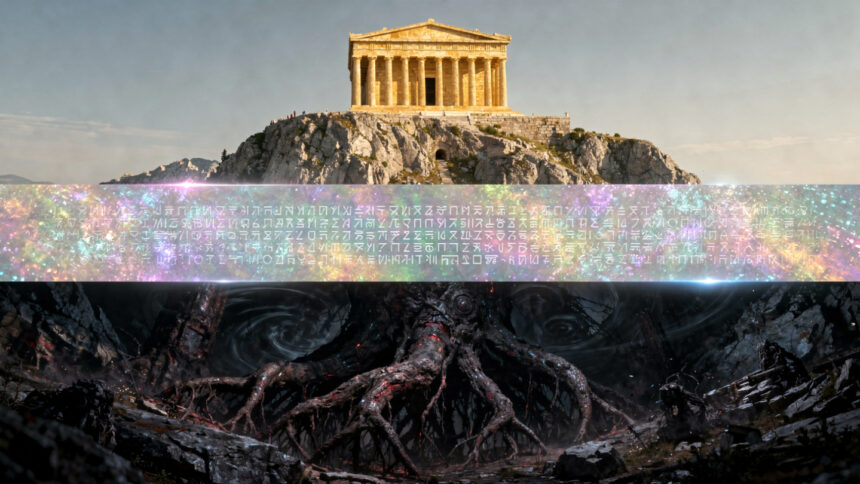
In the beginning was Chaos.
The Greek word chaos did not mean disorder in the sense of the contemporary usage: it meant the yawning gap, the open void, the condition of the undifferentiated in which the distinctions that make the organized world possible had not yet been established. Chaos was not the absence of the gods: it was the condition that preceded the distinctions between earth and sky, between light and darkness, between the living and the dead, between the divine and the mortal. Everything was potential, nothing was actual.
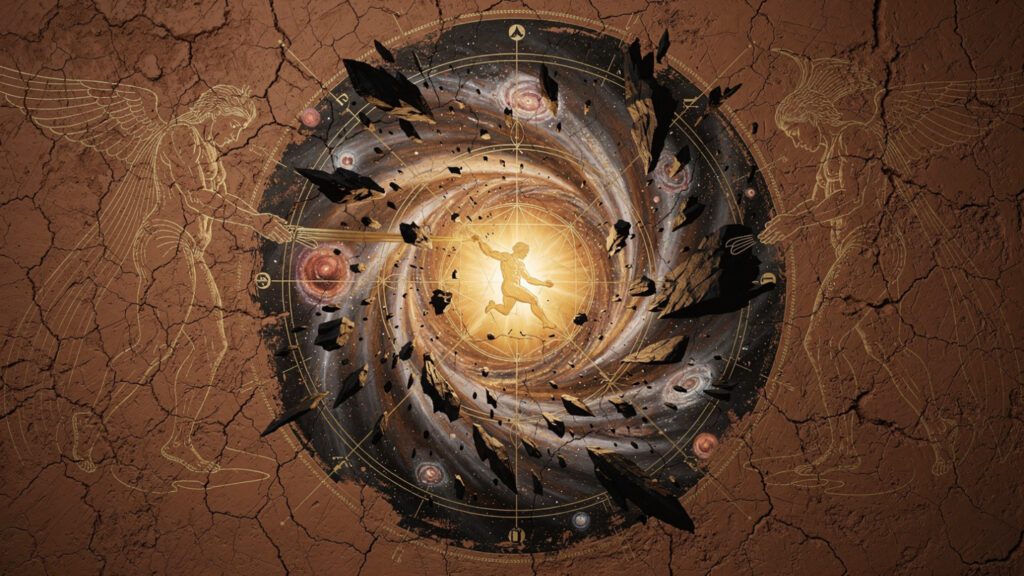
From Chaos emerged the first four primordial beings: Gaia, Tartaros, Eros, and Erebos. None of these is a deity in the anthropomorphic sense the Olympians would later be: each is a cosmological condition given just enough personal form to be told as a story.
Gaia was the earth, not in the sense of the planet but in the sense of the primordial condition of the stable, solid, horizontal material on which the organized world would be built. She was simultaneously the geological foundation of the world and the divine being whose maternal character would generate the subsequent generations of divine beings through the biological metaphor of birth whose application to the cosmic creative process gave the Theogony its narrative form.
Tartaros was the deepest abyss, the pit beneath the earth whose character as the bottommost level of the organized cosmos the Hades article in this collection develops through the underworld geography: Tartaros as the region where the most severely condemned were punished, located as far below Hades as the sky is above the earth. In this earliest account, Tartaros is not a region but a primordial condition, the depth the cosmic order needed simply in order to have a bottom.
Erebos was primordial darkness, the condition of the unilluminated space beneath the earth that Nyx’s night was the above-ground expression of. Erebos and Nyx, darkness and night, together constituted the primordial pair from whose union the first generation of cosmic phenomena emerged: the children of Erebos and Nyx were not divine beings in the Olympian sense but the conditions and forces whose existence constituted the world’s daily and seasonal operation. Hemera, the day. Aither, the bright upper air. Hypnos, sleep. Thanatos, death. The Moirai, the Fates. The Hesperides. Nemesis. Eris. The entire range of the forces that operated on the human experience as the conditions of mortal life were the children of the primordial darkness and the primordial night, born before the Titans and before the Olympians, older than any named deity in the Greek pantheon.
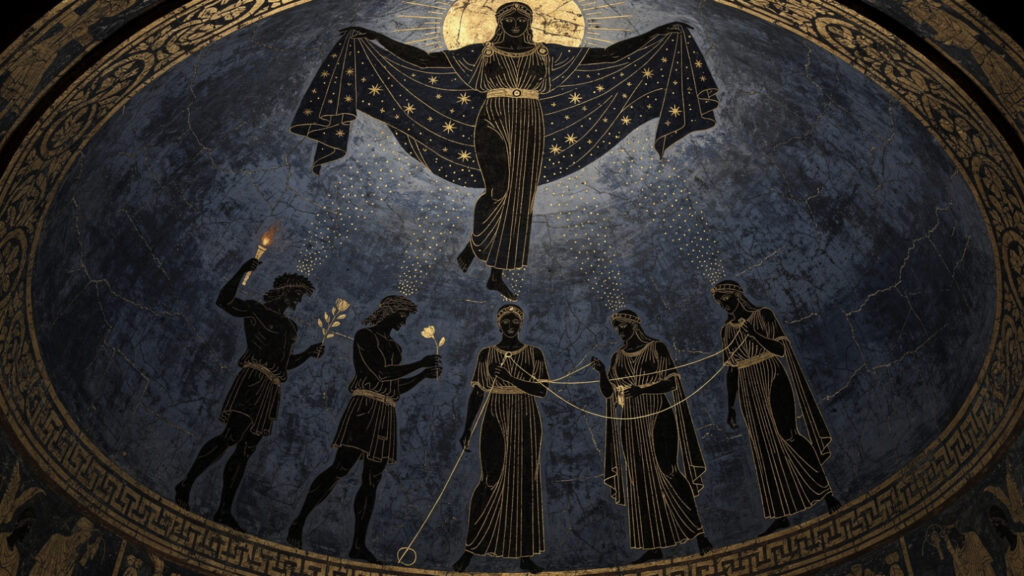
Eros was the most theologically significant of the four primordial beings, and the Eros and Aphrodite article in this collection develops his character at the depth it actually deserves: not the winged boy with arrows of later art, not the deity of romantic love the popular imagination knows, but the cosmological force of attraction that organized the undifferentiated void into the combinations that produced the structured cosmos. Hesiod names him as the most beautiful among the immortals, the limb-loosener, the one who overcomes the mind and the rational thought of all gods and all humans. This is not a description of romantic love. It is a description of the force without which the cosmos itself could not have organized from the undifferentiated void: the force that drew things toward each other, that made combinations rather than separations, that produced the organized complexity of the world from the disorganized simplicity of the Chaos that preceded it.
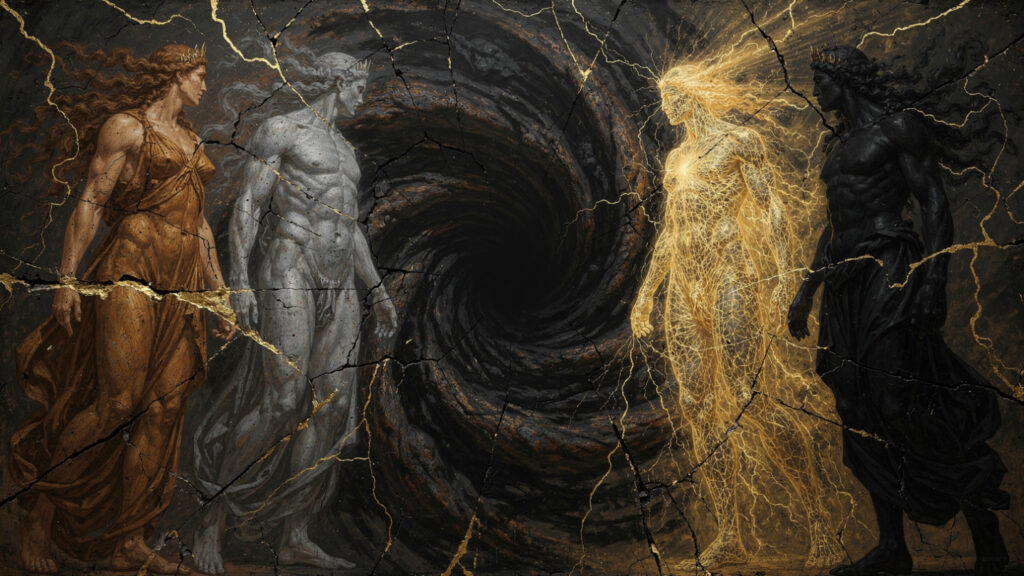
Without Eros, Gaia and Ouranos would not have come together. Without that coming together, the Titans would not have been born. Without the Titans, the Olympians would not have been born. The primordial Eros is the force whose application to the primordial conditions was the condition of the entire subsequent development of the cosmos.
Gaia and Ouranos | The First Creation and the First Violence
Gaia, the earth, generated Ouranos, the sky, from herself without a union: the parthenogenetic birth whose theological content was the content that the primordial earth required the sky as its complementary opposite before any further cosmic development could occur. Ouranos, the sky, spread himself over Gaia and became her covering, the cosmological arrangement of the sky above the earth that the organized world maintained as its fundamental spatial structure.
From the union of Gaia and Ouranos came the first generation of the cosmos’s organized beings: the twelve Titans, the three Cyclopes, and the three Hecatonchires.
The Titans were the divine beings whose generation represented the first fully organized divine order: twelve colossal beings who embodied the cosmic forces and conditions that the organized world required. Oceanus and Tethys as the encircling ocean and the waters. Hyperion and Theia as the light and the radiance from which the sun and moon and dawn would be born. Koios and Phoebe as the intelligence and the prophetic radiance that the world’s rational organization required. Kronos and Rhea as the time that governed the cosmic cycle and the flowing abundance that the earth’s fertility produced. Themis as divine law, her character as the principle of cosmic order connecting her directly to the oracle at Delphi before Apollo arrived to claim it. Mnemosyne as the memory whose character as the preservation of the past made her the divine being whose nine daughters would become the Muses, the preservers and transmitters of the cultural memory. Iapetos, whose children Prometheus, Epimetheus, and Atlas would become the Titans most directly connected to the human world’s own origin, through the creation of humanity and the later conflict with Zeus. Krios, whose domain among the Titans later sources developed less fully than the rest.
The Cyclopes and the Hecatonchires were the beings whose character was the character of the raw cosmic force that had not yet been organized into the form that the Titans represented: the Cyclopes, each with a single eye, who made the thunderbolts and the other divine weapons, and the Hecatonchires, the hundred-handed giants whose combination of the enormous and the multiple gave them the military capacity that the Titans lacked.
Ouranos, the sky, hated the Hecatonchires for their monstrous power and shoved them back into the earth, refusing to let them emerge. Gaia, in agony from containing the Hecatonchires inside her, asked her Titan children to punish their father. Only Kronos agreed. Gaia gave him the adamantine sickle. When Ouranos came to cover Gaia in the night, Kronos reached out and castrated him, throwing the severed genitals into the sea.
From the blood that fell on Gaia’s surface grew the Erinyes, the Furies, chthonic beings of retribution for the violation of the blood bond, and the Giants, whose subsequent conflict with the Olympians the Gigantomachy myth preserves. From the sea foam that formed around the severed genitals in the sea, drifting first near Kythera and then to Cyprus, Aphrodite emerged: the goddess of love and erotic attraction born from the violence of the cosmic castration, from the combination of the sky god’s generative organ with the sea’s primordial fluid. The Hesiodic Aphrodite is not the daughter of Zeus and Dione that Homer describes: she is the force of erotic attraction that emerged from the first great cosmic violence, born from the wounding of the sky and the sea’s reception of that wound.
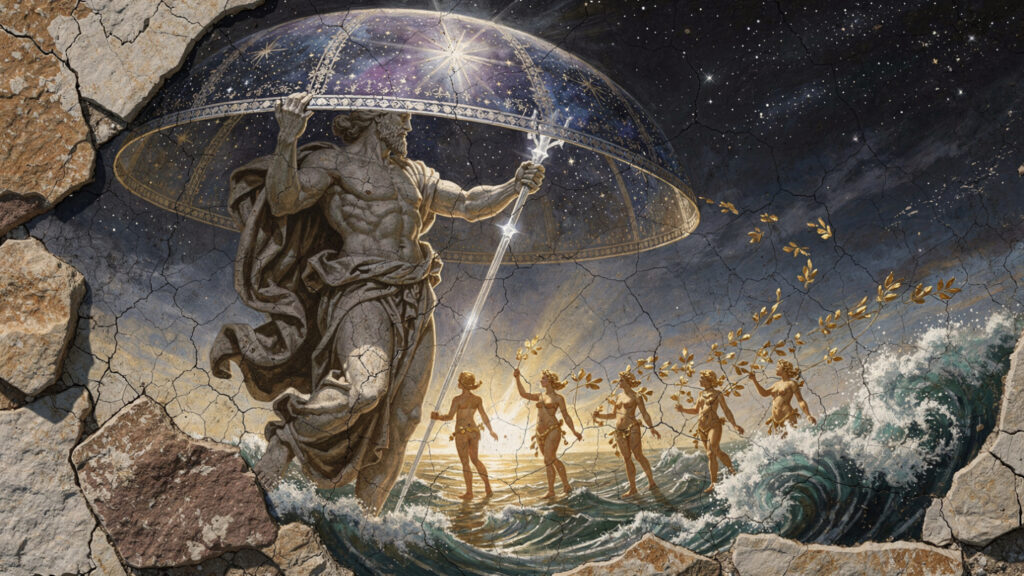
Ouranos, as he withdrew from Gaia in his wound, prophesied that Kronos would be overthrown by his own son, just as Kronos had overthrown him.
Kronos and the Devouring of the Divine Order
Kronos freed the Titans from Tartaros, where Ouranos had imprisoned many of them, and became ruler of the cosmos in what mythology calls the Golden Age, the period of Titan rule before the conflicts that produced the Olympian order had even occurred.
But Kronos was haunted by the prophecy of his own overthrow, and his response to it follows the same pattern the Perseus and Oedipus myths in this collection develop elsewhere: the attempt to prevent a prophesied outcome becomes the very mechanism that brings it about.
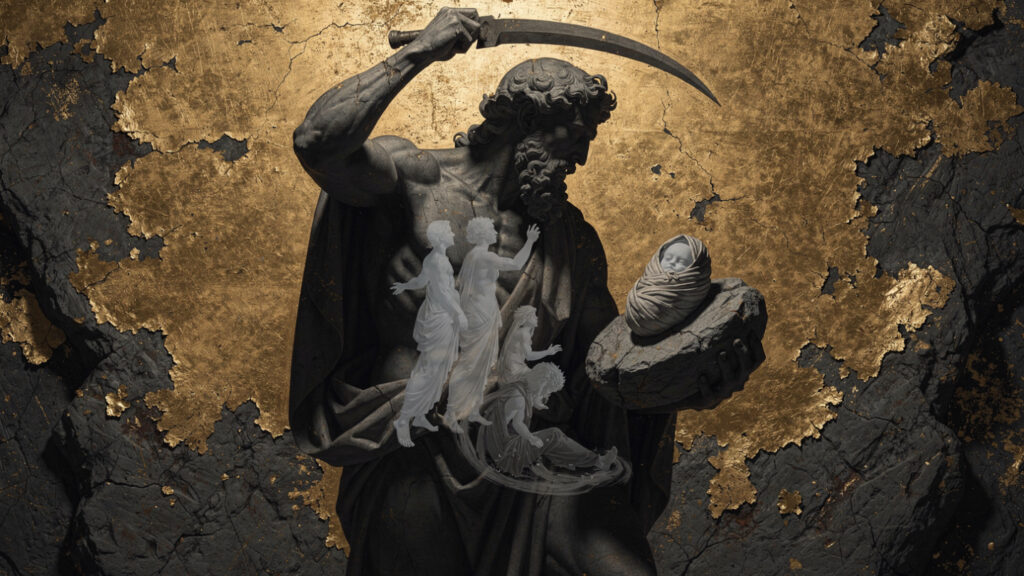
When Rhea bore the first Olympians, Kronos swallowed each child as it was born: Hestia, Demeter, Hera, Hades, Poseidon. Each divine being was swallowed whole before it could develop the capacities that would allow it to overthrow him. The theological content of the swallowing is the theological content of the time that consumes what it produces: Kronos as the personification of the temporal cycle whose character was the character of the cycle that produces and then destroys what it produces, the year that brings the harvest and then brings the winter that destroys the harvest, the generation that produces the next generation and then is consumed by the time that produced it.
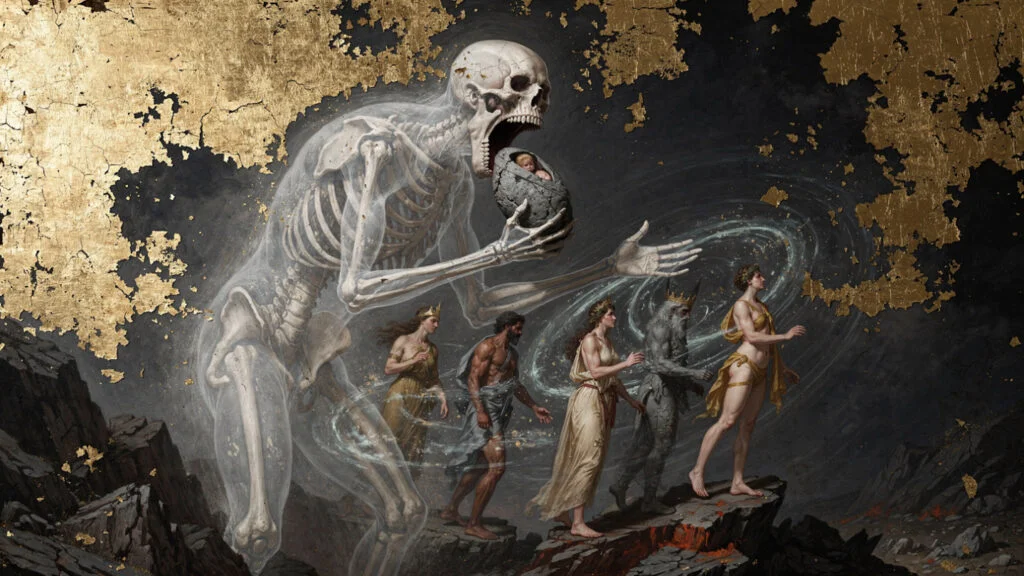
Rhea, in grief for her children, asked Gaia and Ouranos for guidance. They told her to give birth to her sixth child in secrecy and to present Kronos with a stone wrapped in swaddling clothes in the child’s place. Kronos swallowed the stone. The child, Zeus, was carried secretly to Crete, to Mount Ida or to the cave on the Dikte mountain range depending on the source, where the Kouretes, the divine young men whose ritual dance and clash of shields covered the infant’s crying, protected him. The Kouretes article in this collection develops their character and their connection to the Idaean Herakles who organized the first Olympic Games.
Zeus grew to maturity in Crete, the most sacred landscape in the entire pre-Olympian divine geography: the cave where he was raised, the mountain where the Kouretes performed their protective dance, and the island’s own primordial religious life, which the Minoan civilization had already maintained before the arriving Greeks absorbed and transformed it.
When Zeus was grown, Metis, the Oceanid whose name meant cunning intelligence, gave Kronos an emetic that caused him to vomit up the five swallowed Olympians in the reverse order of their swallowing. The five divine beings emerged from Kronos’s body as fully formed adults, carrying with them the development that the years inside Kronos had given them: the time inside time had not destroyed them but had preserved them in the condition of the divine being waiting for the moment of its release.
The Titanomachy | The War That Shaped the World
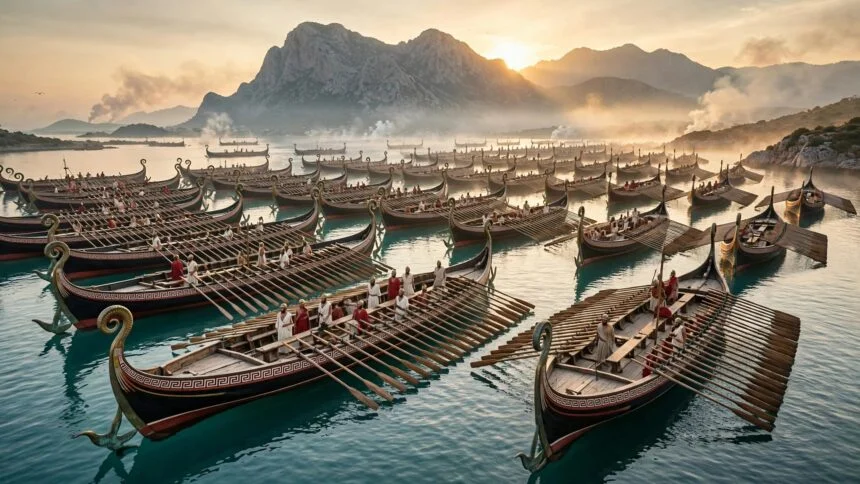
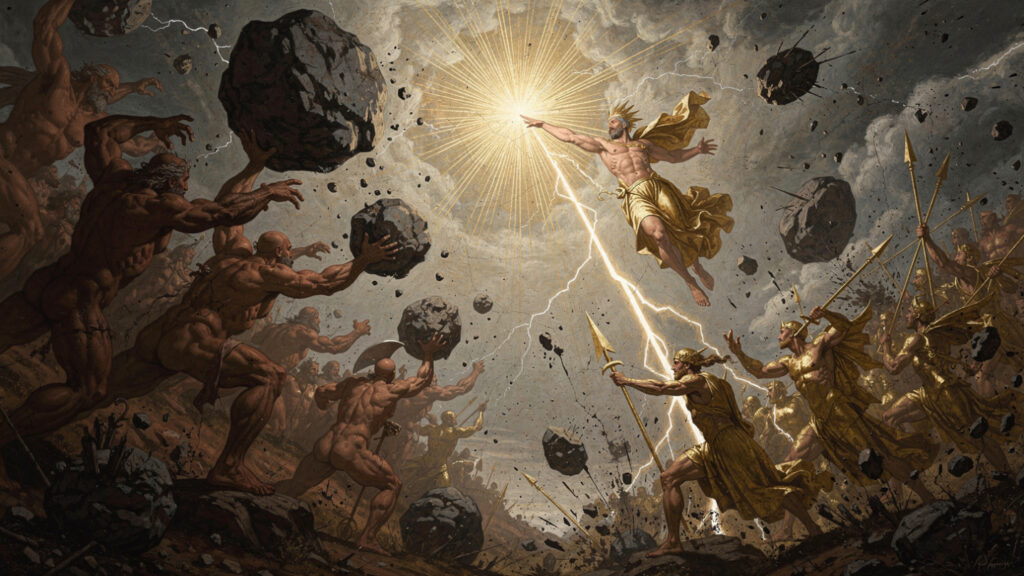
The ten-year war between the Titans and the Olympians, called the Titanomachy, was the cosmological event whose outcome determined the character of the organized world the Olympians would subsequently govern.
The war was not simply a conflict between two generations of divine beings over the governance of the cosmos. It was the process by which the cosmological order the Titans had established gave way to the order the Olympians built in its place: a transition from the Titan principle, raw cosmic force operating according to the necessity of the temporal cycle, to the Olympian principle, organized divine intelligence operating according to a rational order the Olympians themselves identified as the very condition of a just, governed world.
Zeus released the Cyclopes from Tartaros, where Kronos had imprisoned them after freeing the Titans, and the Cyclopes in gratitude forged for him the thunderbolt: the weapon whose character as the organized force of the sky’s electrical violence gave Zeus his divine attribute and whose theological significance as the force of the organized intelligence imposing itself on the world through the medium of the directed lightning strike is the significance that the Apollo article in this collection develops through the comparison between the bow and the lightning bolt as the two weapons that strike from a distance through the organized application of force.
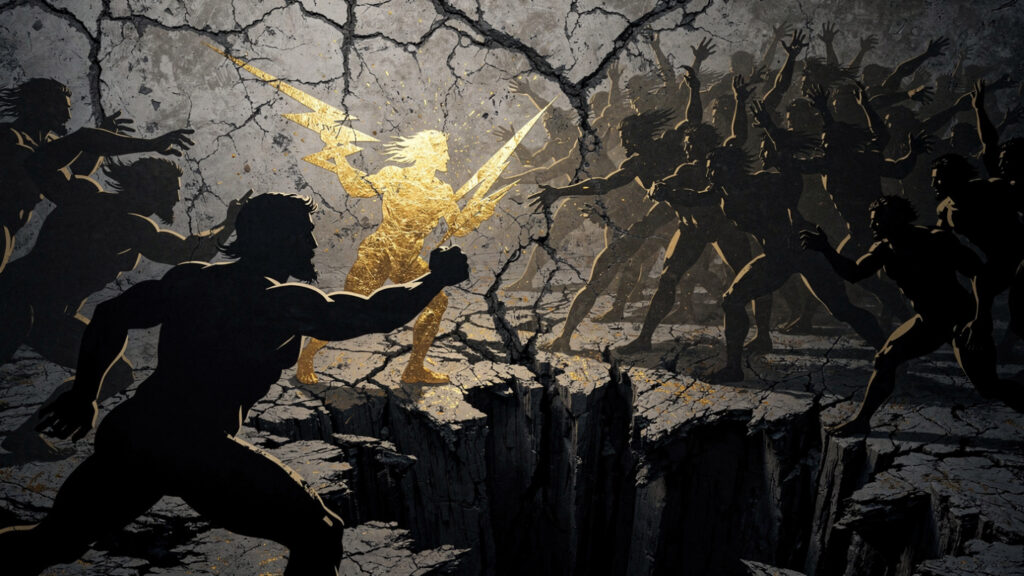
Zeus also released the Hecatonchires, whose hundred-handed capacity to hurl boulders simultaneously in every direction gave the Olympian side the military advantage that the individual strength of any single Titan could not match.
The Gigantomachy articles in this collection, the Nisyros article and the Mount Athos article and the Samothraki article and the Foloi forest article, develop the geological encoding of the conflict between the divine generations in the landscapes of the Greek world: the volcanic islands as the bodies of the defeated Giants, the mountain ranges as the weapons that the gods or the Giants threw, the hot springs and volcanic activity as the breath of the imprisoned beings whose defeat had buried them beneath the landscape’s surface. The Titanomachy and the Gigantomachy are not simply mythological narratives: they are the encoding of the geological reality of the Aegean world in the theological language of the divine conflict whose outcome shaped the landscape.
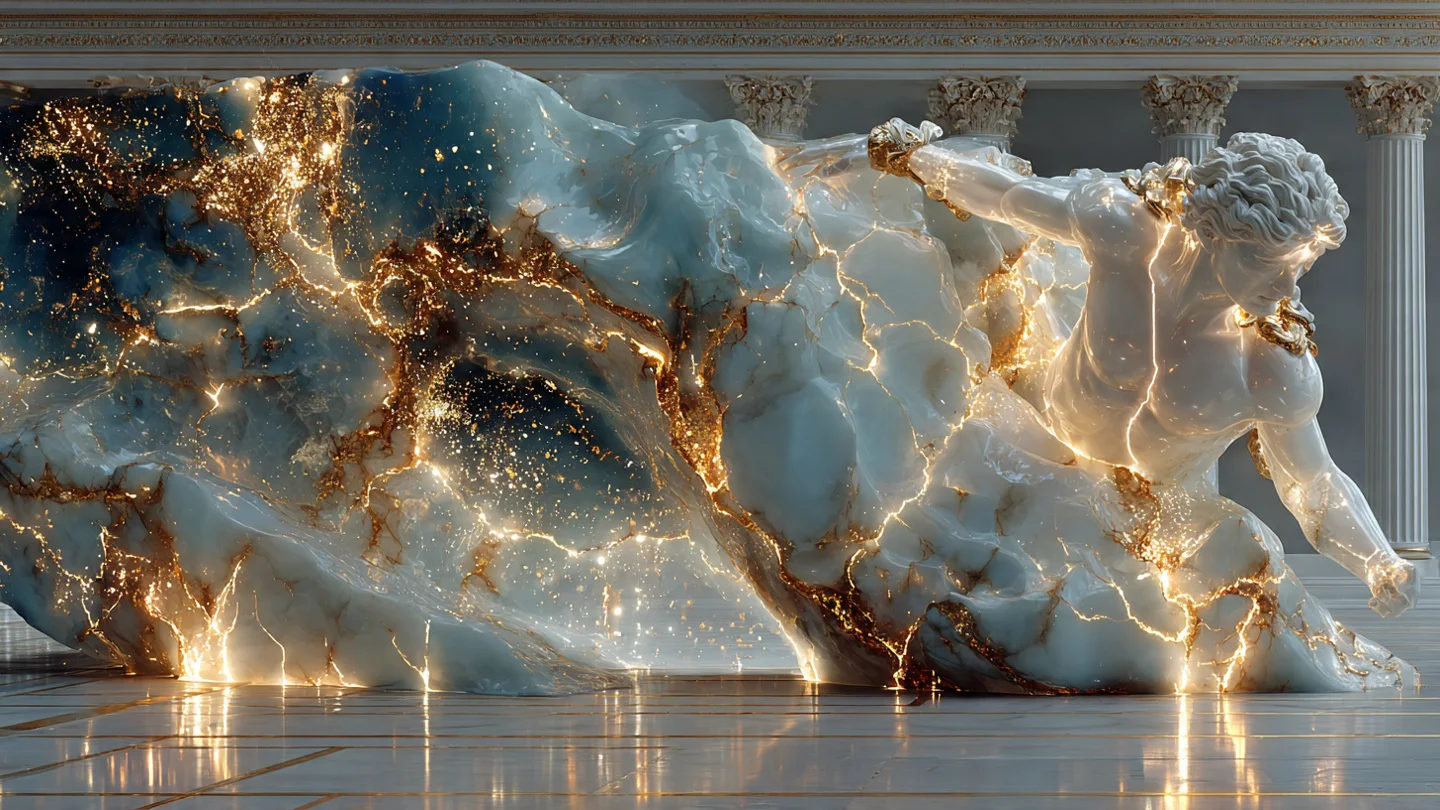
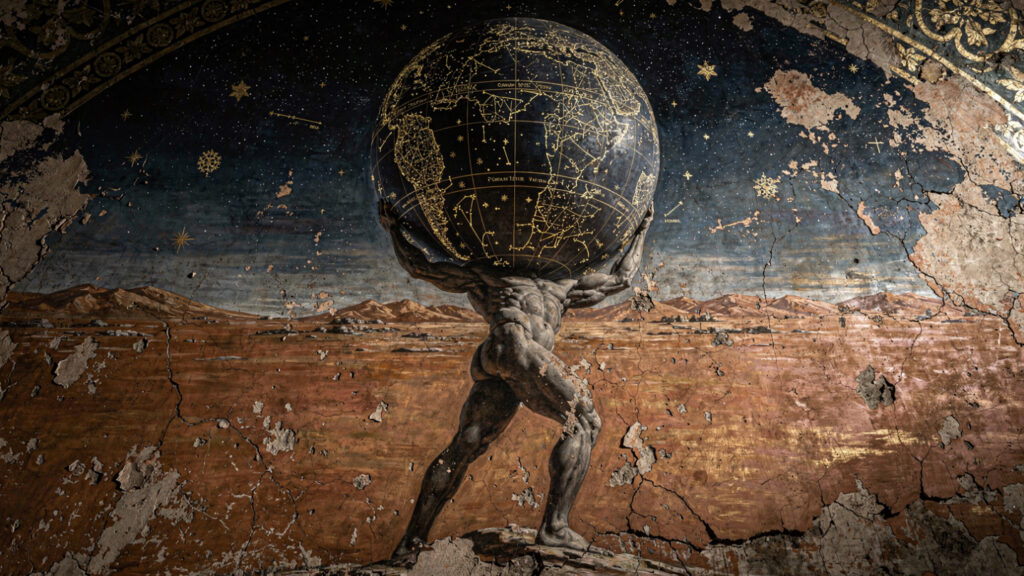
The Titans were defeated and imprisoned in Tartaros, guarded by the Hecatonchires. Atlas, the Titan who had led the Titan forces alongside Kronos, received a punishment whose character was the character of the eternal labor rather than the eternal imprisonment: he was condemned to bear the weight of the sky on his shoulders, which was the reversal of the Ouranos-Gaia relationship whose separation had initiated the entire sequence of events. The sky that had once covered the earth as Ouranos lay over Gaia was now held up from the earth by Atlas’s muscular effort, the labor whose permanent necessity encoded the theological claim that the organized separation between sky and earth required the permanent expenditure of the divine force that Atlas embodied.
Prometheus, the Titan whose name meant forethought, was not imprisoned with the others: his intelligence and his choice to support the Olympian side, or in some versions his neutrality, gave him the position between the Titan generation and the Olympian order that made him the mediating figure between the divine and the human worlds.
The Deucalion article in this collection develops the Prometheus myth further through its genealogical connection to the fire-giver and the flood survivor: Prometheus warned Deucalion about the flood, gave humanity the fire that allowed the technical civilization, and was punished by Zeus for the act of divine gift whose theological content was the gift of the divine capacity to the mortal creature that Zeus had not intended to receive it.
The Lot-Drawing | How the Cosmos Was Divided
After the Titanomachy, the three Olympian brothers divided the cosmos between them by drawing lots. The mechanism of the lot-drawing, the random distribution of the cosmic domains among the three most powerful divine beings, encoded the theological claim that the division of the organized world’s governance was not the product of the strongest Olympian’s imposition of his will but the product of the random distribution that the lot-drawing produced.
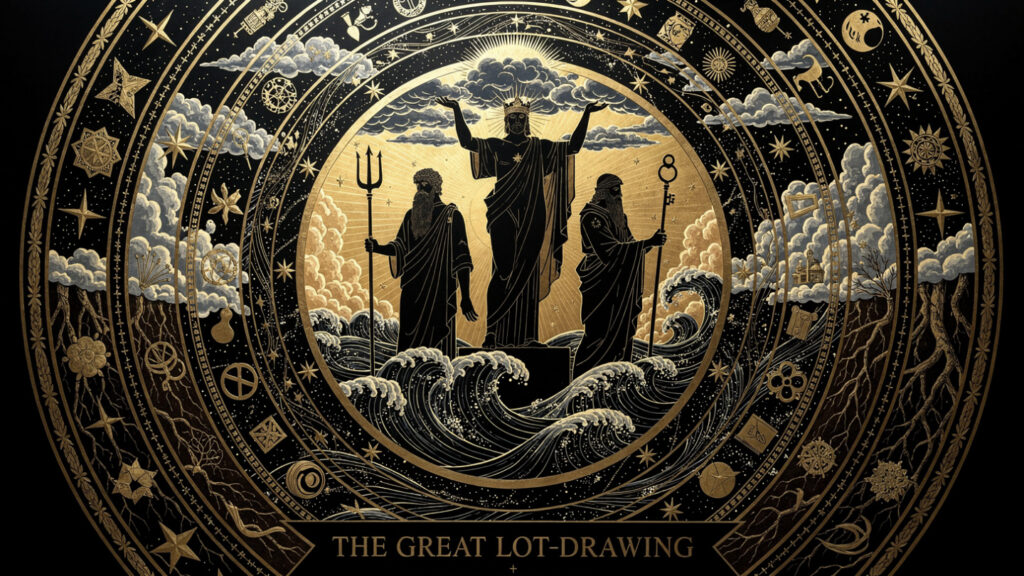
Zeus received the sky and the governance of the divine order. Poseidon received the sea and its geological forces. Hades received the underworld and the dead.
The Poseidon article in this collection develops the character of Poseidon’s portion as the worst of the three: the sea’s irreducible instability and the frustrations that the earth-shaker’s domain generated. The Hades article develops the underworld’s real theological character, the organized realm of the dead rather than the place of punishment later ages made it, and Hades himself as the just administrator of the most absolute boundary in the cosmos, the boundary between the living and the dead.
The earth itself, the Olympos, the sky between the earth and the stars, was shared by all three: the common territory that the three brothers governed jointly rather than the exclusive domain of any one.
This division produced the tripartite universe that Greek theology inhabited from then on: three divine beings governing the sky, the sea, and the underworld, under the rational governance the Titanomachy had installed, each maintaining the ongoing management of the organized world within their own domain.
Zeus and the Olympian Order
As ruler of the Olympian order, Zeus’s actual function was organized, rational governance of the cosmos, not simply the raw power the Titan order had expressed before him. He is the strongest being in the cosmos and the Iliad is explicit about this, that if all the other gods combined their strength against him they could not pull him down from Olympus: but his authority is not the authority of the strongest alone. It is the authority of a being who has organized the cosmos according to principles of divine law the Olympians themselves identified as the actual condition for a just, governed world.
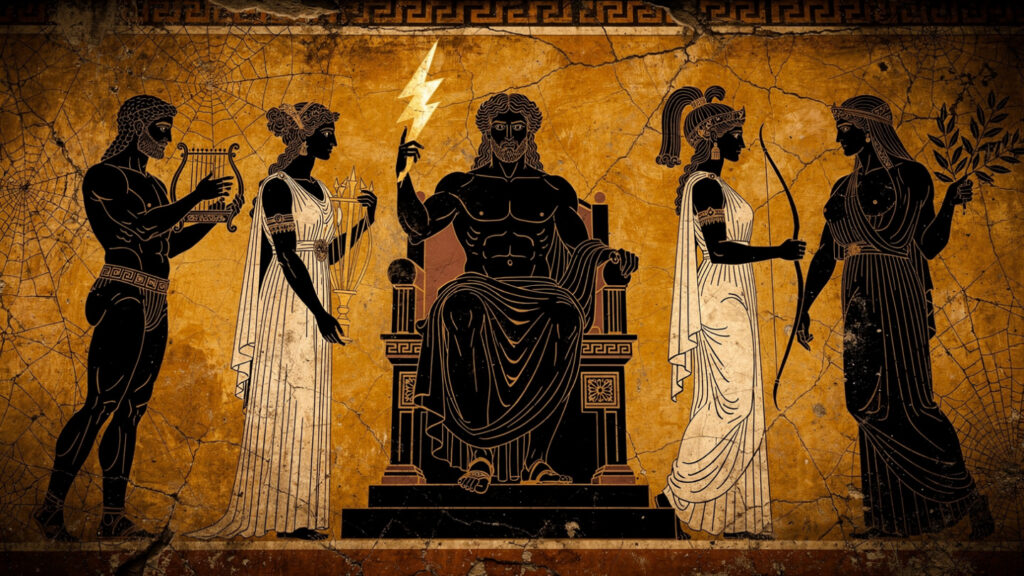
The marriages and liaisons of Zeus produced the divine beings and the mortal heroes whose existence in the organized world gave the Olympian divine order its relationship to the human world: the children of Zeus were the bridges between the divine and the human, the divine beings who intervened in human affairs and the mortal heroes whose divine parentage gave them exactly the capacities a hero required.
Metis, the first wife, was the Oceanid whose intelligence had given Zeus the emetic that freed the swallowed Olympians. The prophecy that her child would surpass its father drove Zeus to repeat exactly the pattern Kronos had enacted before him: he swallowed Metis before she could give birth, and Metis, inside Zeus, kept forging the armor and helmet her child would need. When Zeus’s headache became unbearable, Hephaestus or Prometheus split his skull with an axe, and Athena sprang out fully formed and fully armed: organized intelligence born directly from the head of the organized world’s own ruler, a specifically Apollonian rational intelligence born from the physical center of rational governance itself.
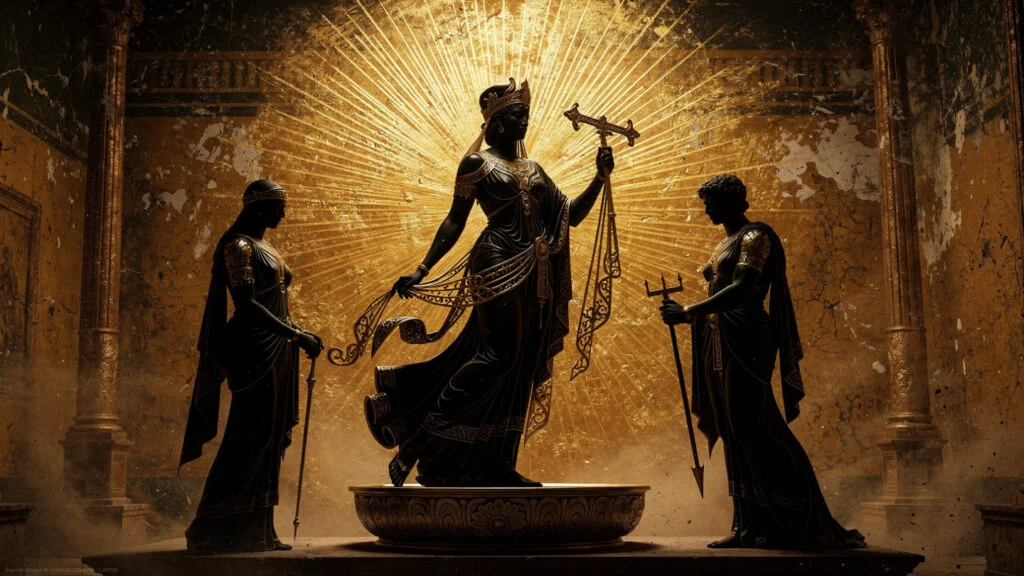
Hera, the second wife and the permanent consort, was the sister whose character as the queen of the Olympian order and the goddess of the legitimate marriage was the character of the divine being who maintained the institutional order of the divine family against the disruptions that Zeus’s constant erotic adventures produced. Hera’s mythology is largely the record of her retribution against the mortal women and divine rivals who attracted Zeus’s attention: Io transformed into a cow, Semele destroyed by the sight of Zeus in his true divine form, Leto pursued across the world by Hera’s prohibition against any stable land receiving her, Callisto transformed into a bear. The theology behind Hera’s jealousy is really the theology of an organized institution responding to a force it was built to channel but could never fully control, the same erotic force the Eros and Aphrodite article develops as a cosmological power older than the Olympian order itself.
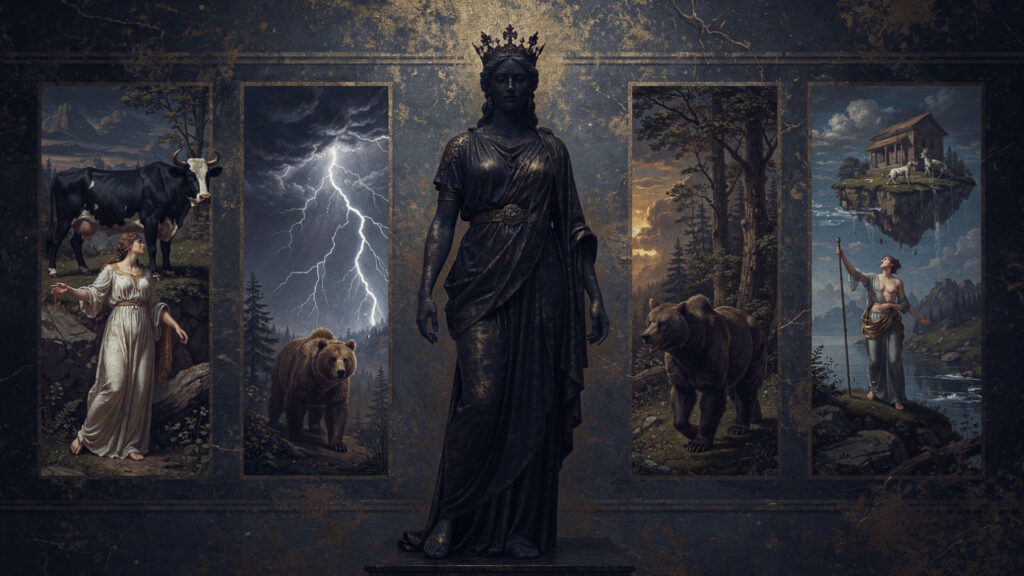
The other divine beings whom Zeus produced from his various unions gave the Olympian divine order its range of domains and its range of relationships to the human world:
From Leto, the Titaness Hera pursued across the world until the floating island of Delos gave her refuge, a story the Apollo article develops further, came Apollo and Artemis: twins whose complementary opposition, the organized rational light of Apollo against the wild lunar freedom of Artemis, gave Greek theology two of its most fully developed divine principles.
From Demeter came Persephone, whose mythological biography the sacred table article and the August fifteenth article and the Hades article all develop through the abduction, the pomegranate seeds, the annual return, and the agricultural calendar her own myth organized.
From Mnemosyne, the nine Muses: the divine beings whose domains were the nine arts and sciences whose cultivation was the expression of the organized human intelligence engaging with the world in its most refined available forms.
From Themis, the Horai and the Moirai: the Hours who organized the seasons, and the Fates, whose governance of the thread of human life gave Greek thought its single most concentrated account of the limits the organized divine order imposed on human existence.
From various mortal women came Heracles, Perseus, Minos, Rhadamanthys, and the other mortal heroes whose divine parentage gave them exactly the relationship to the divine order a hero required: divine capacity combined with mortal vulnerability, the interaction that made a heroic life possible at all.
The Twelve Olympians and Their Domains
The twelve Olympian deities, whose collective governance of the organized world gave Greek theology its primary divine architecture, settled into this configuration only in the classical period’s religious and artistic imagination, though different sources give slightly different lists, and the membership was understood to be considerably more fluid earlier on than the later classical canon suggests.
The twelve whose characters the collection’s individual articles develop at length are the twelve whose collective presence constitutes the complete account of the Olympian divine order’s governance of the organized world:
Zeus, whose character the collection develops through his role in the cosmological sequence, and whose authority is the authority of organized rational governance rather than the raw power the Titanomachy alone demonstrated.
Hera, whose character as the queen of the divine order and the goddess of the legitimate marriage is the character of the institutional principle that maintains the organized structure against the forces whose operation threatens to dissolve it.
Poseidon, whose character the Poseidon article develops at length: the earth-shaker whose domain was the sea and its geological forces, the god who lost the contest for Athens and got the worst of the three cosmic portions, a figure whose combination of enormous power and permanent frustration makes him the most humanly comprehensible of the Olympians.
Demeter, whose character the sacred table article and the August fifteenth article and the Lent and Easter article all develop through agricultural practice and calendar continuity: the harvest goddess whose withdrawal from the world produces winter and whose return produces spring, the single Olympian whose domain the human community needed most urgently just to survive.
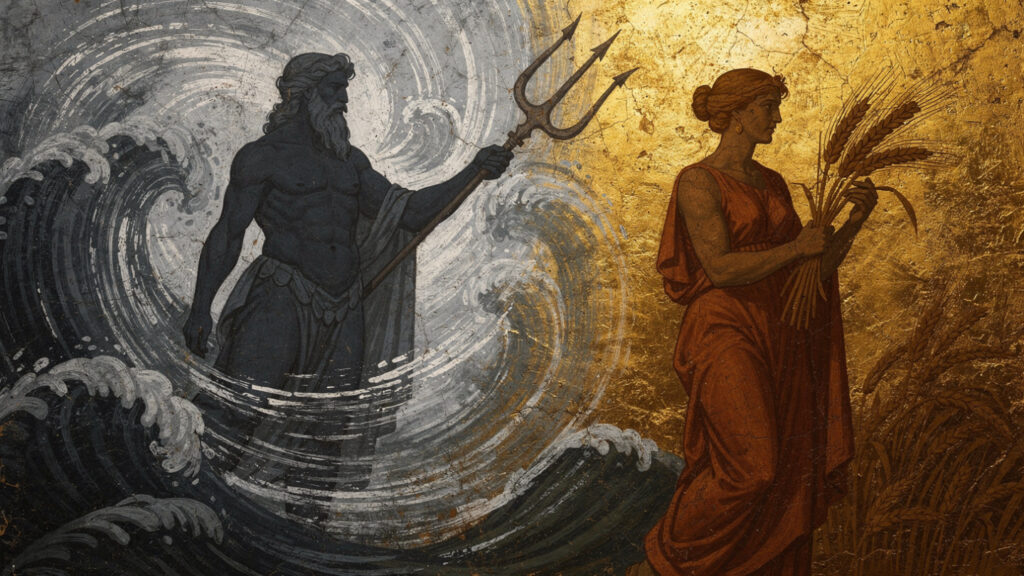
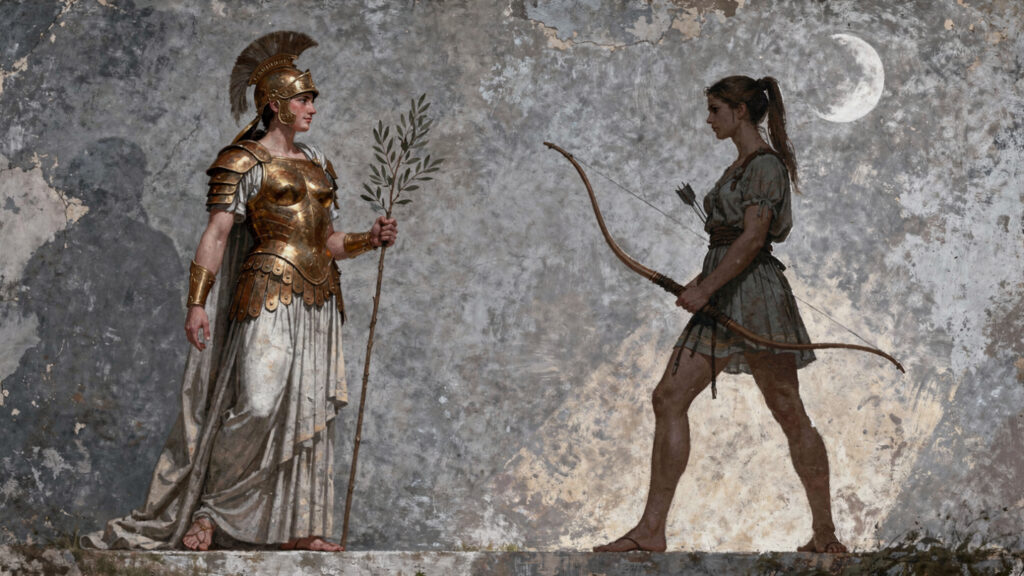
Athena, whose character the sacred trees article and the Eros and Aphrodite article and the Perseus article and the Gorgons article all develop through the olive tree and the contest for Athens: an Apollonian rational intelligence expressed as the wisdom of organized craft and strategic thought, rather than the prophetic, musical rationality of her half-sibling Apollo.
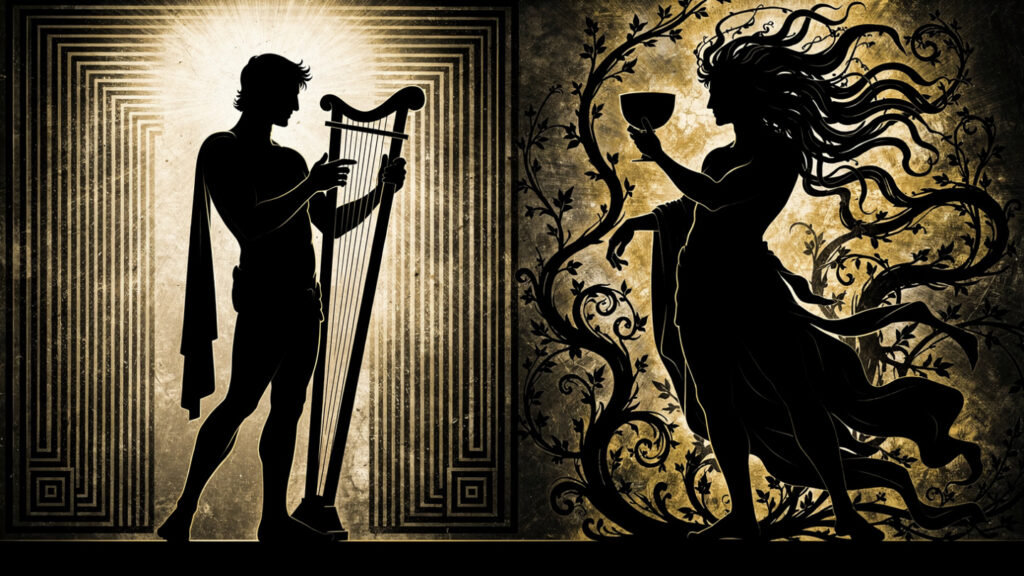
Apollo, whose character the Apollo article develops at length: the god who arrived in Greece from outside it, who killed the Python and established the Delphic oracle, who shared his sanctuary with Dionysus, whose lyre and bow were the two weapons that struck from a distance through organized technique, whose light was the light of the mind rather than the light of the sun.
Artemis, whose character as the goddess of the hunt and the wilderness and the transitions of female life gave her the domain of the wild space outside the organized civic world that her twin Apollo’s domain of the organized civic culture most directly defined against.
Ares, god of war’s raw violence rather than organized military strategy, held the least dignified position among the Olympians, exactly as the Iliad shows when Diomedes wounds him and he retreats whining to Zeus’s throne: necessary and disdained at once, a force the organized world required and could never quite honor without contradicting itself.
Aphrodite, whose character the Eros and Aphrodite article develops through her two distinct origin stories: the Hesiodic Aphrodite, born from the sea foam of Ouranos’s castration, older than the Olympian order and never fully subordinate to it, and the Homeric Aphrodite, daughter of Zeus and Dione, an Olympian court deity whose vulnerability to the other gods’ mockery expressed the organized divine order’s own ambivalence toward an erotic force it had to accommodate without ever fully controlling it.
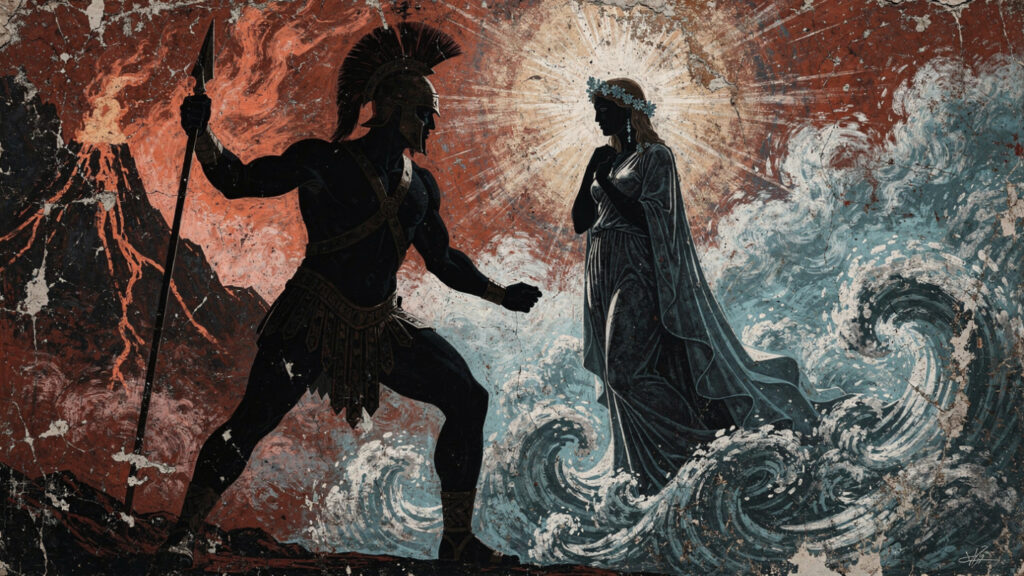
Hephaestus, whose character the Limnos article develops through his fall from Olympus, and whose Shield of Achilles article in this collection develops through the claim that divine craft was the medium organized intelligence used to give material form to the world it governed: the lame god whose physical vulnerability produced a creative capacity whose products, the shield of Achilles, the armor of the gods, the golden automata of his own forge, were the most technically accomplished objects anywhere in the divine world.
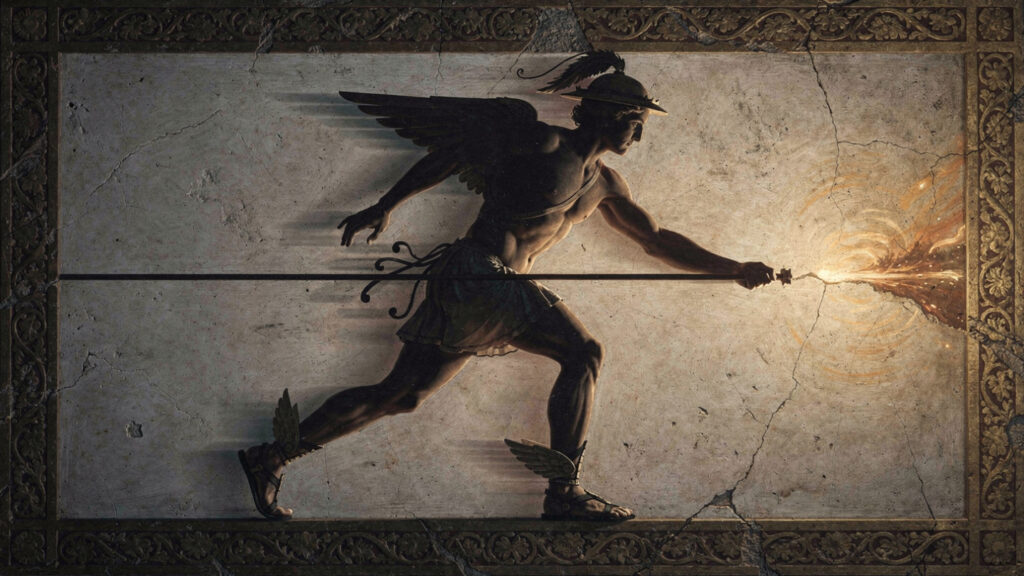
Hermes, the messenger who crossed every boundary in the organized cosmos, moving between the Olympian court, the human world, and the underworld with exactly the freedom that boundary-crossing required: the psychopomp who guided the dead to Hades, the trickster who stole Apollo’s cattle on the very day of his own birth and invented the lyre from a tortoise shell to placate his half-brother’s anger. His place among the Olympians was, quite precisely, the connection between the organized system’s separate domains.
Dionysus, whose character the dining article and the sacred table article and the August fifteenth article develop through wine, theater, and the religious calendar: god of the ecstatic dissolution of the organized individual into the collective, whose domain was the altered state produced by controlled intoxication at the symposium and by collective ecstasy at his own festivals, and whose opposition to Apollo’s rational order gave Greek theater its own character, the product of both principles working simultaneously in the same dramatic space.
The Divine Children and the Heroes
From the Olympian order’s engagement with the mortal world came an entire generation of heroes, divine-mortal combinations whose individual stories this collection’s mythological articles develop as the most concentrated available form of the real questions at stake: mortality, divine justice, heroic capacity, and the cost of any relationship between the divine and the human.
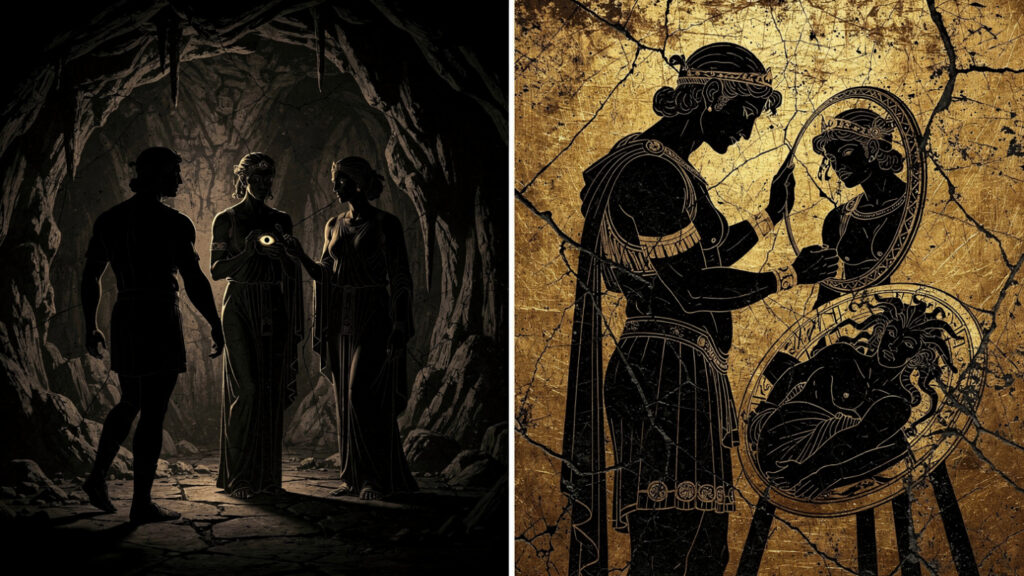
Perseus, whose article in this collection develops the sealed chamber theology and the Graeai and the sleeping Gorgon and the discus at Larissa: the child of the divine light who descended into the sealed space, whose every act expressed the intelligence of the person who understood the mechanism of the obstacle and identified the interval of its vulnerability, and whose death of his grandfather was engineered by the complete chain of events whose first link was the attempt to prevent it.
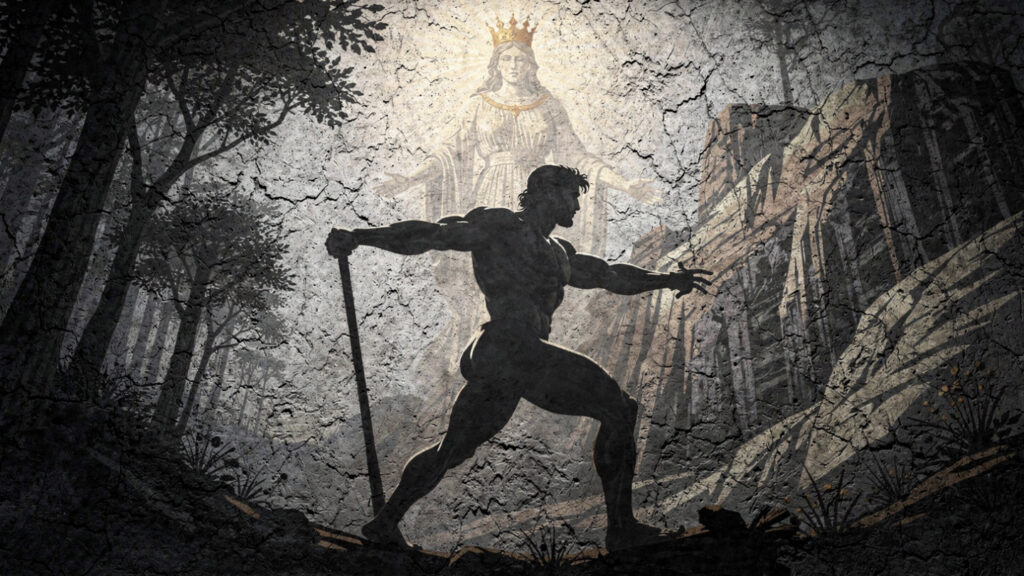
Heracles, whose labors the collection develops through the Foloi forest article and the Nisyros article and multiple cross-references: the strongest mortal who ever lived, whose twelve labors applied real heroic capacity to monsters and tasks the organized world genuinely needed completed, and whose lifelong persecution by Hera gave him the tragic dimension of a hero whose divine parentage produced both his extraordinary capacity and his extraordinary suffering.
Achilles, whose article in this collection develops through the Shield of Achilles and its development of the two cities and the world that the war was destroying: the hero who chose the short glorious life over the long ordinary one, who carried the world’s entire beauty and richness on his left arm in the form of the shield that Hephaestus made between a death and a killing, who killed Hector and accepted that his own death would follow.
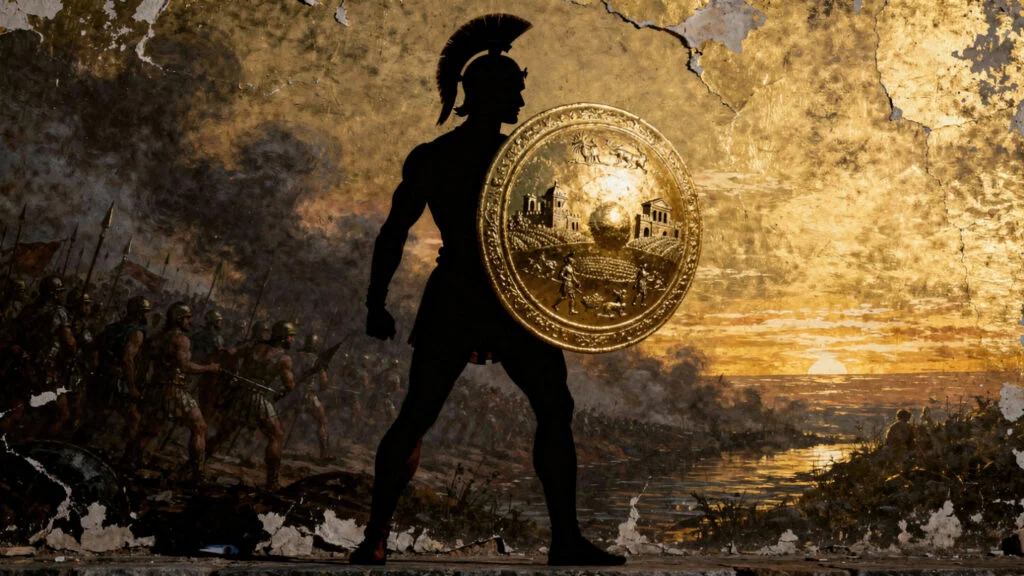
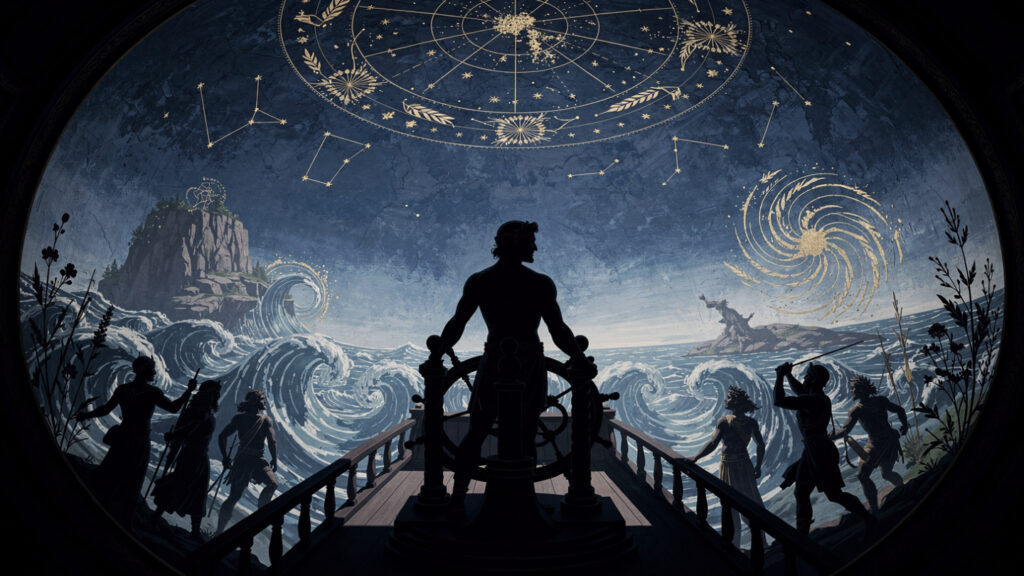
Odysseus, whom the collection develops through the Ithaca article and the Circe and pharmakeia articles and multiple Homeric references: a hero whose excellence was never the physical strength of Heracles, the divine parentage of Perseus, or the divine armor of Achilles, but the intelligence of someone who understood the world well enough to navigate it through whatever combination of plan and improvisation each obstacle actually demanded.
Prometheus and the Human World
The creation of humanity in Greek myth was never the divine breath meeting terrestrial clay the way Mesopotamian and biblical accounts describe it: in Hesiod’s version, Prometheus made humanity directly from the earth’s own clay and water, and the Deucalion article in this collection develops the theological weight of that difference through the stone-throwing that followed the flood, the claim that human beings are the earth’s own material organized by human intelligence, not divine material added on top of terrestrial stuff.
Prometheus gave humanity fire, an act whose theological weight the pharmakeia article develops further through its connection to Greek pharmacology: the gift of a genuinely divine capacity, the organized transformation of the material world through the controlled combustion fire represents. With fire came the technical capacities of the human civilization: the forge and the cooking and the light and the warmth that separated the organized human community from the condition of the wild that fire’s absence imposed.
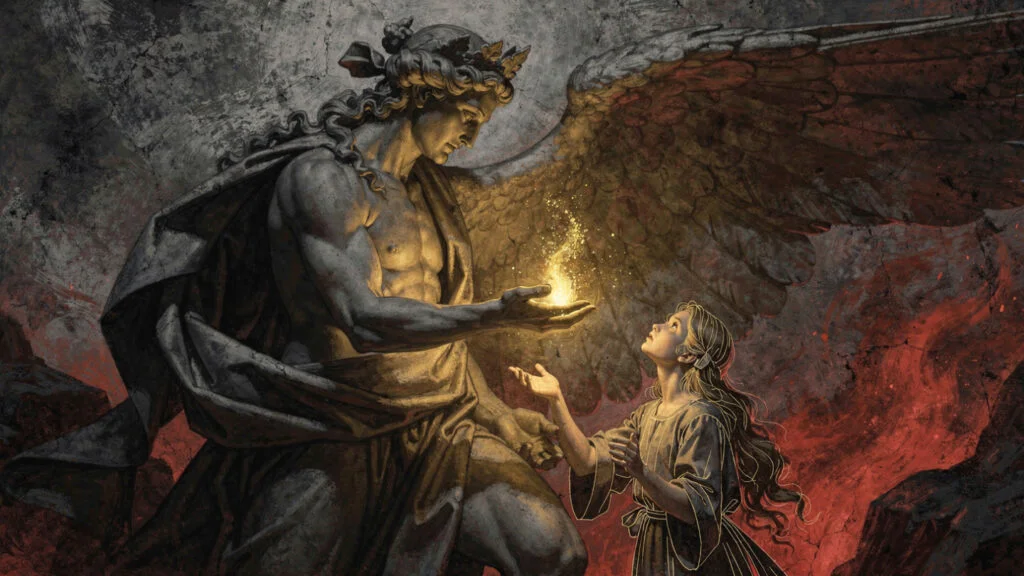
Zeus punished Prometheus with eternal labor rather than eternal imprisonment: chained to a rock in the Caucasus, an eagle ate his regenerating liver every day, and the liver regenerated every night, for a span different sources give as anywhere from thirty years to three thousand, until Heracles finally came, killed the eagle, and freed the Titan.
The Pandora story is Zeus’s own answer to Prometheus’s gift: if Prometheus gave humanity divine fire, Zeus would give humanity a divine container holding the evils, and the hope, that the human condition would carry ever after.
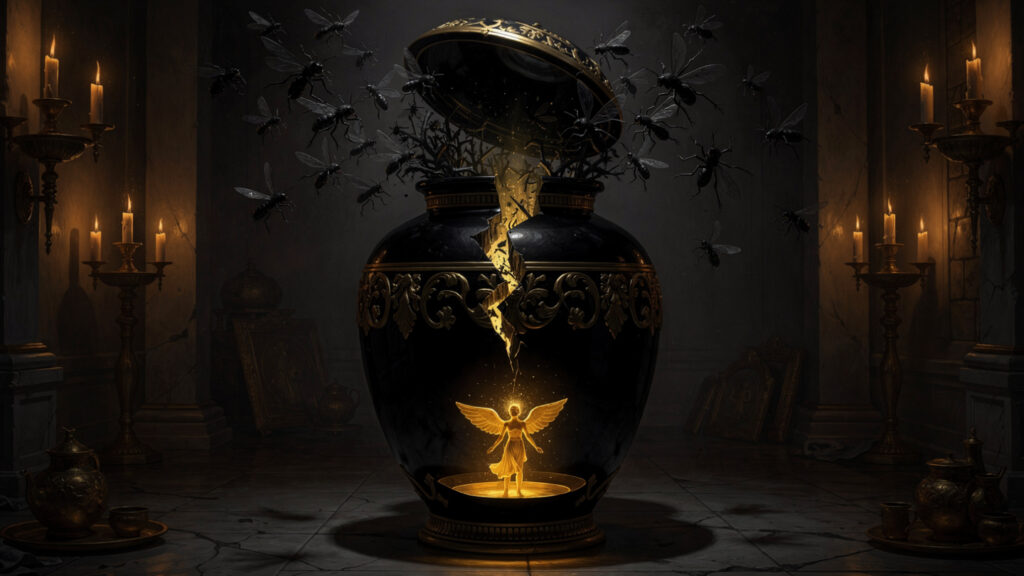
Pandora, the first woman in Hesiod’s own misogynistic account, was made by Hephaestus at Zeus’s command and given a jar she was forbidden to open, a prohibition ordinary human curiosity made inevitable to violate. The jar was opened, the evils escaped, hope remained inside.
The Monsters and the Boundaries
Greek myth populated the organized cosmos’s boundaries with beings who embodied those boundaries directly: monsters representing the violation of categories the organized world depended on maintaining, defining that world precisely by embodying what it was not.
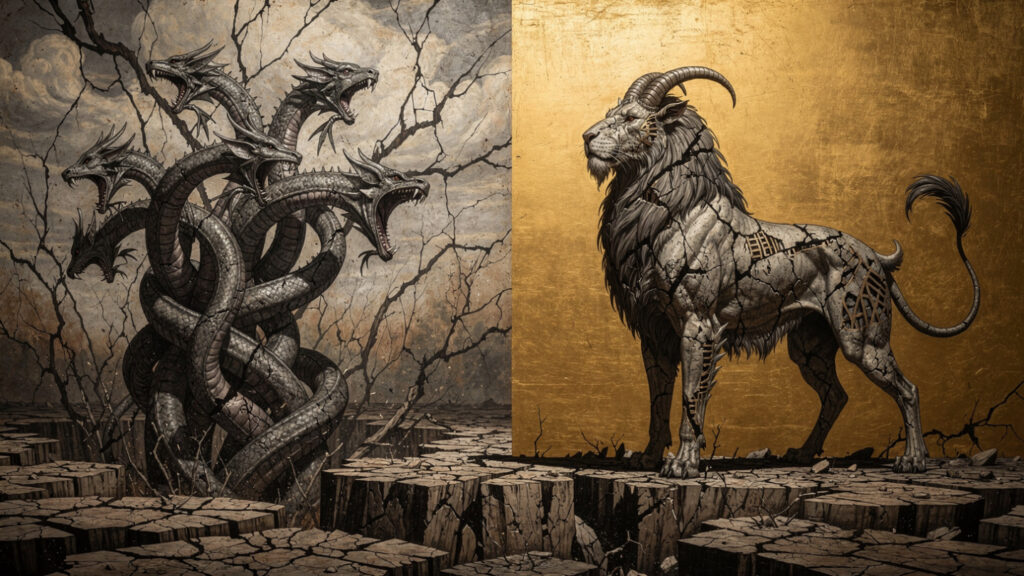
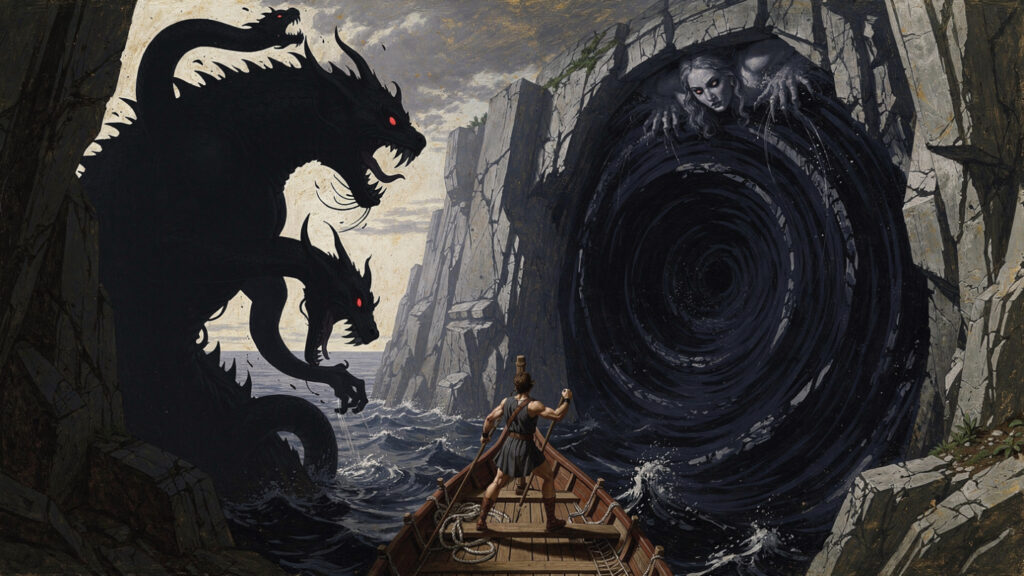
The monsters article in this collection develops several of these figures directly: the Hydra as a chthonic boundary marker whose regeneration embodies a boundary that can never be permanently crossed, the Chimera’s combination of lion, goat, and serpent encoding the violation of natural categories the organized world depended on maintaining, and Scylla and Charybdis, positioned at the passage between two bodies of water, encoding the choice between two forms of the impossible that Greek heroes were consistently required to navigate.
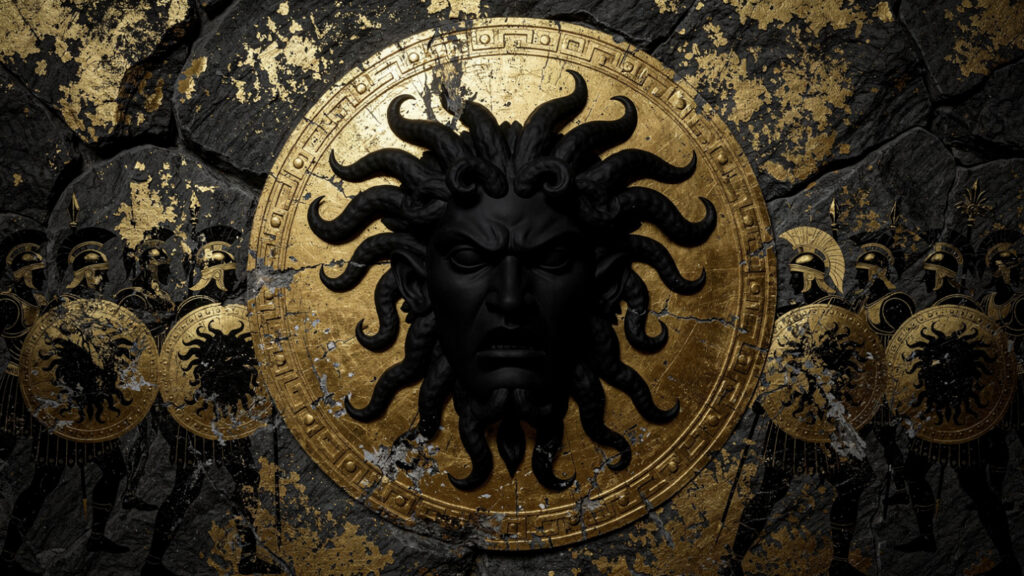
The Gorgons article develops the Gorgon figure through its two competing origin stories, the Hesiodic born-monstrous version and the later Ovidian account of transformation, and through the Gorgoneion’s apotropaic function: the face of the thing most feared deployed as the most powerful protective symbol available, the dead monster’s own lethal gaze repurposed as civilization’s countergaze against whatever approached.
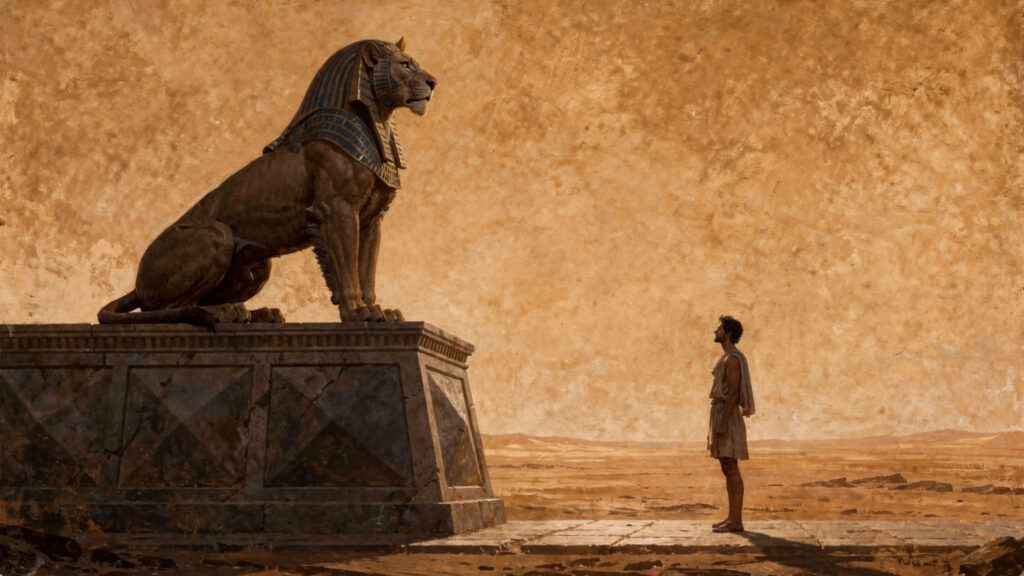
The Sphinx article develops the Sphinx as the monster whose weapon was a question rather than a physical attack: the only Greek monster whose danger was intellectual rather than physical, whose theological content was the content of the question about humanity that the monster at the boundary between Thebes and the outside world posed to everyone who approached, and whose answer was the human being itself.
The Trojan War and the End of the Heroic Age
The Trojan War was the event Greek myth understood as the end of the heroic age itself: the period when the divine and the human were most directly in contact, when the children of the gods walked among mortals, the gods themselves intervened directly in human battles, and heroic capacities that required divine parentage were still available in the world.
After the Trojan War, the heroes died and were not replaced. The direct divine-human contact that had produced heroes at all was withdrawn. The world the Iliad and the Odyssey document was the last period this direct expression ever existed, and Achilles, Odysseus, Hector, Agamemnon, and Helen were the last generation whose combination of the divine and the mortal gave them a quality of heroic life that later ages would celebrate endlessly but could never replicate.
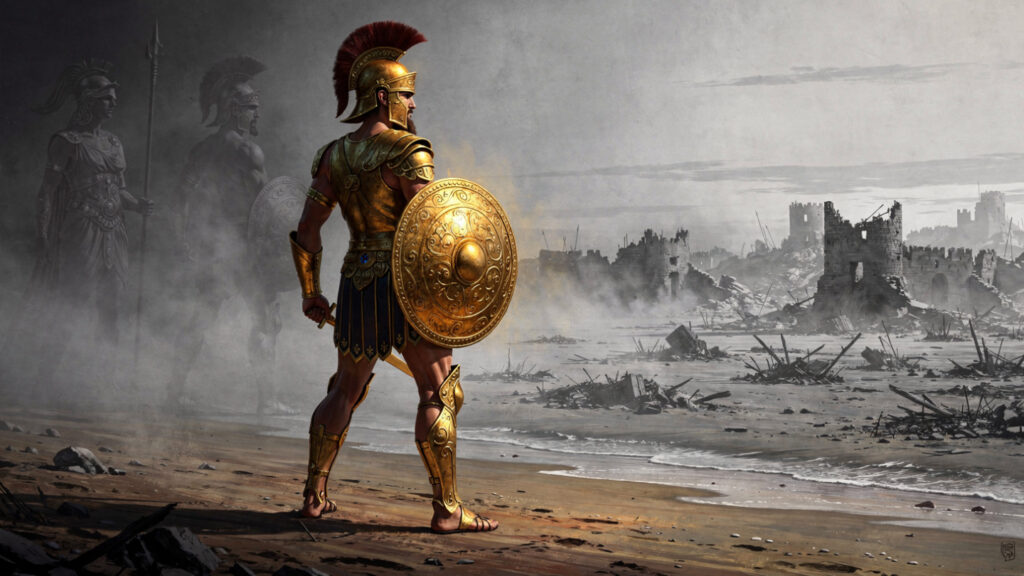
The Shield of Achilles article in this collection develops the moment that expresses this transition most completely: the whole world outside the war shown to a warrior on the eve of the killing that would seal his fate, two cities, a harvest, a vintage, a dance at the world’s own edge, shown to a man who had chosen the short glorious life and was now carrying the entire world on his left arm as he went to perform the single most concentrated act any hero of this age ever performed.
The war ended. The heroes died. The Olympians continued governing the organized human world through religious institutions instead: oracles, festival calendars, sacred geography, all documented across this collection’s travel and cultural articles, the Delphi oracle, the Olympic games, the Eleusinian Mysteries, the Asclepion at Epidaurus, the Tinos pilgrimage, the August fifteenth panigyri, every form through which the human community kept maintaining its relationship to the divine order the cosmological process had installed in the first place.
The Complete Picture
Step back from the individual articles and see the complete picture the Olympus Estate collection has been constructing all along.
The cosmos began as Chaos and organized itself through the sequence of Gaia and Ouranos and the Titans and the Titanomachy and the Olympian installation into the organized world Greek theology would go on to inhabit. Each stage of this organization was a cosmological argument: the Titan order representing raw cosmic force operating according to the necessity of the temporal cycle, and the Olympian order representing organized divine intelligence operating according to the rational principle the Apollo article names as the Apollonian light of the mind.
The human being was created from the earth’s own material by Prometheus’s craft, and carried the intelligence that would decode the oracle at Delphi and throw the stones that became people after the flood. The divine-mortal unions produced an entire generation of heroes, each one the divine capacity applied to the human condition in the most concentrated available form. The monsters were the organized world’s boundaries embodied. The sacred geographies were the locations where the divine and the human were most directly in contact.
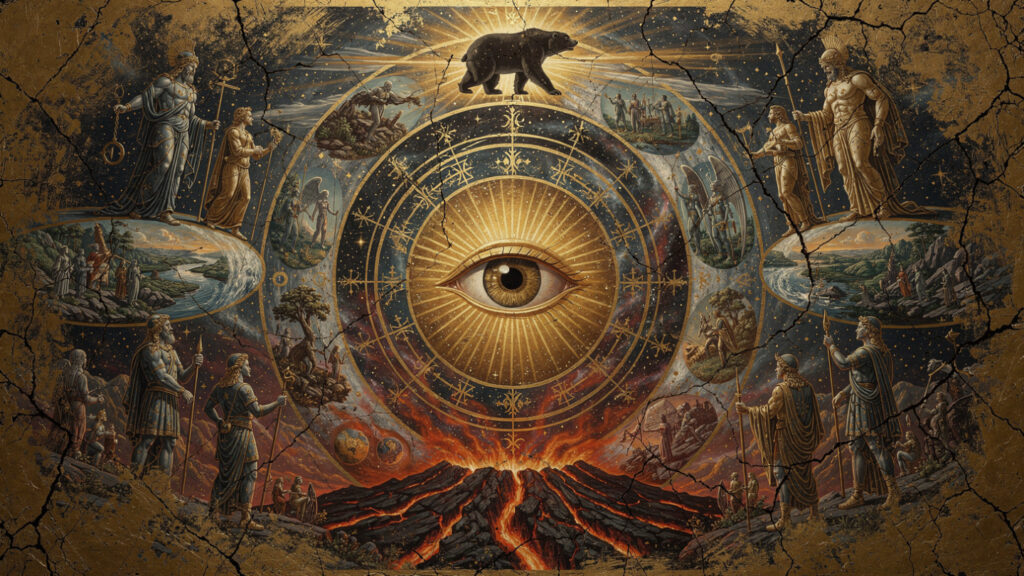
Greek mythology is not a collection of stories about supernatural beings. It is the most ambitious cosmological argument the ancient world produced: an account of how the undifferentiated void organized itself into the structured cosmos through a sequence of divine generations and divine conflicts, each outcome determining the character of the world at that stage.
The gods were never a corporation. They were the stages of the cosmos’s own self-organization, given just enough personal form to make the cosmological argument tellable as a story. Reading them as characters in stories is correct at one level. Reading them as the cosmological forces whose interactions produced the organized world is reading them at the level this whole account was actually built for.
The Chaos that preceded the gods is still there. Tartaros is still at the bottom of the organized world, and the imprisoned beings who were defeated in the Titanomachy are still imprisoned there, and the volcanic activity of the Aegean archipelago is the geological expression of their continued presence beneath the surface. The Bear that Hephaestus placed on the Shield of Achilles, the constellation that never sets and never bathes in the Ocean stream, is still wheeling in place above the Greek landscape, watching Orion.
The cosmological argument is still running.
At Olympus Estate, Mythic Essays moves through the deeper currents of the Greek tradition. Before the gods there was Chaos, the yawning gap, the undifferentiated void. Gaia emerged. Ouranos spread himself over her. Kronos castrated his father and swallowed his children and was made to vomit them up by the child he had not swallowed. The Titanomachy lasted ten years and the geological record of the Aegean archipelago is its permanent monument. The lot-drawing gave Zeus the sky and Poseidon the sea and Hades the dead. The Olympian divine order that resulted was not simply the strongest divine generation’s governance of the cosmos: it was the organized rational governance whose installation the entire preceding sequence had been organized to produce. The heroes were the divine-mortal combinations whose lives asked the most concentrated versions of these very questions. The Trojan War was the end of the heroic age. The cosmological argument is still running. The Bear never sets.