




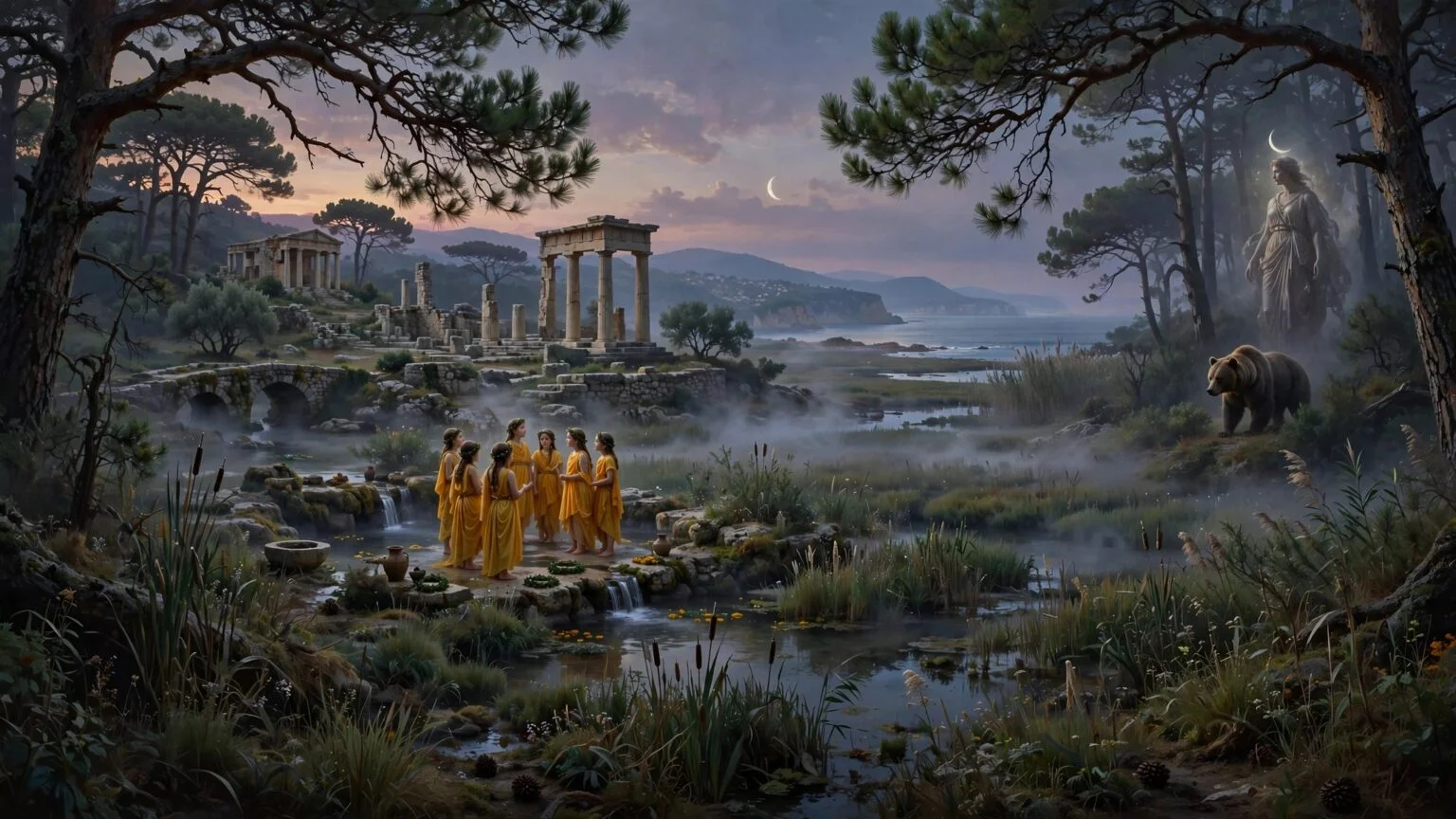
Every Athenian girl, before she was permitted to marry, had to become a bear.
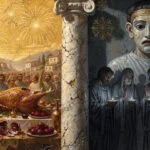
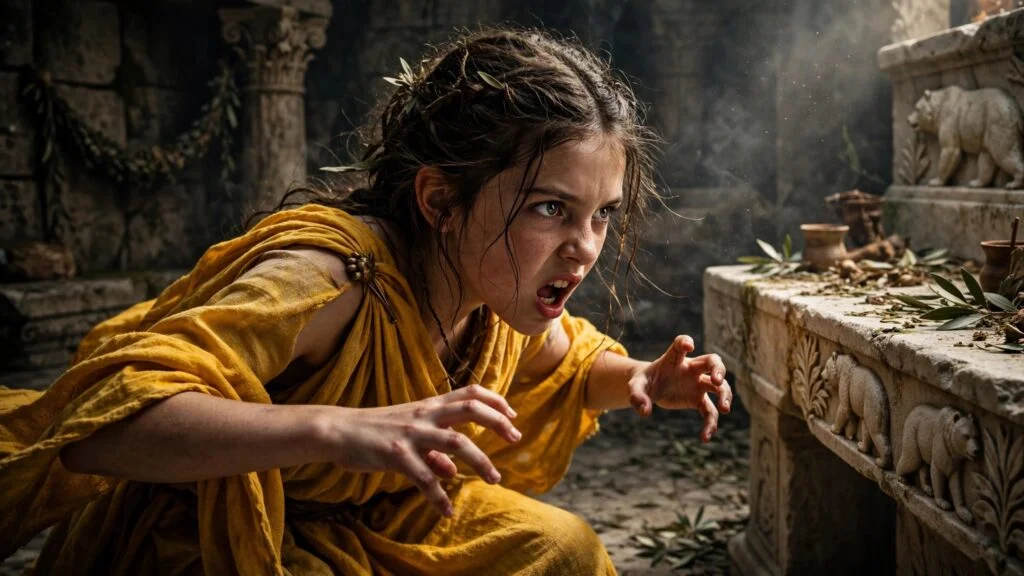
Not metaphorically. Not in the diluted sense that ritual enactment sometimes produces, where you perform the gestures of a thing without quite inhabiting it. As part of the Arkteia, young girls dressed as bears, putting on masks and saffron robes known as the krokotos. They tended the shrine to Artemis, danced, raced, and, most importantly, acted the bear, imitating she-bears to please the powerful huntress.
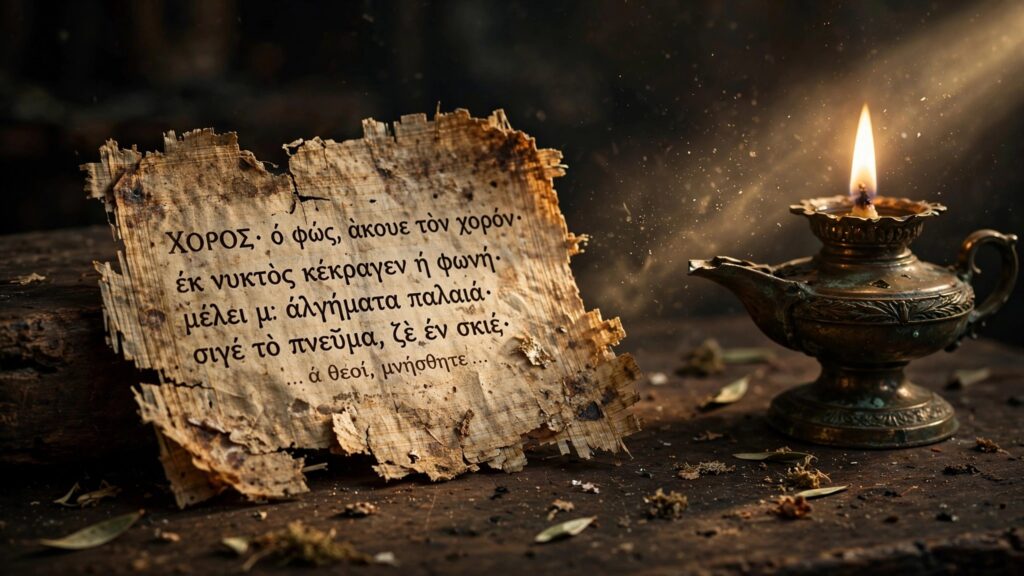
The clearest surviving account of this comes not from a historian or a religious text but from comedy. In Aristophanes’s Lysistrata, staged in Athens in 411 BCE, the chorus of respectable older women recite, almost as a formal résumé of Athenian girlhood, the sequence of religious offices a well-born Athenian girl held on her way to adulthood. At seven, she was an arrephoros, one of the young girls entrusted with carrying sacred, secret objects for Athena on the Acropolis. At ten, she was an aletris, grinding corn in service of the city’s foundress. Then, shedding the saffron robe, she was a bear at the Brauronia. And once, when she was a beautiful girl, she was a basket-bearer, wearing a necklace of dried figs, in one of the processions that immediately preceded a young woman’s marriage. The line is a handful of words in the Greek, ἄρκτος ἦ Βραυρωνίοις, I was a bear at the Brauronia, and it is close to the entire literary record the ancient world left of what this looked like from the inside, a girl’s own voice, however comic and stylized the play around it, naming the thing she once had been.
The girls who participated in the Arkteia, the bear festival, at the sanctuary of Artemis at Brauron on the eastern Attic coast were called the arktoi, the bears. The ancient scholia to the Lysistrata passage, and the surviving literary testimony more broadly, place the arktoi at a particular and, on first encounter, surprising age: somewhere between five and ten years old, not the teenagers on the immediate threshold of marriage that a casual retelling of the ritual usually implies. Athenian girls typically married in their mid-teens, often not until several years after their service at Brauron had ended. The Arkteia was not, then, the last station before the wedding itself. It was an early and formative one, a ritual undergone as a small child that every subsequent stage of a girl’s religious and social life, culminating eventually in marriage, was understood to depend on and build from. The bear came years before the wife. But nothing about a girl’s path to becoming a wife was considered complete without it.
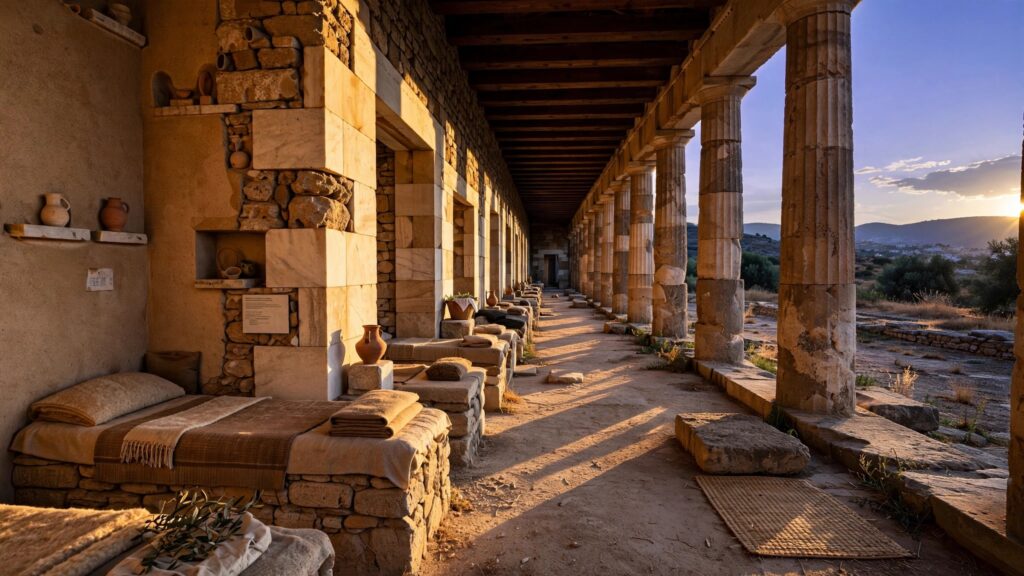
They lived, for the duration of their service, in the dormitories the excavations have uncovered: a large stoa consisting of ten rooms with eleven beds in each. More statuettes were found outside the rooms, depicting girls holding symbolic objects associated with Artemis. These rooms are thought to have been dormitories for the little girls who participated in the Arkteia.
Girls sleeping in dormitories beside a sacred spring, wearing saffron robes, running races, dancing, imitating the she-bear that was the goddess’s sacred animal, and at the ritual’s completion shedding those robes entirely, naked like newborn babies, before they were permitted to return to the city and the childhood, and eventually the marriage, that awaited them there.
The Greek world produced this ritual, maintained it for centuries as a required stage in a girl’s path toward adult womanhood, and built a sanctuary of considerable architectural ambition on the Attic coast to house it. The ritual is the most significant untreated women’s rite in this site’s collection, and it is also one of the most philosophically precise things the Greek world ever encoded in a religious institution about the relationship between wildness and civilization, between what a girl was before marriage and what marriage would eventually require her to surrender.
The Goddess Who Never Surrendered It
To understand what the Arkteia was asking of the girls who underwent it, you have to understand what Artemis herself was and why her patronage was the correct one for a ritual of this kind.
Artemis is the permanent borderline. She is the goddess of the wilderness and the hunt and the wild animals and the unmarried girls and the moment of childbirth and the transition between them: not the hunt itself, not the wilderness itself, but the boundary between the human world and the world that precedes and surrounds it. Her sanctuary at Brauron is in precisely the location her theology required. Artemis was the ancient Greek goddess of maidenhood and wild animals, and her temples were often located in rural areas or at the edges of cities, like Brauron. At the edge. Not in the city, not in the wilderness, but at the threshold between them, in the liminal zone where her own authority was operative.
Artemis herself never crossed into the territory marriage defines. She asked Zeus for perpetual virginity, and the tradition gives her not simply the status of unmarried but the active, physical, permanent inhabitation of the space before marriage: the forest, the hunt, the company of her nymphs who had made the same choice, the wild animals who were simultaneously her prey and her companions, the bears and deer and boars of the woodland that she killed and mourned and killed again in the continuous rhythm of the hunt. She is not waiting to be married. She is the goddess who chose, permanently, the condition of not yet, the condition her arktoi inhabited for the duration of their service before they had to leave it.

This is why Artemis was the correct patron for a rite of transition: she was not a deity who had successfully made the transition and could therefore guide others through it. She was the deity who had refused the transition permanently, and who therefore presided over the transitional space itself with a completeness that no married goddess could have achieved. Hera knew what was on the other side of the threshold and governed it. Artemis knew what was on this side and would not leave it. The girls who came to play the bear were entering her permanent home for a temporary stay, and the ritual was an acknowledgment of what they were leaving when they left it.
The Bear and Why It Was This Animal
Bears were the most important game for Neolithic Eurasian hunting tribes. The killing of these animals was always followed by an expiatory rite to avoid the rage of Artemis.
The bear’s real significance in the cult of Artemis is deeper than simple animal symbolism. The bear is the wild animal most consistently humanized in the cultures that encountered it: it walks upright, it eats what humans eat, it nurses its young in a posture that resembles the human maternal posture, it has hands that can grip and manipulate, its tracks in soft earth look enough like large human footprints that the boundary between bear-nature and human-nature has been a productive zone of mythology and spiritual practice across every culture that shared territory with it.

For the Greek world, and specifically for the Attic tradition of the Arkteia, the she-bear was the specific animal whose maternal character, the nursing mother who is simultaneously wild and specifically gentle with her cubs, made her the correct transitional figure for the rite of passage from girlhood to womanhood. Artemis herself carried the bear so closely in her own iconography and cult identity across parts of the Greek world that some ancient sources treat the association as near-identity, the girls who imitated the she-bear standing in, for the duration of the ritual, as living images of the goddess’s own animal self.
The girl who played the bear was temporarily inhabiting the condition of the wild mother: an animal whose wildness was not incompatible with the most specific and most intense form of maternal care available in the natural world. She was rehearsing, in the form that Artemis’s sanctuary permitted, the combination of wildness and tenderness that her subsequent life as a wife and mother would eventually require her to maintain, not in the animal’s form, but in the human one.
The saffron robe, the krokotos, that the arktoi wore was the color of the bear’s winter coat, the amber-yellow that the she-bear wore as she emerged in spring, and also the color of flame and the color of the dawn, the liminal color of transitions. When the girls shed it at the ritual’s completion, they were shedding the animal color, the transitional color, and emerging from the bear’s temporary identity back into the human one, but changed by the inhabitation: naked like newborn babies, the vulnerable state of a creature that has just crossed a threshold and has not yet dressed itself in the identity that awaits it on the other side.
The Two Origin Myths and What They Share
The Arkteia had two foundation myths, and the ancient sources preserved both without resolving the tension between them, because both were doing necessary theological work.
The first belongs to the literary tradition of Euripides, who connects the ritual directly to Iphigeneia in his play Iphigenia in Tauris. In this version, Iphigeneia, whom Agamemnon intended to sacrifice at Aulis to obtain the winds for the Greek fleet’s departure to Troy, was saved by Artemis, who substituted a deer for the girl at the moment of sacrifice and transported Iphigeneia to the Tauric Chersonese, where she served as a priestess for years before Orestes arrived to bring her home. After her return, Athena instructs the siblings on how to appease Artemis: Iphigeneia should become an Artemis priestess in a sanctuary at Brauron. In this version, Iphigeneia’s long service to Artemis in the wilderness beyond the Greek world is the model that the Arkteia ritually reenacts. The girls who played the bear were, in a compressed and safe form, doing what Iphigeneia had done in full and dangerous earnest.
The second origin myth is the local Attic story. In it, an ancient sacred bear of Artemis lived at Brauron. One day a young girl teased this bear, and it responded by scratching out her eyes. The girl’s brothers, in grief for her, killed the bear. A famine then befell the Athenians. The Athenians inquired at the Oracle of Delphi as to its cause, and Apollo revealed that Artemis was angry at them for killing the bear. As punishment, and to appease her, every Athenian girl must play the bear for Artemis before marriage.
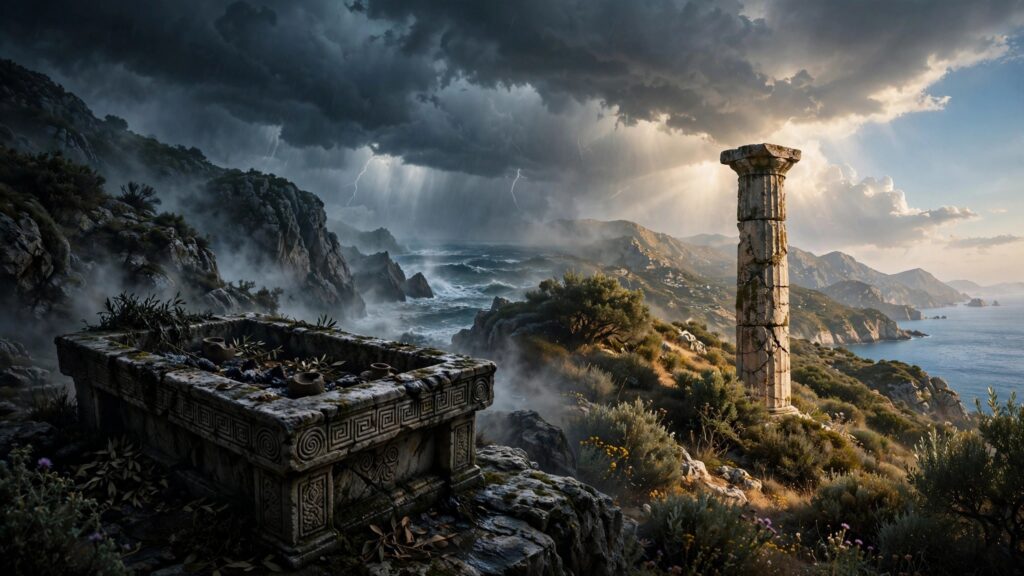
Both myths encode the same theological argument from different directions. The Iphigeneia version says: the goddess once saved a girl from a male-directed sacrifice and requires that the girls of Athens reenact that salvation through service in her sanctuary. The local bear version says: humans violated the boundary between the domesticated world and the wild by killing what belonged to Artemis, and the required restitution is that every girl must temporarily inhabit the wild that was violated. In the first myth, the ritual commemorates the goddess’s protection of a girl. In the second, it commemorates the goddess’s claim on the girls themselves as restitution for a violation of her animals.
What the two myths share is the insistence that the ritual is owed: to Artemis, by Athens, across the full arc of every Athenian girl’s life from early childhood onward. The institutional form of that debt is the Arkteia, and the payment is the temporary suspension of civilized girlhood in favor of wild animal identity, undertaken once, at an early age, but binding across everything that follows it.
What the Krateriskoi Show
The krateriskoi, the small pottery vessels found in significant numbers at both Brauron and the related sanctuary of Artemis Mounichia at Piraeus, are the primary visual evidence for what the Arkteia actually looked like in practice, and they are among the most remarkable objects in Athenian votive archaeology for the precision of what they depict.
The sanctuary of Artemis Brauronia features unique ritual depictions on these krateriskoi, dating from roughly 510 to 450 BCE. These small painted vessels, probably used in the ritual itself or dedicated to the sanctuary after the rite’s completion, show girls in various activities: running races, making offerings at altars, dancing in procession, processing toward the goddess with their saffron robes visible, and in some scenes moving with an animal energy that distinguishes their postures from the formal processional poses of ordinary ritual depiction. Some show bears directly. Some show girls with their arms raised in gestures that scholars have interpreted as the actual movement of the bear imitation itself.
The racing scenes are particularly striking. The girls who ran races at Brauron were not running in the formal, controlled manner of the male athletes at Olympia. They were running on the precinct’s own grounds, in a space that Artemis owned and governed, as girls rather than as athletes, and the krateriskoi that show them running capture a quality of movement that the ancient world’s official athletic imagery, almost universally male, does not preserve. These were children running, and the particular joy that children’s running has, the quality of movement that has not yet been shaped by the performance demands of adult athletic competition, is what the krateriskoi attempt to record.
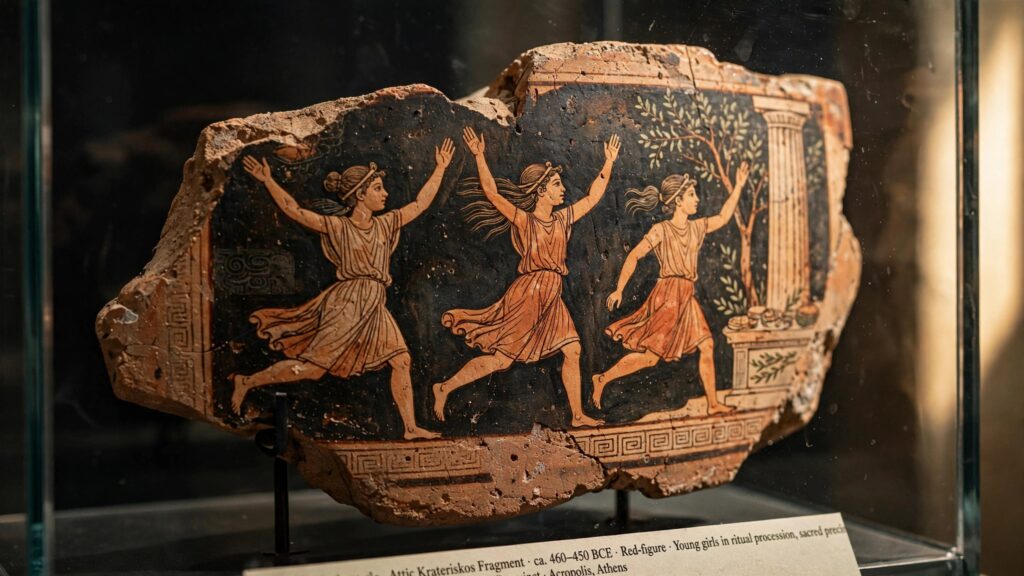
The Brauron Archaeological Museum, in the village now called Vravrona on the Attic coast about forty kilometers east of Athens, holds the best surviving collection of these krateriskoi alongside the votive offerings, clothing dedications, and sculptural fragments recovered from the sanctuary excavations. The museum is the essential complement to the sanctuary site itself, which preserves the fifth-century BCE Doric stoa, the dormitories, the sacred spring, and the foundations of the temple, in a landscape of pine trees and limestone that gives the sanctuary its specific quality: not the civic grandeur of the Acropolis but the bounded, intimate, forest-edge character of a place that was always specifically for girls rather than for the city’s general religious life.
The Clothes Left Behind
Among the most significant finds from the sanctuary excavations are the inventory lists of dedications: written records of what had been left at the sanctuary over time, and the lists reveal that clothing was among the most consistent categories of offering.
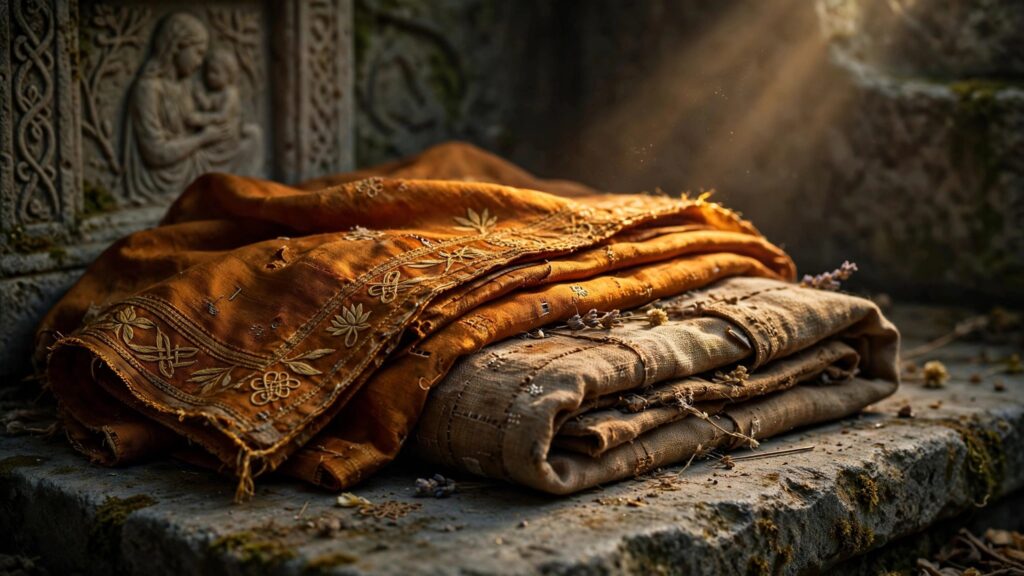
The inventory suggests that the cult received many dedications of clothing, given by mothers after childbirth to Artemis. Euripides suggests that garments would also be gifted in the names of mothers who had died in childbirth.
The garments left at Brauron by the mothers who had survived their children’s births, and dedicated in the names of those who had not, create a direct material connection between the girls who played the bear and the women they eventually became: the clothing of the adult female life, the garments of pregnancy and childbirth and the domestic world that marriage produced, was left specifically at the sanctuary where, years earlier, girls had temporarily shed their garments to become bears. The clothing went from the adult life back to the place of the transition, offered to the goddess who governed the threshold, acknowledging that the passage the girls had made at Brauron as children was the passage that had eventually led toward both the survival and the death that the garments commemorated.
This is the sanctuary’s deepest theological function, made visible in its inventory: not simply the transition from girlhood to womanhood in the abstract, but the specific, physical, sometimes fatal passage through childbirth that marriage led to, years after Brauron, and that Artemis, the goddess who governed the wild and the unmarried and the moment of birth simultaneously, presided over from the beginning of that long arc to its end. The girls who came to play the bear were committing themselves, in the form of the ritual’s required participation, to the full sequence of events that their eventual participation in civilized marriage would produce: the saffron robe shed at Brauron in childhood would, years later, be replaced by the clothing of a pregnant woman, and those garments would eventually end up back at the same sanctuary, worn or unworn, depending on whether the goddess who governed the threshold had decided to keep the woman on the living side of it.
The Theological Argument in the Ritual
What the Arkteia was doing, read from inside its own logic rather than from the outside perspective of subsequent scholarship, was making an argument about the cost of civilization that the Greek world encoded in many of its most significant rituals but rarely stated as directly as this one did.
Civilization requires, in the Greek understanding, the domestication of the wild: the organization of human impulses, energies, and desires into the forms that a stable, productive, law-governed community requires. Marriage is the primary institutional form this domestication eventually takes for women: the transition from the wild, unmarried, pre-social girlhood of Artemis’s domain into the structured, relational, household-governing life of a wife. This transition is real, it is significant, and in the Greek understanding of what it costs, it is genuine loss: the girl who marries is leaving something behind, not simply gaining something, and what she is leaving behind is the specific, temporary freedom of the condition that marriage forecloses.
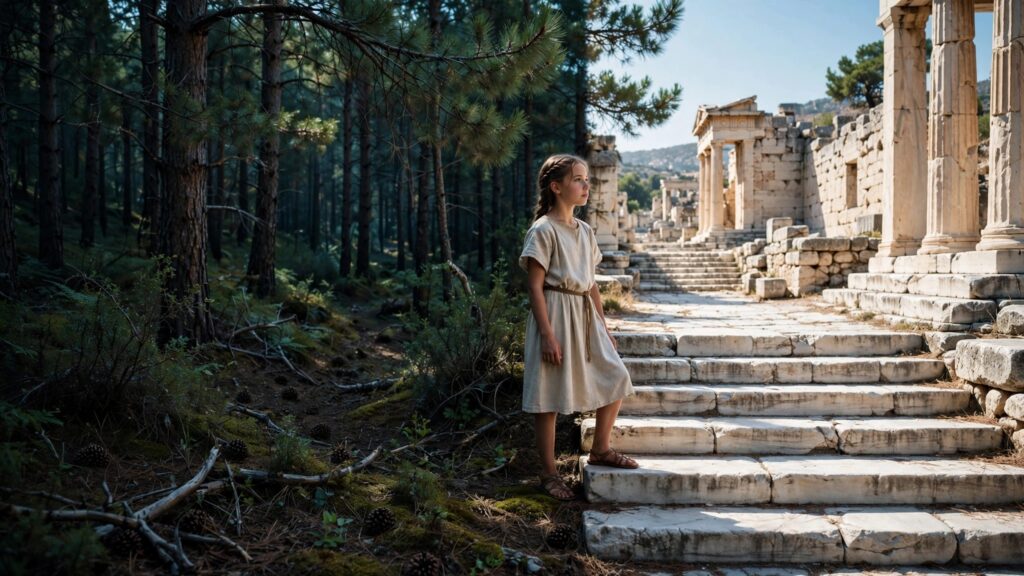
The Arkteia acknowledged this loss directly, rather than pretending it did not exist, and it did so early, before a girl had any lived sense of what marriage would actually demand of her. It said: before you can be permitted to enter the domesticated life, even years before you enter it, you must inhabit the wild life completely, for a defined period, in a protected space specifically provided for that inhabitation, under the patronage of the one goddess who never stopped inhabiting it. You must be a bear before you are a wife, because the condition of being a wife is incompatible with the condition of being a bear, and something in you will need to remember the bear even when, years later, the wife is all that is visible.
At one point in the ritual, the girls shed the saffron krokotos robe entirely. The nakedness at the ritual’s end is the nakedness of rebirth: the girl who was a bear sheds the bear’s color and emerges as something new, the human child who has temporarily inhabited the wild and can now carry forward, into the rest of her childhood and eventually into marriage, the plain knowledge of what she once was rather than the ignorance of what she has never experienced. The Greek world was not naive about what marriage would eventually require of women. The Arkteia was its institutional acknowledgment of that requirement, built into stone and ritual and the periodic residence of young girls at a sanctuary beside the sea, where they could run in saffron robes and imitate the she-bear years before they had to go home and, eventually, be wives.
Visiting Brauron Today
The sanctuary at Vravrona, the modern name for ancient Brauron on the eastern Attic coast, is accessible from Athens by car in approximately forty-five minutes to an hour, depending on traffic on the coastal road south of Rafina. It is one of the least visited major sanctuaries in Attica, which means that the experience of the site is entirely different from the crowded, time-pressured encounters that the Acropolis and Delphi and Olympia now require: you will almost certainly have the stoa and the foundations and the sacred spring largely to yourself, in a landscape of pinewood and marshland that preserves something of the boundary-zone character the ancient sanctuary required.
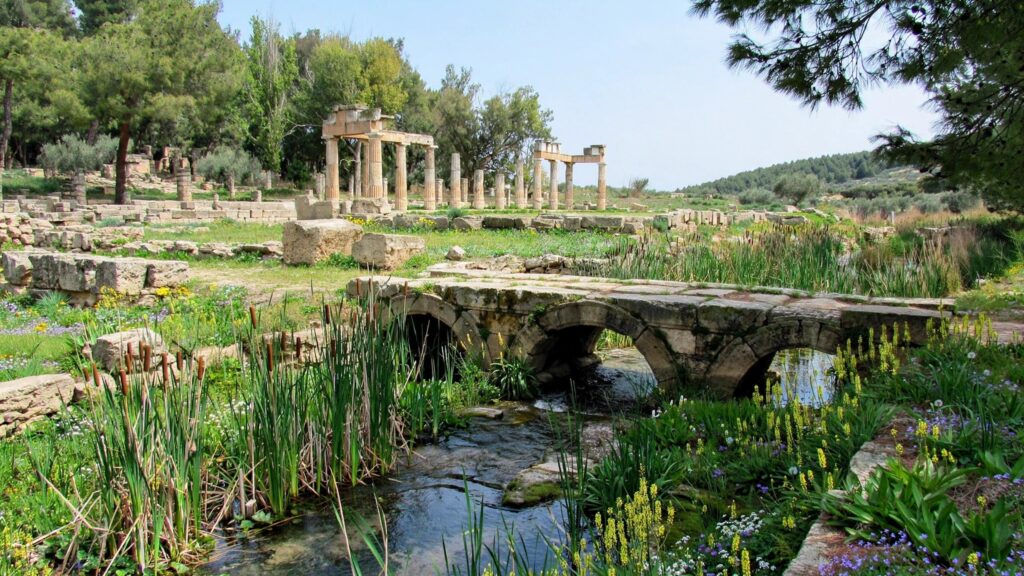
The Doric stoa, the best-preserved above-ground structure, its columns partially restored, its interior divided into the rooms that the excavations identified as dormitories, frames a courtyard whose sacred spring is still audible in wet seasons beneath the footbridge that crosses it. The theatre area, the altar precinct, and the bridge over the Erasinos stream that connected the sanctuary to the processional route from Athens are all identifiable in the site’s current state, and the overall landscape communicates, with unusual clarity for an ancient sanctuary, the quality of place that the ancient Greeks were recognizing when they chose this coastal wetland-edge site as Artemis’s Attic home.
The museum beside the site is small, serious, and contains objects of genuine importance: the krateriskoi with their running girls, the votive statuettes whose confident bearing suggests the quality of religious attention that the arktoi brought to their service, and the inscription fragments that confirm the sanctuary’s identity and the ritual’s institutional character. Allow two hours for the museum before or after the site itself.
The site is most rewarding in spring and early autumn, when the wetland landscape has its own particular beauty and the coastal light has the quality that the Attic coast produces before the summer haze settles over it.
The girls who came to Brauron wore saffron and became bears. They ran on the precinct’s own grounds, in the forest-edge space that Artemis owned, and danced and made offerings and slept in the dormitory rooms beside the sacred spring. They shed the saffron at the end and went home.
They went home, still children, to grow up, to marry years later, to have children of their own, to manage households, and eventually, some of them, to leave their own clothing at the sanctuary in gratitude or in grief for what the passage through birth had cost them. The sanctuary received everything across the span of an entire life: the girl in saffron at the beginning, the clothing in silk or wool at the end, the full arc of the female life between them offered to the goddess who never entered that arc herself, who stayed at the boundary where the forest met the sea and governed the crossing from one condition to another with the authority of the being who had chosen, permanently, to remain in the wild.
The Athenians voted that an Athenian girl was not to live with a man until she had played the bear for Artemis at Brauron.
The vote stands, in the record, as one of the most honest institutional acknowledgments the ancient world produced of what civilization costs the people it domesticates: you must have been wild before you are permitted to be tame. You must have been the bear, long before anyone asked you to be the wife. You must know what the saffron feels like before you shed it.
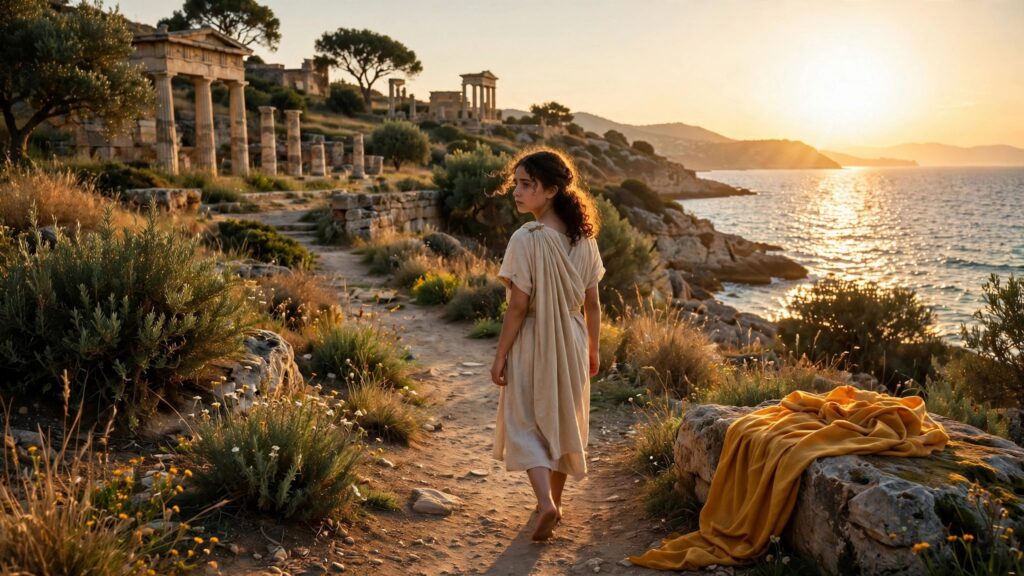
Then, years later, you can go home for good.
At Olympus Estate, Rituals and Festivals traces the ceremonies through which Greek civilization marked its most consequential passages. Every Athenian girl of good family, at some point between the ages of five and ten, spent a period at the sanctuary of Artemis at Brauron as one of the arktoi, the bears, wearing the saffron krokotos and imitating the goddess’s own sacred animal before shedding the robe entirely at the ritual’s end. Aristophanes preserves the clearest surviving account, in a chorus that lists a girl’s ritual offices in sequence: arrephoros at seven, corn-grinder at ten, bear at the Brauronia, and finally, years later, basket-bearer on the eve of marriage. The ritual traced back to two competing myths, one crediting Artemis with saving Iphigeneia from sacrifice, the other explaining it as restitution for the killing of the goddess’s own sacred bear. The krateriskoi found at the site preserve the clearest surviving images of girls running and dancing in the ritual itself. Long before a girl could become a wife, the Greek world insisted, she first had to become a bear.