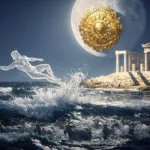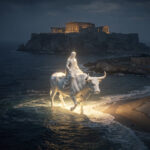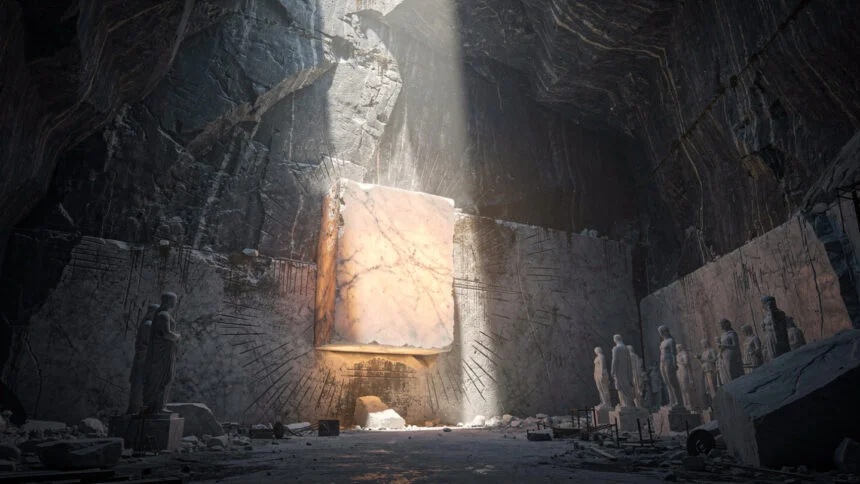


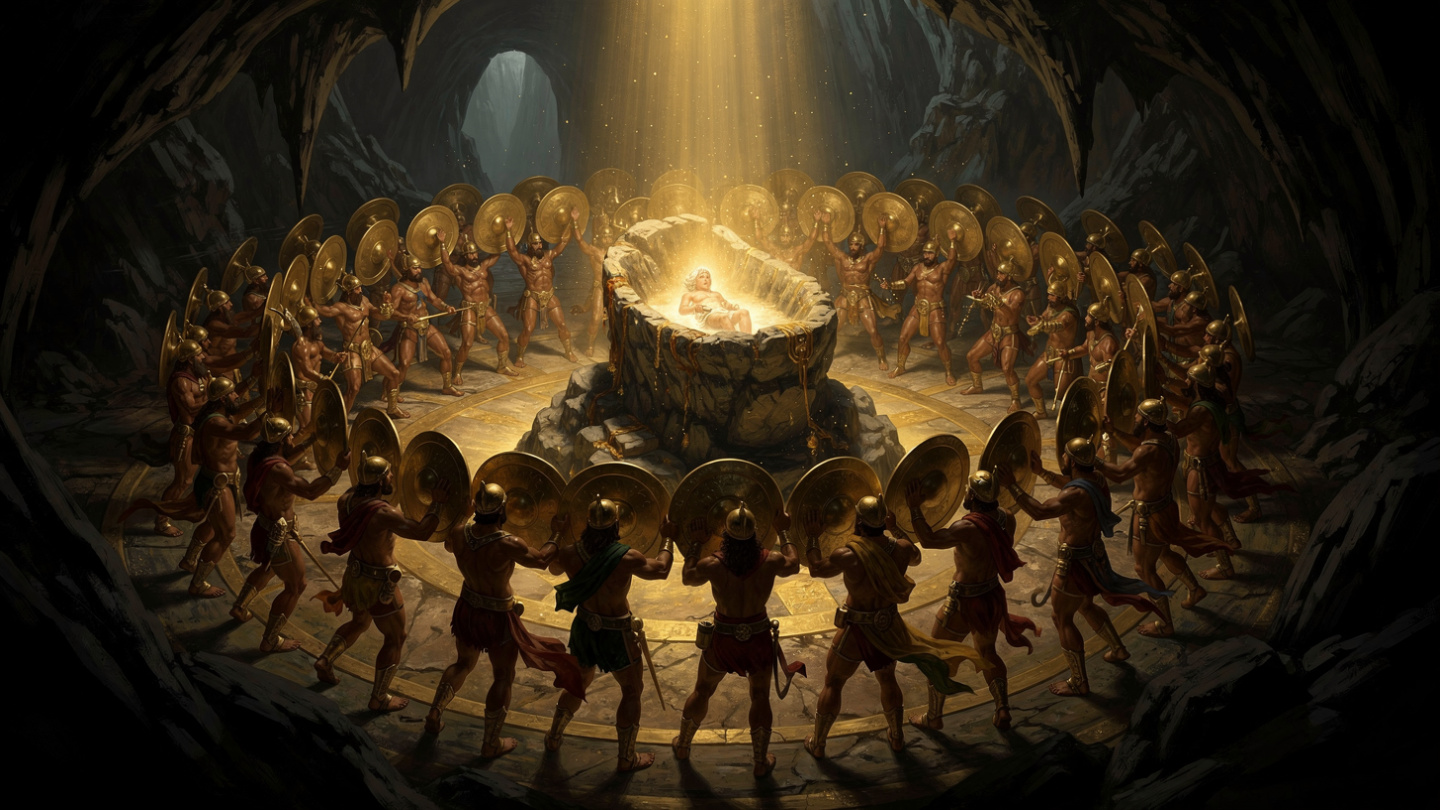
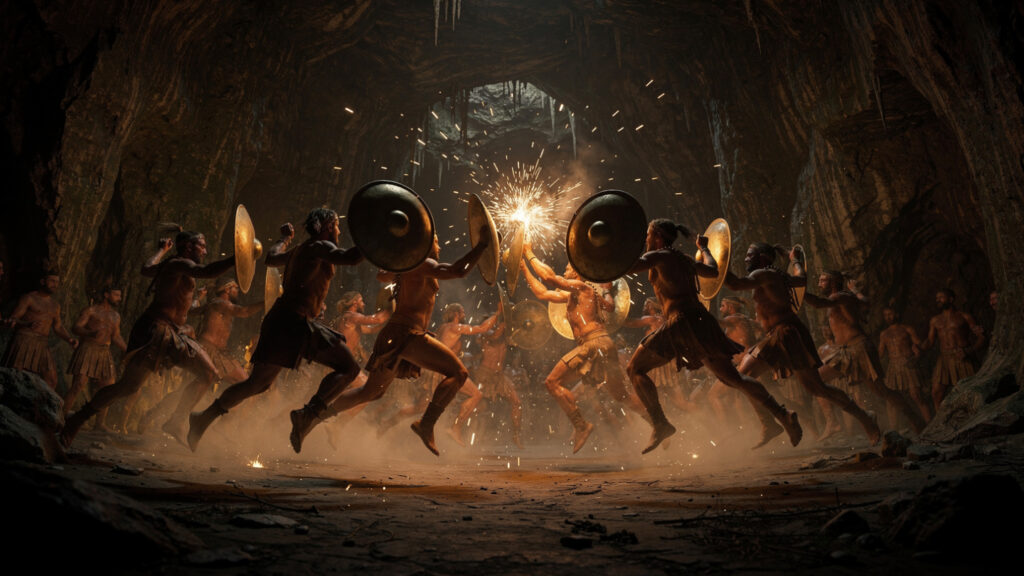
The Kouretes were dancing when Zeus was born.
Not dancing for pleasure, not dancing for art, but dancing with weapons, bronze shields and bronze spears, the noise of the weapons against the shields filling the cave on Mount Ida with the sound that would prevent Kronos from hearing the infant’s cries. The Kouretes, the armed dancers who guarded the infant Zeus in the cave while Rhea recovered from the birth and gathered her strength for the confrontation with her husband that she knew was coming, were performing the protective function that the ancient Cretan tradition assigned to them: the noise of the weapons was the screen behind which the new divine order gestated in the darkness of the mountain cave.
This is the image that the Hymn of the Kouretes, the earliest surviving hymn in the Greek language, encodes in its archaic form: the divine king at the height of his power being celebrated by the community that preserved his life at the moment of his most extreme vulnerability. The hymn, discovered at Palaikastro on the eastern coast of Crete in 1904 and dated to approximately the third century BCE in the surviving inscription though the tradition it preserves is substantially older, calls on Zeus to come to Dikta, to leap for the year, to leap for the herds and for the crops and for the cities and for the people and for divine Justice. The armed dancers who preserved the infant’s life are the dancers who summon the adult king’s annual renewal.
The Hymn and Its Discovery
The Palaikastro Hymn, which the archaeologists Richard Bosanquet and Ronald Burrows recovered from the excavation of a sanctuary site on the eastern Cretan coast in 1904, is the document that most completely preserved the character of the Kouretes world in its Cretan form, and its content is worth attending to before the broader mythological world is developed.
The hymn calls on the Greatest Kouros: io Kouros, the invocation that opens the hymn, addresses Zeus not as Zeus but as the Greatest Youth, the divine young man whose character in the Cretan world was the character of the annually dying and reborn vegetation deity rather than the eternal unchanging sky king of the mainland Olympian world. The Cretan Zeus was not simply the mainland Zeus located on a different mountain. He was a Zeus whose character incorporated the vegetation cycle’s annual death and renewal in a way that the mainland world consistently denied, because the mainstream Greek world insisted that the Olympian gods did not die.
The hymn’s content develops this tension between the Cretan and the mainland traditions: it is simultaneously a hymn to the greatest Kouros who arrives at Dikta to renew the year and a hymn to the armed dancers whose protective function had preserved his life at the moment of his birth. The annual leap for the year that the hymn requests is the annual renewal ceremony whose mythological foundation is the Kouretes’ original protective dance around the infant’s cradle: the community reenacts the original protective event each year to summon the renewal that the original event made possible.
The scholar Jane Ellen Harrison, whose 1912 Themis is the foundational modern study of the Kouretes world, identified the Palaikastro Hymn’s character as the clearest surviving evidence for the ritual pattern that she called the Eniautos Daimon, the year spirit whose annual death and renewal was the foundational religious structure of the pre‑Olympian Greek world.
Harrison’s reading of the Palaikastro Hymn, and of the Kouretes tradition more broadly, has been debated and modified by subsequent scholarship but remains the most coherent framework for understanding what the Kouretes were and what the hymn was for.
The Kouretes in the Ancient Sources
The Kouretes appear in the ancient sources as a category of divine beings whose character was the character of the armed initiatory dancer, the figure whose combination of the martial and the sacred expressed the Greek understanding of what initiation into the adult civic-religious order required.
Hesiod names the Kouretes in the Theogony in the context of the divine succession narrative: they are the figures who concealed the infant Zeus on Crete while Rhea tricked Kronos with the swaddled stone. The detail of the shield-clashing dance that Hesiod does not develop at length is the detail that the Hymn of the Kouretes preserves in its most complete form.
Strabo, in the tenth book of the Geography, gives the most extended ancient prose account of the Kouretes and their mythological relationships, and the complexity of his account reflects the complexity of a world that the different cities and regions of Crete and the broader Greek world had developed in different directions across the centuries of its transmission. Strabo distinguishes between multiple worlds: the Kouretes of Crete who guarded the infant Zeus, the Kouretes of Aetolia who were the companions of Artemis and who appear in the Iliadic world of the Calydonian Boar Hunt, and the Kouretes of Euboea who were the original inhabitants of the island in some accounts. These are not the same Kouretes. They are the different regional adaptations of a category of being whose character, the armed initiatory dancer who guards or escorts or initiates, the different regional worlds applied to the mythological content that each region’s world required.
Diodorus Siculus, in the fifth book of the Library of History, gives the most extensive ancient account of the Kouretes’ relationship to the Idaean Dactyls and to the origins of the mystery cult traditions that the Kouretes were associated with. In Diodorus’s account, the Dactyls were the men who discovered iron-working in the region of Mount Ida, and their contribution to the ancient world was the practical technological knowledge of metallurgy: iron, copper, and the techniques of smelting and forging. The Dactyls taught this knowledge to Orpheus, who then brought it to the mainland, and through Orpheus the mystery cult tradition that would become the Orphic mysteries was connected to the Cretan Dactylic tradition.
The Idaean Dactyls
The Idaean Dactyls, the Fingers of Mount Ida, are a category of divine beings whose association with metallurgy and with the mystery cult world makes them among the most interesting minor figures in the ancient mythological world, and whose connection to the Kouretes the ancient sources develop in different ways in different texts.
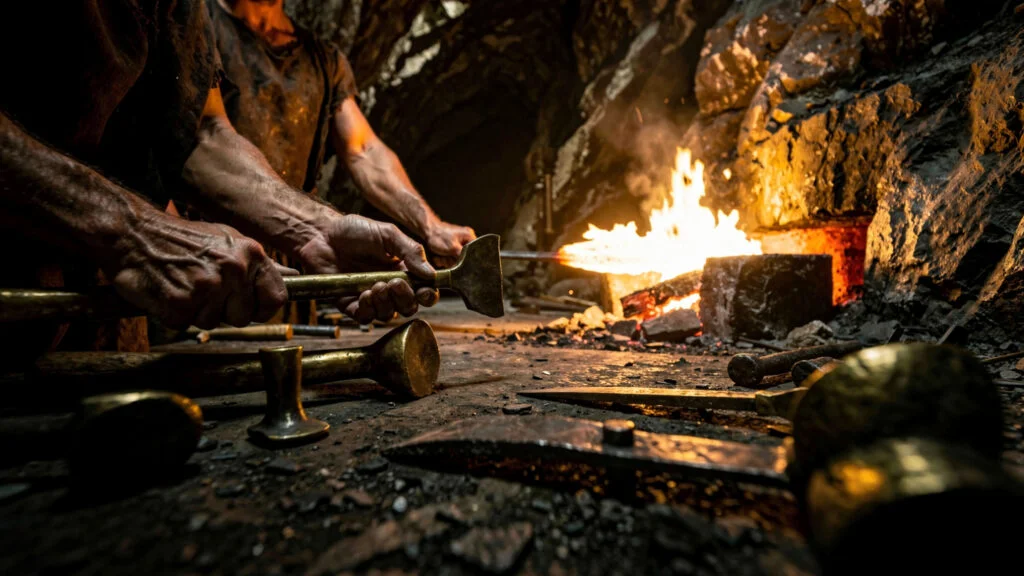
The name Dactyls means fingers in Greek, and the ancient world provided multiple explanations for the name: that they were so called because there were five of them, corresponding to the fingers of a hand, or because they were discovered by Rhea who pressed her fingers into the earth of the Mount Ida cave while in labor, or because their function in the mystery world was connected to the manual arts of metalworking. None of these explanations is mutually exclusive, and the semantic richness of the name, fingers as the instruments of the manual arts and as the human body part most directly associated with craft and skill, is the richness that the world was exploiting in the application of the name to the divine craftsmen of the Mount Ida world.
Strabo names the original Dactyls as five male figures and five female figures, the ten corresponding to the ten fingers of two hands, and locates them in the world of the Mount Ida region that is distinct from the Samothracian and the Ephesian Dactylic worlds that the wider Greek world maintained. The five male Dactyls were associated with the arts of metalworking, the five female with the arts of magic and healing. The gender division of the two groups corresponds to the division in the ancient world between the male crafts of the forge and the female crafts of the sacred healing practice.
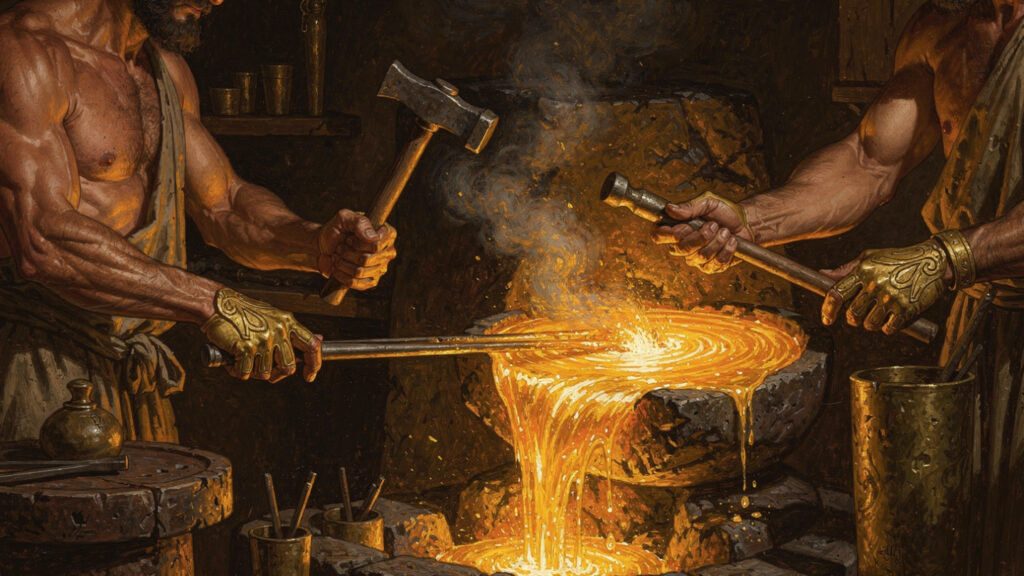
The most important of the Idaean Dactyls in the surviving ancient record is Hercules, who is explicitly identified as a different figure from the more famous Heracles of the twelve labors: the Idaean Herakles was the Dactyl who organized the first Olympic Games on the Hill of Kronos at Olympia, measuring the course with his own feet and planting a wild olive tree as the boundary marker that would become the source of the victors’ crowns.
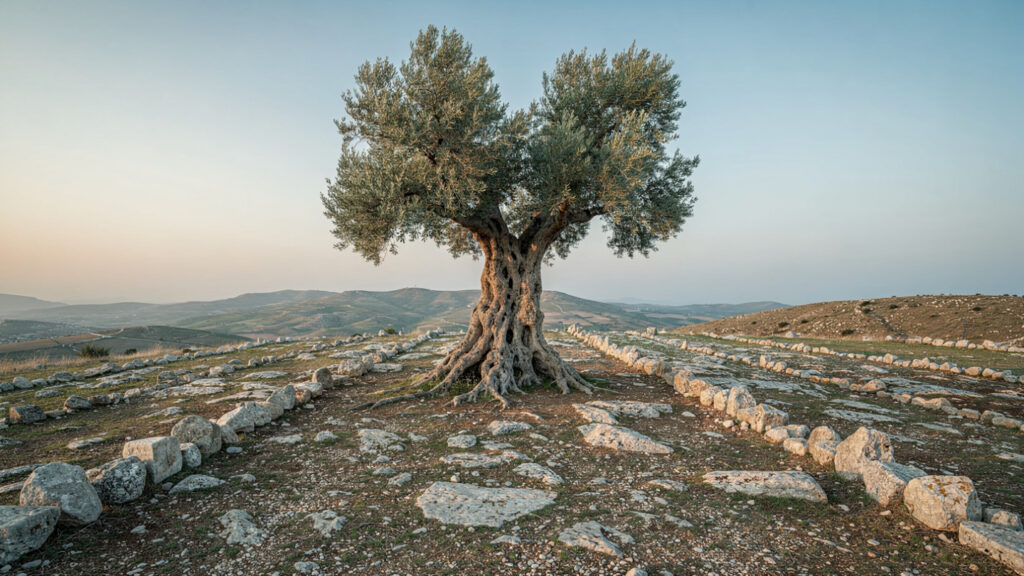
This world, preserved in Pindar’s Olympian Odes and developed by Pausanias in the Description of Greece, gives the Idaean Dactyls a role in the origin of the most significant athletic festival in the ancient Greek world. The Olympic Games began with the divine craftsmen of the Cretan mountain world.
The Kouretes and the Initiatory Function
The function of the Kouretes in the religious world of the ancient Greek world was the function of the armed initiatory escort: the beings whose character combined the martial and the sacred in the particular way that the initiation of the young male into the civic‑religious community required.
The initiatory function is visible in the Kouretes’ relationship to the various divine figures they are associated with as guardians or escorts. They guarded the infant Zeus on Mount Ida. In the Euboean world they are the protectors of Hera’s sanctuary. In the Aetolian world they are the companions of Artemis in the Calydonian Boar Hunt, where the conflict between Meleager and the Kouretes of Aetolia over the spoils of the boar hunt produces the Iliadic episode of Meleager’s withdrawal from battle that Homer develops as the parallel and the precedent for Achilles’ wrath. In the Orphic world they are the dancers who distract the infant Dionysus with mirrors and toys before the Titans tear him apart: the protective dance that failed in the Dionysian context rather than succeeded as in the Zeus context.
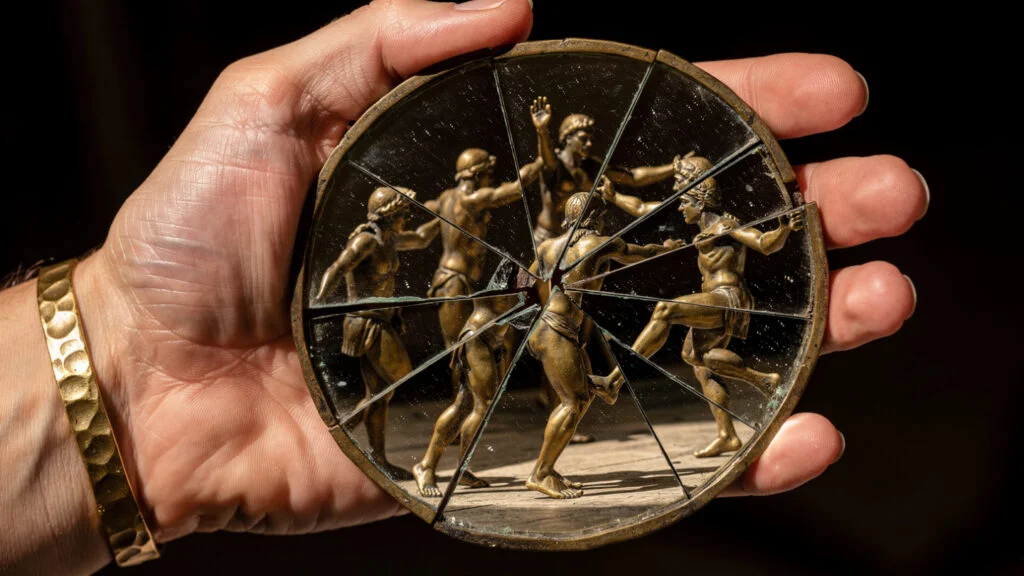
The pattern of the protective armed dance around the divine infant is the initiatory pattern at its most mythologically concentrated: the armed dancers who create the protective circle around the new divine being are the human community performing the ritual that makes the new divine being’s survival possible, and the survival of the new divine being is the condition for the community’s own continued existence. The Kouretes who preserve Zeus are the community whose continuity depends on Zeus’s survival, performing the dance that their own survival requires.
The armed dance itself, the form of the Kouretes’ protective ritual, is the ritual whose anthropological parallel in the initiation worlds of many human cultures has made it the focus of the most sustained scholarly attention. The armed dance of the young male initiates, who perform the dance to demonstrate their readiness for the adult civic role and to scare away the evil forces that the initiation must survive, is the structural parallel that Harrison’s Themis identified as the anthropological foundation of the Kouretes world. The divine armed dancers are the mythological projection of the human initiatory dance world.
The Samothracian Connection
The connection between the Cretan Kouretes world and the Samothracian mystery cult that the Diodorus account develops is the connection that places the Cretan world within the broader network of ancient mystery cults that the Samothracian article in this collection develops from the Kabeiroi world.
Diodorus’s claim is that the Kouretes were among the earliest migrants to Samothrace, bringing with them the mystery cult world that the Samothracian sanctuary subsequently developed into the form of the Kabeirian mysteries. The connection between the Kouretes as the armed initiatory dancers of the Cretan world and the Kabeiroi as the chthonic deities of the Samothracian world is a connection that the ancient sources themselves found difficult to specify precisely. Both categories of being were associated with mystery cult initiation, both were associated with the protection of sailors and travelers, and both were understood in the ancient Greek world as figures whose origin predated the organized Olympian religious system.
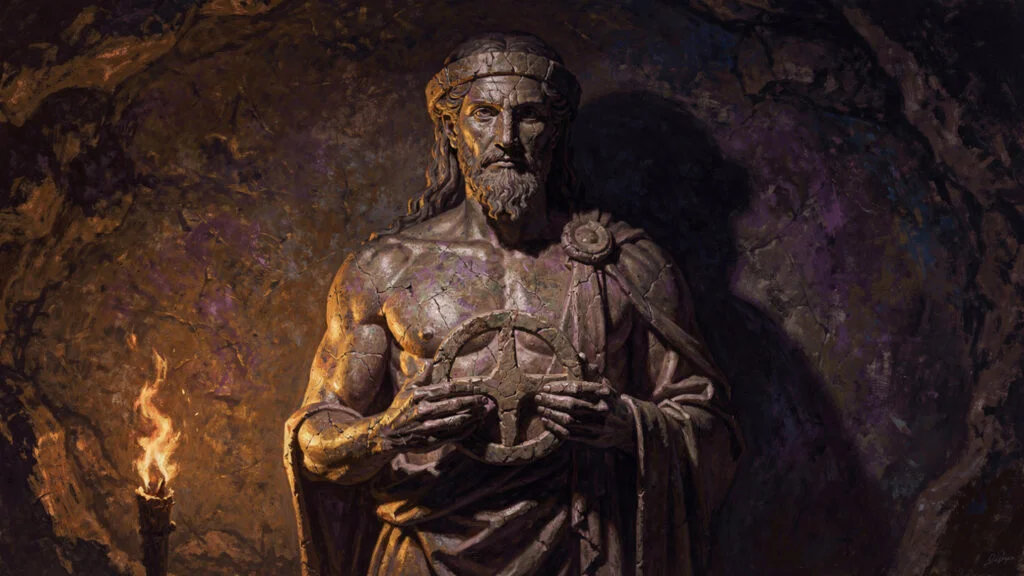
The Kabeiroi of Samothrace, as the Samothraki article in this collection develops, were the pre‑Greek chthonic deities whose mystery cult admitted slaves and free persons alike and whose protective function for mariners made them the most universally accessible of the ancient mystery cults. The Kouretes of Crete were the divine armed dancers whose protective function for the infant Zeus was the mythological foundation of the Cretan mystery world. The connection between the two, which the ancient sources trace through the migration narrative of the Diodorus account, is the connection that places both worlds within the single broader world of the pre‑Olympian mystery cult that the Greek religious world maintained alongside the official Olympian religion.
The Bull-Leaping Connection
The relationship between the Cretan Kouretes world and the Minoan bull-leaping practice that the original article in this collection was attempting to develop is a relationship that the ancient sources preserve without the initiatory framework that the modern reconstruction imposed on it.
The bull-leaping frescoes of Knossos, which the Minoan civilization article and the Knossos travel guide in this collection both discuss, document a ritual practice whose religious significance the undeciphered Linear A script prevents from being fully understood through the administrative records of the palace. What the ancient Greek mythological world preserves about the bull’s role in the Cretan sacred world is preserved through the narratives of the Minotaur and the white bull of Poseidon rather than through any direct account of the bull‑leaping as an initiatory rite.
The Kouretes’ shield-clashing dance around the infant Zeus’s cradle and the bull-leaping acrobatics of the Knossos frescoes are both products of the same pre-Greek Cretan religious culture whose character the Minoan material record documents but whose content the unreadable Linear A denies direct access to.
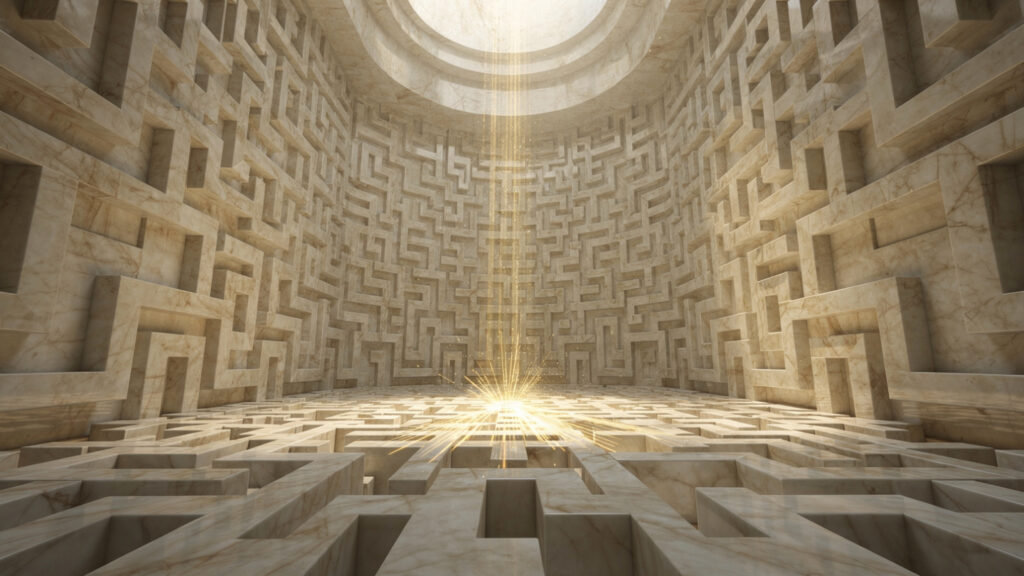
The connection between the two is genuine in the sense that they share the same cultural origin, but the initiatory framework that makes bull-leaping the Small Mysteries and the Labyrinth the Great Mysteries is a modern reconstruction rather than an ancient account.
The Hymn’s Survival and Its Meaning
The survival of the Palaikastro Hymn in its archaeological context, a sanctuary site on the eastern Cretan coast whose excavation produced the inscribed stone on which the hymn is carved, is the survival that gives the Kouretes world its most direct material witness in the ancient record.
The hymn’s address to the Greatest Kouros, calling on the annually renewing divine youth rather than the eternal sky king, is the address that preserves the Cretan theological difference from the mainland Olympian world. Crete knew a Zeus who was born and who annually renewed himself and who was associated with the biological cycle of the year’s renewal in a way that the mainland world had transferred to Persephone and Demeter. The Cretan Zeus who was annually invoked to leap for the year, to bring the year’s renewal to the crops and the herds and the cities and the people, is the Zeus who retained the character of the pre‑Olympian vegetation deity that the mainland world had rationalized out of the sky king’s eternal divine nature.
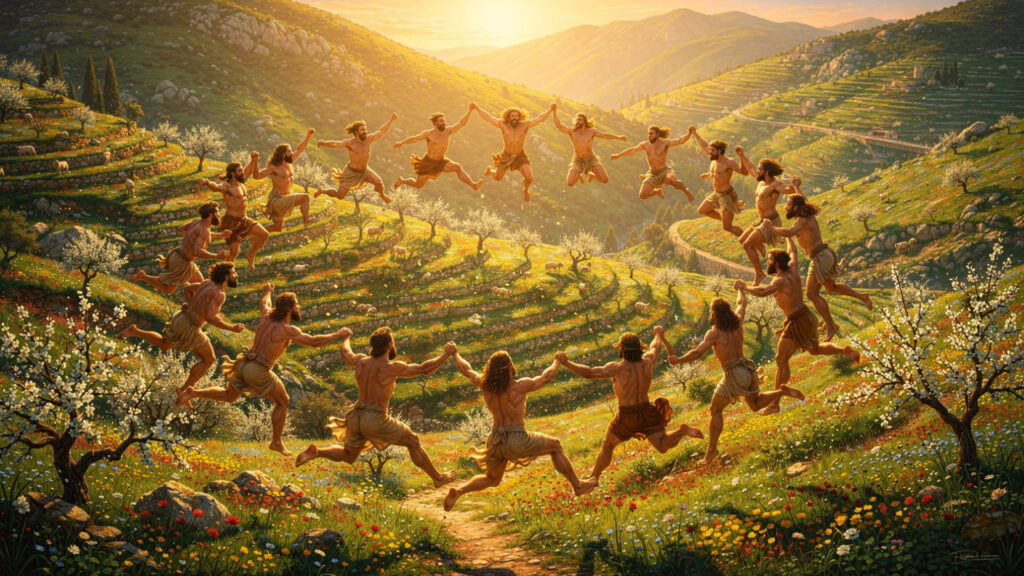
The Kouretes who preserved this Zeus at the moment of his birth are the figures who preserved the theological possibility of the annual renewal: without their protective dance at the moment of the divine infant’s most extreme vulnerability, the new divine order would not have survived to become the order that the entire subsequent tradition was organized around. The armed dancers who saved the king of the gods by making enough noise to cover his crying are the figures whose apparently humble and practical function was the function that the entire subsequent divine order depended on.
The noise of bronze on bronze in a cave on Mount Ida was the sound that made Western theology possible.
At Olympus Estate, Mythic Essays moves through the deeper currents of the Greek tradition. The Palaikastro Hymn was discovered in 1904 on the eastern coast of Crete and is the earliest surviving hymn in the Greek language. It calls on the Greatest Kouros to leap for the year, to renew the herds and the crops and the cities and the people. The Kouretes who danced around the infant Zeus’s cradle with their weapons making noise to cover his crying are the community performing the ritual that made the new divine order possible. The Idaean Dactyls discovered iron and taught metallurgy to Orpheus and organized the first Olympic Games. The noise of bronze on bronze in a cave on Mount Ida was the sound that made Western theology possible. This is not a small tradition.