


The twelve labors of Heracles are not twelve separate stories.
They are a single project, conducted outward in two concentric rings from the center of the Greek world to its absolute edges, and the purpose of the project is exact: to make the world inhabitable. Every monster Heracles was sent to kill or subdue was something that was preventing civilized life from advancing into the territory it occupied. Every impossible task Eurystheus devised was, in its actual effect, an act of infrastructure on a scale that no army or engineer or institution could have achieved, because the obstacles were supernatural and the only available instrument was a being whose capacity exceeded anything the ordinary world contained.
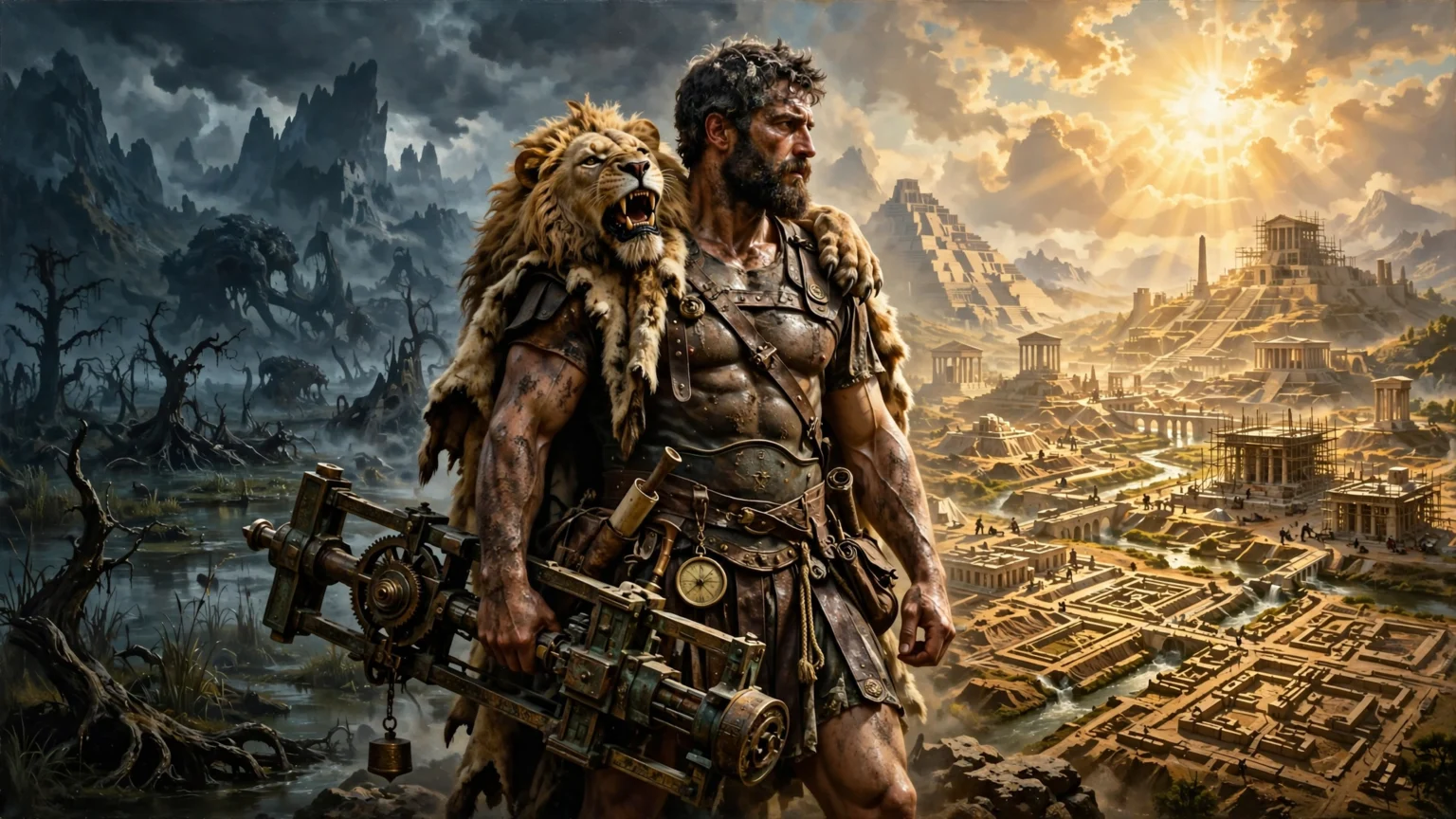
Diodorus Siculus, the first-century BCE historian whose account of Heracles treats him explicitly as what the mythology was always encoding beneath its narrative surface, is direct about this: Heracles is a great general and engineer, imposing civilization, draining swamps, setting up monuments in the territories he conquers. He also has the hobby of eliminating monsters in order to allow civilized life to advance. The word hobby understates it considerably. The monster-killing was the project. The territories Heracles moved through, from the Peloponnese to the edges of the known world to the underworld itself, are territories that human civilization needed cleared before it could function in them, and the twelve labors are the mythological record of that clearing, conducted by the one being whose nature made it possible.
This is the Heracles that the mythology was always building toward: not a strong man doing difficult things, though the strength and the difficulty are both genuinely present, but the most ambitious civilizing project the ancient world ever imagined, told as the biography of a single hero because the scale of what needed to be done exceeded anything that could be told as collective human history.
The Name First, Because the Name Is Everything
His name means the glory of Hera.
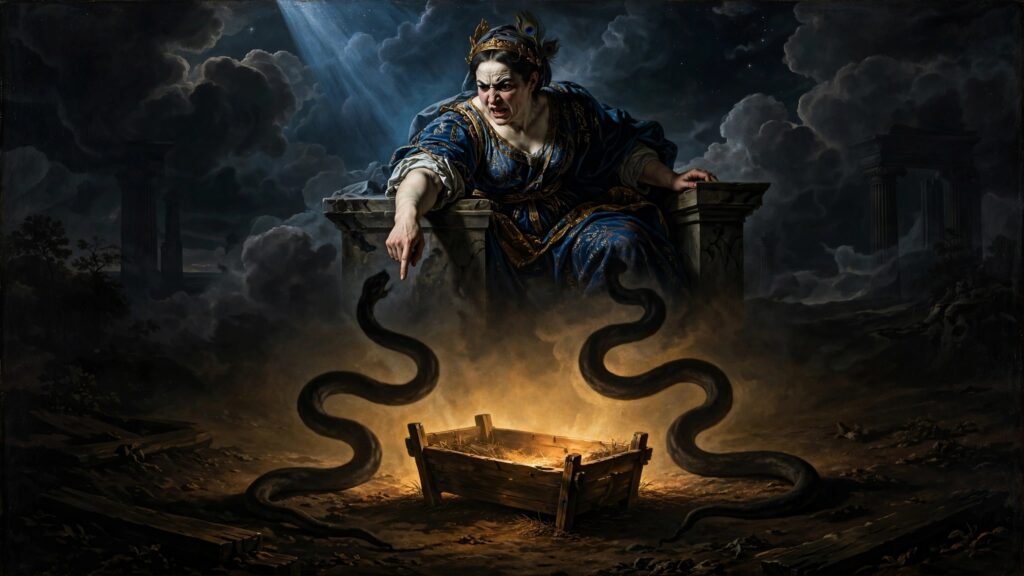
The hero whose entire mythological biography is shaped by the relentless hostility of the queen of the gods carries her name inside his own as a glory, a kleos, the very word the Greek world used for undying heroic fame. This is not a translation problem or a later mythological addition. It is there from the beginning, and it is the tradition’s most precise encoded statement about what the entire story produces.
Two traditions explain the naming. In one, Hera herself causes it, producing a permanent record of their relationship in his very identity before their war has properly begun. In another, it is a propitiation, an attempt to soften a goddess’s fury by naming the child of the affair that enraged her in her honor, as though the name might persuade her to moderate what she had already decided to do. Neither explanation eliminates the paradox. The hero defined by persecution is named for his persecutor, and the name is not a collar. It is glory.
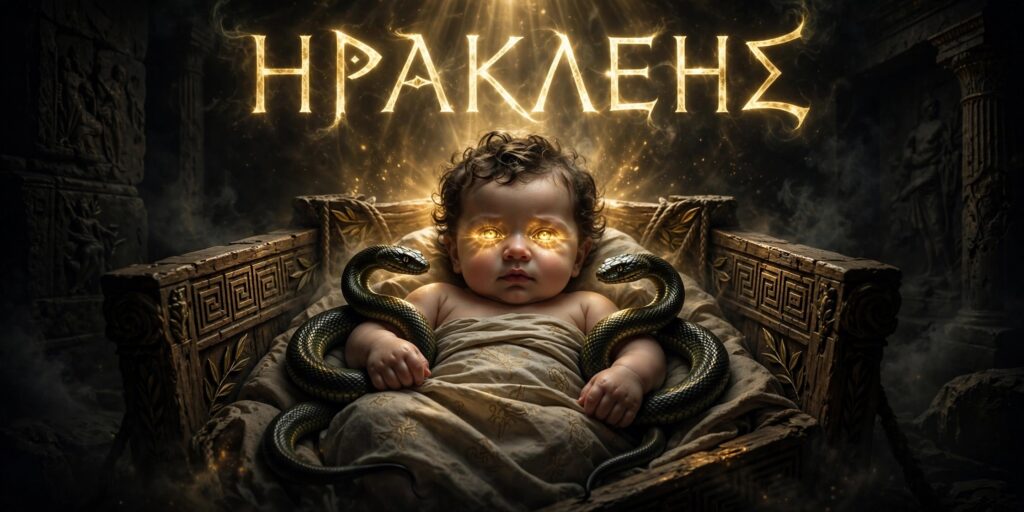
What this means is that the entire story of the twelve labors and the two periods of servitude and the death and the apotheosis is already contained, in compressed form, in the name: the tradition is announcing, before the first serpent is sent to the crib, that what Hera does to Heracles will produce, not despite her efforts but through them, the very fame that makes him what he becomes. She is the instrument of his greatness. He carries the proof of this in his name.
The Madman Before the Hero
Hera drove Heracles mad. He killed his own children.
This is the foundational event of the mythology, and it requires more attention than the quick narrative transition it usually receives in popular accounts, because the particular quality of the crime, what kind of crime it is and why it requires the expiation it receives, determines the entire structure of what follows.
The guilt Heracles carries after the madness is not ordinary guilt. He did not choose the madness, did not choose the violence it produced, did not intend the deaths. The responsibility belongs entirely to Hera, who inflicted the divine madness precisely because she could not destroy him directly and found in his own capacity for love the single reliable vulnerability available to her. And yet the guilt is real: the children are dead, and Heracles is the instrument of their deaths, and the fact that he was used as an instrument rather than acting as an agent does not make them less dead or him less the one whose hands held the weapon.
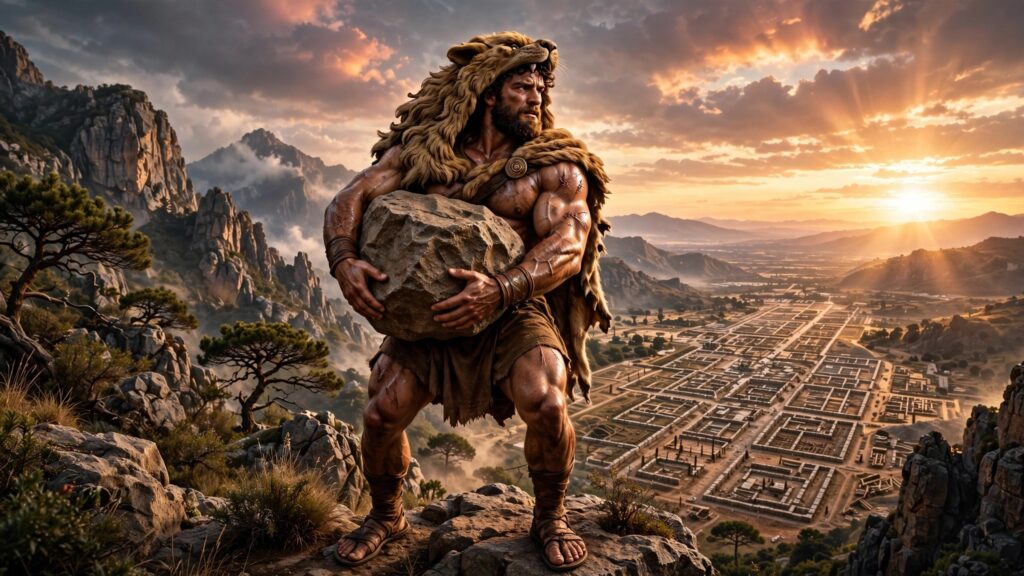
This is the crushing weight that no heroic achievement can simply overcome: genuine guilt for an act you did not choose, whose consequences you cannot undo, whose victims you loved, and whose cause was entirely outside your control. The Delphic Oracle does not tell him to contest the injustice. It tells him to place himself in service to Eurystheus for twelve years and to do whatever is required of him.
The purification is not through argument or through the punishment of the actual guilty party. It is through labor, sustained, outward-directed, world-improving labor, conducted under the authority of someone weaker and worse than himself, for as long as the Oracle specifies. The person who has to live with a guilt that cannot be argued away has to find somewhere to put it, and the Oracle found, for Heracles, the largest available somewhere: the entire known world, and everything wrong with it.
The First Ring | The Peloponnese
The first six labors are all located within or immediately adjacent to the Peloponnesian Peninsula, the heartland of the Bronze Age civilization that Homer’s poems remember and that the myth of Heracles was partly built to explain. This is not geographical coincidence. It is the structure of a civilizing project that begins at home and works outward.
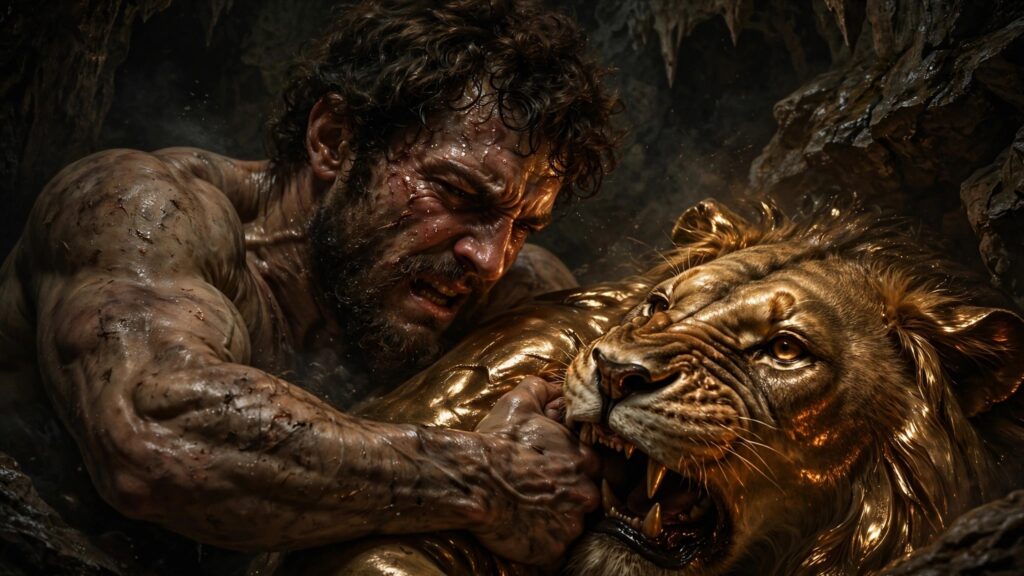
The Nemean Lion occupied the valley between Cleonae and Nemea, preying on the local population with the terrible efficiency of a beast whose skin no weapon could penetrate. Heracles strangled it with his bare hands and wore its impenetrable skin as his own protection from that point forward. The skin that made the lion invulnerable to ordinary human weapons became the armor of the one being capable of overcoming invulnerability with the force of his own body alone. The valley of Nemea, cleared of its predator, eventually became the site of the Nemean Games, one of the four Panhellenic festival cycles. Heracles did not simply kill a lion. He opened a valley to the kind of civilized athletic institution that the Greek world built its shared identity around.
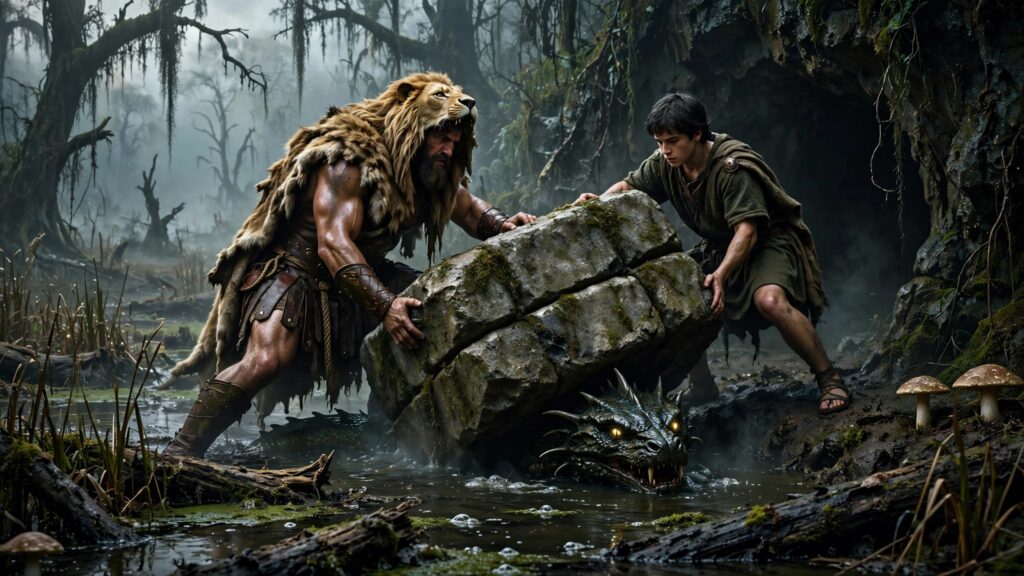
The Lernaean Hydra, as this site has documented at length in its own dedicated essay, was not simply a nine-headed serpent. It was a recursive feedback system inhabiting the swamps of Lerna, a territory that blocked the passage between the northern and southern Peloponnese. The labor’s disqualification by Eurystheus, because Iolaus’s assistance made it a collaborative achievement rather than a solo heroic act, is the mythology’s precise statement about the difference between containing a problem and actually solving it. The swamp was sealed rather than drained. The immortal head was buried under a stone on the road, still alive. The Hydra was managed rather than eliminated. The arrows poisoned with its blood would eventually kill the hero who harvested them.
The Ceryneian Hind, a golden-antlered deer sacred to Artemis, was not killed but captured after a year-long chase through multiple countries. The labor required patience rather than strength, and the delicacy of the task, the animal had to be returned unhurt to Eurystheus and then released back to Artemis, meant that Heracles had to bring something impossible back without damaging it and then relinquish it. The year of pursuit across the known world, following a sacred animal through territories that had never seen a Greek hero, was itself a form of exploration and territorial marking.
The Erymanthian Boar devastated the farming communities of Arcadia from its lair on Mount Erymanthos. Heracles drove it into a snowfield, where the cold slowed it enough to capture alive. The labor that cleared the mountain for the agricultural life the boar had been destroying was also the occasion of the encounter with the centaur Pholus, whose accidental death from one of Heracles’s own poisoned arrows, and whose subsequent dignified burial by the grieving hero, is one of the most humanizing episodes in the whole story: the civiliser who also mourns the collateral damage his own instruments produce.
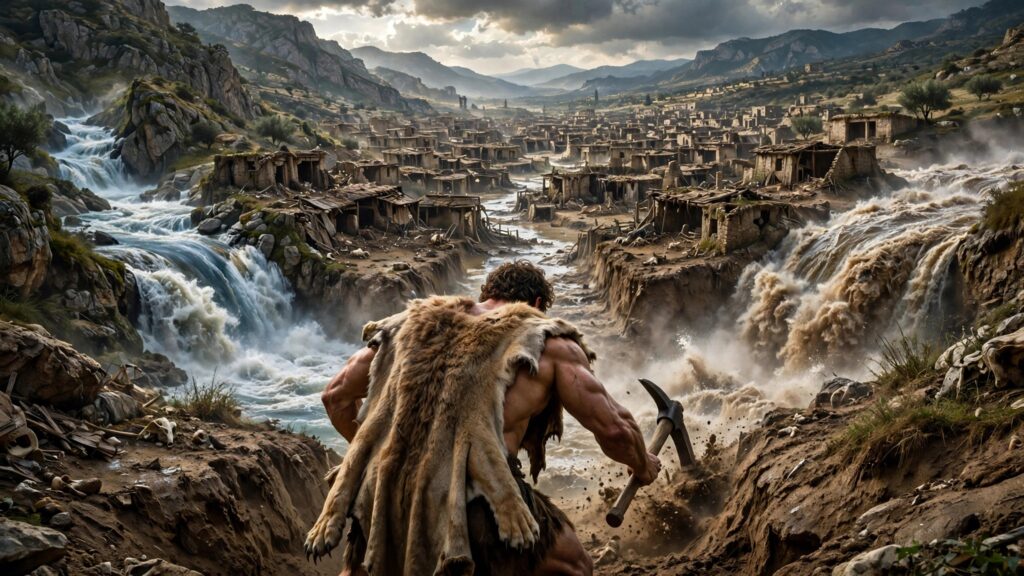
The Augean Stables presented a different kind of obstacle from the previous four: not a predator or a supernatural beast but an accumulated dysfunction of agricultural life. King Augeas had not cleaned his stables in thirty years. The scale of the resulting contamination had turned a functional farm into a public health catastrophe. Heracles diverted two rivers through the stables in a single day, completing in one afternoon what no organized labor could have achieved in decades. The engineering solution, redirecting existing waterways rather than manual cleaning, was the first labor to demonstrate explicitly what Diodorus Siculus was describing: Heracles as engineer rather than simply fighter. The labor was disqualified because Augeas had promised payment, turning it into a commercial transaction rather than a heroic service. Heracles would return to fight and kill Augeas later, completing the account in a way the original labor’s disqualification had left open.
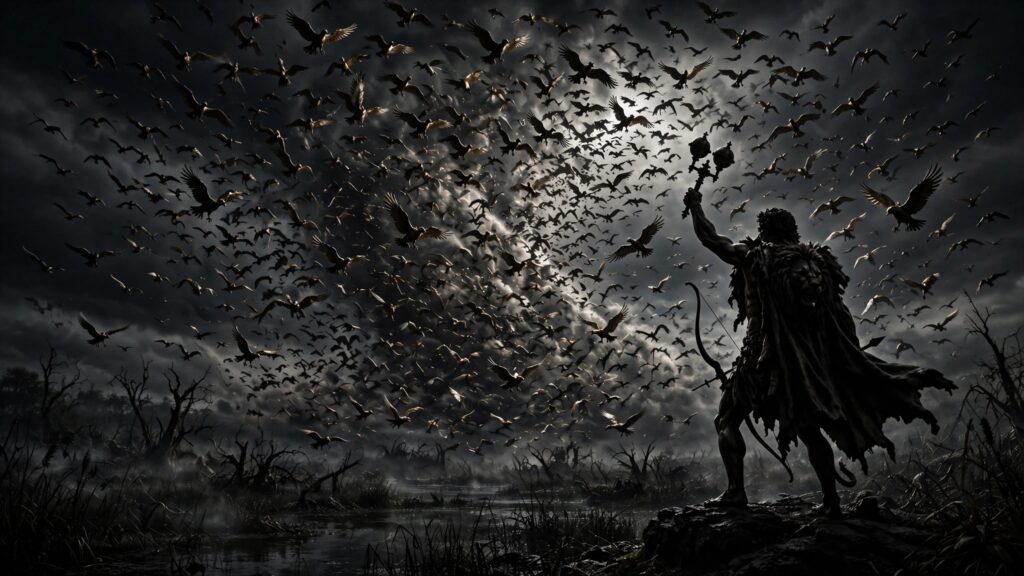
The Stymphalian Birds occupied the marshes of Lake Stymphalia in Arcadia, their bronze feathers functioning as weapons, their droppings toxic to crops, their population density sufficient to darken the sky above the lake. Heracles used a rattle made by Hephaestus to frighten them into flight and then shot them with his arrows as they rose. The labor that cleared the marshes for agriculture used technology, the divine craftsman’s rattle, alongside the hero’s own weapons, establishing a pattern that the outer ring of labors would develop further: the solving of the world’s problems required not simply strength but the full toolkit of divine and human capability working together.
The Second Ring | The Edges of the World
The second six labors move outward from the Peloponnese to the boundaries of the known world, and the geographical progression is deliberate. Each labor claims a further territory for the order that civilized life requires, moving from the Greek peninsula to Crete to Thrace to the Black Sea coast to the far western edge of the Mediterranean to the underworld itself.
The Cretan Bull, the same bull whose offspring had produced the Minotaur that Theseus would later kill, was brought back from Crete to the mainland alive, demonstrating Heracles’s reach across the sea and his ability to manage what a foreign king’s own handlers could not control. The bull was later released and made its way to Marathon, where it became the Marathonian Bull that Theseus eventually killed, connecting the two greatest heroes of the Greek tradition in a single animal’s biography.
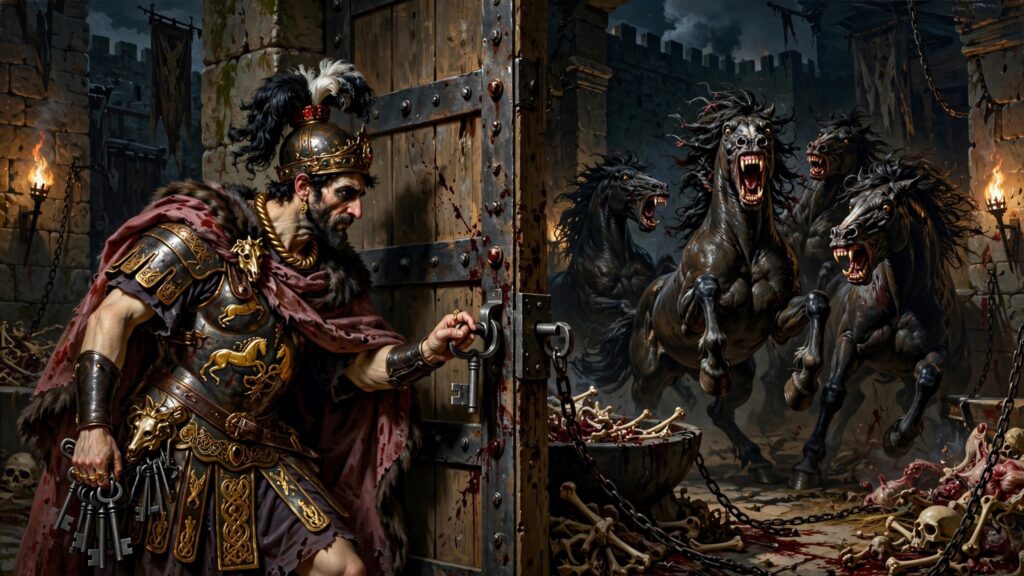
The Mares of Diomedes belonged to a Thracian king whose method of feeding his horses was a systematic horror that makes him one of the most efficiently monstrous human villains in the mythology: he fed them human flesh, and not just any flesh, but that of his own guests, the violation of xenia, sacred hospitality, taken to its logical extreme in a kingdom beyond the edge of the civilized world. Heracles fed Diomedes to his own horses, then drove the mares back to Eurystheus. The labor that cleared the Thracian coast of a king whose kingdom operated on the systematic destruction of the most fundamental social institution of the Greek world was not simply a feat of strength. It was the restoration of a moral order that Diomedes’s practice had suspended.
The Belt of Hippolyta, queen of the Amazons, was sought on behalf of Eurystheus’s daughter at the far edge of the Black Sea coast. The labor began without conflict: Hippolyta, impressed by Heracles, agreed to give him the belt voluntarily. Hera, disguised as an Amazon, spread the rumor that the strangers were plotting to kidnap the queen. The resulting battle killed Hippolyta and several of her warriors. The labor that should have been resolved through diplomatic gift-giving became instead a war, and Hera’s intervention, the same intervention that had shaped this story from the beginning, turned a peaceable resolution into a violent one. The belt was taken, but the manner of its taking is the labor that most clearly shows Hera’s continuing interference in the space between Heracles and the world he is trying to pacify.
The Cattle of Geryon required travel to the westernmost edge of the Mediterranean world. Geryon, a three-bodied giant whose herd of red cattle grazed on the island of Erytheia, identified with the far Atlantic coast near modern Cádiz, was killed after Heracles had already killed his herdsman and his two-headed dog. The journey to and from Erytheia included what is perhaps the most cosmologically significant act in the whole of Heracles’s story that is not technically a labor: the establishment of the Pillars of Heracles at the Strait of Gibraltar. The twin mountains that Heracles either separated or constructed as monuments at the western limit of the navigable world marked the boundary between the ordered Mediterranean and the Atlantic beyond it, the point beyond which Greek civilization had not yet established its order. The Pillars were the edge of the world as the Greek world understood it, and Heracles placed his name on them.

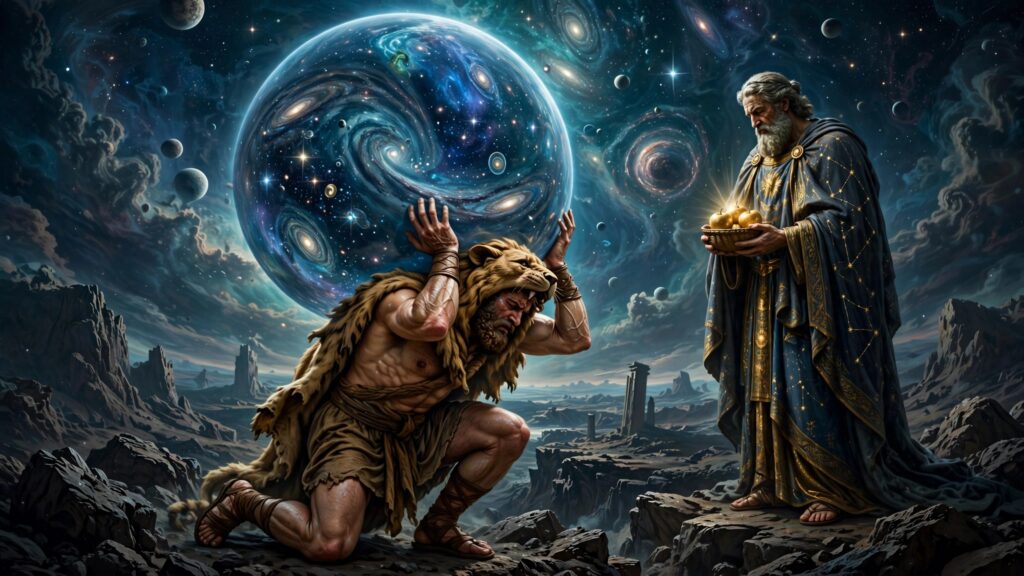
The Apples of the Hesperides required travel to the garden at the world’s northwestern edge where the golden apples grew, guarded by the dragon Ladon and tended by the nymphs who were daughters of the evening. The labor involved multiple adventures including the freeing of Prometheus from his rock, after which Prometheus told Heracles to send Atlas to fetch the apples rather than attempting to retrieve them himself. Atlas, who held the sky on his shoulders, agreed to fetch them if Heracles held the sky in his place. Heracles held the entire weight of the heavens while Atlas collected the apples. When Atlas returned and suggested that he might deliver the apples himself while Heracles continued holding the sky, Heracles agreed, then asked Atlas to take the sky back for just a moment while he adjusted his head-cloth. Atlas resumed the burden and Heracles took the apples and left. The trick is the only labor won by pure cunning rather than strength or endurance, and the apples, once delivered to Eurystheus, were returned to the garden: they could not remain in the mortal world, and Eurystheus knew it. The labor was its own journey, and the journey was the point.
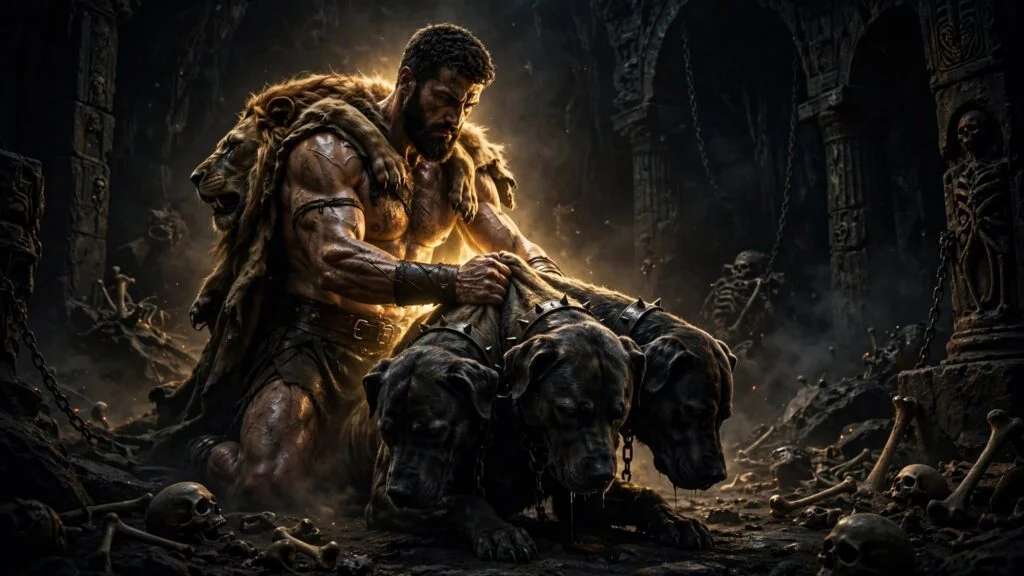
The Capture of Cerberus was the twelfth and final labor, and it was the descent into the underworld itself, the katabasis that this site has already examined as a mythological form in the essays on Orpheus and the Eleusinian Mysteries. Hades granted permission on the condition that Heracles use no weapons, only his bare hands and his body. Cerberus submitted to the grip of a being whose suffering had made him at home in the realm of the dead in a way no other living person could claim. He brought the dog to Eurystheus, who hid in his bronze jar at the sight of it, and then returned Cerberus to the underworld. The labor that completed the twelve was the one that required him to enter death’s own territory and leave it again, carrying the evidence of his presence as the only living being who had done so voluntarily and survived.
The two rings were complete. The Peloponnese was cleared of its monsters. The edges of the world had been reached, claimed, and marked. The underworld had been entered and exited. The civilizing project was finished.
What Diodorus Saw That Homer Didn’t
The Diodorus Siculus reading of Heracles as a civilizing general and engineer rather than simply a mythological hero is not a rationalizing of the myth into something more palatable to a skeptical historical audience. It is the recovery of something that the mythological tradition was encoding all along beneath its narrative surface, and that becomes legible when the geography of the twelve labors is read as a whole rather than as twelve separate episodes.
The first six labors clear the Peloponnese of obstacles to agricultural and civic life: a predator that made a valley unusable, a swamp that blocked a passage, a sacred animal that required diplomatic management rather than force, a boar that destroyed mountain farmland, thirty years of accumulated agricultural dysfunction, and a flock of toxic birds that had contaminated a marsh. When these six labors are finished, the Peloponnese is, in principle, safe for the kind of human civilization that the Greek world was building in the archaic and classical periods.
The second six labors push the boundaries of this cleared territory outward to every edge of the known world: Crete, Thrace, the Black Sea coast, the far west, the garden at the world’s edge, and the underworld below the world’s surface. When these six are finished, the entire known world, from the deepest underground to the Atlantic edge, has been entered by a representative of Greek civilized order and returned from successfully.
The Pillars of Heracles at Gibraltar are the monument to this completed project: the name of the hero placed at the boundary between the world that has been civilized and the world beyond, marking the limit of what has been done and the existence of what still lies beyond it. Every subsequent Greek and Phoenician and Roman sailor who passed through the Strait of Gibraltar sailed under the name of the hero who had established that this point was reachable and that civilized human life could extend to it.
Two Periods of Servitude, and a Fight with a God Between Them
After the twelve labors, Heracles served in this humiliated, purifying capacity a second time, and the crime that occasioned it was, in its own way, as unbearable as the first.
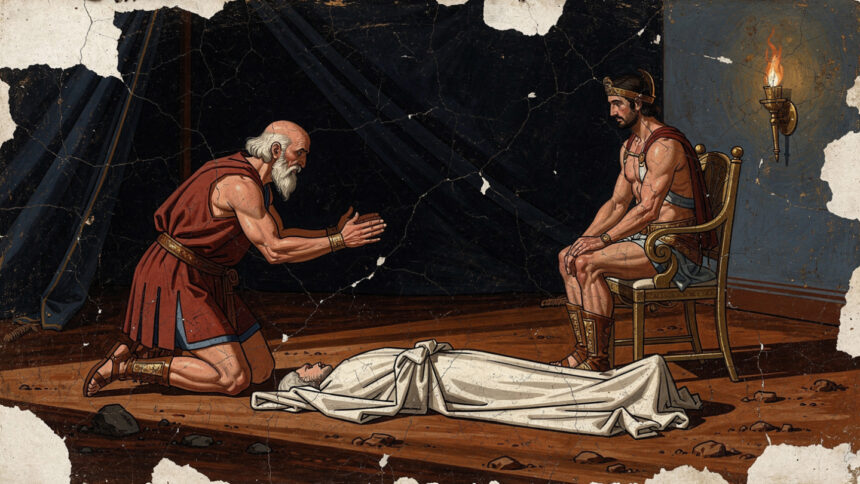
Iphitus had become Heracles’s closest friend, the one member of the royal house of Oechalia who did not turn against him after King Eurytus reneged on a promised marriage to his daughter Iole. When Iphitus later came searching for missing mares, mares Heracles had not in fact stolen, Hera struck him with the same madness that had destroyed his family years earlier, and Heracles threw his friend from the walls of Tiryns to his death. Two kings in succession, Neleus and Hippocoon, refused to purify him for the crime, and even after Deiphobus of Amyclae finally performed the ritual, Heracles was struck by a wasting illness the purification could not touch. He went to Delphi to ask the Pythia how to be free of it. She refused to answer him.
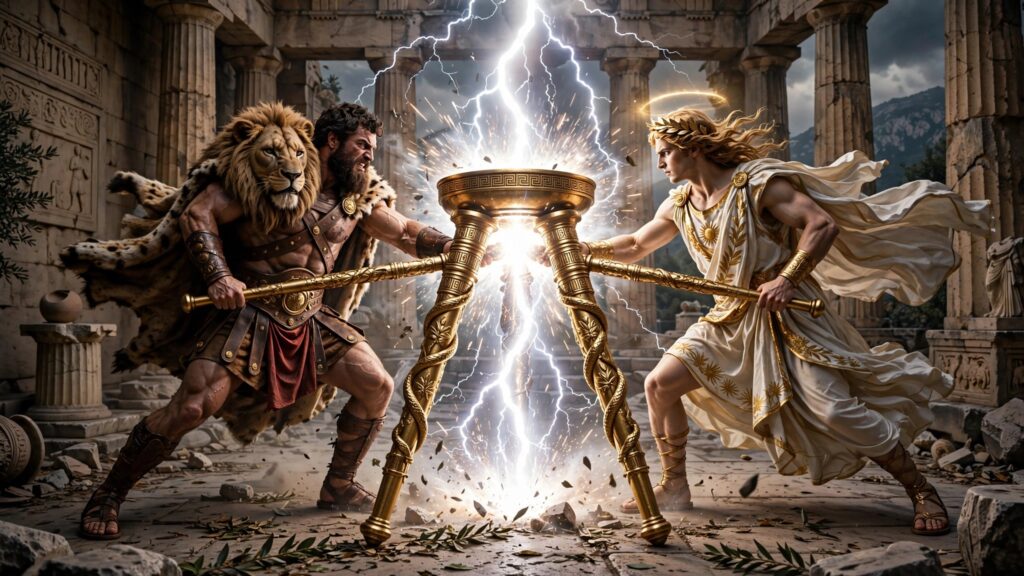
What happened next is one of the strangest and most revealing episodes in his whole biography. Heracles, refused an oracle, seized the sacred tripod from the sanctuary itself and announced that he would carry it off and found his own, a rival oracle answerable to no one but him. Apollo did not send an intermediary. He came himself, and the two grappled directly over the tripod, a god and a mortal hero locked in physical combat at the center of the most sacred site in Greece, until Zeus threw a thunderbolt between them to force the two apart. It is only after this violent separation, with neither side having won, that the Pythia finally speaks, and what she says is not a rebuke but a remedy: Heracles must be sold into slavery for a fixed term, his wages paid as compensation to the family of the man he killed.
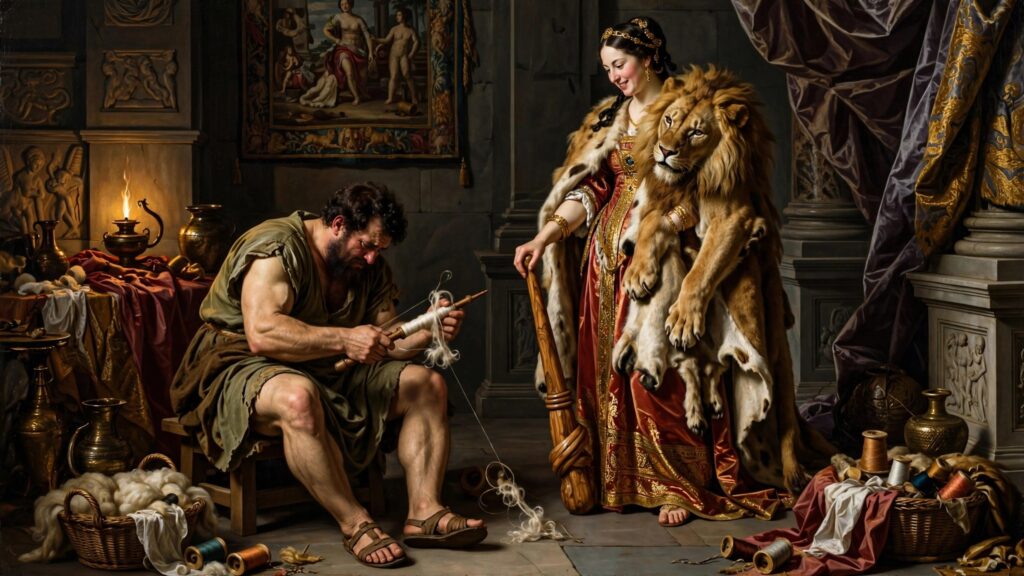
Hermes handled the sale. Heracles was bought by Omphale, queen of Lydia, who had inherited the throne from her late husband Tmolus, and he served her for the length of the sentence the oracle had set. Later tradition, more Roman than Greek in its earliest sources, elaborated the servitude into a full inversion of Heracles’s public identity: he spun wool and performed the domestic labor of the queen’s household while Omphale wore his lion skin and carried his club, an image that Renaissance and Baroque painters would return to again and again as the definitive picture of strength placed, deliberately, in service. Apollodorus’s own account is considerably drier and, in its own way, more interesting: even inside his servitude, unable to stop being who he was, Heracles kept working, capturing the troublesome Cercopes at Ephesus and killing the vineyard tyrant Syleus, still clearing the world of its obstacles even while technically owned by someone else.
There were, in the end, only two periods of servitude, not three, and the distinction matters. The confrontation with Apollo at Delphi was not itself a service. It was a fight, a genuinely violent clash between a god and the mortal hero he would, in every other context, be expected to favor, and its resolution by Zeus’s own direct intervention is the mythology’s way of marking just how volatile Heracles’s relationship to divine authority remained even at the edge of his own purification. He did not humbly accept the oracle’s silence. He tried to take the sacred function of prophecy for himself by force, and only a king of the gods physically separating him from another god could bring the confrontation to an end.
The servitude to Eurystheus and the servitude to Omphale bracket this entire second crisis: humiliation before a lesser man on one side of the story, humiliation before a foreign queen on the other, and in between them, unresolved and unrepeated, the one moment when Heracles’s anger turned not on a monster or a tyrant but on Apollo himself.
The Death He Built Himself
The mechanism of Heracles’s death is the mythology’s most precise statement about the cost of the apotheosis it was building toward, and it arrives not through any act of Hera’s but through a domestic tragedy that he could not have prevented and did not deserve.
Deianeira, the wife he had agreed to take while visiting the shade of Meleager in the underworld, sent him the shirt soaked in what she believed was a love charm: the blood of Nessus the centaur, who had told her it would bind Heracles to her permanently as the centaur was dying from one of Heracles’s own poisoned arrows. The poison in Nessus’s blood was the Hydra’s venom that Heracles had harvested at the second labor, the very resource he had taken from the one labor that Eurystheus had refused to count, the arrows whose power came from the source of the most recursive and most unresolvable problem in the entire twelve labors.
The shirt burned. The burning was so total and so unendurable that Heracles, who had strangled the Nemean Lion and held the weight of the sky and descended alive into the underworld, asked to be burned on a pyre rather than continue enduring what the shirt was doing to his body. He built the pyre himself on Mount Oeta. His companions refused to light it. He persuaded a passing shepherd named Poeas, or in some accounts Poeas’s son Philoctetes, to light it in exchange for his bow, the bow that had shot every arrow of every labor, whose poisoned tips had been the most consistent instrument of the civilizing project.
From the pyre, the clouds descended. Zeus took him up. Hera, in the end, received him.
The goddess who had sent serpents to his crib and driven him to madness and killed his children and interfered in every labor and driven him to kill his own dearest friend Iphitus and done everything in her power across his entire mortal biography to destroy him welcomed him, at his apotheosis, to the family he had been born into and systematically denied. He married her daughter Hebe. He became the divine doorkeeper, the hero-god who held both liturgical registers simultaneously because he had genuinely lived both.
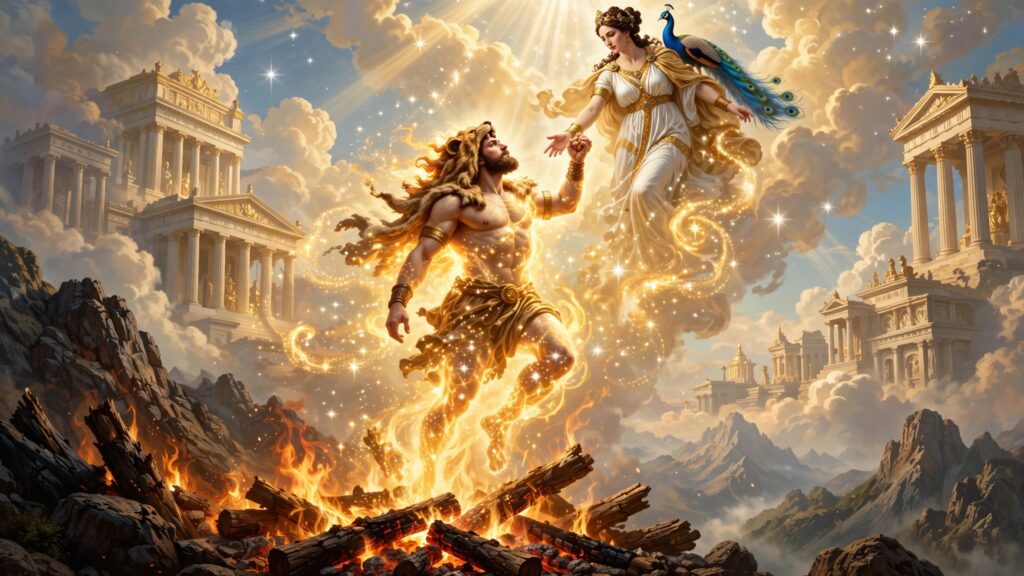
His name had always been her glory. At Olympus, finally, it was.
What the Stoics Built From His Story
The Stoic philosophical tradition, developed at Athens in the third century BCE and spread across the Hellenistic and Roman world, chose Heracles as its central mythological exemplar, and the choice was not arbitrary. The Stoics were interested in the relationship between virtue and suffering, and Heracles provided the most complete available mythological demonstration of the principle they were articulating: that virtue is not the absence of difficulty but the active, positive quality developed through managing difficulty without being destroyed by it.
The text known as the Choice of Heracles, attributed to the sophist Prodicus of Ceos and preserved for posterity only because Xenophon chose to record it in his Memorabilia as a story Socrates himself liked to tell, describes the young hero at a crossroads between two women: Pleasure, who offers the shortest route to apparent happiness, and Virtue, who offers the long, difficult path that produces the only honor that endures. Heracles chooses Virtue, and everything that follows, the labors, the servitudes, the fight with Apollo, the shirt, the pyre, is the working-out of what that choice actually entailed across a complete heroic biography.
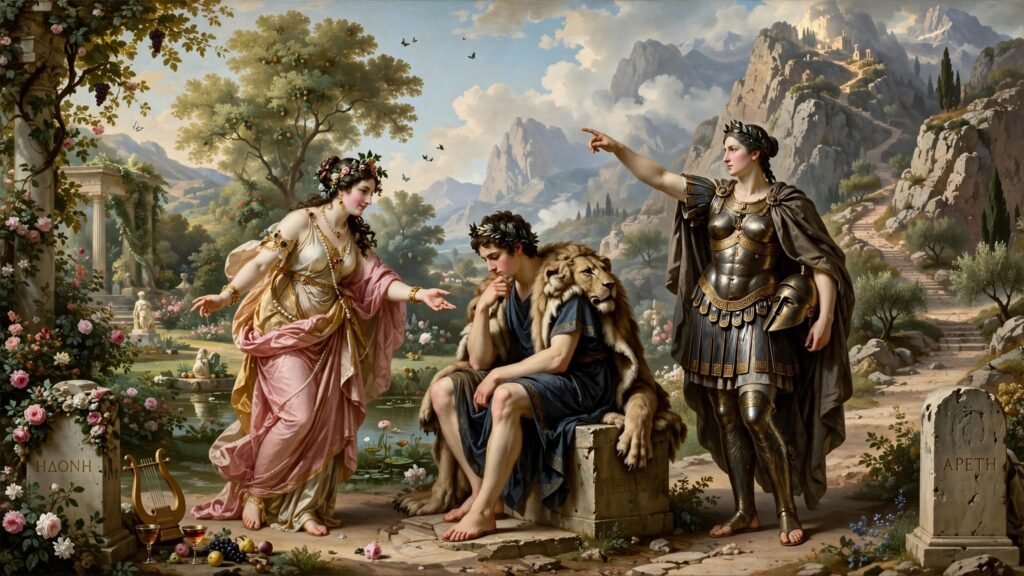
The Stoics read this choice as the paradigm for the philosophical life itself: the deliberate commitment to the difficult path, undertaken in full knowledge of what it costs, sustained through suffering that would destroy a less formed character, resulting in a kind of excellence that only the full experience of difficulty can produce. Heracles was their patron not because he was the strongest but because he was the most completely tested and because he passed every test while remaining, recognizably, the person the tests were conducted on.
Marcus Aurelius returned to Heracles repeatedly. Epictetus lectured on the Choice of Heracles. The Roman imperial cult of Hercules, which produced temples across every province of the empire, was not simply devotion to a strong man. It was the civic enshrinement of the Stoic argument that the path through difficulty rather than around it was the path that produced the kind of person a civilization needed at its center.
The Twelve Labors Carved in Stone at Olympia
The number twelve is so familiar from the mythology that it is easy to forget it needed, at some point, to be fixed. Ancient storytellers did not always agree on which deeds counted and which were simply adventures that happened to fall between them, and it is the Temple of Zeus at Olympia, built between roughly 470 and 456 BCE, that gives the canon its first and most authoritative physical form.
Twelve carved metopes, six crowning the entrance porch and six crowning the rear, ran in relief above the temple’s inner doors, each one a single labor rendered in Parian marble, the whole sequence visible to every athlete and pilgrim who passed beneath it on their way into the sanctuary that housed Pheidias’s own chryselephantine Zeus, the statue this site has already examined in its own right. Athena appears in four of the twelve scenes, a quiet, watchful presence beside the hero rather than a participant in the violence itself, her posture shifting from the comforting nearness of a protector in the earliest scenes to something closer to solemn recognition by the final ones, as if the sculptors themselves wanted the goddess’s own bearing to register just how much the hero beside her had endured by the time the sequence reached its end. In the first metope, showing the newly completed slaying of the Nemean Lion, Heracles is not shown triumphant. He is shown exhausted, his head resting on his own bent arm, the wrinkle of real fatigue carved into a face that still had eleven more labors ahead of it.
The choice of subject was not incidental to the site. Heracles was remembered in the Olympic tradition as the mythical founder of the Games themselves, the figure credited with measuring out the length of the original stadium track using his own feet, and the Temple of Zeus paired his sculpted labors with the pediment showing the chariot race of Pelops and Oinomaos, the other founding myth of the sanctuary, so that any athlete walking into the temple to see Pheidias’s Zeus passed first beneath two complementary accounts of what it had taken, in the deep mythic past, to make Olympia itself possible: a chariot race that founded the site, and a sequence of labors that made the wider world safe enough for such a site to matter. When the temple’s remains were finally excavated in the nineteenth century, first by a French expedition in 1829 that carried several of the metopes back to the Louvre, and then far more comprehensively by German archaeologists beginning in 1875, the sequence that emerged was not simply an illustration of a myth everyone already knew. It was very likely the moment the myth stopped being fluid and became fixed, the physical act of carving twelve chosen labors, in twelve individual panels, in stone, that helped settle what had previously been a looser, more variable body of story into the canonical Twelve that every subsequent telling, including this one, still counts by.
What the Whole Story Adds Up To
Read in full, the mythology of Heracles is the most ambitious philosophical argument the ancient world produced in narrative form about the relationship between suffering, purpose, and human potential.
The hero is named for his enemy before the first story begins. He is driven mad by that enemy and commits the worst act of his life without having chosen to commit it. He serves a lesser man for twelve years under conditions designed to humiliate as well as exhaust. He clears the Peloponnese of its monsters and then pushes the boundary of the civilized world to every edge of the known universe. He fights a god over a sacred tripod and is separated only by the king of the gods. He serves a foreign queen, spinning wool while she wears his lion skin. He descends into the underworld and returns with the proof. He holds the sky on his shoulders. He is burned alive by a shirt soaked in the blood of an enemy he killed years earlier with an arrow poisoned at a labor that was never officially counted. And from the pyre, he ascends.
The question the story asks, and asks with the full weight of every individual episode rather than abstractly, is whether what a person endures can produce something more than damage. Whether the accumulation of injustice and grief and impossible labor and servitude and madness and the guilt of crimes you did not commit can result, in a particular, irreplaceable person who has survived all of it, in something that could not have been achieved any other way.
The Greek world answered yes, and named the result Heracles, and built him sanctuaries across the entire Mediterranean, and argued about him in philosophy schools, and carved his labors on temple metopes in cold marble at the site of the games he was said to have founded, and called him hērōs theos, the hero who was also a god, because no single category was adequate for what the story had produced.
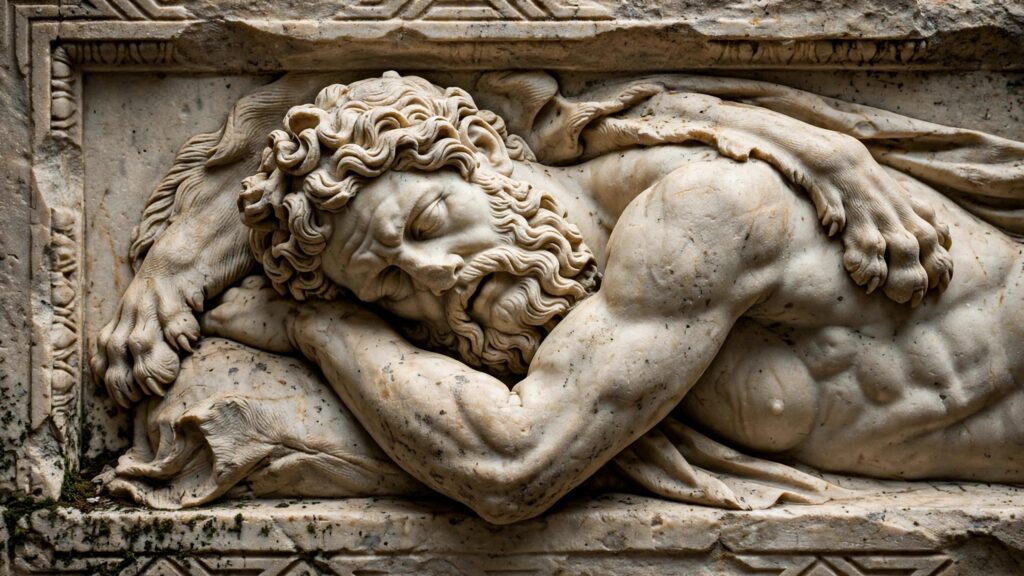
The civilizing project nearly killed its author. That was always the point.
At Olympus Estate, Tales from Olympus moves through the deeper currents of the Greek tradition. Heracles’s twelve labors were never twelve separate adventures. They were a single civilizing project, moving outward in two rings from the Peloponnese to the furthest edges of the known world, undertaken as purification for a madness Hera inflicted and a crime Heracles never chose to commit. He served two periods of humiliating servitude, to Eurystheus and to Omphale, and between them fought Apollo himself over a stolen tripod until Zeus separated them with a thunderbolt. He died from a poisoned shirt made from the same Hydra venom his own second labor had produced, built his own funeral pyre, and ascended from it to marry Hera’s own daughter. The Temple of Zeus at Olympia carved his twelve labors into marble in the fifth century BCE, fixing the count for every telling that followed, including this one. The civilizing project nearly killed its author. That was always the point.