




The Persians brought their own marble.
In 490 BCE, the Persian fleet that landed at Marathon carried in its holds a block of Parian marble intended for a purpose. The Persians were confident of victory. After the battle they planned to erect a trophy, a monument to their conquest of Attica, and they had brought the raw material with them from the island quarries rather than sourcing it locally. The marble was to be shaped into the record of their triumph, placed in the landscape of the people they had come to defeat.
They lost at Marathon.
The marble remained. The Athenians took it. They gave it to Pheidias, the greatest sculptor of the ancient world, who carved from it the cult statue of Nemesis for her sanctuary at Rhamnus in northeastern Attica: the goddess who stands for exactly what the Persians had embodied and exactly what their defeat had demonstrated, made from the stone they had carried for the monument that never existed.
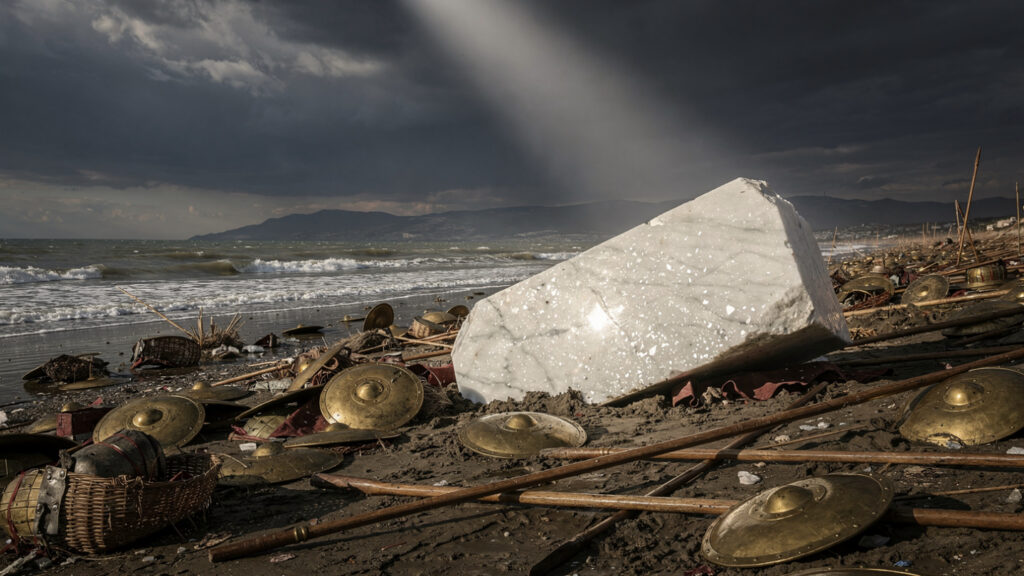
The material of anticipated triumph became the body of the goddess who ensures that anticipated triumph does not arrive intact. The Persians did not know they were carrying the marble for Nemesis’s statue. They were anyway.
What Her Name Says Before Anything Else
The word nemesis entered the English language carrying its narrowest available meaning: punishment, retribution, the thing that brings you down. This is accurate as far as it goes and misleading as far as it stops.
The Greek verb from which her name derives, nemein, means to distribute, to deal out, to apportion what is due. The Proto-Indo-European root nem- means to allot, to assign portions, to divide fairly. And this root did not produce only Nemesis. It spread through the ancient world’s vocabulary wherever human beings needed language for the act of apportionment.
Nem- yields the Greek nomos, meaning law and custom, the organizing principle by which a community assigns rights, territories, and obligations. A city’s nomos is not its rules in the modern bureaucratic sense. It is the agreed-upon distribution of how things stand among its people: who owns what, who owes what, who belongs where. The nomos is the community’s running account of correct apportionment.

The same root yields nomas, the nomad, a word that describes not a wanderer but a distributor of cattle across pastures, a person whose movement across territory is the act of assigning grazing land to the animals under their care. The nomad moves because distribution requires movement. Territory is apportioned through the act of traversal.
Nemesis is not, at the level of her name, primarily about punishment. She is about distribution: the force that ensures things are apportioned correctly, that excess in one direction produces correction in another, that the allocation of fortune and misfortune across human lives follows a structure rather than accumulating permanently at one pole.
Retribution is what happens when distribution has been violated. The punishment is not the primary function. It is the corrective mechanism that restores the distribution when someone has taken more than their portion allows.
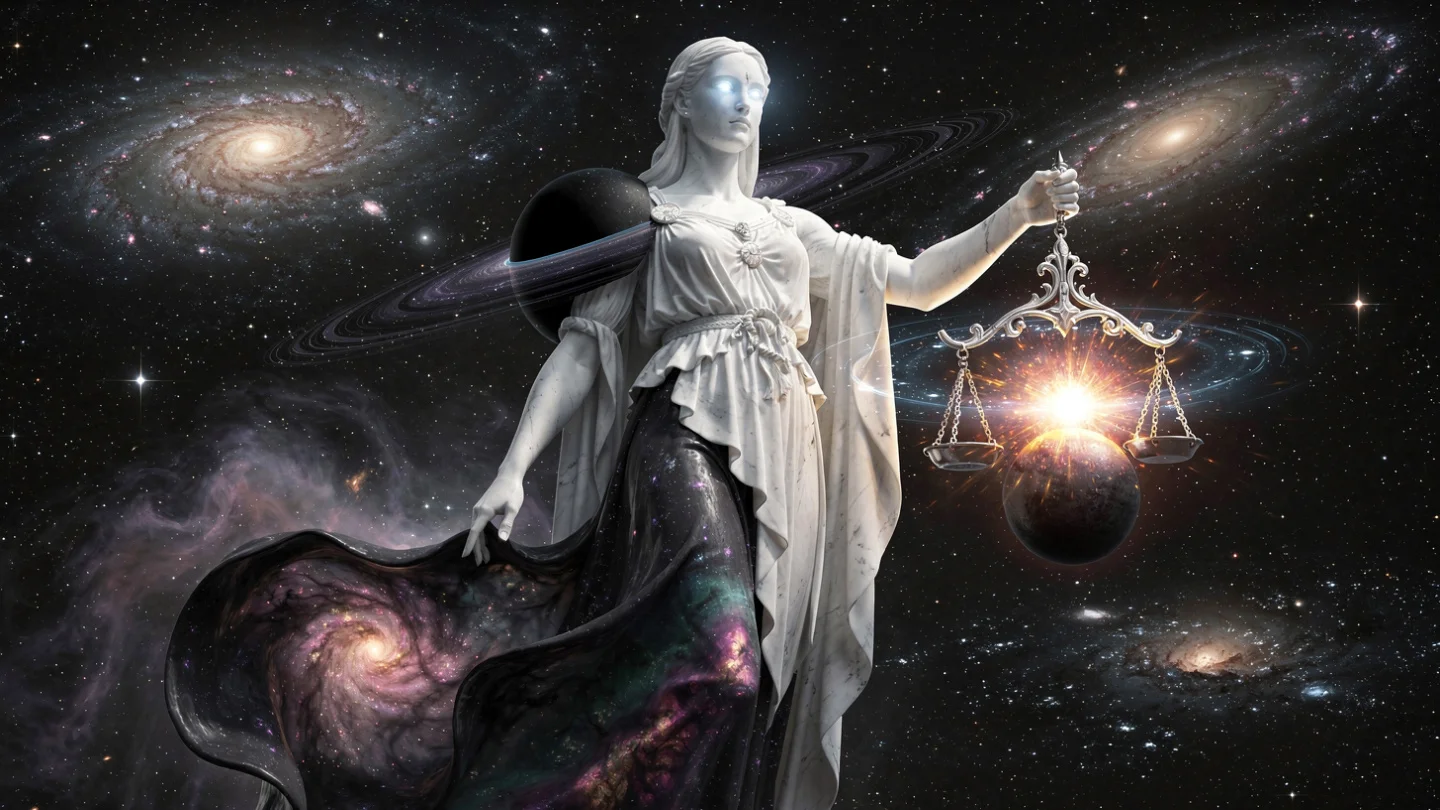
This linguistic inheritance makes Nemesis something far larger than the English word built from her name suggests. She is the goddess of nomos made active, the nomas of cosmic fortune. She is the principle that the ancient world embedded simultaneously in its laws, its pastoral economy, and its theology because the principle was the same in all three domains: things must be distributed correctly, excess must be corrected, and the correction follows as necessarily as the resolution of an imbalance.
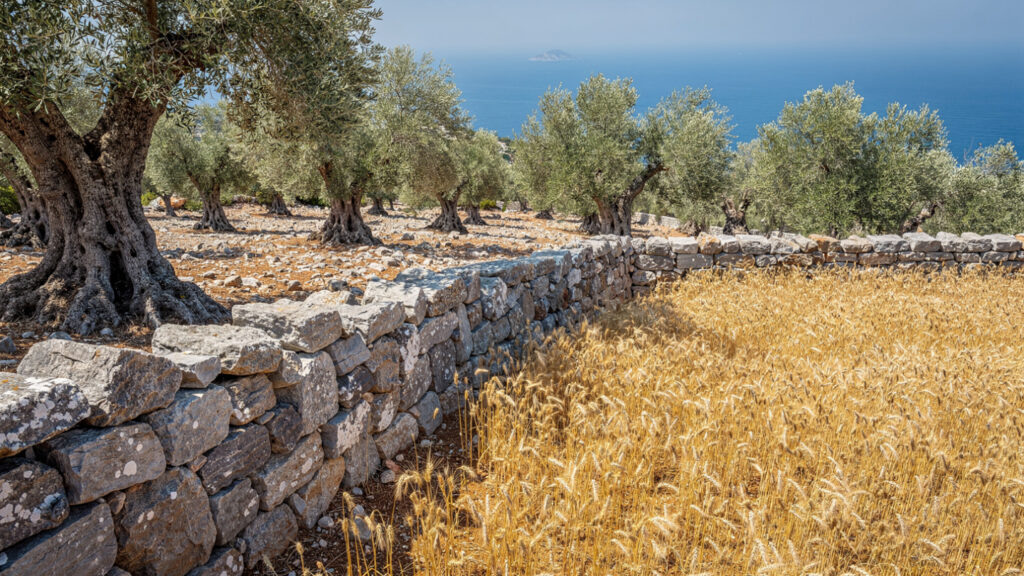
Hesiod places her among the children of Nyx, the night, born alongside the Moirai and Aidos, the goddess of modesty and shame. The genealogy is precise. Nemesis and Aidos are paired in Hesiod and in subsequent tradition as twin principles: one the internal sense of shame that prevents overreach before it occurs, the other the external correction that addresses overreach after it has occurred. The inner and the outer face of the same structural requirement: that human beings remain within what their portion allows.
In the Works and Days, Hesiod describes Aidos and Nemesis departing the earth together as the Iron Age deepens into its worst condition: when shame no longer restrains human behaviour from within and retribution can no longer correct it from without, the age has reached its final corruption. The departure of these two figures is not the departure of two gods. It is the departure of the conditions that make human community possible. When neither shame nor consequence operates, the social fabric has dissolved entirely.
Rhamnus | The Goddess Who Chose This Landscape
The sanctuary of Nemesis at Rhamnus sits in a deliberately isolated position: a district of northeastern Attica remote from the major centres of Athenian life, facing the Euboean strait, occupying a landscape that the ancient sources describe as lonely and separated from the ordinary traffic of the world.
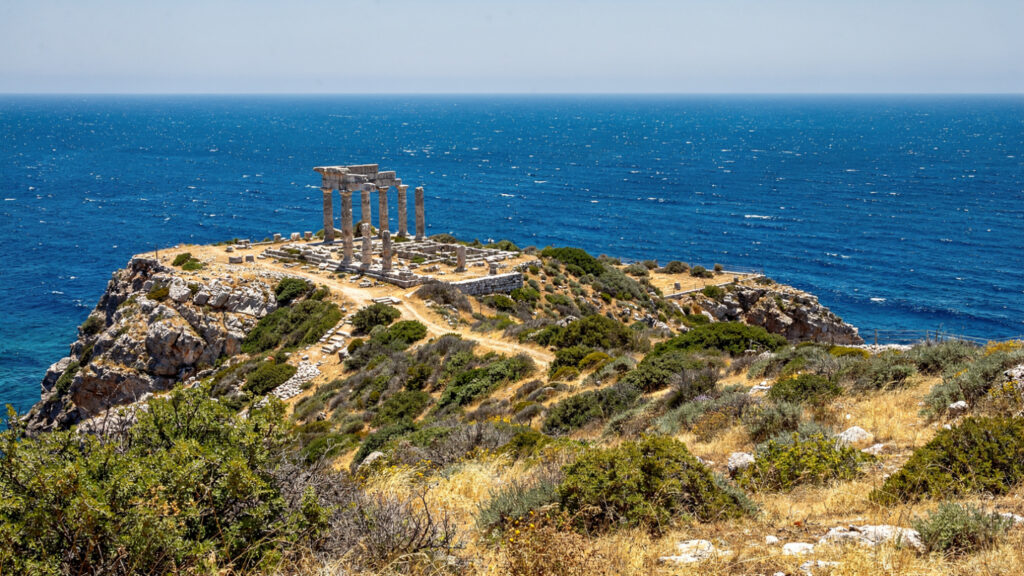
The isolation was appropriate. Nemesis does not operate in the busy centre of social life where Athena’s patronage and Hephaestus’s craft and the other Olympian functions are most visibly at work. She operates at the margin, in the space between what has accumulated and what the structure of the universe will eventually return to equilibrium. Her sanctuary was where you went when you needed to acknowledge the principle she embodied rather than petition for an outcome: there is no record of oracular function at Rhamnus, no dreams sent through incubation, no advice delivered to petitioners. The cult at Rhamnus was the cult of acknowledgement, the ritual recognition of the structural force that the sanctuary housed.
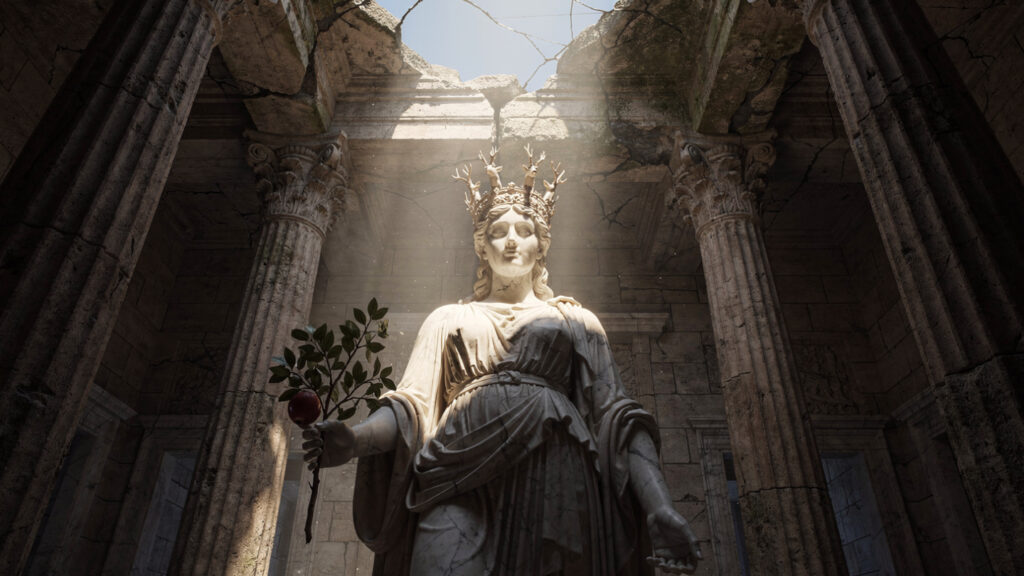
Pausanias, visiting in the second century CE, described the statue Pheidias had carved from the Persian marble. Nemesis stood wearing a crown decorated with stags and small figures of Victory. In her left hand she held an apple branch. At her feet, carved into the base of the statue, was a scene representing Helen being led to Nemesis by Leda. This iconographic detail connects Nemesis directly to the myth that made her the mother of the most beautiful woman in the world and therefore the originating force behind the most destructive war in Greek mythology.
The Persian marble had been brought to make a monument to conquest. It was shaped instead into the figure of the goddess who ensures that conquest does not escape its consequences. Around the base of that figure was carved the origin of the Trojan War, the event that demonstrated most completely in the entire mythological tradition that no military or personal triumph is immune from the structural correction that follows it.
Pheidias understood what he was making. The statue is a complete theological argument contained in stone.
Adrasteia | The Name That Cannot Be Escaped
Nemesis carried a second name, used especially in the context of the cult at Smyrna and in philosophical texts: Adrasteia, the inescapable.
The name derives from the Greek adrastos, not able to run away from, and its application to Nemesis specifies what the distribution principle means for the individual who has exceeded their portion.
You cannot escape the correction. Not through distance, not through time, not through the accumulation of further power, not through prayer to other deities. The correction follows necessarily from the violation the way that the resolution of a mathematical imbalance follows necessarily from the imbalance itself.
The mechanism is not personal. It is structural. Adrasteia does not chase you. She is the shape of what happens when excess exceeds what the structure permits.
The Stoics, who developed the most sophisticated philosophical account of cosmic order in the ancient world, understood Nemesis in precisely these terms. The passage preserved from their tradition describes her as the force that watches in the universe and lets no offense go unchastised: not watching in the sense of a surveillance deity waiting to observe and react, but watching in the sense of the structure being inherently self-correcting, the imbalance being inherently unstable, the correction being inherently necessary rather than contingently imposed.
Alexander the Great slept under a plane tree at the sanctuary of the Nemeseis in Smyrna, the city where the goddess was worshipped in her dual form. The goddesses appeared to him in a dream and told him to found a new city there, to move the Smyrnaians from their old location to a new one on Mount Pagos. He did. New Smyrna, the city Nemesis commanded in a dream delivered to the man who had conquered the known world, became one of the great cities of the Hellenistic world and endured for centuries.
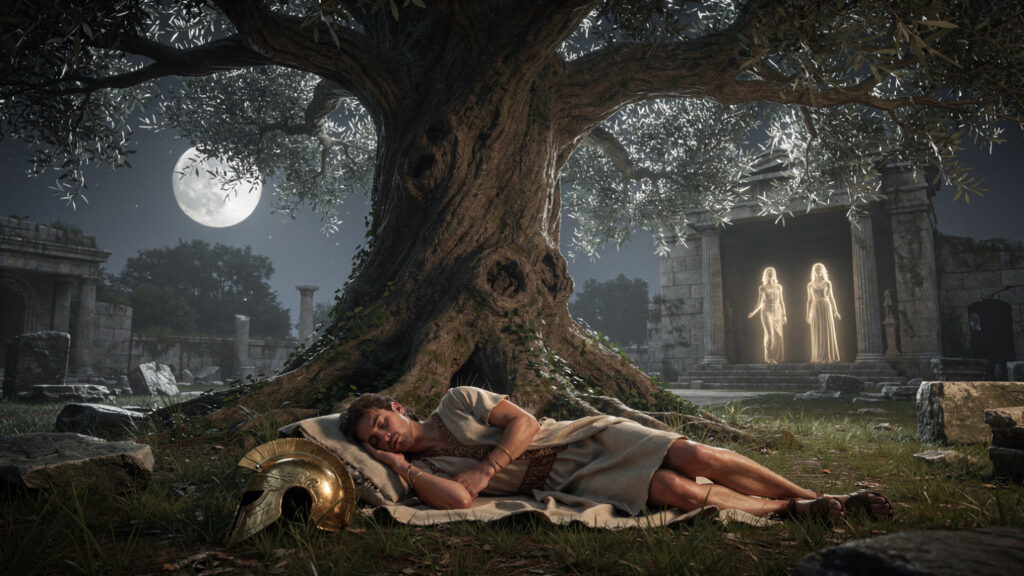
The detail has a quality worth attending to. Alexander was, by the time he slept at that sanctuary, the most powerful human being who had ever lived. The cities he had founded stretched from Egypt to the edge of India. The empire he commanded exceeded anything the ancient world had previously seen. He fell asleep at the sanctuary of the goddess whose principle is that no excess escapes its correction and received instructions. He followed them.
The Greeks found this entirely appropriate.
The Narcissus Problem
The myth that most completely illustrates Nemesis as a structural principle rather than a punishing deity is the myth of Narcissus, and the detail that matters most in it is the one that most retellings omit.
Modern psychology inherited the myth of Narcissus and built from it the clinical category of narcissism: the pathological orientation of the self toward its own image, the ego disorder that produces an inability to recognize others as fully real. In this reading, Narcissus is a case study in internal psychological malfunction. The flaw is located inside the individual. The correction, if it comes, must come from within.

The Greeks read the same myth with entirely different optics, and their reading is more precise.
Narcissus was beautiful and refused all who loved him. His beauty was real. His refusal was not malice. It was simply that he did not extend to others the recognition that they extended to him, that he received the world’s response to his beauty without returning any equivalent response to the world. He was not psychologically disordered. He was economically imbalanced. He was hoarding cosmic currency, absorbing admiration without distributing anything in return, accumulating a surplus of recognition that the structure of things requires to flow.
This is not an internal flaw. It is a logistics failure. The same failure as the Persian generals who carried conquest’s marble into a landscape that belonged to the people they planned to defeat. The same failure as any figure in the tradition who takes more than their portion of what the cosmos allocates and thereby creates an imbalance that the distribution principle must correct.
Where modern psychology places the fault inside the individual mind, the Greeks placed it in the ledger of exchange. Narcissus was not ill. He was in debt. And the cosmos, which keeps its accounts precisely, was about to present the bill.
The Echo myth, which precedes the pool in the full account, shows the structure clearly. Echo, punished by Hera for her talkativeness, could only repeat the final words of whatever was said to her. She fell in love with Narcissus. She could not initiate speech. She could only return to him the last words he spoke. She became, structurally, the mirror of his own voice: his words came back to him from outside himself. When he asked is anyone here and she answered here, he heard only the echo of himself.
Then at the pool he saw his reflection and fell in love with the face in the water, which gave him exactly what Echo had given him: his own image returned from outside himself, a face that gazed back at him with the intensity that he had never directed at anyone else.
Nemesis does not appear in the myth as an active agent imposing punishment. She is identified in some accounts as the one who led Narcissus to the pool, but the pool itself is the mechanism. The pool does not punish him. It gives him exactly what his behaviour had always demanded and never distributed: his own reflection, returned without modification.
The self that refused all relationship is given pure self-reflection and discovers that it is fatal. This is not punishment. This is the cosmic ledger made visible. The correction is not external to the violation. It is the violation completing its own logic.
Narcissus did not receive love from outside. He received exactly what he had been distributing: himself, reflected, unanswerable. The pool was the structure of things making visible what had always been true about the account he was running.
This interaction between the observer and the observed explains why the Greek tradition was so concerned with the management of the gaze. As explored in the Baskania/Mati tradition, the act of looking was never neutral. It was a projection of energy. When concentrated through envy or unreciprocated focus, it carried a physical charge capable of disrupting the cosmic balance that Nemesis serves to maintain.
Why She Came From Night
Hesiod’s placement of Nemesis among the children of Nyx deserves the same attention given to Nyx’s other offspring.
Nyx bore, in Hesiod’s account, the Moirai, the Fates. Thanatos, death. Hypnos, sleep. Nemesis. Aidos. And their various siblings. These are not a random collection of dark things. They are the forces that structure the framework within which the Olympian world operates. The Fates determine the boundaries of each mortal life. Death and Sleep mark the thresholds of consciousness. Nemesis and Aidos maintain the moral equilibrium that makes community possible.
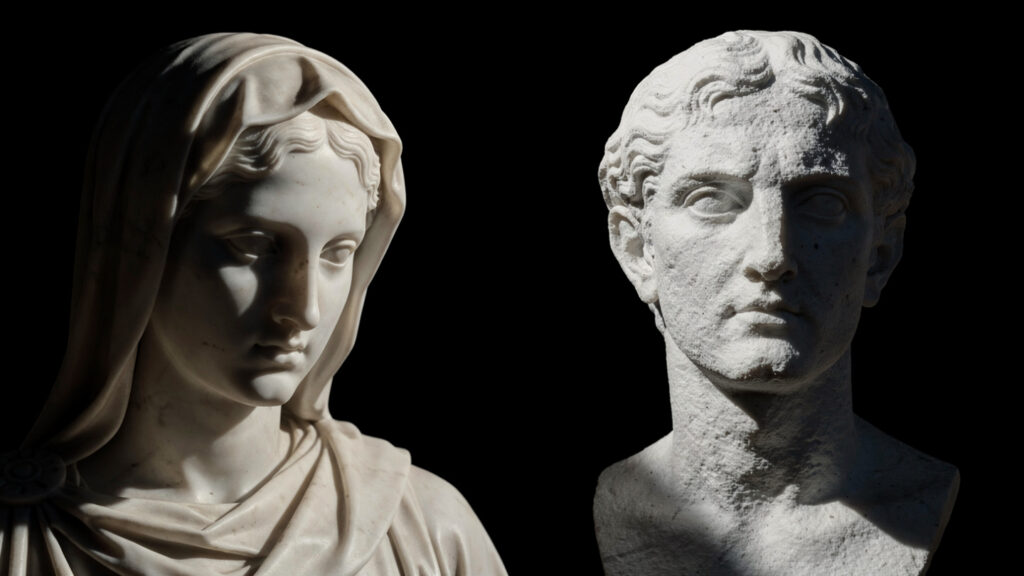
The primordial parentage of Nemesis in the children of Night is the tradition’s way of saying that the distribution principle she embodies is prior to the Olympian order rather than derived from it. Zeus does not decide when Nemesis acts. The correction she administers operates at a level that precedes divine authority in the same way that the Moirai’s threads precede Zeus’s decisions about mortal lives. When Zeus in the Iliad weighs fates on golden scales, he is reading the Moirai’s work. When a king or a hero or a Persian general exceeds their portion and the correction follows, Zeus is not imposing it.
Nemesis is doing what the structure of the cosmos requires, and Zeus’s authority operates within that structure rather than above it.
The genealogy connecting Nemesis to Nyx connects her to the same primordial cluster as the Moirai, and the connection is not incidental. Both are expressions of the same fundamental claim that Greek cosmology makes repeatedly in different vocabularies: that there is a structure to things that precedes authority, that legitimate power operates within this structure rather than overriding it, and that the most powerful beings in the cosmos are the ones wise enough to know this rather than the ones strong enough to test it.
The Persians tested it at Marathon. They brought their own marble.
What the Two Nemeseis Knew
At Smyrna, Nemesis was worshipped in her dual form: two goddesses, the Nemeseis, rather than one. The theological reasoning behind this duality, as Pausanias noted, was unclear even to the ancient commentators. The tradition preserved at Smyrna held that the mother of both was Nyx and that they operated as a pair rather than as a single force.
The duality may encode the same structure as the Narcissus myth: that the distribution principle operates in two directions simultaneously, that correcting excess in one place inevitably affects the distribution everywhere the excess was drawn from. A single force applied in one location would produce a simple and local correction. Two forces operating as a pair would maintain the equilibrium across the entire system, each correction rippling through the related balances rather than simply eliminating a violation.

Alexander slept at this dual sanctuary. He received instructions from both. The city he built at their direction, on the site of their combined presence, was named Smyrna and endured.
The most powerful conqueror of the ancient world, at a sanctuary of the goddess who embodies the principle that no conquest is permanent, received a commission. He built what the goddesses told him to build. The city lasted far longer than his empire.
This is not a diminishment of Alexander. The Greeks who told the story understood it as the fullest expression of his intelligence: that the man who conquered everything knew when to follow instructions from the force that ensures nothing is held forever. The city built at Nemesis’s direction outlasted the empire built by human ambition.
Adrasteia. The inescapable.
She was not inescapable because she was powerful. She was inescapable because she was structural. You cannot escape the shape of things.
At Olympus Estate, Mythic Essays moves through the deeper currents of the Greek tradition, from the Persian marble at Marathon to the pool where Narcissus discovered what he had always owed. Nemesis is not a goddess of punishment. She is the name the Greeks gave to the principle that the distribution of things tends toward equilibrium, and that the marble you carry for your triumph may become the statue of the force that made you lose.