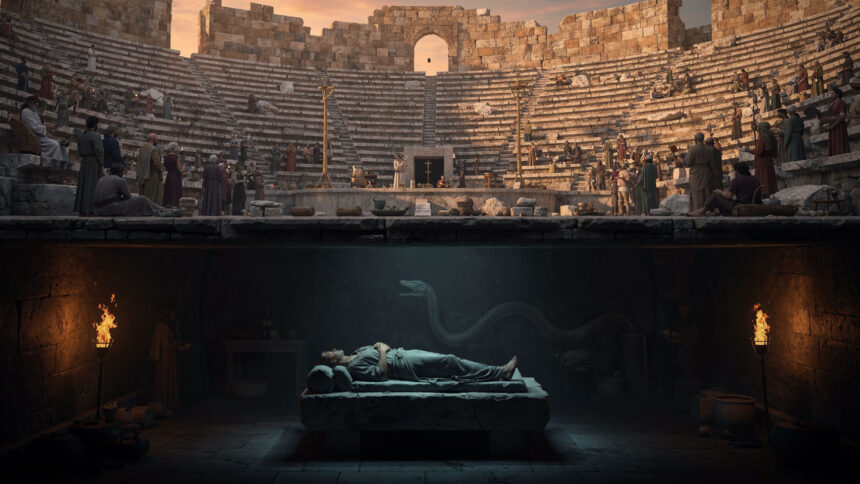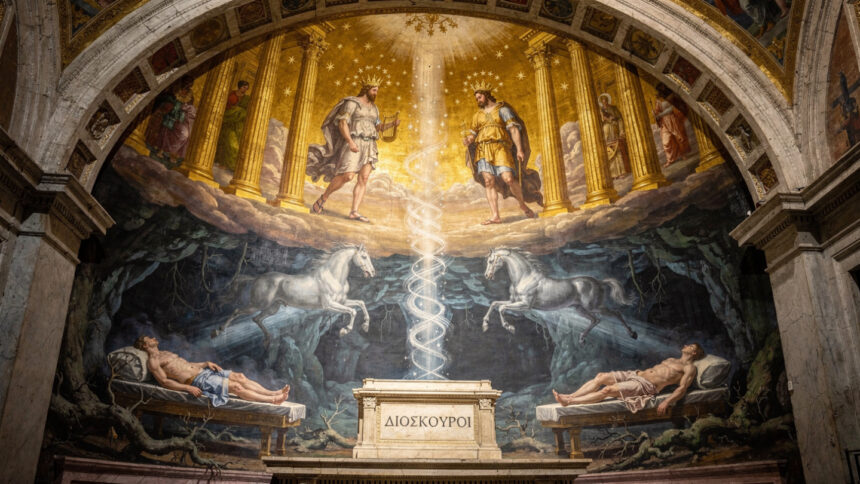






Before the gods, before the earth, before the sea, there was Eros.
Not the winged boy with the arrows that the Roman tradition gave to the Western imagination. Not the mischievous child who shot Dido and ruined Carthage’s queen or who tormented the Olympians with inconvenient desires. That later, more human Eros would eventually get his own complete story, the youngest of the great Greek myths, examined in full elsewhere on this site. Before any of these figures, there was the Eros of Hesiod’s Theogony: the primordial force that emerged from Chaos alongside Gaia and Tartaros in the first generation of beings, the force without which the cosmos could not have organized itself from the undifferentiated void.
Hesiod names Eros as the most beautiful among the immortals, the limb-loosener, the one who overcomes the mind and the intelligent thought of all gods and all humans. This is not a description of romantic love. It is a description of the cosmological force whose function was the function that made differentiation possible: the force that drew things toward each other, that made combinations rather than separations, that organized the chaotic potential of the void into the structured reality of the cosmos. Without Eros, Gaia and Ouranos would not have come together. Without that coming together, the Titans would not have been born, and without the Titans, the Olympians would not have been born, and without the Olympians, the divine order that governed the cosmos the ancient tradition inhabited would not have existed.
Eros in the Hesiodic tradition is not a character in love stories. Eros is the force without which love stories, and everything else, are impossible.
The Two Aphrodites
Aphrodite in the ancient tradition existed in two distinct theological registers whose incompatibility was acknowledged by the ancients themselves and whose content encodes two different understandings of what the force of erotic attraction was and where it came from.
The Hesiodic Aphrodite emerged from the sea foam that formed around the severed genitals of Ouranos after Kronos castrated him and threw the genitals into the sea. This is the mythological event that Hesiod describes with the particular explicitness of a poet who understood that the violence of the castration was inseparable from the character of the deity that the violence generated: the divine force of erotic attraction was born from the most extreme act of the cosmos’s productive violence, from the wounding of the sky god whose wound produced the foam from which the goddess emerged.
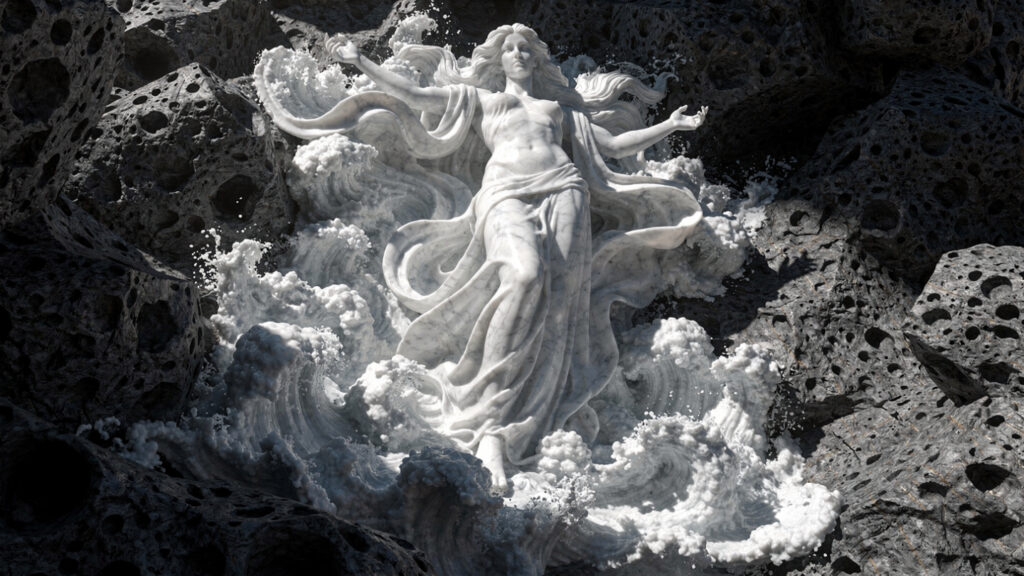
The name Aphrodite, from aphros meaning sea foam, is the name whose etymology the myth was designed to explain, and the quality of the Hesiodic Aphrodite that the birth story encodes is the quality of a force that predates the Olympian order and is not fully subordinate to it: she emerged from the foam before Zeus was born, before the Titan war was fought, before the Olympian order was established. She is older than the divine hierarchy that she inhabits, and the tension between the Olympian court’s attempt to accommodate and manage the erotic force and the erotic force’s tendency to operate outside the organized divine order’s control is the tension that the Hesiodic origin story sets up from the first moment of the goddess’s existence.
The Homeric Aphrodite is the daughter of Zeus and the Titaness Dione, a figure whose parentage places her fully within the Olympian genealogy and whose character reflects the position of a deity who has a place in the organized divine hierarchy rather than the position of a force older than the hierarchy. The Homeric Aphrodite is the deity who is wounded by Diomedes in the fifth book of the Iliad and who runs weeping to Zeus for comfort, who is mocked by Athena and Hera for abandoning the battlefield, whose vulnerability to the mockery of the other Olympians reflects her position as the force that the organized divine order must accommodate without fully respecting. She is important and she is undignified simultaneously, and the Homeric tradition’s comic treatment of Aphrodite in the Demodocus song about her affair with Ares in the Odyssey is the treatment of a deity whose domain is the domain that the organized divine order finds simultaneously necessary and embarrassing.
Plato’s Symposium, in the speech of Pausanias, articulated the distinction between the two Aphrodites explicitly, the Heavenly Aphrodite, Aphrodite Ourania, born from the sea foam without a mother as the Hesiodic tradition described, and the Common Aphrodite, Aphrodite Pandemos, born from Zeus and Dione as the Homeric tradition described. Pausanias used this distinction to argue for the theological distinction between two different forms of erotic love, the erotic that sought the beautiful and the good in the person and through the person in the eternal, and the erotic that sought the physical pleasure of the encounter without the transcendent dimension that the Heavenly Aphrodite’s love inspired.
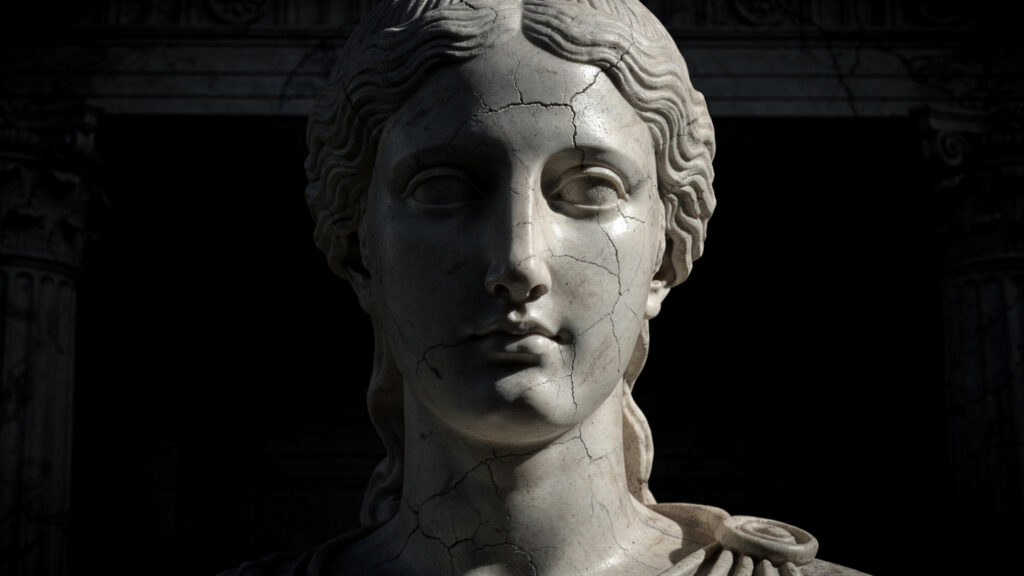
The Platonic tradition’s engagement with this distinction produced the most philosophically developed ancient account of what the erotic force was and what it was for, and the Aristophanes speech in the same dialogue, which the dining article in this collection develops through the myth of the spherical humans split apart and seeking reunion, is the comic poet’s contribution to the same philosophical question: the erotic desire is the desire for the restoration of a wholeness that preceded the division, the desire for the completeness that the cosmos had before the differentiation that organized it into the distinct beings who now move through it seeking each other.
The Cosmological Eros and the Platonic Transformation
The philosophical movement from the Hesiodic Eros as the primordial cosmological force to the Platonic Eros as the human experience of the desire for the beautiful and the good is among the most significant movements in the history of Western thought about love, and its character is the character of a philosophical tradition taking a cosmological concept and finding in it the structure for understanding the most intimate human experience.
In Plato’s Symposium, the speech of Socrates, which Socrates attributes to the wise woman Diotima of Mantinea, develops the most complete ancient account of what Eros is by developing the philosophical account of the erotic as the desire for the beautiful and through the beautiful for the good and through the good for the immortal. The ascent that Diotima describes, from the love of a beautiful body to the love of all beautiful bodies to the love of the beauty that is in souls to the love of the beauty that is in activities and laws to the love of the beauty that is in knowledge to the ultimate vision of beauty itself, is the ascent whose structure makes the erotic force the engine of the philosophical life: the person who loves the beautiful is the person who is being moved by the erotic force from the particular to the universal, from the beautiful body to the Form of Beauty that all beautiful things participate in and that none of them entirely is.

The Hesiodic Eros who drew the primordial beings toward each other and made the cosmos possible becomes, in the Platonic transformation, the force that draws the human being toward the beautiful and through the beautiful toward the good and through the good toward the immortal: the force that makes the philosophical life possible is the same force that made the cosmos possible, operating now in the medium of the human soul’s movement toward what is most fully real.
This is the cosmological seriousness that the Eros of the ancient Greek tradition carries and that the cherub of the Valentine’s Day card does not carry: the arrow that Eros shoots is not the arrow that makes one person desire another person. It is the force that draws the cosmos into organized existence, that draws the philosopher toward the truth, that draws the soul toward the immortal. The person who falls in love is the person who has encountered the Hesiodic cosmological force in the form that the human experience of the beautiful provides.
Kythera | The Island of the First Emergence
The island of Kythera, the southernmost of the Ionian islands lying off the southeastern tip of the Peloponnese at the point where the Ionian Sea meets the Aegean, is the island that the ancient tradition most consistently identified as the geographical location of Aphrodite’s emergence from the sea foam.
The choice of Kythera as the site of the divine emergence reflects the geographical identity of the island’s position. The island that lies at the crossing point between the Ionian and the Aegean, between the western and the eastern Mediterranean, at the confluence of sea currents and sea winds whose particular identity the seafaring tradition of the ancient Mediterranean designated as the meeting point of the seas, was the appropriate location for the emergence of the force whose identity was the force of the union of opposites, the bringing together of what the sea currents kept separate.
The Temple of Aphrodite at Kythera was among the most significant in the ancient world, described by the geographer Pausanias as the most sacred of all the temples of Aphrodite in Greece, and the sanctuary was among the earliest established in the Aphrodite cult tradition, predating many of the more famous Aphrodite sanctuaries of the classical period. The island’s position on the route between the Levant and the Greek mainland, on the sea route through which the Phoenician trading tradition had transmitted the Astarte cult that the Greek tradition absorbed into the Aphrodite cult, gave Kythera its identity as the point of transmission between the eastern Mediterranean divine feminine tradition and the Greek theological tradition that received and transformed it.
The Aphrodite of Kythera was Aphrodite Ourania, the heavenly Aphrodite of the Hesiodic tradition rather than the common Aphrodite of the Homeric one. The sanctuary was the sanctuary of the primordial force rather than the Olympian court deity, and the pilgrimage to Kythera was the pilgrimage to the site of the goddess’s emergence from the sea foam rather than to the temple of the structured cult’s institutional expression.
Today Kythera is among the least visited of the significant Ionian islands, and its character as the island whose significance was its ancient sacred geography rather than its commercial or strategic position gives it the quality of the place that was important for reasons that the contemporary tourist economy has not yet organized itself around. The island’s permanent population of approximately three thousand people, the combination of the deep gorge landscapes of the interior, the Venetian castle of Chora at the island’s highest point, and the quality of the coastline where the two seas meet, is the landscape whose character most directly expresses the theological tradition that the island’s ancient significance encoded.

The beach at Paleopoli on the island’s eastern coast, where the ancient tradition placed the site of Aphrodite’s emergence, is the beach whose character, the point where the sea approaches the low coastal plain whose gentle gradient suggests the mythological image of the goddess rising from the shallow water and approaching the shore, is the beach that the archaeological investigation has confirmed as the location of the ancient Aphrodite sanctuary: the excavations at the Paleopoli site have produced votive objects and architectural fragments whose character is consistent with the ancient literary descriptions of the sanctuary’s importance.
The Aphrodite Tradition Beyond Kythera
The alternative tradition placing Aphrodite’s birth at Paphos on the island of Cyprus reflects the ancient Cypriot claim to the goddess’s origin that the island’s long history as a major Aphrodite cult center supported. Cyprus was the island where the Astarte tradition from the Phoenician coast was most intensively present in the pre‑Greek Aegean world, and the continuity between the Phoenician Astarte cult of Paphos and the Greek Aphrodite cult that replaced it on the island gave the Cypriot tradition its claim to the goddess’s origin that the Kythera tradition could not entirely displace.
The Homeric tradition’s reference to Aphrodite in the Iliad as the Kyprian, the Cypriot one, is the Homeric acknowledgment of the Cypriot claim alongside the Kythera claim. The goddess had two birthplaces in the ancient tradition because the force she embodied had two distinct origins in the historical process of the Greek world’s engagement with the eastern Mediterranean religious tradition, and the ancient tradition preserved both rather than resolving the contradiction between them.

The Corinth Aphrodite tradition, developed through the Temple of Aphrodite on the Acrocorinth and the hetairai tradition, is the connection most directly recorded in the ancient sources as the expression of the Aphrodite cult’s institutional form in the most commercially significant Greek city of the archaic and classical periods. Corinth’s position as the crossroads city whose trade routes connected the Aegean and the Adriatic gave it the commercial identity that the hetairai represented, the educated and independent women whose social and intellectual function the Athenian philosophical tradition repeatedly engaged with as the most complete expression of the feminine intellectual capacity in the ancient Greek world, expressed in its most developed institutional form.
The Eros Tradition in the Lyric Poets
The literary tradition that most completely developed the Hesiodic cosmological Eros into the personal experience of the erotic as a force that acted on the human being from outside was the archaic lyric tradition, and the three poets whose engagement with the erotic force gives the tradition its most complete literary form were Sappho, Anacreon, and Ibycus.
Sappho’s engagement with Eros is the engagement that the Lesbos article in this collection mentions through the reference to the poet’s fragments and their survival: the fragments that survive give the experience of the erotic the quality of a force that operates on the experiencing person as a physical assault rather than a pleasurable state. The physiological description of the erotic experience in the fragment that Longinus preserved in On the Sublime, the flame under the skin, the blindness in the eyes, the roaring in the ears, the cold sweat, the pallor, the somatic symptoms of the erotic encounter with the beautiful person who is speaking with another person, is the description that most directly connects the personal erotic experience to the Hesiodic cosmological force: Sappho’s body is experiencing the physical manifestation of the force that drew the primordial beings toward each other and organized the cosmos from the void.

Ibycus’s description of Eros as coming upon him like the north wind in the winter, sweeping him from under the dark Cyprian thundercloud, shaking him to his roots with fire and darkness simultaneously, is the description whose meteorological imagery gives the erotic force the quality of the natural force that operates without regard for the subject’s readiness or preference: the north wind does not ask permission before it blows. Eros does not ask permission before it operates.
The quality of the archaic lyric tradition’s engagement with Eros is the quality of a literary tradition that interpreted the erotic as a force that arrived from outside and that operated on the human being in the manner that the Hesiodic cosmological force had always operated, as the attraction that drew differentiated beings toward each other, that loosened the limbs and overcame the mind, that made the organized individual temporarily subject to the force that had shaped the cosmos before the individual existed.
Visiting the Aphrodite Landscape
The Kythera visit requires the preparation of the visitor who arrives at a significant ancient site that the contemporary tourist infrastructure has not yet organized itself around. The island is accessible by ferry from Neapoli and from Piraeus, and by a small airport whose connections to Athens are maintained by the local air service. The road network is adequate and the island is manageable by rental car in a long day or by two days at a comfortable pace.
The Paleopoli site on the eastern coast is the archaeological location whose significance the visitor who has read the ancient sources will recognize immediately: the low coastal plain below the ancient settlement, the relationship between the beach and the sea and the slight height of the plateau above, and the quality of the light on the water at the point where the two seas meet, is the landscape that the ancient pilgrimage was approaching when it came to witness the site of the goddess’s emergence.
The Chora village at the island’s highest point, with its Venetian castle and its combination of the island architecture and the panoramic view across both the Ionian and the Aegean, is the base for the island’s exploration: the quality of Kythera from this height, the island surrounded by both seas simultaneously visible, is the visual expression of the geographical character that made Kythera the appropriate location for the emergence of the force whose nature was the union of opposites.
The Milopotamos cave system in the island’s interior, the cave complex whose character as the enclosed underground water world that the island landscape produces through the dissolution of the limestone, is the site that the visitor who wants the experience of the ancient chthonic dimension of the Aphrodite tradition, the dimension that the sea foam emergence myth connects to the violence of Ouranos’s wounding and the blood and the sea combining, encounters most directly.

For the visitor who wants to develop the full arc of the Aphrodite tradition from Kythera across the Aegean, the progression from Kythera to Corinth and from Corinth to the Athenian Agora where the ancient Aphrodite sanctuary occupied the position in the civic landscape that gave the force of the erotic its relationship to the philosophical and commercial life of the city, is the progression that gives the goddess’s tradition its complete geographical expression in the Greek world.
At Olympus Estate, Mythic Essays moves through the deeper currents of the Greek tradition. Hesiod placed Eros before the gods as the force without which the cosmos could not organize itself from the void. Aphrodite emerged from the sea foam of the castrated sky god before Zeus was born. The Platonic Symposium’s Diotima told Socrates that the erotic was the force that drew the soul from the beautiful body toward the beautiful itself toward the good toward the immortal. Sappho’s body felt the physical manifestation of the cosmological force when she saw the person she desired speaking with another person. Kythera is the island where the goddess emerged from the two seas meeting. The ancient pilgrims went there. The contemporary tourist industry has not yet fully organized itself around it. Go before it does.