


The mosaic at Ravenna is still there.
In the apse of the Basilica of San Vitale, completed in 547 CE, one year before Theodora’s death, the empress stands in the procession mosaic on the south wall facing her husband Justinian on the north wall. She wears the imperial purple and a crown of jewels and pearls. The halo of the sanctified encircles her head. The Magi, the three wise men who followed the star to Bethlehem, are embroidered on the hem of her robe in gold: the detail that connects the empress whose origins the historian Procopius described with contemptuous precision to the most sacred narrative of the Christian tradition she had spent her life serving.
The San Vitale mosaic was made while Theodora was alive, which means she approved its iconography. The halo, the Magi, the purple: these were the claims the empress was making about herself in the medium of the imperial court’s most permanent visual language. She had been born the daughter of a circus bear trainer. She had worked as a mime and an actress and by Procopius’s account in considerably less reputable capacities during the years of her early adulthood. She had traveled to Alexandria destitute and returned transformed. She had married the heir to the Byzantine Empire, stood in the Senate chamber when the empire was collapsing around her, and by the force of a single speech prevented the emperor’s flight and saved the dynasty.
The mosaic is making all of this simultaneously present in the figure of the jeweled woman with the halo and the Magi on her hem. Byzantine sacred art does not depict what people were. It depicts what they had become. The Ravenna mosaic is Theodora’s claim about what she had become. The evidence that the claim was recognized is the mosaic’s survival intact for fifteen centuries.
The Sources and Their Limitations
Any account of Theodora’s life must begin with the problem of the sources, because the primary contemporary source for the most discussed dimensions of her biography is a text whose character as evidence requires careful handling.
Procopius of Caesarea was the official historian of Justinian’s reign, the author of the Buildings and the Wars that constitute the most complete surviving contemporary account of the sixth century Byzantine Empire. He was also the author of the Historia Arcana, the Secret History, a text that circulated privately during his lifetime and that was not published until after his death, which contains a systematic account of the vices and crimes of Justinian, Theodora, Belisarius, and Belisarius’s wife Antonina that is among the most virulent character assassination documents to survive from the ancient world.
The Secret History’s account of Theodora’s early life, which is the source for the details of her theatrical career and her sexual history that the subsequent biographical tradition has transmitted, was written by a man who had spent his career in proximity to the imperial court, who held views about the emperor and empress that he could not express publicly during their lifetimes, and who compiled the Secret History as the private record of everything he believed about them that the official account could not contain.
This does not mean the Secret History is simply false. Procopius knew things about the imperial couple that the official sources did not record, and some of the administrative and political details he provides have been corroborated by independent evidence. But it does mean that the details of Theodora’s early biography, the theatrical performances, the sexual career, the episodes that Procopius narrates with particular relish, were written by a hostile witness who had reasons for presenting the worst possible account of the empress, and that the details cannot be accepted as simply factual without the acknowledgment that the source is doing something other than straightforward historical reporting.
What can be said with reasonable confidence is this: Theodora came from the circus world of Constantinople, the demimonde of the Byzantine capital’s entertainment and performance culture, which occupied a marginal and disreputable social position in the Byzantine social hierarchy. She was an actress and mime at minimum. She traveled to the eastern Mediterranean, spent time in Alexandria, and returned to Constantinople transformed in some fashion that contemporaries recognized as genuine. She met Justinian, became his consort and then his wife, and as empress demonstrated the combination of political intelligence, personal courage, and theological sophistication that the historical record of her reign consistently documents.
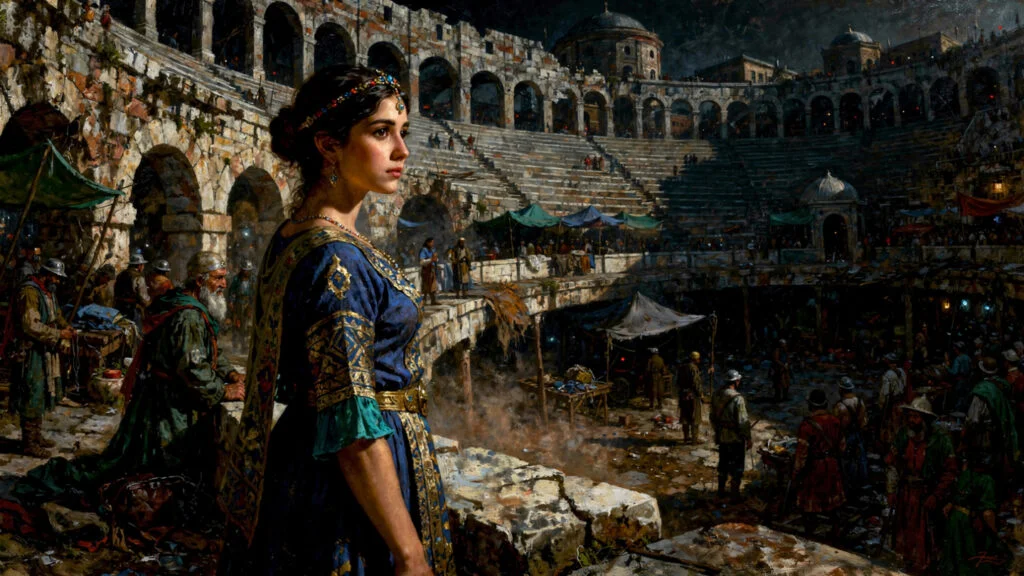
The details that Procopius supplies about the nature and extent of her pre-conversion activities are the details most likely to be embellished by hostility. The transformation itself, and the qualities of the woman who emerged from it, are documented by sources that had no reason to flatter her.
The Circus World and Its Social Position
The Byzantine circus, the hippodrome and the entertainment culture that surrounded it, was the social world into which Theodora was born and in which she grew up, and understanding that world is understanding the nature of the transformation she underwent and the magnitude of the distance she crossed.
The hippodrome of Constantinople was the largest entertainment venue in the city, seating approximately 100,000 spectators, and the center of the social world of the entertainers who performed in and around it: the chariot racers, the beast handlers including Theodora’s father who worked with bears, the mimes and actresses, the prostitutes and courtesans who operated in the entertainment economy surrounding the hippodrome’s events. This world was organized by the two great racing factions, the Blues and the Greens, whose rivalry organized not only the chariot racing but the entertainment and social life of the Byzantine capital in the way that the great football clubs of contemporary Europe organize the social life of their cities.
The social status of the people who worked in this world was specifically low in the Byzantine social hierarchy: the entertainers, the actors, the mimes, and the women who worked in the prostitution economy surrounding the hippodrome were in the category of the infames, the legally dishonored, who were excluded from certain civic capacities and from the rights that full Roman and Byzantine citizenship conferred. The law that Justinian amended to permit his marriage to Theodora was the law that prohibited marriage between aristocrats and women from this category.
Theodora’s mother, after the death of Theodora’s father Acacius, remarried within the circus world and presented her daughters to the two factions seeking patronage: the Green faction refused and the Blue faction accepted, which is the origin of Theodora’s lifelong association with the Blues and the political implications of that association for the Nike uprising. The circus world’s factions were the organized social networks through which the entertainment demimonde navigated Constantinople’s civic life.
Alexandria and the Transformation
The Alexandrian encounter that Procopius mentions only in passing and that the hagiographical tradition develops in greater detail is the episode that the historical record cannot document with precision. Yet it is the episode that the biographical tradition has consistently treated as the turning point of Theodora’s life.
What can be established is the setting. Alexandria in the early sixth century was the most intellectually and theologically active city in the eastern Mediterranean, the center of the Miaphysite theology that Theodora would later defend as empress, and the home of one of the most sophisticated Christian intellectual communities of the period. The figures named as her interlocutors, Patriarch Timothy IV of Alexandria and Severus of Antioch, who was living in exile there, were real historical actors of considerable theological importance. Timothy IV served as the Miaphysite patriarch of Alexandria from 517 to 535. Severus of Antioch was the leading Miaphysite theologian of his generation, driven from the patriarchate of Antioch by the Chalcedonian imperial authorities.
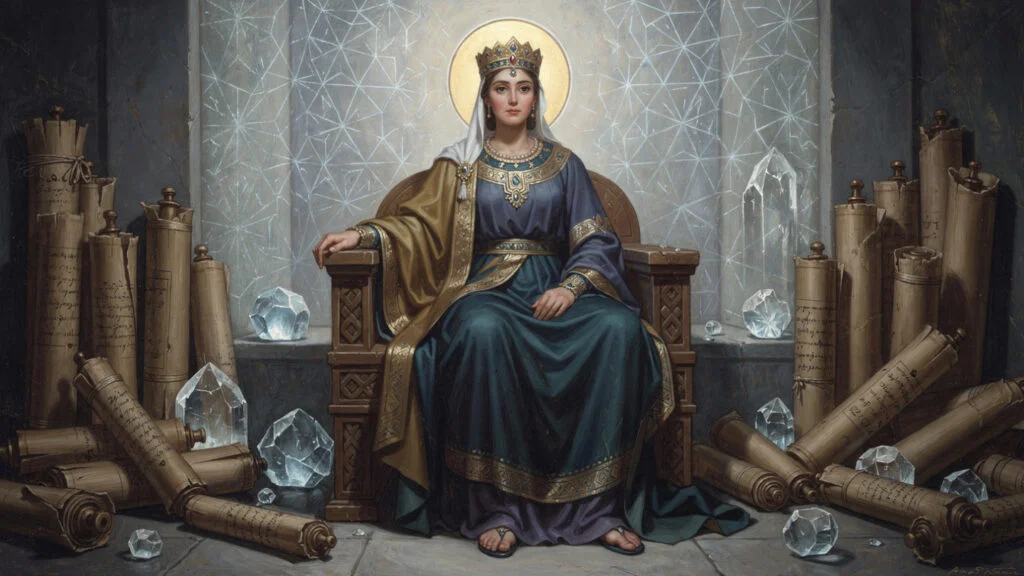
Whether Theodora actually met the figures the tradition associates with her time in Alexandria, or whether later storytellers placed her theological commitments inside the familiar shape of an Alexandrian conversion narrative, is something the evidence cannot settle. What the biographical record consistently affirms, and what the history of her reign confirms, is that she returned from Alexandria with a theological orientation and a moral seriousness that were genuine and lasting rather than performed for effect.
The needlework she undertook on her return to Constantinople, the domestic and respectable occupation that replaced whatever she had been doing before, is the biographical detail that marks the transformation as having practical consequences in the shape of her daily life rather than being simply a change in self-understanding. She supported herself by a craft rather than by the entertainment economy that had supported her before.
Justinian and the Marriage
Justinian was the nephew of the Emperor Justin I, and by the 520s he was the effective power behind his uncle’s throne and the anticipated successor. He met Theodora in the period of her post-Alexandrian respectability, when she was known in Constantinople as an intelligent, witty, and now reputable figure who had visibly transformed her life.
The relationship between them was by all accounts a genuine partnership rather than a simple patron-client arrangement or a political convenience. Justinian amended the law that prohibited his marriage to a woman of Theodora’s category not because the marriage was politically advantageous, which it manifestly was not, but because he wanted to marry her and the law prevented it. The political disadvantage of the marriage to the court and to the empress Euphemia, who opposed it vigorously until her death, was real and was accepted.
After the wedding in 525 CE and after Justinian’s accession as emperor in 527 CE, the formal structure of the imperial partnership was unusual for Byzantine practice: Theodora was given the imperial title and the legal powers that made her a co-ruler rather than simply a consort. Legislation was issued in both their names. Petitions were addressed to both of them. The Ravenna mosaic’s bilateral structure, emperor and empress in equal panels on opposite walls, is the visual expression of the formal equality that the legal and administrative record documents.
The administrative arrangement that Procopius describes, in which Justinian and Theodora cultivated opposing public positions on theological and political questions to ensure that whatever the outcome they would have influence over the winning side, is an interpretation that may reflect Procopius’s suspicious reading of what was in fact genuine disagreement between two strong-willed people who had arrived at different conclusions. Theodora was a committed Miaphysite. Justinian held a more complicated and shifting theological position. That their disagreement was genuine rather than coordinated is at least as plausible as the coordination theory.
The Nike Uprising and the Speech
The Nike uprising of January 532 CE was the most serious political crisis of Justinian’s reign and the crisis whose resolution most completely demonstrated the character of Theodora’s contribution to the imperial partnership.
The uprising began in the hippodrome as a conflict between the Blue and Green factions and expanded into a general revolt against the government, drawing in the senatorial opposition to Justinian’s fiscal and administrative policies. Over five days the rioters burned the Hagia Sophia, the Chalke gate, the baths of Zeuxippos, and large sections of the city center. The death toll was substantial and the damage was catastrophic. By the fifth day, Justinian was in the imperial palace with his generals and courtiers, and the discussion was about flight.
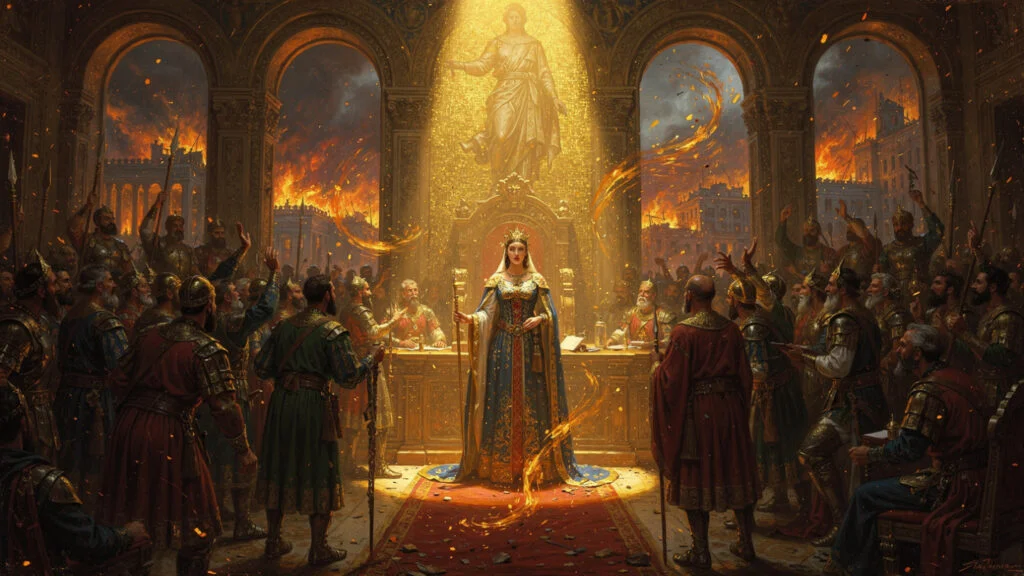
The speech that Theodora delivered in the imperial council chamber at this moment is preserved in Procopius’s Wars, which is the official historical account, not the hostile Secret History, which gives it a different evidentiary status from the Secret History’s narratives. The words that Procopius attributes to her have the character of a paraphrase rather than a verbatim transcript, since Byzantine historians did not typically transcribe speeches word for word but reconstructed them from memory and from the rhetorical conventions of the tradition. The sentiment attributed to her, that the purple is the finest shroud and that she will not leave Constantinople alive if leaving means leaving the throne, is consistent with the outcome: she did not leave, Justinian did not leave, the generals were galvanized, Narses and Belisarius organized the military response, and the rioters were killed in the hippodrome in numbers that Procopius places at approximately 30,000.
The contribution of the speech was the contribution that the administrative record of Theodora’s reign consistently documents: the capacity to hold a position when everyone around her was recommending retreat, the combination of courage and calculation that could read a crisis and respond to it with the clarity that the crisis required. Whether the speech was exactly what Procopius reports or whether Procopius was giving Theodora credit for a position that the council collectively reached is a question the sources do not resolve. What the sources agree on is that Justinian did not flee, and that the empire survived.
The Theological Commitments
Theodora’s Miaphysite theology was the most significant political dimension of her reign and the dimension whose long-term consequences for the Byzantine Empire’s relationship with the eastern Christian communities were most enduring.
The Miaphysite position, which maintained that Christ had a single nature that was simultaneously divine and human rather than the two natures that the Council of Chalcedon in 451 CE had defined as orthodox, was the theology of the Egyptian, Syriac, and Armenian Christian communities whose ecclesiastical traditions had rejected Chalcedon and who were therefore in tension with the official theology of the Byzantine imperial church. Theodora’s personal commitment to the Miaphysite position, which Procopius attributes to her Alexandrian formation, was the commitment that she maintained throughout her reign in direct tension with the imperial church’s Chalcedonian orthodoxy.
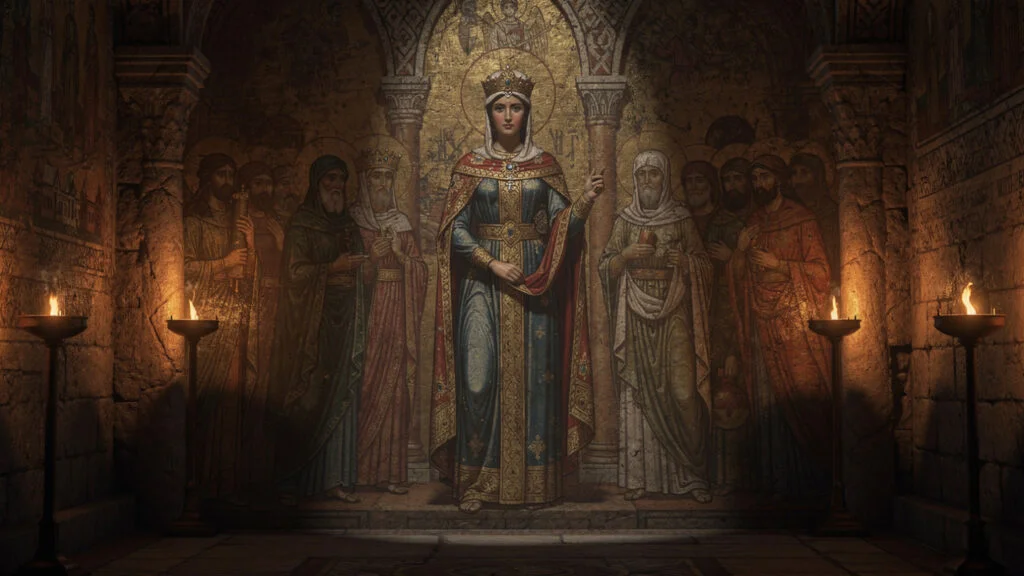
The consequence of her theological protection was the protection of the Miaphysite clergy in Constantinople: she housed Miaphysite bishops and theologians in the palace of Hormisdas adjacent to the imperial palace, providing them refuge from the imperial church’s orthodoxy enforcement while Justinian’s government was formally committed to Chalcedonian positions. The political logic of this arrangement, which the coordination interpretation presents as deliberate and the genuine disagreement interpretation presents as tension managed within a partnership, was the preservation of the empire’s relationship with the eastern Christian communities that Justinian’s reconquest program was trying to incorporate back into the imperial structure.
Theodora died of cancer in 548 CE, eighteen years before Justinian. She was buried in the Church of the Holy Apostles, the imperial mausoleum of Constantinople. The Eastern Orthodox Church canonized her as a saint, together with Justinian, on November 14, which is the date that the Orthodox calendar still observes. The canonization is the tradition’s acknowledgment of the combination of personal transformation and public service that her life documented.
The Ravenna Mosaic and What It Means
The San Vitale mosaic, which every visitor to Ravenna enters and stands before in the light of the sixth-century Byzantine chapel’s interior, is the most direct surviving encounter with how Theodora’s contemporaries represented her at the height of her power.
The procession depicted on the south wall shows Theodora at the center of a group of court attendants, moving toward the altar to present the chalice that she carries. Her crown is the jeweled crown of the empress. Her halo is the halo of the sanctified. The Magi on her hem are moving toward the infant Christ in the same direction that she is moving toward the altar: the visual argument of the mosaic is that the empress’s offering to the church is continuous with the offering of the Magi, that her patronage of the sacred is in the tradition of the most sacred act of recognition in the Christian story.
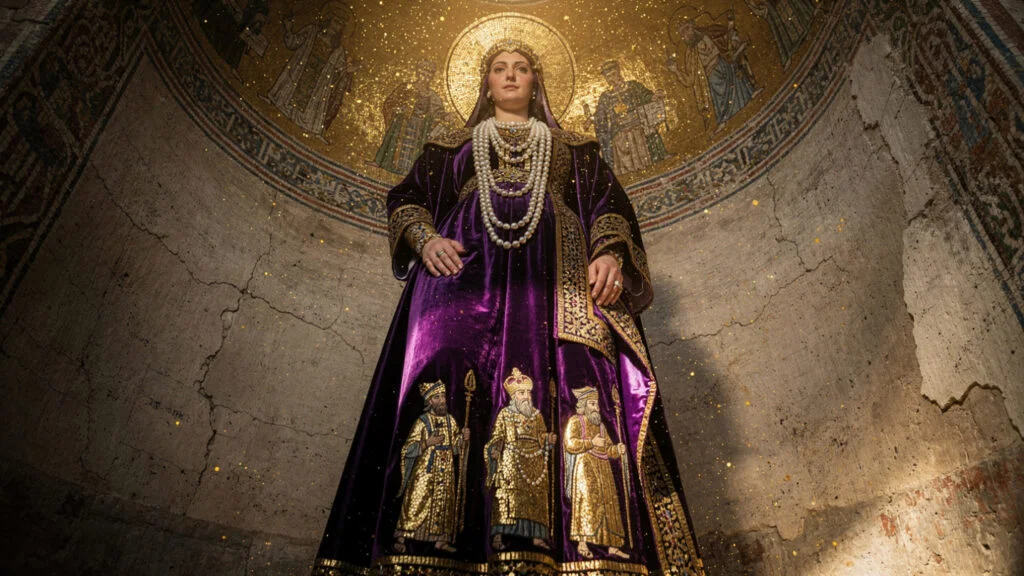
The mosaic does not depict the bear trainer’s daughter or the mime of Constantinople or the woman who traveled to Alexandria destitute and returned transformed. It depicts what the transformed woman had become: the empress who saved the throne, who protected the dissenters, who co-ruled the empire that would stamp its legal and cultural forms on the subsequent history of Europe, who built and commissioned and legislated and in 547 CE approved the iconographic program that would survive her by fifteen centuries and still receive visitors in the apse of the Basilica of San Vitale.
The halo is the argument. The woman who earned it is the evidence for the argument. The mosaic is still there.
At Olympus Estate, Mythic Symbols & Lineage traces the living inheritance of the civilization that maintained the classical tradition through the centuries when the western half of the Roman world had collapsed and rebuilt. Theodora’s story belongs to this inheritance not because she was a saint in the uncomplicated sense but because she was a person whose life documented the possibility that the Christian theological tradition she spent her reign protecting was most centrally concerned with: the genuine transformation of the person, accomplished against the resistance of the conditions the person was born into, made permanent and visible in the world. The mosaic at Ravenna is the evidence. Go and see it.