





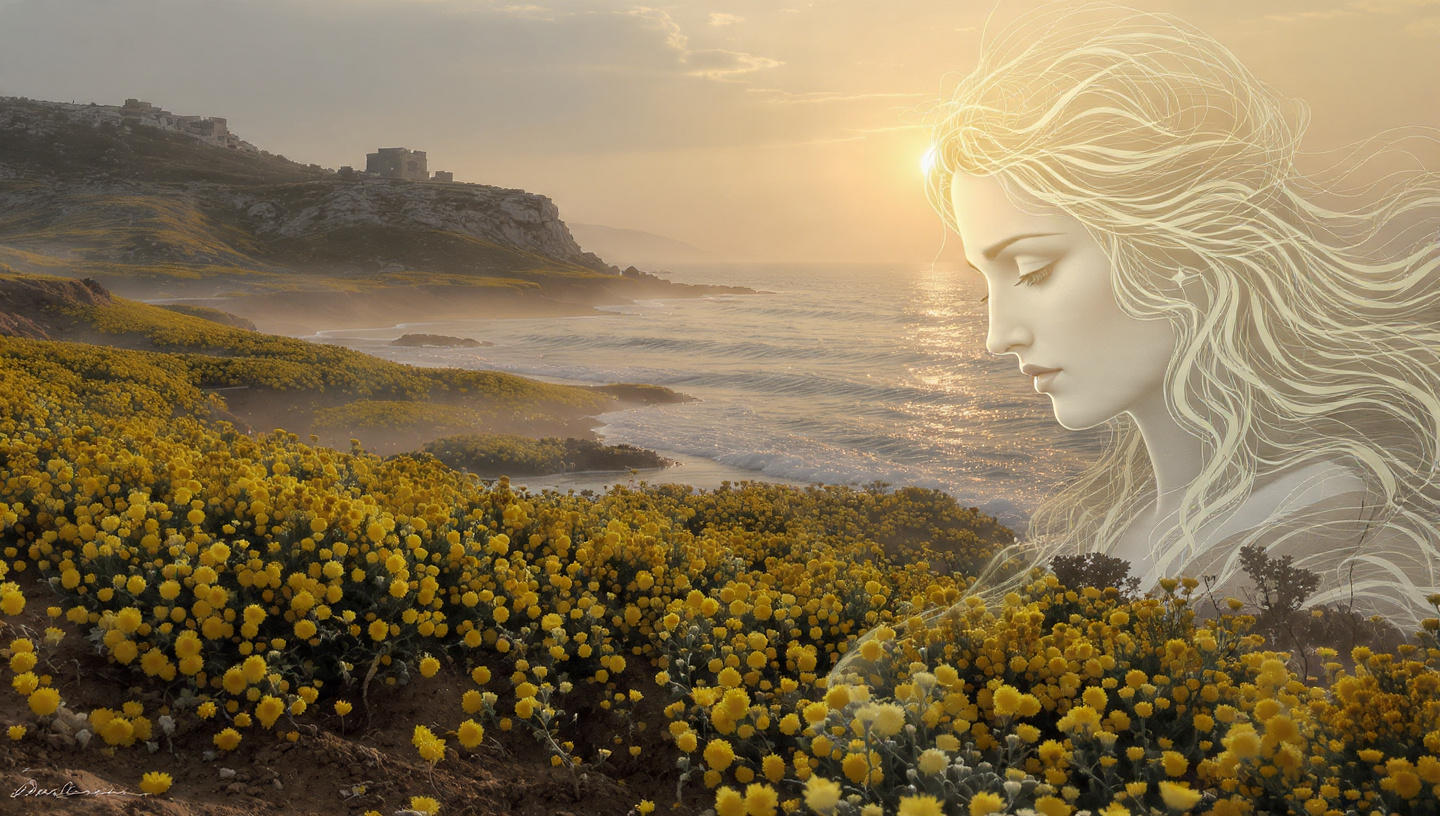
Along the salt marshes near the ancient stones of Mycenae, a bitter yellow bloom rises from the earth each spring, and for nearly two thousand years it has carried a name that ties it to the most consequential departure in Greek myth.
The coastal light across the Peloponnese undergoes a profound shift during the early weeks of spring. The sharp, diamond-edged clarity of winter softens into a warmer, more golden hue settling over the ancient earth. Along the maritime edges near Mycenae, where the dry terrestrial soil yields to salt marshes and low scrub vegetation, this seasonal transition becomes visible through the emergence of a singular plant. Among the early colonizers of the shoreline appears the yellow bloom known as elecampane, Inula helenium, growing in quiet, resilient clusters at the natural boundary between the cultivated interior and the open reach of the Aegean Sea.
A Name Carried From Antiquity
The plant’s botanical name is not a modern poetic flourish. Inula helenium has carried the species name helenium since classical antiquity, a direct linguistic fossil of the tradition that gives the flower its mythic association. Pliny the Elder, writing in the first century CE, recorded that the plant was said to have first sprung from the earth where Helen’s tears fell, and the name has remained attached to it through the entire history of Western botanical classification since.
Pliny was not alone in recording plant lore tied to Helen. Dioscorides, writing in the first century CE as well, catalogued elecampane’s medicinal properties without reference to the myth at all, treating it purely as a root with therapeutic value for the chest and the stomach. This split in the ancient record, poet and naturalist reaching for the same plant with entirely different purposes, is itself informative. The myth and the pharmacology developed along separate tracks and only converged in the common name that survived into later centuries, long after either tradition alone could account for why a war heroine’s tears had become attached to a root sold in the agora for its bitterness.
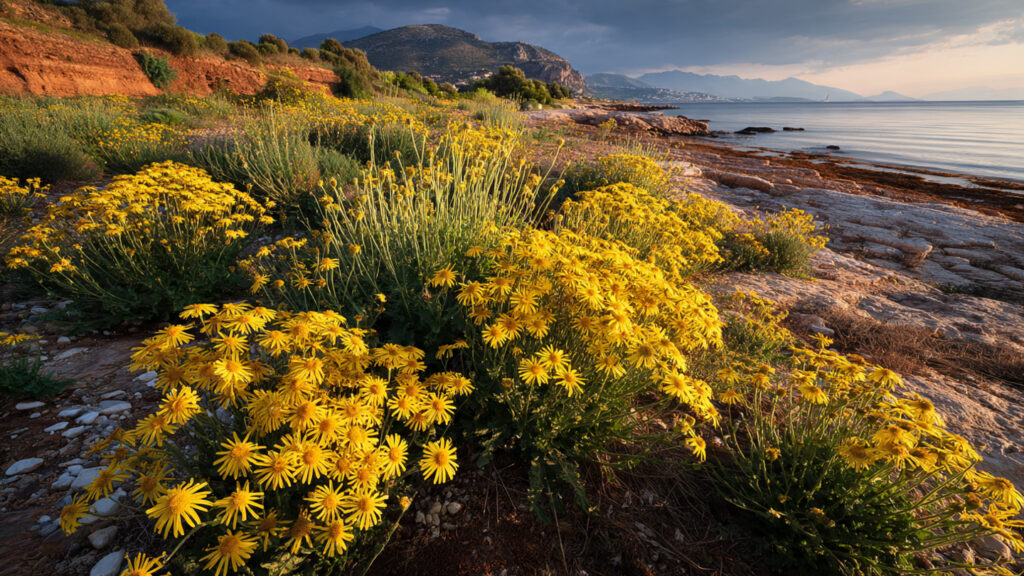
This is one of the more striking cases in Greek plant lore where myth left a permanent mark not just on folk tradition but on the formal scientific record. Long after the stories that produced the name had faded from common memory, the taxonomy itself preserved the connection, embedded in Latin nomenclature used by botanists who may never have read the myth that put it there. Carl Linnaeus, formalizing the genus Inula in the eighteenth century, inherited a name that had already survived two thousand years of transmission through herbals, monastery gardens, and folk apothecaries before it reached his taxonomic system. He did not choose to honor Helen. He simply declined to discard a name that had outlived every empire that might have replaced it.
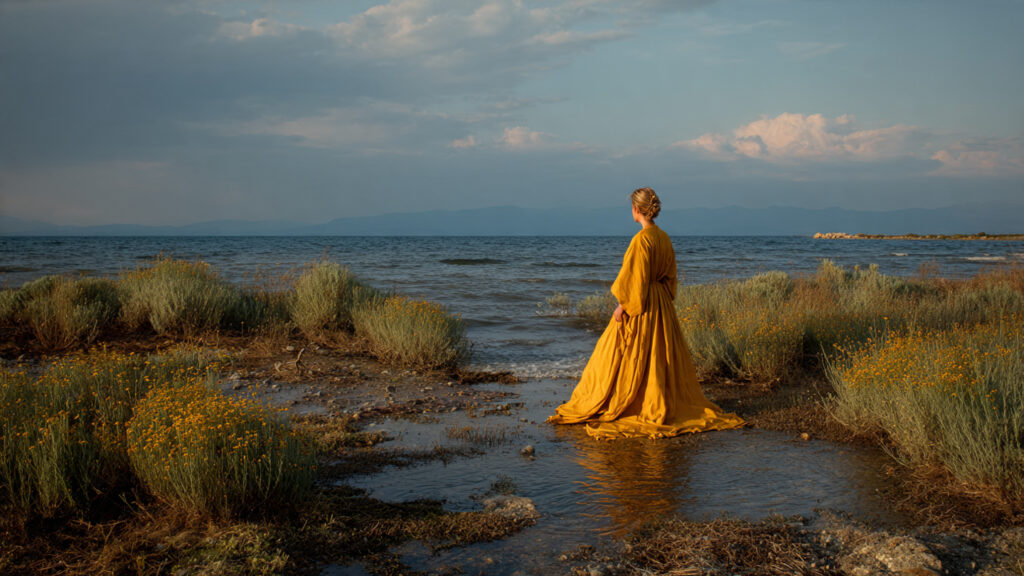
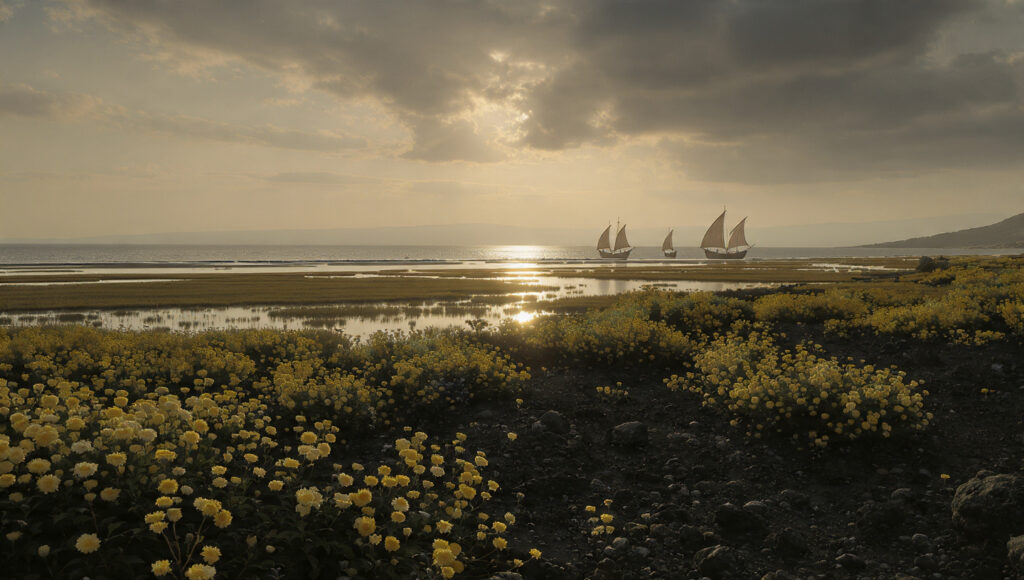
According to the tradition Pliny preserves, the flower marks the moment of Helen’s departure from Sparta toward Troy, her path to the waiting ships becoming one of the defining ruptures of Greek myth, a trajectory of loss and longing significant enough that the land itself was said to bear physical witness to it. In this telling, elecampane became known as the Tears of Helen, a botanical marker of departure rooted into the actual coastal geography the myth describes.
The Plant Itself
Elecampane is a study in contrast. Its bright yellow flower, resembling a small, ragged sun, rises above damp ground while a thick, dark root extends deep into the mineral-rich soil beneath it. The root has been valued in Mediterranean herbal practice for centuries, prized for its bitter, astringent character, with long-documented use across ancient Greek, Roman, and later European medicine, where Inula helenium appears repeatedly as a remedy for respiratory and digestive complaints from antiquity through the medieval period.
The plant can reach nearly two meters in height by midsummer, an unusually tall presence for a coastal wildflower, with broad, felted leaves that distinguish it at a distance from the lower scrub that typically colonizes the same marsh edges. The flower head, when examined closely, reveals dozens of narrow yellow rays radiating from a darker center, a structure that gives the bloom the ragged, sun-like appearance early observers repeatedly reached for when describing it. This is not a delicate or understated plant. It announces itself against the muted browns and greens of the early spring marshland with a directness that likely contributed to its selection, out of the hundreds of species blooming in the same season, as the one myth attached itself to.
The bitterness of the root is its defining quality, and in the broader pattern of traditional Greek seasonal eating, that bitterness was not something to be disguised. Wild bitter greens and roots gathered in early spring, broadly across the Peloponnese, Attica, and the Pindus foothills, were understood within a long-standing dietary logic as a corrective after the heavier, preserved foods of winter, a sharp counterbalance believed to prepare the body for the warmer months ahead. Elecampane sits within this same general tradition of bitter spring botanicals, though the precise details of how any individual household or region historically prepared it, whether steeped in spirits, combined with honey, or used in some other preparation, vary by source and are not uniformly documented, and should be treated as part of a living and regionally diverse folk practice rather than a single fixed recipe.
A Plant of the Threshold
The coastal and marsh-edge habitat where elecampane grows is itself meaningful within the structure of Greek mythological geography. These transitional zones, neither fully land nor fully sea, recur throughout Greek myth as the settings for departure, return, and contact between the mortal and the divine. The shoreline is where journeys begin and where they end, and a plant rooted specifically in that narrow, shifting strip of earth carries an obvious symbolic charge for a culture that told so many of its defining stories at exactly that boundary.
This pattern repeats across the Greek mythological landscape wherever coastline meets myth. The beach where Iphigenia was said to have been led toward sacrifice at Aulis, the shore where Ariadne woke abandoned on Naxos, the strand where Odysseus finally recognized Ithaca after twenty years: each is a threshold rather than a destination, a place where the ordinary rules governing mortal life were suspended long enough for something irreversible to occur. Helen’s departure from the Peloponnesian coast belongs to this same geography, and the plant that marks it grows in exactly the kind of unstable, in-between ground the tradition consistently chose for its most consequential scenes.
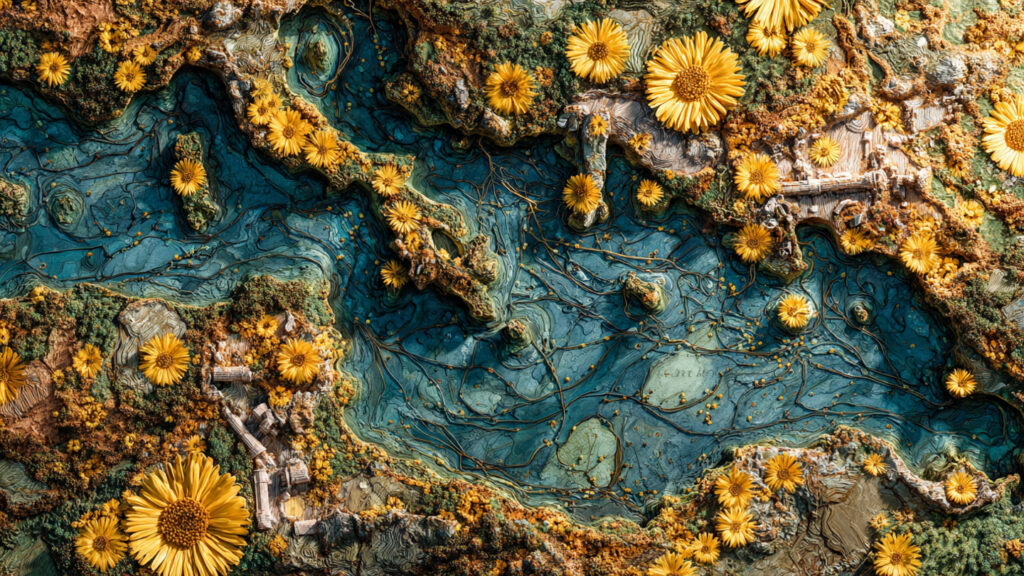
The association of elecampane with Helen places it precisely within this geography of threshold. It is, in the language the myth gives it, a flower of the edge, marking the point where the security of the hearth gave way to the uncertainty of the voyage, whether that voyage was Helen’s toward Troy or, more broadly, any of the journeys by sea that defined so much of the Mycenaean and later Greek world.
What Still Grows There
Today, elecampane continues to appear in these coastal regions of the Peloponnese each spring, largely unremarked by most who pass it, rising from soil that has supported continuous human habitation since the Bronze Age. Walking a coastal path near Mycenae in early spring and encountering the bloom is, at minimum, an encounter with a genuinely ancient piece of botanical nomenclature, a name that has outlived the empire that gave it, the language that first spoke it, and very nearly the memory of why it was given at all.
The plant’s range extends well beyond the Peloponnese today, cultivated and naturalized across much of temperate Europe and parts of Asia, where it is generally known by names that carry no trace of the Greek myth at all. It is only in the specific coastal stretch near Mycenae, and in the handful of botanical references that still note the derivation of the species name, that the connection to Helen survives at all. This narrowing of the myth to a single strip of coastline, rather than its dilution across the plant’s full range, is what gives the local encounter its particular weight. Elsewhere it is simply elecampane. Here, it is still, however faintly, the flower that marked where she left.
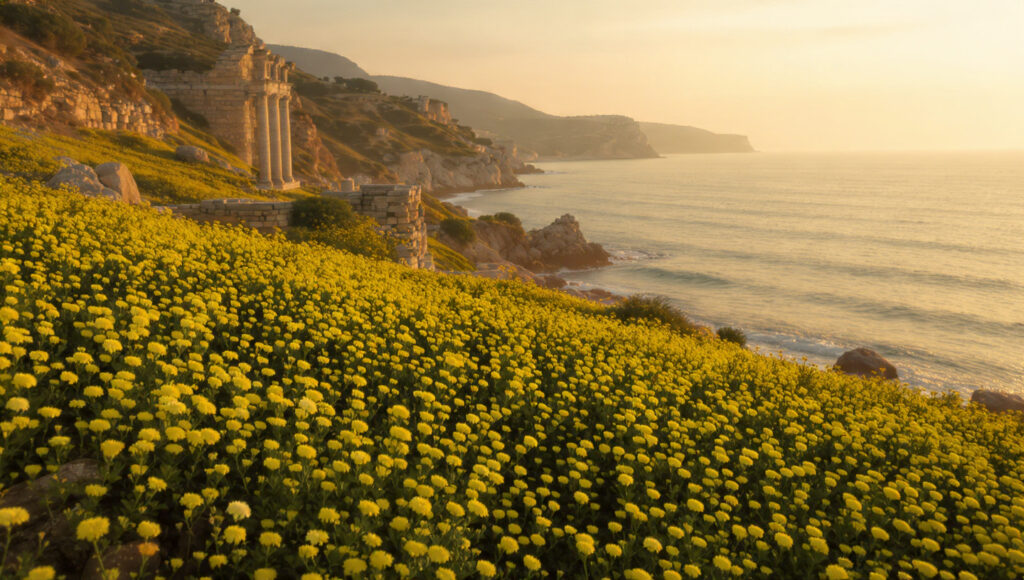
Whether or not any individual flower growing today is consciously gathered, prepared, or remembered as the Tears of Helen by the people who live near it, the name itself persists, carried forward in field guides and botanical texts that have no particular interest in Greek myth and every reason simply to keep using the label that was already there. That is its own kind of continuity, quieter and less dramatic than an unbroken ritual lineage, but real in a way that does not require embellishment: a flower still growing in the place the story put it, still called by the name the story gave it, two thousand years on.
At Olympus Estate, Sacred Geography explores the places across Greece where landscape and myth read as a single text. Inula helenium has carried Helen’s name in its formal botanical classification since antiquity, a linguistic fossil of the tradition Pliny the Elder records: that the flower first sprang from the earth where her tears fell on the way to Troy. Dioscorides catalogued the same root for its medicine without ever mentioning the myth, and the two traditions only converged in the common name that survived into the modern taxonomic system. The plant still grows along the coastal marshes near Mycenae each spring, rooted in the same threshold geography the myth describes.