



Every other Olympian has a fixed domain.
Zeus governs the sky and the divine household. Poseidon governs the sea. Demeter governs the grain and the harvest. Aphrodite governs desire. Ares governs war. Apollo governs light, reason, and prophecy. Artemis governs the hunt and the wild. Hephaestus governs the forge and craft. Athena governs wisdom applied to specific purposes. Hestia governs the hearth and the household’s sacred center.
Hermes governs none of these. He is the messenger between them.
This is not simply a functional description of his role in the divine hierarchy. It is the defining structural fact of his entire theological identity: Hermes has no fixed domain because his function is the crossing between domains. He is not the god of a place or a natural phenomenon or a human activity conducted in one register. He is the god of movement, of transition, of the threshold and the road between, of every moment when a thing or a person or a piece of information moves from one condition to another. He is the patron of merchants because merchants move goods from one place to another. He is the patron of travelers because travelers move themselves from one place to another. He is the patron of thieves because thieves move property from one owner to another without the first owner’s consent. He is the conductor of souls to the underworld because souls move from the condition of living to the condition of dead, and someone has to manage that transition for them.
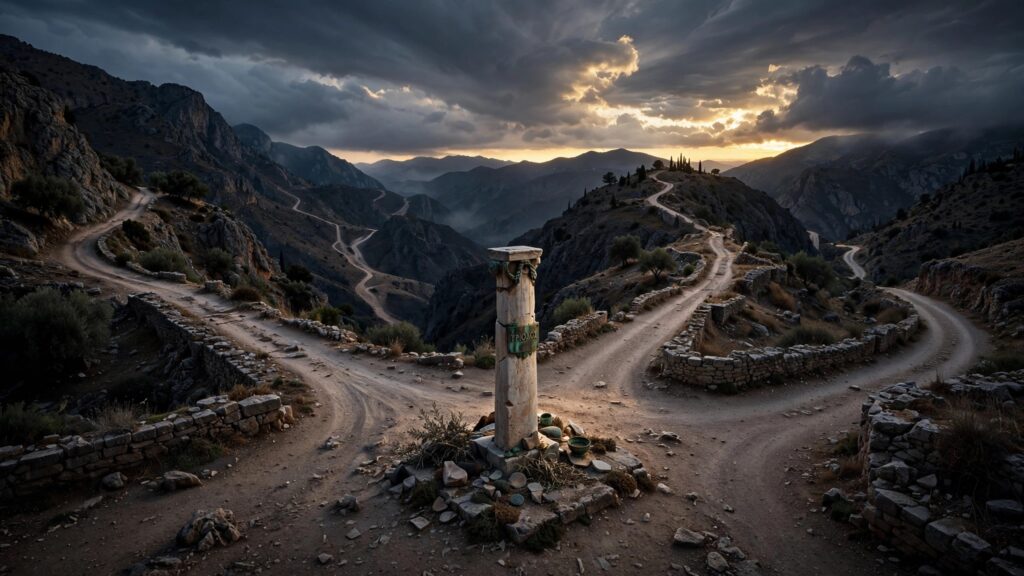
Hermes, in Greek mythology, is the god of boundaries and of the travelers who cross them, of shepherds and cowherds, of orators, literature and poets, of athletics, of weights and measures, and of invention and commerce in general. The list seems, at first reading, like a collection of unrelated patronages accumulated by historical accident. It is not. Every item on the list is a form of crossing: shepherds cross territorial boundaries with their flocks, orators cross the boundary between private thought and public speech, athletics crosses the boundary between training and performance, weights and measures cross the boundary between subjective assessment and agreed standard, commerce crosses the boundary between having and not having. Hermes does not govern disparate things. He governs the one thing that all of these different activities share: the moment of transition.
His name is most often connected to herma, the Greek word for a heap of stones used in the countryside to mark boundaries or serve as a landmark, and popular tradition has long read this as the origin of his name: the pillar came first, and the god’s name grew out of it. The linguistic reality is genuinely less settled than that tidy direction of influence suggests. Hermes appears already in the Mycenaean Linear B tablets from Pylos and Knossos, centuries before the Homeric tradition takes its familiar shape, which has led some scholars to argue the causality actually runs the other way: that the god’s name is the older thing, and the stone piles that mark a boundary took his name from him rather than lending him theirs. Either direction of influence tells the same essential story. He is not simply a god who happens to operate at boundaries. He is bound up, etymologically and theologically, with the boundary marker itself, whichever of the two came first.
What the First Day Tells You

The Homeric Hymn to Hermes, composed sometime between the seventh and fifth centuries BCE and the most complete single account of his mythological character, begins with his birth and then describes, in precise sequential order, what he did on his first day of existence. The sequence is worth reading as a complete statement of his character before any subsequent mythology elaborates it.
Born at dawn, at midday he played on the lyre, and in the evening he stole the cattle of far-shooting Apollo, on the fourth day of the month, the same day that would remain sacred to him ever after.
Four acts in a single day. Four crossings, each more consequential than the last.
The first crossing is the one every birth accomplishes: from non-existence to existence, from the cave’s darkness, where his mother Maia had hidden from the company of the gods, into the world of the living. This crossing is unremarkable as biography and remarkable as theology: the god who will spend eternity managing other beings’ transitions across fundamental thresholds begins his own existence with the most fundamental transition available.
The second crossing happens by midday. According to the Hymn, Hermes finds a tortoise at the mouth of the cave, kills it, empties its shell, and stretches cattle-gut strings across the hollow to produce the first lyre before the morning is even over. The crossing the lyre represents is the crossing from silence to music, from inert material to organized sound, from the physical to the aesthetic. He crosses the boundary between two orders of existence, the natural and the cultural, and does it with the specific tool of a divine trickster: taking what is already there, the shell, the gut, and rearranging it into something that did not exist before.

The third crossing happens by evening. He drives Apollo’s immortal cattle out of their pasture and conceals them, walking them backward to confuse the tracks, in the first recorded instance of a trick that hunters and thieves would use for the next three thousand years. He crosses the boundary between respecting another’s property and taking it, between the divine order that Apollo represents and the chaos that the trickster introduces, and he does it before Zeus has yet taken notice of him, before anyone has decided what category of being he is or what rules apply to him.
The fourth crossing is the one popular retellings usually skip entirely, though the Hymn itself treats it as no less remarkable than the theft it accompanies: preparing to sacrifice two of the stolen cattle, the infant god needs fire, and none yet exists in any form he can simply reach for. So he invents it, rubbing together sticks of laurel and fireweed until a spark catches, becoming, in this single overlooked detail buried inside the more famous theft, the god who crosses the boundary between the world before fire and the world after it, independently of and centuries before the far more celebrated version of that same crossing that this site has already told in the story of Prometheus.

Four crossings before a single sunset. The god whose entire existence will be defined by crossing establishes this identity with the efficiency of someone who understood, from the first moment of consciousness, exactly what they were for.
The Cattle Theft and What It Negotiated
The Homeric Hymn’s central episode, the cattle theft and its resolution, is the mythology’s most complete single account of how Hermes achieved his position in the divine order, and it is considerably more philosophically interesting than a simple story about a divine infant’s precocity.
Apollo discovers the theft and tracks Hermes to his mother’s cave. Zeus was amused by Hermes’s insistence that he was innocent, but decreed that the infant return the cattle to Apollo. Hermes showed Apollo where he had hidden them, but before Apollo could take them away, Hermes picked up the lyre he had created and began to play. The music so enraptured Apollo that he begged Hermes to give it to him. Hermes then suggested a deal: in exchange for the instrument, Apollo would trade his cattle and the position of divine herdsman. Apollo agreed.

The structure of this negotiation is the structure of Hermes’s entire subsequent mythological career. He begins from a position of apparent disadvantage: he has been caught, the god he stole from is furious, and the king of the gods has decreed he must return what he took. And then, from this position, he produces the instrument he invented that morning, plays it, and watches Apollo’s fury dissolve into desire. He turns a legal defeat into a commercial transaction. He exchanges what he was going to have to return anyway for something more valuable: the official position of divine herdsman and the permanent association with cattle that he turns into a domain.
Apollo swore also: verily I will make you only to be an omen for the immortals and all alike, trusted and honored by my heart. The confrontation between the infant trickster and the archer god ends not with punishment but with a formal exchange of gifts and titles and a declaration of mutual trust. Hermes negotiates himself, in a single morning’s work, from the position of cave-born outsider, son of a nymph who avoided the company of the gods, into the formally acknowledged messenger of the divine assembly. He crossed the boundary between the divine periphery and its center, and he did it by stealing from the god of light and then charming him with music made from the guts of what he stole.
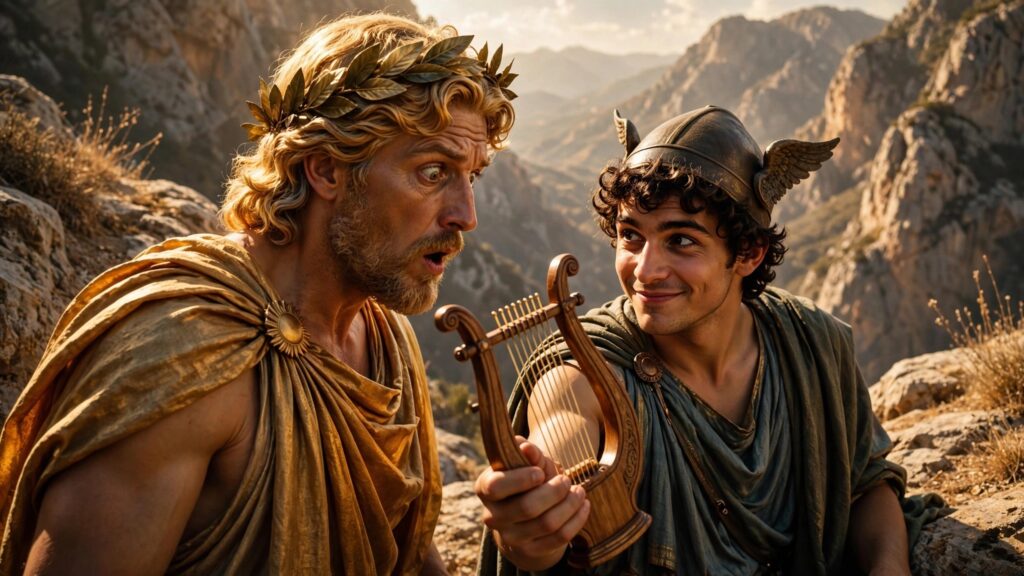
This is the specific quality of Hermes’s intelligence that the tradition distinguishes from every other form of divine intelligence. Athena’s wisdom is strategic: she applies superior knowledge to difficult problems and produces plans that work. Apollo’s knowledge is prophetic: he knows what will happen and communicates it through the oracle. Hermes’s intelligence is what the Greeks called mētis in its specific trickster form: the cunning that works from within adverse circumstances by turning the adversity’s own structure into a resource. He was caught stealing. He played the stolen cattle’s own guts on a shell and made the theft into a gift.
The Name That Became a Discipline
The connection between Hermes and the discipline of interpretation runs deep in the Greek language and in the specific function the god performed, though it deserves to be stated with the same honesty the rest of this essay has tried to bring to Hermes’s etymology.
According to some myths, Hermes was not only a messenger of the gods but also associated with the invention of speech, and Greek tradition connected him closely to oratory and interpretation. In Greece, an interpreter was called a hermeneus, and the modern science of interpretation, hermeneutics, still carries this name today. The connection is ancient and has been treated as etymological for a very long time, but it is worth being honest that philologists genuinely dispute how direct the linguistic link actually is. Some treat it as a settled derivation. Others regard it as a compelling folk etymology, the kind of connection a culture recognizes as meaningful and true to the god’s character even if the technical linguistic history behind the two words is less certain than the association feels.
What is not in dispute is why the connection has felt so right for so long, regardless of its precise linguistic pedigree. Hermeneutics, the systematic study of interpretation and meaning, carries Hermes’s name in the popular and philosophical imagination because Hermes was the being who crossed the most consequential boundary in the divine order: the boundary between divine intention and human understanding. When Zeus had a decision to communicate, Hermes carried it to its recipient. But carrying a divine message to a mortal recipient required more than simple transmission: it required translation across an ontological gap, the crossing of the boundary between what a god means and what a human being can understand. The interpreter, the hermeneus, was doing in the human register what Hermes did in the divine one: finding the form in which meaning could cross from one kind of mind to another.

This is why the discipline of interpretation, in its most rigorous modern form from Schleiermacher through Dilthey through Gadamer and Ricoeur, took Hermes’s name. Not necessarily because the etymology is airtight, but because the figure of the divine messenger who crosses between incommensurable worlds and carries meaning across the gap between them is the exact mythological figure for what interpretation does: it crosses the boundary between one framework of understanding and another and finds what can be carried from one to the other without being entirely transformed in the process.
Every translator works under Hermes’s patronage, whether or not they know his name, and whether or not the philologists ever fully settle the question of where his name actually came from.
The Boundary Stones and the Body of the God
In very ancient Greece, Hermes was a phallic god of boundaries. His name in the form herma referred to a wayside marker pile of stones, and each traveler added a stone to the pile when passing, the accumulation of stones across years and centuries and the thousands of travelers who each added their contribution producing the physical marker that told you where one territory ended and another began.
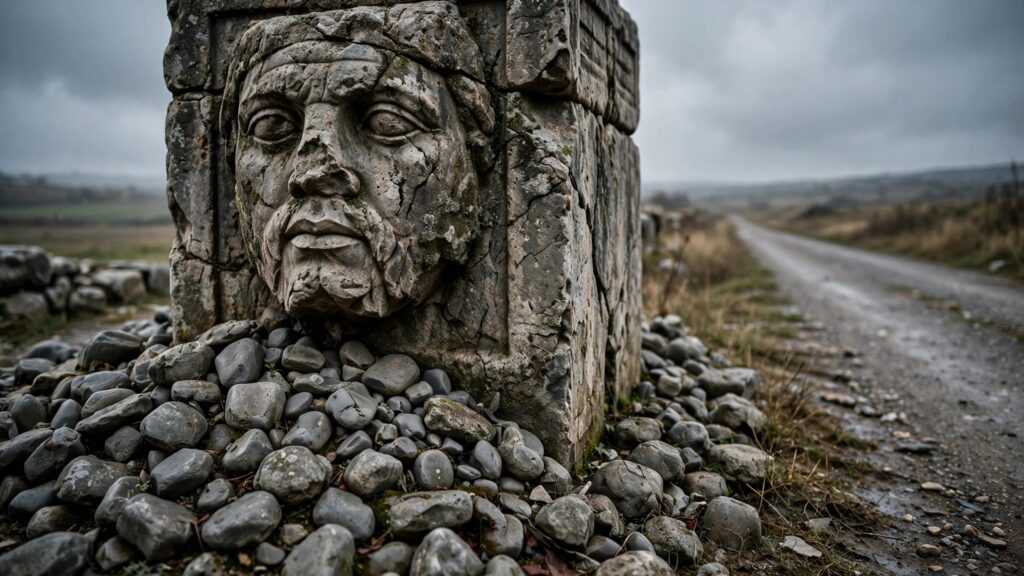
The Hermai, the boundary stones that bore Hermes’s name across the ancient Greek world, evolved from these informal stone piles into formally carved pillars: a stone shaft, square in cross-section, with a bearded head at the top and an erect phallus protruding from the shaft’s middle, placed at doorways, at city boundaries, at crossroads, at the entrances to sacred precincts, wherever a threshold existed between two different conditions of space. The phallic element was not simply a mark of fertility or virility in the straightforward sense. It was an apotropaic function of life-force directed outward against whatever crossed the boundary in the wrong direction, the vital energy of the living world marking its own territory against what moved through the dark.
In 415 BCE, on the eve of the Athenian fleet’s departure for the disastrous Sicilian Expedition, someone or several people mutilated the Hermai throughout Athens, knocking off the phalluses and disfiguring the faces in what was understood immediately as the worst possible omen for a military campaign about to cross the sea. The act, whose perpetrators were never definitively identified, was treated as an act of sacrilege and political subversion simultaneously: it was not simply blasphemy but the deliberate desecration of the specific protective markers whose function was to guard every threshold and every crossing in the city. The fleet whose departure they had failed to protect was destroyed in Sicily two years later.
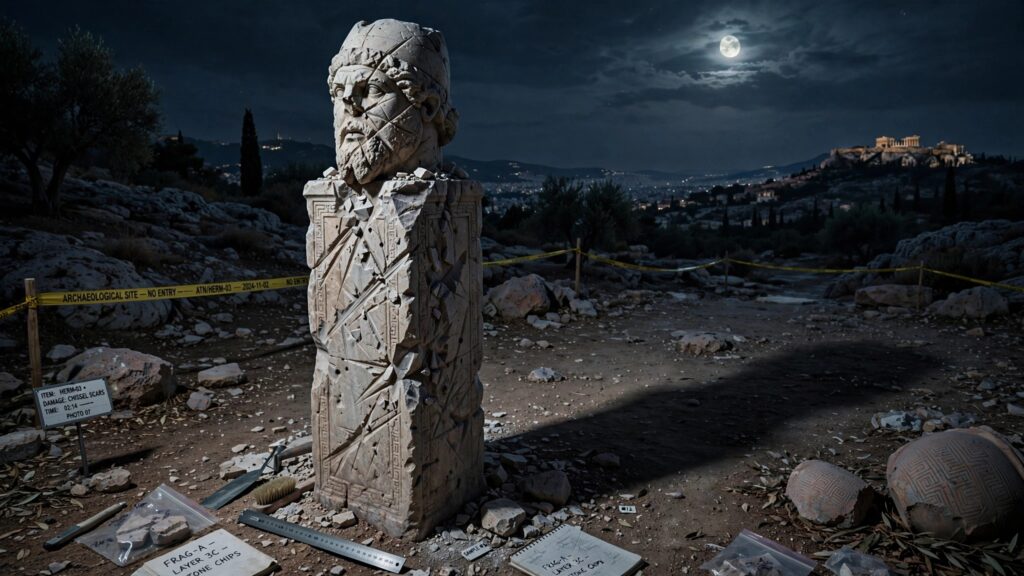
The boundary stones stood at thresholds rather than in centers because that is where Hermes’s power was specifically operative: not in the middle of a territory, where a domain’s own internal order governed, but at the edge, where one order ended and another began, where the question of which rules applied was genuinely open. Every traveler who passed a herm and added a stone to the pile beneath it was acknowledging that the crossing they were about to make required divine management, that the road between two places was not simply the physical distance between them but a genuine transition between two states of existence that Hermes specifically governed.
The Caduceus and the Knowledge It Encodes
The kerykeion, the herald’s staff that Hermes carried and that Roman tradition renamed the caduceus, is one of the most immediately recognizable divine attributes in the entire mythological tradition and one of the least frequently read in its full symbolic depth.
Two serpents coiled around a central staff, their heads facing each other above the staff’s top, sometimes with wings at the apex: this is the image that has been borrowed, in a persistent historical confusion with the single serpent of Asklepios, as the symbol of medicine. The confusion is instructive in a way that goes beyond simple iconographic error: the caduceus is not a medical symbol but a symbol of mediation, of the capacity to move between opposing forces without being consumed by either, and medicine, at its most successful, does something similar with the opposing forces of sickness and health.
The two serpents facing each other encode the fundamental structure of Hermes’s entire domain: the capacity to hold two opposing principles in relationship without collapsing the distinction between them. The road between two territories is not either territory. The moment of crossing is not the origin or the destination. The interpreter is neither the text nor the reader. The messenger is neither the sender nor the recipient. Hermes exists specifically in the space between opposites, and the caduceus is the visual representation of this: two serpents in mutual relationship, held in balance by the staff that is their common ground, neither one dominant, neither one absent.
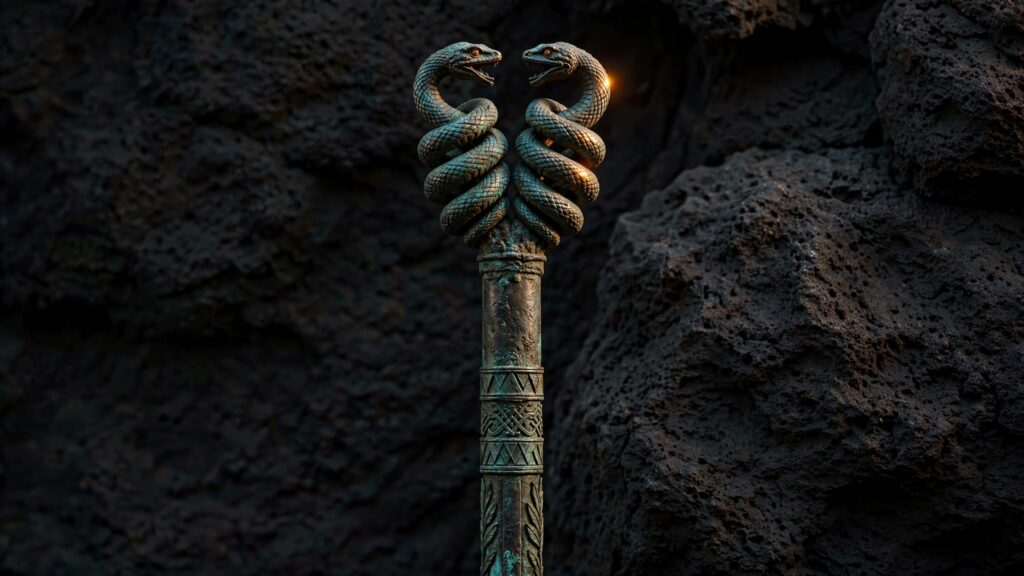
He could put people to sleep or wake them with this staff, the Homeric tradition says, and both acts are crossings: sleep is the daily crossing from waking consciousness to its nightly suspension, death is the permanent version of the same crossing, and Hermes, who managed the permanent version, could manage the daily one as well. He brought dreams to living mortals because dreams are the cargo the boundary between waking and sleep carries in both directions, and Hermes was the boundary carrier.
The Psychopomp and What the Crossing Required
This site has covered Hermes’s function as psychopomp in a different context, but the function deserves its full treatment here as the most extreme expression of his domain.
Hermes was the only Olympian capable of crossing the boundary between the living and the dead and carrying the souls of the dead into Hades. This exceptionality is the crucial detail. Not even the other chthonic deities, not Hades himself, not Persephone, could move between the living world and the dead one with the freedom Hermes exercised. They belonged to the underworld in a way that limited their movement in the other direction. Hermes belonged to neither: he was the crossing, and the crossing could go in both directions with equal facility.
In the Odyssey’s underworld episode, it is Hermes who leads the shades of the slaughtered suitors to Hades, and the Hymn to Demeter shows him conducting Persephone safely back to Demeter at Zeus’s command, the same figure managing the descent of the newly dead and the return of the goddess whose imprisonment in the underworld had produced winter. He crosses both directions with equal competence, because for Hermes there is no direction. There is only the boundary, and both sides of it are equally his territory precisely because neither side is exclusively his territory.
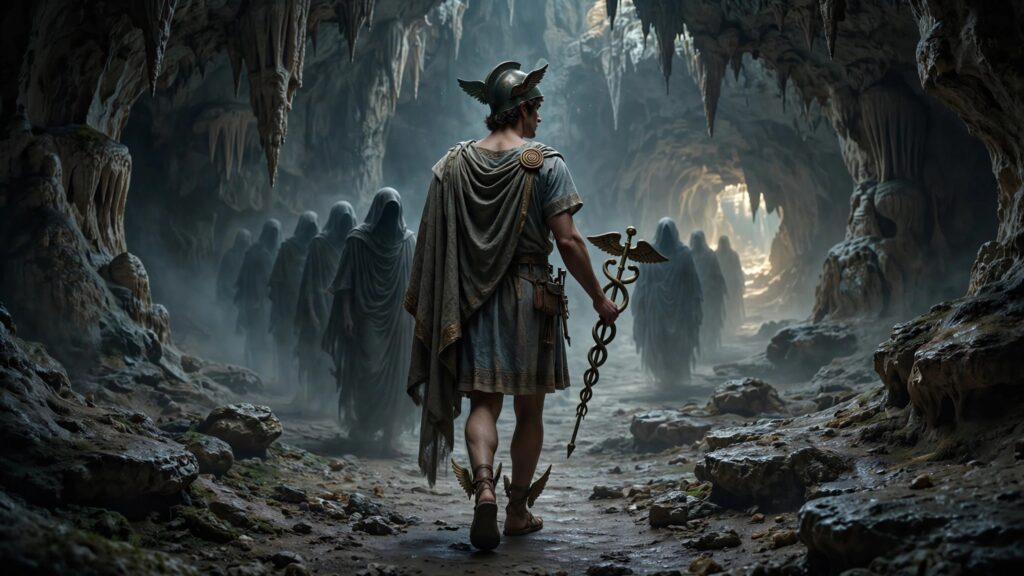
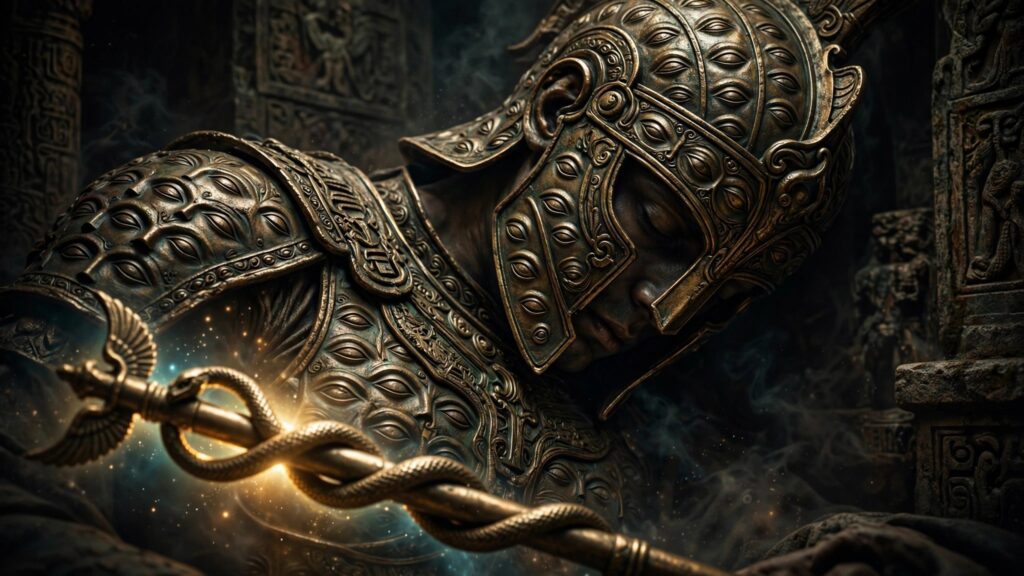
The Argeiphontes epithet, Argus-slayer, recalls his slaying of the many-eyed giant Argos, who had been set to watch over the heifer-nymph Io in the sanctuary of Lady Hera herself at Argos, and it is the other great psychopomp-adjacent episode of his mythology: Hermes lulled the hundred-eyed giant to sleep with music and stories and then killed him, the first recorded use of a story as a weapon. He crossed the boundary between the guard’s consciousness and his unconsciousness first with music, then with narrative, and completed the crossing with the kerykeion that could put any living thing to sleep. The theft of Apollo’s cattle required cunning. The death of Argus required cunning of a more violent order. The instrument in both cases was Hermes’s specific intelligence: the capacity to find, in any situation however guarded, the gap between one state and another and slip through it.
What Hermes Is For
Every civilization needs what Hermes represents, and every civilization that has encountered the Greek tradition has recognized in him the divine figure for the specific human activities and capacities that cannot be captured by any of the stable-domain deities.
Commerce requires the crossing of goods from one owner to another across the boundary of a transaction. Language requires the crossing of meaning from one mind to another across the boundary between private thought and shared expression. Travel requires the crossing of territory from one place to another across the boundaries between domains. Interpretation requires the crossing of meaning from one framework of understanding to another across the boundaries between historically and culturally distinct worlds. Sleep and death both require the crossing of consciousness from one state to another across the boundary between presence and absence.
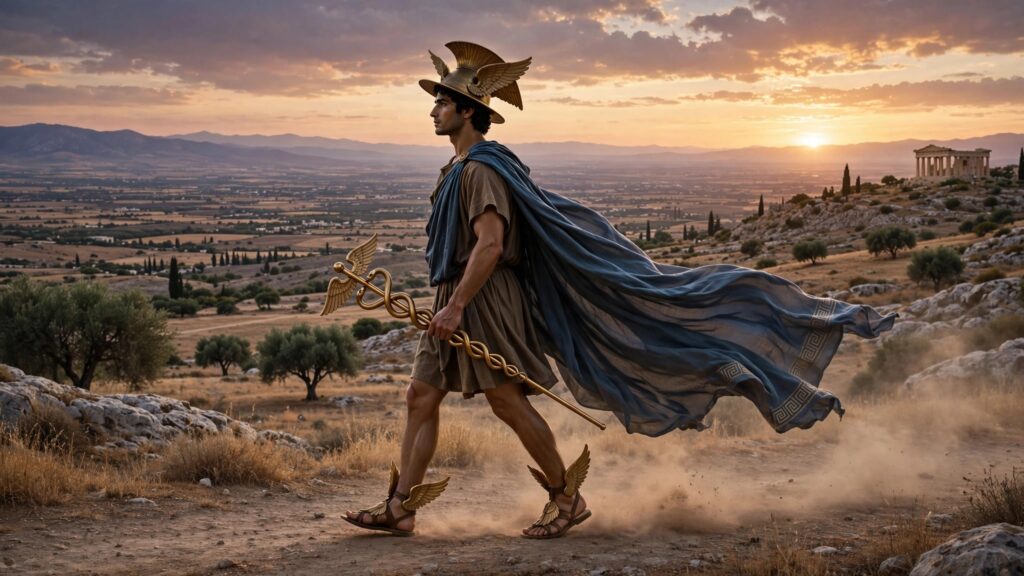
Hermes manages all of these, not as a collection of unrelated patronages but as the single, comprehensive domain of the crossing itself. Where two things are different and communication or transition between them is needed, Hermes is already there, not because he was sent, but because the gap between them is his native territory, the only territory that the god whose name may or may not have come from the boundary stone has ever called home.kerykeion makes sense: it holds opposing serpents in relationship because that is what his entire existence does. The trickster makes sense: cunning intelligence is the specific quality that works in gaps and margins and the spaces between fixed rules, precisely the territory he occupies. The fire-maker and the lyre-maker make sense: invention is the crossing from what does not exist to what does, and the god who manages every other kind of crossing is naturally suited to the most fundamental one of all.
He was simultaneously the messenger of the gods, the maker of fire and the lyre on his own first day, the patron of athletics and commerce and thieves alike, and the psychopomp who helped the dead find their way to whatever came after. This is not a contradictory list. It is the same function expressed across every domain of human experience that involves movement between states: the fire that crosses from cold to warm, the music that crosses from silence to sound, the competition that crosses from potential to demonstrated excellence, the theft that crosses property from one possessor to another, the death that crosses a soul from the living world to what comes after.

He was born at dawn, invented the lyre by midday, stole Apollo’s cattle by evening, and made fire from nothing to cook the meat of what he had taken. He established, in a single day, the complete structure of everything he would spend eternity doing: crossing every boundary the cosmos placed in front of him, in both directions, at will, for reasons that always turned out, on examination, to have been exactly sufficient.
At Olympus Estate, Tales from Olympus moves through the deeper currents of the Greek tradition. Hermes has no fixed domain because his domain is the crossing itself, the moment anything moves from one condition to another. On his first day of existence, according to the Homeric Hymn that bears his name, he was born at dawn, invented the lyre from a tortoise shell by midday, stole Apollo’s cattle by evening, and made fire from friction sticks to cook the meat of what he had taken, four crossings before a single sunset. He negotiated his way from cave-born outsider to formally acknowledged messenger of the gods by trading the very instrument he had made for the cattle he had stolen. His name is popularly linked to herma, the boundary-stone pile, though the god himself appears in Mycenaean Linear B centuries before that connection is secure, and some scholars argue the influence actually ran the other way. He alone among the Olympians could cross freely between the living and the dead. He was born at dawn, and by evening had already established everything he would spend eternity doing.