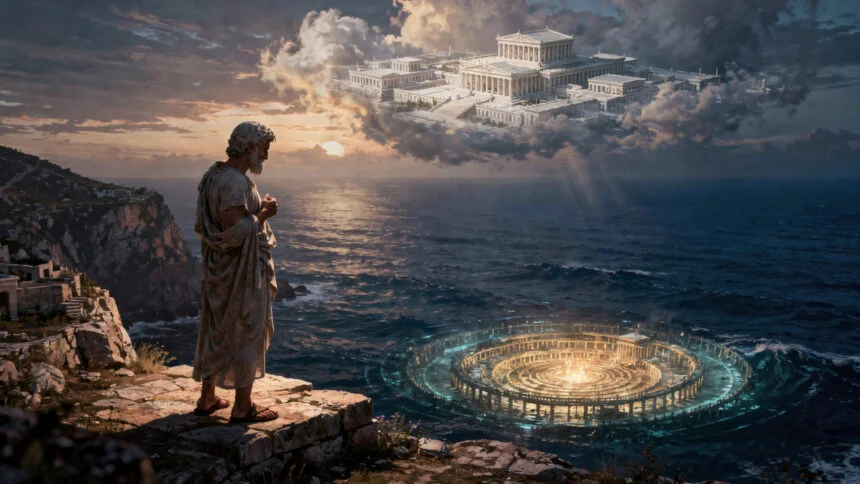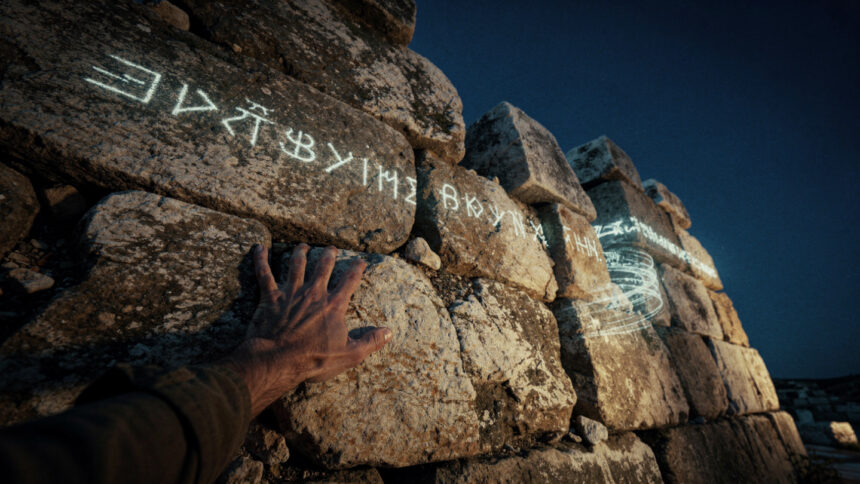


It is the myth that leads to the archaeology.
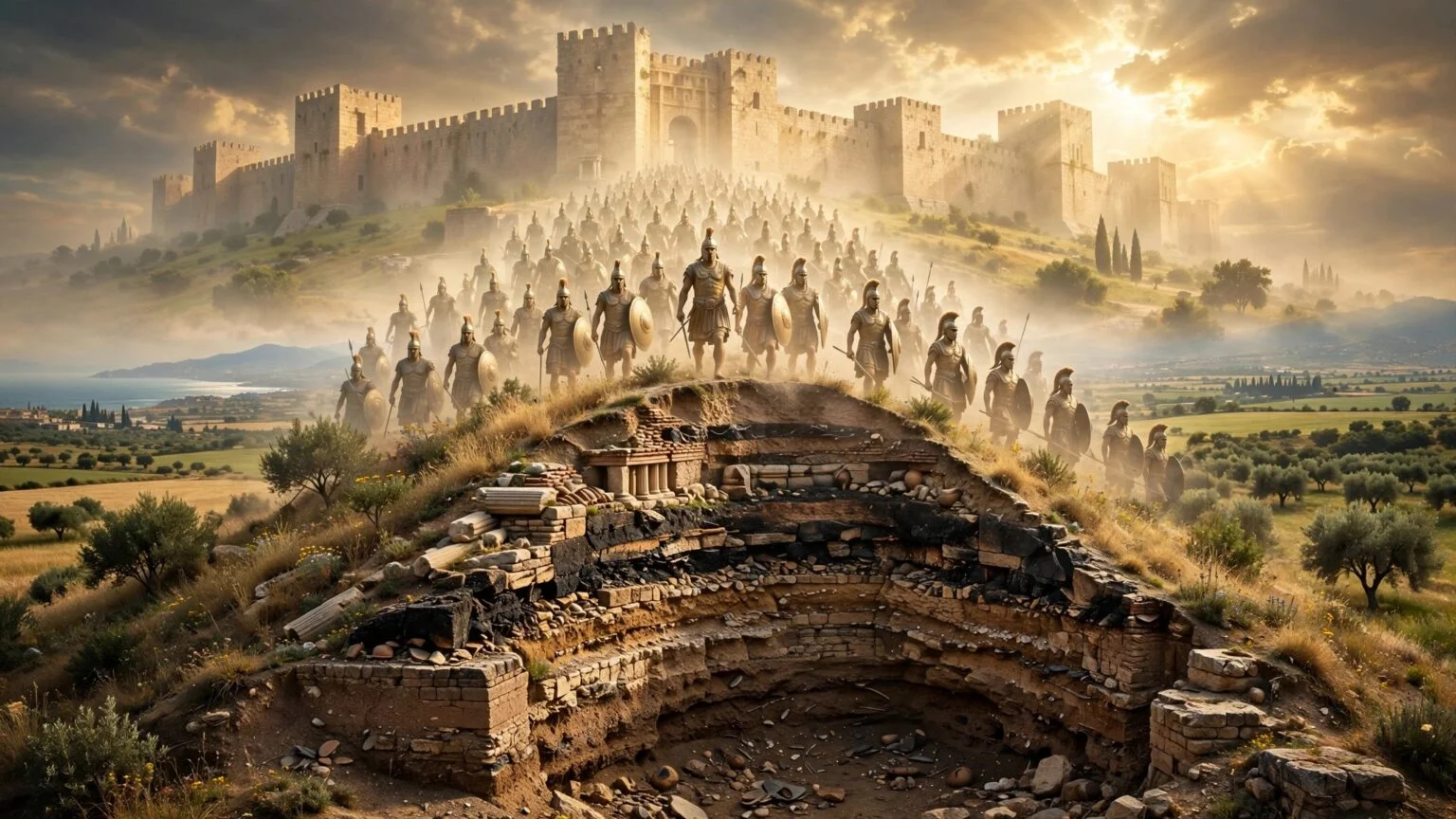
This observation, made by the British Museum archaeologist Lesley Fitton, one of the leading specialists on the question of Troy’s historical reality, is the most honest available account of the Trojan War’s relationship to the physical evidence for it. The hill at Hisarlik in northwestern Turkey has been dug over by serious, trained, well-funded archaeologists for a hundred and fifty years. It has produced nine distinct cities stacked on top of each other, covering a span of human habitation from approximately 3000 BCE to 500 CE. It has produced burnt destruction layers and Greek-style arrowheads and sling stones and unburied human remains and evidence of a population seeking shelter from an extended threat. In 2025, under the direction of Professor Rüstem Aslan, a concentrated deposit of clay and river-stone sling projectiles was found just outside the Troy VI palace structure, in fill layers the team dated to approximately the late thirteenth century BCE, the most concentrated single piece of military evidence the site had yet produced.
None of this would have been excavated if Homer had not written the Iliad.
This is not a criticism of the archaeology. The archaeology is genuine and increasingly compelling. It is the most accurate possible description of the relationship between the story and the physical record: the myth preceded the archaeology by roughly two and a half thousand years, the myth generated the motivation to dig, the myth shaped what the excavators were looking for and how they read what they found, and the myth continues to be the reason that the hill at Hisarlik receives international excavation funding in 2026 rather than being a regional tourist attraction with a small signboard. The physical city was real. The myth is what made anyone care that it was.
This is what it means to call the Trojan War the ur-myth of the Greek tradition: not simply that it is the oldest or the most foundational story the tradition tells, though it is both of those things, but that it is the story from which the tradition’s entire subsequent self-understanding flows, the event that Greek culture used to define what it was, what it had been, what it was capable of, and what the relationship between human beings and divine intention looked like when both were operating at full scale simultaneously.
Everything else in the Greek tradition is either preparation for the Trojan War or consequence of it. The mythology we have covered across this entire site, Achilles and his choice, Cassandra and her useless truth, the theft of the Palladium, Odysseus’s decade of return, Agamemnon’s homecoming, Orestes’s revenge, the diaspora of defeated Trojans that Rome would eventually claim as its founding story, every one of these is a thread pulled from a single event so large that no single poem could contain it and the tradition eventually produced at least eight separate epics, the Epic Cycle, to cover its different parts: the Cypria, telling the war’s causes and its opening years, the Iliad itself, the Aethiopis and the Little Iliad, covering the war’s later stages including the deaths of Achilles and the building of the Wooden Horse, the Iliou Persis, the Sack of Troy, the Nostoi, the Returns of the Greek heroes, the Odyssey, and finally the Telegony, closing the cycle with Odysseus’s own death at the hands of a son he never knew he had. Only two of the eight survived complete. They are the Iliad and the Odyssey, and they are the two greatest poems in Western literature.
The story is that big.
What the War Was About | The Official Version and the Real One
The official version of the Trojan War’s cause is one of the most familiar stories in the entire tradition: Paris, prince of Troy, was given the task of judging which of three goddesses, Hera, Athena, or Aphrodite, was the most beautiful. Each goddess offered him a bribe. Hera offered power and kingdoms. Athena offered wisdom and skill in war. Aphrodite offered the most beautiful woman in the world. Paris chose Aphrodite, received the Judgment in her favor, and subsequently sailed to Sparta as a guest of the king Menelaus, where he was entertained with the full hospitality that xenia, the sacred obligation of guest-friendship, required.
He repaid this hospitality by taking Helen, Menelaus’s wife, back to Troy with him. Whether Helen went willingly or was taken by force is a question the tradition preserves in multiple contradictory answers, and the preservation of those contradictions is itself the tradition’s most honest response to the question: there is no version that satisfies completely, because the story is built on a desire so extreme that the ordinary categories of consent and coercion do not quite contain it.
Menelaus called on his brother Agamemnon, the most powerful king in the Greek world, who assembled the greatest coalition of Greek forces in the tradition’s memory: a thousand ships and tens of thousands of warriors from across the Mycenaean world, gathered at Aulis to sail against a city on the far side of the Aegean whose prince had violated the most fundamental obligation of the Mediterranean social order.
This is the official version, and its structure is the structure of a story that the Greek tradition used to justify a very large war: a violation of the sacred guest-friendship obligation, which was universally recognized across the ancient world as a divine institution under Zeus’s own protection, requiring a collective response from every Greek kingdom that understood itself to be part of the same moral order.
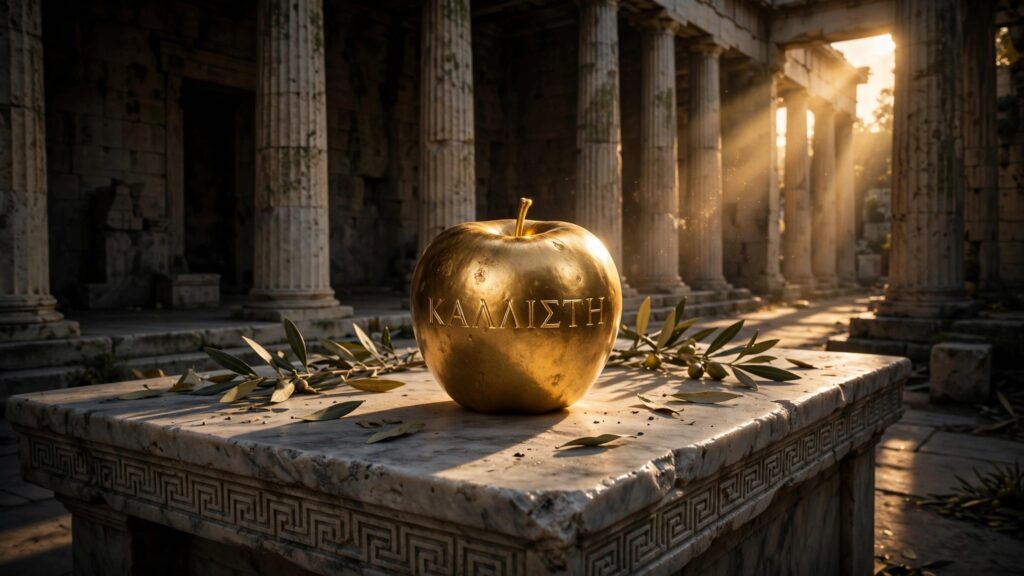
The real version, which the myth itself encodes beneath the official one, is considerably more complex. The Judgment of Paris was not only Paris’s error. It was the consequence of a divine event that the tradition places even further back: the wedding of Peleus and Thetis, where all the gods were invited except Eris, the goddess of discord, who arrived anyway and threw among the assembled deities a golden apple inscribed with the words “to the fairest.” Three goddesses reached for it simultaneously, and the resulting dispute required a mortal judge because no god was willing to make an enemy of two Olympians by choosing one. Paris was not a villain who made a bad choice. He was a mortal placed in an impossible position by a divine dispute that preceded his birth, and the war that followed was the consequence of a divine structure of competition and desire that no human decision could have prevented.
The Greeks understood this. The Iliad’s divine apparatus, the gods arguing on Olympus about whose side to take, intervening directly in battles to save their favorites and kill their enemies, is not decorative color added to a human war story. It is the tradition’s insistence that the Trojan War was, at its deepest structural level, a divine event that happened to require human bodies to fight it. The humans died. The gods argued, intervened, and went home.
The Ten Years and What Happened in Them
The war lasted ten years, according to every ancient source that addresses the question, and the tradition’s account of what actually happened in those ten years is considerably more complex than the popular summary of Trojans in the city, Greeks outside it, periodic battles on the plain between them suggests.
The Iliad covers approximately fifty days in the war’s tenth year. The Odyssey’s flashbacks and the fragments of the other Epic Cycle poems cover the rest. Between them, these sources give us a picture of a war whose texture was determined not only by the great set-piece confrontations between heroes, the duels between Achilles and Hector, between Paris and Menelaus, between Odysseus and the Trojan champions, but by the slow, grinding, logistically complex reality of a large coalition army maintaining a siege for a decade against a well-fortified city whose allies continued to arrive from across the Aegean world.
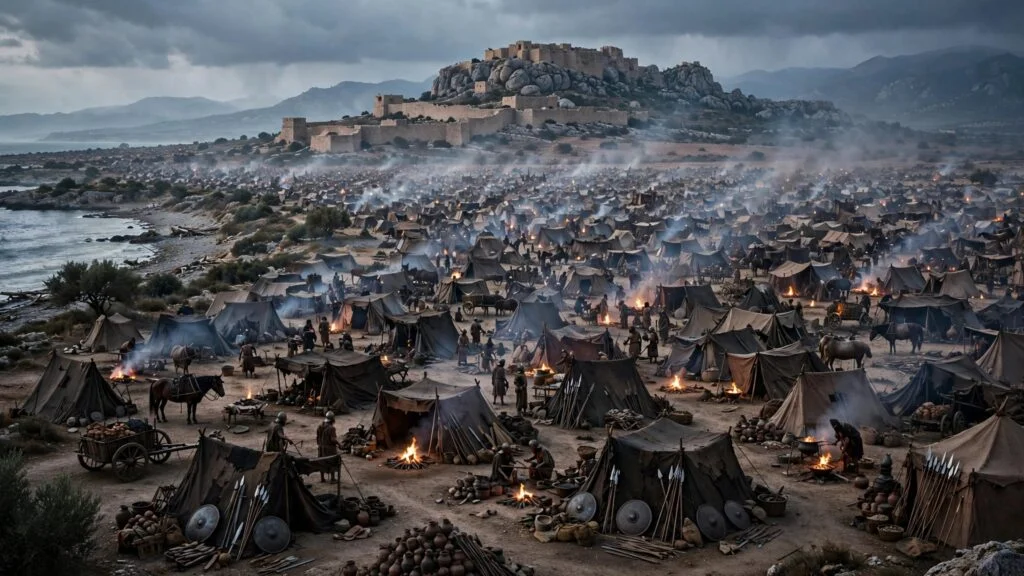
Troy was not merely a city with walls. It was a major Bronze Age commercial and diplomatic center whose relationships across the eastern Mediterranean gave it access to allies, to supply lines, and to the information about Mycenaean politics and military planning that a well-connected city-state on the Dardanelles would naturally have accumulated over centuries of trade. The Hittite archives at Hattusa mention a city called Wilusa, strongly identified by most scholars with the archaeological Troy at Hisarlik, and one surviving treaty names a king of Wilusa called Alaksandu, a name close enough to Alexandros, the alternate name the Iliad itself gives Paris, that many Homerists treat the correspondence as too precise to be coincidence. The city that the Greeks were besieging was not merely a wealthy coastal settlement with a beautiful princess. It was a node in the most sophisticated diplomatic and commercial network the Bronze Age eastern Mediterranean had produced, significant enough that a Hittite king thought it worth a formal treaty with a ruler whose name the Greek tradition may have preserved for three thousand years without ever knowing why it sounded familiar.
This is why the war lasted ten years rather than a season. The Greeks had the warriors and the coalition. Troy had the walls, the allies, and the defensive advantage that any fortified city with access to supply lines holds over a besieging army that has to sustain itself in hostile territory indefinitely. The single most consequential military development of the war’s middle years, Achilles’s withdrawal from the fighting described in the Iliad’s opening books, was consequential precisely because without Achilles the Greek coalition could not maintain the military pressure that the siege required, and the balance of advantage shifted sufficiently toward Troy that the Greeks spent several of the Iliad’s early books fighting on the defensive rather than pressing their siege.
The Figures Who Made It What It Was
The Trojan War’s mythological power derives not only from its scale or its duration but from the individual figures who inhabited it, each of whom embodies a different dimension of the human experience of extreme events.
Achilles is the collection’s most extensively treated figure, with a full dedicated essay on this site. His contribution to the Trojan War’s mythological character is the one the Iliad builds everything around: the hero who already knows he will die at Troy and chooses to stay anyway, whose choice makes the war the subject of the most important poem the ancient world produced, whose wrath and grief and final act of mercy in returning Hector’s body to Priam together constitute the most complete portrait of a particular kind of heroic character in Western literature.
Hector is, as the Achilles essay on this site establishes, the hero whose character the Iliad builds as the foil to Achilles’s own: the man who fights for his city and his family rather than for glory, who is the better man by almost every moral metric the poem applies, and who is killed by the hero whose death will follow shortly after his own. The Iliad’s tragedy is Hector’s death as much as Achilles’s forthcoming death, and the tradition’s decision to make its representative Trojan hero morally superior to most of the Greek heroes is one of its most enduring and most uncomfortable achievements.
Helen is the figure around whom the war’s official cause rotates, and the tradition’s treatment of her is the most consistently unstable element in the entire mythology. She is simultaneously the agent of her own departure from Sparta, the victim of Aphrodite’s compulsion, the passive object of a male dispute, the most beautiful human being in the world, and, in the version preserved by the lyric poet Stesichorus, an entirely innocent figure who never went to Troy at all: Stesichorus’s Palinode, the poem in which he retracted an earlier account that had blamed Helen for the war, proposed that only a phantom of Helen went to Troy while the real Helen spent the war years in Egypt. Stesichorus was said to have written this retraction after Helen’s divine power struck him blind as punishment for his earlier account and restored his sight when he recanted. The tradition could not decide whether Helen was guilty or innocent, and it preserved both verdicts rather than choosing, which is the most honest possible account of a figure whose mythological function requires her to be both simultaneously.
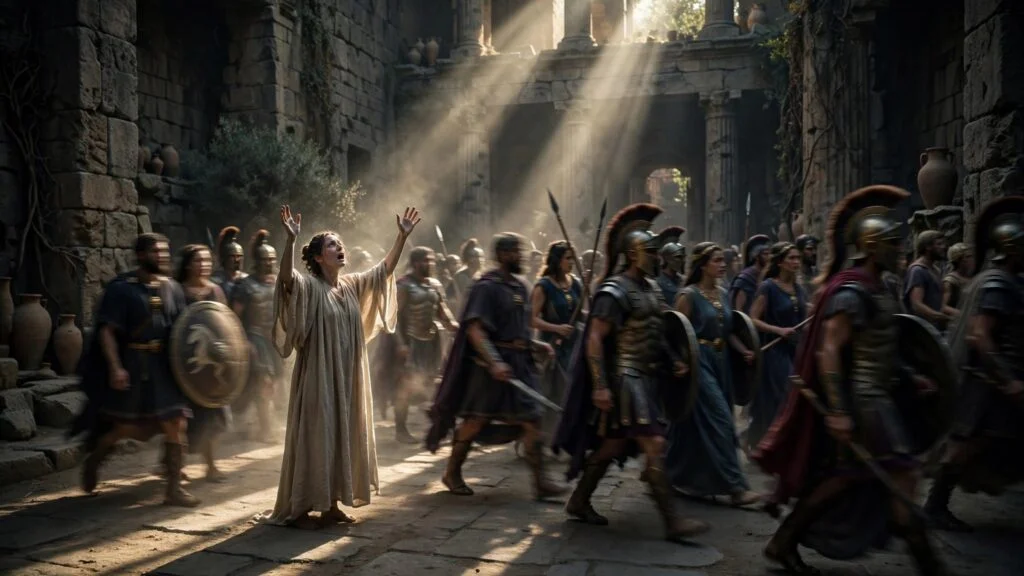
Cassandra, the Trojan princess gifted by Apollo with true prophecy and cursed by Apollo with never being believed, is the figure through whom the tradition expresses its most sustained meditation on the relationship between accurate knowledge and institutional power. She knew every significant thing that was going to happen: the fall of Troy, the death of Hector, the danger of the Wooden Horse, the murder of Agamemnon on his return home. She said all of it aloud, repeatedly, to everyone who could hear her. None of it made any difference. The curse Apollo placed on her was not only the curse of disbelief. It was the curse of perfect information rendered structurally inaccessible to the people who needed it, the curse of being right in every detail about a catastrophe that happens anyway because the systems that needed to respond to accurate information were incapable of doing so. The tradition preserved Cassandra as one of the most haunting figures in the entire mythology because every subsequent culture that encountered her recognized immediately what she was describing: the experience of watching a preventable catastrophe unfold in slow motion while speaking the truth that would prevent it to audiences that cannot process what they are hearing.
Odysseus is the figure through whom the war is finally won, and the method of that winning, the Wooden Horse, is the most mythologically significant military deception in the ancient world. The Greeks spent ten years attempting to take Troy by force and could not. Odysseus proposed that they take it by cunning instead, building a horse large enough to conceal armed warriors, leaving it outside the walls as an offering to the gods, and sailing away as though the war had been abandoned. The Trojans debated what to do with the horse. Cassandra said to burn it. The priest Laocoon said the same thing and was killed, along with his sons, by two serpents sent specifically to silence him at the moment his warning had the greatest chance of being heard. The Trojans pulled the horse inside the walls. That night, the warriors inside it emerged.
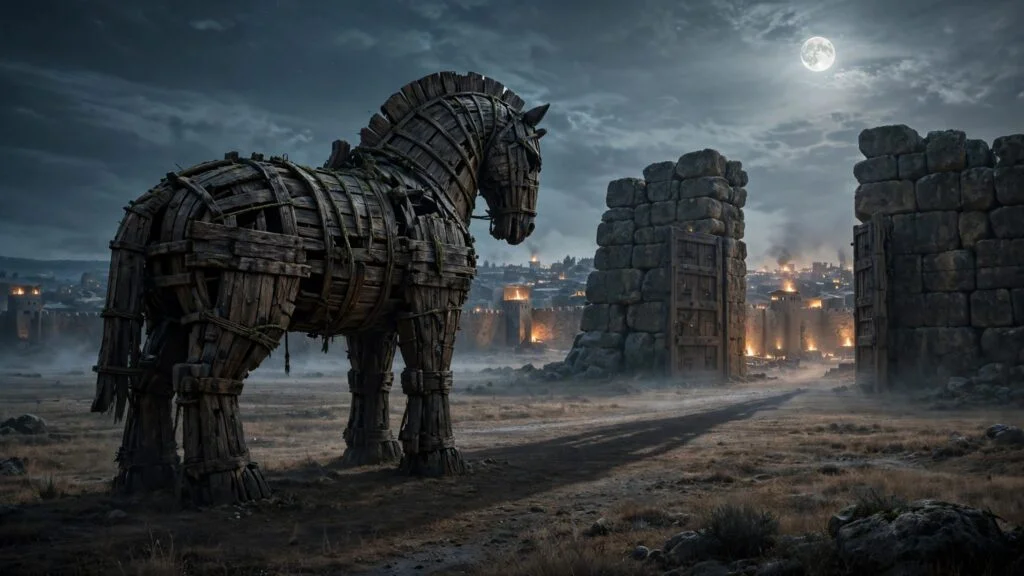
Troy fell not to the greatest warrior in the Greek world but to its greatest strategist. The force that ten years of Achilles could not produce was produced by Odysseus in a single night, without a battle, through the cunning that Greek culture valued alongside and sometimes above the heroic strength that the war’s first nine years had been organized around.
The Bronze Age Reality Beneath the Myth
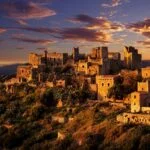
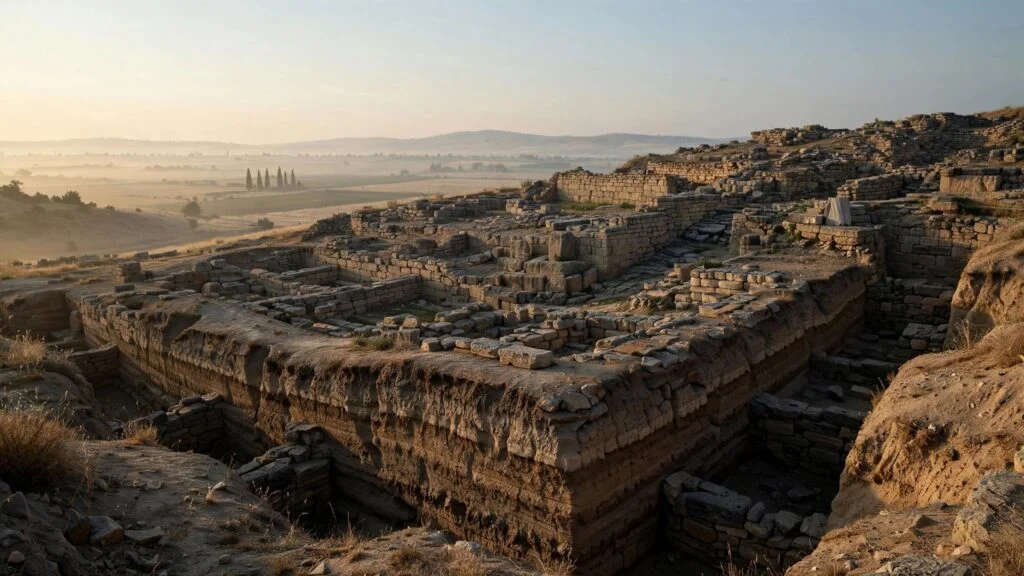
The Troy at Hisarlik is real. Nine cities were built on that hill over roughly four thousand years of continuous occupation, and the one most commonly identified with the Homeric Troy, the settlement archaeologists call Troy VIIa, was destroyed by fire sometime between 1300 and 1180 BCE. Carl Blegen’s excavations in the 1930s found Greek-style arrowheads buried in walls, unburied skeletons, animal bones in storage vessels suggesting a population that had been consuming its emergency reserves, and buildings divided into smaller rooms suggesting that civilians had been sheltering inside a city under external pressure for an extended period.
Manfred Korfmann’s excavations between 1988 and 2005 added an even more significant discovery: the lower city of Troy VIIa was considerably larger than the citadel that previous excavations had focused on, covering an area of approximately thirty to forty hectares with a population estimate of perhaps ten thousand people, a major Bronze Age commercial center rather than the modest fortified settlement that Schliemann’s original excavation had suggested. The circuit of ditches and fortifications that Korfmann identified around the lower city demonstrated that Troy VIIa was a defended urban settlement of real scale, the kind of city that would have been worth a significant military campaign.
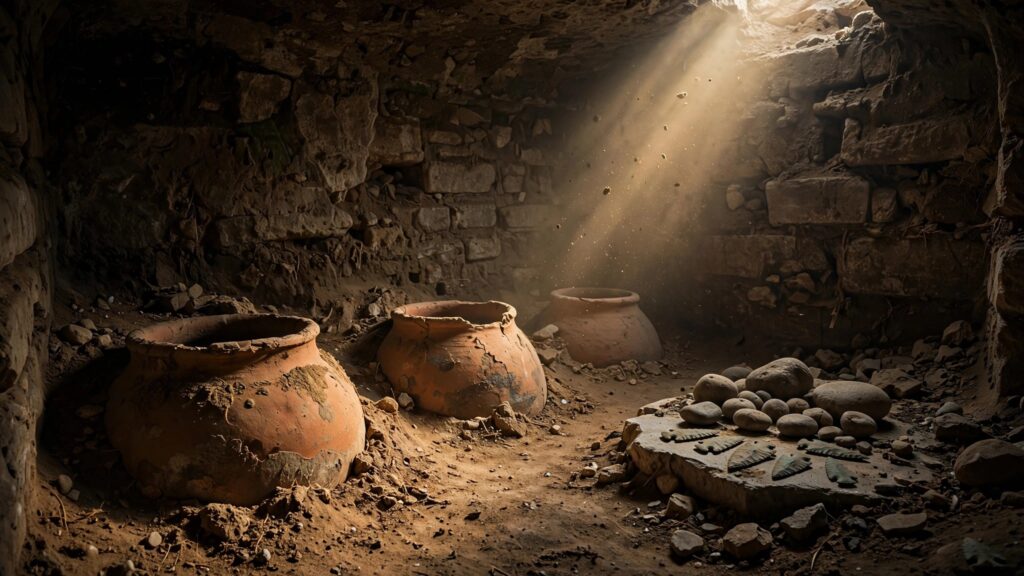
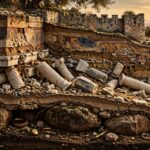
The 2025 excavation season, under the direction of Professor Rüstem Aslan, part of the ongoing Legacy for the Future Project, added the concentrated deposit of sling stones just outside the Troy VI palace structure, which the research team interpreted as evidence of a concentrated military attack on the palace specifically rather than a generalized fire whose cause could not be determined. The stones, made of clay and smoothed river rock, date to approximately 3,500 years ago, and Aslan noted that a pair of Late Bronze Age arrowheads recovered from the same area the previous season had already suggested the site was worth this closer attention. The concentration in such a small space, Aslan told reporters, points to activity connected with either a determined defense or a determined assault, precisely the kind of concentrated military evidence that a century and a half of previous excavation had not yet produced with this much precision.
The honest scholarly position, which the best archaeologists working at the site have consistently maintained, is that the archaeological evidence supports the existence of a real Bronze Age conflict at Troy during the period of widespread Mediterranean collapse between 1300 and 1180 BCE, but that distinguishing between a Mycenaean Greek military campaign, an internal conflict, the broader Bronze Age collapse that destroyed multiple eastern Mediterranean civilizations in the same period, or some combination of all three, is genuinely difficult from the physical evidence alone. The city was real. The destruction was real. The agency behind the destruction remains, despite a century and a half of serious archaeology, genuinely uncertain.
What is not uncertain is the relationship between the myth and the archaeology that followed it. Lesley Fitton was right: it is the myth that leads to the archaeology. Without the Iliad, there would be no Hisarlik excavation. Without the Iliad, the question of what happened to Troy VIIa would be answered, if at all, by a brief entry in a Bronze Age archaeology survey rather than by an ongoing international research program. The myth generated the question, sustained the motivation to pursue it, and continues to give the answer a significance that the bare archaeological facts alone would not produce.
How the War Flows Backward | The Causes Behind the Cause
The tradition that placed the Trojan War at the center of Greek mythological history also organized an enormous amount of earlier mythology as the war’s preparation: the events and decisions that made the war inevitable long before Helen made her choice and Paris made his.
The wedding of Peleus and Thetis, at which Eris threw the apple, is the chronological and theological origin of the war’s divine dimension: the competition among the goddesses is the event that required the Judgment of Paris, which is the event that required Paris to travel to Sparta as the guest of Menelaus, which is the event that required Helen’s departure. The war begins not in Troy or Sparta but at a divine wedding, with a fruit and a word.

The Oracle at Delphi, which told Priam before Paris’s birth that this son would be the destruction of Troy and which led Priam to order the child exposed on Mount Ida rather than killed outright, set up the biographical trajectory that made Paris the person he was: raised by shepherds on a mountain rather than in the court whose destruction he was prophesied to cause, aesthetically sensitive in the way that suggests a life of pastoral contemplation rather than warrior training, placed in a position to make the Judgment of Paris precisely because he had no Olympian allegiance and no political stake in any of the three goddesses’ competing claims. The attempt to prevent a prophecy by abandoning the child to die, which consistently fails across the entire Greek mythological tradition, produced, in Paris’s case, the exact instrument of Troy’s destruction that the prophecy had announced.
The Oath of Tyndareus, the oath that Helen’s father extracted from all of her suitors that they would defend the rights of whichever man she chose as her husband, bound every king in the Greek world to respond to Menelaus’s call precisely because they had all wanted what Menelaus eventually obtained. The Greek coalition that sailed against Troy was assembled through a legal instrument that Tyndareus had designed to prevent the war among his daughter’s suitors that her beauty had threatened to produce. It produced instead a war against Troy of incomparably greater scale.
How the War Flows Forward | The Consequences That Never Ended
The war’s consequences extended outward through the ancient world in every direction, and the tradition that preserved those consequences understood them as genuinely continuous rather than as a set of discrete subsequent episodes.
The returns, the nostoi, of the Greek heroes from Troy became the subject of the Epic Cycle poems whose fragments survive alongside the Iliad and the Odyssey, and the common thread running through those returns is the impossibility of coming home unchanged from an event of that scale. Agamemnon returns to be murdered by his wife. Ajax the Lesser is drowned in punishment for a sacrilege committed at Troy’s fall. Diomedes finds his wife unfaithful and his kingdom usurped. The men who survived the war did not just sail home and resume their lives. They sailed home into consequences that the war had produced in their absence, and the tradition’s insistence on following each hero to his own individually appropriate conclusion is its account of what ten years of extreme events at Troy did to the individual personalities of each of the men who underwent them.
Odysseus’s return is the only one that ends successfully, and the Odyssey’s twenty-four books are required to bring it about. This disproportion between the length of the return and the brevity of the war itself, the fact that it took ten years to fight the war and ten more years to get home from it, is the Odyssey’s structural argument: that what the war did to Odysseus was at least as significant as what Odysseus did in the war, and that the recovery of an ordinary life, a household, a wife, a son, a father, from the damage of extreme events requires at least as much of a person’s full capacity as the extreme events themselves.

The Trojan refugees who scattered across the Mediterranean after Troy’s fall became, in the tradition that Rome eventually developed into its own founding mythology, the ancestors of the Romans: Aeneas, the Trojan hero who escaped the fall carrying his father and the household gods of Troy, became in Virgil’s Aeneid the founder of the lineage that would produce Romulus and Remus and eventually Rome itself. The most powerful empire the Mediterranean world produced traced its origin to the losing side of the war that Homer’s two poems described from the winning side. The Roman Trojan myth is not merely a piece of political flattery or a convenient genealogical claim. It is the tradition’s most complete acknowledgment that the Trojan War did not produce a simple winner: it produced a dispersal of people and meanings and stories across the entire Mediterranean world, each carrying some portion of what Troy had been, and the empire that eventually emerged from that dispersal was built, in the mythology’s own account, from the ruins the Greeks had made.
The Reason the Story Is Still Here
The Trojan War has been retold in every major literature of the Western world for twenty-eight centuries, not as a curiosity or a historical exercise but as a story whose content continues to address questions that each new generation finds itself asking about war, desire, heroism, loyalty, divine purpose, and the relationship between a person’s choices and the structures that made those choices inevitable.
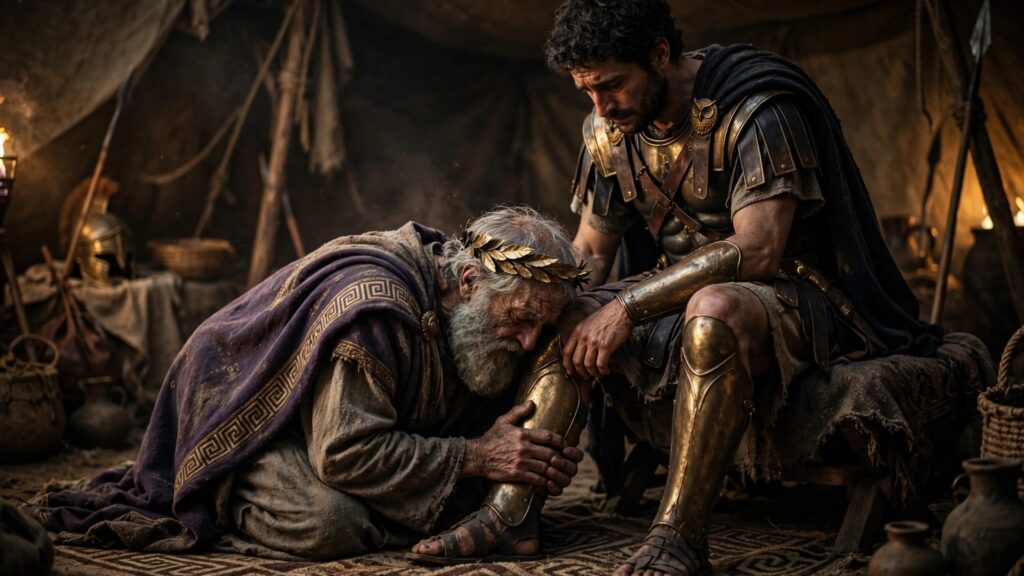
The myth addresses the experience of extreme events with a precision that no abstract account of them can match, because it is built from specific people in specific situations making specific choices whose consequences the tradition then follows without flinching. Cassandra knew and was not believed. Achilles chose and died. Hector fought for his city and lost. Odysseus was clever and suffered anyway. Priam came to his son’s killer and knelt and asked and was given what he came for. Helen went or was taken and neither answer satisfies completely. These are not ancient answers to ancient questions. They are specific, detailed, emotionally complete accounts of experiences that continue to exist: the experience of speaking truth that cannot be heard, the experience of choosing commitment over safety, the experience of fighting for something that is eventually lost, the experience of enduring, the experience of desire that overrides every other consideration, the experience of grief that requires a specific form of encounter with the person who caused it to begin its resolution.
The myth is still here because the experiences it describes are still here. The archaeology at Hisarlik continues because the story is compelling enough to sustain international research funding in 2026. The Iliad and the Odyssey are still read in universities on every continent. Every contemporary retelling of the Trojan War, from novels to films to graphic novels to video games, is a new iteration of the tradition’s oldest argument about what it means to be human in the presence of forces larger than any individual human life.
The city burned. The story of the burning has been generating new light ever since.
At Olympus Estate, Tales from Olympus moves through the deeper currents of the Greek tradition. Every major thread this collection has traced, Achilles’s choice, Cassandra’s ignored truth, the theft of the Palladium, Odysseus’s decade home, Agamemnon’s murder, Aeneas’s founding of Rome, pulls from a single event so large the ancient world needed eight separate epics, the Epic Cycle, to hold it, of which only the Iliad and the Odyssey survive complete. The physical city at Hisarlik is real, excavated continuously since the 1870s and again in 2025, when Professor Rüstem Aslan’s team found a concentrated deposit of sling stones outside the Troy VI palace. But as the British Museum’s Lesley Fitton has put it, it is the myth that leads to the archaeology, not the reverse. Without the Iliad, no one would have gone looking for Hisarlik at all. The city burned around 1200 BCE. The story of the burning has been generating new light for twenty-eight centuries since.