



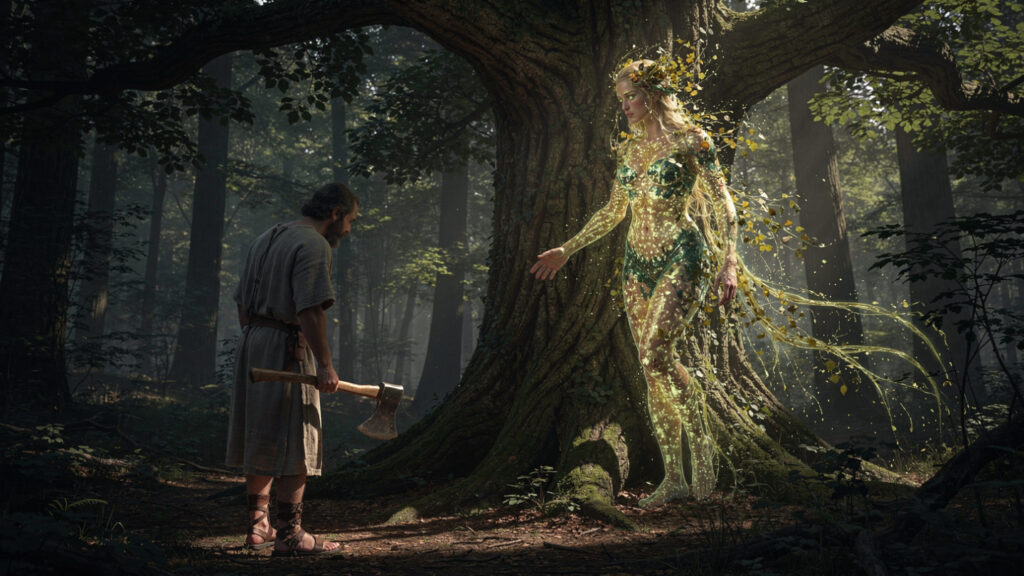
When the ancient Greeks felled a tree, they asked the dryad’s permission first.
This is not a charming folkloric detail about a people who felt generally fond of nature. It reflects a real theological position about what a tree actually was: not an object to be used without consequence, but a living being whose existence was the existence of the divine presence inhabiting it, whose destruction was therefore the destruction of that presence rather than the simple removal of a piece of timber. Hesiod’s Works and Days gives agricultural instruction rooted in exactly this understanding, and the wider tradition around it consistently required the woodcutter to acknowledge the tree’s own presence before the axe fell, to explain the necessity of the felling, to ask permission rather than simply proceed. The instruction was practical rather than sentimental: cutting a tree without that acknowledgment was an act of violence against a divine being, and the consequences of that violence were exactly what any practical person wanted to avoid.
The theology behind this came from the dryads and the nymphs: divine beings whose existence was identified with the natural feature they inhabited, rather than merely associated with it. A dryad did not live in a tree the way a person lives in a house, free to leave once the house becomes uninhabitable. The dryad was the tree, and the tree was the dryad, and felling the tree was the death of the dryad, not the eviction of a tenant. The Homeric Hymns preserve this identification directly in the image of a felled trunk bleeding: the tree bleeds when it falls because the being whose existence was the tree’s existence has been destroyed along with it, and the blood is the blood of that divine being rather than the sap of an ordinary plant.
This theology is the foundation the whole ancient Greek relationship to trees and groves grew from, and understanding it explains why the sacred grove, the temenos of trees surrounding a sanctuary, was the sanctuary’s most essential feature rather than its decorative border. The grove was the divine presence itself. The temple was simply the human structure built at its edge.
The Dodona Oak and the Voice of Zeus
The oracle at Dodona in the Epirus mountains is the oldest oracle in Greece, older than Delphi by several centuries according to the ancient Greeks’ own account, and its mode of prophecy expressed the ancient understanding of the tree as a vehicle of divine communication more directly than any other Greek institution.
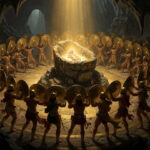
The Dodona oracle operated through a sacred oak grove rather than through a Pythia’s trance. The sanctuary’s priests and priestesses, the Selloi, who slept on the ground and never washed their feet, interpreted the rustling of the oak’s leaves as the voice of Zeus speaking to whoever brought their questions on the bronze tablets excavation has since recovered from the site. The god’s voice was the wind moving through the leaves, and the Dodona priests’ real expertise lay in reading the patterns of that wind as divine communication rather than the ordinary movement of air through foliage.
The choice of oak as Zeus’s chosen vehicle carried its own mythological logic. Oak was the tree most frequently struck by lightning in the ancient Mediterranean landscape, and lightning was the direct expression of Zeus’s power, which made the oak the tree most consistently linked to the divine force he embodied. The tree the god’s thunderbolt most often chose was the same tree through whose leaves the god most reliably spoke.
Homer preserves the Dodona oracle directly in the episode where Odysseus, planning his return to Ithaca, consults it to learn whether he should approach his home openly or in disguise. The question went to the oak grove at Dodona, and the oak’s leaves gave the answer. This is the oldest surviving oracle consultation anywhere in Greek literature, and it belongs not to Delphi, whose elaboration of the oracular mechanism became far more famous, but to Dodona, whose character was direct divine communication through the tree itself.
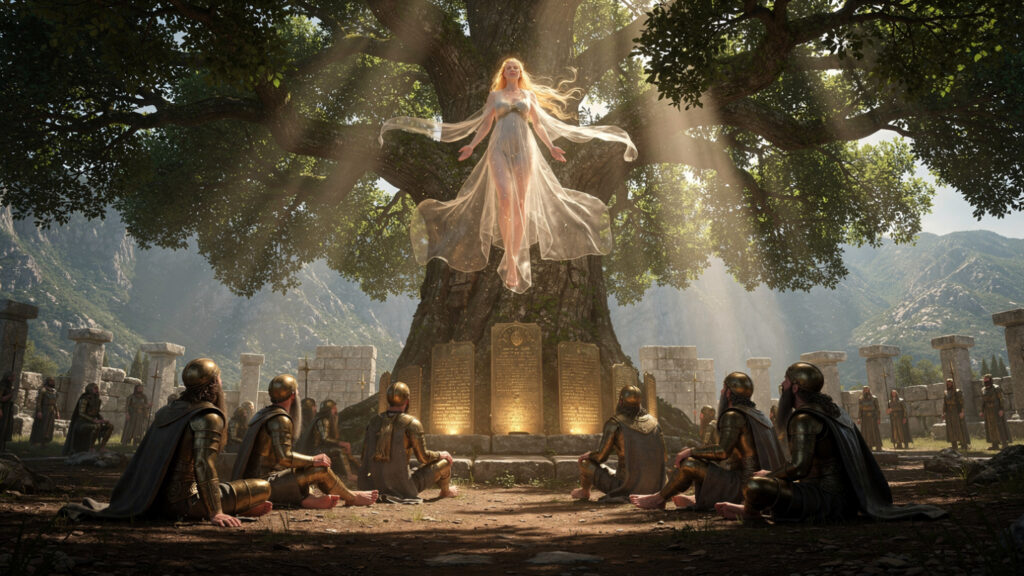
The bronze tablets recovered at Dodona, now held by the Ioannina Archaeological Museum, are the most direct surviving evidence of how the oracle actually operated across the centuries it was consulted: questions about marriage and business and travel and illness, asked by ordinary people who came to the oak grove seeking guidance from the tree’s leaves. The oracle’s democratic accessibility, free of the elaborate purification requirements and professional intermediation Delphi imposed, was a direct consequence of how the oak communicated: a god whose voice was simply the wind spoke to anyone who came to listen, with no mediating apparatus required.
Athena’s Olive | The Tree That Defined a City
The foundation myth of Athens is a tree story.
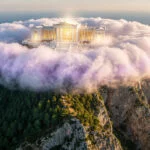
In the contest between Athena and Poseidon for patronage of the city that would take the winner’s name, each god offered a gift. Poseidon struck his trident on the Acropolis rock and produced a saltwater spring. Athena struck the same rock with her spear and produced the first olive tree. The council of the gods, or in some versions the city’s own assembled citizens, including its women, judged Athena’s gift superior: the olive offered nourishment, peace, and the practical abundance of Mediterranean agriculture, while the saltwater spring, impressive as a demonstration of power, served the community’s actual needs far less directly.
The mythological logic pits two divine principles directly against each other: the sea god offering maritime power, the thing that would eventually make Athens great in the military and commercial sense the sea route to empire provided, against the goddess of wisdom offering a tree whose cultivation underpinned the entire Mediterranean agricultural economy, a tree whose cultivation demanded and rewarded patience, knowledge, and sustained attention across the whole span of its long productive life. The city chose the tree. That choice made Athens what it became.
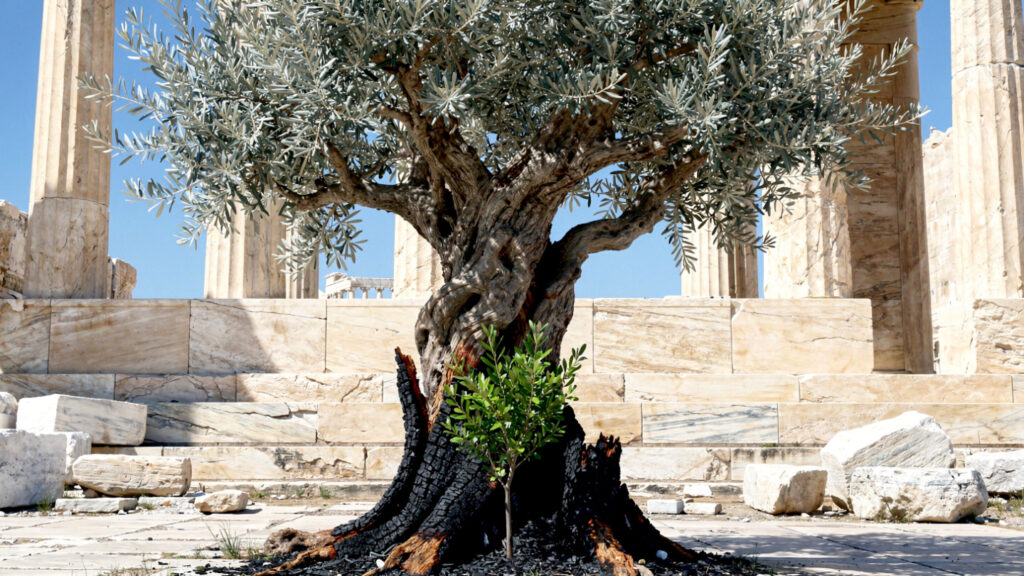
The Athenian sacred olives, the moriai, were olive trees whose origin Athenian tradition traced directly to shoots of Athena’s original gift tree on the Acropolis. When Xerxes burned Athens in 480 BCE, the sacred olives on the Acropolis burned with everything else. But Herodotus, reporting what the returning Athenians actually found, records the miracle: the stump of the burned sacred olive had already put out a new shoot, about two cubits high, in the single day since the fire. The tree that was the goddess’s gift could not be permanently destroyed, because the goddess’s own presence in the city could not be permanently expelled, not even by the Persian invasion.
The moriai were subsequently distributed across Attica as protected sacred olive groves, and their oil supplied the prize for victors at the Panathenaic Games, filling the Panathenaic amphorae that recorded and rewarded the city’s own competitive ideals. This connection between the sacred olive, the goddess’s original gift, and the athletic prize expressing the city’s highest values, was how Athens maintained the most direct, continuous expression of Athena’s presence in its own civic life.
The Laurel and Apollo
The laurel’s connection to Apollo runs from the Daphne myth through the Pythian Games victor’s crown, through the Roman triumph, through the poet laureate of English literary tradition, to the modern honorary degree ceremony where the word baccalaureate still carries the laurel inside it.
Daphne, the nymph who was the object of Apollo’s pursuit, called on her father the river god Peneus to transform her before Apollo could reach her, and became a laurel tree at the moment of transformation. Apollo, his embrace closing on bark rather than the body he had been chasing, declared the laurel sacred to himself and wore it from then on. The mythological logic of the Daphne transformation, which the tragic loves article in this collection develops at length through Ovid’s version, is the logic of a desire that cannot reach its object turning into a permanent sacred relationship with the transformed object instead: Apollo could never have Daphne as a lover, but he wore the laurel forever as the form their relationship was allowed to take.
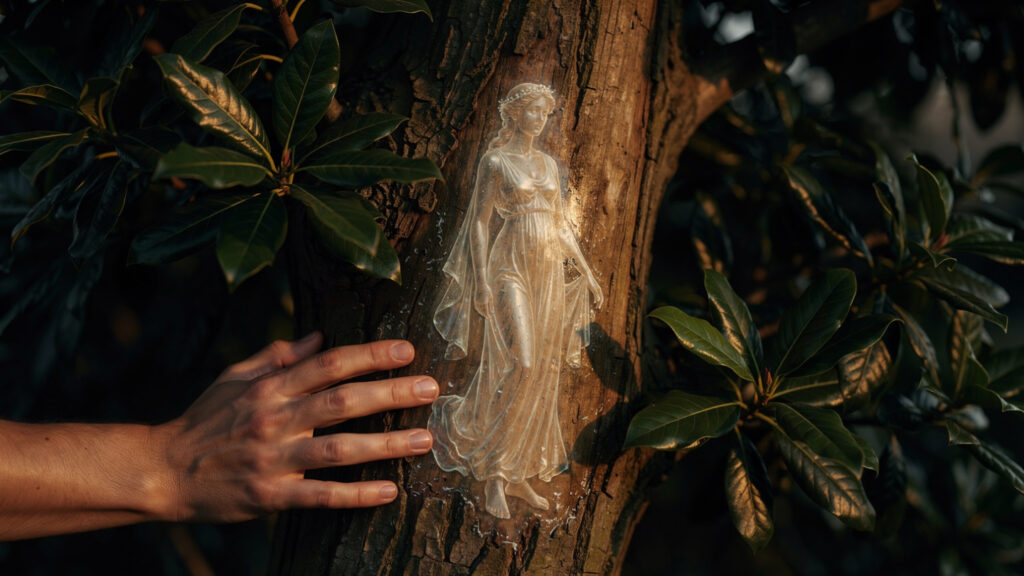
The Pythian Games at Delphi, whose victory prize was the laurel crown rather than the olive, celery, or pine the other Panhellenic games awarded, announced through that prize the divine authority of the god who had founded them: the laurel a Pythian victor wore was the very laurel Apollo wore, and crowning an athletic victor with the god’s own sacred plant identified that victor directly with the divine patron of both the games and the sanctuary that hosted them.
Rome’s adoption of the laurel crown as the symbol of military triumph carried the same Apollonian plant through Rome’s own engagement with the god. The triumphal procession that moved through Rome to the temple of Jupiter Capitolinus placed on the victorious general’s head the very laurel the Greek world had given the Pythian athletic victor, and that both worlds had given to Apollo. The laureate poet of English tradition, the baccalaureate degree of the European university, and the phrase resting on one’s laurels in every language that uses some version of it, all carry forward the Daphne transformation and the Pythian Games, preserved in the medium of a single sacred tree.
The Plane Tree at Gortys
The Europa myth preserved its own tree as the marker of a divine encounter: the evergreen plane tree at Gortys on the southern Cretan plain, under whose shade the union of Zeus and Europa took place, commemorated on Gortynian coinage and understood by ancient tradition as the tree that never shed its leaves because what happened in its shade was too significant to be allowed to pass into the forgetfulness of autumn.
The evergreen plane tree of Gortys encodes something specific about how the ancient Greeks understood a sacred tree’s relationship to the divine event it marked: not a site where something happened and the ordinary botanical world simply resumed afterward, but a permanent living record of the event, its perpetual greenness holding the encounter in a kind of permanent present tense. A tree that never sheds its leaves is a tree that never lets the event recede into the past. It holds the moment in its own refusal of autumn’s usual logic that everything eventually falls.
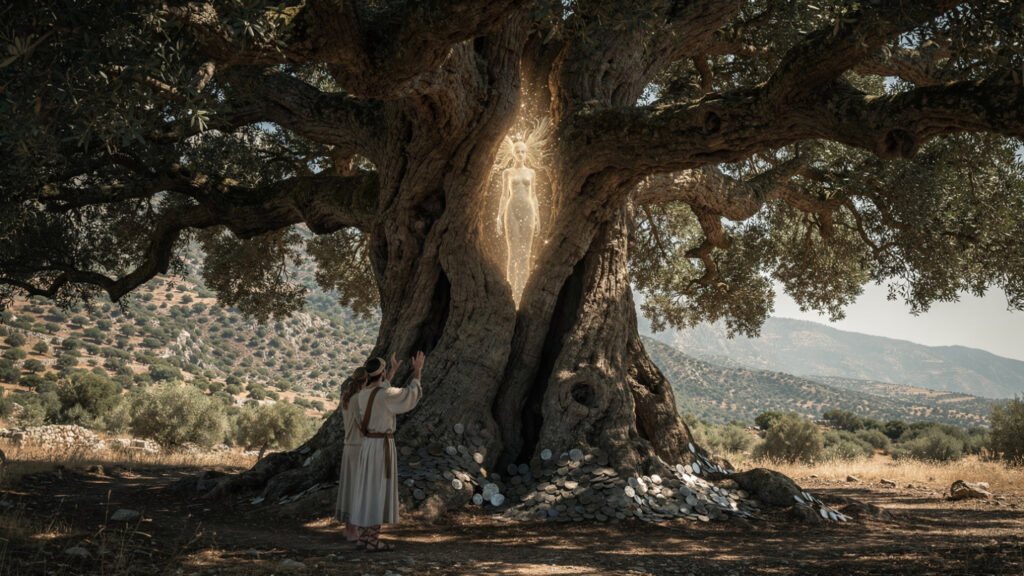
The Europa myth article in this collection develops the Gortynian coinage that commemorated this event in full, along with the two competing Cretan traditions about exactly where the union took place. That a living tree, rather than a stone or a temple, became the chosen memorial reflects a real Greek conviction: the tree was the most fitting monument to a divine event precisely because the tree was itself divine, its living presence the most direct possible expression that the event it marked still mattered.
Folk Customs and Their Ancient Roots
The folk customs around trees the Greek countryside has maintained from antiquity into the present are a living inheritance of exactly the theology the ancient sources document, and the customs reflect those ancient theological positions rather than any generic modern reverence for nature.
The olive branch hung above a newborn’s cradle in certain island communities continues the connection between Athena’s olive and the protection of vulnerable new life. The city’s own sacred tree, born of the goddess’s gift, is the fitting guardian for a human being at their most extreme vulnerability. The olive’s presence above the cradle is the goddess’s presence at the threshold birth itself represents.

Burning laurel in the hearth on New Year’s morning, still practiced in parts of the Ionian islands, continues the purificatory use of Apollo’s own sacred plant: laurel produces an aromatic smoke ancient practice associated directly with divine purification, and New Year’s morning is exactly the threshold moment such purificatory burning was thought to suit best. The prosperity said to rise with the laurel smoke is the prosperity of the god whose sacred plant is providing the purification in the first place.

Walnut leaves placed beneath the bridal bed in Thracian custom carry forward the fertility association the ancient Greeks attached to the walnut in multiple contexts. The walnut’s own botanical character, the way its divided kernel resembles the human brain, together with its connection to the older fertility-goddess cults of the pre-Greek northern Aegean, produced exactly the fertility magic the bridal-bed custom still maintains.

The custom of asking forgiveness before pruning an olive tree, still maintained by older generations in Peloponnesian olive-growing communities, whether or not the full theological conviction survives with it, directly continues Hesiod’s instruction to the woodcutter: acknowledging that pruning requires the tree’s own permission, because the tree was never simply a plant but a presence in real relationship with the person whose action would affect it.
Dodona Today
The archaeological site of Dodona, in the valley south of Ioannina in Epirus, ranks among the most evocative ancient sites in Greece precisely because its setting, an enclosed mountain valley, the low stone walls of the sanctuary, and the particular silence of the valley when the wind drops, communicates so directly what the oracle actually was and how it worked.
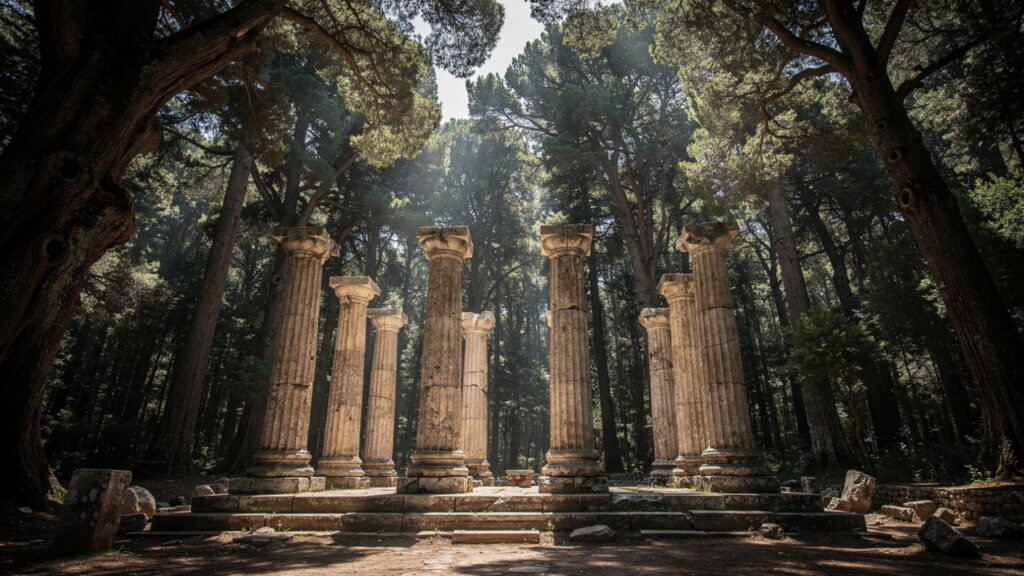
The theater of Dodona, whose seating capacity of roughly seventeen thousand made it one of the largest in the ancient Greek world, was built in the third century BCE by Pyrrhus, king of Epirus, whose military campaigns in Italy and Sicily gave English the phrase Pyrrhic victory. Its presence at the oracle site, the largest theatrical space in the Greek northwest standing beside the sacred oak grove, reflects a consistent ancient pairing of the theatrical and the sacred, the same pairing that placed a theater beside the oracle at Delphi and beside the sanctuary at Epidaurus.
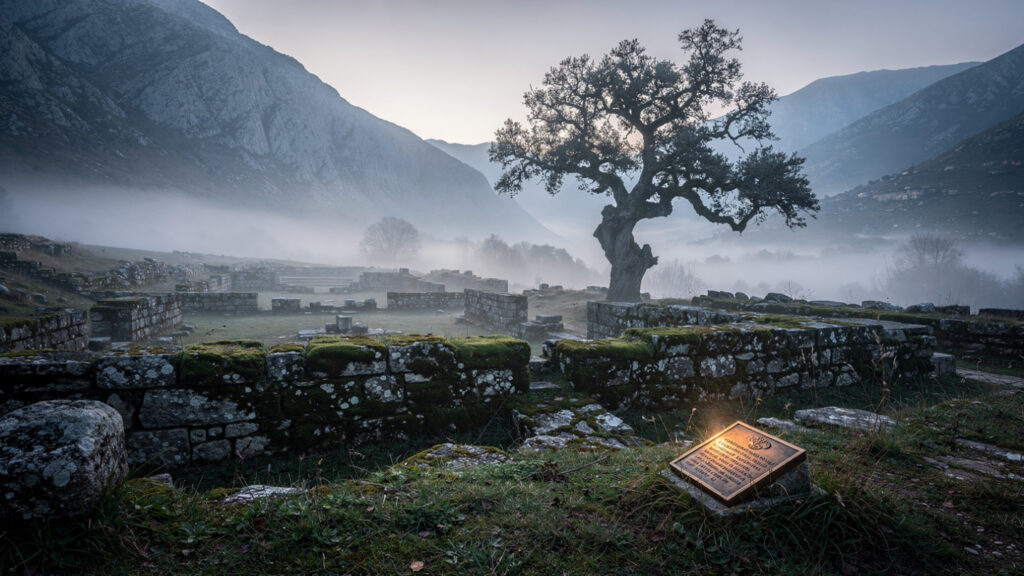
The lone oak standing within the sanctuary’s preserved precinct today is not the ancient sacred oak whose leaves once spoke for Zeus. It is a descendant planting the site’s management maintains as a living marker of what the oracle was. Standing beside it in the early morning, before the tour coaches arrive from Ioannina, in the valley’s own silence and the particular quality of mountain light on the sanctuary walls, is the closest available approximation to what ancient petitioners felt bringing their bronze tablets to the oak grove and waiting for the wind to answer.
The Grove as Sanctuary
The ancient Greek sanctuary’s most essential feature was always the grove surrounding it, not the temple at its center. The temenos, the sacred precinct, was originally simply the grove: a cut-off space, its very name derived from the Greek temnein, to cut, referring to the act of marking the boundary between sacred and profane. That boundary’s sacred character came from the divine presence in the trees, not from any human architectural monument built inside it.
The temple was the human response to the divine presence the grove already embodied: a built structure at the grove’s edge, sheltering the cult image and providing space for the community’s rituals in the presence of the god. The god’s actual presence remained in the trees. The cult image was simply the human representation of that presence, provided for the worshippers’ convenience, since they needed something specific to look at, and the diffuse divine presence filling the whole grove could not by itself give them that focal point.
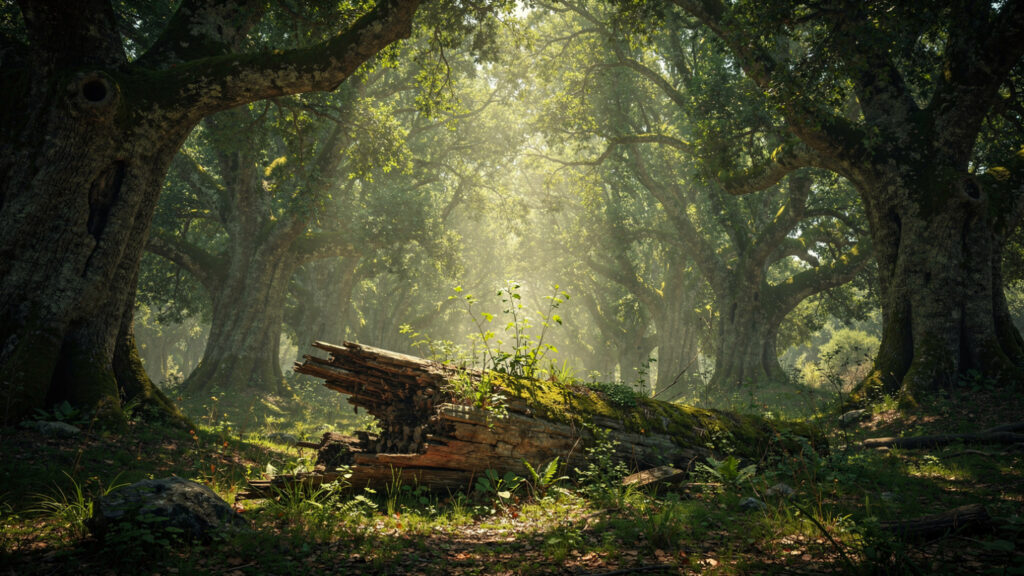
Understanding the ancient Greek temple in this relationship to the grove that preceded and surrounded it means understanding the temple as a human addition to a space that was already sacred before the temple existed, rather than the thing that created that sacredness in the first place. The grove came first. The grove was the reason. The temple was simply the community’s response to what the grove already was.
The natural heritage article in this collection develops the relationship between Greece’s exceptional botanical diversity and the conservation history the ancient sacred grove practice contributed to: trees too sacred to fell survived into the modern period as the old-growth remnants national parks and Natura 2000 zones now protect. The ancient theological prohibition against reckless felling was, in effect, the first conservation measure in the Greek landscape, and its effect across the centuries of Greek civilization left real traces in the old-growth that contemporary conservation now protects for entirely different reasons, but to exactly the same practical effect.
At Olympus Estate, Cultural Chronicles traces the practices and institutions that defined Greek civilization from the inside. The dryad was the tree and the tree was the dryad and the felling of the tree was the death of the dryad. Hesiod told the woodcutter to ask forgiveness before the axe fell. The Dodona oak’s leaves were the voice of Zeus. Athena’s olive resprouted within a day of the Persian burning. The laurel that Apollo wore became the laurel that the Pythian victor wore became the laurel that crowns the laureate poet became the baccalaureate degree. The sacred grove was the sanctuary before the temple existed. The tree was divine before anyone thought to build beside it. Greece has known this for three thousand years. The rural communities that still ask forgiveness before pruning know it still.