



We gave the Greek gods everything.
Immortality. Strength beyond any mortal reckoning. The power to reshape weather and war and the human heart. Bodies that did not age, did not tire, did not bleed in ways that could not be healed. We gave them Olympus, which was not a mountain so much as a condition: the state of being permanently beyond the reach of the things that diminish ordinary life.
And then, with what looks very much like deliberate intent, we gave them grief.
Not the grief that passes. Not the manageable sorrow that mortals learn to carry until it becomes part of the ordinary weight of a life and no longer registers as unbearable. We gave the gods grief that had nowhere to go. Loss that could not be resolved by time, because the gods did not experience time the way their mourning required. We gave immortal beings the one experience that immortality made not easier but inescapable.
A mortal who loses someone they love will, in time, die too. The grief will end, if only because everything ends. There is a mercy in this that nobody who is suffering can access, but that the long view of a human life reveals: the wound closes, or the one who carries it stops carrying it, and either way the story finishes.
A god who loses someone carries that loss permanently. There is no end coming that will resolve it. The grief does not soften into memory because nothing in the divine experience is required to soften. Athena did not eventually stop thinking about Pallas. Apollo did not eventually stop seeing Hyacinthus in the flowers that bore his name. Demeter did not eventually make peace with the fact that her daughter belonged to the underworld for a portion of every year.
The Greeks understood this with extraordinary precision. They built divine grief into the architecture of their mythology not as a weakness in the gods but as an explanation for the world. Every change in the natural order, every flower that bloomed from a god’s sorrow, every season that shifted because a goddess had lost someone, was evidence that the divine beings who governed the cosmos were not above loss.
They were defined by it.
Athena and Pallas | When Wisdom Carries Guilt
We begin here because the story, examined carefully, contains the entire argument of this article in compressed form.
The death of Pallas is the foundational grief of the Greek mythological tradition. Not the most dramatic, not the most catastrophic in its consequences, but the most structurally revealing: it tells us, with the precision of a theorem, what divine grief looks like when it is fully inhabited rather than performed.
Athena killed her friend by accident. They were sparring, as they had sparred many times, and Zeus intervened with the aegis at the wrong moment, and Athena’s blow landed on Pallas when Pallas could not defend herself. The moment was irreversible before it was understood.
What Athena did next is what distinguishes this grief from ordinary mourning.
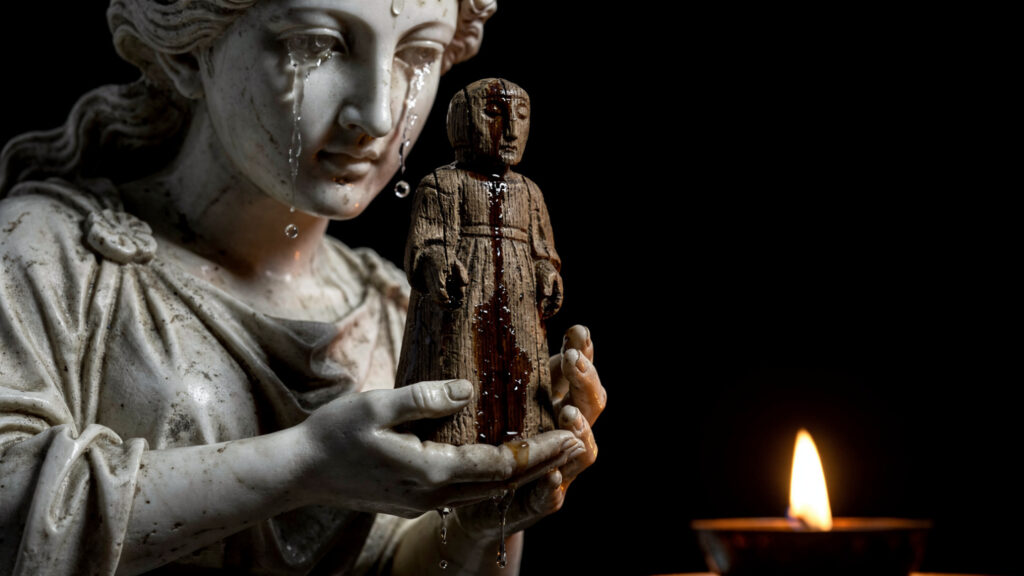
She did not perform it. She did not weep in the manner that Homer’s heroes weep, loudly and publicly, calling on witnesses. She made something. She carved the Palladium in the image of the friend she had killed, dressed it in the aegis, washed it with tears that the sources describe as genuinely divine in their quality, tears that transferred something of Athena’s grief into the wood itself and made the statue a vessel of protective attention.
Then she took the name. Pallas Athena. The dead companion carried forward in the very identity of the goddess who had caused the death.
Think about what this means for the goddess of wisdom.
Wisdom, in the Greek understanding, is not the absence of error. It is the capacity to respond to error with something other than denial or paralysis. Athena could not undo what she had done. The Palladium was not an undoing. It was an acknowledgement: I caused this, I cannot reverse it, I will carry it in a form that transforms it from pure loss into something that protects.
Every city that placed the Palladium at its centre was, without knowing it, placing Athena’s guilt at its centre. Every wall built under the statue’s protection was built, ultimately, by the attentiveness of a goddess who had learned, through the worst possible lesson, what it costs when protection fails.
Guilt transformed into guardianship. Loss carried forward as the source of the very quality that made the goddess indispensable. This is the first shape that divine grief takes in Greek mythology.
Apollo and Hyacinthus | The God Who Abandoned the Centre of the World
Ask someone to name a Greek god associated with grief and they will almost certainly not say Apollo.
This is understandable. Apollo is the god of light and reason and the oracle and the perfectly calibrated arrow. He is the god of clarity, of the world made legible, of the ordering principle that structures the cosmos. He is, in the standard account, the least susceptible of all the Olympians to the kind of emotional turbulence that produces grief.
And then there is what he did for Hyacinthus.
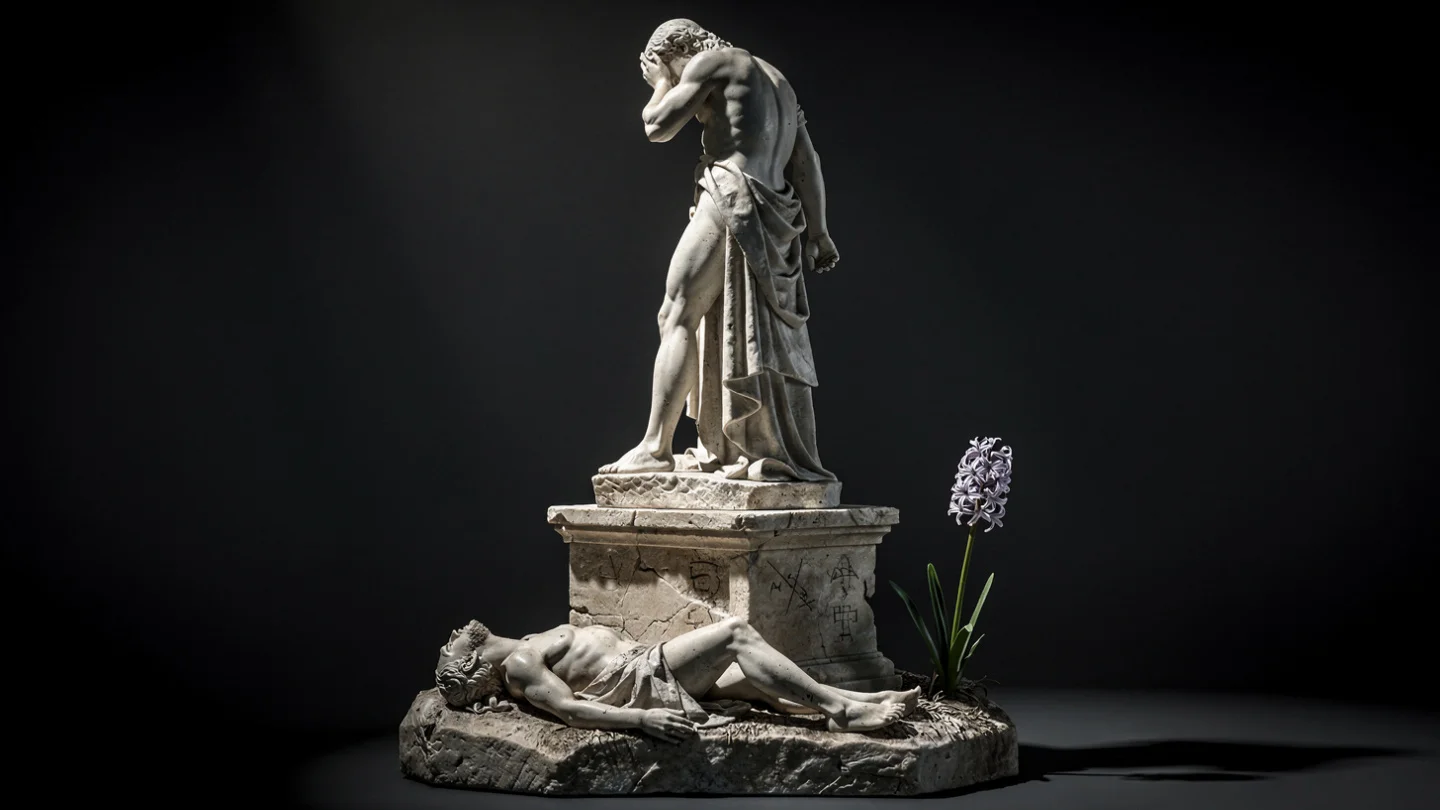
Apollo left his temple at Delphi, the centre of the world, unattended. He went into the hills of Sparta carrying hunting nets and following Hyacinthus’s dogs, serving as the boy’s companion through the fields and mountains, forgetting his lyre and his oracle for the sake of being near a Spartan prince of extraordinary beauty who had inclined his heart toward the god of light over every other divine claimant.
This detail is the one that makes what followed fully comprehensible. A god who would abandon the most sacred site in the ancient world, the address where the ancient Mediterranean brought its most consequential questions, to carry hunting nets through the Laconian hills for a mortal: that god was already as exposed to loss as a god can be.
On the day Hyacinthus died, they were throwing the discus at noon, at the midpoint between day and night, when the sun reaches the apex of the sky. The accounts of what happened next diverge: in the earliest sources, including Apollodorus and fragments of Hesiod, the death is a straightforward accident, the discus rebounding from the ground and striking Hyacinthus in the head, the wound beyond even the god of medicine’s capacity to heal. In later sources, Zephyrus the west wind appears as a jealous rival who deflected the throw, the murder-of-passion narrative giving the jealousy of gods for each other a lethal expression. What does not vary across any version is the outcome, and what does not vary is what Apollo did next.

Philostratus the Elder, describing an ancient painting of the moment, wrote: Apollo with averted face is still on the thrower’s stand and he gazes down at the ground. You will say he is fixed there, such consternation has fallen upon him.
The god of clarity and light, frozen on the thrower’s stand. Face averted. Looking at the ground. Unable to move from the position from which the throw had been made, unable to look at what the throw had produced, unable to do what the god of medicine had the capacity to do for anyone else in the world but could not do here.
He held Hyacinthus as he died and tried everything he knew. The sources that record this moment describe a desperation entirely uncharacteristic of the god of measured calm: the undoing that comes when a being discovers that the domain that defines them, the capacity for light and order and healing, cannot reach the one loss they are experiencing. Apollo was, in that moment, exactly as helpless as any mortal who has held a dying person and applied every available skill to no effect.
When Hyacinthus died, Apollo transformed him into the flower that bears his name, inscribing on its petals the sounds of mourning, AI, AI, his lament visible on every petal of the bloom, the grief made permanent, made returnable, made visible every spring.
The Spartans built a cult at Amyclae whose architecture encoded the grief in stone. The great statue of Apollo at Amyclae stood on an altar-like pedestal. Beneath the pedestal was the tomb of Hyacinthus. The boy was buried under Apollo’s own statue: the mourner standing permanently above the mourned, the grief made architecturally literal, every suppliant who came to Apollo at Amyclae standing at the site of the grief without necessarily knowing it was grief they were standing on.
The Hyacinthia, the three-day festival at Sparta commemorating Hyacinthus, was one of the most significant religious events in the Spartan calendar. On the first day, the people mourned: no garlands were worn, no bread was eaten at the sanctuary, the songs were without joy. On the second and third days, the tone shifted to celebration, games and processions and choral singing and the weaving of a robe offered to Apollo. The festival moved from grief to celebration in the same sequence that the myth moved from loss to transformation: mourning first, then the resumption of what the world requires.
What does this grief do to Apollo?
It sits inside his role as the god of prophecy with a weight. Apollo knows the future. He knew, in the way that the god of oracles always knows, that love between a god and a mortal ends one way. He left Delphi anyway. He carried the hunting nets anyway. He stood on the thrower’s stand and threw the discus anyway. The god of certainty chose a love he knew would be lost, and carried the loss in the flower that blooms in his own season, and in the tomb under his own statue, and in the annual festival whose first day requires mourning before celebration can begin.
Demeter and Persephone | When Loss Becomes the World
The grief of Demeter is the only divine grief in the Greek tradition that changed the physical structure of the world.
Every other divine loss stays within the god who carries it, expressing itself through a transformation of the lost person or an alteration of the grieving deity’s behaviour or domain. Demeter’s grief did something different. It withdrew the fertility of the earth. It produced winter. It killed the crops and dried the rivers and brought the human world to the edge of extinction, not as punishment but as the natural consequence of a mother’s anguish so total that the capacity for growth itself switched off.
This is worth sitting with.
The Greeks were not simply explaining why winters happen. They were making a claim about the relationship between divine grief and the physical world that goes considerably further than poetic metaphor. They were saying: when a god is in mourning, the world mourns with it. The grief is not contained inside the divine consciousness. It radiates outward into the natural order, and the natural order responds with the only language it has, which is the language of cessation and return.
Demeter did not decide to punish the world for what had happened. She was simply, in her grief, unable to do what she had always done. The earth went cold because the goddess who maintained its warmth had stopped maintaining it. The crops died because the goddess who sustained them had turned inward, toward the place where her daughter had gone, and could not be reached.
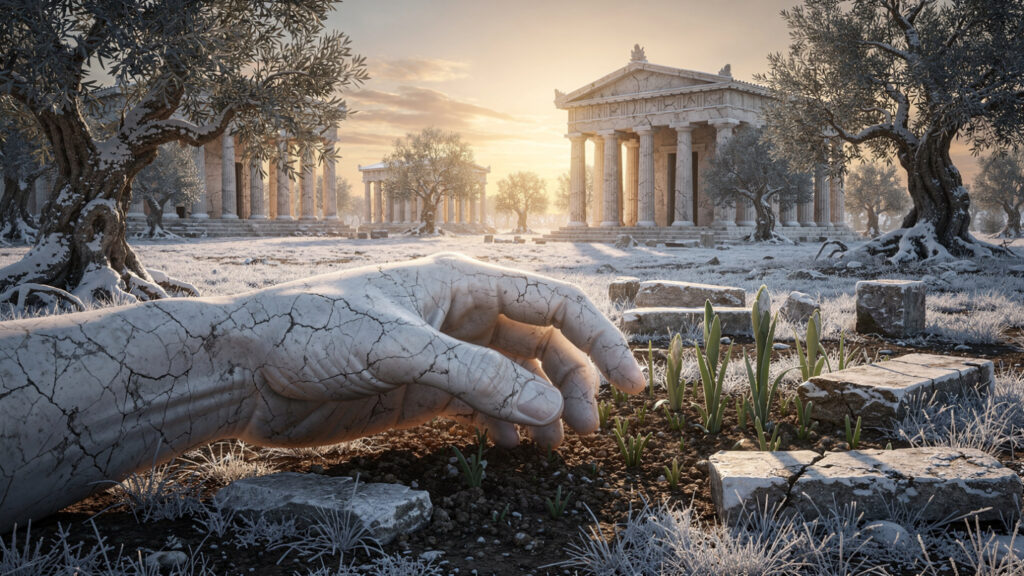
This is, as anyone who has experienced serious grief knows, one of the most accurate descriptions of mourning in the entire mythological tradition. Grief does not announce its withdrawal of capacity. It simply withdraws it. The things that used to be maintained without effort stop being maintained. The warmth goes out of things not because you want it to but because you no longer have the resources to generate it.
Zeus, watching the world freeze, was not dealing with a goddess who had chosen to act. He was dealing with a goddess who had stopped being able to. The negotiation that produced the seasons, Persephone divided between the upper and lower worlds, was not a punishment or a compromise so much as a practical accommodation of what Demeter’s grief had revealed: that the world could not function if the mother’s loss remained absolute.
The seasons are the shape of Demeter’s grief given permanent form in the structure of time. Every winter is a god who cannot maintain warmth. Every spring is the return of what makes maintenance possible again. The world runs on the emotional economy of its divine caretakers, and when those caretakers grieve, the world shows it.
Eos and Memnon | The Grief That Made Morning
Not every divine grief is as well known as Demeter’s. Some of the most interesting operate quietly in the background of the mythological world, shaping the natural phenomena that everyone experiences without thinking about their origin.
Eos is the goddess of dawn. Her role is simple and perpetual: she opens the gates of the sky each morning to allow the sun to rise, riding in her rose-fingered chariot across the horizon before Apollo follows with his brighter light. She is one of those deities who tend to be appreciated for their function rather than examined for their interiority.
Her son Memnon was the king of Ethiopia and one of the great warriors of the Trojan War, fighting on the side of Troy in the final phase of the conflict. He was killed by Achilles in single combat, and the accounts describe it as one of the war’s most consequential moments: a hero of genuine stature whose death diminished both sides of the conflict.
Eos wept for her son.
And her tears became the morning dew.

Every morning when you see the dew on the grass in the hours before the sun has dried it, the Greek tradition is telling you that you are looking at the grief of a goddess for a son killed in a war three thousand years ago. The dew does not stop. The morning does not begin without it. Eos carries her grief into every dawn she has opened since the day Achilles killed Memnon, and the world receives it as moisture on the grass without knowing what it is looking at.
This is the third shape divine grief takes: not guilt made into guardianship, not love persisting through natural transformation, but loss embedded so permanently into the daily rhythm of the world that it becomes invisible through repetition. The grief that is too constant to be noticed any longer as grief, only as the ordinary condition of a morning.
Hephaestus | The Grief Nobody Names
Here is a divine grief that the mythological tradition almost never describes as grief, though it is one of the most formative wounds in the entire Olympian story.
Hephaestus was thrown from Olympus.
The accounts differ on who threw him and when and why. In one version, Zeus cast him out in fury during a dispute. In another, Hera threw the infant Hephaestus away because he was born lame and she was ashamed of him. The details shift. What does not shift is the essential fact. The god of the forge, the craftsman of the divine world, the creator of Achilles’ armour and Hermes‘ winged sandals and Aphrodite’s enchanted girdle and the very throne of Olympus itself, began his existence by being rejected.
He landed on the island of Lemnos. He was taken in by the people there and he built his forge and he worked. Everything the gods wore and sat on and carried into battle came from his hands. He was indispensable to the divine world in a way that none of the radiant Olympians were, because they could not make what he made. And he had been thrown away before he had made anything.
The grief of Hephaestus never appears in the mythological record as grief. It appears as work.
The armour he made for Achilles was so detailed, so completely realised as a vision of the human world, that Homer’s description of it in the Iliad occupies nearly an entire book of the poem. Scholars have written about that passage as one of the greatest pieces of descriptive writing in the Western tradition. What it is, if you read it knowing who made it and why, is the work of a god who had been told by his own mother that he was not good enough to keep, and who spent his entire divine existence proving, through the only language available to him, that he was more than good enough.
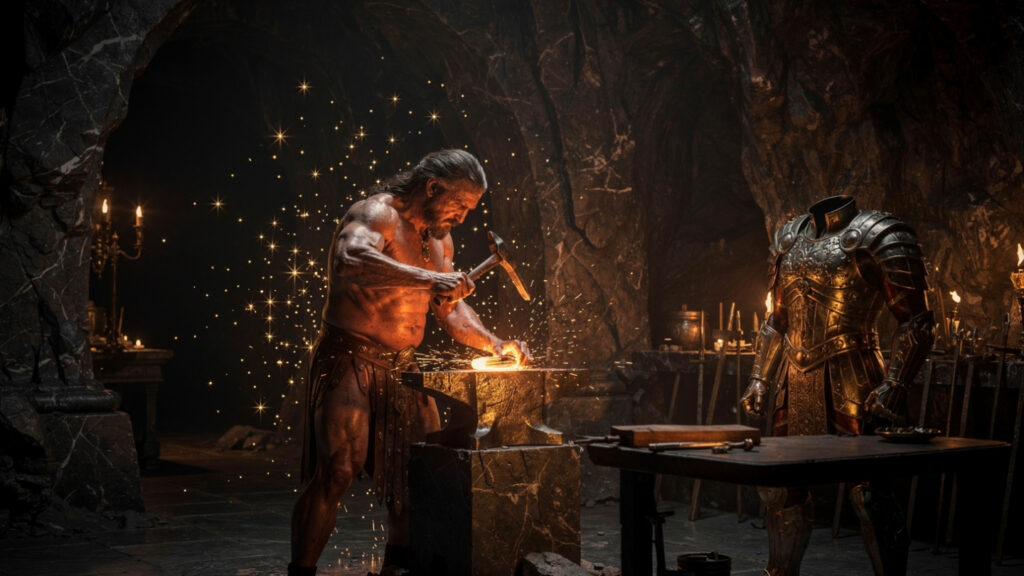
This is the grief that does not announce itself. It appears as productivity, as perfectionism, as the compulsion to make things more beautiful than they need to be, as the inability to stop working because stopping means confronting what the work is compensating for. The Greeks built into his story every structural feature of the wound that comes from being rejected by the people who were supposed to keep you, and then they watched what a person does with that wound when they have centuries of divine time to do it in.
What Hephaestus did was make things. Perfect things. Things that the world needed and that only he could produce. If that is not grief transformed into purpose, the mythological tradition has nothing else to offer on the subject.
What Divine Grief Does That Mortal Grief Cannot
By now a pattern has emerged across these stories that is worth naming directly.
Mortal grief, in the Greek understanding, does one of three things: it resolves over time into manageable memory, it destroys the person who carries it, or it is interrupted by the death of the person carrying it. These are the only available outcomes in a life that has an end.
Divine grief has a fourth option.
Because the gods do not die and do not, in any meaningful sense, resolve or diminish, their grief has to go somewhere. It cannot simply be absorbed. It cannot be waited out. It must be transformed into something that the divine capacity can sustain across an unlimited timeline.
What the Greek tradition shows us, in story after story, is that divine grief transforms into the thing the grieving god is responsible for maintaining. Athena’s guilt becomes guardianship. Apollo’s love becomes the flower that returns each spring, the tomb beneath the statue, the festival that begins with mourning before it allows celebration. Demeter’s loss becomes the structure of the seasons. Eos’s mourning becomes the moisture on the morning grass. Hephaestus’s rejection becomes the craft that sustains the divine world.
In each case, the transformation is not a resolution. The grief is not gone. Athena is still Pallas Athena. Apollo’s discus throw is still visible in the flower, still present in the architecture at Amyclae, still rehearsed each spring in the Hyacinthia’s first day of mourning. Demeter still withdraws in winter. Eos still weeps every morning. Hephaestus still works with the particular intensity of someone who has something to prove to a person who is not listening.
The grief persists. What changes is its direction. It moves from inward devastation to outward expression, finding a form that the god’s domain can hold and that the world can receive.
This is the most sophisticated thing the Greeks ever said about grief. Not that it passes. Not that it can be overcome. But that it can be redirected into the activity of a life, that it can become the source of the very qualities that make a person, or a god, worth attending to.
What the Mortals Who Watched Understood
The Greeks who built this mythology were not simply telling stories about gods. They were observing something about how loss works in a life and encoding the observation in the only form available to them: the form of a divine narrative that could be transmitted across generations.
They watched human beings carry grief and they noticed that the ones who emerged from it, not unchanged, not undiminished, but still functioning, still capable of their characteristic activities, were the ones who found a way to redirect what they carried. The craftsperson who returned to the forge after a loss and made something better than they had made before. The farmer who, after a devastating season, learned something about the soil that a successful season would never have taught. The person who lost a companion and became, in the absence of that companion, more attentive to the world around them.
The Greeks placed this pattern in the bodies of the gods so that it would be available to the mortals who needed it. Not as instruction exactly. Not as comfort in the direct sense. But as evidence: look, even the immortals who have everything carry something that cannot be resolved. Even Athena kills her best friend by accident. Even Apollo abandons the centre of the world for a love he knows will end badly. Even Demeter loses her daughter to a world she cannot follow her into.
And then they go back to work. They maintain what they are responsible for maintaining. They transform the loss into the quality of their attention, and the world is changed by that attention in ways that would not have been possible without the loss.
This is what divine grief does that mortal grief cannot: it makes the pattern visible across a timeline long enough to see it whole. The gods grieve in ways we can observe from outside the grief, which means we can see what the grief produces, which means we can understand something about our own losses that we cannot see from inside them.
Athena is still Pallas Athena.
That is the most important sentence in this article, and it belongs at the end rather than the beginning because it takes everything that comes before it to make it mean what it means.
She did not choose that name as a strategy. She did not decide to honour her friend in a calculated act of mythological branding. She took the name because the name was the only honest account of who she had become in the moment of Pallas’s death. The goddess of wisdom, who had failed to protect the one person she was closest to, carrying that failure in her own identity forever.
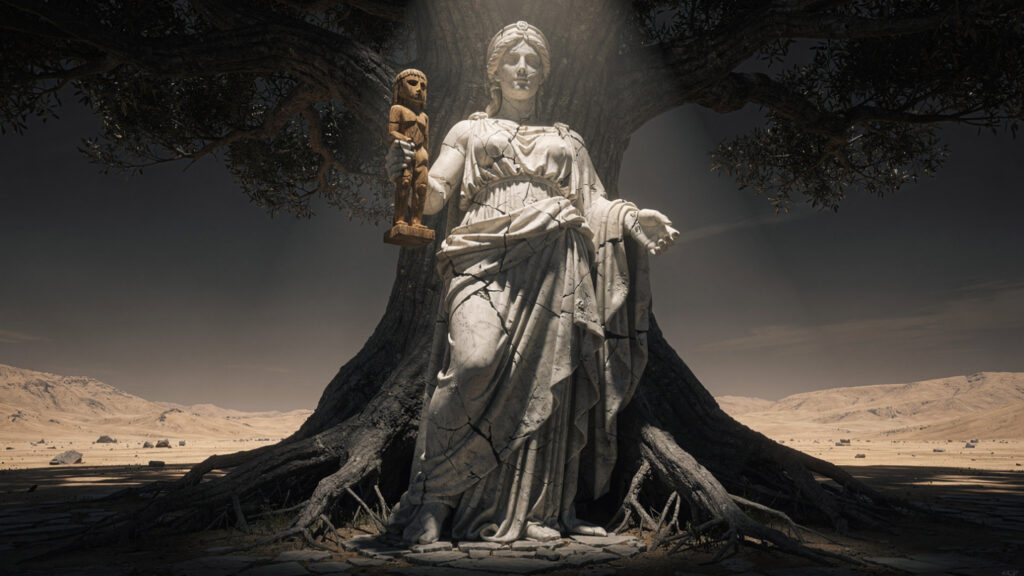
And because of that failure, and because of the Palladium that grief produced, and because of the quality of attention that a god who has experienced catastrophic loss brings to the task of protection, every city that placed itself under Athena’s guardianship was placing itself under the care of a grief that had been transformed into the most thorough protectiveness in the divine world.
Apollo stood frozen on the thrower’s stand at noon with his face averted, unable to look at what he had done, while Hyacinthus lay on the discus below him. He stands there still in the account that Philostratus preserved. And every spring, in the hills above Sparta, the flower that carries his lament returns.
You did not get the perfect, unwounded Athena. You got the Athena who knew what it cost when protection failed. You did not get the Apollo who had never chosen a love he knew would end in loss. You got the Apollo who chose it anyway and carried the consequence in the flower’s inscription forever.
The gods keep going. They make things. They name themselves honestly. They transform, over time, in the long work of a life that does not stop because it has been wounded.
What they become, because of what they carry, is indistinguishable from wisdom.
At Olympus Estate, Mythic Essays moves through the deeper currents of the Greek tradition. We gave immortal beings the one experience that immortality made not easier but inescapable. Athena killed her friend by accident and carved the Palladium and took the name. Pallas Athena. The dead companion carried forward in the very identity of the goddess who caused the death. Apollo left Delphi unattended to carry Hyacinthus’s hunting nets through the Laconian hills. He stood frozen on the thrower’s stand with his face averted and could not move. The tomb of Hyacinthus is beneath Apollo’s own statue at Amyclae. Demeter did not decide to punish the world. She simply stopped being able to maintain it. The earth went cold because the goddess who maintained its warmth had stopped maintaining it. Eos weeps every morning and the dew on the grass is her tears for Memnon. The grief of Hephaestus never appears as grief. It appears as work. The gods keep going. They transform what they carry. What they become because of what they carry is indistinguishable from wisdom.