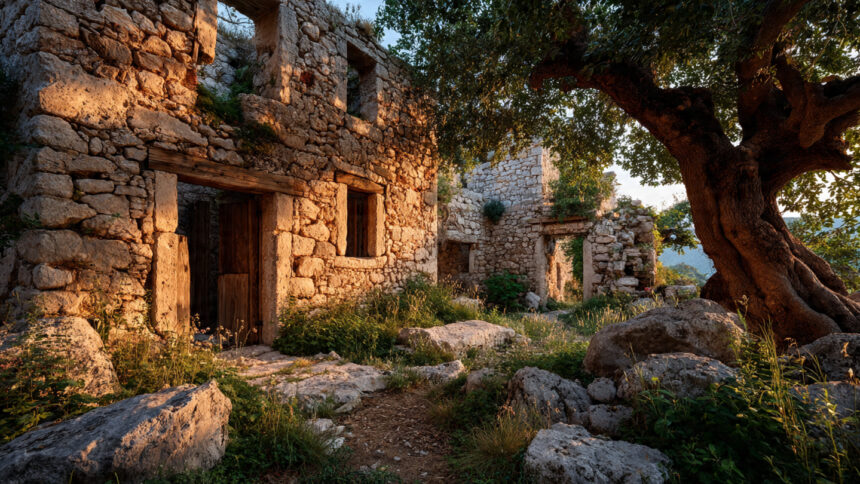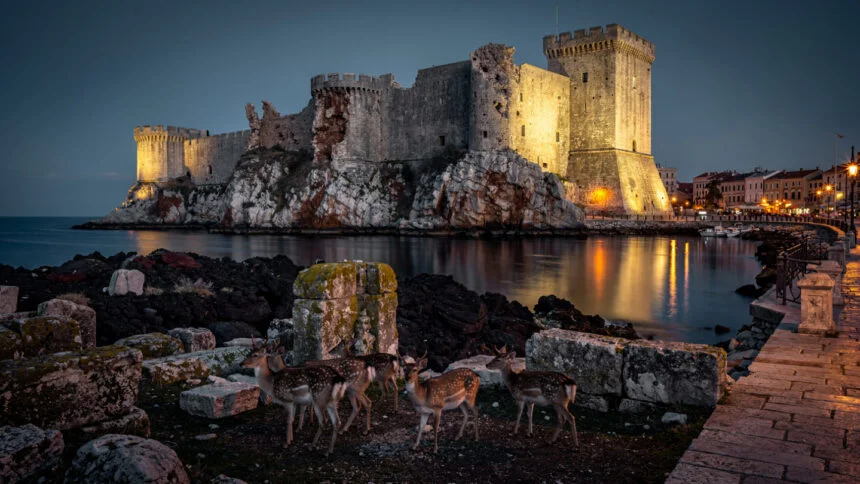


The mountain was already there before anyone decided it was the home of the gods.
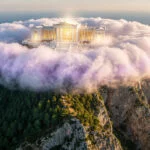
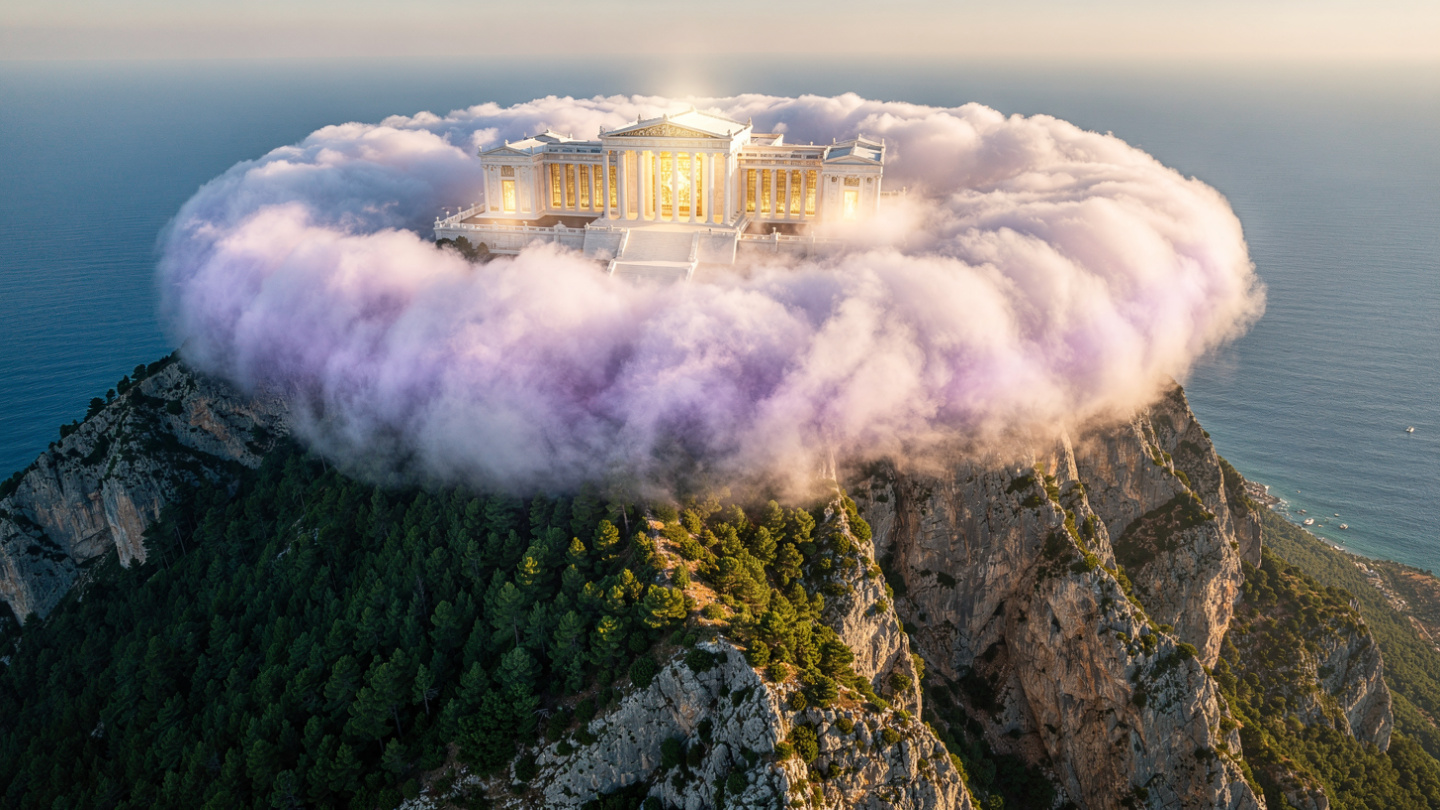
Mount Olympus rises to 2,917 meters in northern Greece, on the boundary between Macedonia and Thessaly, its highest peak, Mytikas, standing above the permanent cloud layer that gives the summit its quality of invisibility from the plains below. For most of the year, the peak is in cloud or snow. The mountain has the character of terrain that stands above the threshold where ordinary weather systems operate: its upper ridges exist in a different atmospheric condition from everything below, simultaneously present in the same landscape and inaccessible to ordinary human movement through it.
The ancient Greeks looked at this and understood. The mountain that was always above the cloud layer, that snow-covered in winter and cloud-covered in summer, whose summit no ordinary person could reach, was the mountain whose summit the gods inhabited. The decision to place the divine court on Olympus was not arbitrary. It was the recognition that the mountain was already occupying the boundary between the accessible world and the world beyond access, and that the beings who occupied the inaccessible part of the world were the right beings to inhabit it.
This article is Olympus Estate’s account of the myths that gave the mountain its second identity: the stories that the ancient Greek world built around the fact that the most visible mountain in northern Greece was also, for most of the year, the most invisible in its highest reaches. These myths shaped Greek civilization, Greek thought, and the inherited vocabulary of Western culture so thoroughly that understanding them is not an act of historical study. It is an act of self-knowledge, for anyone whose intellectual and cultural inheritance includes Greece.
The Mountain Before the Gods
Before Olympus became the throne of the divine court, before the Olympians displaced the Titans and established their order, the mountain belonged to the older cosmological structure that the Theogony of Hesiod describes.
The Titans, the generation of divine beings that preceded the Olympians, were themselves the children of Ouranos and Gaia, the sky and the earth, the two primary forces that the Greek cosmological imagination placed at the foundation of everything. The Titans did not inhabit Olympus in the way the Olympians would: they were not localized in the geography of a single mountain but distributed across the cosmos in the way that primordial forces are distributed, present everywhere rather than resident somewhere.
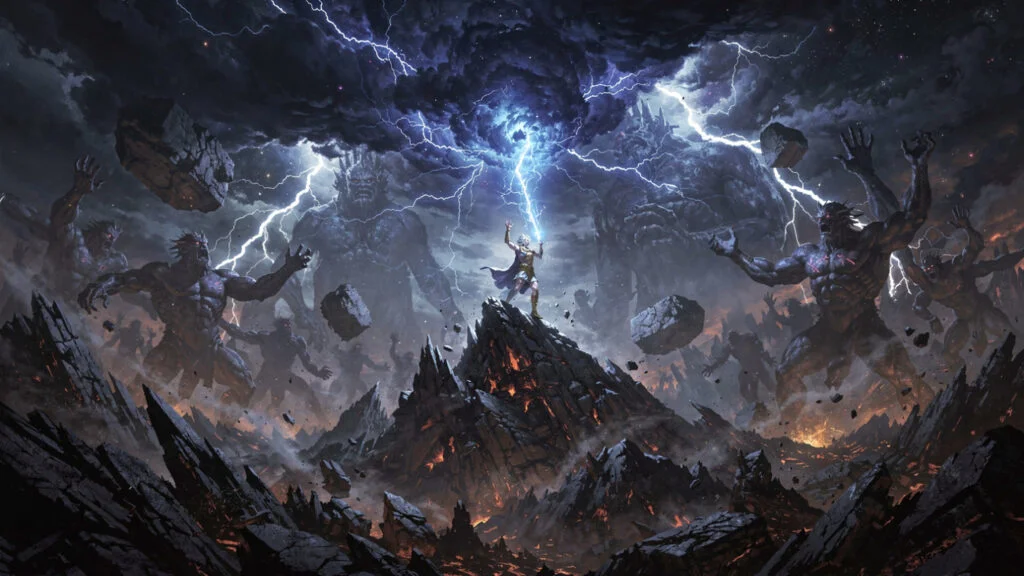
The Titanomachy, the war between the Titans and the Olympians that Zeus led to establish the new divine order, was fought over ten years and decided by the intervention of the Hecatonchires, the hundred-handed giants, whom Zeus released from Tartarus to fight on the Olympian side. The victory established Zeus as the king of the gods and established Olympus as the court from which the new divine order would govern the cosmos. The Titans were confined to Tartarus. The mountain became the residence of the gods rather than merely the highest point of the landscape.
This cosmological sequence matters for understanding what the Olympus myths are. They are not simply stories about supernatural beings with human personalities. They are the Greek civilization’s account of how the world’s governing order was established, through conflict, through the displacement of older forces by newer ones, through the qualities of intelligence and power that Zeus brought to the final struggle. The divine court on Olympus is the consequence of a historical event in mythological time, and the stories that unfold there inherit the weight of everything that preceded them.
Zeus and the Architecture of Divine Order
Zeus does not arrive at the throne of Olympus by inheritance. He arrives there by overthrowing his father.
Kronos, the Titan who ruled the previous divine order, had received a prophecy that one of his children would overthrow him, as he had overthrown his own father Ouranos. His response was to swallow his children as they were born: Hestia, Demeter, Hera, Hades, and Poseidon were all swallowed by Kronos before Zeus was born. Rhea, their mother, concealed Zeus’s birth by substituting a stone wrapped in swaddling clothes for the infant, which Kronos swallowed without inspecting it too closely, and raised Zeus in Crete until he was strong enough to act.
Zeus returned, compelled Kronos to vomit up his swallowed siblings, and with them fought the war against the Titans that ended with the Olympian order established. The distribution of cosmic domains that followed the victory defined the structure that the subsequent mythology operates within: Zeus took the sky, Poseidon the sea, Hades the underworld. The earth and Olympus were common ground, shared among all the gods rather than allocated to any individual deity.
The quality of Zeus’s authority is intelligence as much as force. He is the god who governs through the reading of the situation and the application of the most effective response to it, which is not always the most direct response. He is the deity who weighs fates on golden scales in the Iliad, who reads the structure of what is happening rather than simply imposing his will on it. His authority is legitimate not merely because he won the Titanomachy but because he governs in accordance with the Moirai, the Fates, whose threads he reads rather than overrides.
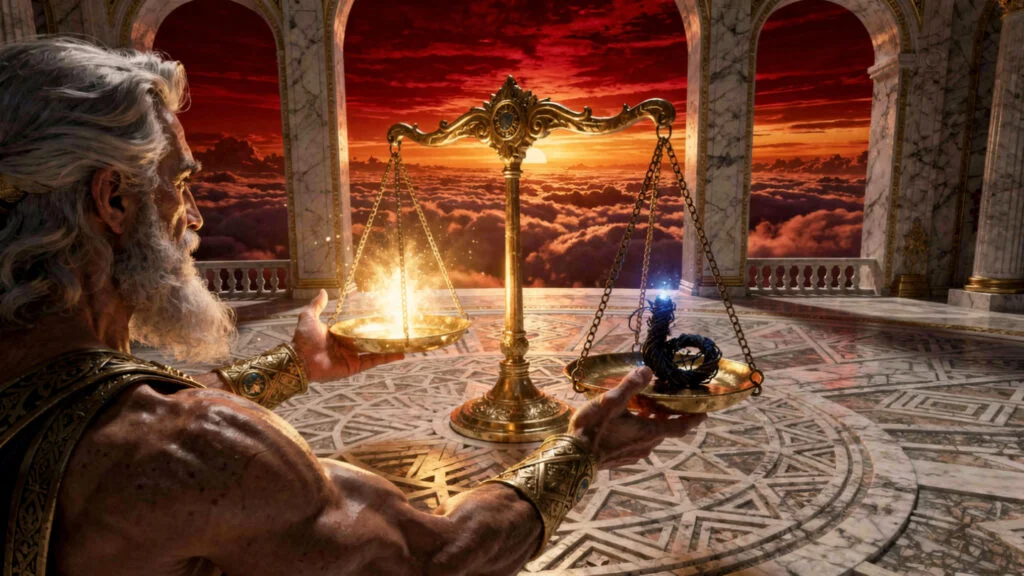
The limitations of Zeus’s authority are as significant for the mythology as the extent of it. He cannot prevent the death of his son Sarpedon at Troy because the Fates have determined it. He cannot entirely control the other Olympians, who pursue their own agendas through the mortals they favor. He is the most powerful figure in the divine court, but he operates within a structure that precedes his authority rather than being the source of it. The Greek divine order is not an autocracy. It is a court of powerful personalities governed by structural forces that even the most powerful of them must ultimately defer to.
The Court and Its Members
The twelve Olympians who inhabit the divine court are not a random collection of powerful beings. They are a structured ensemble, each occupying a domain that the ensemble as a whole requires, each embodying a quality of the world that the others cannot provide.
Hera, the queen of the gods and the goddess of marriage, embodies the institutional form of the most fundamental human bond. Her jealousy in the myths is not a character flaw imposed on an otherwise admirable deity. It is the response of the principle of marital loyalty to the constant violation of that principle by the god she is married to. Zeus’s infidelities are systematic, and Hera’s responses to them are the mythology’s sustained examination of what happens when the divine order violates the principle that one of its own members embodies.
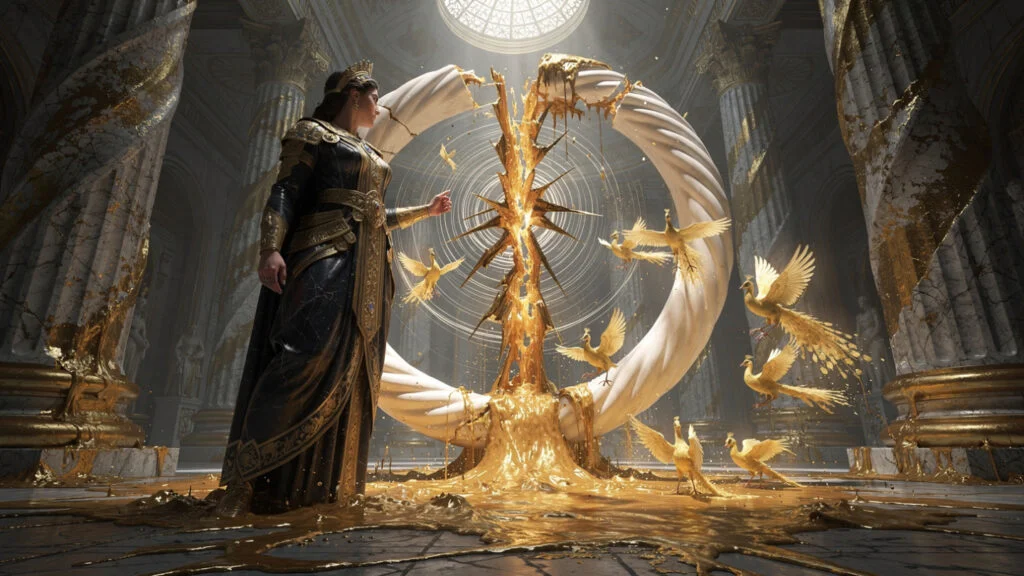
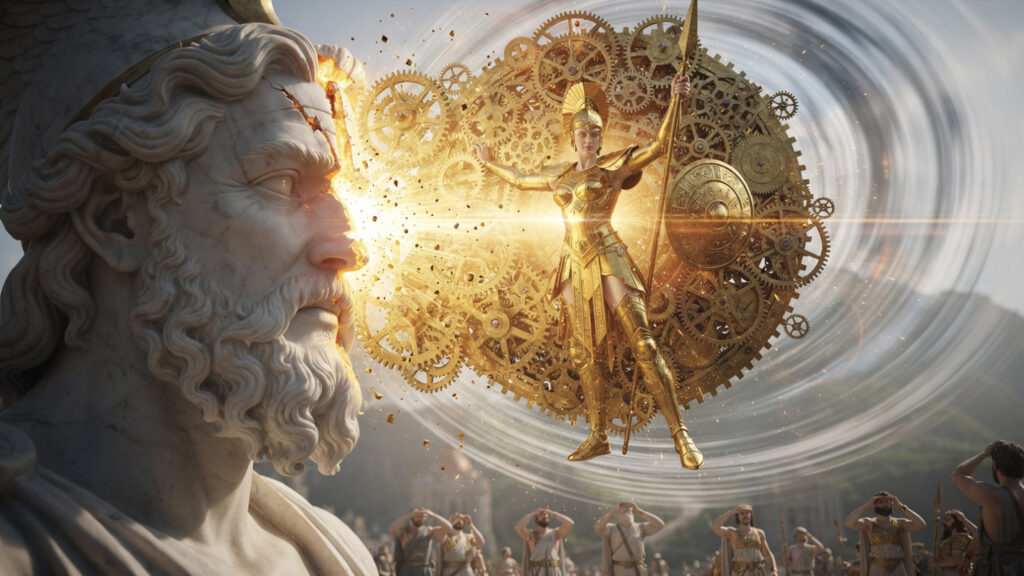
Athena, born fully armed from the head of Zeus after he had swallowed the Titaness Metis to prevent the prophecy that her child would be more powerful than its father, is the goddess of wisdom, craft, and strategic warfare. Her birth from Zeus’s head rather than from a maternal body is the mythology’s most precise statement of her nature: she is thought made divine, intellect given form, the quality of mind that produces strategy rather than impulse. She is the patron of Athens not because Athens chose her but because the city’s intellectual and civic character made her the appropriate patron. The city and the goddess chose each other.
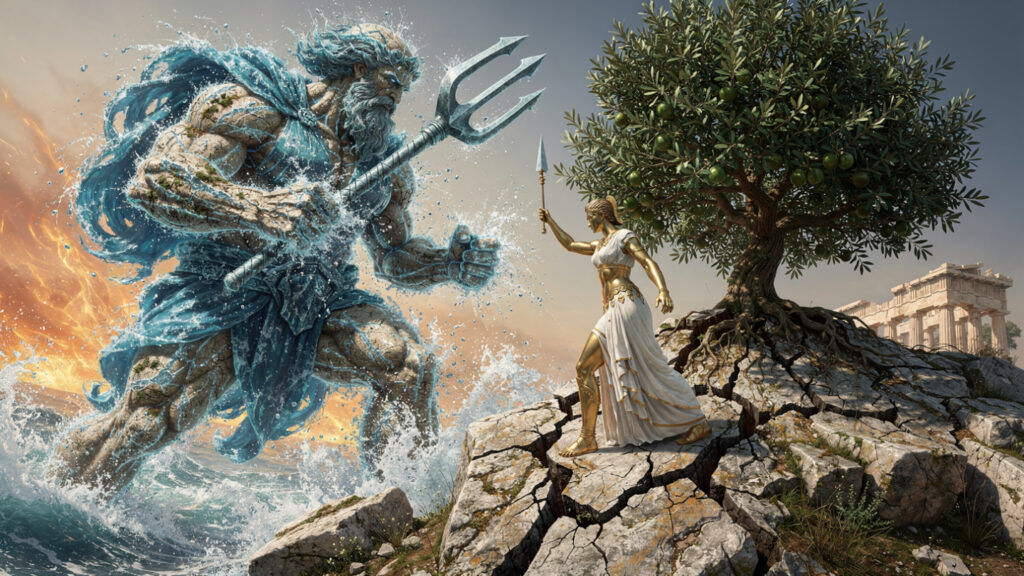
Poseidon, whose domain is the sea and whose power expresses itself in earthquakes as well as waves, embodies the quality of force that operates beneath the surface of the ordered world: the sea that connects everywhere and belongs to no one, the ground that moves when it should be stable, the dimension of the natural world that the Olympian order governs least completely. His contest with Athena for the patronage of Athens, in which he struck the Acropolis with his trident and produced a saltwater spring while she struck the same rock and produced an olive tree, is the mythology’s account of two different kinds of power meeting in the same city and the city choosing which one it needed more.
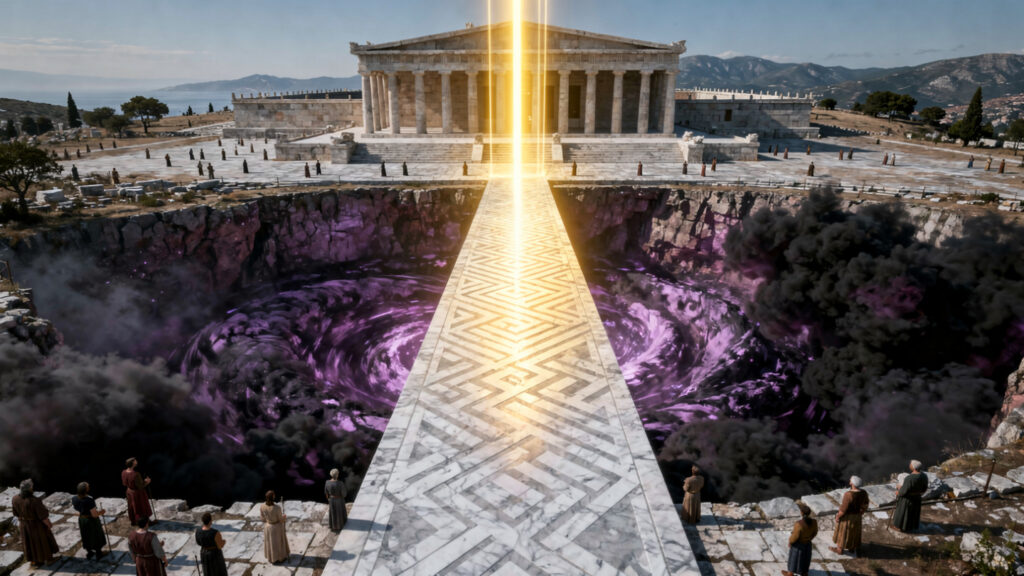
Apollo, the god of light, of music, of prophecy, and of the healing arts, is the Olympian who most completely embodies the Greek understanding of divine order as the imposition of clarity on complexity. His sanctuary at Delphi, the most important oracular site in the ancient world, was the place where the structured knowledge of the divine court was made available to mortal petitioners in the form of ambiguous prophecy: not the direct revelation of future events but the communication of their structural shape, which the petitioner was responsible for interpreting correctly. The oracle’s ambiguity was not a limitation. It was the appropriate form of the communication.
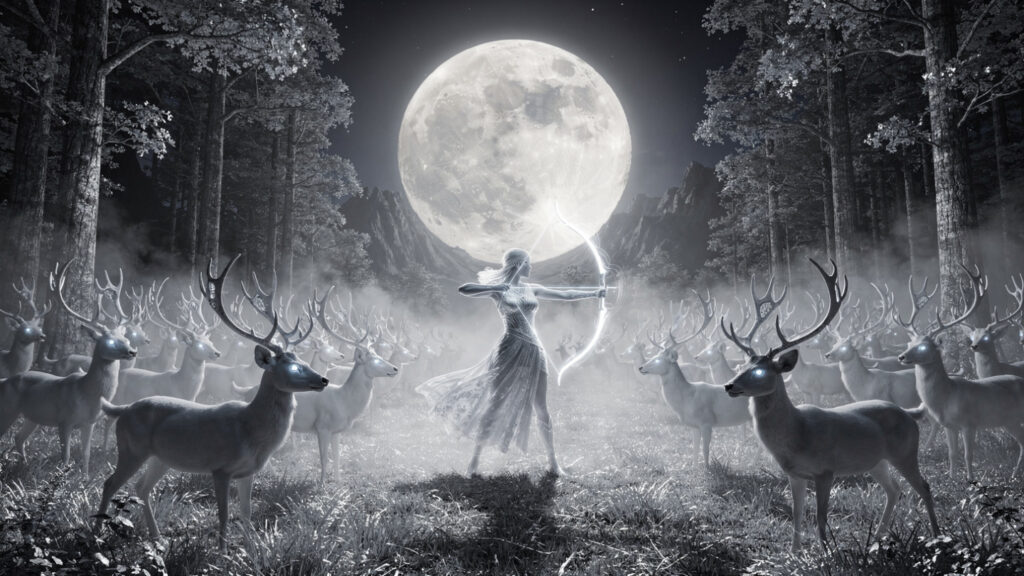
Artemis, Apollo’s twin sister and the goddess of the hunt, the moon, and female transitions, governs the liminal and the wild: the spaces outside the city where the organized structures of human society do not reach, the transitions between the stages of human life that culture marks with ritual but that nature conducts in its own terms. Her association with hunting is not incidental: the hunt takes place in the space between the human and the animal world, in terrain that the farmer has not organized and the builder has not enclosed, and Artemis’s domain is precisely this in-between.
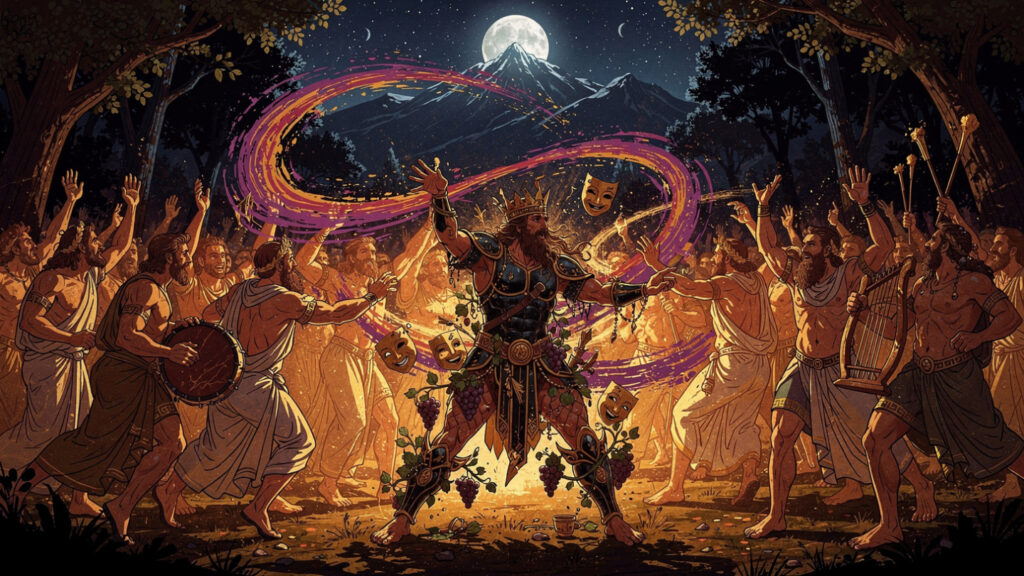
Dionysus, the youngest of the Olympians and the one whose inclusion in the divine court the mythology treats as the most recent and most contentious addition, is the god of wine, of theater, of ecstasy, and of the dissolution of individual identity into collective experience. He is the god whose rites are not conducted in temples but in the open, in the mountains, in the wild places, by participants whose ordinary identity is temporarily suspended by the ritual process. His myths, more than those of any other Olympian, are about the consequences of rejecting the divine presence that he embodies: the Theban king Pentheus, who refuses to acknowledge Dionysus’s divinity, is torn apart by his own mother in a state of ritual ecstasy induced by the god. The mythology’s statement is precise: denying the experience of collective dissolution is more dangerous than accepting it.
The Mortal World and Its Divine Entanglements
The most narratively rich dimension of the Olympus mythology is not the lives of the gods among themselves but the entanglements between the divine court and the mortal world below.
The gods of Olympus are not remote. They intervene in human affairs with a frequency and specificity that reflects the ancient Greek understanding of divine presence as immediate and personal rather than abstract and distant. Athena advises Odysseus. Apollo guides the arrow that kills Achilles. Aphrodite causes Helen to love Paris. Hera engineers the suffering of Heracles. The divine court is not watching from above: it is present in the decisions and encounters of mortals, shaping events through a combination of direct intervention and the exploitation of human tendencies that the gods understand because they share them.
The mortal heroes who move through this divine attention, Heracles, Achilles, Odysseus, Theseus, Perseus, are not simply human figures who happen to encounter gods. They are the mythology’s examination of what human excellence looks like under divine observation: how the qualities of intelligence, courage, endurance, and cunning that each hero embodies are tested and developed by the challenges that the divine court’s interest in them produces.
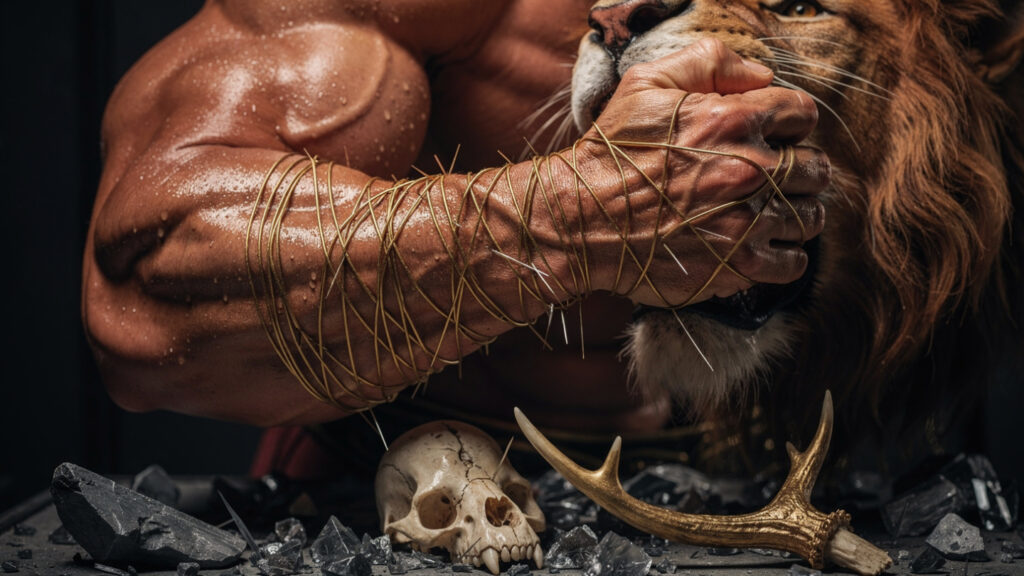
Heracles is the mythology’s most complete examination of what extraordinary capability looks like when it is directed by divine will and frustrated by divine enmity simultaneously. He is the son of Zeus and therefore the object of Hera’s sustained campaign of obstruction. The twelve labors are not simply heroic achievements: they are the tasks that Hera’s scheming assigned him as punishment for the madness she induced, and they are the means by which his divine capability is fully developed and proven. The enmity that made the labors necessary also made the hero that the labors produced.
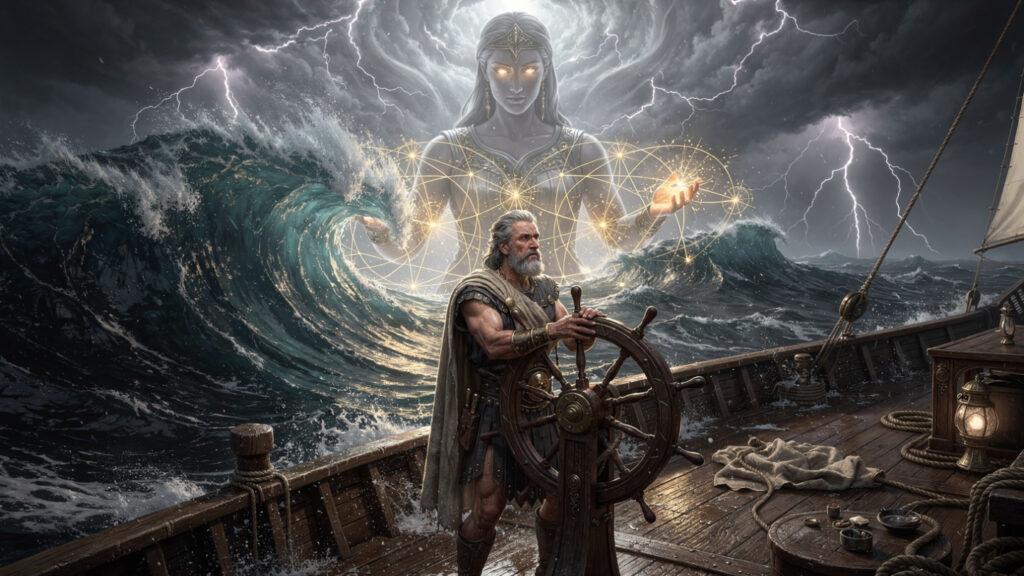
Odysseus is the mythology’s examination of intelligence as the primary heroic quality. The ten years it takes him to return from Troy are not simply a series of obstacles: they are the curriculum through which the most resourceful mind in the Greek world is developed to its fullest capacity, each encounter building on the previous one, each solution creating the conditions for the next challenge. The gods who help him, Athena in particular, do not simply remove obstacles. They present challenges at the level that his intelligence requires to grow.
Dion | The City Where the Mountain Met the World
At the foot of Olympus, in the plain between the mountain and the sea, lies Dion, the sacred city of the Macedonians.
Dion was the place where the Macedonian kings performed their rites before war, where Alexander the Great made his offerings to the Olympian gods before departing on the campaign that would take him to the edge of the known world, where the theatrical and athletic festivals that honored the gods of Olympus were held in the most direct geographic relationship to the mountain itself that a human settlement could maintain.
The ruins of Dion, excavated from the first century of modern archaeological investigation and continuing to yield significant finds, preserve the physical evidence of this relationship: the sanctuary of Zeus, the sanctuary of Demeter, the theater, the baths, the villa with its extraordinary mosaic floors, the archaeological strata that document continuous occupation from the archaic period through the late Roman era. Dion was a functioning city with a full civic life, and it was also a sacred place whose identity was inseparable from the mountain visible on its western horizon.
The Olympus Festival that Dion hosted in antiquity, which combined athletic competition, theatrical performance, and religious rites in the combination that the great Panhellenic festivals elsewhere in Greece maintained, was the most geographically precise expression of the mountain’s divine identity: the place where the human world honored the gods in whose home the mountain’s summit was located, at the maximum proximity to that home that a settled human community could maintain.
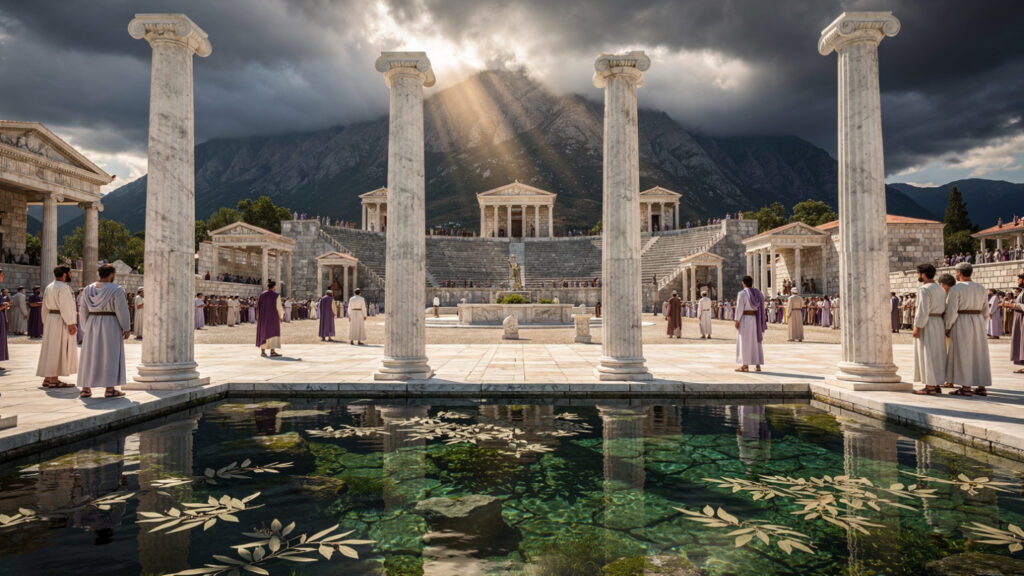
The contemporary Olympus Festival in Pieria, which brings theater and music to the region in the summer months, inhabits this same geographic logic: performance at the foot of the mountain, in the light of the Macedonian summer evening, with the peak visible on the western horizon in the conditions that permit it.
The Trails and What They Offer
Mount Olympus is a UNESCO Biosphere Reserve, and the trail network that crosses its lower and middle slopes is among the most rewarding mountain hiking in the Aegean region, independent of any mythological association.
The primary access point for the upper mountain is the village of Litochoro on the eastern slope, from which the trail system ascends through the gorge of the Enipeas river, through zones of mixed forest that give way to the vegetation of the upper mountain, to the refuge huts at Spilios Agapitos at 2100 meters and Christos Kakkalos at 2655 meters, from which the summit ridges are accessible for experienced mountain walkers.
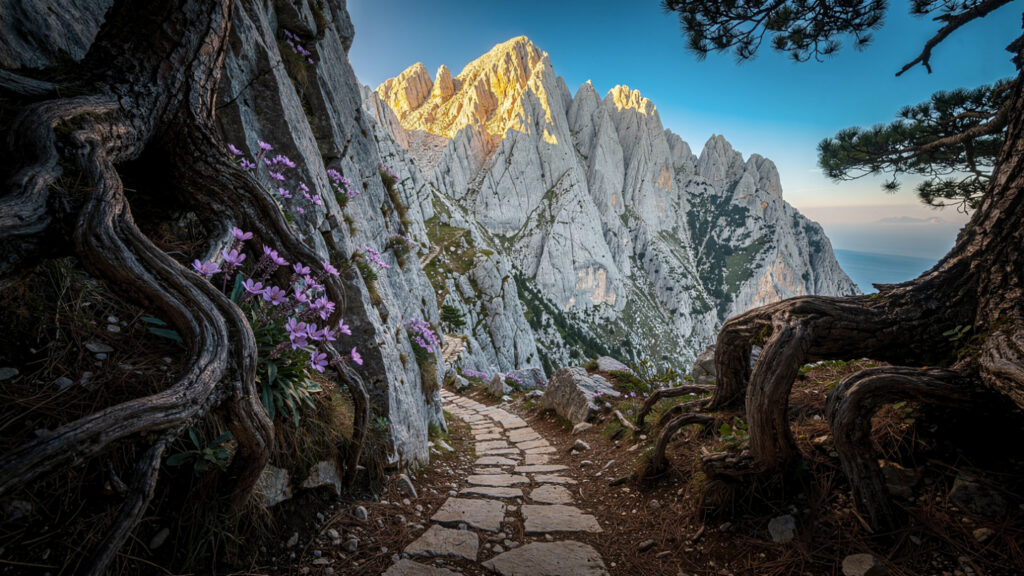
The summit, Mytikas, is the highest point in Greece and a technical scramble in its final section rather than a trail: hands-on rock and exposure to height are required, and the summit is not accessible to the ordinary hiker who has not encountered this type of terrain before. The refuges provide overnight accommodation for those making the two-day ascent and descent, and the quality of the Olympus morning at 2100 meters, with the Aegean Sea visible to the east and the Macedonian plain visible to the north, is available to anyone who reaches the first refuge regardless of whether they attempt the summit.
The rare endemic plant species of Olympus, including Jankaea heldreichii, a plant found only on the shaded north-facing cliffs of the mountain’s upper limestone formations, and the wildflowers of the lower slopes in spring and early summer, are the biological expression of the same geographic specificity that the mythology expressed in divine terms: Olympus is a mountain with its own ecology as well as its own mythology, a place that the altitude and the geology and the precipitation patterns of the region have made distinct from its surroundings in ways that are visible and measurable as well as mythological.
What the Mountain Still Gives
The myths of Olympus are not the myths of a religion that still commands belief in the sense that the ancient Greeks believed them. The modern visitor to Litochoro does not expect to encounter Zeus on the trail above the gorge or to receive Athena’s guidance at a moment of difficulty in the upper rock. The religious framework within which the myths were meaningful as accounts of how the world was actually governed has been superseded.
What the myths retain, and what the mountain continues to communicate to anyone who walks toward it or looks at it from the Thessalian plain, is something that the religious framework preserved but does not exclusively hold: the sense that the world is structured, that the structure has a quality of order that exceeds human capacity to fully comprehend or control, and that the appropriate human response to this quality is not mastery but attention.
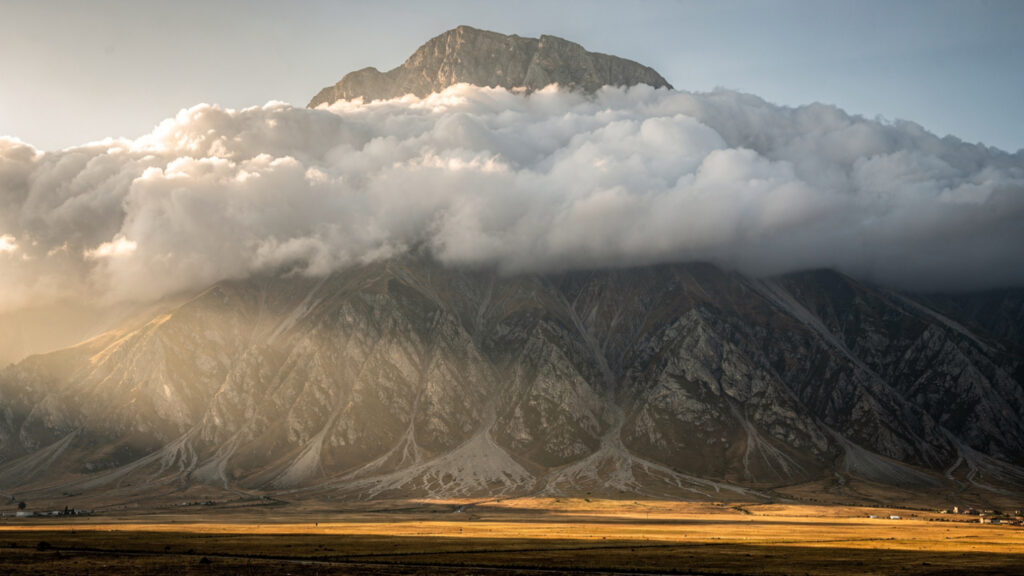
The ancient Greeks encoded this sense in the figure of Zeus governing within the structure of the Moirai, in Nemesis correcting the excesses of those who mistake their portion for the whole, in Athena’s wisdom as the ability to read the situation correctly rather than simply to impose upon it. The encoding is mythological. The sense it encodes is available to anyone who stands at the base of a mountain whose summit is in cloud and understands that the world extends beyond what they can see.
Olympus Estate takes its name from this mountain and this mythology because the mountain and the mythology are inseparable from the landscape and the culture that this site is dedicated to. The myths of Olympus are the oldest layer of the inheritance that everything else in Greek culture has been built from. They are the stories that gave the Greek world its divine geography, its understanding of the relationship between human excellence and divine attention, and its vocabulary for the forces that govern the world beneath the cloud layer and above it.
The mountain is still there. The cloud is still there. The summit, on most days, is not visible from below. The myths are the account of what is up there, offered by a civilization that understood the mountain better than it understood the summit, and that was honest about the difference.
At Olympus Estate, every article in our collection begins from the same ground: the mountain visible on the horizon, the myths that named what the summit contained, and the living culture of a country that has never stopped being shaped by both. Tales from Olympus is where the myth essays live. Wanderlust Greece is where the trails begin. Cultural Chronicles is where the heritage continues. All of it starts here, at the foot of the mountain.