


Poseidon got the worst of the three.
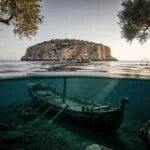
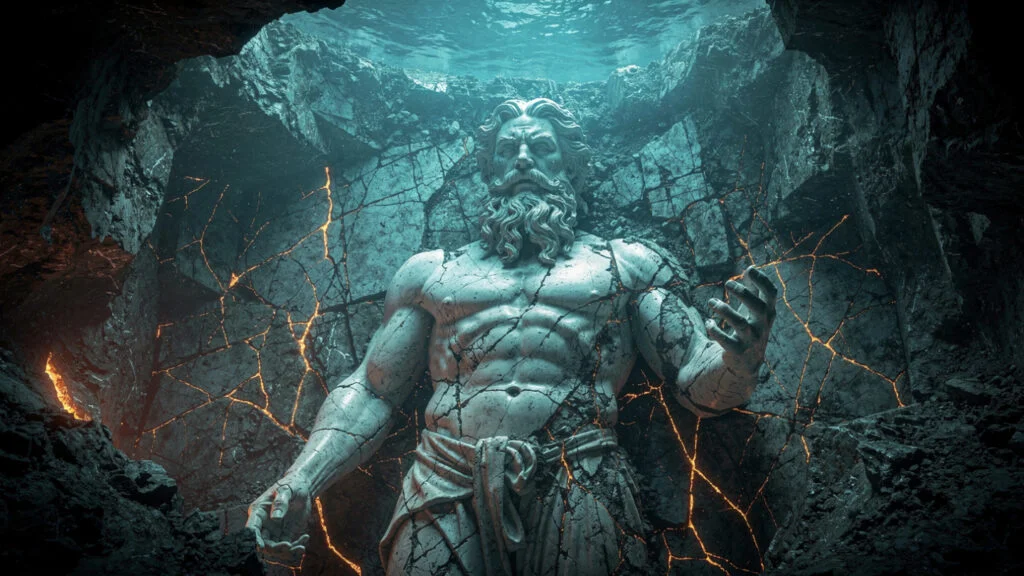
When Zeus and his brothers divided the cosmos after defeating the Titans, the three sons of Kronos drew lots for their domains: Zeus received the sky and its governance, Hades received the underworld and the dead, and Poseidon received the sea. The myth records this division as roughly equal in dignity, three brothers ruling three realms of an organized cosmos. But the sea’s own character, its instability, its destructive capacity, the irreducible wildness of a domain the divine order could govern in its movements but never fully tame, gave Poseidon’s portion a quality Zeus’s and Hades’s did not share. The earth-shaker’s realm never settled.
And Poseidon himself never quite settled either.
Myth preserves him as the most consistently aggrieved of the Olympians: the god who lost the contest with Athena for Athens, who lost the contest with Hera for Argos, who competed unsuccessfully with Zeus for Thetis until the prophecy that her son would surpass his father forced both gods to abandon the pursuit, a powerful deity repeatedly outmaneuvered in exactly the contests that determined which cities and regions he would actually govern. He is the second most powerful being in the Olympian hierarchy, and a figure whose frustration with its constraints gives his mythology the particular quality of power that has never quite reconciled itself to its own limits.
The Earth-Shaker and What That Title Meant
Poseidon’s most frequent epithet in the Homeric poems is Ennosigaios, the earth-shaker, and this title’s theological content is what most directly separates Poseidon from Olympians whose domains were less geologically violent.
The link between the sea god and seismic activity was encoded directly through the Aegean world’s own geology. The same tectonic forces producing the Aegean’s volcanic islands and its earthquakes also generated the submarine tremors behind the tsunamis and storm surges ancient maritime communities experienced as the sea’s sudden, violent advance onto the land. A sea that normally stopped at the shore occasionally pushed inland as a wave a submarine earthquake had generated, and treating both the earthquake and the sea’s violence as expressions of one divine power was simply the theological register for a real geological fact: the same tectonic process connected submarine seismicity to maritime instability. Nisyros carries this connection most directly, a living volcano the Greeks explained as Poseidon’s own doing, examined in full elsewhere on this site.

Homer describes Poseidon moving beneath the earth when he travels, driving his chariot not across the sea’s surface but through the earth’s own depths, and this is the description of a deity whose domain reached beyond the sea’s surface into the geological depths beneath both sea and land at once. The earth-shaker who moved the land and the god who ruled the sea were one and the same being, because seismic movement on land and instability at sea were both expressions of a single force working through the same subterranean medium.
The horses Poseidon bred and gave to humanity, the hippoi, whose breeding in the Corinthian and Thessalian regions gave those areas their particular horse culture, express this same domain a third way. A horse’s own movement and power across the earth’s surface read as the surface echo of the seismic movement beneath it, an earthly manifestation of the same force moving both earth and sea.
The Contest for Athens
The contest between Poseidon and Athena for the patronage of Athens ranks among the most politically significant events in Greek myth, because its outcome determined which divine principle would govern the most intellectually and politically productive city in the ancient world.
The sacred trees article and the Eros and Aphrodite article in this collection both touch this contest from their own angles, the olive tree as Athena’s gift and its theological status in Athenian religious life, and the character of divine competition itself for a city’s patronage. Its full development belongs here.
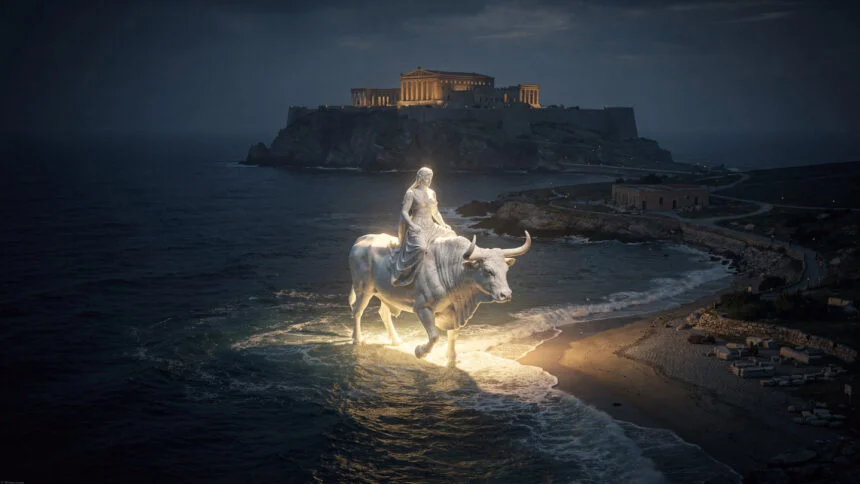
Poseidon struck the Acropolis rock with his trident and produced a saltwater spring: the gift of the sea, maritime power whose control of the Aegean would let the receiving city project military and commercial force across the eastern Mediterranean. Mythical Athens was being offered, in advance, the very maritime empire historical Athens eventually built through Themistocles’s navy and its victory at Salamis.
The saltwater spring Poseidon’s trident produced on the Acropolis is still shown to visitors today, on the northern edge of the Erechtheion’s interior, where the exposed rock still marks the spot ancient visitors identified as the trident’s own impact. The spring itself was visible in antiquity, water rising from a fissure the trident had opened, and the water’s very saltiness, rising from an inland Attic hill’s rock, was itself the proof of divine rather than ordinary geological origin.
Athena struck the same rock with her spear and produced the first olive tree: the gift of agricultural and technological intelligence, a tree whose cultivation demanded and rewarded exactly the patience, knowledge, and sustained attention Athens would come to treat as its own defining excellence. The city that chose the olive chose long-term investment in organized intelligence over the short-term acquisition of maritime power the sea god’s spring offered.
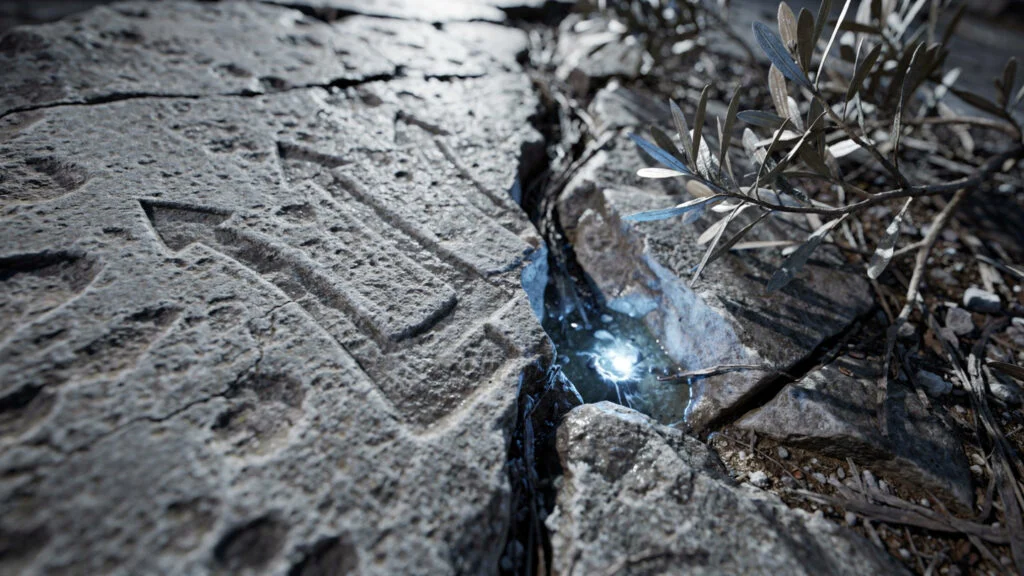
The council of the gods, or the assembled Athenians themselves in versions that give the decision to the city rather than the divine assembly, chose the olive. Poseidon flooded the Attic plain in anger. The olive survived, the flood receded, and the city belonged to Athena.
What the myth actually encodes is a claim Athens made about itself: that its own character was the character of organized intelligence, whose patience and sustained attention produced the cultural and intellectual achievements the fifth century BCE would display, rather than the character of maritime power built on sudden, violent force. The city that lost the sea god’s gift built the navy anyway, but its identity was organized around the olive rather than the trident.
Cape Sounion and the Geometry of the Sacred
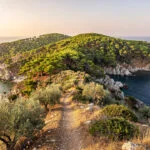
The Temple of Poseidon at Cape Sounion occupies the southernmost point of the Attic peninsula, a position from which every ship entering or leaving the Piraeus harbor was visible from the temple, and the temple visible from every such ship.
This relationship between the sanctuary’s position and the maritime traffic it watched over was no accident. Ancient sacred geography consistently placed the sanctuaries of maritime deities at coastal positions with maximum visual command of the sea and the ships crossing it: the god who governed the sea got the vantage point from which to actually observe it, and the temple marking that vantage point was both the divine observer’s residence and the visible signal to any approaching or departing ship that the observation was ongoing.
The Doric temple standing at Sounion today, built in the early 440s BCE to replace an earlier one the Persians destroyed, gives the god exactly the residence Athenian religious geography assigned him: visible from the sea approach to Athens, marking the entry to the Saronic Gulf and the approach to Piraeus harbor.
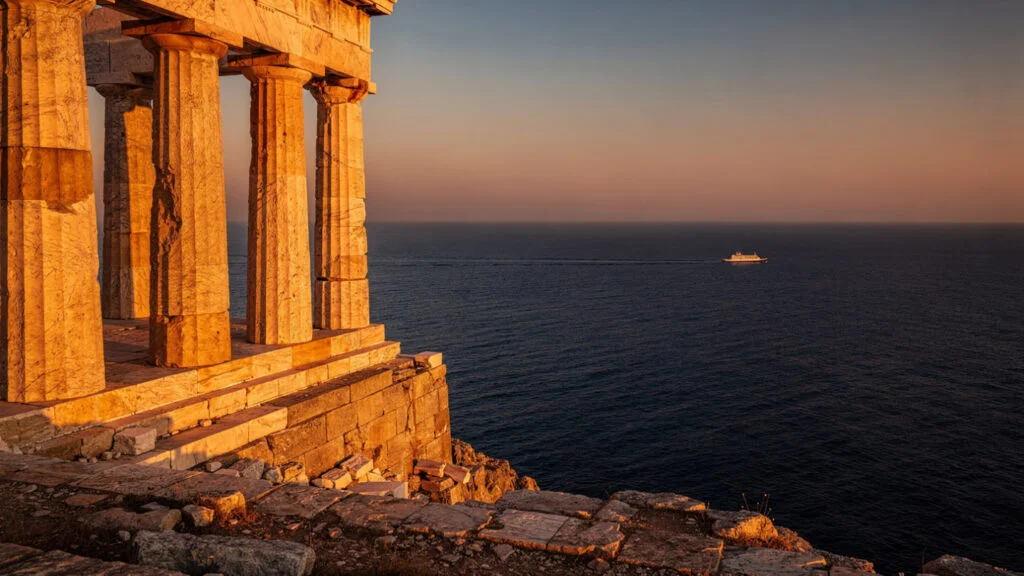
The Sounion temple uses local Agrileza marble rather than the Pentelic marble the Parthenon used at the very same time, and its coarser crystalline structure gives the Sounion columns a distinct surface quality in the Attic light, coarser than Pentelic, less luminous than Parian, but carrying in its own grain the local geological material a regional sanctuary was consistently given rather than the finest stone the island quarries could offer.
Lord Byron’s name is carved into the base of one of the surviving columns, not the graffito of a casual tourist but the deliberate inscription of a poet who understood that standing at Sounion, temple at the land’s edge above the sea, ruin and view and mythological weight together, called for exactly this kind of acknowledgment. His name sits alongside the inscriptions of Greek and Roman visitors doing the same thing centuries earlier: marking that they had stood at the point where the land ended and divine observation of the sea began.
The Isthmian Games and Poseidon’s Second Festival
The Isthmian Games at the Sanctuary of Poseidon at Isthmia, near Corinth, ranked among the four great Panhellenic athletic festivals that formed the athletic summit of the ancient Greek world. The Olympian, Pythian, Nemean, and Isthmian games together made up the periodos, the circuit the greatest ancient athletes completed, and the Isthmian festival held a unique place in it as the only Panhellenic festival dedicated to Poseidon rather than Zeus or Apollo, a reflection of the Corinthian isthmus’s own position as the crossing point between the Aegean and Ionian seas.

The isthmus, the narrow strip of land between the Saronic Gulf to the east and the Gulf of Corinth to the west, was the geographical feature that made Corinth the most commercially significant city in the classical Greek world: ships whose cargoes were too valuable, or whose hulls too large, to risk rounding Cape Malea, the treacherous southern tip of the Peloponnese, were hauled instead across the isthmus on the diolkos, a ship-transport way whose engineering let vessels be dragged on rollers across four kilometers of land to the sea on the other side.
The Poseidon sanctuary’s position at the isthmus gave the god authority over both seas the isthmus separated: his most significant mainland sanctuary sat exactly where the two seas confronted each other across the narrowest available strip of land.
Myth traces the Isthmian Games back to Melikertes, the son of Ino who was transformed into the sea deity Palaimon after Ino drowned herself and her child fleeing Hera’s persecution: the festival began as a mourning rite for the drowned child, whose body a dolphin carried to the isthmus, discovered there by Sisyphus of Corinth, who established the games in his honor. Into the historical period, the Isthmian festival kept this character as a mourning rite for Palaimon running alongside the Poseidon cult that gave the games their wider Panhellenic standing.
The archaeological site at Isthmia preserves the sanctuary through successive building phases from the archaic, classical, and Hellenistic periods: the archaic Temple of Poseidon, dated to roughly 700 BCE, ranks among the earliest monumental Greek temples archaeology has documented, and its role in establishing the Doric order’s canonical proportional system gives it real importance in the history of Greek architecture, out of proportion to its relatively obscure standing today.
Poseidon and the Thessalian Plain
Poseidon’s most direct connection to the Greek mainland interior, rather than the coast, runs through the story of the Thessalian plain and the Vale of Tempi.
The Thessalian plain, the largest flat agricultural landscape on the Greek mainland, was understood in antiquity as a former lake whose waters were released when Poseidon struck the mountain barrier with his trident and opened the passage through which the Peneus River could drain it. The Vale of Tempi, the narrow gorge between Mount Olympus and Mount Ossa through which the Peneus flows from the Thessalian plain to the Aegean, was the geological feature this myth attributed to the trident’s action.

Underneath the myth sits a genuine geological process: tectonic activity opened the drainage channel through which the landlocked basin became a river valley. The same force that shook the earth also shaped the land by opening the passages the water drained through, and the Thessalian plain’s agricultural productivity, the most fertile land on the Greek mainland, was the real effect of exactly the geological activity myth assigned to the earth-shaker.
Poseidon’s role in Greek myth was never simply that of a sea god whose anger produced storms. It was the role of a deity governing the geological force behind the most violent, and most productive, interactions between earth and water: the tidal wave that pushed the sea inland, the earthquake that opened or closed the channels water moved through, and the horse whose hoofbeats echoed, at the surface, the same geological force moving beneath the landscape it crossed.
The Nereids and the Sea’s Divine Population
Poseidon’s mythological world was never simply the undifferentiated mass of the sea. It was populated by an organized divine community whose hierarchy and individuals ancient sources documented as extensively as the population of Olympus itself.
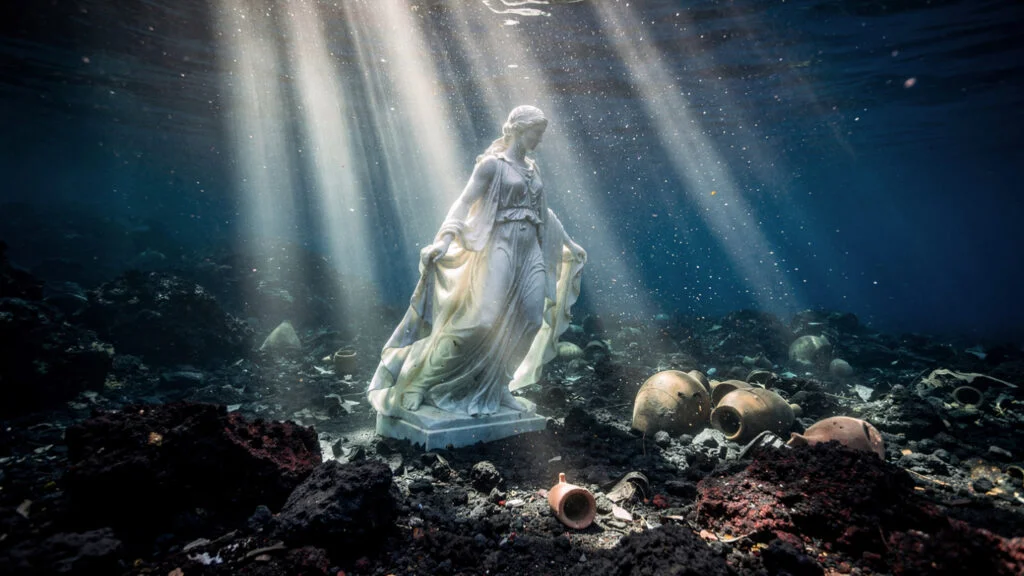
The fifty Nereids, daughters of the sea god Nereus and the Oceanid Doris, gave individual names to the sea’s own varied character. Thetis the silver-footed, mother of Achilles, whose combination of divine beauty and maternal grief gives the Iliad one of its central divine figures. Amphitrite, whom Poseidon pursued, who initially fled but was persuaded by the dolphin Delphin to accept his courtship and became the sea god’s queen, her story carved into the east pediment of the Athenian treasury at Delphi, whose surviving fragments are held in the Delphi archaeological museum today. Galatea, whose pastoral tragedy with Polyphemus the Cyclops, who loved her without any hope of return, gave pastoral poetry one of its most affecting stories.

The Nereids belonged to the Mediterranean specifically, an enclosed sea bounded by land on three sides with a single Atlantic connection, and it was this particular sea, whose moods and geography ancient sailors spent centuries learning to read, that gave the Nereids the qualities most directly their own.
Visiting Sounion
The Temple of Poseidon at Cape Sounion sits sixty-nine kilometers from central Athens along the coastal road that follows the Attic shore through Vouliagmeni and Varkiza and the beach communities of the southern Attic Riviera to the cape’s own point, where the road ends at the site’s entrance.
A visit by public bus from Athens is possible but slow, roughly two hours from the Pedion tou Areos bus terminal on the express service. A private car or taxi covers the same route in about ninety minutes from central Athens without traffic.
The Sounion visit reaches its best at two specific moments: dawn, when Aegean light strikes the marble columns while the sea below still sits in shadow and the horizon just begins to lighten, and sunset, when the marble catches the last horizontal light while the sea below catches the sky’s reflected color, a combination consistently ranked among the most photographed moments at any ancient site in Attica.

The archaeological site also includes the Temple of Athena on the promontory’s lower plateau, less well preserved than the Poseidon temple above it but reflecting a real ancient choice: placing both major protective deities at the land’s southern edge, the maritime god on the highest point commanding the sea approach, the civic goddess on the lower plateau, where the community’s acknowledgment of both kinds of protection was made architecturally visible.
Standing at the Sounion temple’s western edge, where the cliff drops to the sea and the horizon runs south uninterrupted, gives a visitor the exact sensation the site was built to produce: the organized human landscape of Attica giving way to the domain of the deity whose trident struck the Acropolis rock, and whose temple still stands at the land’s southernmost point as the permanent marker of his presence at that boundary.
At Olympus Estate, Mythic Essays moves through the deeper currents of the Greek tradition. Poseidon received the sea in the lot-drawing after the Titanomachy and spent the following centuries losing contests for the governance of cities to Athena and to Hera before finally accepting the sea, the earthquake, and the horse as his own domain. His trident struck the Acropolis rock and produced a saltwater spring, and the city chose the olive anyway. His sanctuary stood at the southernmost tip of Attica, and every ship entering or leaving Piraeus harbor sailed past it. The earth shook in his domain, and the tidal waves that pushed the sea inland were the expression of that same geological force. A horse’s hoofbeats echoed the seismic movement beneath it. Sounion is ninety minutes from Athens. Go at dawn.