

The Greeks did not invent Zeus.
He arrived with them, already ancient, when the Indo-European-speaking peoples who would eventually become the Greeks migrated into the peninsula now bearing their civilization’s name sometime in the third or second millennium BCE. He arrived already carrying his name, which is not a Greek invention but the Greek pronunciation of a word so old that it predates every written language the ancient world produced. The root from which Zeus derives, the reconstructed Proto-Indo-European *Dyēus, meaning the daylight sky conceived as a divine entity, is the same root that produced the Vedic Sanskrit Dyaus Pita, the Latin Jupiter from the older Djous Pater, the Illyrian Deipaturos, and the Baltic Dievas, among others. It is among the most widely distributed divine names in the history of human religion, present in cultures separated by the full geographic span from Ireland to India, and Zeus is its Greek pronunciation, arrived at through the specific sound changes the Proto-Indo-European language underwent as it became Greek over several millennia of divergence.
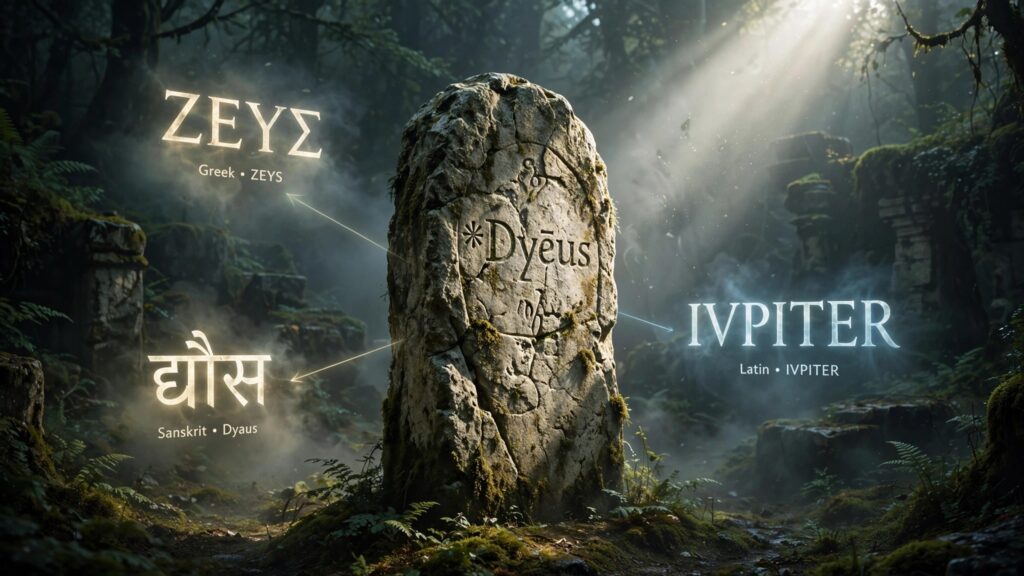
This makes Zeus unique among the Olympians in a way that the popular treatment of Greek mythology rarely emphasizes. Every other major Olympian deity, Athena, Apollo, Artemis, Ares, Dionysus, Aphrodite, has a name whose Greek etymology is either uncertain, clearly pre-Greek in origin, or borrowed from neighboring cultures. Aphrodite’s name almost certainly reflects her Eastern origins rather than any Greek root. Apollo’s name remains etymologically disputed among linguists to this day. Athena’s name appears to derive from the city that bears it rather than explaining the city’s name, a puzzle this site has examined elsewhere. Zeus alone has what linguists call a transparent Indo-European etymology, a name whose origin can be traced clearly and unambiguously through the comparative method back to the five-thousand-year-old reconstructed language that is the ancestor of everything from Greek to Sanskrit to Latin to English. His name is, in this technical sense, among the oldest surviving divine names in continuous use in the Western world.
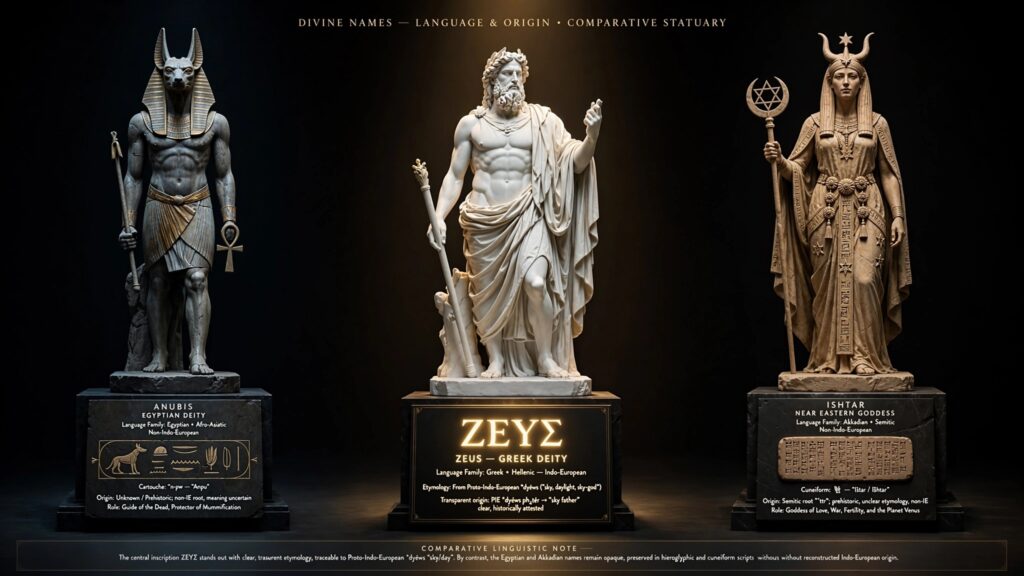
He was not, however, born the king of the gods. What the Greeks called Zeus is at least three things layered on top of each other, and understanding all three layers is what gives the mythology its actual depth rather than its surface narrative of a powerful old man with a thunderbolt who cannot keep his hands off mortal women.
The First Layer | The Ancient Sky
The original *Dyēus was not the ruler of the cosmos. The reconstructed Proto-Indo-European religion suggests a sky god who was prominent, widely revered, and cosmologically important as the vault of heaven itself, the divine entity who witnessed oaths because he encompassed everything visible from the earth below, whose rain fertilized the ground his consort Earth produced, and who was the father, across multiple Indo-European traditions, of the dawn goddess and the divine twins whose myth appears in Norse, Vedic, and Greek traditions simultaneously.
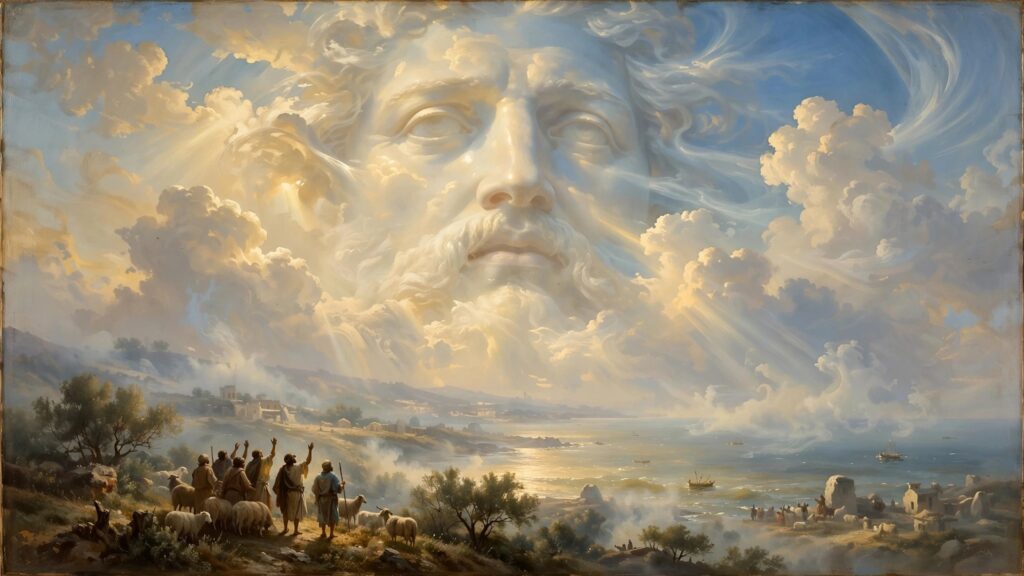
He was not, at this earliest recoverable layer, the supreme political sovereign who managed divine affairs through a combination of force and cunning. He was the sky, quite literally, and his authority was the authority of the visible heavens, not commanded but simply present, not enforced but simply there, the way the open sky above the Mediterranean is simply there, containing everything and commanding nothing.
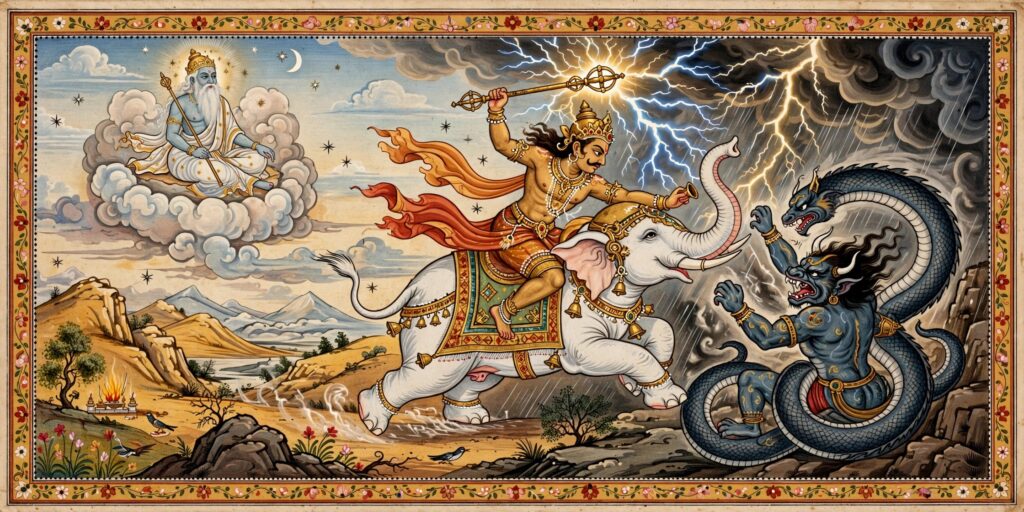
The Rigveda, the oldest surviving Indo-European religious text, gives Dyaus a role that reflects this: present in the hymns, specifically paired with the earth goddess Prithvi in the way the sky and earth naturally pair, but not the dominant personality his later Greek cousin would become. The Vedic tradition eventually marginalized Dyaus as the more dynamic Indra, whose storm-championship and monster-killing drove the Rigvedic religion’s emotional center, came to prominence, in a process that provides an instructive parallel for what happened in the Greek tradition as well, except that in Greek the two figures did not remain separate. They merged into one.
The sky is not, in the end, a dramatic figure. It does not act. It witnesses, contains, and provides the medium through which everything else moves, but the qualities that make a deity compelling in a narrative tradition, agency, struggle, cunning, triumph over a named adversary, belong to a more active kind of power than simply being the heavens. Zeus, as the Greek tradition developed him, accumulated these qualities through a process of mythological enrichment that the comparative method allows scholars to partially reconstruct, even where no written record documents it directly.
The Second Layer | The Storm Champion
Both Zeus and the Roman Jupiter assumed the attributes of the thunderbolt and the storm from another deity of Indo-European origin, a storm champion who in the Vedic tradition remained a clearly distinct figure named Indra, in the Norse tradition became Thor, and in the Greek tradition was absorbed into Zeus himself rather than maintained as a separate divine personality.
This merger is the key to understanding why Zeus carries a thunderbolt at all. The ancient sky father was not primarily a storm deity. He was the clear, bright sky, not the violent weather that periodically crossed it. The storm champion, by contrast, was specifically the deity who wielded the lightning weapon, who killed the monster blocking the rains, whose victory over a named adversary cleared the way for the fertility the earth required. In the Vedic tradition, Indra killed the serpent Vritra who had been blocking the waters. In the Norse tradition, Thor killed the Midgard Serpent, Jörmungandr. In the Greek tradition, Zeus killed the Titans and imprisoned them in Tartarus, and killed the monster Typhon when it threatened the Olympian order, and it is in these acts of combat rather than in his role as sky father that the storm champion’s character is most legible.
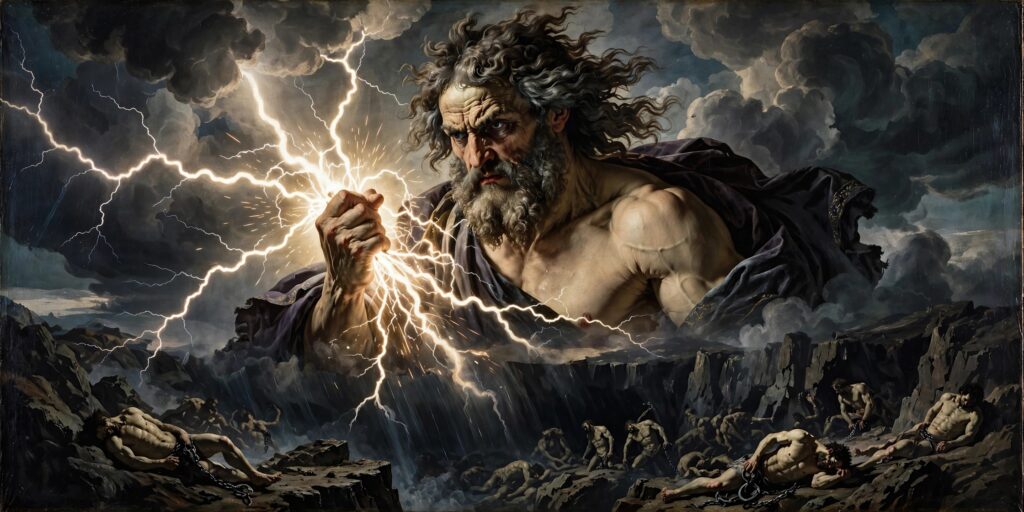
The Titanomachy and the war against Typhon are, in this reading, the same mythic pattern told twice. Hesiod’s Theogony describes Zeus’s battle against Typhon in language that deliberately echoes the earlier war against the Titans: the earth groans, the sea boils, the sky itself seems to buckle under the violence of the confrontation. Typhon is described as a creature born from Gaia and Tartarus specifically to challenge Zeus’s new order, a hundred serpent heads issuing flame and every animal cry at once, and Zeus defeats him with the thunderbolt alone, hurling him finally beneath Mount Etna, where his continued struggling was understood by the ancient world to be the cause of volcanic eruption. This is the storm champion doing exactly what storm champions do across the entire Indo-European family of myths: killing the chaos serpent so that the ordered world can exist.
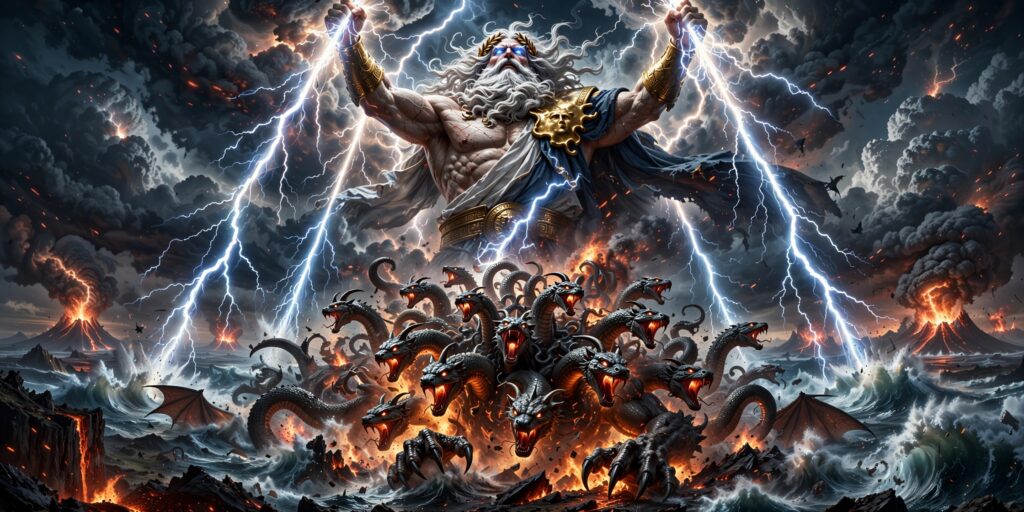
The Greek tradition merged these two figures completely, so that Zeus is simultaneously the clear sky and the storm within it, both the father whose authority witnesses oaths and the champion whose thunderbolt enforces them. This merger gave Zeus something neither the original sky father nor the storm champion possessed alone: not simply the authority of presence, and not simply the power of violent action, but authority backed by demonstrated power, which is precisely the combination that makes a convincing sovereign.
The Third Layer | The Political God
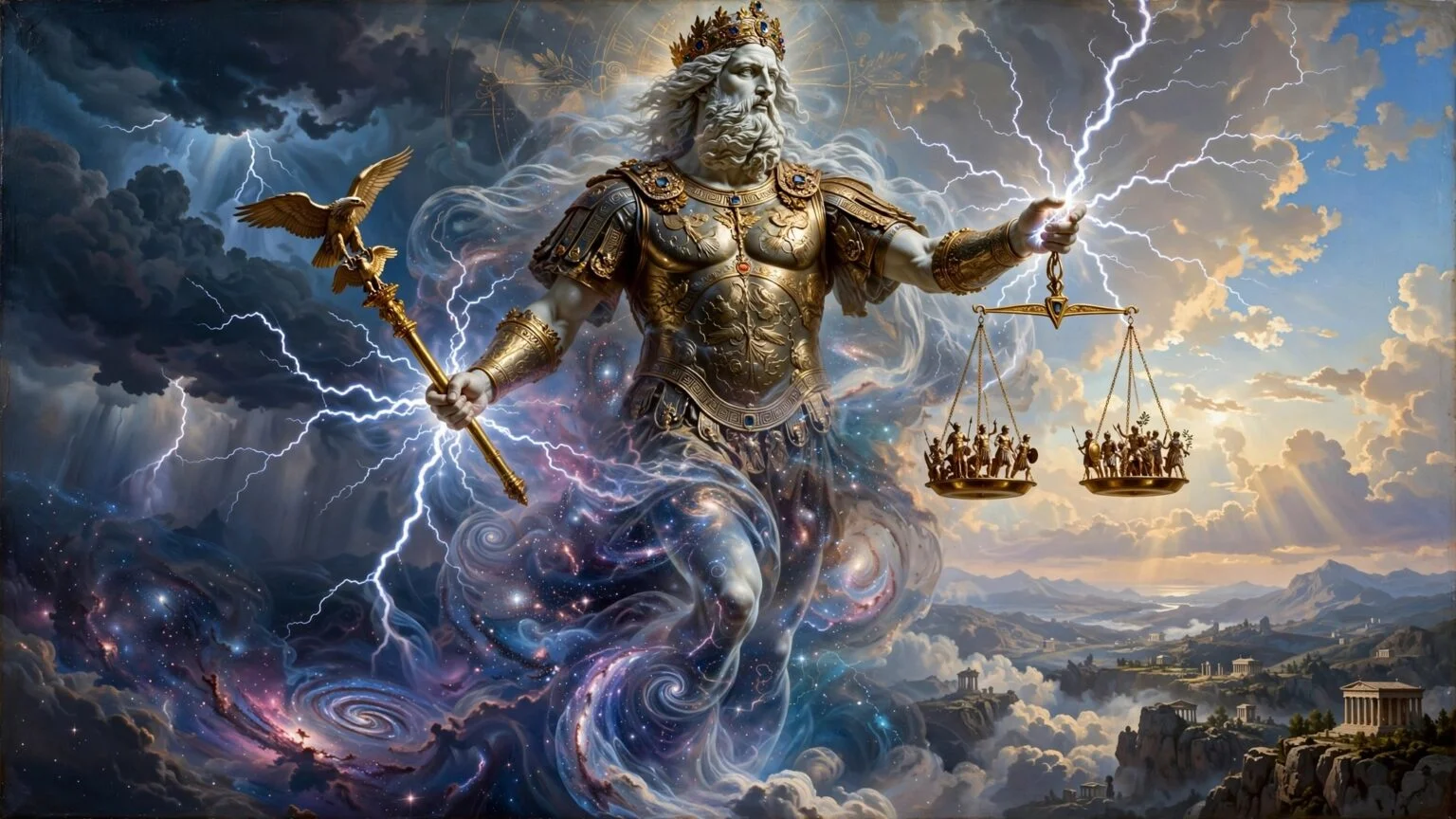
The Zeus of Homer and Hesiod and the tragedians is neither simply a sky father nor simply a storm champion. He is a political sovereign, a ruler who governs a complex divine household of equals and near-equals through a combination of superior power, superior cunning, established precedent, and the leverage that comes from being the being everyone else’s authority ultimately depends on. He holds the golden scales in the Iliad, weighing the fates of heroes, but he defers to what the scales show rather than simply imposing his own preference. His sovereignty is constitutional rather than absolute, operating within the structure of fate rather than above it.
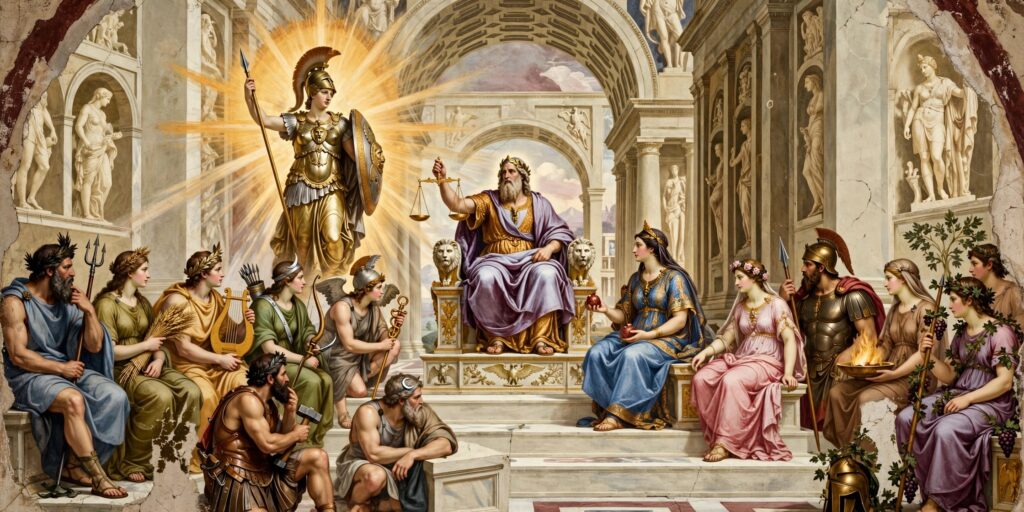
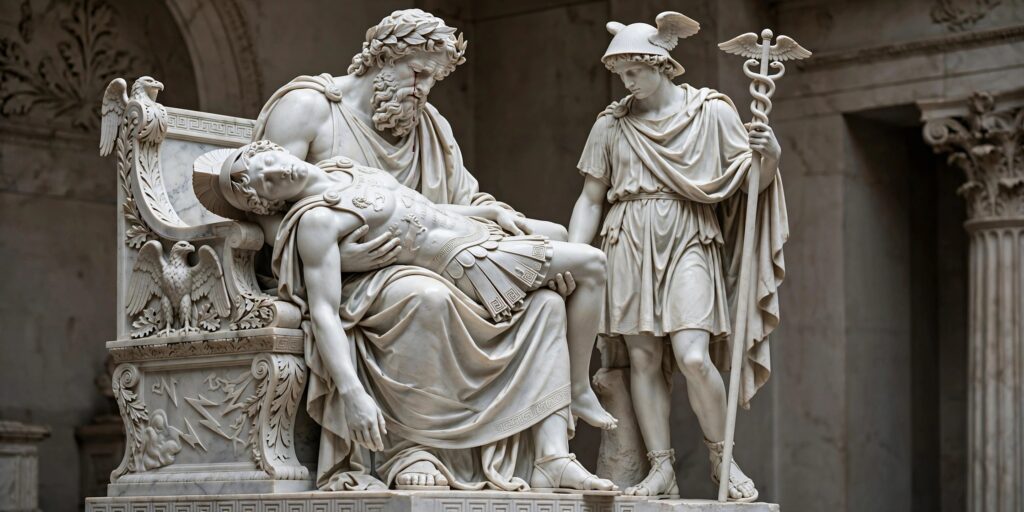
This is the Zeus who swallowed Metis rather than simply defeating her, understanding that eliminating a superior intelligence required absorbing it rather than simply overpowering it, and who then produced Athena from his own head, fully armed, as if the political sovereign’s cunning had become the sovereign’s own daughter. This is the Zeus who defers to the Moirai, the Fates, rather than overriding them, because Homer consistently presents him as knowing, with the clarity of the very wise, that his authority is legitimate precisely because it operates within the cosmic structure rather than above it. When Zeus in the Iliad considers saving his son Sarpedon from a fated death, Hera‘s counsel that doing so would shatter the cosmic order stops him. He weeps tears of blood and does not intervene, and this restraint is presented not as weakness but as the wisdom that distinguishes a legitimate sovereign from a tyrant.
The Zeus who carries the thunderbolt did not earn it through lineage. He won it from the Cyclopes, who had forged it as a weapon of war, after freeing them from their imprisonment by his father Kronos. The instrument of his power was made by others, won by him through an act of liberation and alliance, and this genealogy of the weapon is the mythology’s precise account of how the third layer of Zeus’s character developed from the second: the storm champion’s weapon became the political sovereign’s instrument of legitimate authority because the political sovereign earned it through the right acts rather than simply inheriting it.
The Many Faces the Cult Kept Separate
The three layers are not only a scholarly reconstruction visible through comparative linguistics. The Greeks themselves, in their cult practice rather than in their poetry, kept different aspects of Zeus’s character separate, worshipping him under dozens of distinct epithets that functioned almost as separate, specialized divinities sharing a single name.
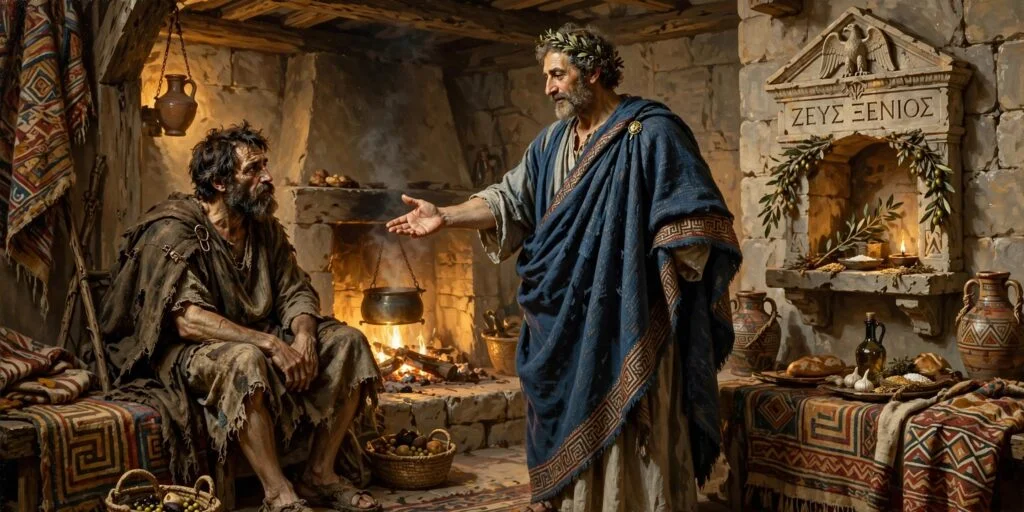
Zeus Xenios governed the sacred duty of hospitality, the guest-friendship that ancient Mediterranean survival depended on in a world without inns or reliable roads, and violating it was understood as an offense against the god personally rather than simply against social custom. This is the Zeus who watches over Odysseus’s long and dangerous progress through the households of strangers, and the Zeus whose anger the suitors of Penelope’s household earn precisely because they abuse the guest-right of a home that is not theirs. Zeus Horkios governed the sanctity of oaths, and a statue of him stood at Olympia holding a thunderbolt in each hand, before which athletes competing in the games were required to swear that they had trained honestly, a visible reminder that the god who witnessed the sky also witnessed the spoken word and punished its violation. Zeus Ktesios protected the household storeroom and its accumulated property, worshipped through a small jar or vessel kept in the home rather than through any temple, the sky father narrowed down to the scale of a single family’s grain supply. Zeus Herkeios protected the courtyard enclosure of the house itself, the boundary between the family’s private world and the world outside it, and it was at the altar of Zeus Herkeios that Priam was killed in the fall of Troy, a detail later poets preserved precisely because the murder of a suppliant at this particular altar was understood as a violation of an especially sacred category of protection.
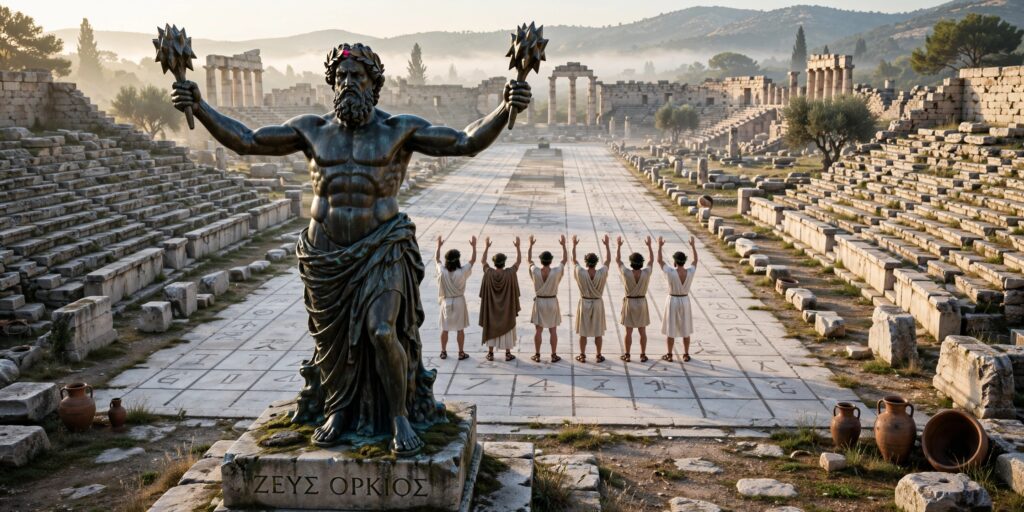
These epithets are not decorative variations on a single theme. They are the cult’s own working proof that Zeus’s authority operated at every scale simultaneously, from the vault of the entire sky down to the storage jar in a single kitchen, and that the Greeks experienced this as a coherent whole rather than as a contradiction requiring resolution. The god who could be invoked to guarantee an oath between two kings was the same god who was invoked to guarantee that a household’s grain jar would not run empty, and the theological confidence required to hold both of these at once, without strain, is itself a kind of evidence for how deeply Zeus’s authority had settled into Greek life by the time these cults are attested.
The Sanctuary at Dodona and the Oldest Oracle
The oldest oracle in the Greek world was not at Delphi but at Dodona, in the mountains of Epirus in northwestern Greece, and it belonged to Zeus rather than Apollo. This alone should shift the conventional narrative about which deity governed the transmission of divine knowledge to the Greek world, and it reflects, in geographical terms, the different origin and different character of Zeus’s authority compared to the distinctly Greek, distinctly Apollonian oracle that later became more famous.
Dodona’s oracle did not originally speak through a human medium in a trance, as the Pythia at Delphi did. The earliest surviving account of it, in the Iliad, describes it speaking through the rustling of a sacred oak tree, interpreted by priests whom Homer calls the Selloi, men whose feet went unwashed and who slept upon the ground, maintaining a continuous physical contact with the earth that suggests their role was to mediate between the sky father above and the earth below, the same divine pair that the original Indo-European cosmology had placed in relationship from the beginning. This is Homer’s own description, given in Achilles’s prayer to “Zeus of Dodona, Pelasgian, dwelling afar,” and it is the single earliest literary reference to the sanctuary that survives.
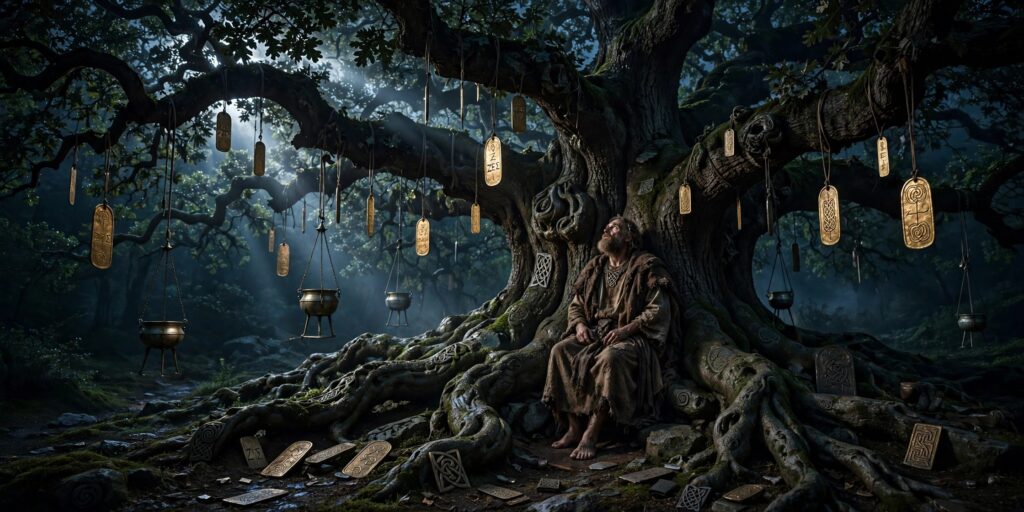
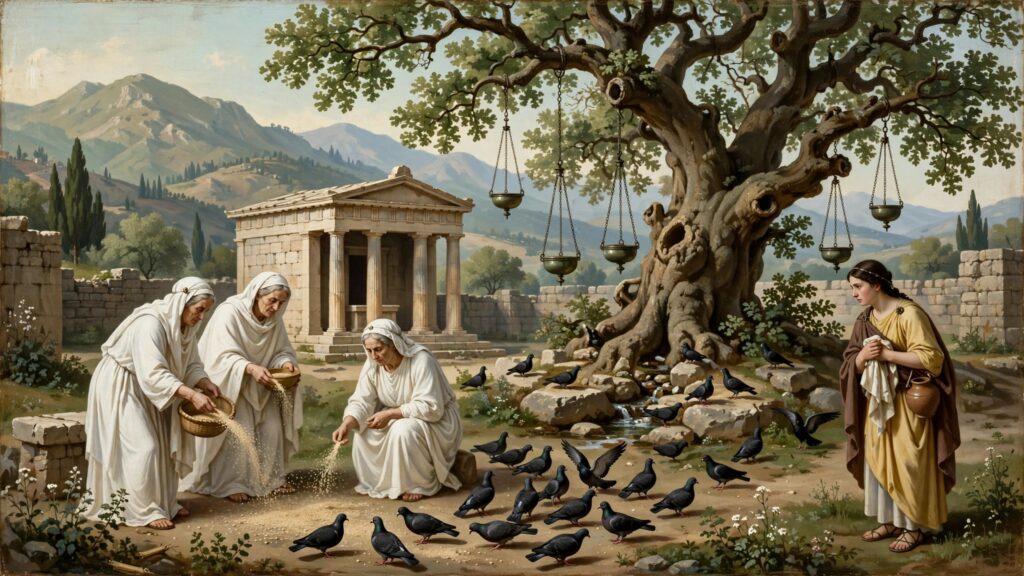
By the time Herodotus wrote his account of Dodona several centuries later, the character of the priesthood had changed. Herodotus does not mention the Selloi at all. What he describes instead are three priestesses, whom he names as Promeneia, Timarete, and Nicandra, known locally as the Peleiades, the doves, and it is from Herodotus that the sanctuary’s most famous foundation myth survives: that two black doves flew from Thebes in Egypt, one settling in Libya to found the oracle of Zeus Ammon and the other settling in an oak at Dodona and speaking there in a human voice, commanding that a shrine to Zeus be built. Herodotus, characteristically skeptical, offers his own rationalized version alongside the myth as it was told to him, suggesting that the “doves” were in fact two captured priestesses sold by Phoenician traders, one into Libya and one into Epirus, and that the story of the speaking bird was a folk memory of a foreign woman gradually learning to speak intelligible Greek. Whether the older male priesthood that Homer describes had genuinely vanished by Herodotus’s time, or whether Herodotus simply chose not to mention it while building his case for Dodona’s Egyptian origins, remains a live question among scholars of the sanctuary’s history. What is certain is that the two accounts, Homer’s ascetic Selloi and Herodotus’s speaking doves, describe two different centuries of the same continuously operating shrine.
The oracle at Dodona received questions on small, thin lead tablets from visitors across the Greek world. Thousands of these tablets have been recovered by archaeologists and are now held at the Archaeological Museum of Ioannina, their questions ranging from the profoundly consequential to the mundanely personal, addressed to Zeus in a sanctuary whose character reflects the sky father’s original role as the divine witness to whom all human affairs, important and trivial, were ultimately accountable. A petitioner might ask whether a business venture would succeed, whether a marriage would be fortunate, whether a missing item of property would be recovered, or whether a child was truly his own, questions with no place in the grand civic consultations that Delphi is remembered for, but questions that reveal, more intimately than any literary source could, what an ordinary person actually wanted to know from the god of the sky.
By the time the traveler Pausanias visited the site in the second century CE, the sacred grove that Homer and Herodotus both describe had been reduced, in the long slow decline of the pre-Christian cults, to a single surviving oak. Pilgrims continued consulting the oracle until 391 CE, when it was formally suppressed under the religious edicts of the emperor Theodosius, and the holy tree itself was cut down not long after. The oracle that had operated continuously since at least the early first millennium BCE, older than Delphi, older than most of what the Greek world would come to consider its classical heritage, ended within the same imperial decree that ended paganism as the Roman state’s tolerated religion.
The Chryselephantine Zeus of Olympia
The greatest sculptor of the classical world, Pheidias, produced two works that ancient opinion consistently ranked above everything else he made and above everything anyone else had made: the Athena Parthenos inside the Parthenon, and the Zeus at Olympia.
Of these two, only the Athena survives in any real sense, through later Roman copies and ancient descriptions. The Olympian Zeus, the original, is lost. It was one of the Seven Wonders of the Ancient World, a seated figure in gold and ivory, chryselephantine, roughly twelve meters tall, filling the interior of the Temple of Zeus at Olympia to such a degree that ancient visitors recorded feeling that if the god stood up he would take off the roof. Pausanias, describing the completed temple and its cult statue in his own travel account centuries after its creation, notes the god crowned with a wreath of olive shoots, holding a small statue of Nike in his right hand and a scepter topped with an eagle in his left, seated on a throne elaborately decorated with gold, ebony, ivory, and precious stones, and with reliefs depicting Greek myth arranged along its footstool and its legs, so that the statue was not simply a single figure but an entire theological program rendered in gold and ivory around a single seated god.
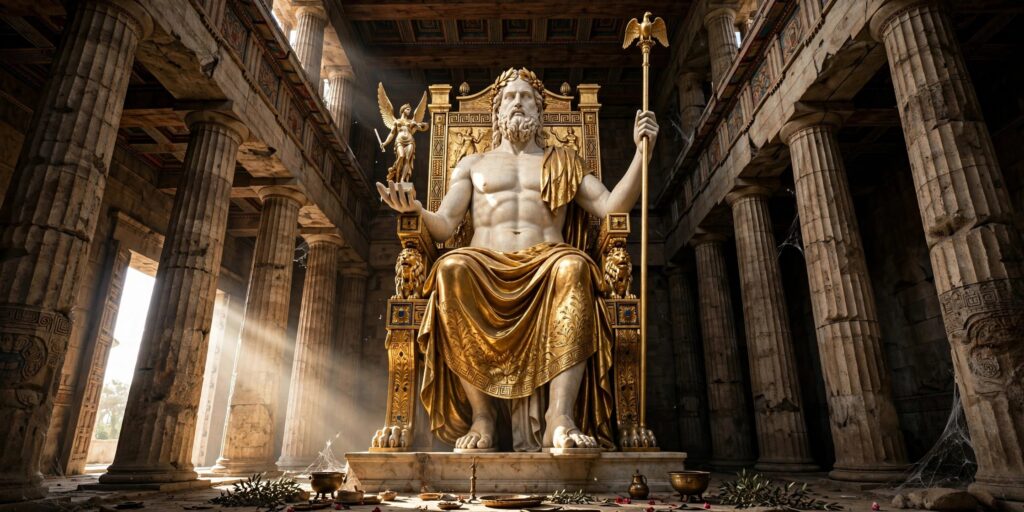
The Roman general Aemilius Paullus, viewing the statue in 168 BCE after his victory at Pydna had ended the Antigonid kingdom of Macedon, reportedly felt overwhelmed by an emotion he had not expected to feel in front of a man-made object, a response ancient writers record as something close to the sensation of having genuinely stood before the god in person. Pheidias had apparently calculated this precisely. The god’s scale was designed to produce an experience of divine presence rather than simply admiration for artistic skill.
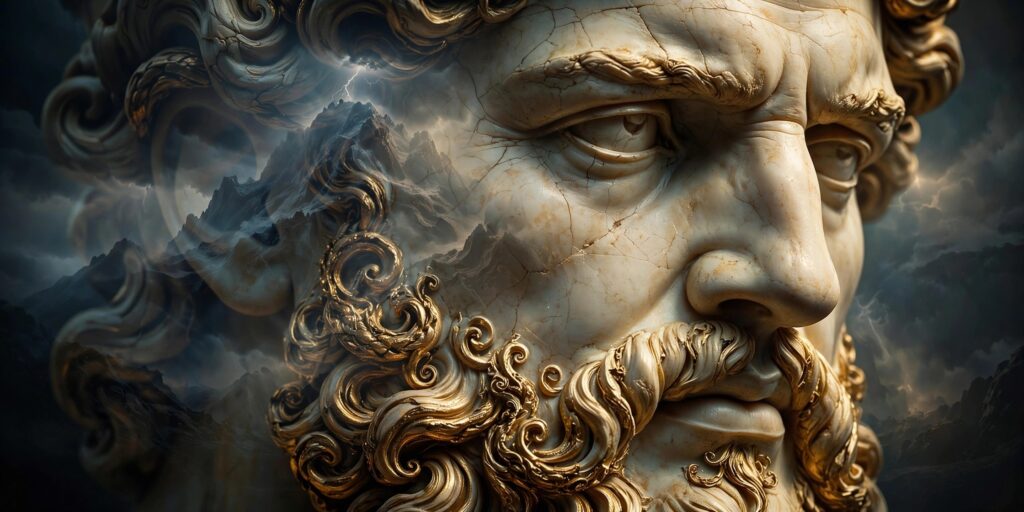
Pheidias is said to have been asked, when he had finished it, what had inspired his vision of Zeus’s face. He quoted the Iliad: as he spoke, the son of Kronos nodded his dark brows, and the ambrosial locks flowed forward from the immortal head of the king, and great Olympus shook. The sculptor had read the poem and built what the lines described, and the result was, by the near-universal judgment of antiquity, the most complete successful rendering of divine majesty in the physical form available to human craft. The statue was eventually transported to Constantinople in late antiquity, where it was, by most later accounts, destroyed by fire in 475 CE, and nothing that could be called a likeness survives. What survives is the written testimony of a hundred ancient visitors who tried to describe what they had seen and kept failing, because Pheidias had achieved something that description apparently could not follow.
The God Who Was Never Allowed to Have a Grave
Crete claimed something about Zeus that the rest of the Greek world found intolerable: that he had a tomb.
The Cretan tradition held that Zeus was born on the island, hidden by his mother Rhea in a cave on Mount Ida or Mount Dikte to keep him safe from his father Kronos, who had been devouring his children to prevent exactly the succession that Zeus would eventually accomplish. The Kouretes, armored young men, clashed their weapons together around the infant to mask his cries from Kronos’s hearing, a myth this collection has examined elsewhere in its own right. But the Cretan tradition went further than the birth story that the rest of Greece was willing to accept. It held that the god had also died, and that his grave could be visited on the island’s soil.
This claim scandalized the wider Greek theological imagination for a clear reason. A god who could die was not, by the logic the rest of Greek religion had settled into, actually a god in the full sense the word required. The poet Callimachus, writing his Hymn to Zeus in the third century BCE, addresses the problem directly and with open irritation: Cretans, he writes, are always liars, for they have even built a tomb for you, lord, though you did not die, for you are forever. The line is a direct rebuke of the Cretan claim, and it draws on a much older piece of Greek philosophical wit, the paradox attributed to the semi-legendary Cretan prophet Epimenides, who is said to have declared that all Cretans are liars, a self-referential puzzle that logicians still study today under Epimenides’s own name, and which Callimachus deploys here with evident relish: the Cretans are liars, and here is the proof, because look what they have said about Zeus this time.
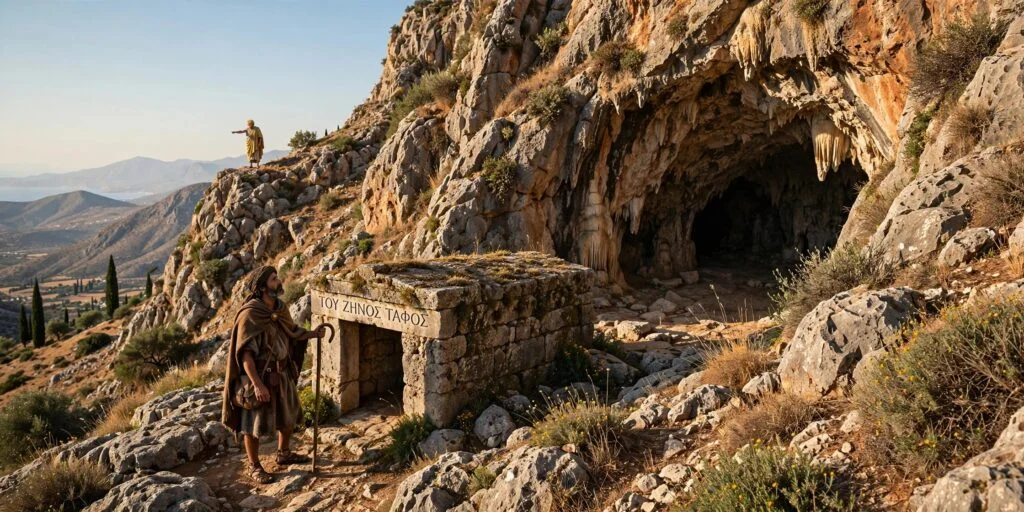
The dispute is a small thing in the scope of the mythology, but it is a genuinely revealing one. It shows a Greek religious culture actively policing the boundary of what a god was permitted to be, even against a regional belief as old and as locally sincere as Crete’s own memory of the god’s birth on its own mountains. Zeus could be born. Every Greek region agreed on that, and treated the Cretan birth caves as sacred sites worth pilgrimage. Crete was not even the only claimant: an entirely separate Arcadian tradition placed his birth on a Peloponnesian mountain summit instead, an altar whose ash predates Greek worship of Zeus by a thousand years. But he could not be allowed to die, because the entire structure the later mythology had built, the sky that contains everything, the storm that clears the way for order, the sovereign whose authority is legitimated by the cosmic structure he operates within rather than above, required a god who simply could not be subject to the one force that governed everything else that breathed.
What Zeus Was Ultimately About
The three layers, sky father, storm champion, political sovereign, do not explain each other away. They are not contradictions to be resolved into a single simpler figure. They are the accumulated mythology of a god who had been accumulating for five thousand years before Hesiod wrote the Theogony, and who continued accumulating through every subsequent generation that found it necessary to think about what supreme authority in the cosmos actually meant.
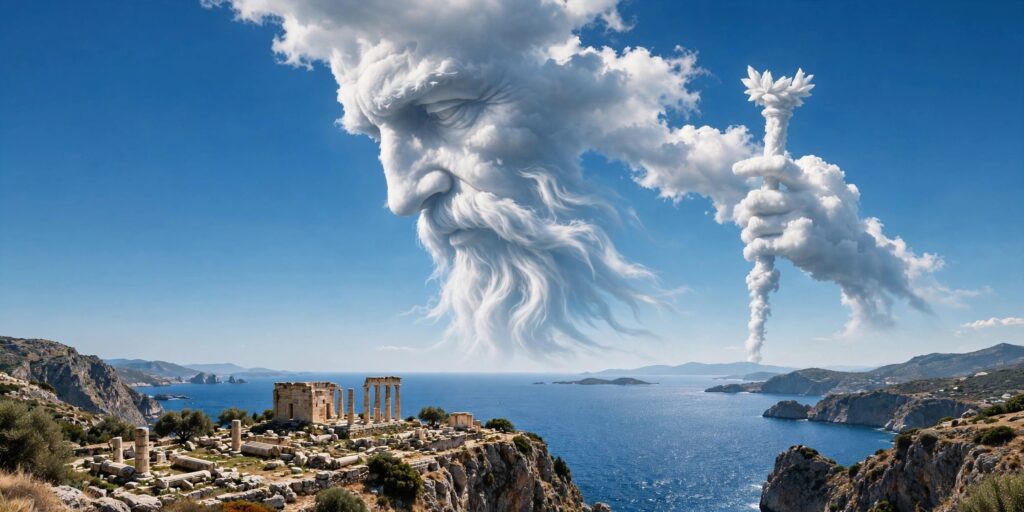
The Zeus who witnesses oaths and punishes their violation is the sky father doing what the sky does: seeing everything and remembering it. The Zeus who kills Typhon and imprisons the Titans is the storm champion doing what the storm champion does: clearing the way for the order that life requires against the forces that would prevent it. The Zeus who defers to the Moirai and holds the scales and refuses to save his own son from a fated death is the political sovereign doing the one thing that makes political sovereignty legitimate rather than merely powerful: operating within the structure that gives authority its meaning rather than outside it. And the Zeus who could be worshipped in the same breath as the guarantor of guest-friendship between kings and the small household jar that kept a family’s grain safe from spoiling is the sky father made small enough to fit inside an ordinary life without losing anything of what made him the sky in the first place.
He was already ancient when Homer wrote him down. His name was already thousands of years old. The sky he represented had been the sky as long as anyone under it had been watching it.
What Hesiod added, and Homer, and the tragedians, and the priests of Dodona interpreting an oak tree’s rustling leaves, and Pheidias’s twelve-meter figure filling the interior of Olympia until visitors felt the roof might lift, was not Zeus himself. It was the Greek world’s particular account of what that much accumulated divinity, witnessed across that much accumulated human time, finally meant.
At Olympus Estate, Mythic Essays moves through the deeper currents of the Greek tradition. Zeus’s name derives from the reconstructed Proto-Indo-European *Dyēus, the same root that produced the Vedic Dyaus Pita, the Latin Jupiter, and the Baltic Dievas, making him nearly unique among the Olympians in having a transparent, traceable etymology rather than a pre-Greek or borrowed name. He is at least three gods layered into one: the ancient, largely passive sky father inherited from the deepest Indo-European past, the storm champion who absorbed the thunderbolt and the dragon-slaying myth that Indra and Thor also carry in their own traditions, and the political sovereign of Homer and Hesiod who defers to the Moirai and operates within the cosmic order rather than above it. The oldest oracle in Greece belonged to him at Dodona, older than Delphi, where Homer’s Selloi slept unwashed on the ground and Herodotus’s priestesses later spoke through doves. Pheidias built him in gold and ivory at Olympia, a work so overwhelming that a Roman general wept before it. And when Crete claimed he had a tomb, the rest of the Greek world, through the poet Callimachus, called Crete a nation of liars for saying so, because the god who contained everything else was never permitted to be contained by death.