

The Greek word for monster is teras.
The same word also means sign, omen, or wonder: the thing that appears at the boundary of the known and signals that something beyond ordinary experience is at work. A monstrous birth, an eclipse, a two-headed animal, the appearance of a comet: all of these were terata in the ancient Greek understanding, all of them signs that the boundary between the ordinary world and the forces beyond it had been briefly crossed or disturbed. The monster and the omen were not two different categories of experience for the ancient Greek world. They were the same category: the appearance in the ordinary world of something that belonged to what lay beyond it.
This understanding of the monster as a boundary marker rather than simply as a large and dangerous animal is the understanding that gives the Greek mythological monsters their theological function. The Lernaean Hydra is not simply a many-headed serpent. It is the creature that marks the boundary between the organized agricultural world and the swampy unchosen depths beneath it, the boundary that Heracles must cross in his second labor before he can proceed with the work of imposing civilization on the wilderness. The Scylla and Charybdis are not simply sea monsters. They are the creatures that mark the boundary between the navigable sea and the two kinds of destruction that mark its edges, the reef that tears the ship apart and the vortex that swallows it whole, and the passage between them is the passage through which the surviving navigator has demonstrated that human intelligence and courage can navigate what appears unnavigable. Cerberus is not simply a large dog. He is the guardian of the most fundamental boundary in the Greek cosmos, the boundary between the living and the dead, and the hero who crosses that boundary is the hero who has done what no ordinary mortal can do.
The monsters guard the boundaries. The heroes who defeat or pass them are the heroes who have demonstrated that the organized human world can extend its reach to those boundaries without being destroyed by what it finds there. Understanding what each monster guards is understanding what each hero’s achievement means.
The Lernaean Hydra | The Boundary of the Cultivated World
The Hydra lived in the swamps of Lerna, in the Argolid, and the location of its lair is the first indication of what boundary it marked. Lerna was understood in the ancient tradition as one of the entrances to the underworld, a place where the boundary between the organized surface world and the chthonic depths beneath it was especially thin: the swamp whose quality of neither-land-nor-water, neither-alive-nor-dead, neither-organized-nor-chaotic made it the appropriate habitat for the creature whose properties embodied the same boundary condition.
The Hydra’s regenerative power, the growth of two heads for every head severed, is the property whose mythological logic is most worth attending to. The monster that cannot be defeated by the direct application of force, that makes every direct assault productive of more resistance rather than less, is the monster that encodes an understanding of what kinds of problems cannot be solved by the direct application of force. The swamp whose draining produces more swamp, the political problem whose suppression produces more opposition, the chronic condition whose treatment produces more symptoms: the Hydra’s regeneration is the ancient mythological encoding of the class of problems that require a different kind of solution from the one that direct force provides.

The solution that Heracles and Iolaus develop is the solution of the immediate cauterization: the fire applied to the wound before the regeneration can begin, the closing of the boundary before the monstrous can breach it again. This is not simply a clever tactical solution. It is the heroic insight that the boundary condition requires not just the removal of the monstrous but the permanent sealing of the wound through which the monstrous was emerging. The immortal head that Heracles buries beneath the stone is the head that cannot be killed but can be permanently contained: the acknowledgment that some aspects of the monstrous cannot be destroyed but can only be prevented from returning.
The Hydra’s parentage in the Hesiodic tradition is the parentage of Typhon and Echidna, the two primordial monsters who were the parents of the majority of the Greek canonical monster tradition: Typhon the last great challenger of Zeus’s cosmic order, Echidna the half-woman half-serpent who lived in a cave and produced the monsters that the heroes would spend their careers defeating. The Hydra is the child of the resistance to the Olympian order, and Heracles’s defeat of it is the confirmation that the Olympian order’s champion can overcome the resistance’s most powerful weapon.
Scylla and Charybdis | The Two Modes of Destruction
Scylla and Charybdis guard the strait between Italy and Sicily, and their characters encode the two fundamental modes of maritime destruction that the ancient Greek tradition understood the sea to threaten.
Scylla was the cliff-dwelling monster: her twelve paws gripped the rock, her six heads on long necks extended from her cave to snatch the sailors who passed within range, and her predatory method was the selective and localized seizure of the individual rather than the destruction of the whole. She was the danger that the careful navigator could minimize through the management of distance and course: the ship that passed close enough to the cliff for Scylla’s reach gave up six men in exchange for the ship’s survival, and Odysseus’s tactical choice to pass Scylla rather than Charybdis was the choice of the controlled and limited loss over the total destruction.

Charybdis was the vortex: she drank the sea three times a day and disgorged it, creating the whirlpool that swallowed ships whole. Her predatory method was the complete engulfment rather than the selective seizure, the destruction of everything within range rather than the taking of the accessible few. She represented the catastrophic total loss rather than the manageable partial loss, the storm that sinks the ship rather than the reef that damages it.

The Odyssey’s treatment of the Scylla and Charybdis passage is the treatment of the leadership decision that the threat poses: Odysseus knows that passing Charybdis risks total destruction, that passing Scylla means the certain death of six of his men. He chooses the certain partial loss over the likely total loss, and he does not tell his men what the choice means because the knowledge that six of them will certainly die would produce panic that would make the total loss more likely. The navigation between Scylla and Charybdis is the navigation of the leadership dilemma in which both available options produce loss and the choice is between the controlled partial loss and the catastrophic total loss.

The ancient belief that placed Scylla and Charybdis in the straits of Messina was the belief that encoded the navigational dangers of the passage in the mythological form the ancient mind used to preserve and transmit hazardous geographical knowledge. The strait where the currents of the Tyrrhenian and Ionian seas meet is genuinely dangerous and capable of producing the vortex conditions described in the Charybdis story. The timing of the whirlpool’s greatest force in the tidal cycle corresponds closely to the three daily swallowings that the myth specifies, and the narrative preserved the danger in a form that sailors could remember and respect.

The phrase between Scylla and Charybdis has survived in the English language as the precise idiom for the dilemma of the two inescapable dangers: it has survived because the logical structure of the dilemma, the choice between the controlled partial loss and the catastrophic total loss, is a structure that the human experience consistently encounters and that the mythological language of the monsters most precisely names.
The Chimera | The Monster of the Composite
The Chimera, the lion‑headed, goat‑bodied, serpent‑tailed fire‑breather of the Lycian world described by Homer in the Iliad and by Hesiod with the additional goat head at the body’s middle, is the monster whose nature is the nature of the composite. It is the creature assembled from parts of different animals, the being that does not belong to any single category of the organized natural world. Its form is the form of the unnatural combination, the embodiment of the fear that arises when the boundaries of species and order are broken and the familiar world is replaced by something that cannot be classified.
The combination of the lion, the goat, and the serpent in the Chimera’s composition is the combination of the three registers of the ancient Greek natural world’s organization: the lion as the apex predator of the terrestrial world, the goat as the domesticated pastoral animal most closely associated with the agricultural boundary between the wild and the cultivated, and the serpent as the chthonic creature most closely associated with the underground boundary between the living and the dead. The Chimera assembled in a single body the three registers of the natural world’s boundary conditions, which is why it was the monster that the Lycian landscape, the boundary between the Mediterranean coastal world and the Anatolian interior, generated: the landscape that was itself a composite of different ecological and cultural zones produced the composite monster.

Bellerophon’s defeat of the Chimera, accomplished from the back of the winged horse Pegasus that Perseus’s killing of Medusa had generated from the Gorgon’s blood, is the defeat that introduces the aerial dimension into the monster confrontation: the Chimera’s fire breath made direct ground-level approach impossible, and the elevated approach from the winged horse was the approach that bypassed the boundary that the fire breath enforced. The hero who could fight from above the monster’s reach was the hero who had accessed a dimension of the conflict that the monster’s mode of defense had not anticipated.
The word chimera has passed into English as the word for the impossible or the illusory: the chimera as a false idea or an unachievable goal. The passage from the mythological monster to the general concept of the unachievable reflects the ancient philosophical tradition’s engagement with the Chimera as an emblem of the category error, the thing that cannot exist in the organized natural world because it violates the categorical boundaries that the organized natural world maintains. The Chimera was not simply impossible in the sense of never having existed. It was impossible in the more precise sense of being constitutionally inconsistent: a creature assembled from parts that belong to different categorical domains of the natural world, none of which can coexist with the others in the form the Chimera represents.
The Cyclopes | Two Traditions Separated
The name Cyclopes appears in two entirely distinct ancient Greek worlds that the sources themselves distinguished and that the modern reader often conflates. Separating the two is essential for understanding what each describes. One world is the world of the divine craftsmen, the builders of the gods’ weapons and the forgers of the thunderbolt. The other is the world of the Homeric giants, the pastoral beings who live outside the structures of civilization. The same name was used for both, but the two belong to different imaginations and different explanations of how the world was organized.
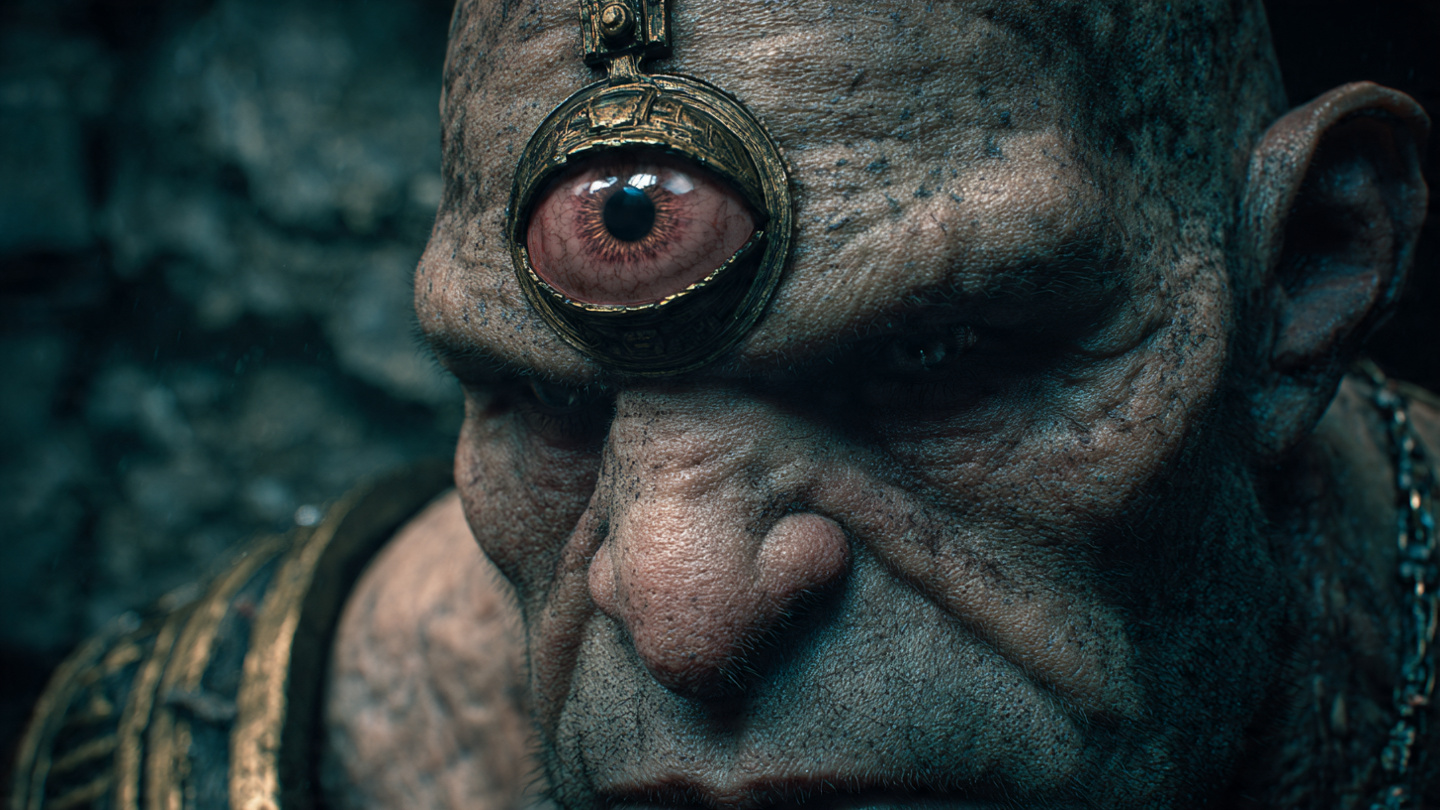
The Hesiodic Cyclopes are the three primordial divine smiths, Brontes, Steropes, and Arges: sons of Uranus and Gaia, imprisoned in Tartarus by their father alongside the Titans, liberated by Zeus during the Titanomachy in exchange for their contribution to the Olympian victory. That contribution was the thunderbolt: the Cyclopes forged for Zeus the weapon that allowed him to defeat Kronos and the Titans, and they subsequently forged the trident for Poseidon and the helmet of invisibility for Hades that the three divine brothers used in the final phase of the cosmic conflict. The Hesiodic Cyclopes are divine craftsmen at the level of Hephaestus himself, and their single eye is the mark not of limitation but of the focused intensity of vision that the divine smith requires: the forge-worker who looks directly into the fire.
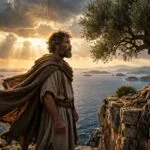
The Cyclopes of the Odyssey belong to an entirely different world. They are a race of pastoral giants who live in caves on an unnamed island, who practice no agriculture, who acknowledge no gods, who maintain no community, and who eat their sheep and goats and the occasional shipwrecked sailor without the civic organization that the polis required. Polyphemus, the son of Poseidon, who traps Odysseus and his men in his cave and eats them one by one, is the representative of this world. He is the human form without the fully human civic and intellectual development that the Greek imagination identified as the content of humanity rather than simply its container.

The Polyphemus episode’s intellectual content is the content of the conflict between the organized intelligence of Odysseus, who outwits the physically overwhelming Cyclops through the combination of the Nobody trick and the fire-hardened stake and the sheep’s belly, and the brute physical force of the Cyclops, who has the strength to move the boulder that seals the cave but lacks the intelligence to anticipate that the blinded man he has promised not to kill will escape beneath the sheep. The intelligence of the organized human world defeats the physical force of the uncivilized natural world, and Odysseus’s Nobody trick is the instrument of the victory: the name he gives himself is the name that renders the Cyclops’s curse on him meaningless, because Nobody cannot be cursed by Poseidon if Polyphemus cannot name the person he wants Poseidon to punish.
The belief that Apollo killed the Hesiodic Cyclopes for forging the thunderbolt that Zeus used to strike Asclepius is the belief that links the two Cyclopean worlds through the narrative of divine family conflict. Asclepius, Apollo’s son, was killed by Zeus’s thunderbolt for the hubris of restoring the dead, and Apollo’s vengeance on the Cyclopes who made the weapon was the consequence of that act. The story preserved the tension within the divine household and explained the killing as the moment when the grief of a father collided with the authority of the king of the gods.
Cerberus | The Necessary Guardian
Cerberus, the dog of Hades whose three heads and serpent tail and serpent mane guarded the entrance to the underworld, is the guardian of the most fundamental boundary in the Greek cosmological system: the boundary between the living and the dead that the Greek tradition understood as the most absolute of the cosmic divisions.
The properties of Cerberus’s guardianship are the properties of a boundary guardian whose function is specifically asymmetrical: Cerberus allowed the dead to enter the underworld without difficulty, because the passage into death was the passage that the cosmic order required of every mortal and that no guardian needed to prevent. What Cerberus prevented was the exit: the soul that had crossed into the underworld could not return to the living world, and Cerberus was the instrument of this prevention.
The three heroes who crossed the Cerberus boundary were the three heroes who most completely represent the different ways in which the human world could engage with the absolute limit that death represented.

Orpheus charmed Cerberus with his music, which is the engagement that worked through the medium of the divine art rather than through force or cleverness: the music that could move the rocks and the rivers could also move the three-headed guardian, not by overpowering him but by producing in him the state of attention to beauty that his position as guardian did not normally require him to exercise. The Orpheus crossing is the crossing that demonstrates the power of the artistic over the merely physical.
Heracles subdued Cerberus by direct physical constraint, which was the condition that Hades himself imposed: no weapons, only the hero’s body applied to the guardian’s body. The Heracles crossing is the crossing that demonstrates the heroic capacity to apply human force to the divine limit and make it temporarily yield, not through the destruction of the limit but through the temporary suspension of its operation by the force that only the son of Zeus could apply.

Psyche, in the late tradition developed by Apuleius in the second century CE, crossed the Cerberus boundary with the honey cakes that she was instructed to bring as the payment that the guardian required: the acknowledgment that even the absolute guardian of the absolute boundary could be managed through the understanding of what the guardian’s appetite was and the provision of what would satisfy it. The Psyche crossing is the crossing that demonstrates the wisdom of understanding the boundary’s conditions rather than attempting to overcome the boundary by force or art.
The Gorgons | What the Petrifying Gaze Names
The Gorgon tradition, which the dedicated Medusa and Gorgons article in this collection develops in full through both the Hesiodic and the Ovidian worlds. It is the monster whose defining property, the gaze that turns the living to stone, most precisely expresses the ancient philosophical understanding of what the encounter with the absolutely other does to the person who confronts it without preparation.
The petrifying gaze of the Gorgon is the gaze that stops all motion, that converts the living and the changing into the fixed and the permanent. It is the encounter with the absolutely horrifying in the form that produces not flight but paralysis: the freezing of the person who has seen what cannot be unseen in the condition of the person who is no longer moving in time but has become part of the permanent landscape of the unchanging.

Perseus’s defeat of Medusa through the mirrored shield, looking at the reflection rather than the original, is the defeat that most precisely encodes the philosophical insight about how the confrontation with the absolutely other can be navigated: not by direct encounter but by the mediated representation that maintains enough distance from the original to prevent the paralyzing effect while providing enough information for the action that the confrontation requires.
What the Monsters Guard Together
The Greek monster world, read as the theological boundary system it constitutes rather than as a catalogue of impressive beasts, is a map of the limits of the organized human world.
The Hydra marks the limit of the cultivated land and the chthonic depths beneath it. Scylla and Charybdis mark the limits of the navigable sea. The Chimera marks the categorical limits of the organized natural world. The Cyclopes, in the Homeric world, mark the limit between the civic and the uncivilized. Cerberus marks the limit between the living and the dead. The Gorgons mark the limit between the visible and the paralyzing encounter with the absolute.
The heroes who defeat or navigate these limits, Heracles, Odysseus, Perseus, Bellerophon, and Orpheus, are the figures who demonstrate that the organized human world, at the cost of extraordinary effort and intelligence and courage, can extend its reach to each of these edges without being destroyed by what it finds there. The monster worlds are the ancient account of what it costs to be human in a cosmos whose borders are not hospitable to humanity, and the hero worlds are the ancient account of what it looks like when the human world pays that cost and extends its reach anyway.
The monsters are still there. The boundaries they mark have not moved.
At Olympus Estate, Mythic Essays moves through the deeper currents of the Greek tradition. The Greek word for monster is teras, which is also the word for sign and wonder. The monsters mark the boundaries of the organized cosmos. The heroes who defeat them demonstrate that the human world can reach those boundaries without being destroyed. Every monster tradition is a boundary tradition. Every hero tradition is the tradition of the crossing. The boundaries have not moved. The crossings are still being attempted.