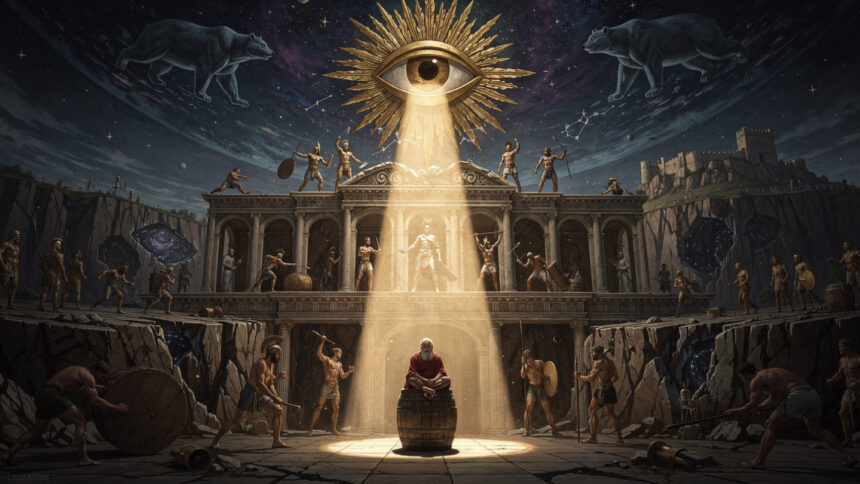





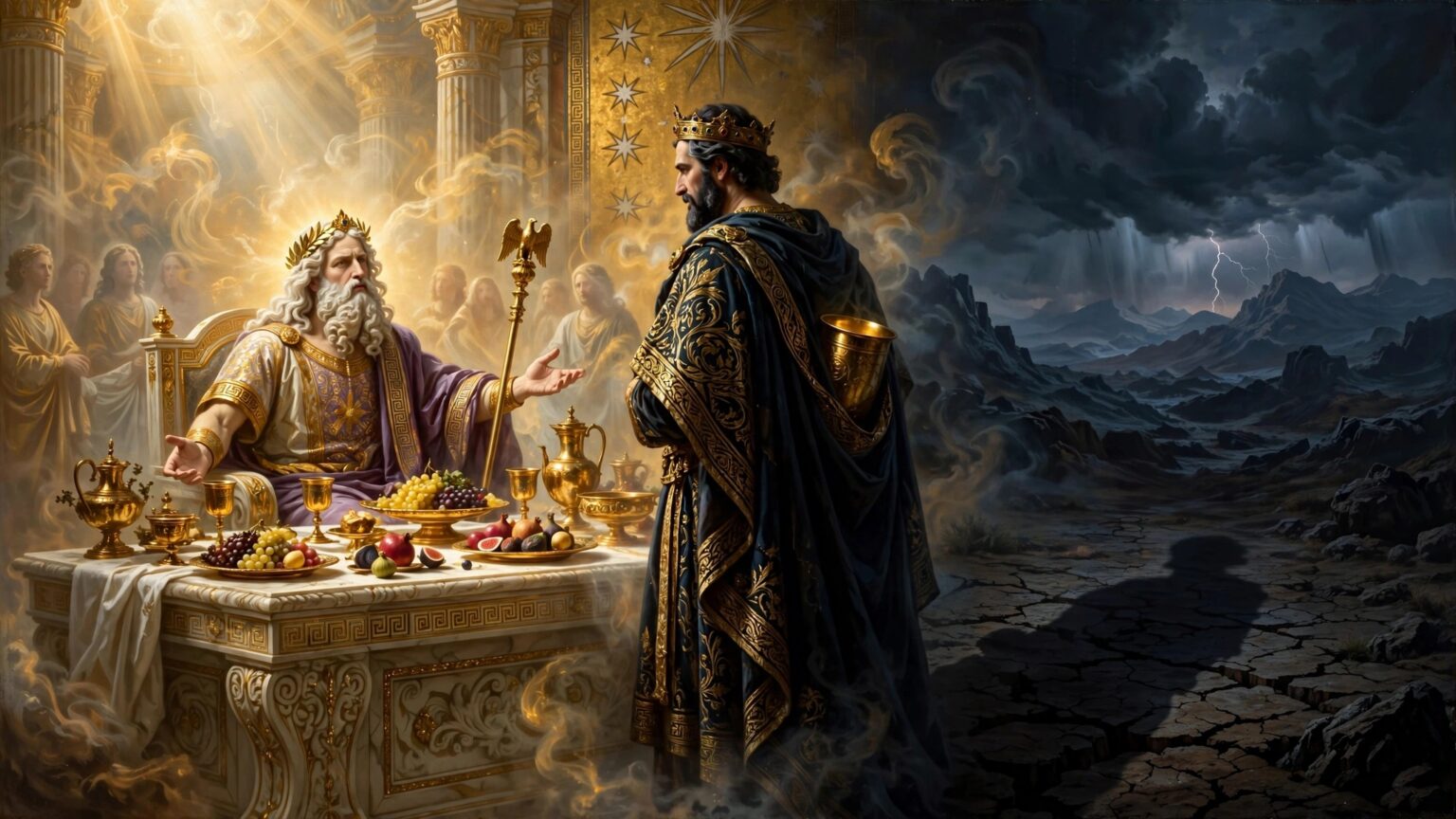
Before the punishment, there was the privilege. That is the part most retellings hurry past on their way to the fruit that withdraws and the water that disappears. Tantalus was not simply a wicked king who committed one terrible act and was sent below the earth for it. In every surviving tradition, he stands extraordinarily close to the gods: a son of Zeus, a man admitted to the divine table and trusted with things no ordinary mortal was meant to know.

What he did with that closeness is where the ancient sources stop agreeing with each other. He stole the food of the immortals and gave it to mortal men. He lied to Zeus over a stolen golden dog. In the version that became most famous, he killed his own son Pelops and served the body to the gods to see whether their divine knowledge could be fooled. But that story is not the oldest one we have. Homer gives us the punishment with no crime attached to it at all.
Pindar, writing a century and a half later, knew the cannibal feast and refused to tell it. Diodorus Siculus gives Tantalus an entirely different offense. The result is not a single consistent biography. It is a myth that kept asking, across five centuries of retelling, what kind of act could possibly deserve a punishment this exact.
A Mortal at the Gods’ Own Table
The tradition places Tantalus among kings, but it never lets him stay there. Diodorus Siculus calls him a son of Zeus, a man of enormous wealth, and, in his own words, “a very especial friend of the gods,” dwelling, in Diodorus’s telling, in the part of Asia later known as Paphlagonia, on the Black Sea coast, rather than the Sipylus and Lydia of the more familiar tradition. The disagreement over where he even ruled is itself the first sign that Tantalus was never the subject of one fixed history. He accumulated, the way a genuinely old myth accumulates, around several regional traditions that never fully merged.

His mother is usually named Pluto, and the name deserves one correction before it causes confusion: she is not Plouton, the underworld god later identified with Hades. She is an Oceanid, a daughter of the Titans Oceanus and Tethys, whose name happens to share a root with the Greek word for wealth. The coincidence is linguistic, not mythological.

Diodorus gives the most revealing account of what that closeness actually consisted of. Tantalus, he says, was admitted not only to the gods’ table but to their private conversation, and in his version the offense is already visible before anyone mentions Pelops or a golden dog: “he made known to men happenings among the immortals which were not to be divulged.” In this telling, Tantalus needed no further crime. The access itself was the temptation, and indiscretion was enough to end it.
A Crime the Sources Never Agreed On
There is no ancient master list of Tantalus’s offenses. What survives is several independent explanations, composed by different poets for different purposes over hundreds of years, and it is tempting, but wrong, to file them into one chronological life story, first the theft, then the false oath, then the feast, as though Tantalus committed all three in sequence. The sources do not present them that way. They present them as competing answers to the same question: what could a mortal possibly do, at that table, to earn a punishment the tradition never stopped elaborating?
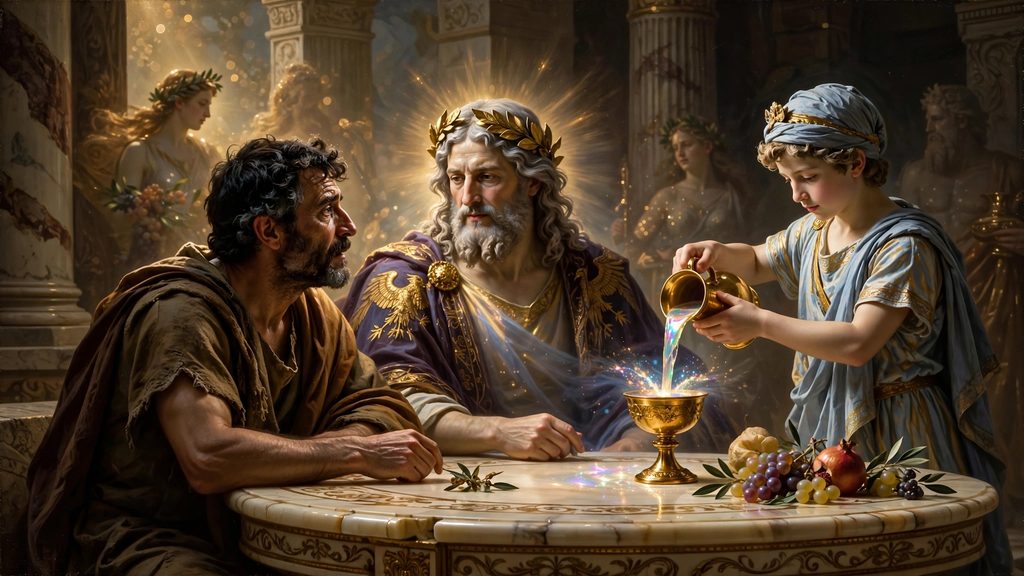
One answer, and the one Pindar makes decisive in the First Olympian, is theft: Tantalus stole nectar and ambrosia, the substances of divine immortality, and shared them with his mortal drinking companions. Pindar’s phrasing matters, because it ties the crime directly to the privilege rather than to any separate act of cruelty. Tantalus, he says, could not bear the greatness of his own good fortune. He had been let in, and he could not stay inside the limits that letting him in was supposed to carry.

A separate, later strand adds a golden dog. Antoninus Liberalis preserves the tradition that Pandareus stole a golden dog that had once guarded the infant Zeus in Crete and gave it to Tantalus to keep safe. When Zeus sent Hermes to recover it, Tantalus swore he had never received the animal, a false oath sworn in the name of the very god who had trusted him. This version belongs to the mythographers and the scholia, not to Homer, and it should be kept distinct from the underworld punishment’s oldest attestation rather than folded into it as an earlier chapter of the same story.
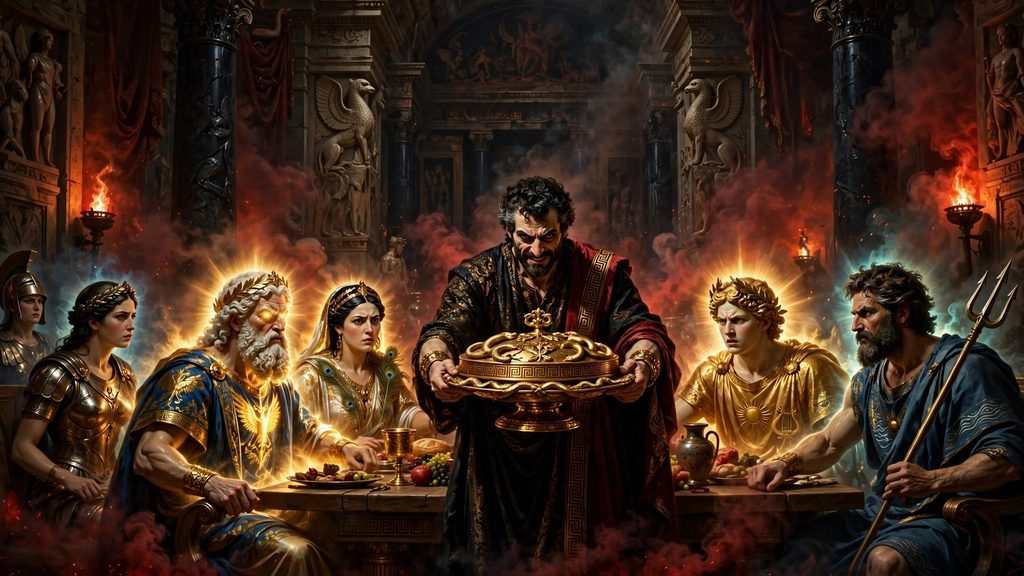
The version that eventually became the defining image of Tantalus is the feast: he killed his son Pelops, cut the body apart, cooked it, and served it to the gods, not from hunger or desperation but as a deliberate test of whether omniscient beings could be deceived by a disguised meal.

This account is preserved by Apollodorus and Hyginus and became, by far, the most widely repeated version in later antiquity and in everything since. But “most widely repeated” is not the same as “original,” and the gap between those two things is most of what makes this myth worth reading closely.
Homer Gives Us the Punishment Before Any Crime
The oldest surviving account of Tantalus is Homer’s, in Book Eleven of the Odyssey, where Odysseus descends to the house of the dead and reports what he sees among the great sinners. Tantalus stands in a pool of water that reaches his chin. Fruit trees hang over him, heavy with pears, pomegranates, apples, figs, and olives. Whenever he bends to drink, the water drains away and the ground dries beneath his feet. Whenever he reaches for the fruit, the wind lifts the branches out of range. Homer places him a few lines from another famous sinner rolling a boulder up a hill, a figure this site has examined at length in its own article on Sisyphus, and the two men have shared a sentence in the underworld’s catalogue of the damned for twenty-eight centuries.

What Homer does not do is explain why. No feast, no golden dog, no stolen ambrosia, no revealed secrets. Just the punishment, described with the precision of an eyewitness and offered without a word of justification. Every explanation the later tradition supplies is exactly that: later, an answer built backward from an image that apparently demanded one. A punishment this vivid does not stay unexplained for long. It simply took the Greek world several centuries, and several incompatible attempts, to decide what it was explaining.
The Feast, and What Demeter Ate
In the version that dominates later retelling, the gods recognized the meal at once and refused it, except for one goddess, distracted enough not to notice what was on the plate in front of her until it was too late. The majority tradition, preserved by Hyginus, names Demeter, absorbed at that exact moment in her search for the newly abducted Persephone. A scholiast’s note on Pindar preserves a minority variant naming Thetis instead, a reminder that even this famous detail was never universally fixed.
What is easy to miss is that the earliest surviving mention of Demeter eating the shoulder comes from Pindar himself, in the very ode where he refuses to endorse the story. He narrates it, grief and shoulder and all, specifically in order to set it aside as something no god would actually do. Pindar is not ignorant of the dark version. He is on record rejecting it, which means the feast tradition and Pindar’s objection to it are not two separate strands arriving at different times. They were already in conversation with each other in the same poem.

The parallel the majority version preserves is hard to read as accidental: a goddess whose own child has just been taken from her fails, in that same grief, to notice someone else’s child in front of her. The sources never claim Tantalus timed the meal to exploit it. They do not need to. The coincidence does the work on its own.
Pindar’s Refusal, and What He Put in Its Place
Composing the First Olympian for Hieron of Syracuse in 476 BCE, Pindar states outright that he is departing from earlier tellers, calls the cannibal story a tale spread by envious neighbors, and refuses to say that any of the blessed gods could be a glutton for human flesh. In his replacement version, Tantalus hosts the gods at Sipylus in return for hospitality they had shown him, and Poseidon simply falls in love with Pelops and carries him off to Olympus, a story Pindar explicitly compares to Zeus’s abduction of Ganymede. No cauldron. No dismemberment. No test of divine omniscience.

Pindar does not, however, make Tantalus innocent. His crime becomes the ambrosia theft described above, and his punishment is not the pool and the branches at all. It is an enormous stone suspended permanently over his head, never falling, never lifting, which he must spend eternity trying to fend off. The logic of this punishment is different from the water and fruit: it is not proximity to what he corrupted, but the permanent, physical form of an anxiety that never resolves, the exact inversion of the ease his place at the table was supposed to represent.
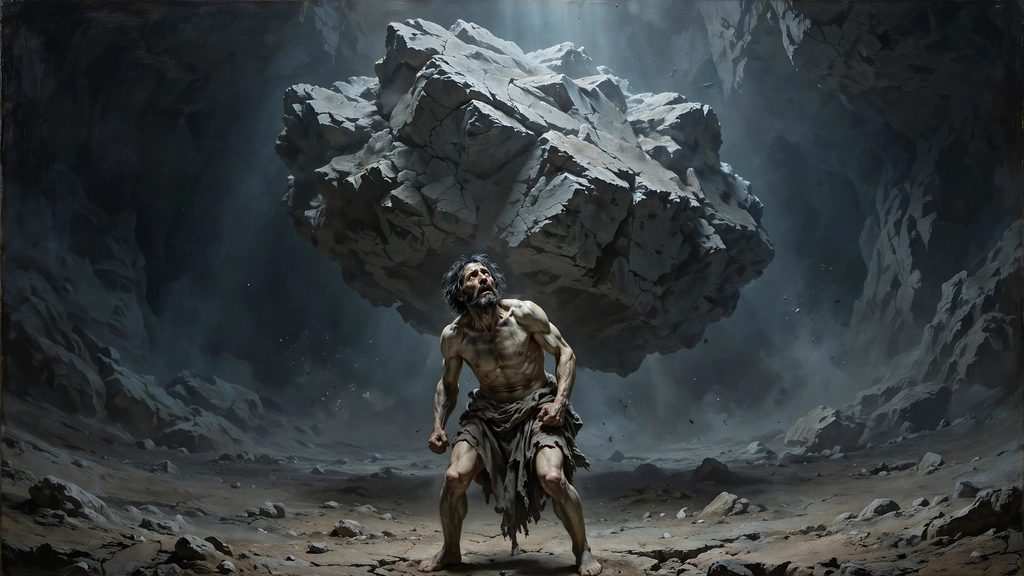
The two punishments were never reconciled into one official version, and the source that comes closest to combining them only proves how far apart they stayed. Homer gives the water and fruit with no stone. Pindar gives the stone with no water or fruit. Apollodorus’s Epitome puts the stone, the lake, and the overhanging fruit trees into a single sentence, and then gives, in the same breath, not the feast but two other reasons entirely: Tantalus “blabbed to men the mysteries of the gods,” matching Diodorus’s account almost word for word, and separately “attempted to share ambrosia with his fellows,” matching Pindar’s. The feast of Pelops plays no part in Apollodorus’s explanation of this particular punishment at all.

Apollodorus preserves a third punishment besides, attached to the golden dog rather than to either of the others: when Tantalus swore falsely that he had never received the stolen animal, Zeus’s response, in this telling, was not the pool and branches and not the stone overhead. It was Mount Sipylus itself, piled directly on top of him. Three punishments, three sets of reasons, inside the work of the one ancient author who tried hardest to collect the whole tradition in a single place. Apollodorus was not reconciling these stories. He was cataloguing the fact that they had never been reconciled, and leaving the contradiction standing rather than editing it away.
The Shoulder That Could Not Be Regrown
In the feast tradition, Zeus ordered the boy reassembled. The Fates drew Pelops from the cauldron whole, and where the missing shoulder had been, Hephaestus, the god this site has examined elsewhere as the craftsman who made a career of working around what could not be undone, forged a replacement piece of ivory.

Pelops was reassembled, not restored. The shoulder Demeter had eaten could not be regrown, only replaced with something not organic and not truly his, worn on his body for the rest of his life as visible proof of what his father had done.
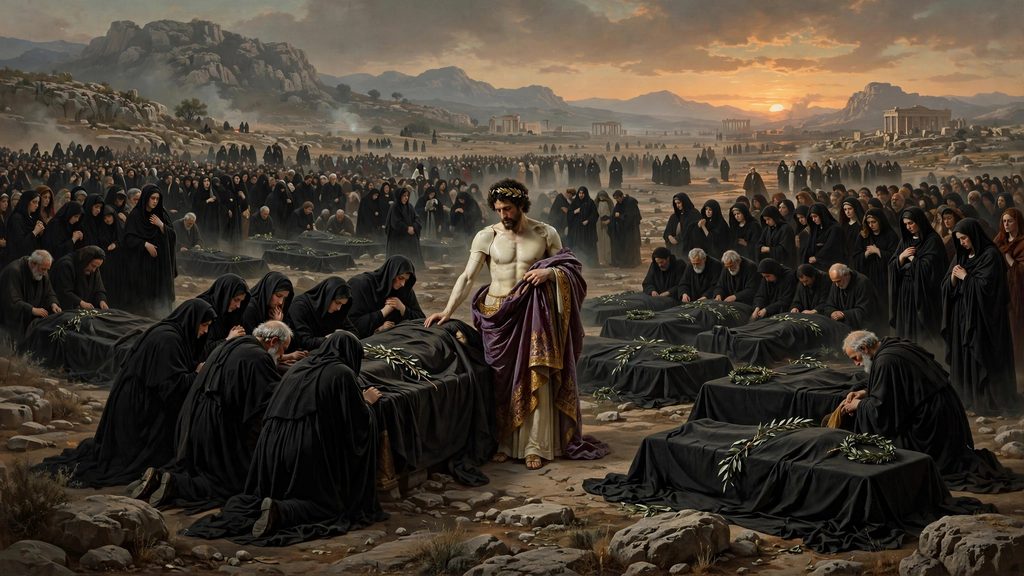
Ovid returns to it generations later, in the sixth book of the Metamorphoses, pausing over Pelops, present and grieving among the mourners for his sister Niobe’s dead children, the ivory still showing, the family’s original wound on display at a funeral her own pride had caused.
The Son Who Became a Dynasty
Pelops did not remain simply his father’s victim. He won Hippodamia by defeating her father Oenomaus in the chariot race that founded the Olympic tradition, and gave his own name to the peninsula this site has traced in full in its article on the Peloponnese. Even the victory has two irreconcilable versions: Pindar has Poseidon simply give Pelops divine horses and a winged chariot outright, while other traditions credit the treachery of Oenomaus’s own charioteer, Myrtilus, who sabotaged his master’s chariot for a bribe he was never paid. Pindar, once again, is cleaning up a darker story on his own authority, the same move he makes with the feast.

Later genealogy makes Pelops the father of Atreus and Thyestes, and through them the ancestor of Agamemnon and Menelaus, the entire House of Atreus whose crimes and reprisals became the central subject of Athenian tragedy and, generations later, the engine of the events this site has documented in its article on the Trojan War.
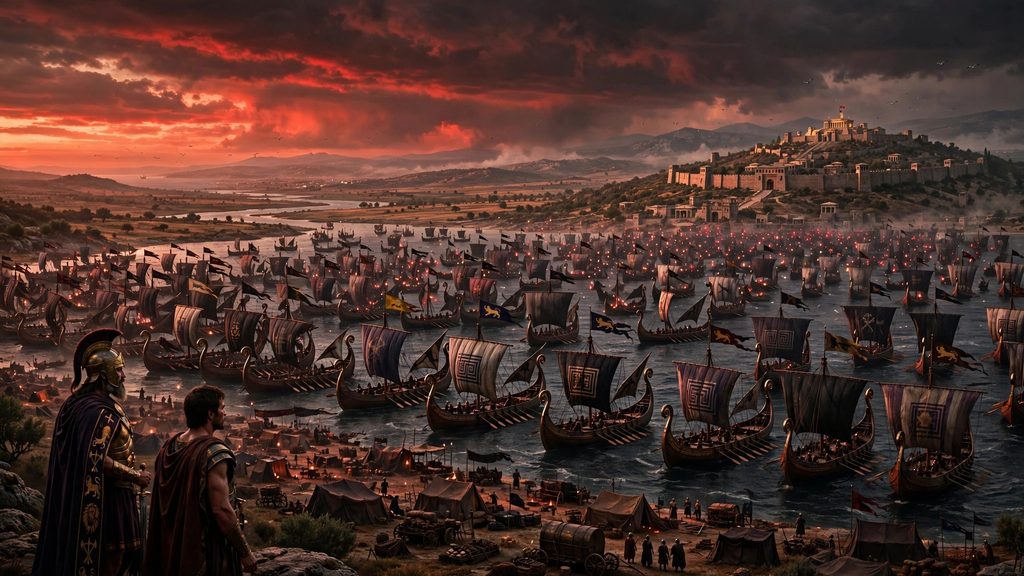
Tantalus’s own punishment ended his story. It did not end what his crime, whichever version of it one believes, had started.
Niobe and the Family’s Dangerous Confidence
Tantalus’s daughter Niobe carries the same underlying pattern into a different register, though here too the details shift by source rather than holding still. Homer gives her six sons and six daughters, twelve children in total; it is Ovid, centuries later, who makes her the mother of seven and seven, the fourteen that became the version later European art and literature preferred. The numbers vary. The offense does not: Niobe compared herself openly to Leto, mother of Apollo and Artemis, boasting that her greater number of children made her more deserving of honor than a goddess with only two.
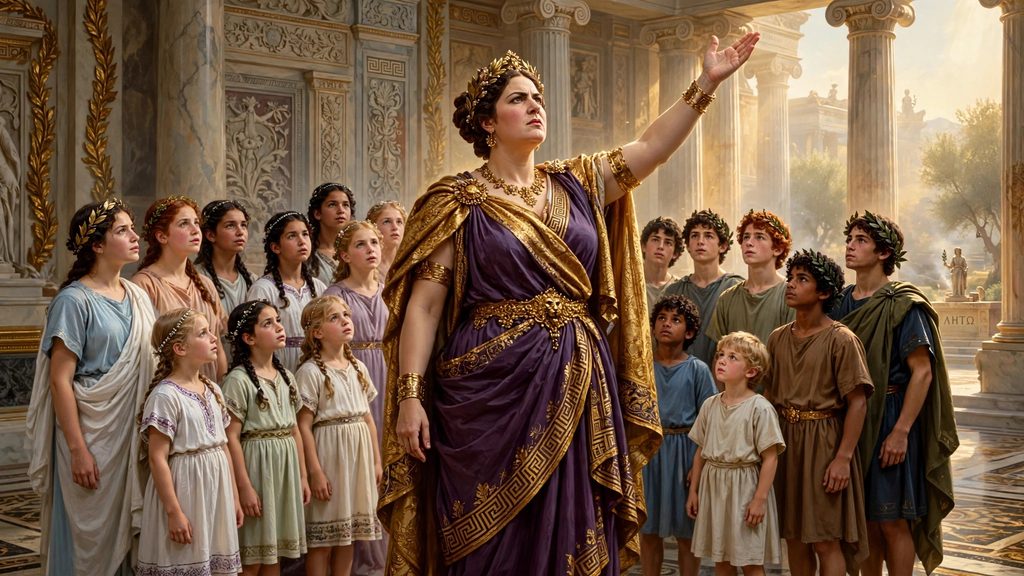
Apollo killed her sons with his arrows. Artemis killed her daughters with hers. Niobe wept until she turned to stone on Mount Sipylus, the same region the tradition gives as her father’s kingdom, and ancient travelers identified a rock formation there that was said to weep continuously, moisture running from the stone for children divine wrath had taken and could never give back.

It is tempting to call this a mechanically inherited curse, as though Niobe’s children died simply because of what her father once did. The sources do not actually claim that causal chain. What connects Tantalus and his daughter is not a curse working itself out automatically. It is the same mythic question, asked twice: what happens when a mortal who has been given something extraordinary decides to test whether it can be measured against the gods themselves. Tantalus tested whether divine knowledge could be deceived. Niobe tested whether divine honor could be outcounted by arithmetic. Neither test was one either of them needed to run. Both lost everything the test was actually about.
A Punishment Built From What He Had, Not From What He Lacked
Across every version of the crime, one thing never changes, which is the shape of the consequence. The popular memory of the myth treats the water and fruit as generic images of frustrated desire, thirst denied, hunger denied, and stops there. Read beside the competing traditions about what Tantalus actually did, the punishment becomes more exact than that.
Tantalus is not punished by having something withheld that he never had. He is punished by being shown, endlessly, the specific kind of thing his position had given him and no longer gives him: nourishment offered and then taken back, in a body that once sat at a table where nourishment was never in question. The water is not absent. It is present and visible, and it disappears the instant he tries to close the distance. The fruit is not out of sight. It hangs directly overhead, and it withdraws the moment his hand rises toward it. Whichever crime a given ancient source believed he had committed, theft, perjury, indiscretion, murder, the punishment answers all of them the same way: total visibility, total unreachability, held at the exact range that separates a guest from the table he is no longer welcome at.
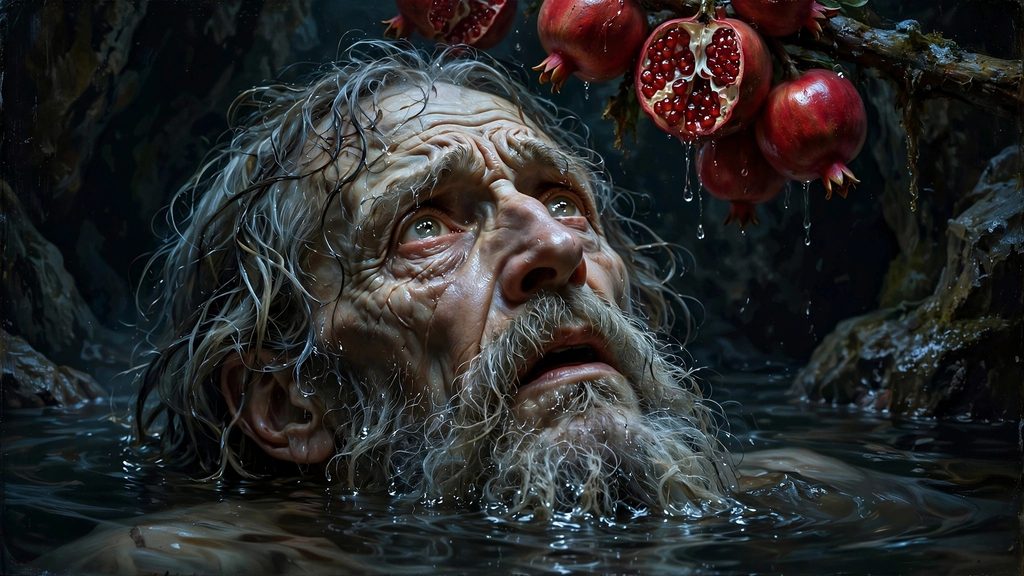
That is why the myth outlasted any single version of its own plot. The crime kept changing because different poets needed different crimes for different purposes. The punishment never needed to change, because it was never really about the crime’s details. It was about what happens to proximity once the thing it was built on has been broken. He was the most favored mortal any Greek poet ever put in front of an audience. Every version of his story agrees on that much, and every version of his punishment holds him exactly where that favor used to sit, close enough to see it, never again close enough to keep it.
What the Word Kept, and What It Left Behind
Tantalize entered English in the mid-nineteenth century by way of the French tantaliser, carrying the meaning it still has: to torment someone by keeping something desirable maddeningly out of reach. A tantalus, in the narrower and now largely antique sense, is a glass-fronted cabinet built to display decanters of spirits behind a lock, the bottles fully visible and entirely inaccessible without the key, the punishment of Tartarus reduced to a piece of Victorian dining-room furniture applied to whisky.

What the word kept was the sensation. What it left behind was the argument, the one the ancient sources never actually finished having: whether Tantalus fell because he stole, because he talked too freely, because he lied to his own father, or because he served that father’s grandson at a table of his own. The word does not need an answer to any of that to work.
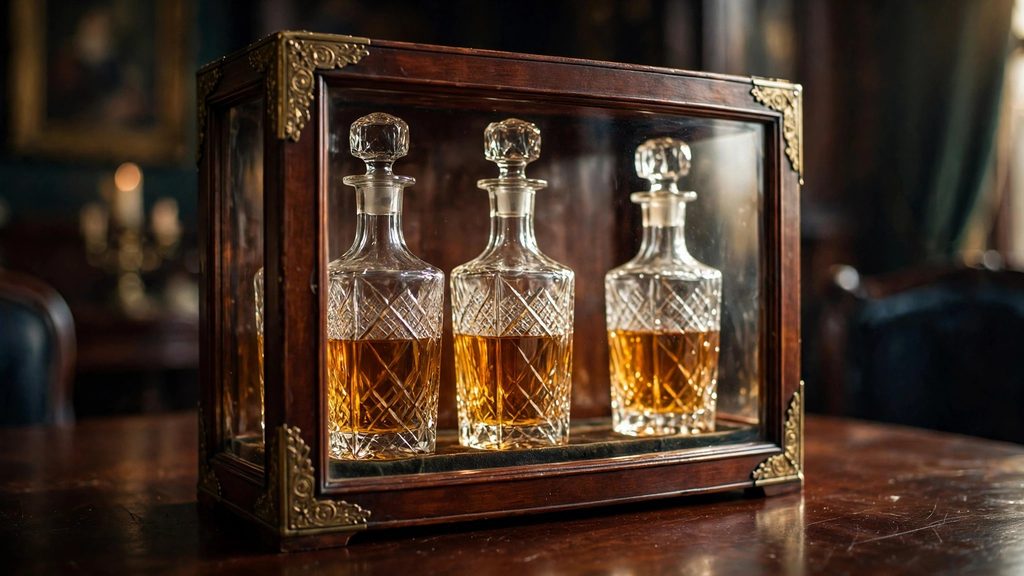
A person does not need to know who Tantalus was to understand the agony of seeing what they want and being unable to reach it. But knowing who he was is what turns a Victorian decanter cabinet back into one of the oldest and most contested stories the Greek tradition ever told about what a mortal owes the gods for letting him in.
At Olympus Estate, Tales from Olympus moves through the deeper currents of the Greek tradition. Tantalus, son of Zeus, was admitted as a regular guest to the table of the Olympians, and the ancient sources never agreed on what he did to lose that place: Pindar makes his crime the theft of ambrosia and nectar and gives him an eternally overhanging stone as punishment; Diodorus Siculus has him revealing divine secrets he heard at that same table; the mythographers Apollodorus and Hyginus preserve the version that became dominant, in which he killed his son Pelops and served him to the gods to test their omniscience, with only Demeter, distracted by grief for the newly abducted Persephone, tasting the meal before the rest refused it. Homer’s Odyssey, the oldest surviving account, gives none of these motives at all, only the punishment: water that recedes, fruit that withdraws, a boy’s ivory shoulder carried forward into a bloodline that produced Pelops, the House of Atreus, and the Trojan War. What the tradition never stopped agreeing on, across every rewriting of the crime, was the shape of the consequence: the most favored mortal who ever lived, held forever within sight of the table he was no longer allowed to reach.