


In the autumn of 406 BC, a crowd of men walked into the Athenian Assembly dressed in black, their heads shaved to the skin. They came as the relatives of drowned sailors, and they came at a carefully chosen moment. Six of the city’s generals were on trial for leaving those sailors to the sea, and the trial had just paused for a family festival, the three days each year when Athenian fathers stood before their kinsmen and swore whose children were whose.
The historian Xenophon, who lived through it, says the mourners were a trick. The politician Theramenes, he writes, had them dressed and shaved and sent into the Assembly to pose as kin of the dead. Whether that is true has been argued ever since. What is certain is that within days the generals were condemned in a single illegal vote, and six of them were executed, among them the son of Pericles.
The festival was the Apaturia. It was the day Athens checked who belonged, and its own founding legend was the story of a lie.
A Festival of Common Fathers
The name says what the festival was for. Apaturia, also spelled Apatouria, is usually explained as a worn-down form of a word meaning the gathering of those with common fathers. It belonged to the phratries, the brotherhoods of Athens, and its business was descent.
It was older than Athenian democracy and wider than Athens. Herodotus treats it as the badge of Ionian identity. All Ionians who trace their origin to Athens keep the Apaturia, he writes, except the people of Ephesus and Colophon, who gave it up because of an old murder. From Miletus to the islands, the festival marked a family of cities that claimed a common ancestry, just as it marked the families inside each city.
At Athens it fell in Pyanepsion, the autumn month that also held the Pyanepsia, Apollo’s bean boil, and the Thesmophoria, the three days when the citizen wives held the Pnyx. The exact days of the Apaturia are not known, and since each phratry ran its own celebration they may have varied from brotherhood to brotherhood. In a single lunar month, somewhere between mid-October and mid-November, Athens thanked its gods for the harvest, entrusted its seed to Demeter, and counted its families.
What a Phratry Was | The Brotherhood Behind Every Citizen
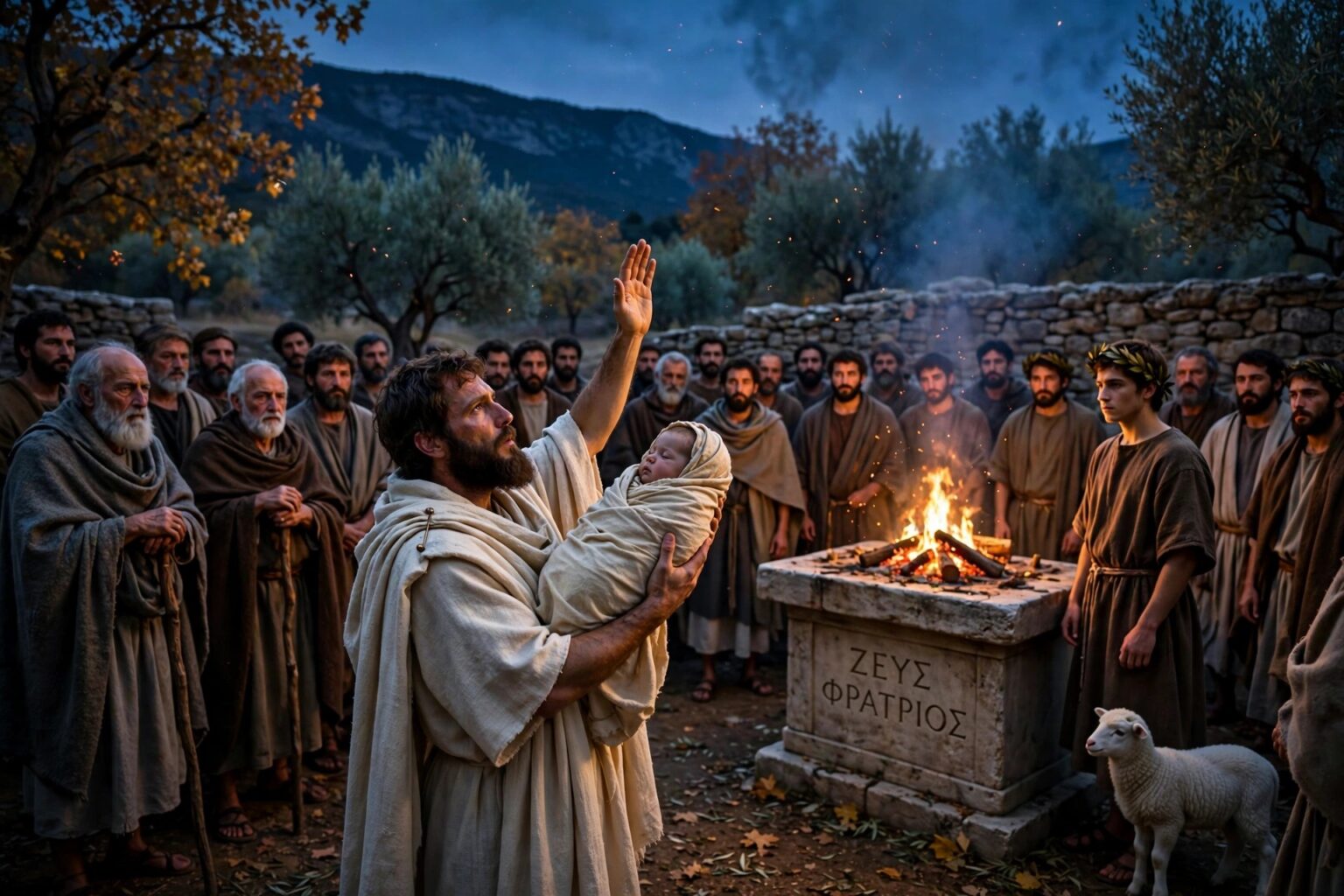
A phratry was a brotherhood of families, larger than a household or a clan and smaller than a tribe. The word shares its root with the Latin frater and the English brother. Athenians belonged to one by birth, every phratry had its own priests, its own altar of Zeus Phratrios and Athena Phratria, and its own officer, the phratriarch, and each kept a register of its members.
That register mattered more than any family feeling. When Cleisthenes reorganised Athens in 508 BC, he made the deme, the local village or district, the official roll of citizens. Yet the old brotherhoods kept their place beside it. Almost every citizen belonged to a phratry, and in practice only citizens did. When a dispute arose over an inheritance or a man’s right to vote, the speeches that survive from the Athenian courts call phratry members as witnesses. To be accepted by your brotherhood was a large part of being accepted as an Athenian.
In 451 BC the stakes rose. A law proposed by Pericles limited citizenship to men whose fathers and mothers were both Athenian. The demes enrolled only men, so the proof of a mother’s standing now rested on older forms of witness. Above all it rested on the phratry, where a new husband introduced his bride to his brothers with an offering called the gamelia and the brothers ate from it. A festival named for fathers had become, in practice, a check on mothers too. The women who were camped on the Pnyx for the Thesmophoria that same month were the women whose descent the brotherhoods were vouching for.
Three Days in Pyanepsion | Supper, Sacrifice and the Day of Youths
The festival ran for three days, and each had its own name. Ancient writers also mention a fourth, the epibda, but that word simply meant the day after any feast, the morning when everybody was tired.
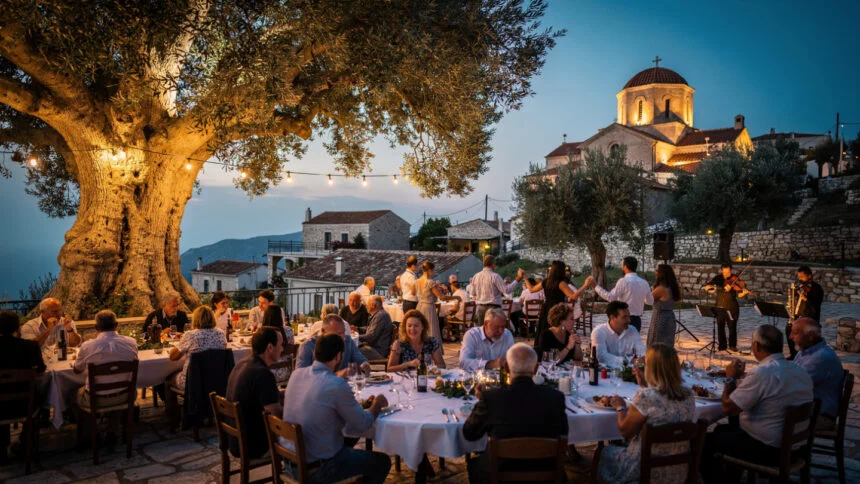
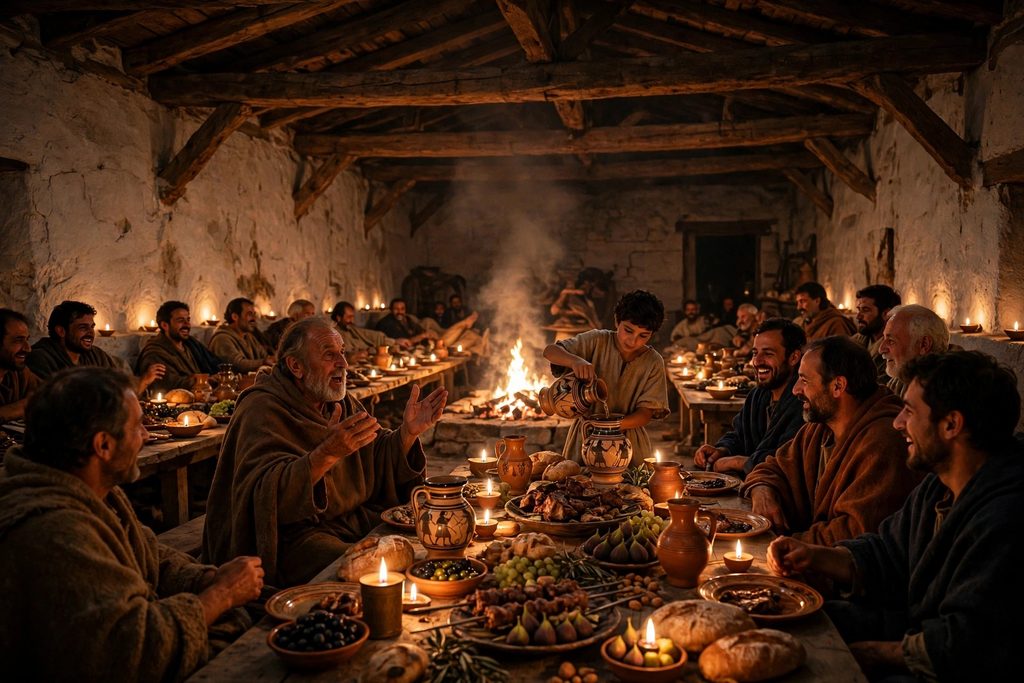
The supper came first, and it set the tone. Men who now lived in the city, on the coast or on farms across Attica came back to the place that proved who they were and ate with the people who knew them. On the second day the brotherhood sacrificed to Zeus and Athena in their roles as patrons of the phratry, the two greatest gods of the city turned toward its smallest unit of belonging. Dionysus was honoured too, and wine flowed. The third day was the reason for the other two.
Koureotis | The Day the Children Were Counted
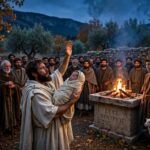
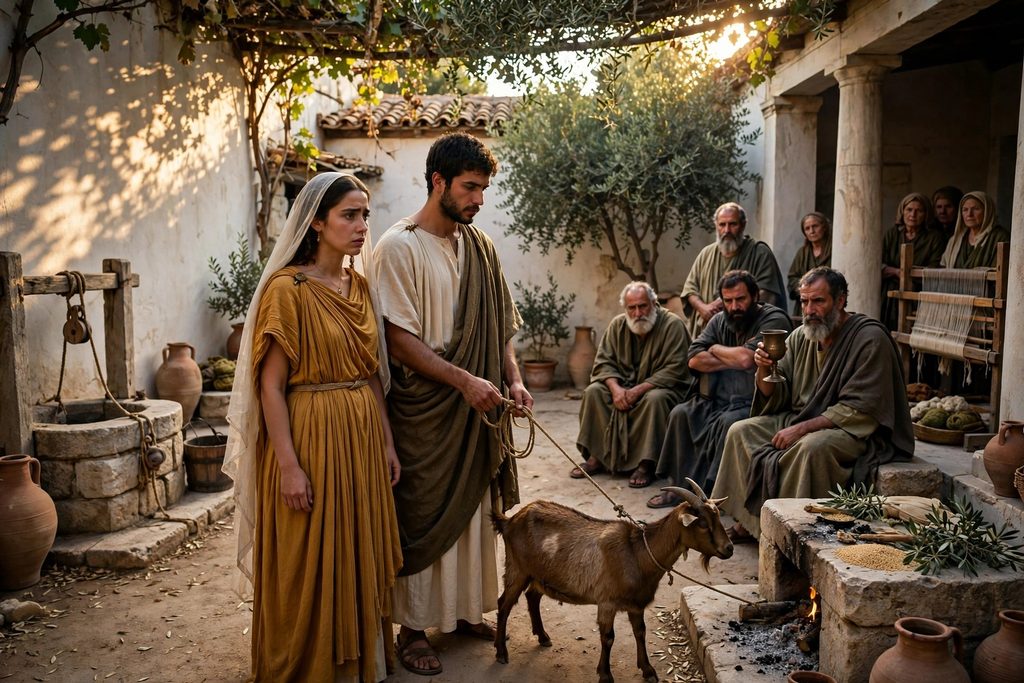
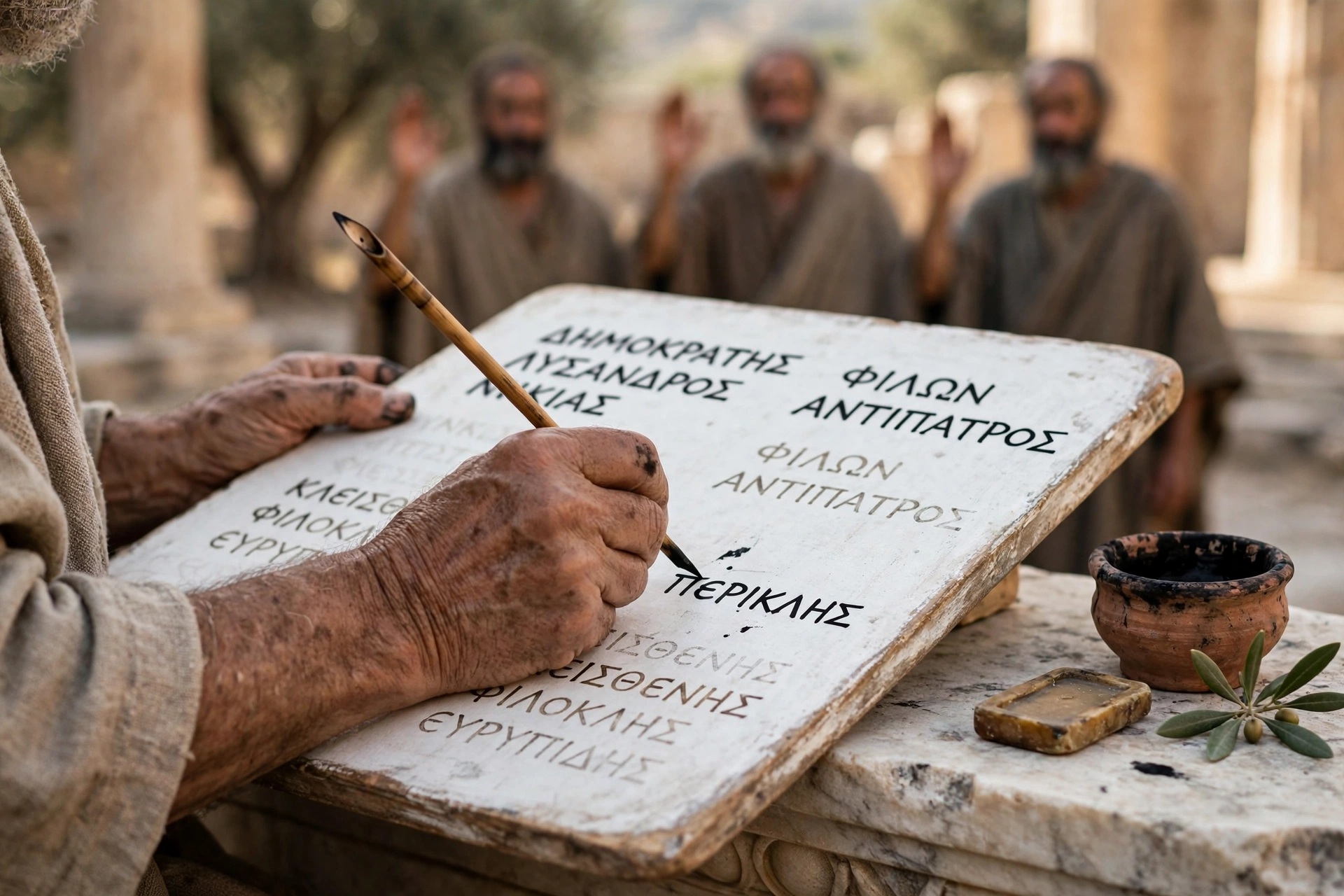
On Koureotis, fathers brought forward the children born since the last festival. Each father led a small animal to the altar, the meion, and swore before the brothers that the child was his own, born to him by a lawful Athenian wife. The meion had to reach a set weight. According to ancient lexicographers, if it fell short, the brothers shouted “too small, too small”, and the word stuck to the offering. Aristophanes borrowed the joke in his Frogs, where the poets’ verses are to be weighed like a sacrificial lamb.
The father’s word was not enough by itself. A remarkable inscription from Dekeleia, north of Athens, preserves the rules of one brotherhood, the Demotionidai, in the 390s BC. Candidates were presented at the altar during the Apaturia, three witnesses had to swear to the child’s descent, the members voted, and a father who introduced a child the brotherhood later rejected faced a fine. Every phratry seems to have done things a little differently, but all of them asked the same question, and all of them took it seriously.
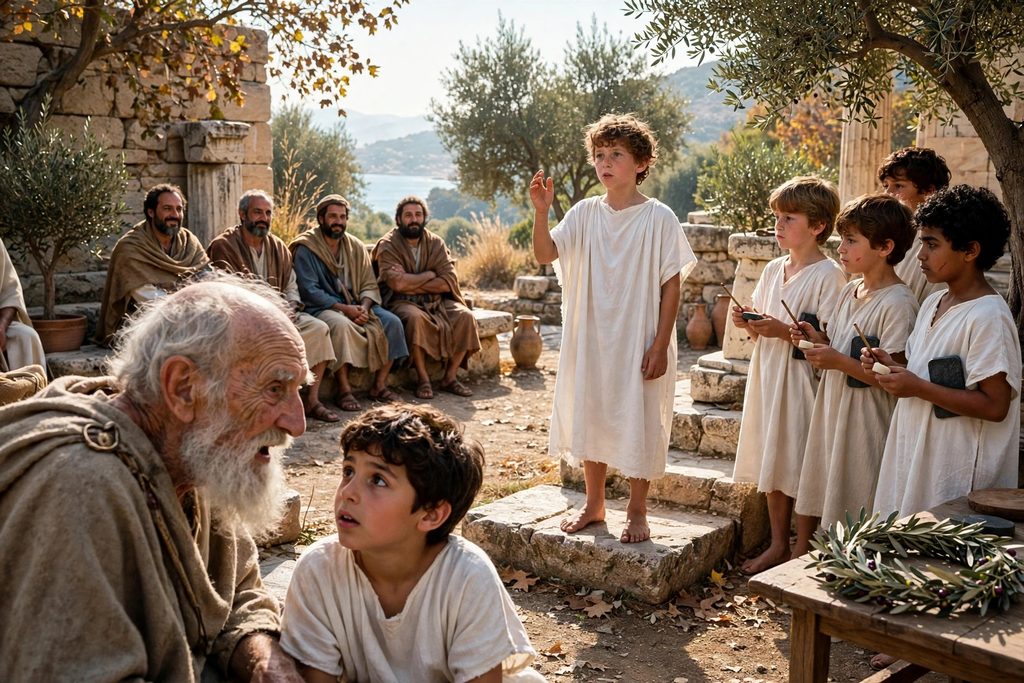
Around sixteen, a boy returned with a second offering, the koureion. The name of the day and the name of the sacrifice probably both come from kouros, a youth, and from keirein, to cut hair. Greek boys let their hair grow long through childhood and offered it to a god when they came of age, and at the Apaturia that lock of hair marked a boy’s full entry into the brotherhood of his fathers. Remember the hair, because it returns in 406.
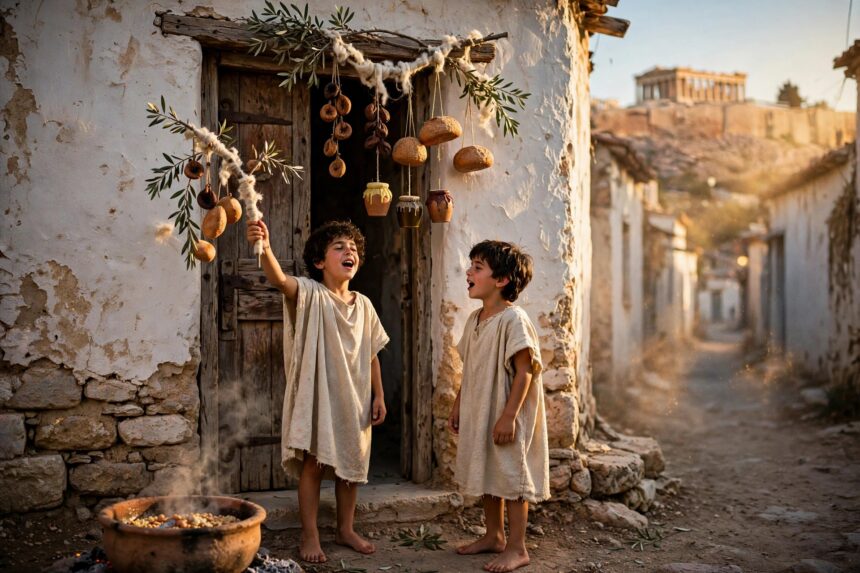
Koureotis was also a children’s festival. Plato remembers it in the Timaeus. His character Critias recalls a Koureotis from his boyhood, when the fathers set prizes for the boys’ recitations and many of the boys sang the poems of Solon, which were new at the time. That day, the old Critias told the boy a story Solon had brought home from Egypt, the story of a great island empire that sank beneath the sea. The tale of Atlantis, in Plato’s telling, was first heard at a family festival on the day of youths.
The Founding Lie | Melanthus and the Man in the Black Goatskin
Every Greek festival had a founding story, and the Apaturia’s is a story about a trick. Ancient writers derived the name from apate, deceit, and told this tale to explain it.
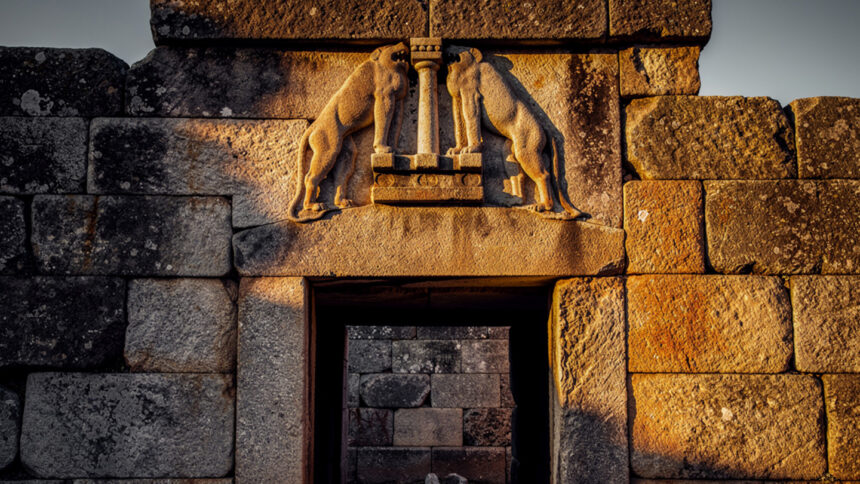
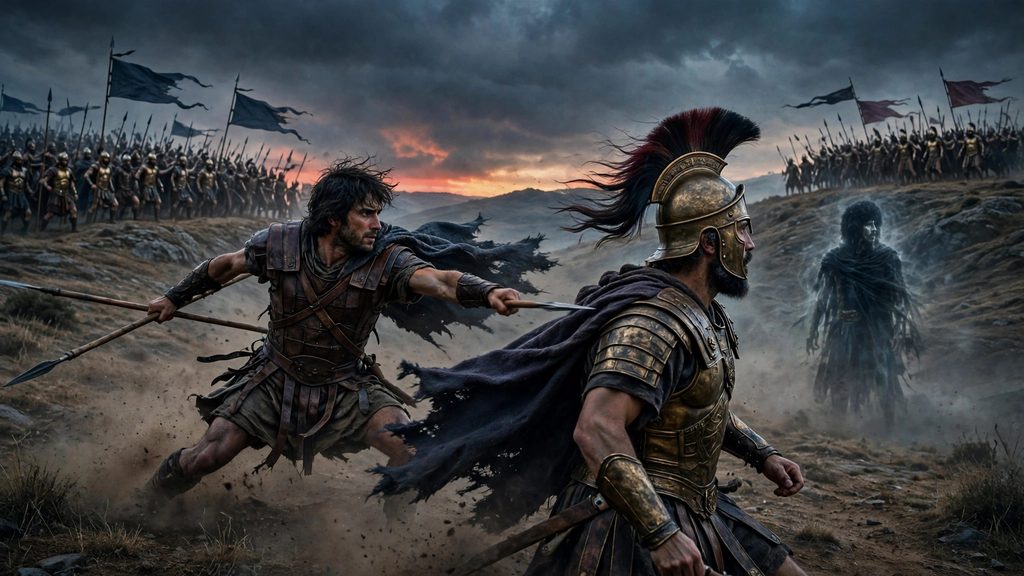
In the age of the kings, Athens and Boeotia fought over a strip of borderland. The Boeotian king Xanthus offered to settle it by single combat. Thymoetes, the king of Athens and the last of the line of Theseus, refused to fight. A newcomer stepped forward instead. Melanthus was an exile from Pylos, a descendant of Nestor’s family driven out of the Peloponnese, and he accepted the duel on condition that he would be king if he won.
In the middle of the fight, Melanthus shouted that Xanthus had broken the rules and brought a second man, a figure in a black goatskin standing behind him. Xanthus turned to look, and Melanthus killed him. The Athenians decided that the figure had been real and that it was Dionysus, and they worshipped him afterwards as Dionysus Melanaigis, of the black goatskin. Melanthus became king, and his son Codrus became the last and most famous king of Athens.
The derivation from apate is a folk etymology. The real meaning points to common fathers. But the story the Athenians chose for their festival of kinship is worth reading closely. An outsider with no Athenian ancestry wins the kingship by making a claim at the decisive moment, a claim that may have been false, and the city accepts it and builds a cult around it. The royal line of Athens begins with a foreigner and a deception. A festival in which men stood up and asserted descent had a founding legend that admitted, from the start, that an assertion can be false and still win.
Arginusae | The Mourners in Black
In the late summer of 406 BC, twenty-five years into the war with Sparta, Athens won its last great naval victory, off the Arginusae islands near Lesbos. To man the fleet it had melted down the gold of its temple statues and promised freedom to the slaves who rowed. The battle was won, but a storm broke as it ended. The crews of some twenty-five wrecked Athenian ships were left in the water, and most of them drowned. The generals said they had ordered two trierarchs to rescue the men and the storm had made it impossible. One of those trierarchs was Theramenes.

Back in Athens, grief turned to anger, and the blame began to move. The generals were deposed and recalled. Two refused to come home. Six returned, and Theramenes, the man who had failed to reach the drowning sailors, became one of their loudest accusers. The Assembly heard the case, and the generals’ defence was starting to win sympathy when night fell. In the dark nobody could count the raised hands, so the vote was postponed. Then came the Apaturia.
Xenophon tells the next part in two sentences. After this came the Apaturia, he writes, at which fathers and kinsmen meet together. At the festival, Theramenes and his supporters arranged for a large number of men dressed in black and shaved to the skin to attend the Assembly as though they were kinsmen of the dead, and bribed Callixeinus to accuse the generals before the Council.
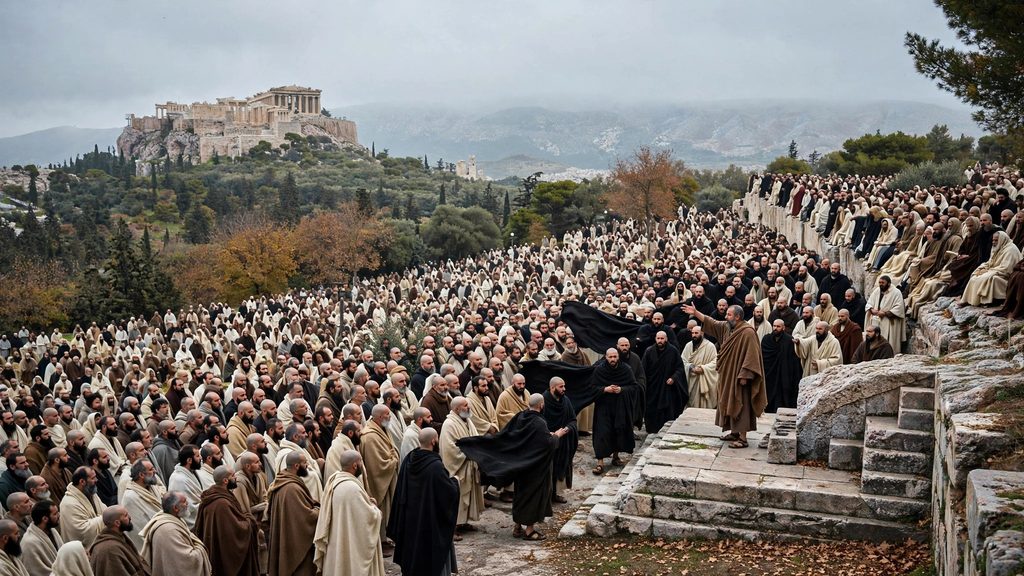
When the Assembly met again, the mood had changed. A man came forward who said he had survived the wreck by clinging to a barrel of meal, and that the drowning men had begged him to tell the people that the generals had abandoned the bravest of them. Callixeinus then proposed that all the generals be judged together in a single vote, a direct breach of the rule that every citizen had the right to a separate trial. When a few men objected, the crowd shouted that it was monstrous if the people were not allowed to do whatever they wished.
The councillors presiding that day were threatened until they agreed to put the motion. One of them would not. He was Socrates, then in his sixties, who later reminded his own jury that he had stood alone against the Assembly that day, under threat of arrest. He could not stop the vote. Eight generals were condemned, and the six in Athens were put to death.
Regret came quickly. The Athenians soon voted to bring charges against the men who had deceived the people, Callixeinus among them. He escaped before he could be tried. When he finally came home, years later, Xenophon says he was hated by everyone and died of hunger. A year after the trial, without the commanders it had killed, Athens lost its fleet at Aegospotami, and in 404 BC it surrendered to Sparta.
The Son Who Was Voted Into a Family
One of the executed generals carries the whole story of the Apaturia in his life. Pericles the Younger was the son of Pericles and Aspasia, the brilliant woman from Miletus who shared his house for years. Because his mother was not Athenian, he was barred from citizenship by his own father’s law of 451.
Then the plague of 430 killed both of Pericles’s legitimate sons. Plutarch describes the old statesman, who had never wept in public, breaking down as he laid a wreath on the body of the younger of them. Moved by his grief, the Athenians did something extraordinary. They set aside his own law and allowed him to enter his son by Aspasia in the register of his phratry, under his own name.
So the brotherhood’s book, the record that existed to keep outsiders out, was opened by a vote of the whole city to let one man’s son in. About twenty years later that son, now an Athenian general and a victor at Arginusae, was condemned in a trial that had paused for the festival of the phratries and resumed with a crowd claiming to be kin of the dead. The register gave him his place in Athens, and the season of the register helped take his life.
Were the Mourners Real?
Xenophon was an Athenian who lived through these months, but he disliked the democracy and had little love for Theramenes. The other surviving account, in Diodorus, written more than three centuries later from older sources, tells the trial differently and has no staged mourners. Modern historians have argued both ways. Some point out how risky the trick would have been in a city where real relatives could easily recognise strangers in their midst. Others note how naturally grief would show itself at a festival where every family counted who was missing.
Both readings rest on the same fact. During the Apaturia, the outward signs of kinship carried enormous weight. A man in a black cloak with his head shaved, standing in the Assembly, looked like a man who belonged to the drowned. True or manufactured, that look moved the vote.
The hair makes it sharper still. On Koureotis, a boy’s hair was cut to mark his entry into the brotherhood of the living. In 406, in the same festival season, heads were shaved to claim membership of a family of the dead. Whether the grief was real or staged, it spoke in the festival’s own language.
Whose Are You? | The Question Greece Still Asks
No rite of the Apaturia survives. Its shape does, in ways most Greeks would recognise.
An Athenian belonged to his ancestral deme wherever he happened to live, and passed that membership to his sons. Modern Greece kept something remarkably close. Greek citizens are entered in the municipal register, the dimotologio, of their family’s place of origin, often a village their parents left decades ago. For generations that register decided where a Greek voted, and election weekends still empty the cities as families drive back to the villages that prove where they come from.
The supper of the returning kin survives in the village panegyri and in the great homecoming of the Fifteenth of August. The presentation of a child before witnesses survives in baptism, where the koumbaros takes a vow that ties a second family to the first for life. And the old custom of naming the first son after his paternal grandfather keeps the line of fathers visible in every generation, much as Pericles insisted on giving his own name to the son the city let him keep.
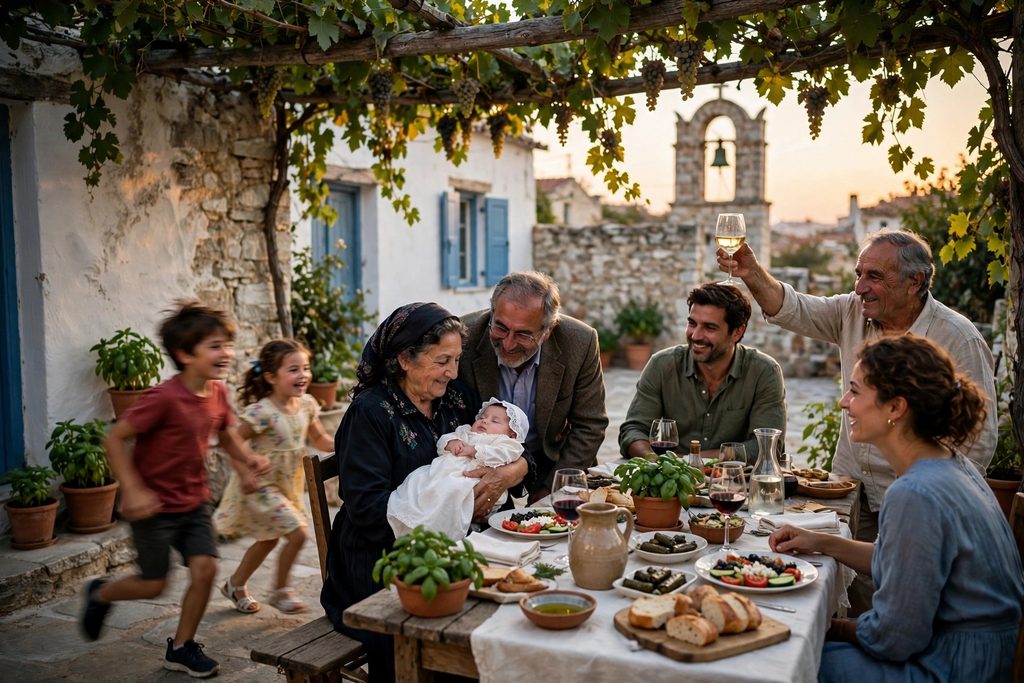
Even the first question a Greek grandmother asks a stranger in a village is the Apaturia’s question. Not what do you do, but tinos eisai. Whose are you?
What the Festival Was Counting
The Apaturia checked who belonged, and in doing so it showed what belonging rested on. It rested on witnesses and oaths, on a father’s word and his brothers’ willingness to accept it, on a register that could be read and trusted. It rested quietly on mothers, whose descent the brotherhood vouched for without ever seeing them at the altar. And it rested on appearances, because no system of oaths can see inside a person.
That is why a man in a black goatskin stands at its founding and a crowd in black cloaks stands at its most famous moment. In Athens, the festival of common fathers was the point in the year when every family stood up to be counted. Its own legend never let the city forget that anyone who can be counted can also be counterfeited, and that a city which votes on who belongs can be fooled into voting on who dies.
At Olympus Estate, Rituals and Festivals follows the ceremonies that shaped the Greek year. The Apaturia, the festival of common fathers, was kept by every phratry, the hereditary brotherhoods of Athens and the Ionian cities, in the autumn month of Pyanepsion. Over three days, the Dorpia supper, the Anarrhysis sacrifice to Zeus Phratrios and Athena Phratria, and the Koureotis, the day of youths, fathers presented their children with the meion, sixteen-year-olds offered the koureion and their hair, new husbands introduced their wives with the gamelia, and witnesses swore to each child’s descent before names went into the register. After Pericles’s law of 451 BC made citizenship depend on both parents, that register became a check on mothers as well as fathers. Plato sets the first telling of Atlantis on a Koureotis, and the festival’s founding legend, Melanthus tricking Xanthus with a man in a black goatskin, derives its name from apate, deceit. In 406 BC, during the trial of the Arginusae generals, Xenophon says Theramenes sent men in black with shaved heads into the Assembly as false kin of the drowned, and six generals were executed, among them Pericles the Younger, the son the city had once voted into his father’s phratry. The question the festival asked still lives in the Greek village, Whose are you?