



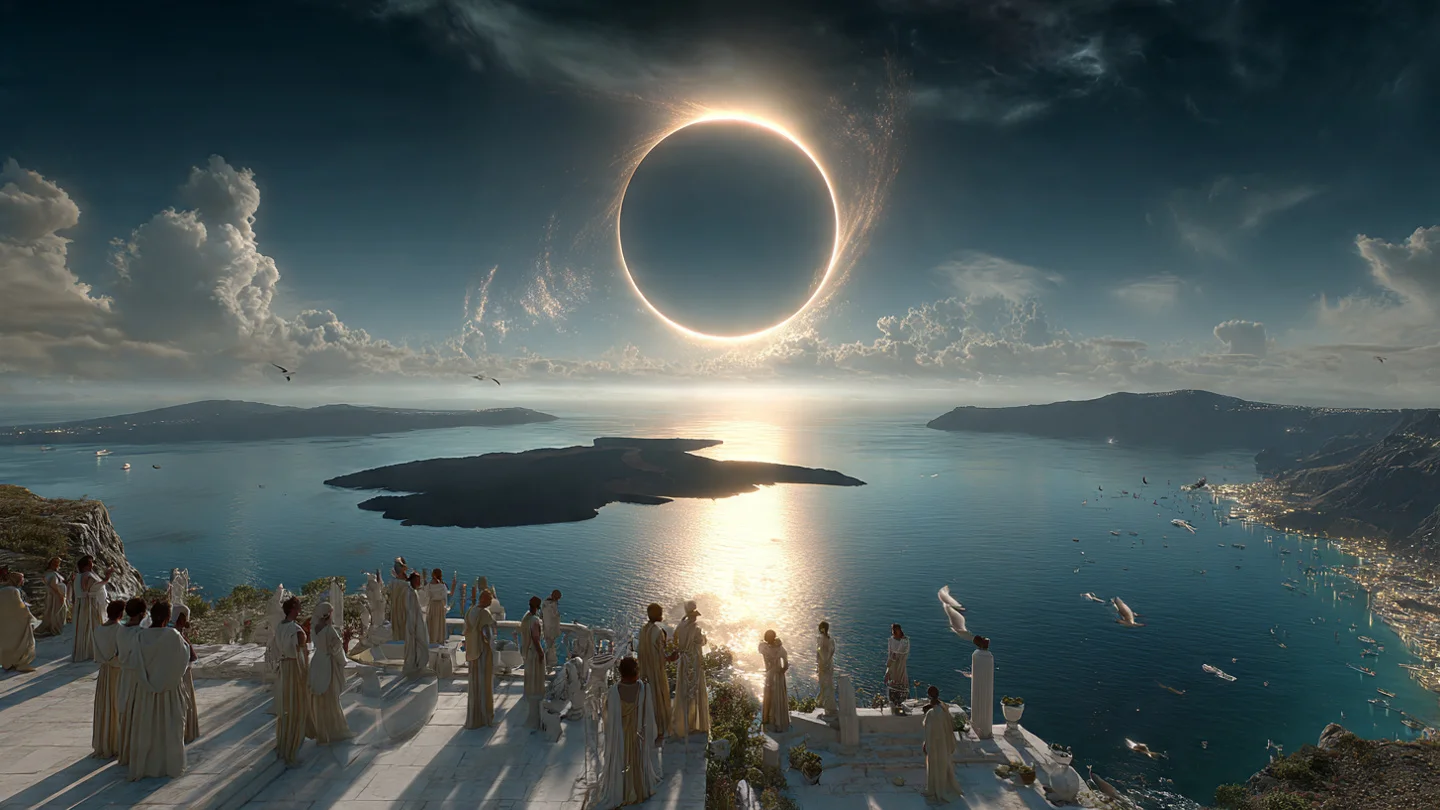
On August 12, 2026, the sky above most of Europe will do something it has not done since 1999.
The Moon will move in front of the Sun. In the narrow corridor of totality, daylight will collapse completely. The temperature will drop several degrees in the space of minutes. Birds will stop singing, not because they are frightened exactly, but because every instinct they carry will tell them that night has arrived without warning. The corona of the Sun, that ghostly silver halo normally invisible behind the blinding disc, will appear, and for those standing in the right narrow strip of the planet, they will see the star we orbit in a way that no photograph adequately prepares you for.
That path of totality cuts through Iceland and northern Spain. No part of Greece lies inside it, and unlike much of the rest of Europe, Greece will barely see the partial eclipse either: only a sliver of the country’s far northwest gets any real bite taken out of the sun, and Athens will not see the eclipse at all.
Here is the interesting part.
Greece is the civilization that understood eclipses better than anyone else in the ancient world. That predicted them. That built philosophical frameworks around them. That looked at the darkening sky and saw not a disaster, not a punishment, not a monster devouring the sun, but something far more precise, far more demanding, and in its own way far more unsettling.
What did they see that we no longer do?
That is the question this article is going to answer. And by the end of it, you may find that our modern understanding of an eclipse, for all its scientific precision, has actually lost something the Greeks possessed.
What Greece Will Actually See
Let’s start with the numbers, because they are more modest than a casual glance at a European eclipse map might suggest.
Greece sits far enough east and south of the path of totality that most of the country will see only a small bite taken out of the sun, if it sees anything at all. The far northwest, Corfu, Igoumenitsa, the mountains above Kastoria, is the one part of Greece where the eclipse will be visible in any meaningful sense, and even there the obscuration is modest, a genuine but limited partial phase rather than the dramatic darkening that much of Britain, France, and northern Italy will experience that same evening. Moving southeast from there, the visible fraction of the sun’s disc that the Moon covers drops off quickly. Athens and the Aegean islands, at the eastern and southern edge of the eclipse’s reach, will not see the eclipse at all: the Moon and Sun will not overlap from that vantage point on August 12.
This is worth being honest about, because it changes what this article can reasonably ask of a reader in Athens or the islands. For most of the country, August 12 will be an ordinary August afternoon, indistinguishable from any other, with nothing overhead to notice at all. Only in the far northwest corner of Greece is there a genuine, if modest, partial eclipse to go looking for.
So the question this article set out to ask, what did the Greeks see in an eclipse that we no longer do, turns out to matter for a much narrower slice of the country than a first glance at the August 12 eclipse maps suggests. But the older Greek framework for understanding what an eclipse means is not tied to any particular percentage of coverage. It applies as fully to the modest partial phase visible from Corfu as it would to a deep partial eclipse or a total one, and it applies, in a different way, to the readers elsewhere in Greece who will simply be told, correctly, that the sky above them will do nothing unusual at all this particular August.
What We See Now
Let’s be honest about the modern experience of an eclipse.
We know what it is. We know it is the Moon passing between the Earth and the Sun, a matter of orbital geometry, predictable to the second centuries in advance. We schedule viewing events. We buy eclipse glasses. We take photographs and post them. We feel the temperature drop and find it delightful. The whole experience is framed, from the moment the date is announced, as a spectacle: a rare and beautiful astronomical event that rewards those who pay attention with something genuinely extraordinary.
There is nothing wrong with any of this. The science is real, the beauty is real, and the corona, for those in the path of totality, is one of the most striking things a human eye can encounter.
But notice what the modern experience does not include.
It does not include uncertainty. We know the eclipse is coming, when it will arrive, how long it will last, and when the light will return. We know that the sun will not stay dark. We know that the ordinary day will reconstitute itself precisely as it was. The event is dramatic but completely contained. It arrives as a visitor, stays briefly, and leaves without having altered anything.
This is not how an eclipse felt for most of human history. And it is emphatically not how the Greeks experienced it, even the Greeks who knew, scientifically, exactly what was happening.
What Thales Actually Did
In 585 BCE, a solar eclipse occurred that stopped a battle.
The Medes and the Lydians had been at war for five years on the plains of what is now central Turkey. On a day Herodotus would later record as one of the most documented events of the ancient world, the sky went dark in the middle of the fighting. Both armies, interpreting the sudden darkness as a divine sign, laid down their weapons, negotiated a truce, and ended a conflict that had shown no signs of ending on its own terms.
The Greek philosopher Thales of Miletus is said to have predicted this eclipse. The claim has been debated by scholars for centuries: whether he truly predicted it, whether he used Babylonian astronomical records, whether the story is even accurate in all its details. But here is what is not seriously disputed. Thales represents the beginning of a Greek tradition of treating the eclipse not as divine whim but as calculable phenomenon.
He looked at the sky and said: this is not a god acting arbitrarily. This is a pattern. This is a system. And if it is a system, it can be understood.
This moment is usually celebrated as the beginning of rational science, the point at which mythology surrendered to geometry.
But that reading is too simple. And it misses the deeper thing the Greeks were doing.
Because Thales did not say the eclipse was merely mechanical. He did not strip it of meaning. What he said, in essence, was that the eclipse was meaningful precisely because it followed a pattern: that the cosmos was ordered, that the order was legible, and that understanding the order was itself a form of participation in something sacred.
The Greeks did not choose between science and religion when it came to the sky. They held both simultaneously. And their eclipse was richer for it.
Apollo’s Absence
To understand what a Greek standing beneath a darkening sun actually felt, you need to understand who owned the sun.
Not Helios alone, the Titan who drove the solar chariot across the sky each day, whose horses required the discipline of a divine charioteer to prevent the burning of the earth, as Phaethon discovered to his fatal cost. But also Apollo: god of light, reason, prophecy, and the ordering principle of the Olympian cosmos.
Apollo was not simply associated with the sun. He was associated with everything the sun made possible: clarity of thought, the precision of the archer’s aim, the lucidity of the oracle’s vision, the structure of music, the coherence of law. When Apollo held his lyre, the world had order. When Apollo drove the sun, the day could be trusted.
What did it mean, then, when the sun went dark, even partially?
It meant Apollo had withdrawn.
Not permanently. Not arbitrarily. But deliberately, a recession of the ordering principle, a moment in which the cosmos demonstrated that its light was conditional, that the coherence of the visible world depended on a presence that could, for reasons the mortals below might not immediately understand, choose to step back.
This is a profoundly different experience from watching a predictable orbital event.
The Greek eclipse was not a mechanical demonstration. It was an interruption of divine attention, brief, intentional, charged with the quality of a world that has been briefly left to its own devices. If you have ever stood outside during even a moderate partial eclipse and felt the light go strange, the shadows sharpen oddly, the temperature shift, you know that the rational explanation, however accurate, does not fully account for what you feel in your body.
The Greeks had a framework for that feeling. We have mostly lost it.
When an Eclipse Changed Greek History
The Athenians had no business being in Sicily.
In 415 BCE, one of the most ambitious and catastrophic military expeditions in Greek history set sail from Athens for Syracuse. The Sicilian Expedition was the gamble of a civilization at the height of its confidence, an attempt to extend Athenian hegemony across the entire Greek world. It ended in annihilation: the Athenian fleet destroyed, tens of thousands of men killed or enslaved, the power of Athens fundamentally broken.
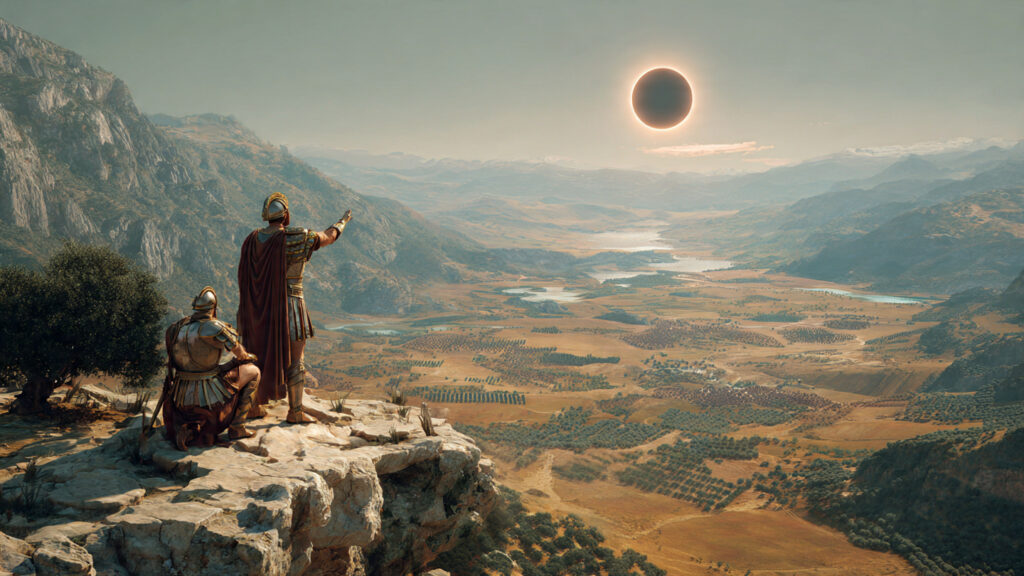
There is a moment inside that catastrophe that no account of the Sicilian Expedition can omit.
In 413 BCE, the Athenian general Nicias had ordered a withdrawal. The army was exhausted, the campaign was failing, and the window for retreat was still open. On the night the fleet was to depart, a lunar eclipse occurred.
Nicias was not a superstitious man by Greek standards. But he had soothsayers with him, and according to Thucydides, they told him the army could not move until three times nine days, twenty-seven days, had passed.
Nicias waited.
The Syracusans used those twenty-seven days to complete their blockade of the harbour. When the Athenians finally tried to leave, it was too late. The fleet was trapped, then destroyed. The army that survived the harbour battle was captured in its retreat and worked to death in the stone quarries of Syracuse.
An eclipse changed the outcome of a war.
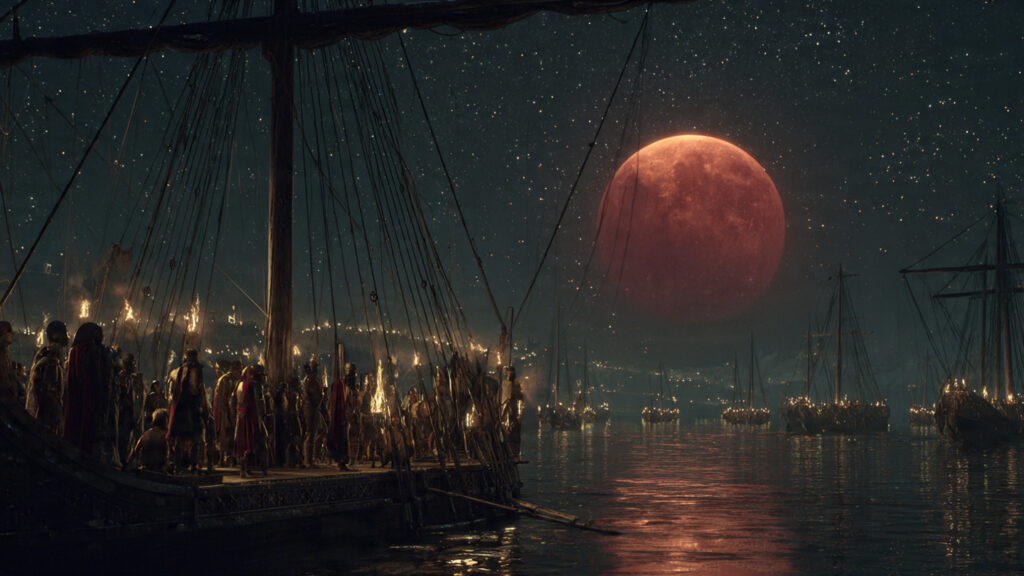
The Athenians who reflected on this later did not simply conclude that Nicias had been foolish to heed the omen. The more sophisticated reading that emerged was that the eclipse had been read correctly but responded to wrongly, that the days of waiting were not a command but a test, and that the test required something other than paralysis. The eclipse revealed, in this reading, not the will of the gods but the character of the man. Nicias paused when he should have moved. The eclipse did not cause the disaster. It created the conditions in which the disaster became possible, and the disaster was chosen.
This is sophisticated thinking. This is a civilization using an astronomical event not as an excuse for fate but as a mirror for human agency.
Order Making Itself Visible
Here is the idea about eclipses that the Greeks arrived at, and that we have largely abandoned.
The eclipse is not a disorder. It is one of the most dramatic possible demonstrations of order.
Think about what a total eclipse requires. The Moon must be at exactly the right distance from Earth, close enough that it appears, from the surface of the planet, to be nearly the same apparent size as the Sun. This is an extraordinary coincidence in any framework. The Moon is roughly 400 times smaller than the Sun and roughly 400 times closer to Earth. The result is that the two discs appear almost perfectly matched in the sky.
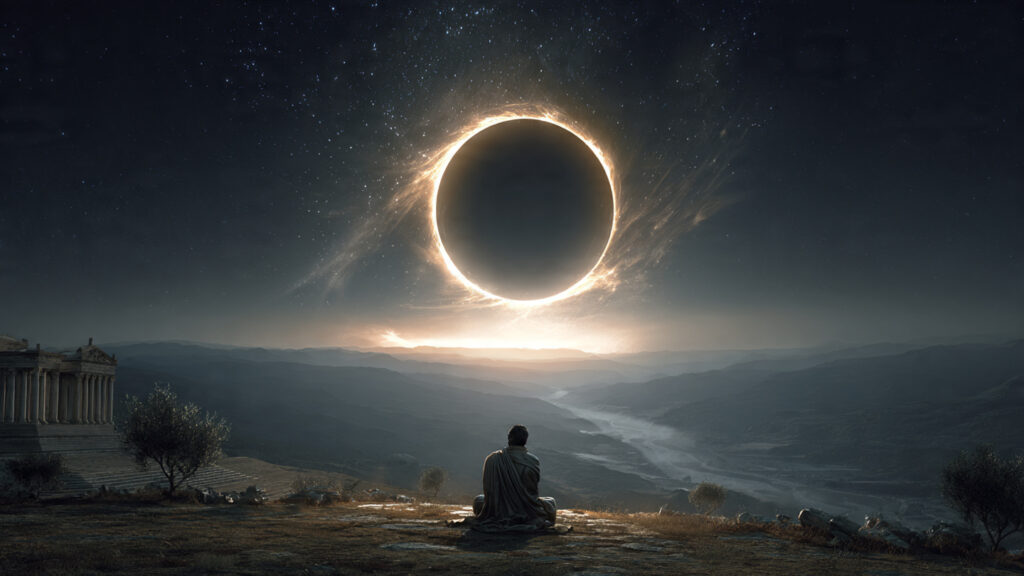
The Stoic philosophers, whose intellectual lineage ran directly through the Greek tradition, saw in this precision the signature of the Logos: the rational principle that structures the cosmos, the ordering intelligence in which every event participates. An eclipse, for the Stoics, was not the cosmos going wrong. It was the cosmos demonstrating, with theatrical precision, exactly how right it was.
The Stoic tradition held that mathematical regularity in the heavens was not separate from divinity but was divinity’s most legible expression. The eclipse was legible. It was calculable. And it was, precisely because it was calculable, evidence that the universe was held in order by an intelligence that did not operate by mood or whim but by principle.
The darkness, in this framework, is not the absence of order. It is order making itself visible by briefly withdrawing the light that normally obscures its structure.
A Greek Theology of Restored Light
Every culture that has recorded an eclipse has also recorded the relief when it ends.
But the Greeks theorised the relief. They thought about what it meant that the light came back, not just biologically or emotionally, but cosmologically.
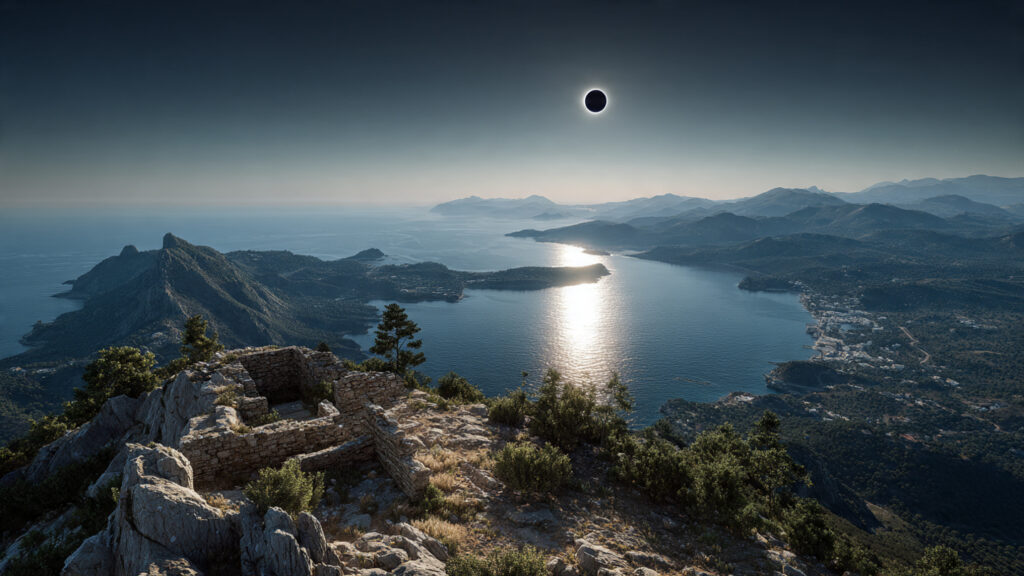
The word the Greeks used for this kind of return is apokatastasis: the restoration to an original condition, the return to the proper order of things. The term appears in Stoic cosmology for the great cyclic restoration of the cosmos after the long fire of transformation. But it applies just as naturally to the smaller cycles: the return of dawn after night, of spring after winter, of the sun after an eclipse. Every restoration, however minor, participates in the same logic as the cosmic one.
What this means for the eclipse is precise: the darkening is not a deviation from the cosmic order. It is part of the cycle. The light that returns is not merely the same light that left. It is light that has gone through the experience of its own partial absence and come back to its function with, so to speak, the evidence of its own necessity.
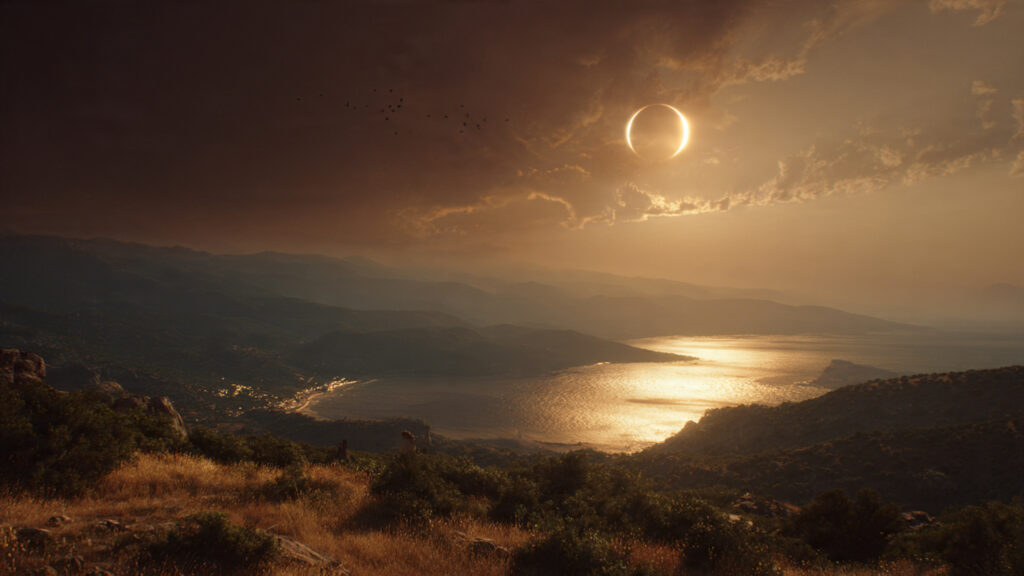
You did not understand what the light meant until you watched it dim.
This is the Greek theology of the eclipse in its most concentrated form. The darkness is not punishment. It is not omen in the crude sense. It is the cosmos giving you, briefly and without asking your permission, the clearest possible demonstration of what order costs, what sustains it, and what the world looks like in its momentary absence.
What We Lost When the Eclipse Became Content
We have excellent eclipse science. Better than anything the ancients possessed.
We can predict every eclipse for the next ten thousand years. We can tell you the exact second and percentage of coverage in any city on the planet. We have photographs of coronas that would have seemed miraculous to Thales.
And yet.
When was the last time an eclipse made you think about the nature of order? About what it means for the light you take for granted to temporarily withdraw, even partially? About the relationship between the predictability of the cosmos and the unpredictability of what you feel standing inside that predictability?
We have turned the eclipse into content. Into an event to plan for, document, and share. The experience is real and the wonder is genuine. But the framework for making meaning from it has largely evaporated.
The Greeks did not just watch the eclipse. They thought about what it meant that an eclipse was possible, that the cosmos could produce, through the operation of its own perfect order, a moment of apparent disorder. They built philosophical systems sophisticated enough that we are still drawing on them, whether we know it or not.
We lost something when we separated science from meaning, when we decided that understanding the mechanism of a thing was equivalent to understanding its significance. The Greeks would have found this distinction strange. For them, the mechanism was the significance. The precision of the eclipse was exactly what made it worth thinking about.
How to Watch August 2026 the Greek Way
Most of Greece will not see any eclipse at all this August. That is worth saying plainly rather than working around.
If you happen to be in Corfu, Igoumenitsa, or the mountains above Kastoria that afternoon, there is a modest, genuine partial eclipse worth stepping outside for, and the notes below apply to you directly. If you are in Athens, the Peloponnese, or the Aegean islands, this is not a day when the sky itself will give you anything to watch, though the reflection below still applies, just without the sensory occasion to anchor it.
Here is how to watch it the way the Greeks would have watched it, if you happen to be standing in the part of Greece where there is something to see.
Go outside that afternoon, with proper eclipse glasses if you intend to look anywhere near the sun directly. Notice the quality of the light as the eclipse builds toward its local maximum: the temperature, the strange flatness that comes over shadows, the particular way the light falls differently than it does on an ordinary August day.
Then think about what it means for that light, the light the entire Greek landscape and the entire Greek theological imagination organized themselves around, to be partially withdrawn for a period of time and then to return.
You do not need totality to understand what the Greeks understood. You need only to take the light seriously for a few minutes, to notice it the way you would notice the absence of something you had stopped consciously valuing, and to feel, when it returns to full strength, something of the relief the ancients felt and theorised and built entire philosophical systems to explain.
The sun will be back. It always comes back. That was always the point.
But the Greeks would tell you: it is the noticing, and the brief uncertainty, however manufactured by modern astronomical certainty, that makes the return matter at all. Hold both of those things in your mind on August 12, and you are, however briefly, thinking like an ancient Greek standing beneath a softened, strange midday light, watching the sky do something extraordinary, and understanding exactly what it means.
At Olympus Estate, Tales from Olympus: Commentary & Reflections looks at the present through the lens of ancient Greek thought. The Greeks did not separate the science of the eclipse from its meaning. Thales predicted one and ended a war. Nicias misread one and lost Athens its army at Syracuse. The Stoics saw in the eclipse’s precision the clearest evidence of the cosmic Logos. On August 12, 2026, only the far northwest corner of Greece, Corfu, Igoumenitsa, the mountains above Kastoria, will see a modest partial eclipse. Athens and the rest of the country will see nothing overhead that day, but the Greek framework for what an eclipse means is worth carrying regardless of what the sky happens to be doing.