

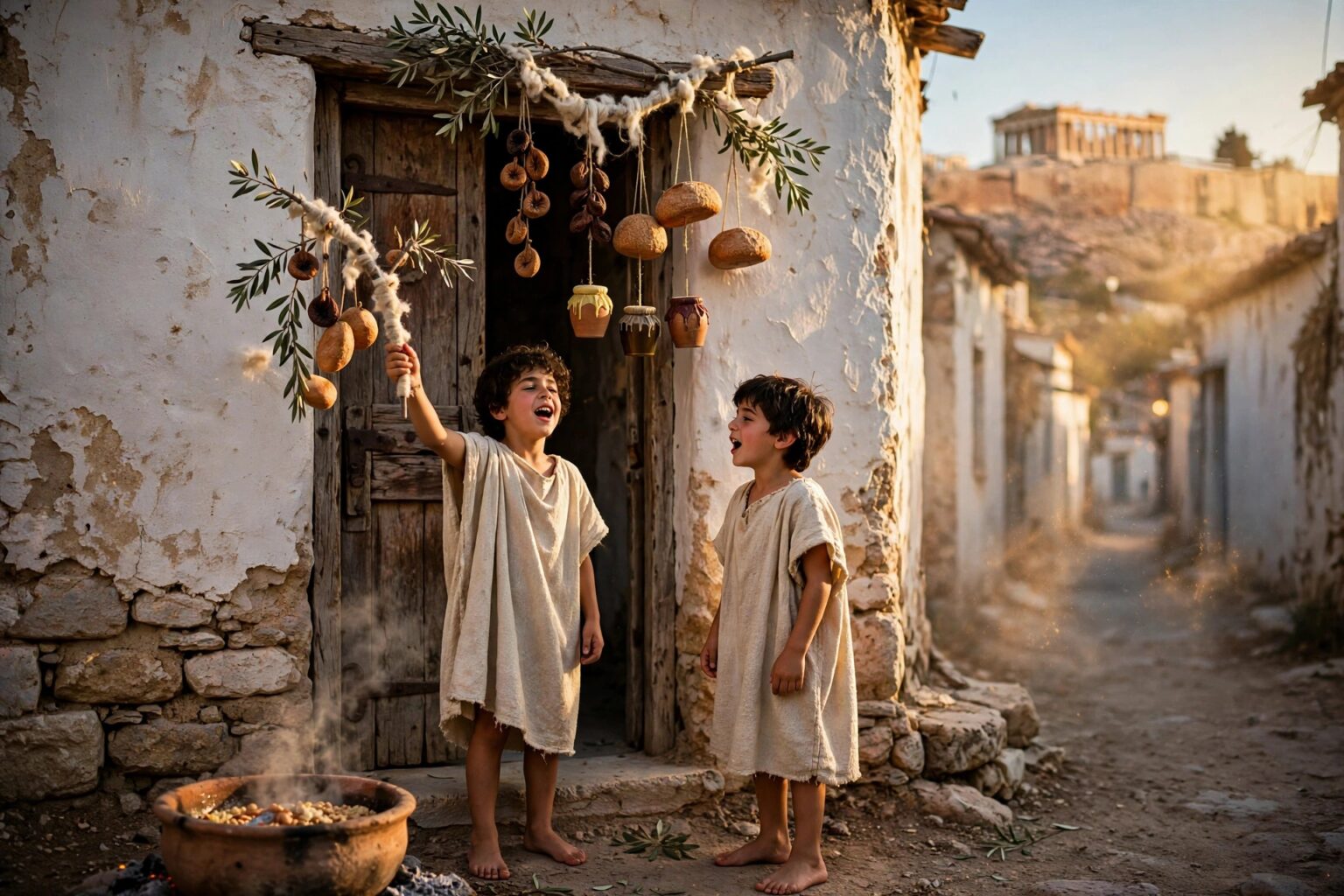
Above the front doors of Athens hung a dried-out olive branch. By autumn it was brittle, the figs on it had shrivelled black, and its wool had gone grey with a year of dust. In Aristophanes’s comedy Wealth, an old woman is mocked as so dried up that a single spark would set her alight like an old eiresione. Everyone in the theatre got the joke, because one hung over their own door.
Once a year, in the month the Athenians named after a pot of beans, the old branch came down and a fresh one went up. Boys carried new branches through the streets, singing at the doors, and kitchens across the city boiled a mixed pot of pulses and grain. The festival was the Pyanepsia, the bean boil, held for Apollo on the seventh day of the month Pyanepsion.
Its story is the last chapter of the most famous voyage in Athenian myth. When Theseus came home from Crete, Plutarch says, he and his companions threw everything left of their food into one pot, boiled it, and ate it together. Athens went on cooking that meal for centuries. It was the meal of people who had nearly not made it home.
A Festival Named for a Pot of Beans
The name is a plain description. Pyanepsia comes from pyanos, an old word for bean, and hepsein, to boil. Ancient writers also spelled it Pyanopsia. The festival gave its name to the whole month, Pyanepsion, the fourth month of the Athenian year. Because the Athenian calendar followed the moon, the month began with a new crescent somewhere between mid-October and mid-November, so the bean boil never had a fixed date in our calendar.
The day belonged to Apollo. In Works and Days, Hesiod calls the seventh of the month holy, because on that day Leto gave birth to Apollo of the golden sword. Two of those sevenths carried the god’s greatest Athenian festivals, the Thargelia in early summer and the Pyanepsia in autumn.
Many festivals set the best of the year before the gods. The Pyanepsia set out a pot of leftovers. Its sacred dish recalled the moment the food ran out, and the city chose to remember that moment every year.
The Voyage Behind the Pot | Theseus, the Vow and the Black Sail
Every Athenian child knew the background. Athens owed King Minos of Crete a tribute of seven young men and seven young women, sent into the Labyrinth to be devoured by the Minotaur. Theseus, son of King Aegeus, volunteered to sail with them.
Before leaving, according to Plutarch’s Life of Theseus, he went to Apollo’s sanctuary of the Delphinion in Athens carrying a suppliant’s branch, cut from the sacred olive and bound with white wool, and prayed for the voyage. He made vows to the god. If Apollo brought them home, there would be thanks.



The middle of the story is the famous part. At Knossos, Ariadne gave Theseus the thread, he killed the Minotaur, and he sailed from Crete with her and the fourteen young Athenians. He then left Ariadne asleep on Naxos, for reasons the ancient sources never agree on. On the way home the ship put in at Delos, Apollo’s birthplace, where Theseus and the young people danced the geranos, the crane dance, its winding steps said to trace the passages of the Labyrinth.
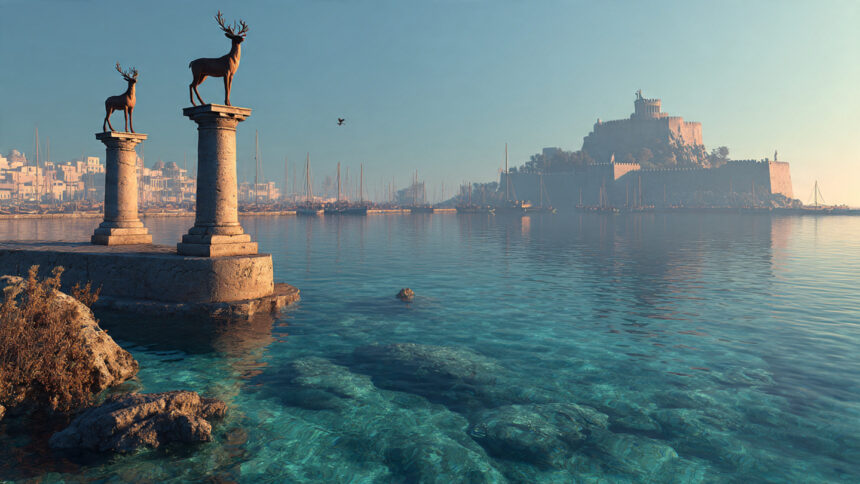
Then came the mistake that ruined the homecoming. Aegeus had given the ship’s pilot a white sail to raise if his son was alive. In the joy of the return nobody changed the black one. Aegeus saw the dark sail from the heights of Athens and threw himself from the rock. In the other well-known version he leapt into the sea that still carries his name.

Theseus landed at Phaleron, the old harbour of Athens, and made the sacrifices he had promised. He sent a herald up to the city with the good news, and the herald found a city in mourning. Plutarch says this is why, at the libations of the Oschophoria held in the same days, Athenians shouted two cries together, eleleu, the shout of triumph, and iou iou, the cry of grief. The festival season began on a day of victory and loss at once.
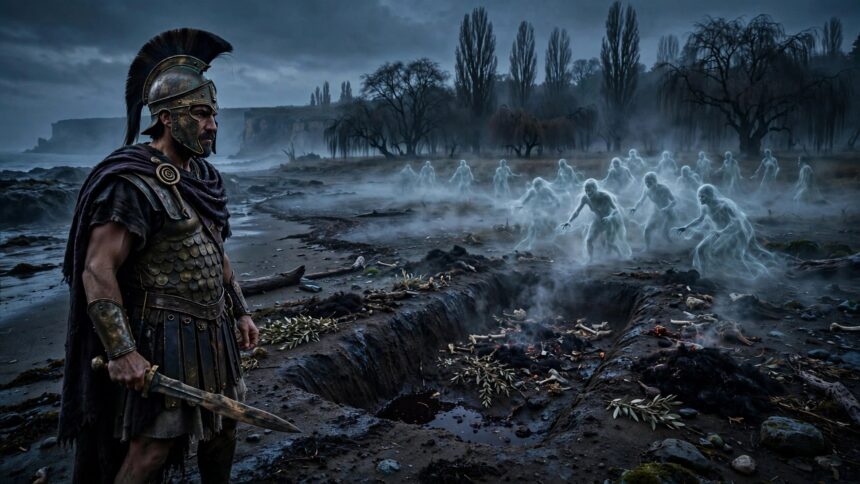
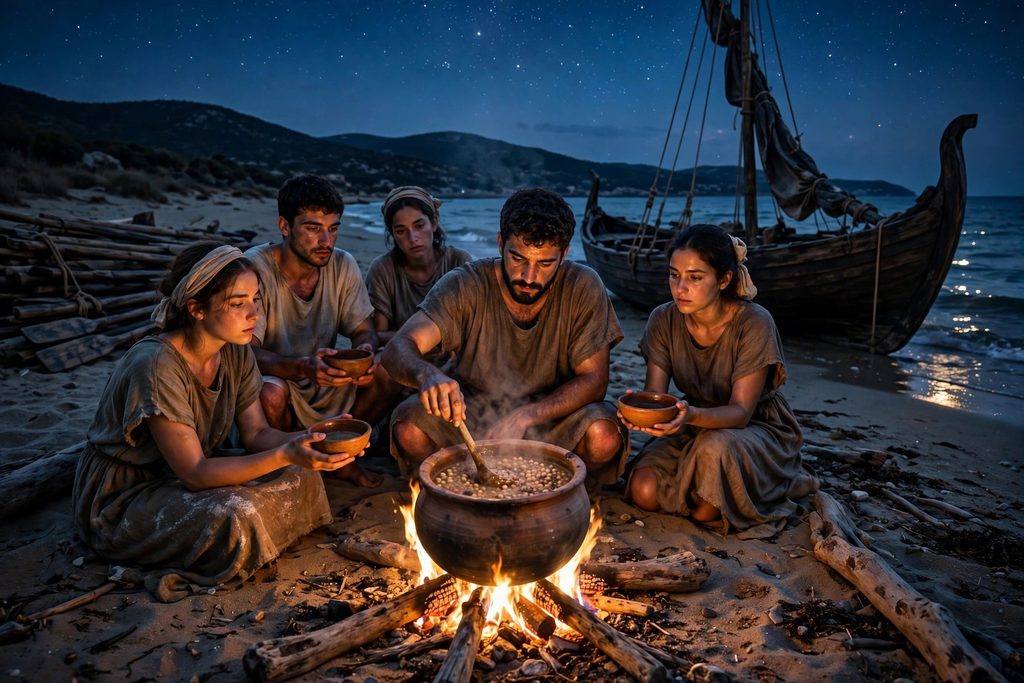
And on that shore the crew made their pot. Plutarch’s explanation of the Pyanepsia is simple. Theseus and his companions, safely home, put all the food they had left into a single pot, boiled it together and feasted on it together. There was not enough of anything to cook on its own, so they cooked everything at once and shared it.
What Went Into the Pot
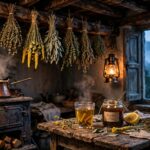
The ritual name for the dish was panspermia, all the seeds. No ancient recipe survives, and there probably never was one. The mixture was the point. Each household threw in whatever it had.
We know what Athenian households had. The pyanos of the festival’s name was almost certainly the broad bean, the bean the Greeks more often called kyamos. Beside it stood chickpeas, lentils, bitter vetch for lean years, and a relative of the grass pea that still makes Santorini’s famous yellow fava. The grains were barley, the everyday staple of Attica, and wheat, which cost more. Together they made up the backbone of the ancient Greek pantry.
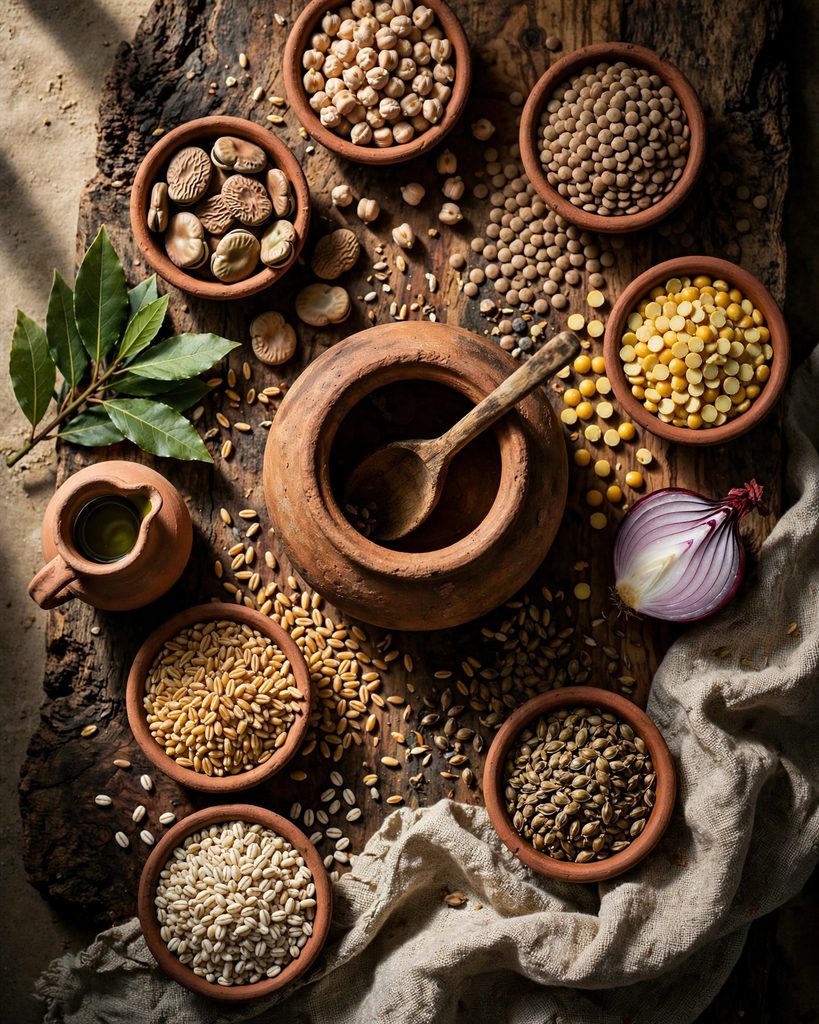
One thing the pot never held was the white bean of a modern fasolada. Haricot beans came from the Americas after 1500, along with tomatoes and potatoes. The Athenian bean boil was a pot of broad beans, chickpeas and lentils thickened with grain, closer to a dense pulse soup than to anything we would call a bean stew today.
The mixed pot had a darker twin in the Athenian year. At the Anthesteria in early spring, on the day called Chytroi, the Pots, Athenians boiled pulses for Hermes of the underworld and the souls of the dead, who were then told to leave the city. Nobody ate that pot. It was food for the dead. The autumn pot was cooked for Apollo and eaten by the living, which is the whole difference between the two festivals.
The Eiresione | An Olive Branch on Every Door
The festival’s second offering was a branch. The eiresione, named from eiros, wool, was an olive branch, sometimes laurel, wound with wool and hung with the good things of the season. Plutarch describes it as a bough of olive wreathed with wool, like the one Theseus carried as a suppliant, loaded with every kind of fruit to show that scarcity was over.
The two branches are one object with two meanings. Before the voyage, Theseus carried the woollen olive branch to Apollo as a man asking for help. Every autumn, Athens carried it back heavy with figs and bread as a city giving thanks. The festival turned a suppliant’s branch into a branch of plenty.
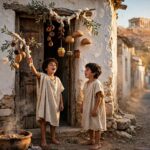
A boy with both parents living carried the branch to Apollo’s sanctuary, while bands of boys took other branches through the streets and sang at each door. Plutarch preserves their song.
Eiresione brings figs and fat loaves,
The eiresione song, from Plutarch, Life of Theseus 22
honey in a cup and oil to rub on the skin,
and a cup of strong wine, so she can go to bed tipsy.
It is less a prayer than a list of good things. The branch is spoken of as a woman, and the closing line, sending her to bed a little drunk, has the cheek of a song children sang for treats.
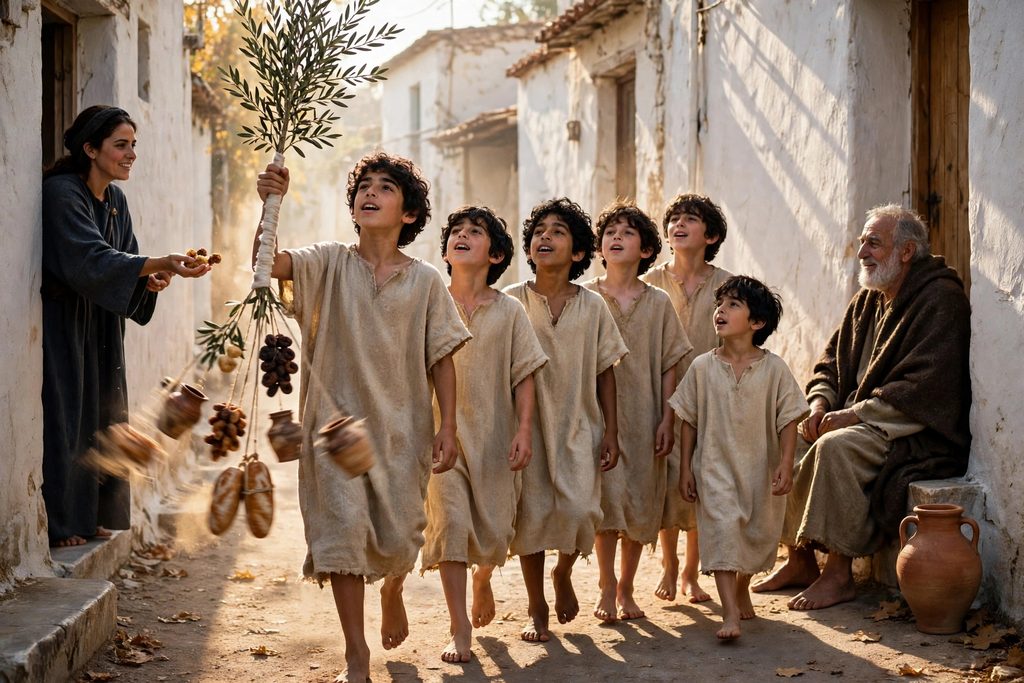
After the procession, the branch went over the door, and there it stayed. Ancient commentators on Aristophanes say the eiresione hung outside the house all year, until the next festival brought a fresh one. Aristophanes himself shows the custom twice. In Knights, staged in 424 BC, Demos, the Athenian people in person, storms out of his house complaining that the racket at his door has torn his eiresione to pieces. In Wealth, staged in 388 BC, comes the joke about the old woman who would catch fire like an old eiresione. For most of the year, then, Athens lived beneath drying branches, the figs blackening and the wool fading above door after door.
The olive was Athena’s tree, the gift that won her the city in her contest with Poseidon. The sacred olive on the Acropolis was the first of them. The branch over each door gave every household its own small piece of it.
Why Apollo
Apollo seems an odd god for a pot of beans. He is the lord of Delphi, of prophecy, music and plague arrows. But Athens also knew him as a god of seasons and ripening, and his two great Athenian festivals frame the farming year.
The Thargelia, on the sixth and seventh of Thargelion in early summer, opened the harvest. Its name comes from the thargelos, a pot of the year’s first fruits offered to the god, and the eiresione was carried at the Thargelia too. The Pyanepsia closed the season, when the threshing was done, the grapes were in and the autumn sowing was about to begin. A pot of first fruits in summer and a pot of leftovers in autumn, both offered on the god’s seventh day.
The voyage fits the same pattern. Apollo was the god Theseus asked for a safe return, and the god whose island the ship visited on the way home. A city of farmers and sailors thanked one god for the crop and for the crossing.
Pyanepsion | The Most Crowded Month in Athens
The bean boil opened the busiest stretch of the Athenian festival year. In a single lunar month the city honoured Apollo, Dionysus, Athena, Theseus, Demeter, Zeus and Hephaestus, from the eve of the ploughing to the craftsmen’s feast at the month’s end.
The Oschophoria, the festival of the grape branches, belongs to the same homecoming. Plutarch says Theseus swapped two of the maidens for two young men with girlish faces and dressed them as women. In their memory, two youths in women’s robes led a procession carrying oschoi, vine branches heavy with grapes, from the sanctuary of Dionysus to the shrine of Athena Skiras at Phaleron, the shore where the ship had landed. Young men raced along the route, and later writers say the winner drank the pentaploa, a cup mixed from five things, wine, honey, cheese, barley meal and oil.
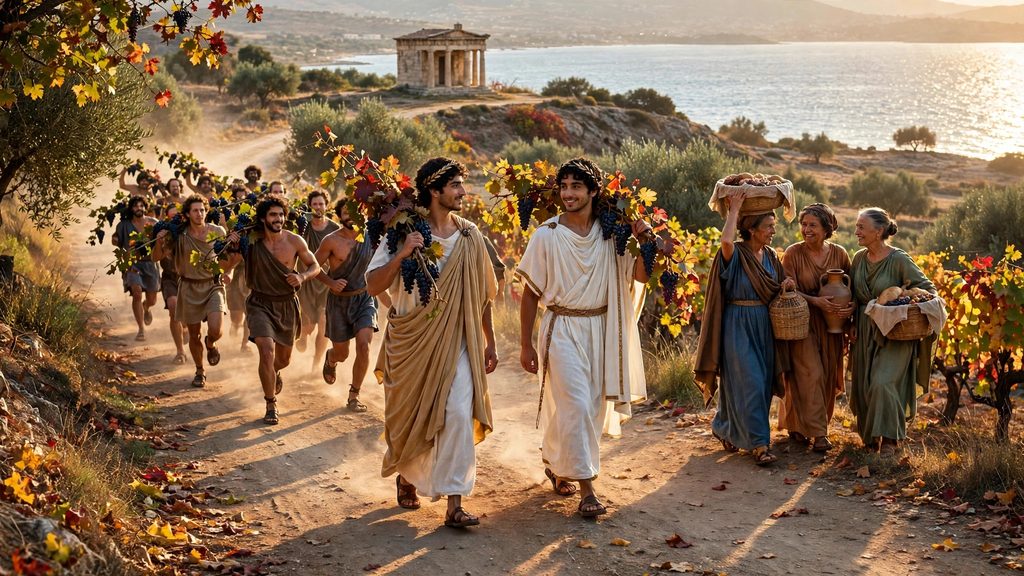
Women called deipnophoroi, the dinner bearers, walked in the procession too. They played the mothers who had brought food to their children before the ship sailed, and they told stories along the way, as those mothers had told stories to give their children courage.
The next day was the hero’s own. Plutarch says the chief sacrifice to Theseus fell on the eighth of Pyanepsion, the day he came back from Crete with the young Athenians. The Theseia grew into a major civic festival after 475 BC, when the general Cimon brought home from the island of Skyros bones said to be Theseus’s and buried them in a shrine near the Agora. So Apollo was thanked on the seventh, and the man he had saved was honoured on the eighth. A few days later the women of the city climbed the Pnyx for the Thesmophoria.
The Ship That Kept the Vow
Theseus’s vow did not end with a pot of beans. Plato records a second promise in the Phaedo. The Athenians, he writes, vowed to Apollo that if the young people came home safe they would send a sacred embassy to Delos every year. They kept that promise for centuries, and they sent the embassy in the ship that was believed to have carried Theseus to Crete.
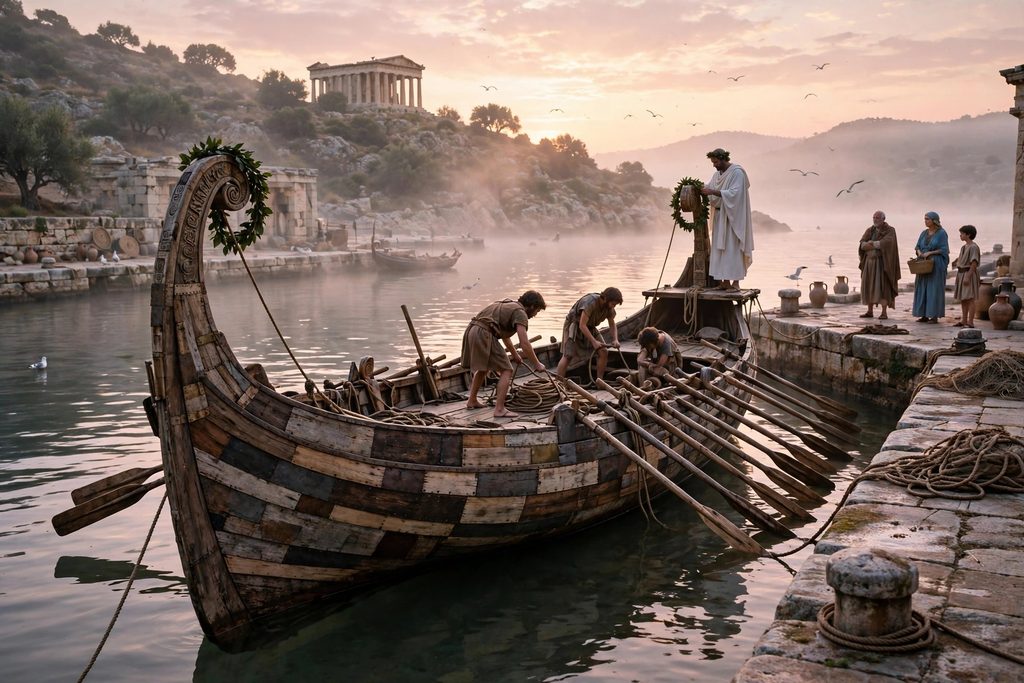
Plutarch says the thirty-oared ship was kept in Athens until the time of Demetrius of Phalerum, around 300 BC. Whenever a timber rotted it was replaced with a sound one, until philosophers began to use the ship as a puzzle. If every plank has been replaced, is it still the same ship? The question is still known as the Ship of Theseus.
The voyage came with a law. From the day the priest of Apollo garlanded the ship’s stern until it returned from Delos, the city had to stay pure, and nobody could be put to death. In 399 BC the garland went on the stern the day before Socrates was condemned. Contrary winds held the ship back, and Socrates spent about a month in prison, talking with his friends, before it came home. Plato’s Phaedo is set on his last day. The same promise that filled the bean pot gave Socrates his final month of conversation.
Did the Pot Survive? | Polysporia and the Panagia of the Sowing
In Greek villages the mixed pot never quite left the calendar. On 21 November, the feast of the Entry of the Virgin into the Temple, many families cook polysporia, literally many seeds, a pot of beans, chickpeas, lentils, wheat and whatever else the house has, and take a bowl to church to be blessed. The feast falls in the middle of the autumn sowing, and in the countryside the Virgin of the day carries farmers’ names. She is the Mesosporitissa, the Panagia of the mid-sowing, or the Polysporitissa, the Panagia of many seeds. This year the feast falls on Saturday 21 November.
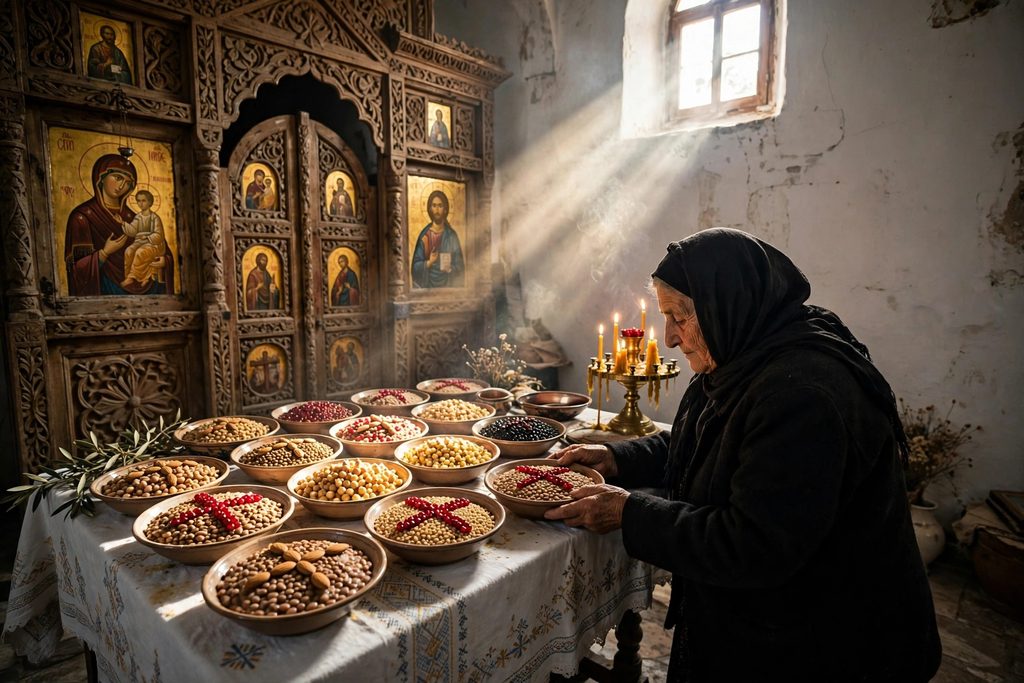
The pot suits the season in another way too. The feast falls inside the forty-day fast before Christmas, and polysporia needs no meat, cheese or eggs. At Eleusis, a chapel of the Panagia Mesosporitissa stands on the hill above the ruins of Demeter’s sanctuary, and the custom of the blessed pot has been revived there.
Greek folklorists have long compared polysporia with the ancient panspermia. A straight line from Theseus to the village church cannot be proven, and the Christian feast carries its own meaning. The shape is still hard to miss, a pot of mixed seeds cooked as autumn turns toward winter, offered at a sanctuary and shared at home. Greece has kept older patterns inside new feasts before, as the Fifteenth of August shows.
The singing boys may have descendants too. A short begging song from Samos, preserved in an ancient Life of Homer, is also called the Eiresione, and children sang it at the doors of wealthy houses. Greek children still go from door to door singing the kalanta at Christmas, at the New Year and at Epiphany, and they are still paid in sweets and coins. Folklorists have compared the two customs for well over a century.
Cooking the Bean Boil Today
No ancient recipe for the panspermia survives, so the pot below is a modern version built only from ingredients an Athenian kitchen would have known. That means broad beans, chickpeas, lentils, barley and wheat, with olive oil, onion, leek and bay, and no tomato, potato or white beans. The bay leaf is the laurel, Apollo’s own tree, so it earns its place.
Olympus Estate · Rituals & Festivals
Panspermia · The Bean Boil Pot of Pyanepsion
Broad beans, chickpeas, lentils, barley and wheat in one pot, with olive oil and laurel. Only what an Athenian kitchen knew, and nothing that arrived later.
Ingredients
The pulses
- Dried chickpeas, soaked overnight150 g
- Dried skinned split broad beans, soaked overnight150 g
- Brown or green lentils, rinsed100 g
The grains
- Wheat berries, soaked overnight100 g
- Pearl barley, rinsed80 g
The pot
- Red onion, finely chopped1 large
- Leek, white and pale green parts, sliced1
- Celery stalk with its leaves, chopped1
- Garlic cloves, sliced2
- Bay leaves3
- Dried thyme or summer savory1 tsp
- Waterabout 2.5 l
To finish
- Extra virgin olive oil, divided100 ml
- Red wine vinegar1–2 tbsp
- Sea salt and freshly ground black pepperto taste
- Fresh mint or dill, chopped1 handful
- Crumbled sheep’s milk cheese, optionalto serve
Method
-
1
Soak the night before (12 hrs)
Put the chickpeas and wheat berries together in one large bowl and the broad beans in another. Cover both with plenty of cold water and leave them overnight.
-
2
Start the slow ones (50 min)
Drain the chickpeas and wheat, put them in a large heavy pot and cover with 2.5 litres of fresh water. Bring to the boil, skim off the foam, add the bay leaves and simmer, partly covered, for 50 minutes.
-
3
Soften the base (10 min)
While the chickpeas cook, warm half the olive oil in a frying pan over medium-low heat. Cook the onion, leek and celery gently for 8 minutes until soft and sweet, add the garlic for one more minute, then tip everything into the pot.
-
4
Add the broad beans and barley (25 min)
Drain the broad beans and add them to the pot with the barley and the dried thyme. Simmer, stirring now and then so nothing catches on the bottom. Add a splash of hot water if the pot thickens too fast.
-
5
Add the lentils (25 min)
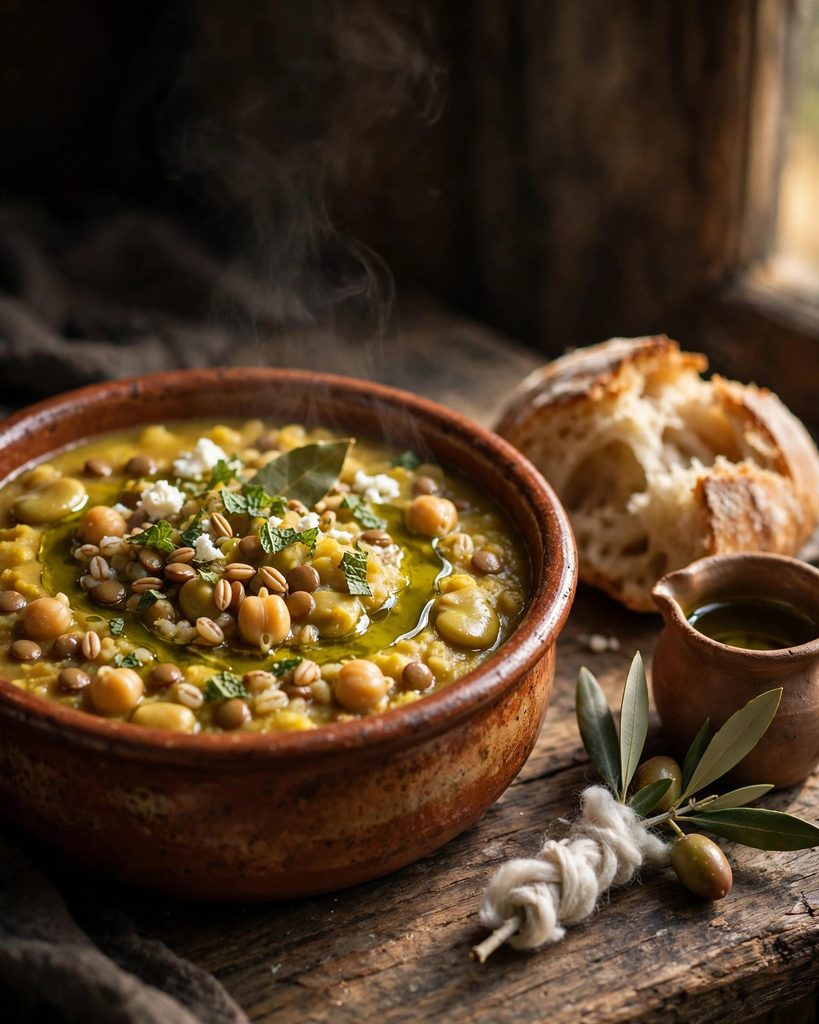
Stir in the lentils and simmer until every pulse and grain is tender. The broad beans will break down and thicken the pot into a dense, golden soup.
-
6
Season and rest (10 min)
Season generously with salt and pepper and stir in the vinegar, a tablespoon at a time, until the pot tastes bright. Take it off the heat, remove the bay leaves and let it rest for 10 minutes.
-
7
Serve from one pot
Ladle into bowls, pour the remaining raw olive oil over the top and scatter with mint or dill, and with cheese if you like. Serve with bread, straight from the pot to the table, so everyone eats from the same one.
To hang an eiresione on your own door, you need very little.
- The branch. Cut an olive branch about the length of your arm, or a bay branch if no olive grows nearby.
- The wool. Wind it loosely with undyed white wool yarn, leaving short ends to hang down.
- The gifts. Tie on dried figs, a small hard-baked bread ring, and tiny stoppered bottles of honey, olive oil and wine, the five things named in the song.
- The year. Hang it above or beside the front door and leave it until next autumn. When it is brittle and the figs have turned black, it is doing exactly what the Athenian branches did.
What the Pot Remembers
Most festivals remember a victory. The Pyanepsia remembered the meal after one. It recalled a shore at Phaleron, a black sail that should have been white, a king dead on the rocks, and a crew boiling the last of their food in one pot because there was no other way to feed everyone.
Athens could have marked the moment with the finest produce of the harvest. It kept the leftovers instead. Every autumn the whole city ate the meal of the day the food ran out, thanked the god who had brought the ship home, and hung a branch of plenty over the door. Boil the beans this month. Share the pot. Hang the branch, and leave it there until next year.
At Olympus Estate, Rituals and Festivals follows the ceremonies that shaped the Greek year. The Pyanepsia, the bean boil, was held for Apollo on the seventh of Pyanepsion, the autumn month named after it. Plutarch traces it to Theseus’s return from Crete, when his crew landed at Phaleron on the day Aegeus died at the sight of the black sail, threw everything left of their provisions into one pot and ate it together. Athenians cooked the same panspermia of broad beans, chickpeas, lentils and grain every year, and carried the eiresione, an olive branch wound with wool and hung with figs, bread, honey, oil and wine, to Apollo’s sanctuary and to every front door, where it stayed until the next festival. The bean boil sat at the heart of the city’s busiest month, beside the Oschophoria, the Theseia, the Stenia, the Thesmophoria, the Apatouria and the Chalkeia. The same vow sent the Ship of Theseus to Delos each year and delayed the death of Socrates, and the mixed pot still reaches Greek tables as polysporia on the feast of the Panagia Mesosporitissa.