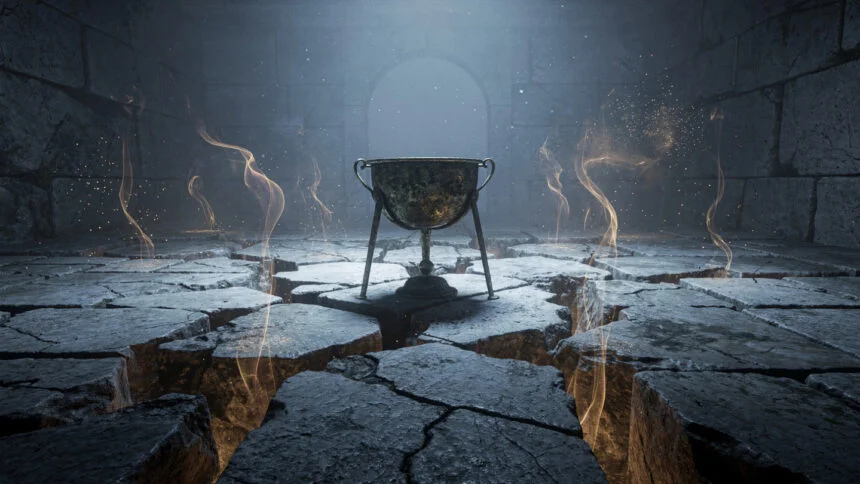






The curse did not begin with a murder. It began with a dinner party where the meat was the host’s own son.
Four generations separate Tantalus from Orestes, and across every one of them the pattern repeats with a consistency that stops looking like coincidence and starts looking like the actual argument the myth is making: hospitality turned into murder weapon, family turned into meal, and each generation’s attempt to settle the account only degrading further the currency it was paid in. This is the fullest account this collection has given of the third great tragic bloodline in the Greek tradition, after Troy and Thebes, and it is, by most measures, the darkest of the three.
The Meal That Started It
Tantalus, a son of Zeus and a king wealthy enough and favored enough to dine at the gods’ own table, decided to test whether their famous omniscience was genuine. He killed his own son Pelops, cut the body into pieces, and served the meat to the assembled Olympians as a feast. Every god at the table recognized the abomination instantly and refused to eat, with one exception: Demeter, distracted by grief over the recent abduction of her own daughter, absently consumed a piece of the boy’s shoulder before anyone stopped her.
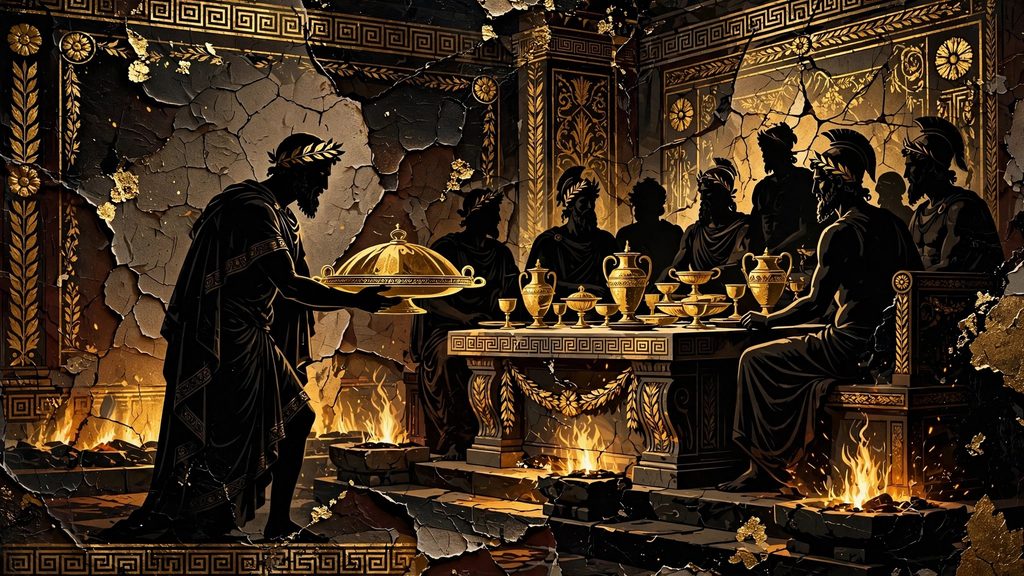
The gods reassembled Pelops from what remained, and Hephaestus forged him a replacement shoulder of ivory to complete him. Tantalus was condemned to Tartarus, fixed eternally beneath a laden fruit tree whose branches lifted just out of reach whenever he grasped upward, and standing in a pool that receded whenever he bent to drink from it. The word tantalize is what remains in ordinary English of a punishment two and a half thousand years old.

Not every ancient source accepted the cannibalism at face value. Pindar, in his own retelling, found the story of the gods eating human flesh too grotesque to credit, and offered instead a gentler tradition: that Poseidon, struck by the boy’s beauty, abducted Pelops to Olympus out of love, the way Zeus would later take Ganymede, and that the cannibalism story was slander invented by Pelops’s jealous neighbors. Both versions were current in the tradition simultaneously. The myth itself could not settle whether its founding horror was real.
The Second Curse, Layered Onto the First
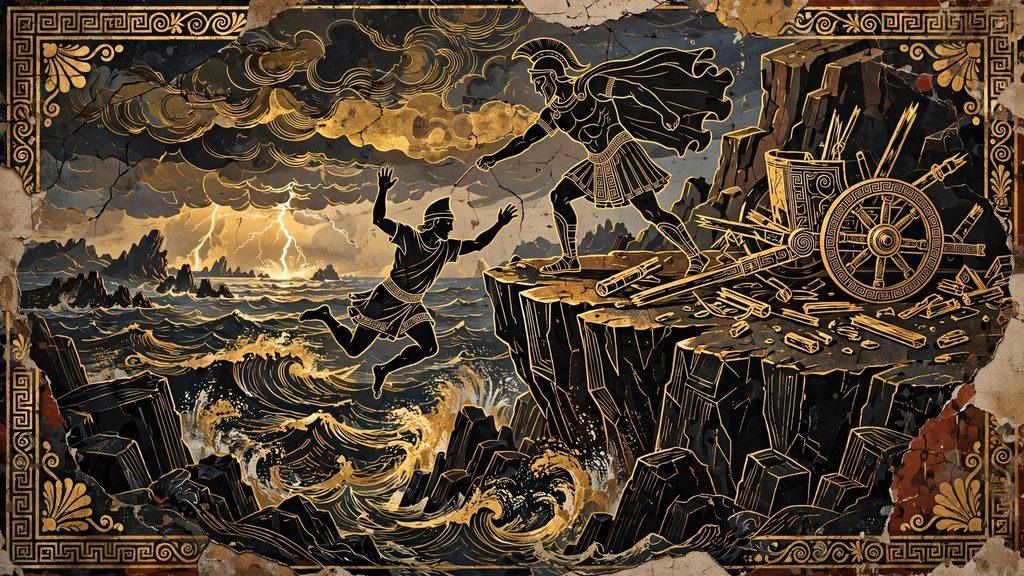
Pelops, restored to life, eventually sought the hand of Hippodamia, daughter of King Oenomaus, who had killed every previous suitor in a chariot race he could not lose, since his horses were a gift from the gods. Pelops bribed the king’s own charioteer, Myrtilus, to sabotage the royal chariot’s axle, and won both the race and the bride when Oenomaus was thrown and killed. Rather than paying Myrtilus the reward he had promised, Pelops threw him from a cliff into the sea. Myrtilus, dying, cursed Pelops and every one of his descendants.
Ancient sources genuinely disagree on which curse is doing the actual work in everything that follows, Tantalus’s blasphemy against the gods or Myrtilus’s dying curse against a man who had just betrayed him exactly as Myrtilus himself had betrayed his own king. The honest answer is that the tradition never fully chose, and the family that resulted carried both debts at once, examined further in this site’s own account of the wider Peloponnesian region where these events are traditionally placed.
The Feast Atreus Served His Brother
Pelops’s sons, Atreus and Thyestes, inherited the pattern in full. When the throne of Mycenae came open, the brothers agreed the crown would go to whichever of them possessed a golden-fleeced ram, a sign of divine favor Atreus already owned and had pledged to sacrifice. Atreus’s wife Aerope, carrying on a secret affair with Thyestes, stole the fleece and gave it to her lover, and when the moment of judgment came, Thyestes produced it and claimed the throne. Atreus, humiliated and unaware yet of his wife’s full betrayal, appealed to Zeus for a countersign, and when the god reversed the sun’s course through the sky at Atreus’s request, the frightened Mycenaeans restored the crown to him instead.
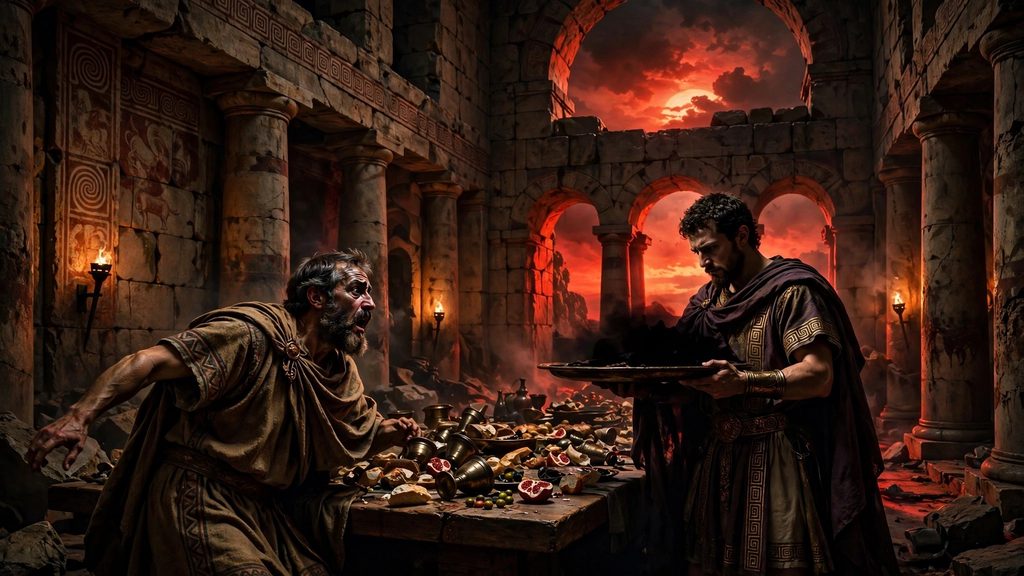
Discovering the adultery afterward made exile feel, to Atreus, like far too light a punishment. He sent word to Thyestes offering full reconciliation and invited him back to Mycenae with his young sons for a feast meant to seal the peace between them. Thyestes came. Atreus secretly killed his brother’s sons, cut them apart, and served their flesh to Thyestes at the reconciliation table. Only at the meal’s end did Atreus bring out what he had kept back, the children’s hands, feet, and heads, to show his brother exactly what he had just eaten. The tradition holds that the sun itself recoiled from the sky at the sight, refusing to look down on Mycenae until the meal was finished.
Thyestes, exiled again and consumed by the need for a revenge equal to what had been done to him, consulted an oracle, which told him the only instrument capable of destroying Atreus would be a son born of Thyestes and his own daughter, Pelopia. Thyestes did as the oracle instructed.
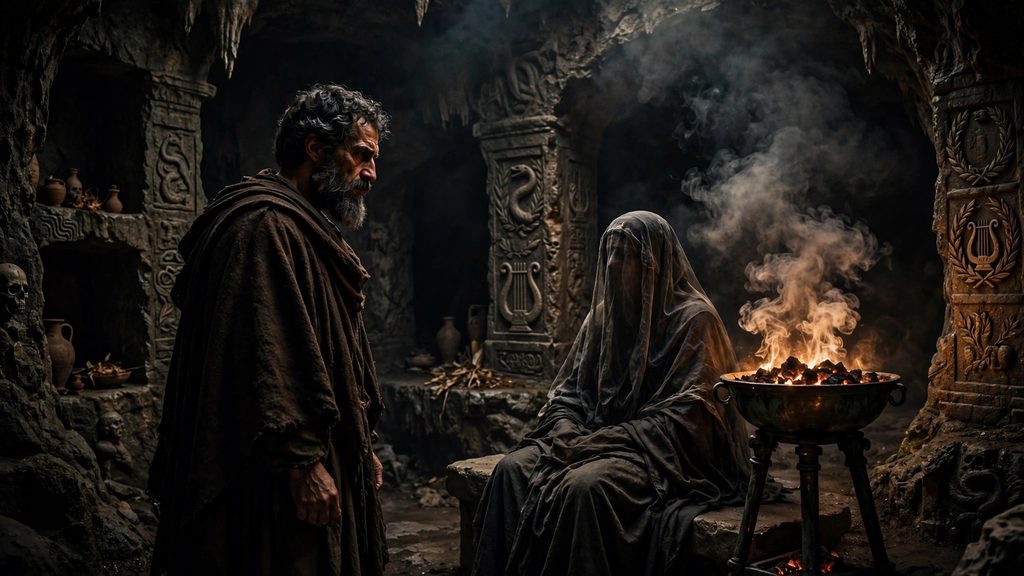
The son born of that union was Aegisthus, raised without knowing his own origin, engineered from the moment of his conception to become exactly what he eventually became: the man who would help kill Atreus’s own son, a generation later, in payment for a meal Aegisthus had not yet been born to witness.
The Price of the Wind at Aulis
Atreus’s son Agamemnon became king of Mycenae and, alongside his brother Menelaus, the commander of the entire Greek expedition against Troy, a war examined in full in this collection’s own account of the conflict that made everything else possible. Before the fleet could sail, it sat becalmed at Aulis, the winds refusing to blow, and the seer Calchas revealed the cause: Artemis was angry, over an insult ancient sources describe differently depending on the telling, and would not release the winds until Agamemnon sacrificed his own daughter, Iphigenia.
Agamemnon sent for his wife Clytemnestra and their daughter under a false pretext, that Iphigenia was to be married to Achilles at the army’s camp. What arrived at Aulis instead of a wedding was an execution. Aeschylus, in the choral ode that remains one of the most harrowing passages in Greek tragedy, describes Iphigenia gagged at the altar specifically so that she could not speak a curse against the men killing her, her saffron-dyed robes pooling on the ground as the priests did what the army’s departure required. Aeschylus treats her death as final and irreversible.
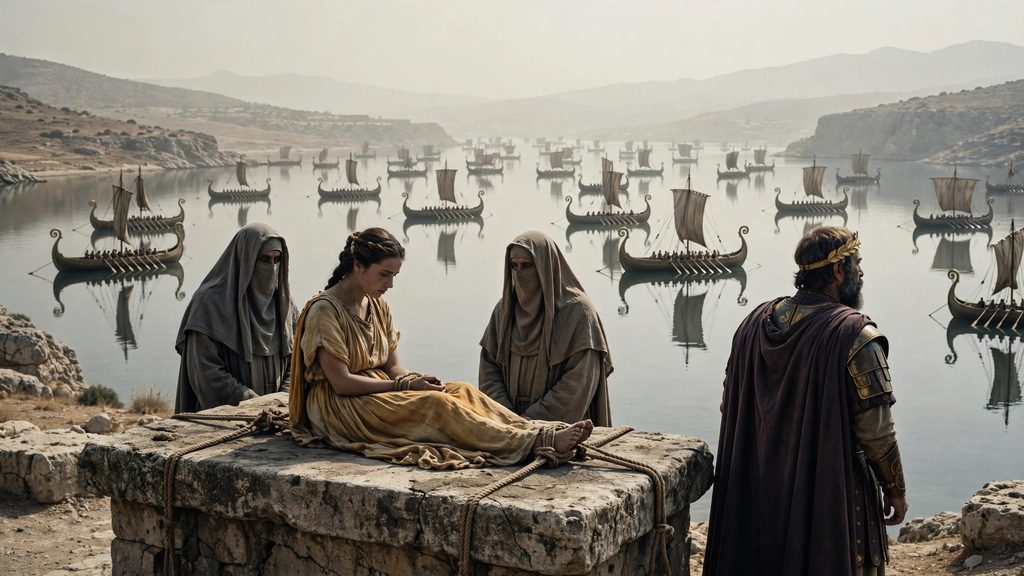
A different, gentler tradition, developed at length in Euripides, has Artemis relent at the last possible moment, substituting a deer on the altar and spiriting Iphigenia away to serve as her own priestess in the distant land of Tauris, alive but permanently separated from the family she was taken from. Both versions were told. Only one of them gives Clytemnestra the grievance that everything she does next depends on.
Ten Years of Waiting to Become Ten Years of Planning
Agamemnon sailed for Troy and did not return for ten years. Clytemnestra, left to rule Mycenae in his absence, spent that decade in a grief that curdled, by every ancient account, into something closer to a verdict than mourning: her husband had killed their daughter to secure a fair wind for a war fought to recover another man’s wife, and no length of eventual victory would make that arithmetic balance. She took Aegisthus, Thyestes’s engineered son and Agamemnon’s own cousin, as her lover, and the two of them spent the war years not simply waiting but preparing, each carrying a motive the other completed: Clytemnestra’s for Iphigenia, Aegisthus’s for the brothers and father Atreus had once served at a table.
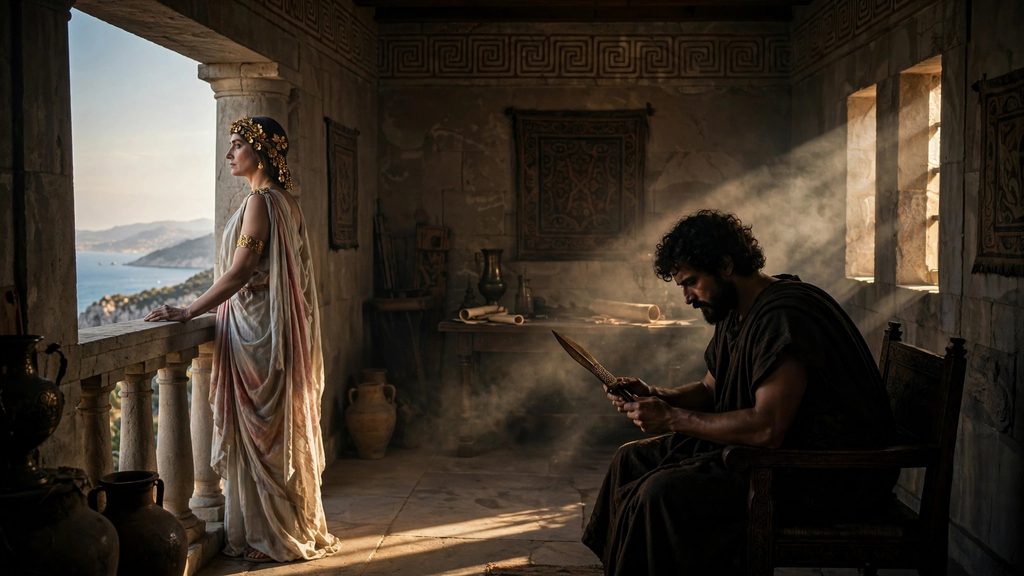
Agamemnon returned victorious, bringing with him Cassandra, the Trojan princess whose own tragic gift is examined at length elsewhere on this site, taken as war prize and concubine, and paraded in front of the wife he had not seen in a decade with no apparent awareness of how that looked. Clytemnestra welcomed him home with every outward form of celebration, laid purple cloth for him to walk on into the palace, and prepared a bath for him to wash away the dust of the journey. In the bath, she threw a net or heavy robe over him, entangling his arms so he could not defend himself, and killed him where he stood.

She killed Cassandra in the same act. Homer’s Odyssey, in the version Nestor and Menelaus tell to Agamemnon’s own son years later, places the plotting and the killing itself in Aegisthus’s hands, an ambush prepared at a banquet that deliberately echoes the banquet where his own father once ate what Atreus served him. Aeschylus gives Clytemnestra the blade directly, arriving at her husband’s death by her own hand rather than her lover’s, and lets Aegisthus arrive afterward merely to claim what her act had already won him.
The Son Who Had to Choose Which Parent to Betray
Orestes, Agamemnon and Clytemnestra’s son, was a child when his father was killed, smuggled out of Mycenae by his sister Electra or a loyal servant before Aegisthus and Clytemnestra could treat him as the threat to their new rule that he genuinely was. He grew up in exile, and Electra remained behind at Mycenae, living under her mother’s rule in a state ancient tragedy consistently portrays as something close to captivity, grieving a father she was given no space to properly mourn.
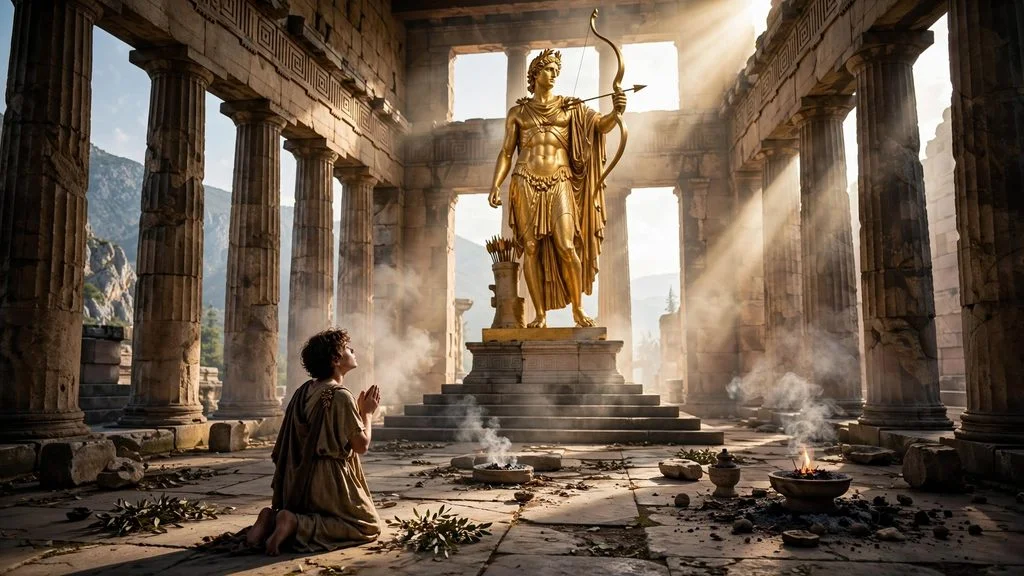
Orestes returned as a young man, consulted Apollo’s own oracle at Delphi about what he owed his murdered father, and was told directly that he was required to avenge Agamemnon’s death, meaning he was required to kill his mother.
Reunited with Electra at their father’s grave, the two planned the killing together. Orestes entered the palace disguised as a messenger bringing news of his own death, was received without suspicion, and killed Aegisthus first. Clytemnestra, confronted by the son she had not seen since he was a child, bared the breast that had once nursed him, in some tellings a final, desperate appeal to whatever remained of the bond between them.
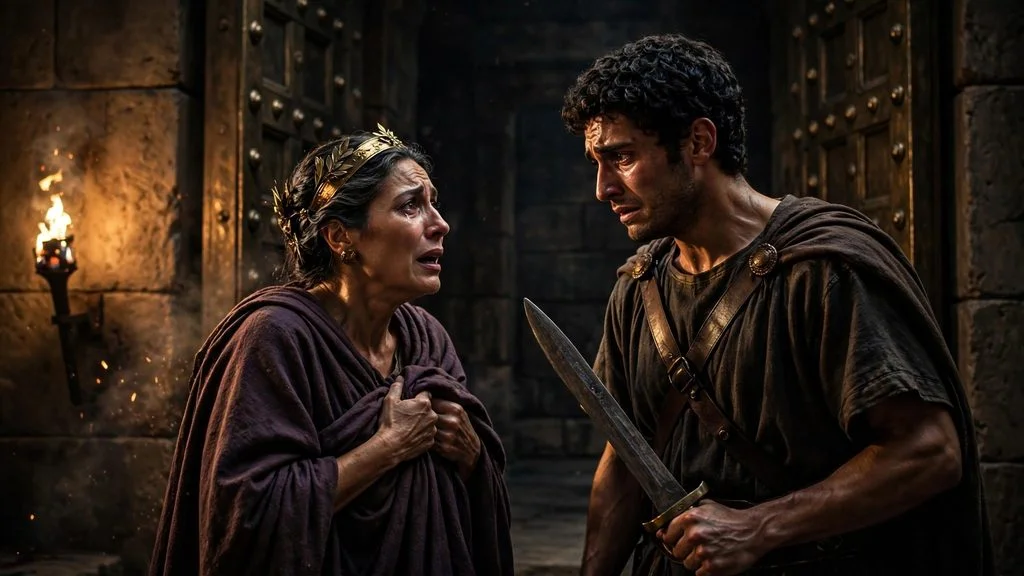
Orestes killed her anyway, on a god’s own direct instruction, completing the one act the Greek moral tradition treated as almost impossible to justify regardless of the provocation that preceded it: matricide.
What the Furies Would Not Let Go
Apollo’s sanction did not protect Orestes from the consequence his own tradition attached to killing a parent. The Erinyes, the Furies, whose specific nature and cosmic authority this site has examined in full elsewhere, pursued him relentlessly afterward, tormenting him with madness regardless of whether the killing had been commanded by a god, because the Furies answered to an older, blood-based order of justice that predated Apollo’s own authority and did not recognize his instruction as sufficient defense.
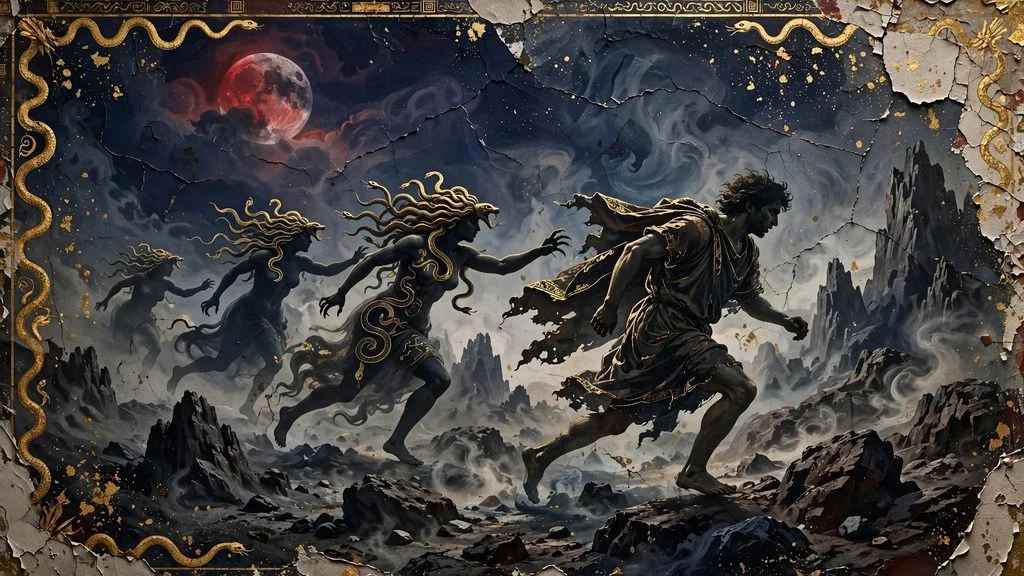
Orestes fled from city to city, unable to find lasting shelter, until the case was finally brought before a divine court at Athens, with Athena herself presiding and casting the deciding vote that acquitted him, transforming the Erinyes from vengeful pursuers into the Eumenides, the kindly ones, and establishing, in the same act, the first murder trial in the Greek tradition: a resolution by law and argument rather than by an endless further round of blood answering blood.
The Debt That Finally Stopped Compounding
Four generations, from Tantalus’s table to Orestes’s trial, and at every single link in the chain the same mechanism repeats with only the names changed: a wrong answered by a wrong precisely calibrated to match it, hospitality corrupted into the exact shape of the injury it was meant to avenge. Tantalus served the gods his own son. Atreus served his brother the same crime one generation down, sons for a son. Agamemnon killed his daughter for a wind. Clytemnestra killed the husband who had killed the daughter. Orestes killed the mother who had killed the father. Each act was, in the actor’s own accounting, justice rather than murder, and each one simply became the next generation’s grievance to inherit.
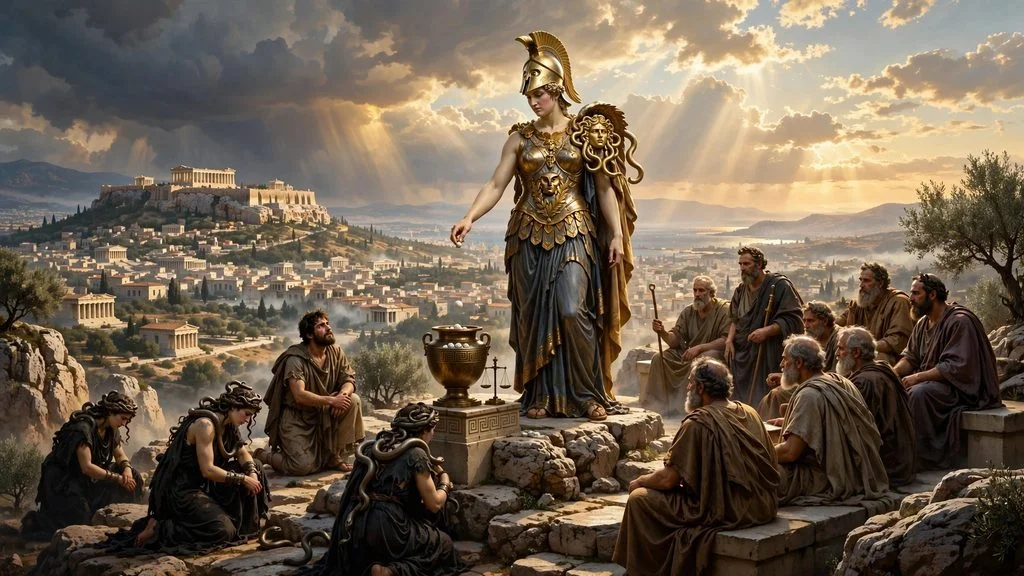
What stopped it was not a stronger act of vengeance. It was Athens choosing, at the trial’s end, to replace the entire logic the family had been trapped inside for four generations, blood answered only by blood, with something the House of Atreus had never once tried across a hundred years of dinners that ended in murder: a verdict, argued and voted on, that both sides were required to accept as final.
At Olympus Estate, Tales from Olympus moves through the deeper currents of the Greek tradition. Tantalus served his own son to the gods to test their knowledge. His grandsons Atreus and Thyestes repeated the crime one generation down, a feast of children serving as revenge for a stolen throne. Agamemnon sacrificed his daughter Iphigenia for a favorable wind to Troy, and returned a decade later to be killed by the wife who never forgave him for it. Their son Orestes, commanded by Apollo’s own oracle, killed his mother in turn, and was pursued by the Erinyes until Athens itself, through the first murder trial in the Greek tradition, finally broke a cycle that four generations of blood vengeance had failed to end.