In the yards of the old farmhouses on Skopelos there are small stone ovens, domed and blackened, with iron doors that have not been opened in years. For generations, every summer, families filled them with plums. The fruit went in purple and came out as prunes, packed in cotton sacks and loaded onto boats for the mainland and beyond. For a long time the island lived on them.
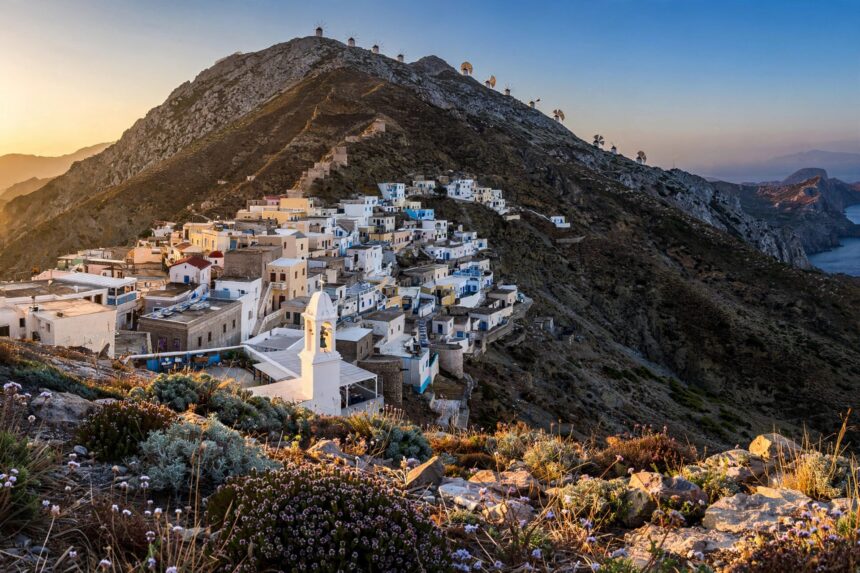
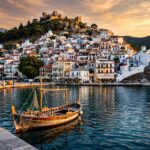
Most visitors never see the ovens. They come for the pine forest that runs down to the sea, for the white town climbing its hill above the harbour, or for the chapel on a rock where Meryl Streep’s daughter almost got married in Mamma Mia! All of that is real, and all of it is worth the ferry. But the island behind the film is older and stranger. It has a Bronze Age prince buried with a gold-hilted sword, an ancient wine famous across the Aegean, more than 360 churches and chapels for some 4,500 people, and an economy that dried its fruit in stone and then quietly disappeared.
The Island Pelion Left in the Sea
Skopelos is often called the greenest island in Greece, and from the deck of a ferry it is easy to believe. Pine covers most of it, by local reckoning around two-thirds of its surface, from the ridges down to the water’s edge. Where the Cyclades are bare rock and white light, Skopelos is dark green against blue-green sea.
The reason lies across the water. The Northern Sporades, Skiathos, Skopelos and Alonissos, are the seaward continuation of Mount Pelion, the forested mountain above Volos where the centaurs lived. They share its rock, its rainfall and its northern winds. When the sea stood lower in the Ice Age, these islands were the tail of the same mountain range, and they still carry its vegetation.
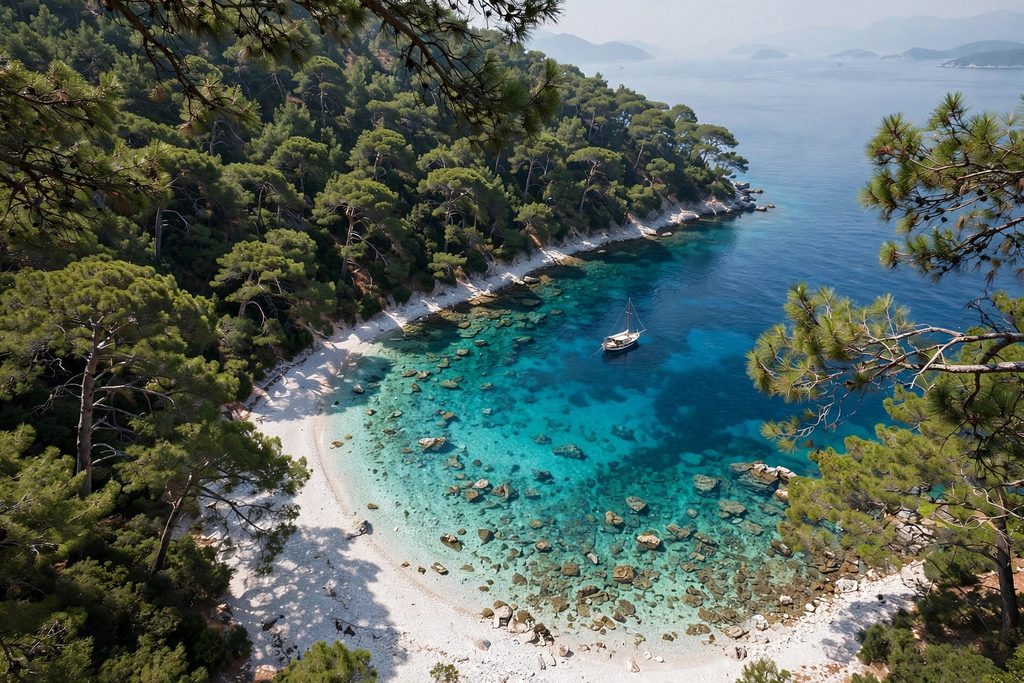
The forest is mostly Aleppo pine, with kermes oak on the dry ridges, a small wood of holm oak, and plane trees along the stream beds. Between them, on terraces cut into the hills over centuries, grow olives, almonds, figs, walnuts and plums. Water is the island’s quiet advantage. Springs and seasonal streams kept the valleys farmable long before anyone thought of tourism, and the farms in turn shaped everything else.
Peparethos | The Island of Dionysus’s Son
In antiquity the island was called Peparethos. Myth said it was first settled by Staphylos, whose name means bunch of grapes, a son of Dionysus and Ariadne, the Cretan princess whom Theseus abandoned on Naxos and the wine god made his bride. Another of their sons, Peparethos, gave the island its old name. A wine god’s family for a wine island. The myth was a boast, and the island could back it up.
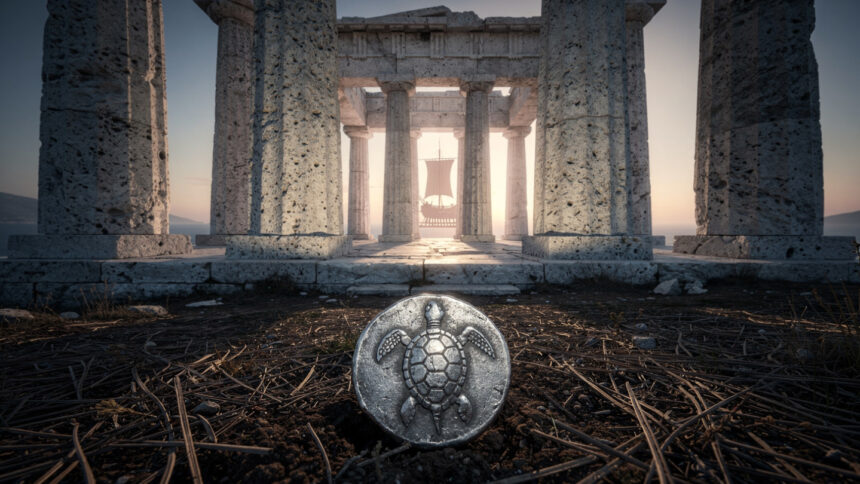
Peparethian wine was famous across the Greek world. It appears in ancient writers beside the great wines of Thasos, Chios and Lesbos, and the island’s amphorae carried it around the Aegean. In the sixth and early fifth centuries BC Peparethos was prosperous enough to mint its own coins, exported wine and olive oil, and sent athletes to Olympia. Agnontas Bay, where the ferries sometimes dock in rough weather, is said to take its name from one of them, a victor called Agnon.
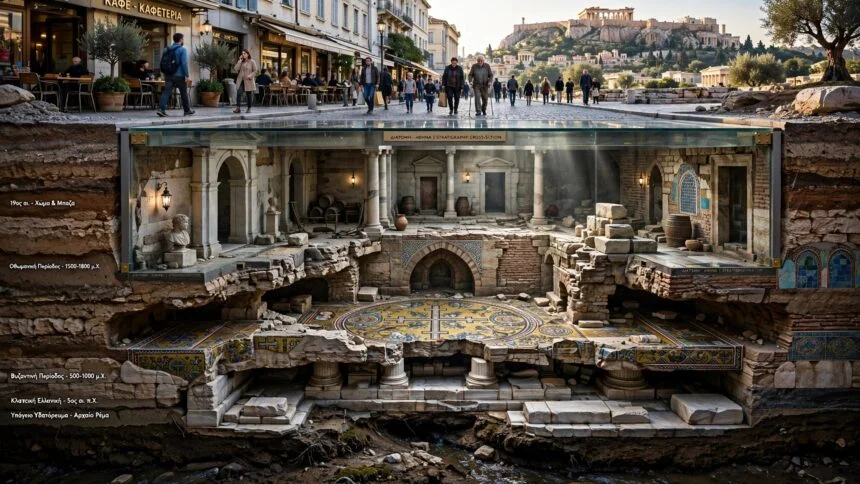
The island also appears in Thucydides. In the summer of 426 BC, a season of earthquakes across Greece, the sea drew back from Peparethos, and a tremor threw down part of the city wall, the town hall and a few houses. The ancient town stood where Chora stands today, and the Venetian castle at its summit sits on the old acropolis.
The Gold-Hilted Sword of Staphylos
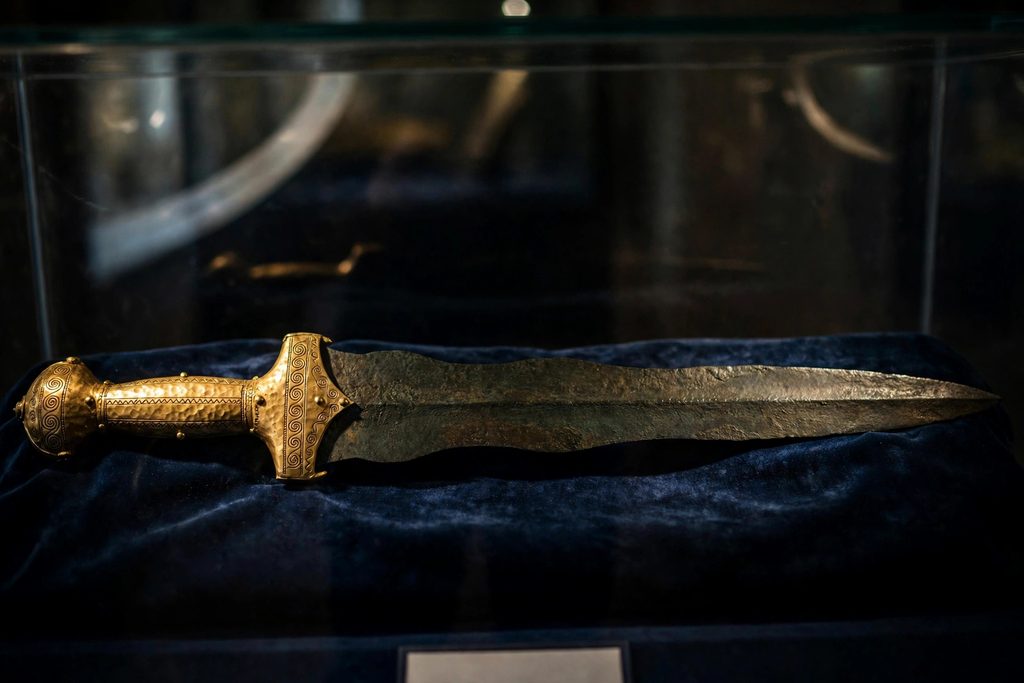
The myth of Staphylos might have stayed a myth. Then, in 1936, the archaeologist Nikolaos Platon excavated a tomb on the small headland between the beaches of Velanio and Stafylos, on the island’s south coast, the bay that still bears the prince’s name.
It was a Bronze Age burial of real wealth. Among the finds was a bronze sword with a hilt sheathed in gold, dated to the fifteenth century BC and now in the National Archaeological Museum in Athens. The tomb belongs to the age when Minoan Crete and then the Mycenaean world reached across the Aegean, and a Cretan connection is exactly what the legend of Ariadne’s son implies. Locals have called it the tomb of Staphylos ever since. Nobody can prove whose it was, but somebody important was buried on that headland with a golden sword, facing the sea, some 3,500 years ago.
Pirates, Bishops and 360 Chapels
Christianity reached the island early. Its patron saint, Riginos, was bishop of Skopelos and was martyred in 362 under the emperor Julian, the last pagan to rule Rome. His tomb lies in the monastery that bears his name, a short drive from Chora, and the island still keeps his feast every February.
The next thousand years were hard. After the Fourth Crusade in 1204 the Venetian house of Ghisi took the Sporades and fortified the summit of Chora, until Byzantium recovered the islands in the 1270s. In 1538 the Ottoman admiral Hayreddin Barbarossa raided Skopelos, killing and enslaving much of its population, and for generations afterwards the island lived with the threat of pirates. Its settlements climbed to defensible heights, and its monasteries were built like forts.
Then came the chapels. Skopelos has more than 360 churches and chapels, roughly one for every twelve inhabitants. A handful are grand. The Monastery of Evangelistria, founded in the early eighteenth century on the slopes of Mount Palouki, hides behind fortress walls a carved and gilded iconostasis. Beside it on the same mountain stand the monasteries of Metamorfosis, Prodromos and Agia Varvara, and the basilica of Agios Athanasios inside the castle walls is the island’s oldest surviving church, built in the eleventh century.
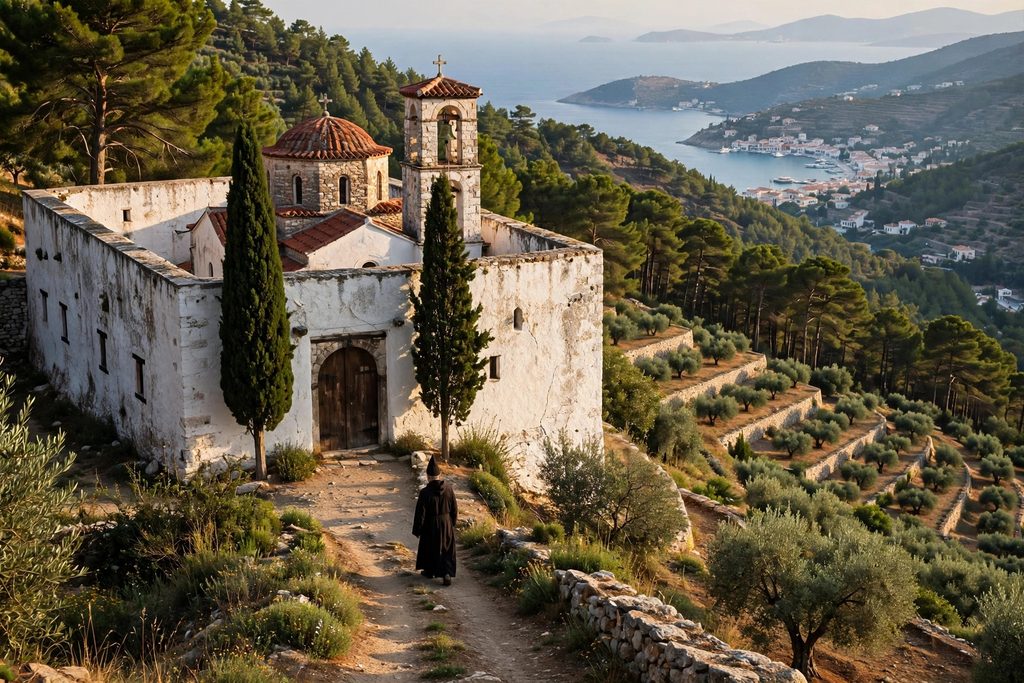
Most of the 360, though, are small and private. A family built one to give thanks for a son home from the sea, for a harvest, for a recovery, or to keep a vow, and the family still holds the key. The chapels stay shut for most of the year and open on the day of their saint, when the family and their neighbours gather for a service and a meal under the trees, a small version of the village panegyri. The number is less a measure of piety than a record of private gratitude, one family and one promise at a time.
The Prune Ovens | An Economy Dried in Stone
By the eighteenth and nineteenth centuries Skopelos had recovered. Its shipbuilders and captains traded across the eastern Mediterranean, its island took part in the War of Independence of 1821, and in 1830 the Northern Sporades became the northern frontier of the new Greek state. Beneath the shipping lay the land, and the land’s great crop was the plum.
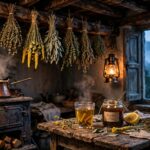
The island grows several varieties, harvested from mid-June to mid-September, and three of them shaped its kitchen and its economy. The black and red plums went into the ovens. Behind almost every country house stood a stone kiln, where the fruit was laid on racks and dried slowly over a low wood fire until it shrank, darkened and could keep through the winter and survive a long voyage. Prunes from Skopelos were sold across Greece and abroad, and for many families they were the cash crop that paid for everything else.
The trade died in the 1980s. Industrial drying elsewhere made prunes cheaper than any island family could make them by hand, and the margin vanished. The young were already leaving, and tourism was arriving with a better offer. Orchards shrank, the ovens went cold, and the iron doors rusted shut.
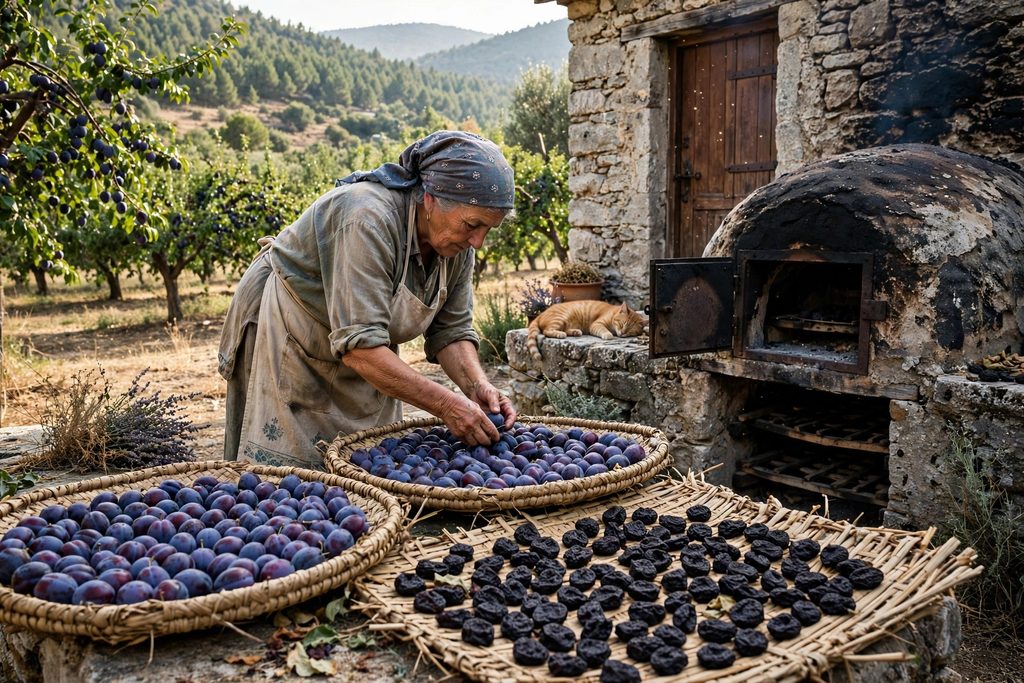
Skopelos is not the only Greek island whose fortune left and whose monuments stayed. On Symi, the sponge trade built a harbour of mansions and then abandoned it. On Skopelos, the plum trade built nothing grand. It left hundreds of small ovens in hundreds of yards, each one the memory of a family’s summer.
Skopelos at the Table | Prunes and the Spiral Pie
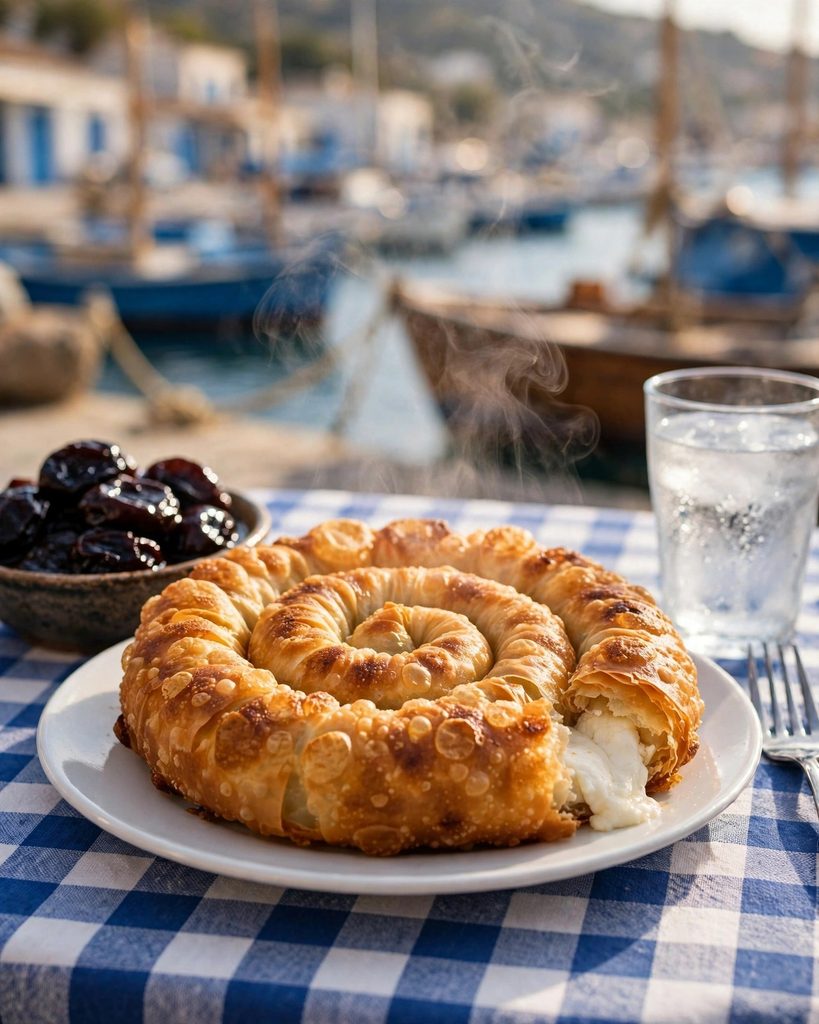
The economy went, but the flavour stayed. Island tavernas still cook pork with prunes, add sour red prunes to lentil soup and to octopus stews, and slip prunes into a winter stifado. Families still dry their own and keep them in cotton bags through the winter. Ask for prunes at breakfast with thick yoghurt and island honey and you will be eating the old export at its source.
The island’s other signature is its cheese pie. The Skopelitiki tyropita is nothing like the folded pies of Athens. A long rope of thin pastry is filled with tangy local goat’s cheese, coiled into a flat spiral about the size of a saucer, and deep-fried until it crackles. It arrives hot, golden and dusted with nothing at all, and it is the first thing most Greeks order when they step off the ferry.
Chora and Glossa | Two Towns on Two Hills
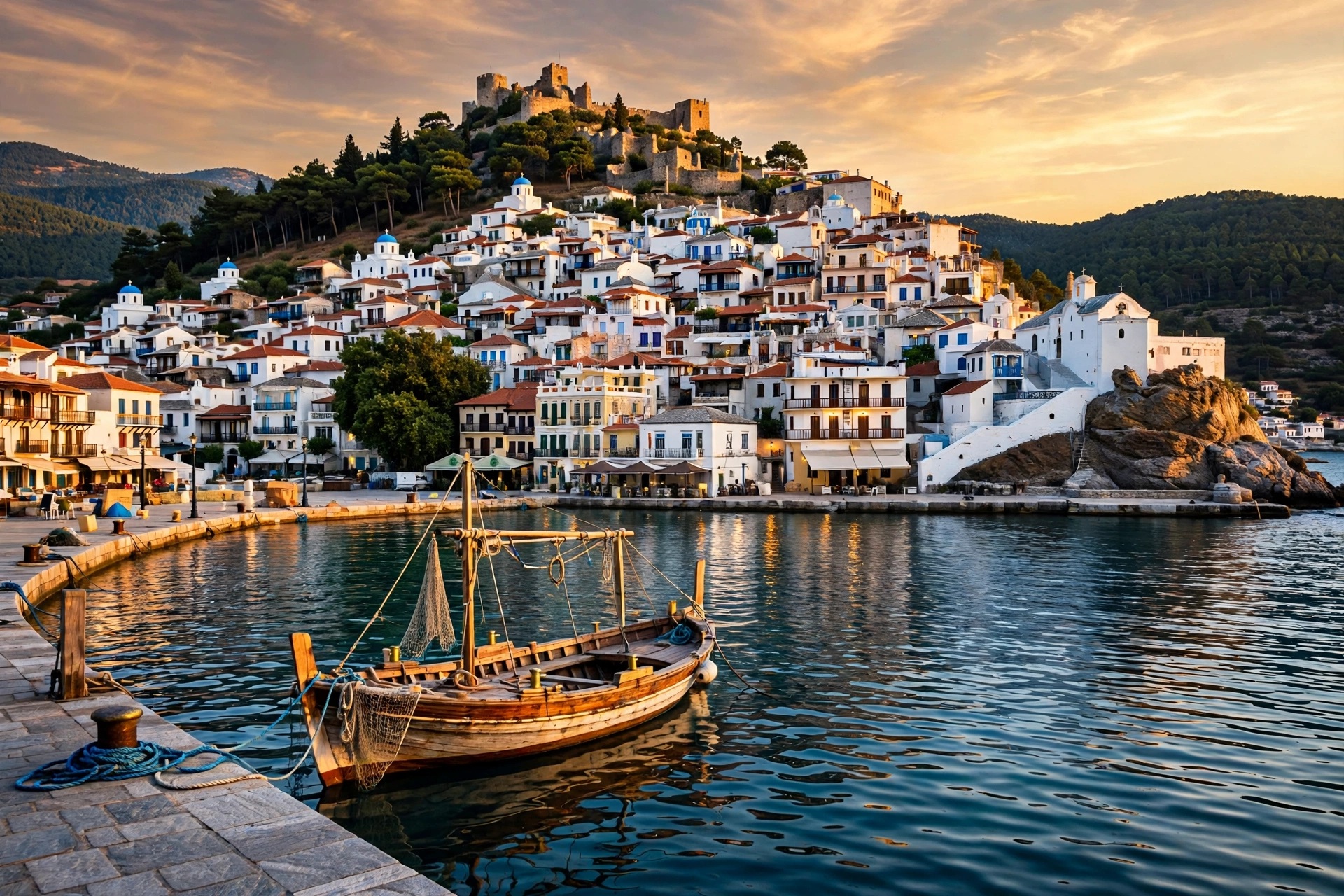
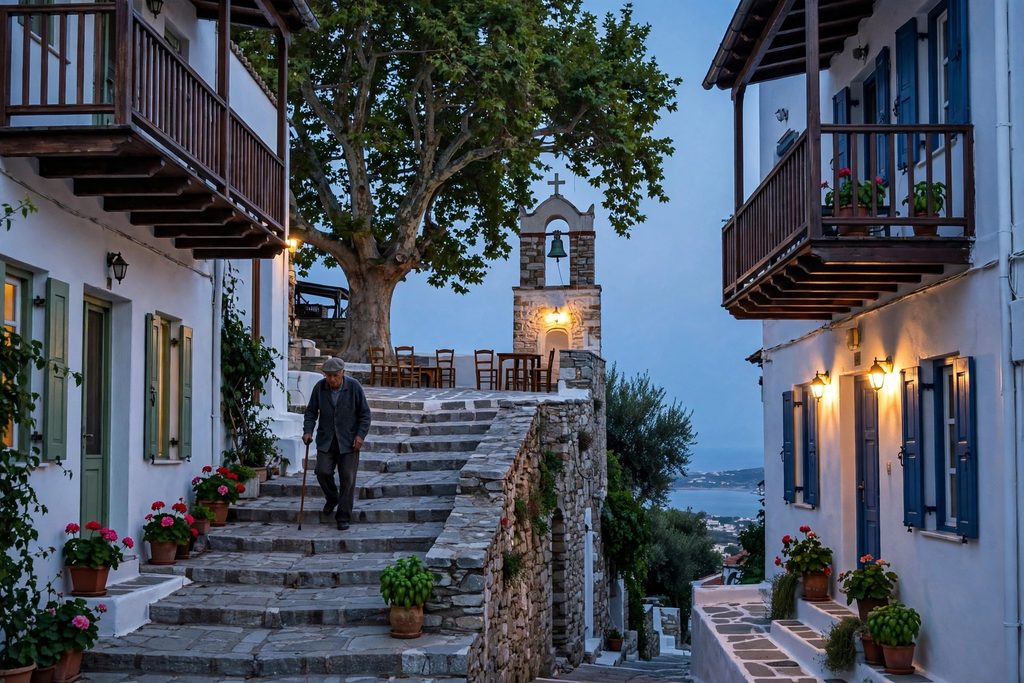
Chora, the island’s capital, rises in an amphitheatre from the harbour to the castle, a steep tangle of whitewashed houses, wooden balconies and stone lanes too narrow for cars. Its roofs are red tile and grey stone slab, in the style of Pelion across the water. It looks this way because it has to. Since 1978 the town has been a protected traditional settlement, and new houses may not rise above two storeys, roofs must be sloping and tiled or stone, and doors, windows and balconies must be made of wood. The result is one of the best-preserved island towns in the Aegean, much like car-free Hydra in its refusal to modernise its looks.
Glossa, at the island’s northwestern end, is the second town and the quieter one. It sits high above the little port of Loutraki, where the ferries from Skiathos call first, on a hill that was chosen for watching the sea. Its lanes are steeper, its squares are shaded by plane trees, and its evenings belong to the people who live there. Below it, near Loutraki, lie the scattered remains of an ancient settlement, one of the island’s towns in antiquity.
Mamma Mia! and the Rock of Agios Ioannis
In September 2007 a film crew arrived on Skopelos and neighbouring Skiathos. The following summer Mamma Mia! turned the island into the fictional Kalokairi, and Skopelos became famous overnight. Kastani beach on the west coast was the setting for the beach scenes. Much of the rest was shot on studio sets in England.
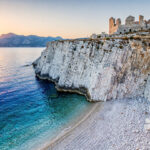
The image everyone remembers is the chapel. Agios Ioannis sto Kastri, Saint John on the Castle, sits on top of a sheer rock that rises straight out of the sea on the north coast near Glossa. A stair of roughly a hundred stone steps, cut into the rock, climbs from the cove to the door. The wedding procession was filmed there, and Meryl Streep sang “The Winner Takes It All” on the rocks below. The tiny interior on screen was a set. The real one holds a few icons and the candles of visitors who climbed up.
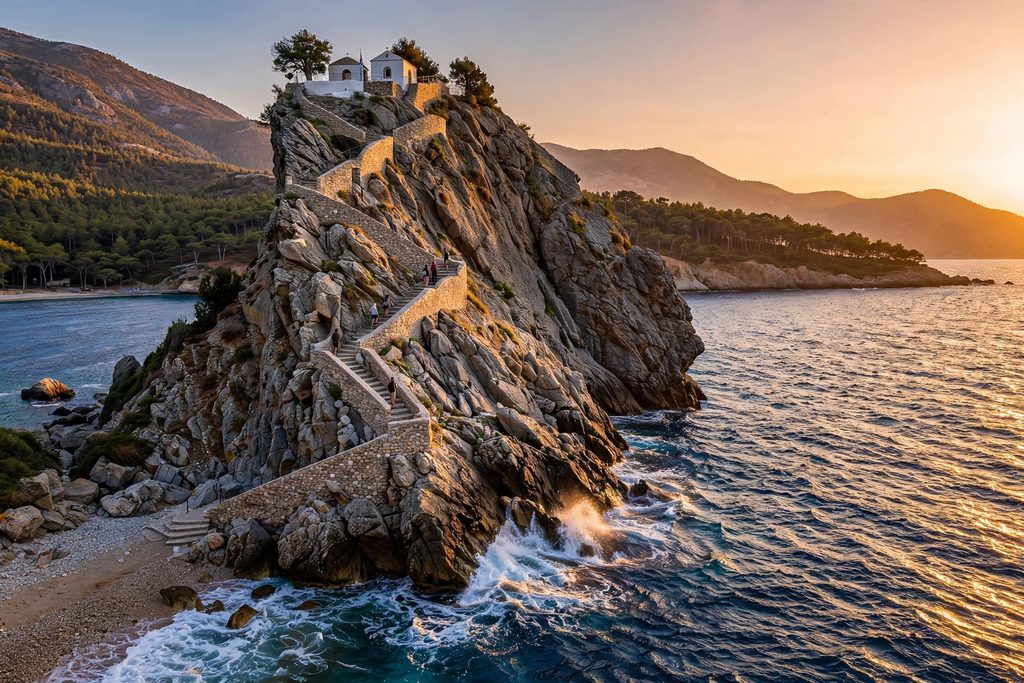
The chapel on the rock was not built for a view. Like hundreds of island chapels set on capes and cliff tops, it marks a place the islanders thought holy long before anyone filmed it, a place where you could pray for a ship you could see from the top. The sequel, ten years later, was shot on the Croatian island of Vis. Skopelos never needed it.
Walking the Green Island
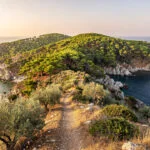
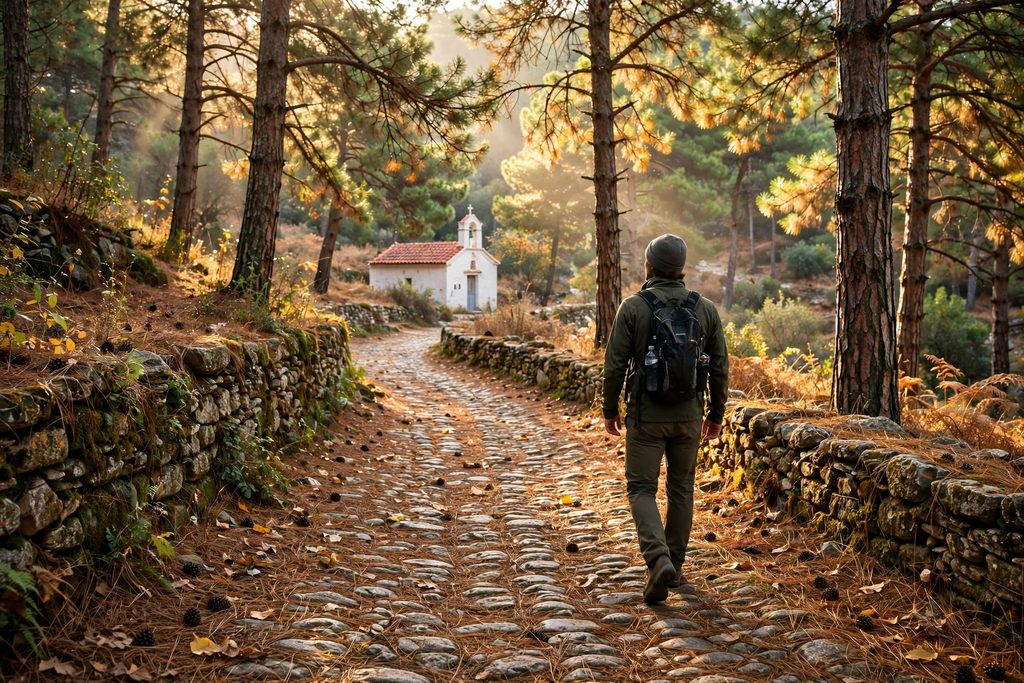
The best of Skopelos is on foot. Old mule paths, the kalderimia, link the monasteries, the farm valleys and the coves, and many are now waymarked. The walk from Chora up to the Palouki monasteries gives the whole bay at your feet. The path through the pines to Stafylos and Velanio passes the headland of the prince’s tomb. On the slopes inland from Chora, rock-cut tombs known as the Sendoukia, the chests, lie open in the hillside, ancient graves carved straight into the stone.
The sea is part of the forest’s story too. Skopelos looks across to the national marine park around Alonissos, one of the last refuges of the Mediterranean monk seal, and the clear water along its quieter coasts has the blue-green colour of pine shadow on white pebbles.
What the Ovens Remember
Skopelos has been rich three times. Once on wine, when a son of Dionysus gave it his name and its amphorae crossed the Aegean. Once on ships and plums, when its captains traded and its yards smoked every summer with drying fruit. And now on visitors, many of whom arrived because of a film.
Each fortune left something behind. The wine left a myth and a prince’s tomb in a bay named for grapes. The plums left the ovens in the yards. The pirates left fortified monasteries, and private gratitude left 360 chapels in the pines. Walk inland from any beach and you will pass all of it, under the same forest that has covered this island since Pelion lost it to the sea.
At Olympus Estate, Greek Islands looks past the postcard to the history that made each island what it is. Skopelos, the ancient Peparethos, is the green island of the Northern Sporades, a seaward piece of Mount Pelion with pine over most of its surface. Myth gave it to Staphylos, son of Dionysus and Ariadne, and its wine was prized beside that of Thasos, Chios and Lesbos. In 1936 Nikolaos Platon excavated a Bronze Age tomb at Stafylos with a gold-hilted sword of the fifteenth century BC, now in the National Archaeological Museum in Athens. Saint Riginos was martyred here in 362, the Venetian Ghisi fortified Chora after 1204, and Barbarossa sacked the island in 1538, leaving monasteries built like forts on Mount Palouki and more than 360 mostly private chapels across the island. For generations its black and red plums were dried into prunes in stone ovens behind every farmhouse, until industrial drying ended the trade in the 1980s. Prunes still flavour its pork, lentils and octopus, the spiral cheese pie is its signature, Chora has been a protected settlement since 1978, and Agios Ioannis on its rock near Glossa became famous in Mamma Mia! in 2008.