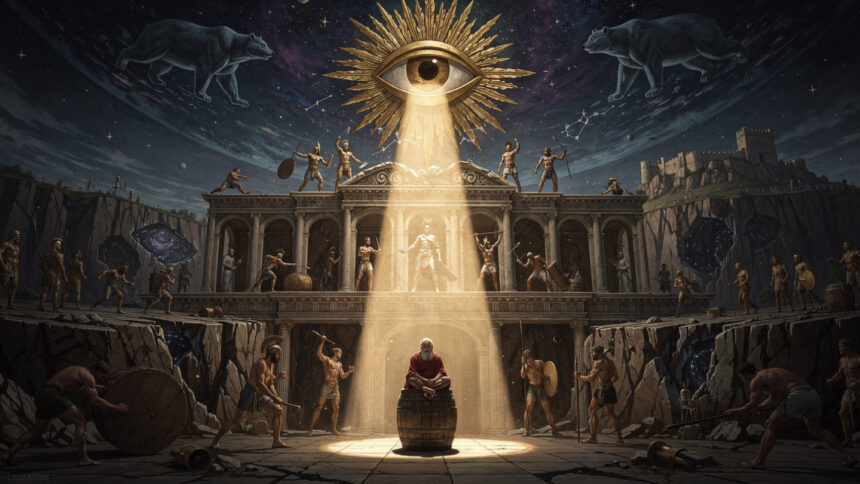





His name means foresight.
This is not a coincidence the myth asks you to notice in passing. It is the myth’s entire argument, placed in the name of its protagonist before the first event has occurred. Prometheus, pro-metheus, the one who thinks ahead, the fore-thinker: the naming encodes the distinction that separates him from every other figure in the Greek tradition who suffered divine punishment.
Every other figure was surprised.
Agamemnon did not know he would be killed on his return from Troy. Oedipus did not know the man he killed at the crossroads was his father. Actaeon did not know that the pool he came upon in the forest contained Artemis bathing. The tragedies of the Greek tradition are built on this structure: the figure whose knowledge falls short of the situation they are in, whose good intentions or bad luck or genuine moral failure meets a consequence that arrives from a direction they were not watching.
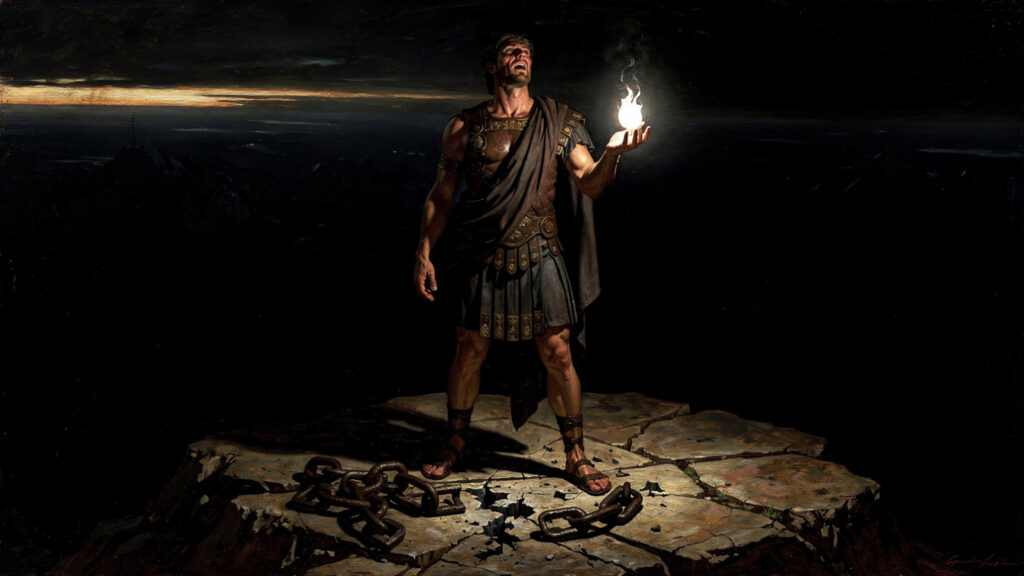
Prometheus watched every direction simultaneously. The Titan who possessed foreknowledge saw what Zeus would do when the fire was stolen. He saw the eagle. He saw the rock and the chains and the daily repetition of the wound that healed overnight only to be reopened at dawn. He saw all of it, clearly, before he took the fire from the forge of Hephaestus and carried it down to the people who were living in the cold.
He took it anyway.
The myth is not about the dangers of overreach. It is about what it means to choose a known suffering for a reason that makes the suffering worth it, and it is the only myth in the Greek tradition that poses this question in a form that requires the hero’s full foreknowledge rather than his ignorance.
What He Saw Before He Acted
The Theogony and the Works and Days, Hesiod’s two great poems, establish Prometheus’s foreknowledge as the foundation of everything that follows. His brother Epimetheus, whose name means afterthought, received Pandora from Zeus’s hand and did not resist her. Prometheus had warned him: accept no gift from Zeus. Epimetheus forgot, or chose not to remember, and the consequences arrived in the form of every illness and suffering that Pandora’s jar released into the world.
The contrast between the brothers is the myth’s first and clearest statement of its theme. Epimetheus acts without anticipating consequence. Prometheus anticipates consequence and acts anyway. The outcomes for humanity are similar: they receive the fire that Prometheus gives them and they receive the suffering that Pandora releases, and both of these gifts arrive through the same divine dynamic, the contest between Zeus’s authority and Prometheus’s defiance. But the moral structure of the two givers is entirely different. Epimetheus is simply human in the colloquial sense: he is the figure who acts without fully thinking, who receives what is given without calculating the cost. Prometheus is something else: the figure who calculates the cost completely, arrives at a figure that most beings would consider prohibitive, and pays it.
Aeschylus, writing in the fifth century BCE, gave the fullest dramatic treatment of this quality in Prometheus Bound, the play that depicts Prometheus already chained to his rock in the Caucasus, already undergoing the punishment, visited by a sequence of figures who attempt to understand or persuade or simply witness what he has chosen. The Prometheus of Aeschylus is not suffering in ignorance or confusion. He is suffering in full possession of his knowledge, including the most consequential piece of it: that he knows a secret about Zeus’s future that Zeus does not know, a secret about which of Zeus’s potential unions will produce a son who will overthrow him. He holds this secret as his single remaining leverage, and he will not release it despite the agonies being applied to extract it.
The Aeschylean Prometheus is the most philosophically demanding figure in Greek tragedy precisely because his situation eliminates the two explanations that usually make suffering comprehensible: he is not suffering because of an error, and he is not suffering because of ignorance. He made no error. He was not ignorant. He chose, with full information, to do something that he knew would produce this outcome. The chains are not punishment in the sense of a consequence he failed to anticipate. They are the price he agreed in advance to pay.
The Sacrifice Before the Fire
Before the fire, there was a subtler act whose significance the tradition has sometimes underemphasised.
At Mecone, the site of a great gathering between gods and men, Prometheus organised the first division of the sacrificial ox, the moment when the relationship between mortal offerings and divine receipt was formally established. He divided the animal into two portions: in one, the edible flesh and organs wrapped in the stomach. In the other, the bones wrapped in gleaming fat, made to appear rich and desirable from the outside.
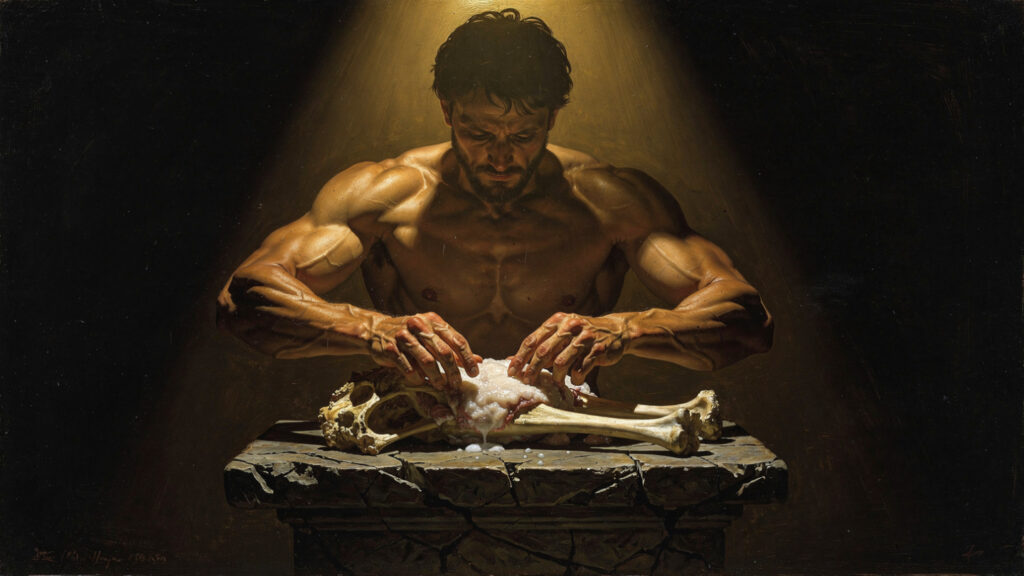
He invited Zeus to choose.
Zeus, according to Hesiod, was not deceived. He saw through the arrangement. He chose the bones deliberately, knowing they were inferior, in order to have grounds for the anger he would exercise against humanity. The myth does not present Zeus as a victim of a clever trick. It presents him as a ruler who accepted a pretext for the exercise of his displeasure.
Prometheus knew this too. He arranged the sacrifice knowing that Zeus would see through it, knowing that Zeus would choose the lesser portion in order to establish the precedent for punishment, knowing that the entire exchange was less a trick and more a declaration: that humanity would keep the meat, would keep the nourishment, would maintain the physical sustenance of life against the portion that the divine hierarchy claimed.
The fire followed this as its logical extension. If humanity kept the meat, they needed the fire to cook it. If the divine hierarchy removed the fire in response to the sacrifice division, the gift of meat was incomplete and the human condition was specifically diminished: they had the food they needed but not the means to prepare it, the substance of civilisation without the technology.
The theft of fire was the completion of the sacrifice arrangement. The Titan who had given humanity the better part of the animal gave them, in the same gesture extended across two acts, the means to use what they had been given.
What Fire Actually Was
In the Greek mythological understanding, fire was not simply a useful tool among others. It was the technology that separated the human condition from the animal one, the single capability whose possession defined the boundary between the life of a creature and the life of a civilisation.
Cooking: the transformation of raw food into something the human digestive system could more efficiently process, something that could be stored, something that could be shared at a table as a social act rather than consumed immediately at the point of acquisition. Warmth: the extension of human habitation beyond the climatic zones where the unaided body could survive, the expansion of the geographical range of human settlement. Metalworking: the production of tools capable of agriculture at scale, capable of construction, capable of the mechanical interventions in the natural world that the subsequent development of civilisation required.
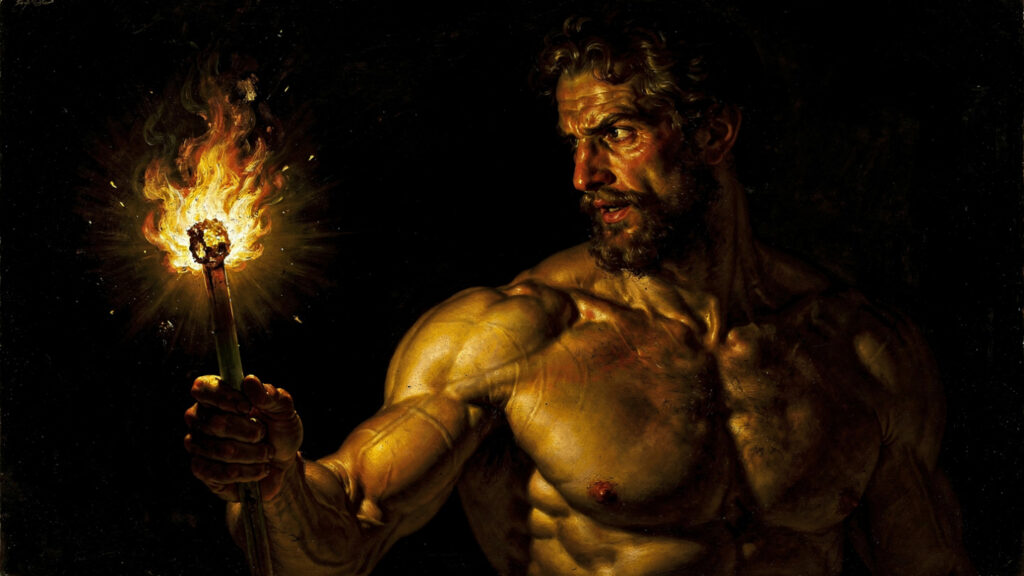
Prometheus taught them not only to use fire for warmth and cooking but also the technical arts that fire enables. He taught them metalwork, the cultivation of the earth, and the mastery of the hard materials that the world offered. The Aeschylean Prometheus enumerates these gifts in the play. He taught them blind hope so they would not see their deaths coming. He gave them fire. He gave them all the arts that fire enables. The catalogue is the catalogue of civilisation, and its first author is the Titan who accepted the eagle in exchange for delivering it.
The exchange rate is the myth’s central statement. One Titan’s daily suffering, endured in full foreknowledge, sustained for centuries, purchased for humanity the full set of capabilities that the subsequent development of Western civilisation was built from. The price paid per unit of human civilisation is, in the myth’s accounting, Prometheus’s liver consumed and regenerated and consumed again, day after day, for as long as the gift required defending.
He knew this was the price. He paid it. He did not negotiate.
The Liver and What the Greeks Knew About It
The choice of the liver as the organ of Prometheus’s daily torment was not arbitrary, and the ancient tradition’s understanding of the liver illuminates why this wound was selected as the vehicle for the myth’s central statement.
The liver was understood in ancient Greek medicine and in the wider ancient Mediterranean world as the seat of vitality, the organ most associated with the force of life itself. Divination through the examination of sacrificial livers, haruspicy, was among the most significant ritual practices of the ancient world: the liver’s condition was read as the index of the world’s condition, its lobes and markings interpreted as the map of future events. To strike at the liver was to strike at the force of life, and to regenerate it overnight was to insist on the continuation of that force regardless of the damage inflicted on it.
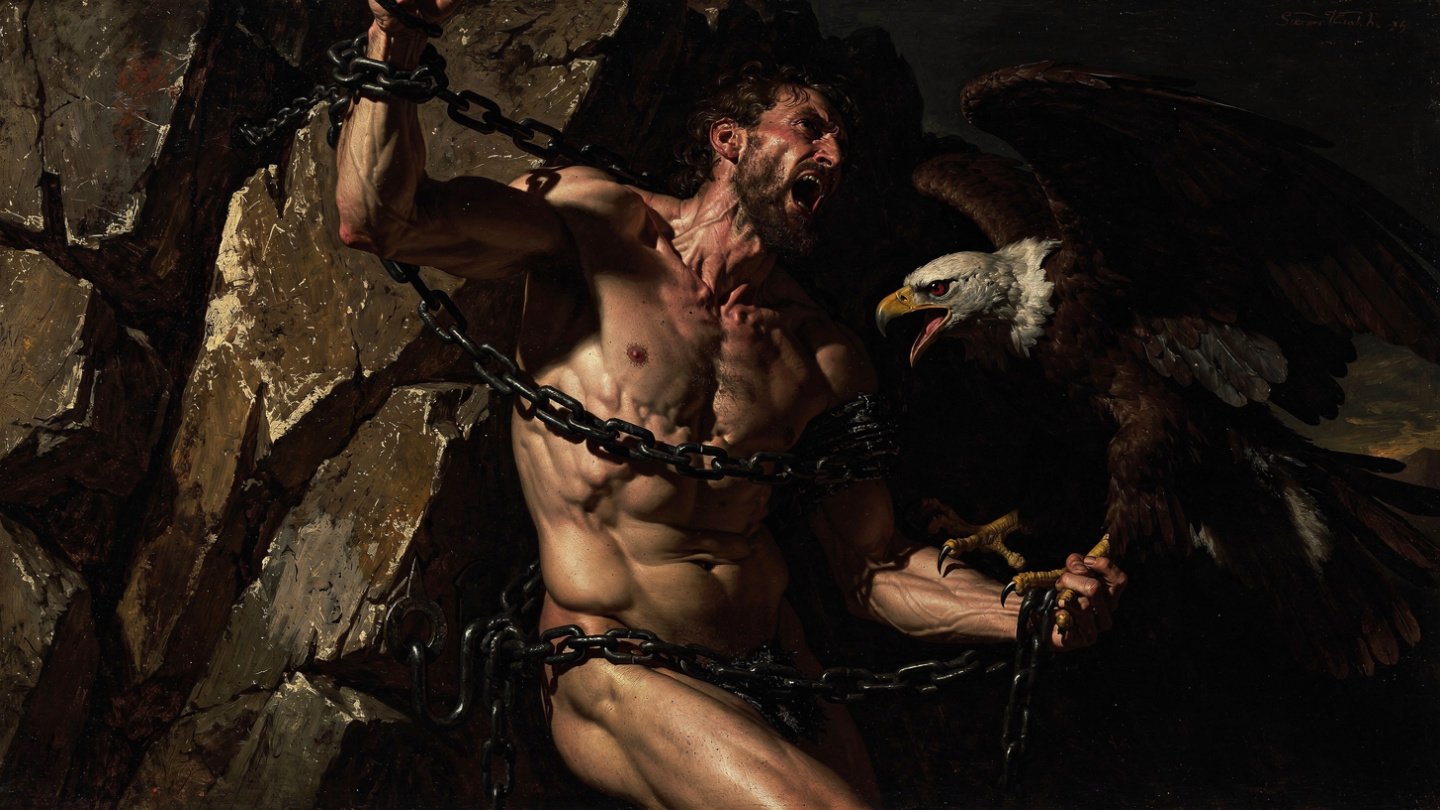
Prometheus’s liver regenerates because Prometheus is immortal, but the myth’s logic is more precise than simple immortality. The daily regeneration is the daily renewal of the vital force that the Titan represents: the force of foresight, of reasoned action in advance of consequence, of the willingness to sustain suffering for a reason that the suffering itself does not diminish. The eagle removes it and it returns. The eagle removes it again and it returns again. The wound that is renewed each morning is the same wound, and the liver that grows back is the same organ, and the Prometheus who endures it is the same Titan, unchanged in his foreknowledge and unchanged in his assessment of whether what he did was worth doing.
He does not recant. No ancient source presents him as regretting the theft of fire. The Aeschylean Prometheus, asked if he would make the same choice again, does not answer with regret. He answers with the secret he is keeping, the one piece of information that gives him leverage against the power that has chained him. He is not broken. He is waiting.
Heracles and the Liberation
The liberation of Prometheus by Heracles is the myth’s resolution, and it is more theologically complex than the simple image of a hero killing an eagle and breaking a chain suggests.
Zeus permitted the liberation. This is the detail that changes the meaning. Heracles did not defy Zeus to free Prometheus. He acted, in the mythological account, with Zeus’s knowledge and acquiescence. The liberation was not a second act of defiance against divine authority. It was divine authority acknowledging, after whatever interval the myth assigns to the suffering, that the terms of the punishment had been sufficiently met.
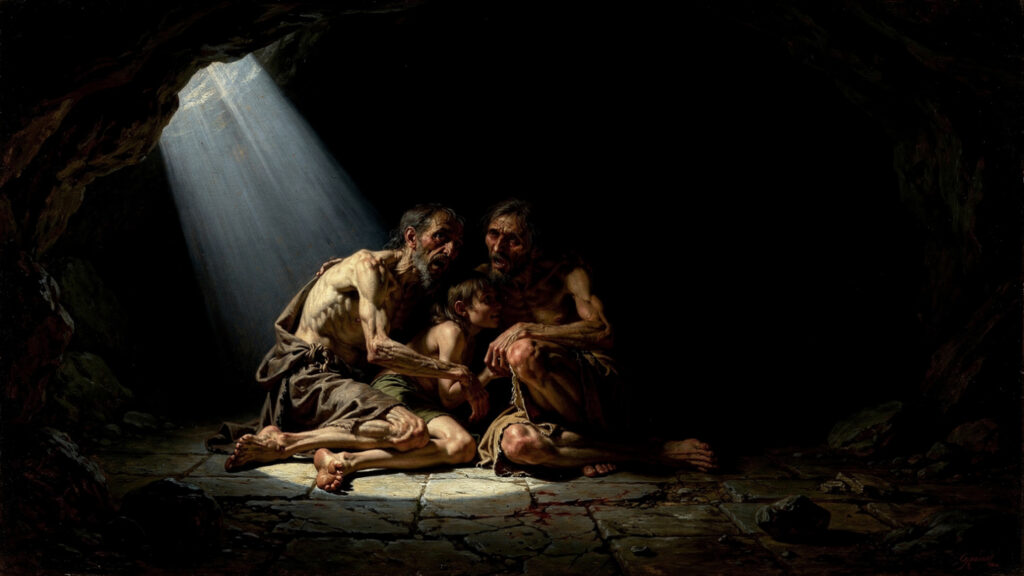
What changed Zeus’s position? The ancient sources suggest several mechanisms. Prometheus’s knowledge of the secret about Zeus’s vulnerability, the son who would overthrow him if a union were permitted, gave the Titan a leverage that the centuries of punishment had not extinguished. The reconciliation between Zeus and Prometheus was in part an exchange: the secret for the liberation, the knowledge that protected Zeus against his own potential overthrow given to him in exchange for the chains being broken.
But there is a deeper dimension that Aeschylus’s lost plays were said to have developed. The reconciliation between the fore-thinker and the sky king was the reconciliation of foresight with power, of the knowledge that acts in advance of consequence with the authority that must manage the consequences of all actions. A Zeus without Prometheus’s foresight is a ruler whose power exceeds his wisdom. A Prometheus without the world’s acceptance of what he gave is a benefactor whose gift is permanently contested. The liberation produced a cosmos in which the Titan’s foresight and the king’s authority were no longer opposed but aligned.
Heracles, who carried out the physical act of liberation, was himself the product of one of Zeus’s mortal unions: a being who embodied both divine power and mortal vulnerability, who endured his own catalogue of suffering and labours, and whose existence represented exactly the kind of hybrid between the divine and the human that the Prometheus myth was organised around enabling. The hero who freed Prometheus was, in his own nature, the evidence that the fire had worked.
What the Name Has Meant Since
The Promethean inheritance in Western thought is wide enough that tracing it fully would require a separate essay for each century in which it was actively drawn upon.
The Romantic tradition’s appropriation of Prometheus as the archetype of creative rebellion against tyrannical authority, which runs from Byron’s poem Prometheus through Percy Shelley’s Prometheus Unbound to Mary Shelley’s subtitle for Frankenstein, the Modern Prometheus, consistently focuses on the element of chosen suffering for a principle. The Romantic Prometheus is not simply brave. He is the figure who accepts the consequence of a creative act because the creative act was necessary, because the thing he made or gave or enabled was worth the price of making it, and because the authority that punishes him for it is wrong rather than simply powerful.

Karl Marx, in the preface to his own doctoral dissertation in 1841, quoted Prometheus’s defiance of the gods directly and called the Titan the most eminent saint and martyr in the philosophical calendar, the figure who chose suffering over submission to divine authority.
Aeschylus, Marx wrote, was the greatest master of ancient tragedy. The Prometheus Bound was the work he returned to repeatedly. The figure who possessed foreknowledge and acted on it regardless of the personal cost was, for Marx as for the Romantics, the correct archetype for anyone who understood the structure of what they were opposing and chose to oppose it anyway.
The myth continues to do this work precisely because it was built correctly. Its structure does not depend on ignorance or recklessness or the dramatic irony of the figure who does not know what the audience knows. Its structure depends on complete knowledge applied to a moral choice, and on the willingness to sustain the consequence of that choice for as long as the consequence requires sustaining.
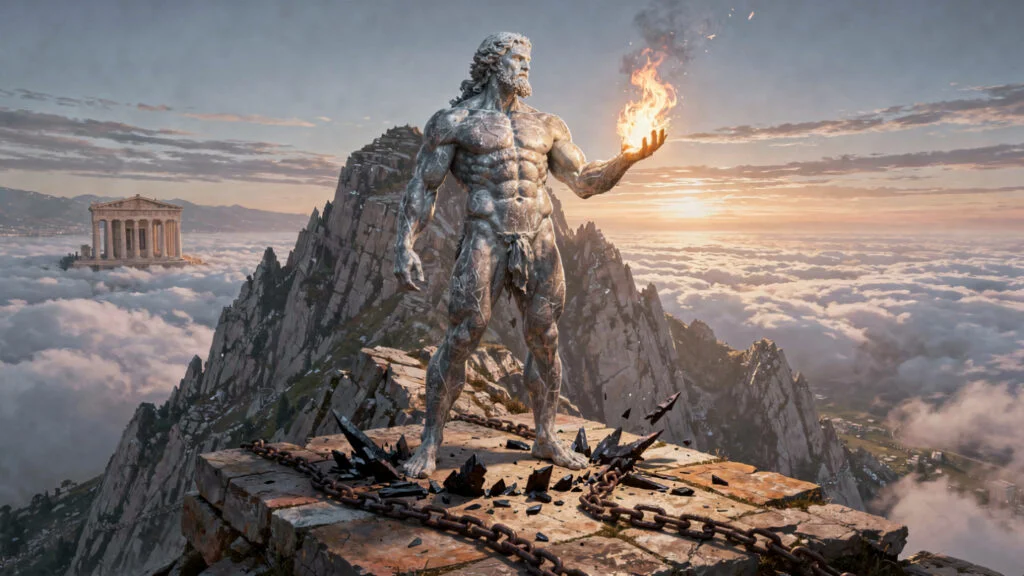
The eagle comes each morning. The liver regenerates each night. The Titan watches the horizon for what he knows is coming.
He has always known what was coming.
At Olympus Estate, Tales from Olympus reads the figures of Greek mythology at the depth their traditions require. This article takes Prometheus’s name as its argument: the fore-thinker who stole fire not in ignorance of the consequences but in full knowledge of them, establishing in the Greek tradition the distinction between transgression as error and transgression as choice. The punishment on the Caucasian rock was not a surprise. It was the price he calculated and paid anyway.