



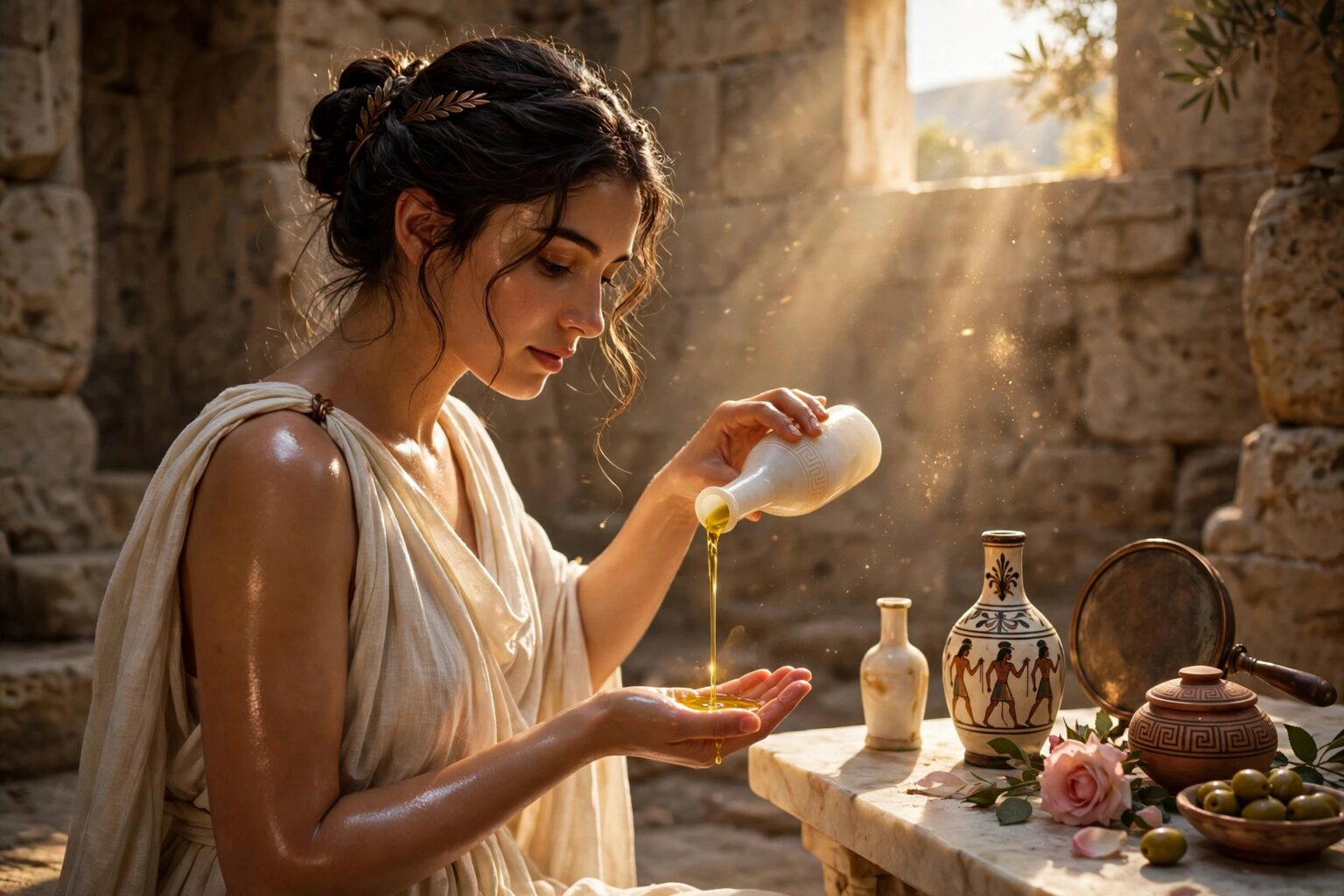
The internet likes to say that Homer called olive oil liquid gold. He never did. What he actually wrote is lovelier. In the sixth book of the Odyssey, the queen of the Phaeacians packs a picnic for her daughter Nausicaa, who is going down to the river to wash clothes, and adds “liquid oil in a golden flask”, so that the girl and her maids can anoint themselves after bathing. The gold was the bottle. The oil was the treasure inside it.
That small scene holds the whole of ancient Greek beauty. Bathe, then oil the skin. It was what a princess did after a swim, what an athlete did before a race, what a goddess did before a seduction, and what a physician prescribed for a cracked hand. Greeks also gave us the word itself. Cosmetic comes from kosmos, order and ornament, the same word they used for the ordered universe. To make yourself beautiful was to put yourself in order.
Some ancient Greek cosmetics passed onto the modern bathroom shelf almost unchanged. One of them, a face whitener made from lead, slowly poisoned the women who used it. Both halves of the story begin with a flask of oil.
The Golden Flask | Oil in Homer
Homer’s people oil themselves constantly. After every bath, heroes and guests are “anointed richly with oil” by the women of the house, and only then dressed in fresh tunics and cloaks. A visitor who has been bathed and oiled has been made presentable and welcome. A body left dry and salt-stained is a sign that someone has been through hardship.
The finest scene comes with Odysseus himself, shipwrecked and naked on Nausicaa’s beach. He washes the brine from his back and shoulders in the river and rubs himself with the oil from the golden flask. Then Athena makes him taller and broader, and gives him hair that curls like the hyacinth. She pours grace over his head and shoulders, Homer says, the way a master craftsman lays gold over silver. The oil does the first part and the goddess does the rest, but the image is the same. Oiled skin shines like precious metal.
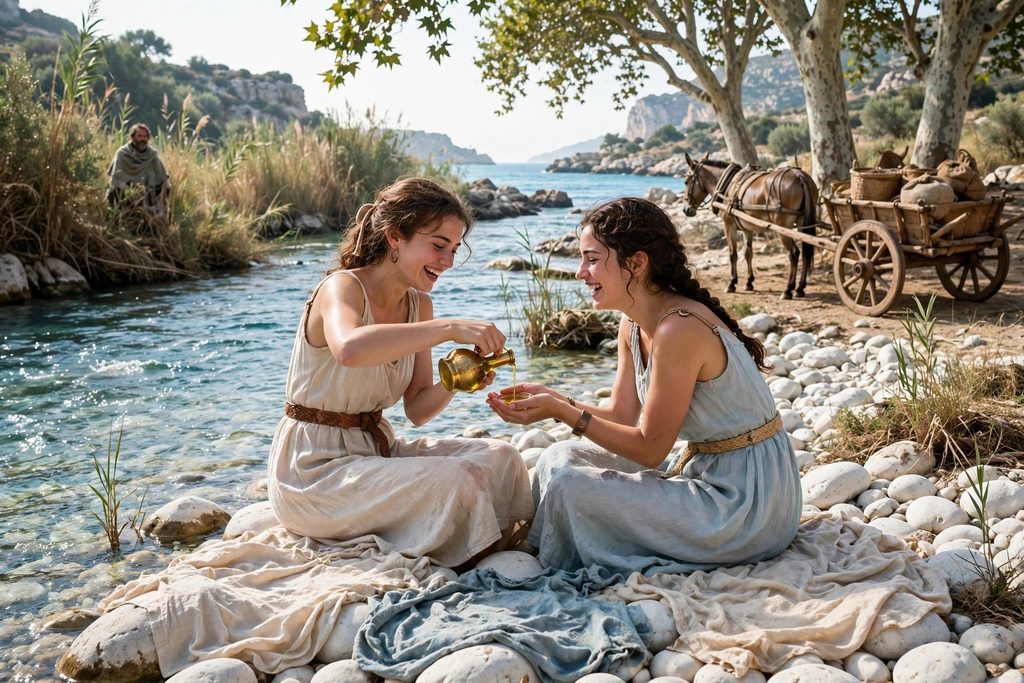
The oil itself came from the most important tree in Greece. The olive was food, fuel for lamps, medicine and the basis of every cosmetic, and its oil was so central that the Bronze Age palace scribes of Pylos were already recording it, centuries before Homer, as something perfumers flavoured with rose and sage.
Hera’s Toilette | The Goddess Gets Ready
The most famous beauty routine in Greek literature belongs to Hera. In Book Fourteen of the Iliad, she decides to distract Zeus from the war by seducing him, and Homer describes her preparation step by step.
She shuts herself in the chamber her son Hephaestus built for her, with doors no other god can open. First she cleanses every trace of dirt from her skin with ambrosia. Then she anoints herself with a rich oil, ambrosial and sweet, so fragrant that when it was stirred in Zeus’s bronze house its scent spread through earth and heaven. She combs her hair and braids it into shining locks, puts on a robe Athena wove for her, pins it with golden brooches, ties a belt with a hundred tassels, hangs earrings with three clustered drops, and covers her head with a new veil as white as the sun. Finally she borrows Aphrodite’s embroidered band, which holds love, desire and persuasion.
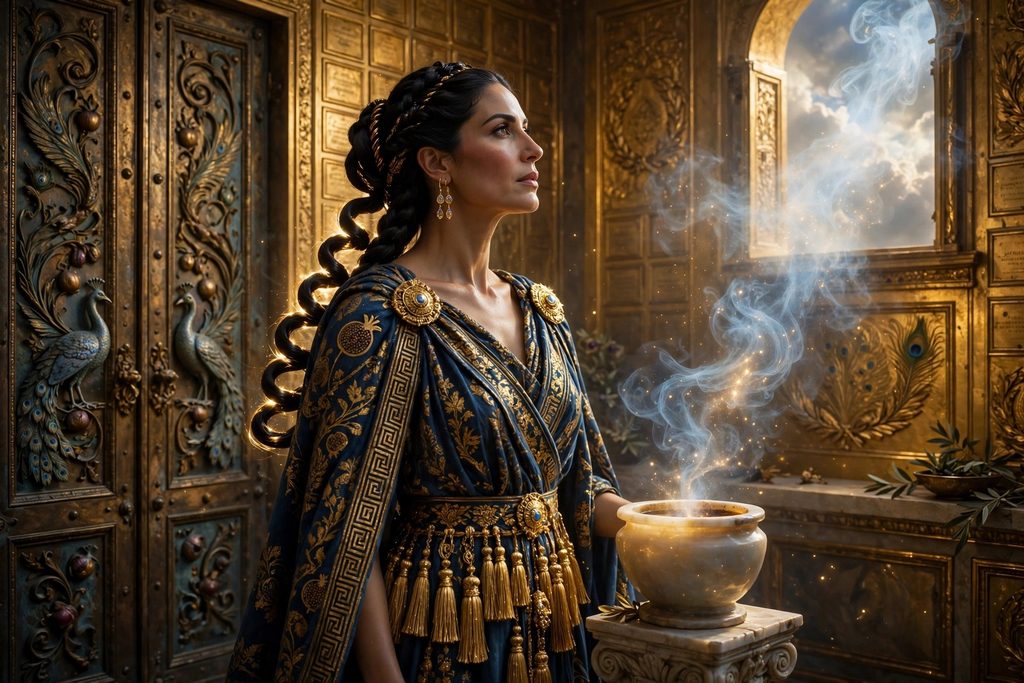
It works, of course. What matters is the order of the steps, because it is the order every Greek woman of means followed. Cleanse, oil, perfume, dress the hair, adorn. The goddess simply had better ingredients. Aphrodite, in the Odyssey, is bathed at her shrine in Paphos by the Graces and anointed with the immortal oil that clings to the gods. Mortal beauty, in Homer, is a copy of what the gods do to themselves.
Oil, Dust and the Strigil | The Athlete’s Skin
The most oiled people in Greece were men. In every gymnasium, athletes stripped, rubbed their bodies with olive oil, and often dusted themselves with fine sand or earth to protect the skin and give an opponent’s hands less to slip on. After exercise they scraped off the whole mixture of oil, sweat and dust with a strigil, a curved bronze blade shaped to follow an arm or a thigh. A small round oil flask, the aryballos, hung from the wrist on a cord, often with the strigil on the same ring.
The athletes of Olympia trained this way, and the oil cost a city a fortune. Gymnasiums needed it in huge quantities, and supplying it was a public honour for wealthy citizens. At the Panathenaic Games of Athens, the prizes were amphorae of oil from Athena’s sacred olive trees, and a champion could carry home dozens of them, enough oil to make him rich.
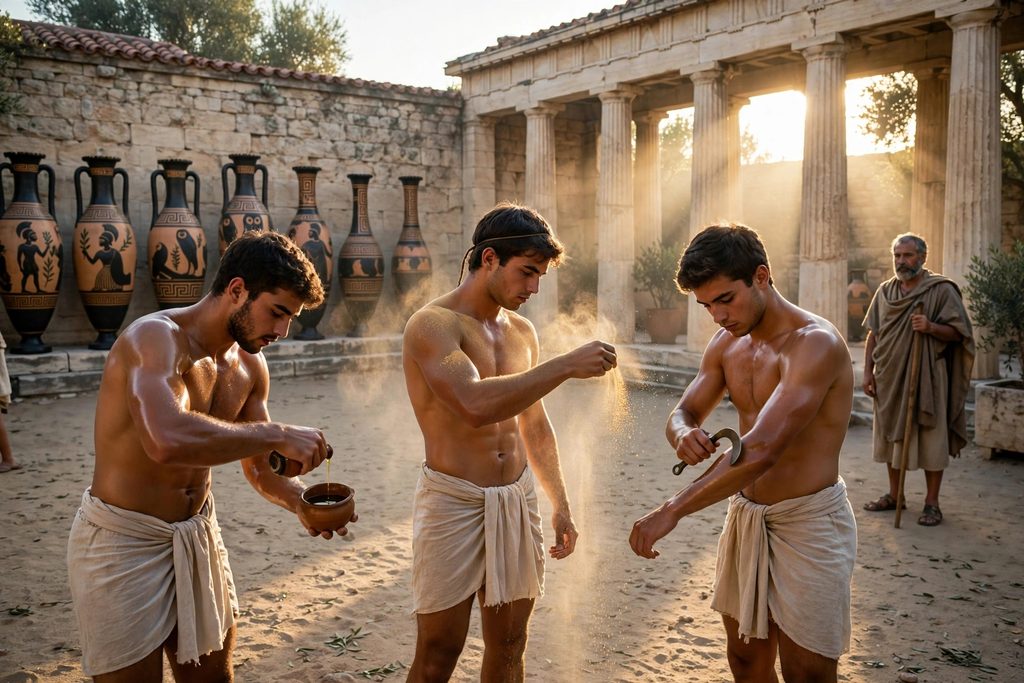
Nothing was wasted. Pliny the Elder records that the greasy scrapings from the gymnasium, the gloios, were collected and sold as a medicine for inflamed joints and sores. Even the bath attendant’s leftovers had a market.
The Greeks thought this ritual worthy of their greatest art. Around 330 BC the sculptor Lysippos cast an athlete in bronze in the act of scraping his arm, the Apoxyomenos, the man scraping himself. Pliny says the emperor Tiberius loved it so much that he moved it from the public baths in Rome to his own bedroom, and the people of Rome shouted in the theatre until he put it back. The original is lost, but a Roman marble copy stands in the Vatican, and in 1999 divers raised another bronze athlete with a strigil, now also called the Apoxyomenos, from the seabed off the Croatian island of Lošinj.
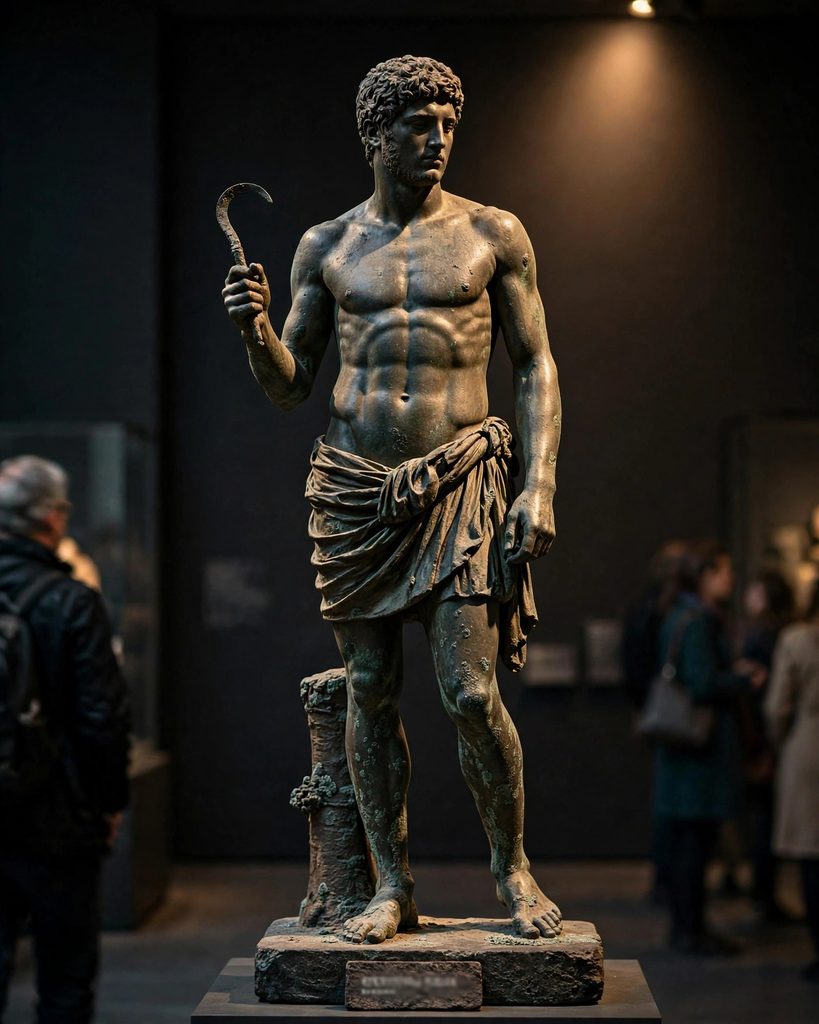
Socrates, in Xenophon’s Symposium, says perfume is fine for women, but that for a man the smell of the gymnasium oil is sweeter than any scent. For a Greek man, glowing oiled skin meant discipline and health, not vanity.
The Perfumers | Rose, Iris and Unripe Olives
Ancient perfume was oil, not alcohol. Distilled spirits did not exist, so perfumers steeped flowers, roots, resins and spices in oil until it carried their scent, and sold the result in slender alabaster flasks and painted bottles. Perfumers’ shops in the Athenian agora were famous places to sit and gossip.
Aristotle’s successor Theophrastus wrote a whole treatise, On Odours, explaining the trade. The best base was an oil that took a scent well and had little smell of its own. One favourite was omphakion, the green oil pressed from unripe olives, the same oil Dioscorides praised as the best for health. It is close to the early-harvest agourelaio that Greek presses still make each autumn, a story told in the Pantry of the Gods. Into these oils went rose, iris root, the speciality of Corinth’s perfumers, lily, myrrh and cinnamon from the trade routes, sometimes thickened with resins so the scent would last.
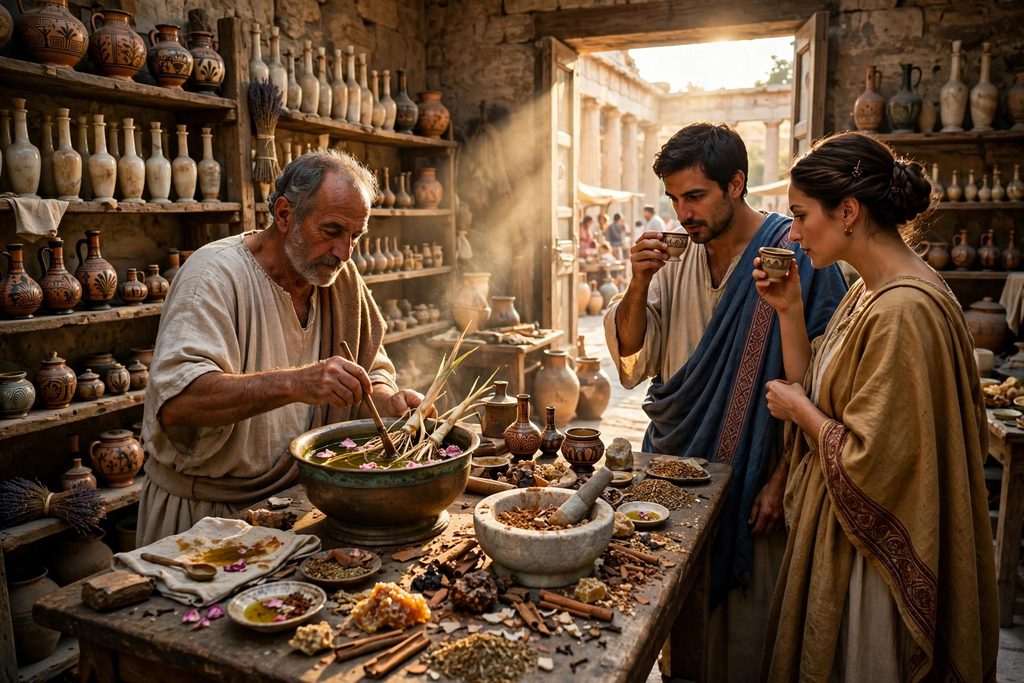
Theophrastus was practical about it. Perfumes should be kept in cool upper rooms, out of the sun, in containers of alabaster or lead, which hold a scent best. Some, he notes, keep their scent for years. These were not simply luxuries. Women and men wore them at the symposium and in courtship, at festivals and funerals, and the dead were sent to the grave with perfumed oil in white-ground flasks.
White Lead and Alkanet | The Deadly Face
Then there was make-up, and here the story darkens. Greek ideals of female beauty prized pale skin, the sign of a woman who stayed indoors rather than working in the fields. To get it, women painted their faces with psimythion, white lead. Theophrastus describes how it was made, by suspending lead over vinegar until a white crust formed, then grinding and drying it. For colour they added rouge from the root of alkanet or other red plants on the cheeks and lips, and darkened their brows and lashes with soot.
The men who wrote about it disapproved. In Xenophon’s Oeconomicus, the landowner Ischomachus finds his young wife made up with white lead to look paler and alkanet to look rosier, and wearing platform shoes to look taller. He lectures her that a husband would rather have the real woman, and tells her to get her colour from housework instead. In Aristophanes’s comedy Wealth, a young man jokes that if an old woman washed off her white lead, you would see the wrinkles underneath.
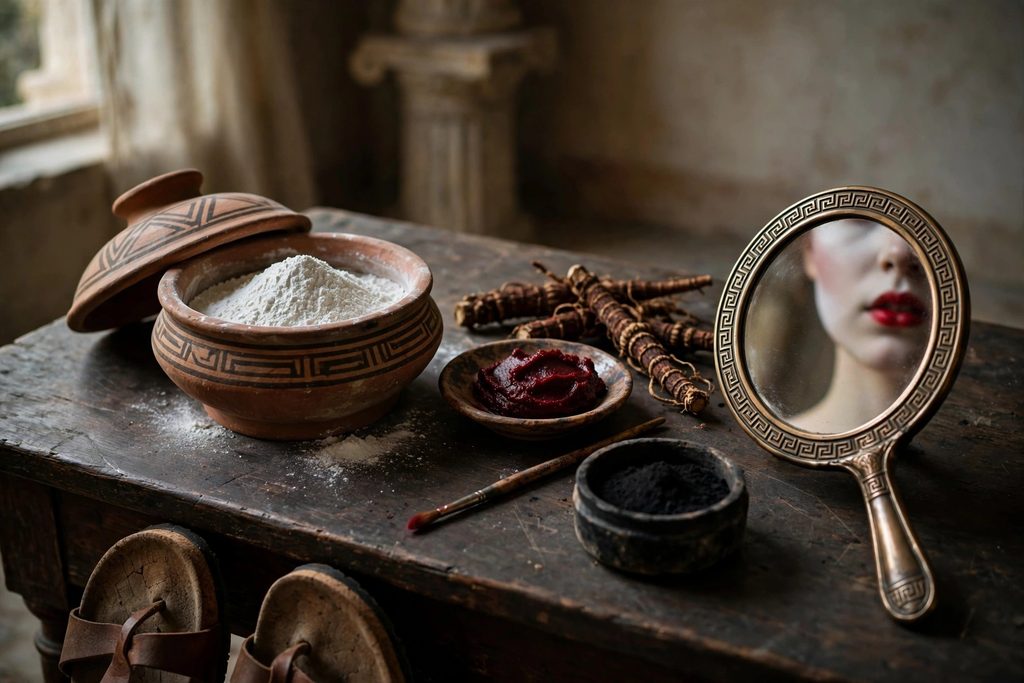
Nobody in antiquity knew what it cost them. Lead is absorbed through the skin and the mouth, and over years it damages the nerves, the kidneys and the blood. Lead whites stayed in European face powders until the nineteenth century, long after their dangers were known, and they killed women from Athens to Elizabethan London. It is the one ancient Greek beauty secret nobody should revive.
Philosophers drew a line here. Plato’s Socrates calls the art of make-up a counterfeit of gymnastics, a flattery that fakes health instead of producing it. Five centuries later the physician Galen made the same distinction in medical terms. True cosmetics, kosmetike, preserve the body’s natural beauty and belong to medicine. Make-up, kommotike, paints on a beauty that is not there, and is no business of a doctor’s.
Galen’s Cerate | The First Cold Cream
Galen of Pergamon, the second-century physician whose writings shaped medicine for more than a thousand years, did not despise skincare. He collected recipes from earlier writers on cosmetics, among them a book circulating under the name of Cleopatra, and he left one preparation that never went out of use.
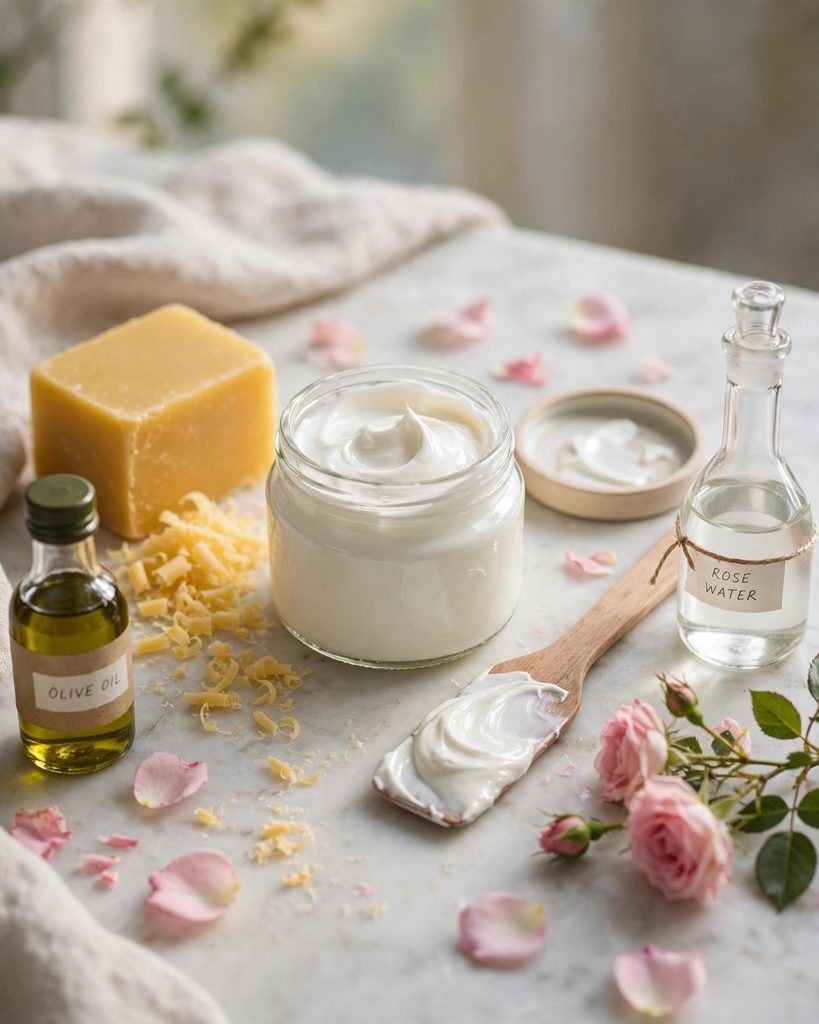
It was a cooling cerate. Beeswax was melted into oil scented with roses, and water was beaten in little by little until the mixture turned white and creamy. On the skin the water evaporates, leaving a pleasant chill, and the wax and oil stay behind as a soft protective film. That chill gave it its later English name, cold cream. In France it is still sold as cérat de Galien, Galen’s cerate. Later versions replaced the plain water with rose water, which became widely available only after medieval distillers perfected it, and modern ones swap the oils and add stabilisers, but the idea of wax, oil and water whipped together is still the basis of most face creams.
Kimolian Earth and Mastic | Cleansing the Greek Way
The Greeks had no true soap. To clean skin and clothes they used lye made from ash, soda, and above all fine white clays. The most famous came from the little island of Kimolos, beside Milos, and Aristophanes mentions Kimolian earth in the Frogs as the stock-in-trade of a bath-keeper. The clay absorbed grease and dirt, much as the cleansing clay masks of today do, and it gave its name to a mineral, cimolite.
For the mouth there was mastic, the fragrant resin that weeps from the lentisk trees of southern Chios. Dioscorides recommends it for the teeth and gums, and chewing it to sweeten the breath was an ancient habit that never stopped. Today Chios mastic goes into toothpastes, chewing gum and a whole range of creams and soaps, and it is one of the few ancient beauty ingredients still produced in the same place for the same purpose.
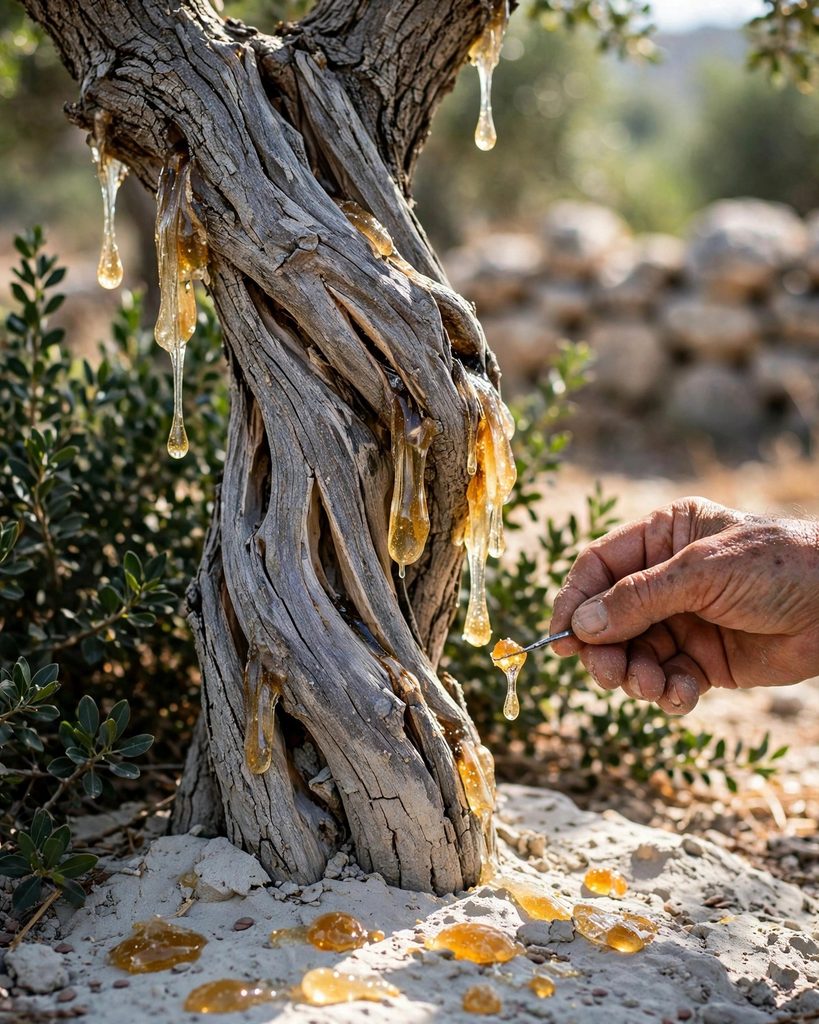
Ancient Greek Cosmetics and Their Modern Descendants
Modern dermatology adds a few cautions the ancients could not. Olive oil is a fine body oil and a gentle make-up remover, but it is rich in oleic acid, which can weaken the skin’s protective barrier in some people, so it is not the best choice for babies or for dry, eczema-prone skin. Honey is a proven aid for minor wounds and coughs, and many people love it as a face mask, but the old claims of miraculous rejuvenation are not supported. Herbal oils such as rosemary or laurel smell wonderful, and their benefits are mostly modest. The Greek herb cabinet works best when treated with the same honesty.
Making Galen’s Cerate at Home
The cream below follows Galen’s idea with modern measures, wax, oil and rose water beaten together. It contains no preservative, so make it in small batches and keep it in the fridge.
Olympus Estate · Wellness & Renewal
Galen’s Cooling Cerate · A Modern Cold Cream
Beeswax, olive oil and rose water, beaten until white. The same idea a physician of Pergamon wrote down in the second century, made in your kitchen.
Ingredients
The oil phase
- Beeswax pellets or grated beeswax12 g
- Extra virgin olive oil, or half olive and half sweet almond oil55 g
The water phase
- Rose water (a pure rose hydrosol, without alcohol)35 g
Method
-
1
Clean everything (5 min)
Wash a small heatproof jug, a whisk or milk frother and a jar in hot soapy water, rinse with boiling water and let them dry completely. Clean tools help a preservative-free cream last.
-
2
Melt the wax into the oil (10 min)
Put the beeswax and oil in the jug and set it in a pan of barely simmering water. Stir gently until the wax has melted completely and the oil is clear. Meanwhile, warm the rose water slightly in a small bowl so it is just warm to the touch.
-
3
Beat in the water (5 min)
Take the jug off the heat. Whisking constantly, pour in the warm rose water in a very thin stream. Keep whisking as the mixture cools and thickens. It will turn from clear gold to an opaque, creamy white, exactly as Galen described.
-
4
Jar and chill
Spoon the cream into the jar, let it cool fully, close it and keep it in the fridge. Use a clean spoon rather than your fingers to take it out, and use it within two weeks.
-
5
Use it
Smooth a little over clean skin. You will feel the cooling effect that gave cold cream its name. It also removes make-up well, wiped off with a warm damp cloth.
A few other rituals need no recipe at all. After a bath or a swim, pat the skin half dry and smooth on a little olive oil, as Nausicaa did. Use a clay mask once a week, the descendant of Kimolian earth. Chew a piece of Chios mastic after a meal. And leave the white lead in the history books.
The Shine of the Gods
The Greeks did not separate beauty from health as neatly as we do. The same oil went on the athlete, the bride, the guest, the patient and the dead. The same doctor who wrote about fevers wrote down a cream. Their philosophers even drew the line we still argue about, between caring for the body and disguising it.
What they wanted from it all was a particular kind of light. Odysseus came out of the river oiled and shining as if gold had been laid over silver. Hera’s scent filled heaven and earth. The oiled athlete in bronze, scraping his arm, was beautiful enough for an emperor to steal. The flask was gold. The oil inside it was the real treasure, and it still is.
At Olympus Estate, Wellness and Renewal looks for the Greek ideas about health that still hold up today. Homer never called olive oil liquid gold. He gave Nausicaa “liquid oil in a golden flask”, and his heroes are bathed and anointed after every journey. Hera’s toilette in Iliad 14 sets the order of the Greek routine, cleanse, oil, perfume, dress the hair, adorn. Athletes oiled and dusted their bodies and scraped them clean with the strigil, Panathenaic victors won amphorae of sacred oil, the scrapings were sold as medicine, and Lysippos’s Apoxyomenos turned the gesture into art. Perfumers steeped rose and iris in omphakion, the unripe-olive oil Theophrastus and Dioscorides praised. Women whitened their faces with toxic white lead and reddened them with alkanet, which Xenophon and Aristophanes mocked and Plato and Galen set apart from true cosmetics. Galen’s cerate of wax, rose oil and water became cold cream, the cérat de Galien, while Kimolian clay and Chios mastic still clean skin and teeth today.