



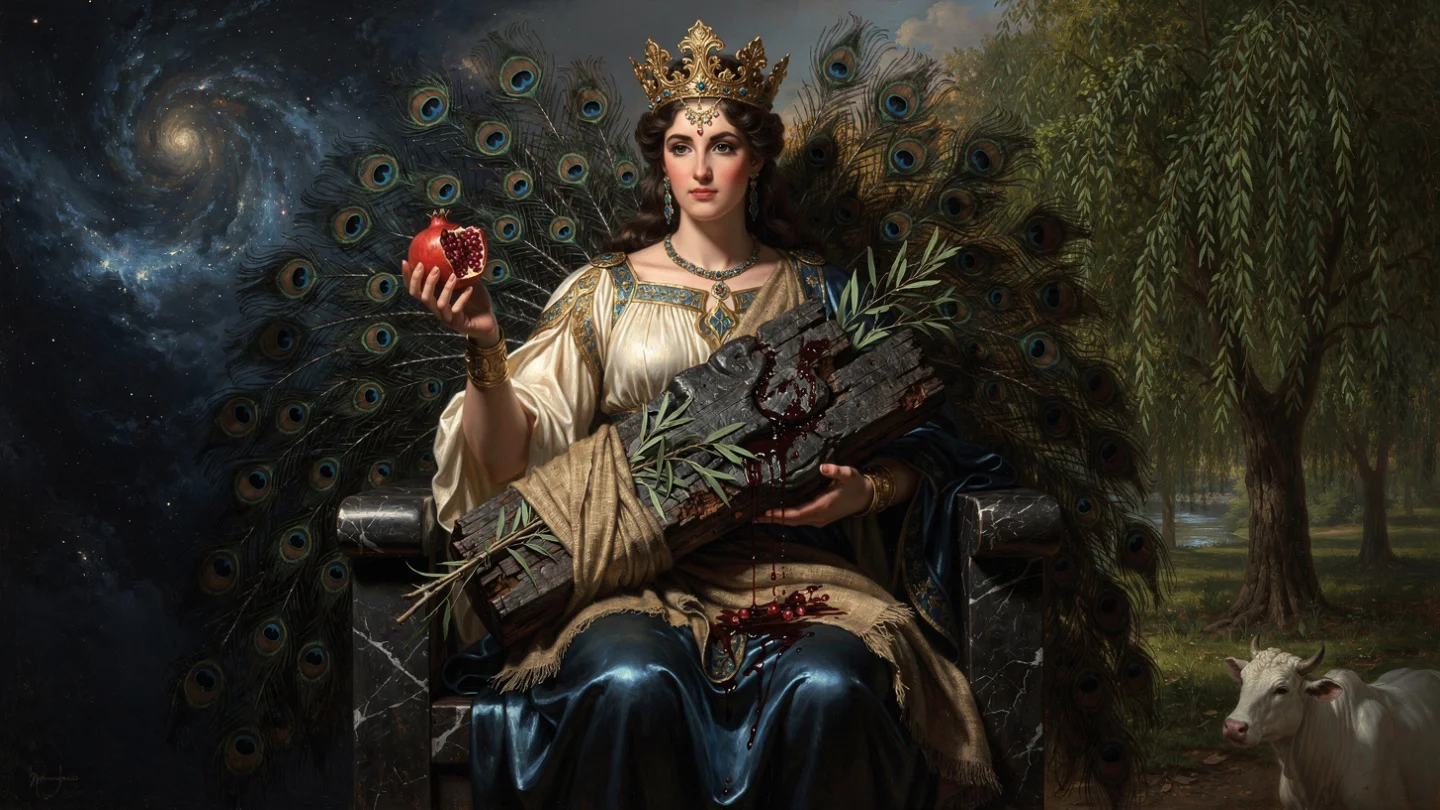
Before Hera was Zeus’s wife, she was a plank of wood tied to a willow tree.
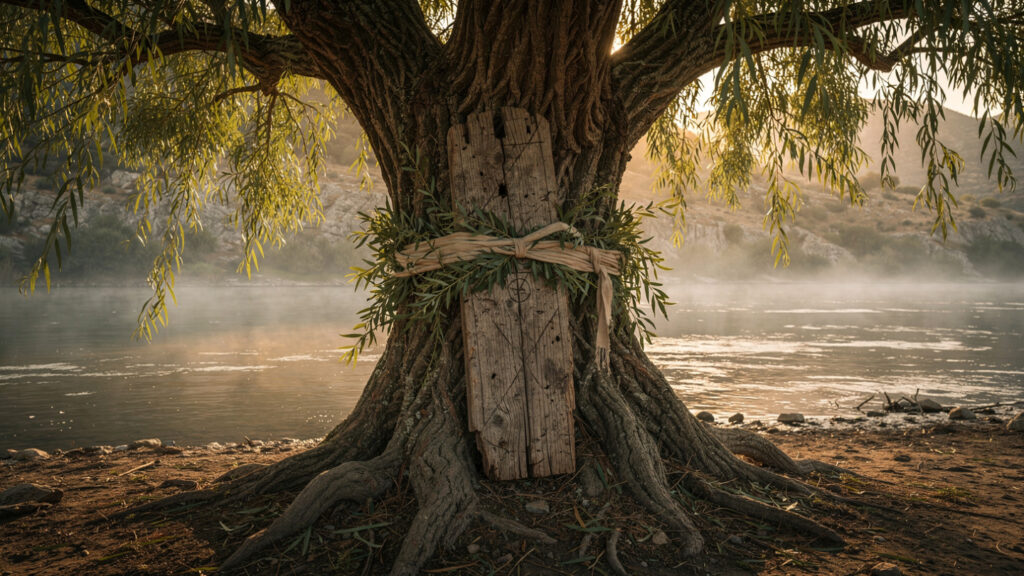
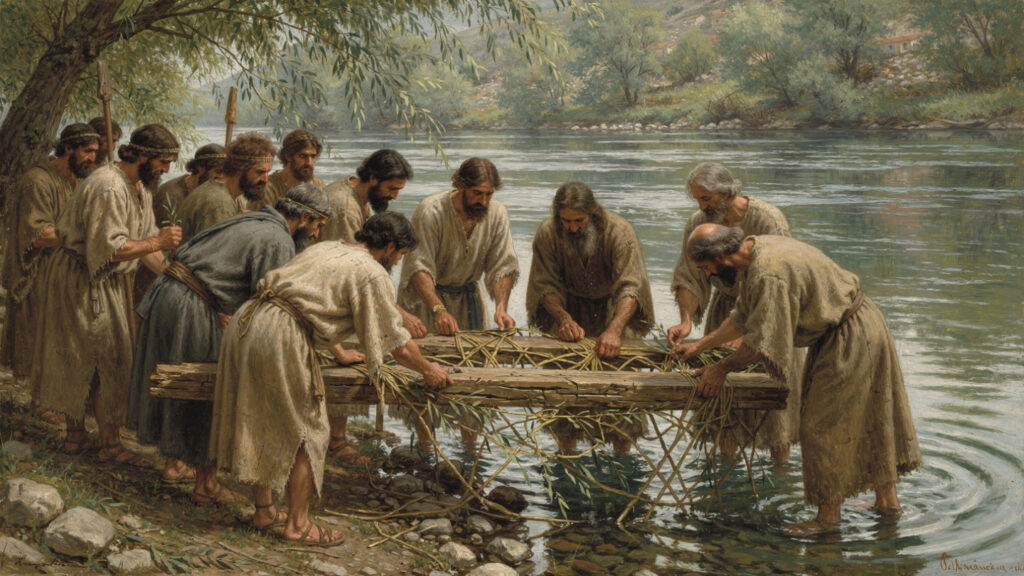
This is not a metaphor and it is not a figure of speech invented to make an old goddess sound stranger than she was. Walter Burkert, whose Greek Religion remains the single most authoritative synthesis of the field, states the matter as plainly as the evidence allows: there are memories of an earlier aniconic representation of Hera, a pillar at Argos and a plank at Samos. No face. No crown. No sceptre, no throne, no beautiful young woman rendered in marble with her eyes fixed reproachfully on her husband’s latest indiscretion. At Argos, the goddess was a standing pillar to which, in the myth that Argive tradition preserved about her own priestess, an image of Hera was bound. At Samos, she was a plank of wood, cut from a sacred willow, the lygos, that grew on the bank of the river Imbrasos, and every year that plank was taken down, ritually washed, wound about with willow branches, and either rehung in the tree or carried to the shore and back in a ceremony called the Tonaia. A community that performed this rite year after year needed no anthropomorphic image to understand what it was doing. It was tending a divine presence that had chosen to inhabit a specific tree, by a specific river, on a specific island, and the rite’s entire purpose was to keep that presence bound to the place it had chosen rather than let it drift.
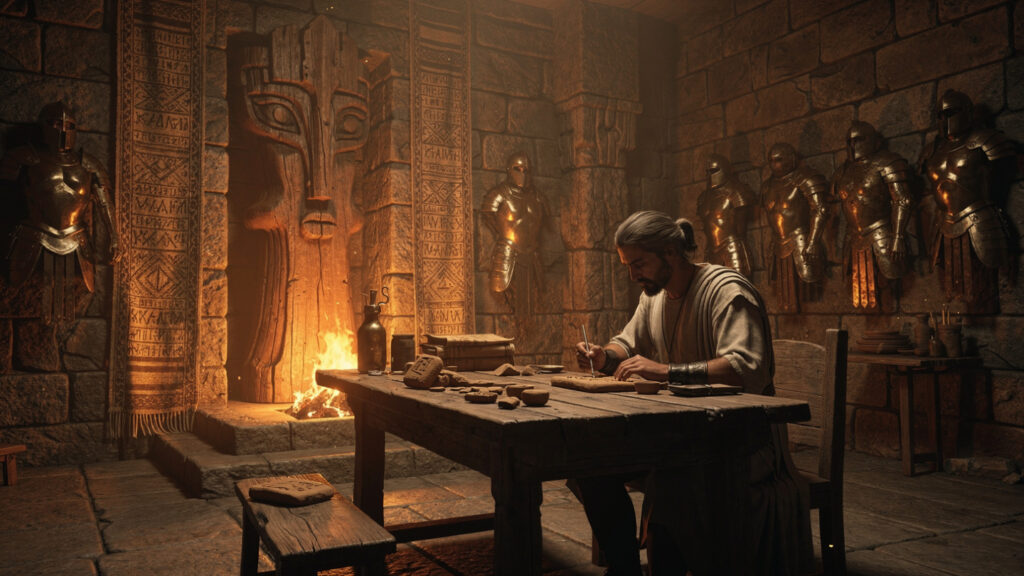
By the time the Homeric poems give Hera her fixed epithets, white-armed, ox-eyed, golden-sandalled, queen of Argos, she has already acquired the human form and the human marriage plot that the classical tradition would spend the next thousand years elaborating. But her oldest sanctuaries, the Heraion of Samos and the Heraion of Argos, had been receiving cult for centuries before any sculptor attempted to give her a face, and the goddess those sanctuaries served bears only a partial resemblance to the figure the Iliad makes famous: the jealous, scheming, perpetually humiliated wife of a husband who cannot keep his attention where his marriage requires it.
At Argos she was the foundational patron of one of the most powerful citadels of the Mycenaean Bronze Age. At Samos she was a presence whose willow tree and whose river had been sacred longer than any surviving record can trace, worshipped first, according to the island’s own oldest name for itself, as a virgin. She was a queen with her own cult, her own territory, and her own claim on the landscape and the people who lived in it, long before Zeus’s mythology expanded to absorb the whole cosmos she had previously governed in her own right. The marriage the mythographers eventually built around her is not the foundation of her identity. It is the record of what happened to a goddess who once ruled in her own right, once a rival tradition needed her territory and could not simply erase her from it.
The Three Bodies: Argos, Samos, Olympia
Hera’s three principal sanctuaries tell, in their geography and their archaeology, a considerably more interesting story than the Homeric narrative offers on its own, and the story becomes clear only when the three sites are read together rather than treated as interchangeable stops on a single goddess’s itinerary.
At Argos, which Homer calls Hera’s own city and has her declare in the Iliad that the three towns she loves best are Argos, Sparta, and Mycenae of the broad streets, the cult was already old by the time anyone thought to write its history down. The Heraion sits on the lower slopes of Mount Euboea, between Argos and Mycenae, in a position that put it within sight of two of the most powerful citadels of the Late Bronze Age Aegean, and the site’s own archaic memory, preserved in the myth of the priestess Io tying an image of the goddess to a pillar, points toward a period when the cult had no need of a human face to be legible to the people who kept it. Pausanias, visiting in the second century CE, called the surrounding region Prosymna and described a sanctuary whose antiquity he took entirely for granted, one that had already been ancient in the archaic period when the Argives began building the terraced platforms whose remains still survive on the hillside today. Hera’s name appears, in a form scholars read as an early attestation of the goddess, among the small number of Olympian deities identifiable in the Linear B tablets of the palatial Mycenaean world, a survival that places her recognisably present in the region’s religious life a full seven or eight centuries before Homer gave her the voice and the grievances by which most people now know her.
At Samos, which ancient sources record as both Hera’s birthplace and the site of her marriage to Zeus, the sanctuary by the Imbrasos preceded, by several centuries, the monumental Ionic temple that eventually made the Heraion one of the largest religious structures anywhere in the Greek world. The island itself carried an older name that later tradition remembered clearly: Parthenie, the Maidenly, and the river beside the sanctuary was known in the same period as the Parthenios, the maidenly river, in direct reference to the virgin aspect of the goddess who was born, according to the local myth, beneath the willow on its bank. The later, more exclusively matrimonial tradition would go on to absorb and largely obscure this pre-marital layer of Hera’s Samian identity, but the encyclopedic tradition preserved it clearly enough for modern scholarship to recover: at Samos, Hera was worshipped as Parthenos, virgin, before she was worshipped as wife, and the theological trajectory this implies runs in exactly the opposite direction from the one the classical myths assume. A goddess who was virgin first and married second is a goddess whose cult included an independent, self-sufficient aspect that predates any narrative in which her identity depends on a husband, and the plank tied to the willow tree, renewed every year in the ritual of the Tonaia, is the material trace of that older independence, still being tended long after the marriage plot had become her dominant public identity.
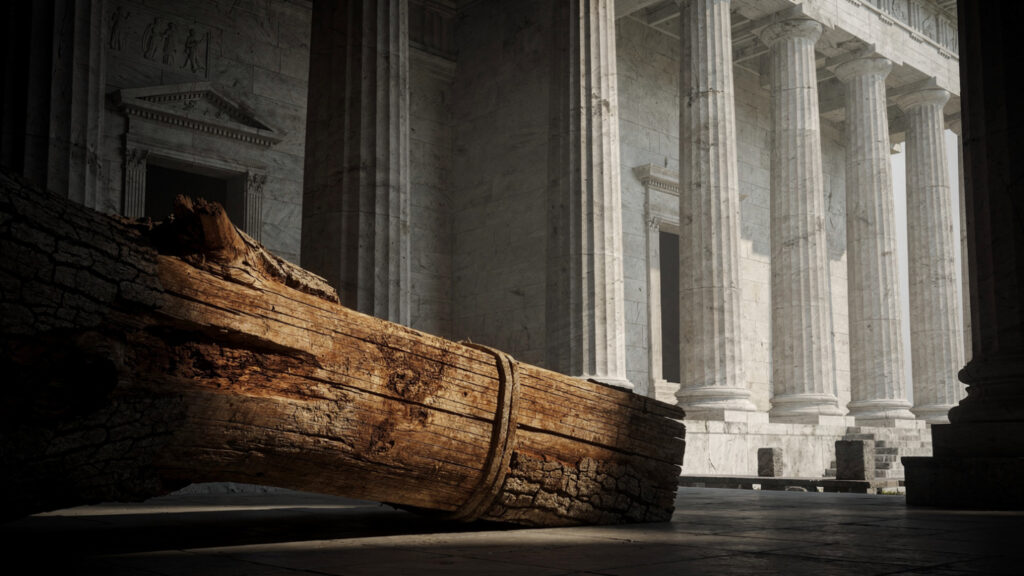
At Olympia, in the sanctuary that would eventually host the greatest athletic festival in the ancient world, Hera’s temple is the older of the two great buildings on the site. The Heraion at Olympia was raised around 590 BCE, roughly a century before the neighbouring Temple of Zeus, and it is among the earliest peripteral Doric temples anywhere in Greece, its long, narrow proportions and its originally wooden columns marking a moment when Greek sacred architecture was still working out what a monumental stone temple should look like. Pausanias, visiting the site more than seven centuries after its construction, noted that one of the temple’s original oak columns, in the rear chamber, was still standing in his own lifetime, the last surviving remnant of a building whose other timber supports had been replaced with stone one at a time across the intervening centuries, so gradually that no single generation could have said exactly when the wooden temple became a stone one. A women’s counterpart to the men’s Olympic Games, the Heraia, was celebrated in Hera’s honour at the same sanctuary, and by some accounts predates the men’s competition.
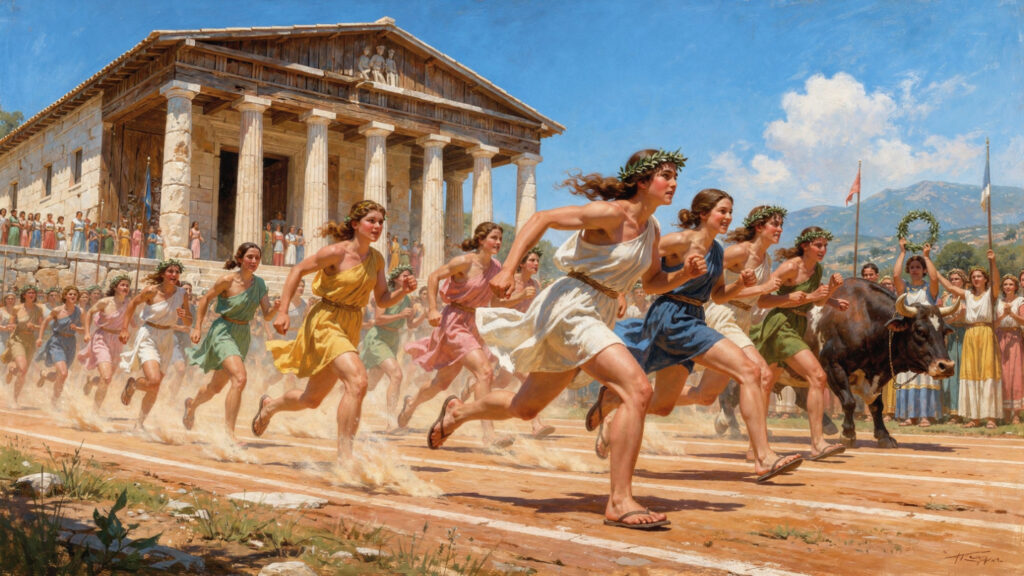
Unmarried women ran footraces divided into three age categories, on a shortened track that the sanctuary’s own administrators maintained specifically for the event, and the winners received olive crowns, a share of the meat from the ox sacrificed to the goddess, and the right to have their portraits displayed in the shallow niches carved into the temple’s eastern columns, a detail modern visitors can still see cut into the stone today. In the sanctuary of the god who would eventually be remembered primarily as the presiding deity of the Olympic Games, women ran their own race, for a prize the tradition explicitly described as hers to give rather than his.
The Willow, the Virgin, and the Yearly Renewal
The Samian material rewards closer attention than most retellings of Hera’s myth give it, because the details that survive describe a theology considerably stranger, and considerably more coherent, than the domestic drama that absorbed her elsewhere.
Hera was said to have been born beneath the lygos, the chaste willow, on the bank of the Imbrasos, and the same tree that marked her birth was the tree to which her cult object, the plank, was annually bound. The Tonaia, the festival named for this binding, involved taking the sacred plank down from its place, washing it, wrapping it in willow branches, and eventually restoring it to the tree or to a display within the sanctuary, a cycle that some ancient sources connect to a further myth in which the image was deliberately hidden and then triumphantly rediscovered, as though the community needed, once a year, to lose the goddess and find her again in order to feel the force of her continued presence. Robert Graves, writing in the twentieth century, proposed reading this cycle, together with Hera’s parallel epithets as Pais, the girl, Teleia, the fulfilled wife, and Chera, the widow or the separated one, all three attested at the Arcadian sanctuary of Stymphalos, as a lunar sequence: the new moon as virgin, the full moon as wife, the waning and dark moon as widow, a threefold goddess moving through the same cycle the sky itself moves through every month.
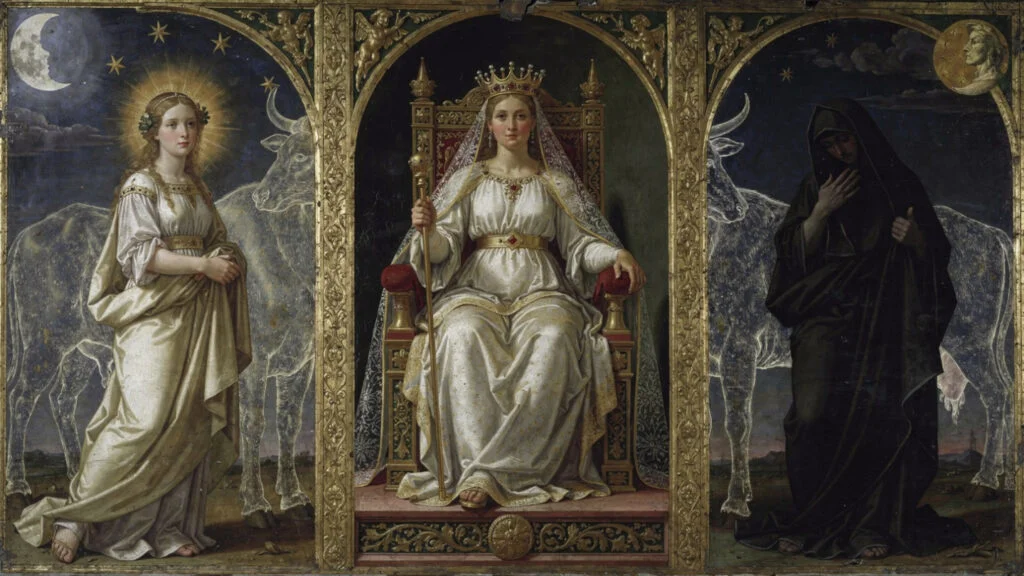
This is an interpretation rather than a certainty the ancient sources state outright, but the underlying pattern it is trying to explain, a goddess worshipped simultaneously as virgin, wife, and widow, at different sanctuaries and under different names, is not in dispute. Hera was never a single fixed identity even within her own cult. She was a sequence, and the marriage to Zeus captured and then flattened only the middle term of that sequence into her permanent, universally recognised public role.
The virgin aspect did not simply belong to Hera’s past. It was renewed, deliberately and repeatedly, within the very theology that also made her Zeus’s wife. At the spring of Kanathos, near Nauplia in the Argolid, ancient sources record that Hera bathed every year and, in doing so, restored her virginity, a rite so central to her cult and so carefully guarded from outside description that the sources call it arrheton, unspeakable, a thing that could be performed but apparently not narrated in full even by the writers who knew it existed. A goddess who renews her own virginity annually, by her own ritual action, independent of anything her husband does or fails to do, is not a goddess whose identity is structurally dependent on marriage.

She is a goddess who submits to marriage, participates in it fully, and then, once a year, returns by her own power to the unmarried, self-possessed state that preceded it, a cycle the Homeric narrative has no room to represent because the Homeric narrative has already decided that Hera’s story is the story of a wife.
The Hieros Gamos and What It Actually Meant
Every spring, across a wide stretch of the Greek world, communities performed some version of the hieros gamos, the sacred marriage of Hera and Zeus, and the geographical spread of this ritual, together with its consistent internal logic, tells us something important about what Hera’s theological function actually was before the later narrative compressed it into a story about a difficult husband.
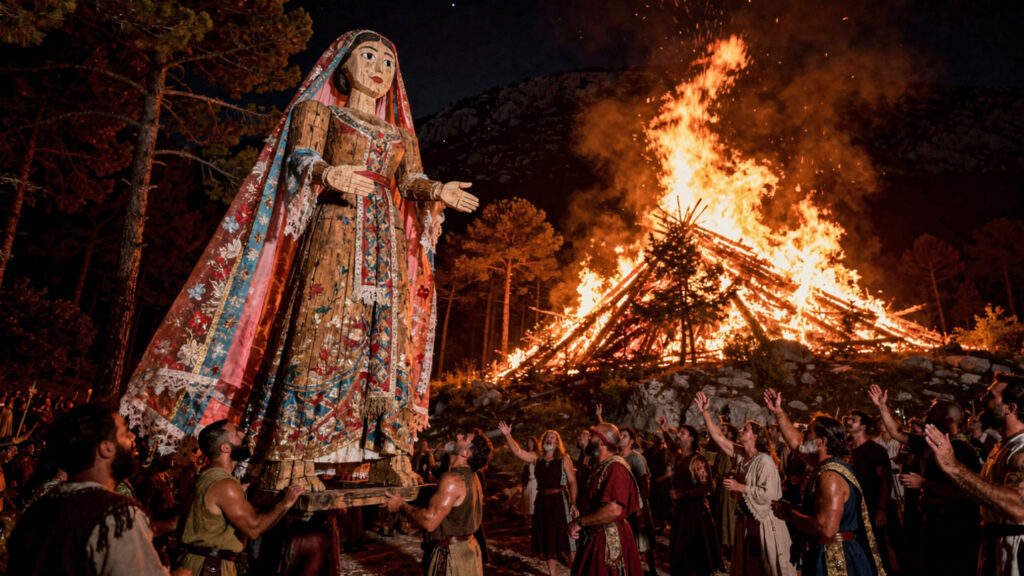
At Plataea in Boeotia, the ritual took its most fully documented form in the festival called the Daedala. According to the aetiological myth Pausanias records, Hera had quarrelled with Zeus badly enough to withdraw entirely to Euboea, refusing to return to her husband’s company. Zeus, unable to win her back by any direct means, sought the advice of Cithaeron, the local ruler renowned for his cleverness, who told him to carve a wooden image, dress it as a bride, and announce publicly that he intended to marry the nymph Plataea. Zeus followed the plan. Hera, hearing the news of her husband’s supposed new marriage, abandoned her exile at once and confronted the wedding procession, tearing the bridal veil from the wooden figure in a fury that, on discovering the deception, dissolved immediately into laughter, and the goddess who had refused all reconciliation moments before returned willingly to her marriage the instant she understood the whole thing had been staged for her benefit. The Plataeans commemorated this reconciliation with a lesser Daedala roughly every four to seven years and a greater Daedala, drawing participants from across Boeotia, at intervals of roughly sixty years, and the effigy at the centre of the ritual, carved specifically from oak, was carried in procession, bathed in the river Asopus, and ultimately burned on a pyre atop Mount Cithaeron, an ending that turns the whole cycle into a yearly, or generational, enactment of quarrel, deception, reconciliation, and sacrifice, repeated for as long as the cult itself survived.
At Samos, the marriage was enacted by the Imbrasos, at the very willow that marked the goddess’s birth, and the mythographic tradition records that Zeus and Hera first came together there in complete secrecy, their union sustained for three hundred years before it became public knowledge, a detail that reads less like a literal chronology than like an attempt to give the marriage a weight and a duration that the sudden, quarrelsome unions of Homeric narrative never carry. At Corinth, at Sparta, across the wider Argolid, local variations of the same underlying rite made the same underlying claim: that the union of the reigning queen and the sky father was not simply the marriage of two mythological individuals but an annual, cosmologically necessary event, one on which the fertility of the world genuinely depended.
This is the version of Hera’s marriage that the jealous-wife narrative almost entirely obscures. The hieros gamos was not a love story, and it was not, in its original theological register, primarily a story at all. It was closer to a mechanism: the claim that the generative order of the universe required the queen and the sky father to renew their union each year, that without this renewal the earth would not produce what it was supposed to produce, and that Hera’s participation was not incidental to the cosmic cycle but structurally load-bearing within it. A wife, in the ordinary sense of the word, depends on her husband’s continued presence and fidelity for her own status. The goddess whose annual sacred marriage renewed the fertility of the entire world is something considerably more consequential than a wife, and the later tradition that built an entire mythology of jealousy and humiliation around her was, in effect, taking a cosmic function and reducing it to a domestic grievance small enough for human audiences to recognise.
The Cow-Eyed Queen
Homer’s most persistent epithet for Hera, repeated so often across the Iliad and the Odyssey that it functions almost as a formal title, is boôpis, cow-eyed, and the epithet is older and stranger than its conventional translation as a compliment on the goddess’s large, dark, handsome eyes usually allows it to seem. Hera’s earliest archaic association was not with any human attribute at all but with cattle directly, a Cow Goddess venerated with particular intensity in Euboea, the very region she flees to in the Plataean myth of her quarrel with Zeus, as though the tradition itself half remembered that Euboea was not simply a convenient place for an angry wife to sulk but her own older cultic territory, a place where her standing as a cattle goddess predated her standing as anyone’s spouse.
The mythology preserves this cattle association most directly in the story of Io, the priestess of Hera’s own Argive sanctuary whom Zeus desired and transformed into a heifer, by one account to hide his infidelity from his wife and by the crueller logic of the myth’s own internal structure, to place his conquest inside a form that belonged, symbolically, to Hera herself. Hera’s absorption of Io’s cult, and her subsequent, characteristically thorough persecution of the transformed heifer by way of the gadfly that drives her in a frenzy across the length of the known world, reads as more than an isolated episode of jealousy. It reads as the goddess reasserting proprietary authority over an animal form, and a cultic identity, that belonged to her before Zeus’s desire complicated it. Scholars have long noted the resemblance between this cattle-centred layer of Hera’s cult and the maternal cow-goddess Hathor of ancient Egypt, and further afield, a plausible structural kinship with Prithvi, the earth-goddess of the Vedic tradition, comparisons that place Hera within a much older, wider Mediterranean and Near Eastern pattern of commanding female divinities whose authority was expressed through cattle long before the Greek-speaking world gave that authority a human face and a marriage plot.

None of this is presented by the ancient sources as competing with Hera’s later, fully anthropomorphic Olympian identity. It sits alongside it, the way the plank at Samos sat alongside the increasingly elaborate marble temple that eventually enclosed it, an older layer that the newer one never quite managed to erase. Every time Homer calls her cow-eyed, the epithet carries, whether or not the poet’s audience still consciously registered it, the memory of a goddess who once needed no human eyes at all.
Why the Jealous Wife Narrative Exists
The question a serious reading of Hera eventually has to answer is why the Greek mythological corpus, across centuries of accumulated storytelling, devoted so much narrative energy to her perpetual humiliation at Zeus’s infidelities and her retaliatory cruelty toward his mortal children. The sheer volume of mythology built around Hera’s jealousy is not an accident of storytelling taste. It is a sustained, repeated, cross-textual pattern, consistent across sources that otherwise disagree about nearly everything else in the mythological tradition, and a pattern that consistent points toward something real rather than toward narrative convention alone.
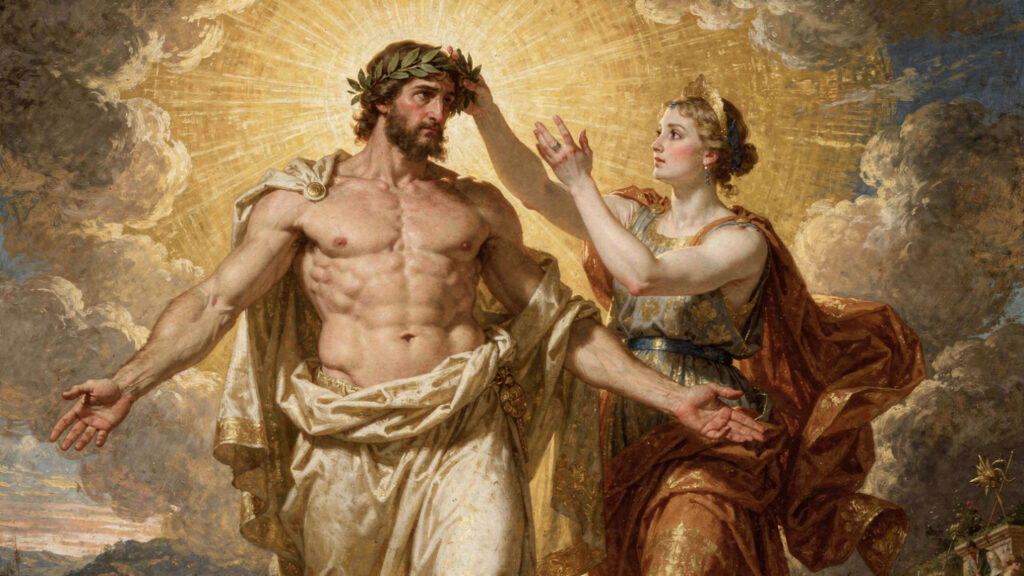
The most persuasive scholarly account treats this pattern as the mythological residue of a genuine historical transition: the displacement, gradual and incomplete, of an older goddess-centred religious world by the sky-father theology that migrating Greek-speaking peoples brought with them into the peninsula during the second millennium BCE. Before the arrival of that incoming tradition, the pre-Greek populations of Argos, of Samos, and of the other sites that would become Hera’s sanctuaries already maintained an autonomous female deity whose cult, on the archaeological evidence, was old and firmly established. The scholarly consensus that Hera’s own name resists explanation as a native Greek or Indo-European word, unlike the names of Zeus or Poseidon, both of which analyse cleanly into inherited Indo-European roots, supports exactly this reading: Hera looks, linguistically, like a survival, a name that belonged to the religious landscape before the Greek language itself fully took hold of it. The incoming sky-father tradition, embodied in the mythology by Zeus, did not eliminate this earlier independence. It absorbed it, by the mechanism mythology characteristically uses for exactly this kind of absorption: marriage. The native ruling goddess became the wife of the arriving sky god, her independent authority reframed as marital subordination, her own primary domains, cosmic fertility, the productive cycle of the earth, the institution of marriage itself, redescribed as the management of a difficult husband’s domestic behaviour.
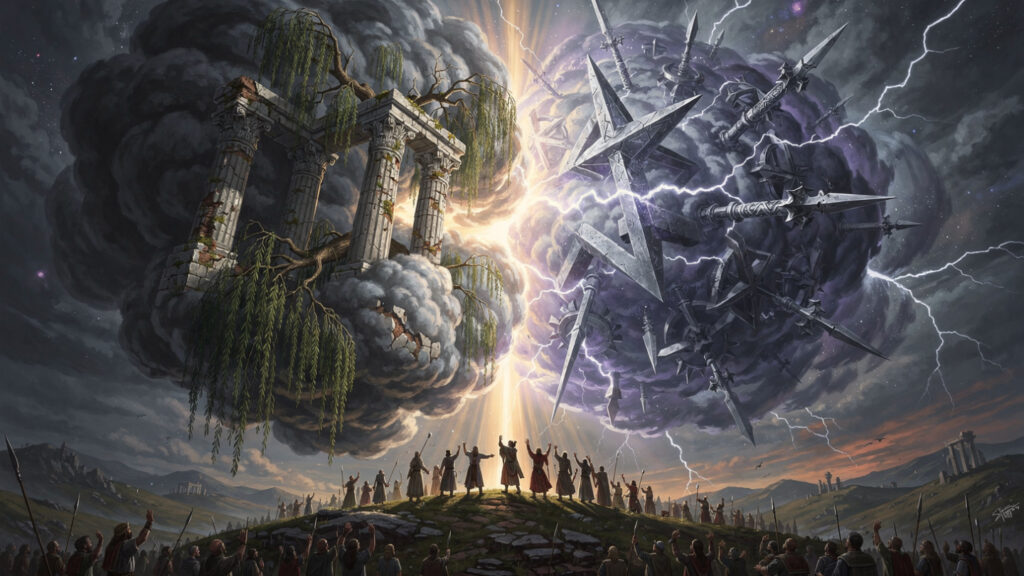
The fury the Homeric Hera directs at Zeus’s infidelities is, on this reading, not petty jealousy but the specific, displaced form that dispossession takes when it cannot be expressed directly against its actual cause. She cannot challenge Zeus’s supremacy head-on, because the mythology has already settled that question in his favour long before any individual story begins. What she can do, and does repeatedly, with a persistence and an inventiveness the tradition never quite manages to make unsympathetic, is refuse to be a purely passive participant in an arrangement she plainly never fully accepted. The punishments she inflicts on Zeus’s mortal children, the sustained persecution of Heracles above all, read less like the actions of a jealous wife and more like the actions of a dethroned queen still exercising whatever authority remains within her reach, directing at the visible symbols of her displacement, the divine children who represent the new order’s claim to legitimate paternity, an anger her own diminished position will not permit her to direct at its actual source.
Hera and Heracles: The Long War Between Queen and Hero
The mythology of Hera’s persecution of Heracles is the longest sustained narrative of divine hostility anywhere in the Greek tradition, and it has puzzled readers who take the jealous-wife explanation entirely at face value, because the persecution begins before Heracles is even born and continues with a totality and an inventiveness that reads less like the reaction of a wronged wife and more like the sustained campaign of a monarch defending a specific, coherent political position across an entire lifetime.
She tries to prevent his birth outright, delaying it by keeping Eileithyia, goddess of childbirth, away from his labouring mother Alcmene. When that fails and Heracles is born regardless, she sends two serpents into his crib to kill him in his infancy. When the infant strangles them instead, she waits and, years later, drives the grown Heracles into a fit of madness that causes him to kill his own children, the atrocity that becomes the direct origin of the labours he must undertake in expiation. She interferes in the labours themselves at nearly every turn: she sends the crab to harass him during his fight with the Lernaean Hydra, she raises the storm that scatters his fleet on his first expedition toward Troy, she sends the gadfly that stampedes the cattle he has just recovered from Geryon on the western edge of the world. This is not the record of a single betrayed spouse lashing out. It is the record of a sustained, decades-long campaign, conducted with the patience and the reach of an imperial power, against the single mortal figure who most completely embodies the new order’s claim to produce heroes capable of overcoming everything the older divine world can put in front of them.
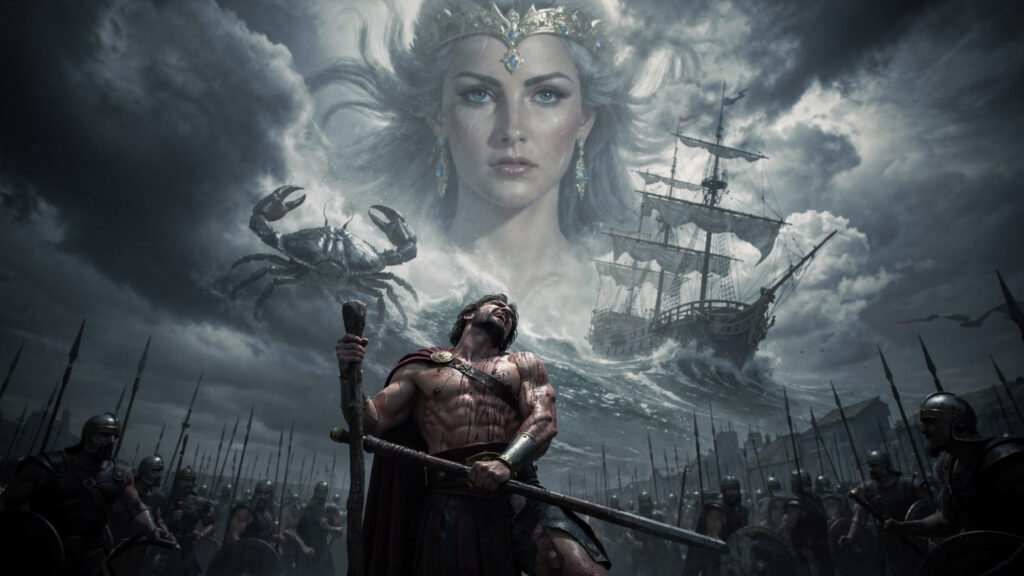
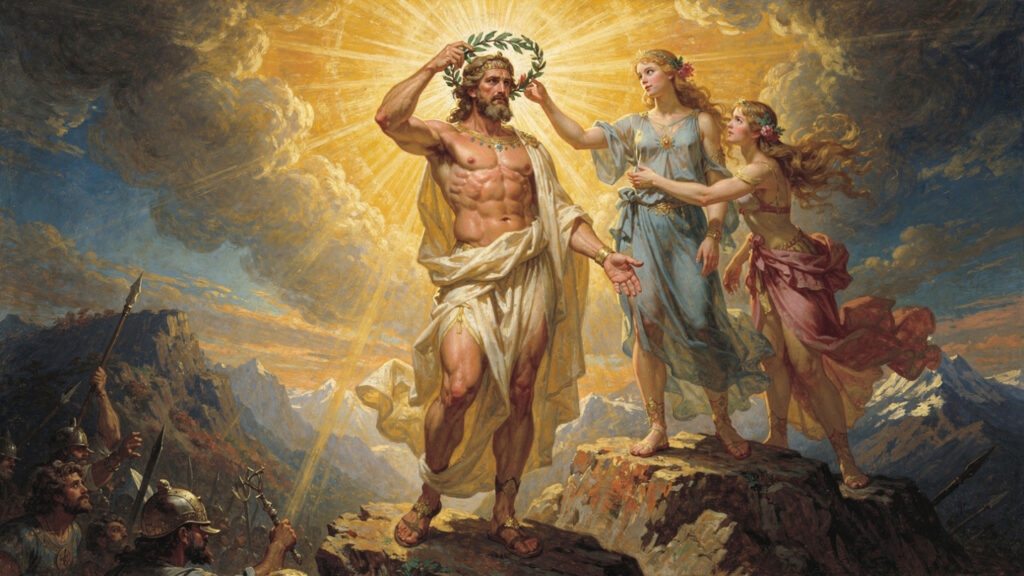
Heracles is, after all, the hero who completes twelve labours and achieves apotheosis, whose cult spread across the entire Greek and later Roman world, the paradigmatic representative of the new, Zeus-centred, patrilineal divine order: the son of Zeus by a mortal woman, proof that the sky god’s power could generate heroes capable of overcoming every obstacle the older divine order placed in front of them. Hera’s war against him is, on the reading this article has been building, the mythological expression of the older tradition’s resistance to exactly this new heroic paradigm, the one that was actively displacing it. She loses the war so completely, and so publicly, that the mythology eventually gives her a reconciliation with Heracles at the moment of his apotheosis, when he is received into Olympus and she gives him her own daughter Hebe in marriage. The goddess who spent her adversary’s entire mortal life trying to destroy him gives him her own child the moment he achieves the immortality she could never prevent. The reconciliation functions as the mythology’s own acknowledgement that the transition is finished: Hera accepts, at last, what she spent an entire heroic biography resisting, and the new order is by that point so completely established that even her resistance has been folded back into its own story, offered as evidence of just how difficult the hero’s achievement really was.
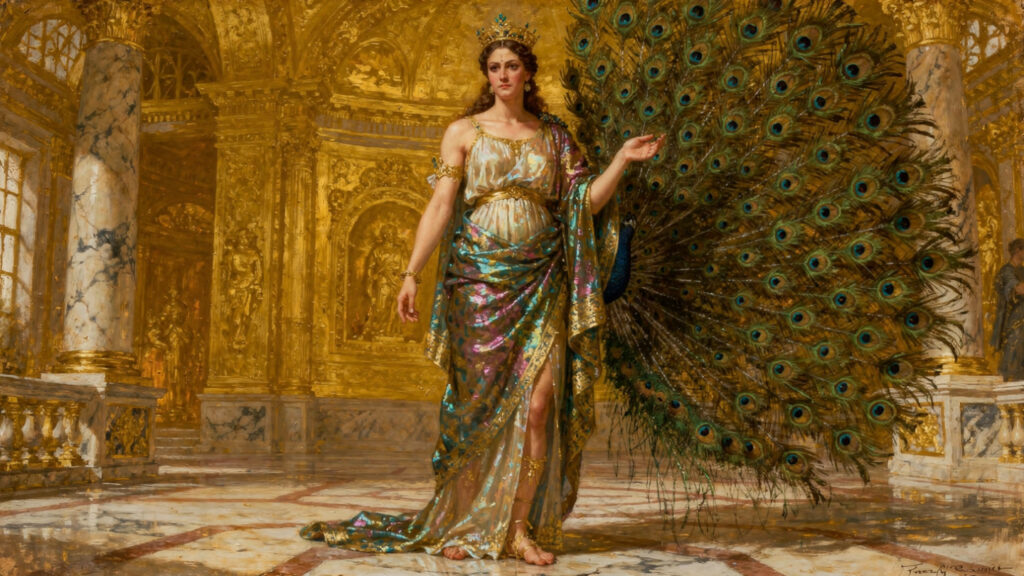
The later classical tradition gave Hera two further attributes that reward the same kind of attention. The peacock, with its hundred eyes folded into a single tail, became her bird only in the later period of Greek art, imported from the East along with the bird itself and attached to Hera specifically because a hundred watching eyes suited a goddess whose authority, by that point in her mythology, had narrowed into the vigilant, all-seeing surveillance of a husband’s infidelities. It is a telling attribute for exactly the reason it looks decorative: a goddess reduced to watching is a goddess whose authority has been redirected into supervision.
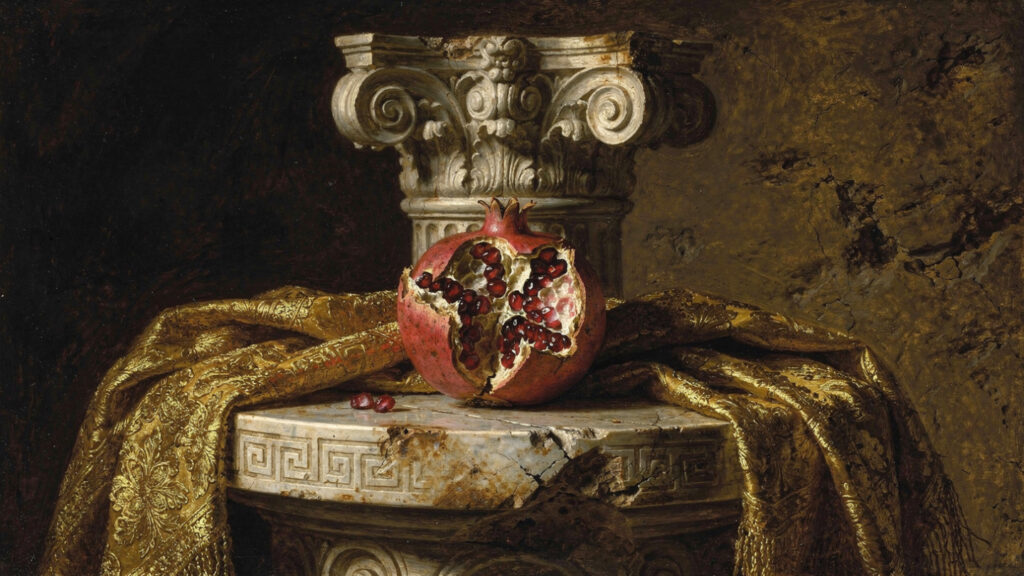
The pomegranate she sometimes holds carries an older and darker charge, an emblem of fertile blood and of death together, the same fruit that binds Persephone to the underworld for half of every year, and in Hera’s hand it reads less as a simple fertility symbol than as a reminder that the goddess who presides over marriage and childbirth has never been fully separable from the goddess who presides over their opposite, the blood of labour and the blood of loss occupying the same fruit without contradiction, the way the plank at Samos and the marble temple that eventually surrounded it occupied the same sanctuary without either one displacing the other.
The Queen Without a Kingdom
Read in full, across her sanctuaries and her seasons rather than through the single narrow lens of the Iliad, Hera is the most consistently powerful and the most consistently tragic figure in the entire Olympian system. She is the queen of the gods and, simultaneously, the most regularly humiliated of them. She governs the institution of marriage while locked into the most notorious unhappy marriage in the whole mythology. She presides over childbirth while functioning, in story after story, as the primary divine force working to prevent specific births from occurring. She is the only Olympian whose central domain, the ordered, productive, mutually respected union of two people, is something the mythology itself systematically depicts her own marriage as failing to achieve.
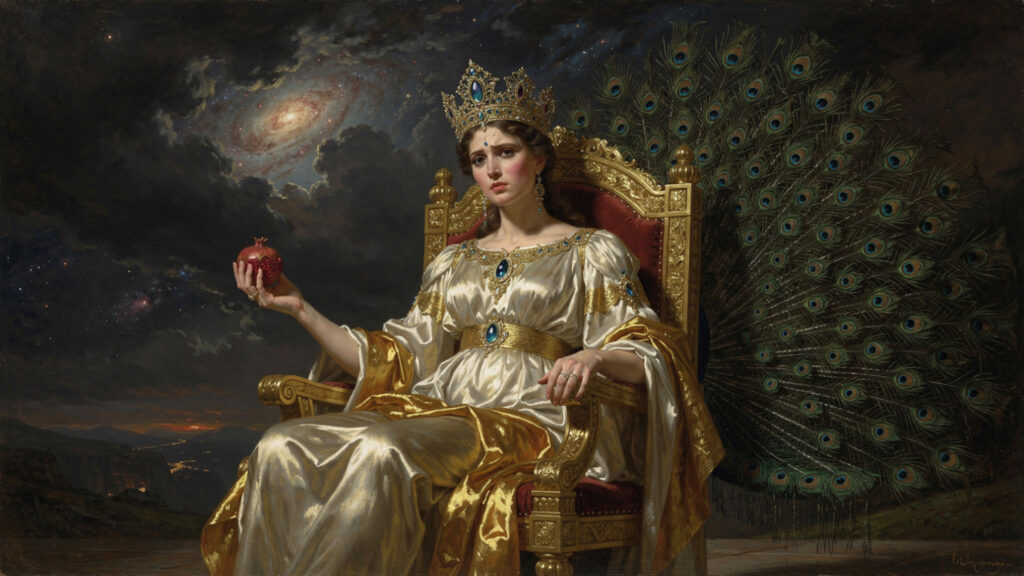
This is the deepest irony the tradition built into her, and it deserves to be read as irony rather than dismissed as simple inconsistency in the storytelling. The goddess of marriage trapped in a famously bad marriage is not a contradiction requiring explanation away. It is the mythology’s most precise account of what her particular authority actually cost her once Zeus entered the story: she governs the ideal of an institution from inside a specific instance of that institution that consistently, visibly fails to match the ideal. She holds authority over what marriage is supposed to be while being unable to make her own marriage into what she herself knows it should be, and the fury she directs outward, at her husband’s lovers and at his children, is the narrow, sanctioned channel for a much larger grief that the tradition never names directly, because naming it directly would require acknowledging that what happened to Hera was not simply the consequence of her own difficult temperament.
She was a queen before she was a wife. She commanded before she obeyed. The plank tied to the willow tree at Samos, receiving devotion from a community that needed no face on its goddess, no catalogue of a husband’s infidelities, no inventory of revenges, only the presence of a divine feminine authority that governed the island’s fortune in its own right, is the original Hera, standing before the mythology gave her the marriage that defined and diminished her in a single motion.
She is still there, in a sense, in the archaeology of the oldest sanctuary in the Greek world. The willow that Pausanias noted was still growing in his own lifetime, in the second century CE, beside the site where the wooden plank had been ritually bound and unbound for the better part of a thousand years before him. The plank itself is gone now, lost somewhere in the long span between antiquity and the present.
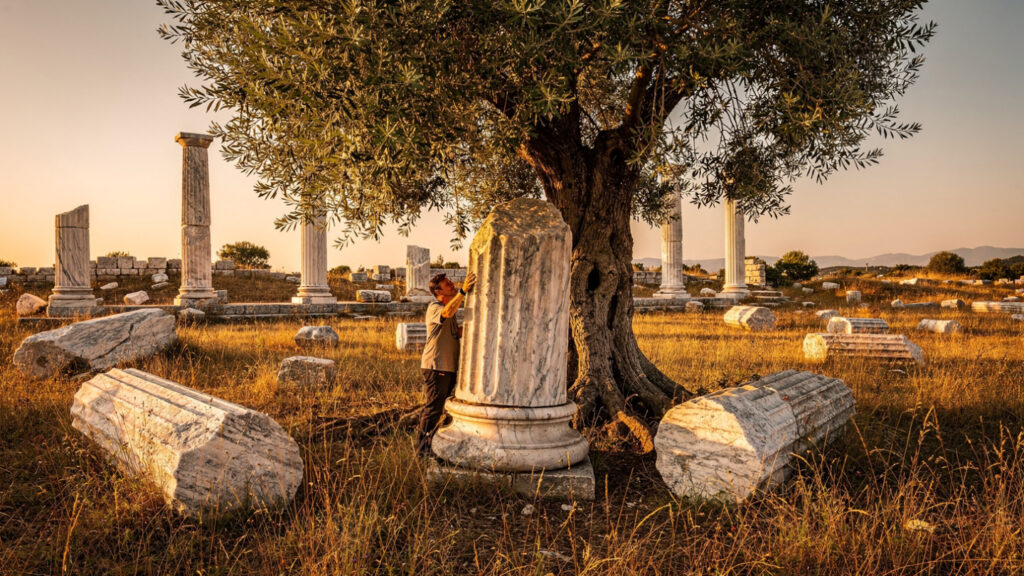
The practice of tying something to that tree, in one form or another, in one theology or another, went on for a very long time indeed, and it went on because a community once understood, with a clarity later ages found difficult to recover, that a divine presence, once it has chosen a place, does not need a face to be real. It only needs to be held there, faithfully, year after year, by people willing to keep doing the binding.
At Olympus Estate, Tales from Olympus explores the full architecture of Greek myth, including the goddesses whose original authority the dominant narrative eventually buried beneath the more comfortable story of a difficult wife. Hera was worshipped first as a plank of wood tied to a willow tree on the banks of the Imbrasos at Samos, and as an aniconic pillar at Argos, centuries before any sculptor gave her a human face. Samos was once called Parthenie, the Maidenly, in honour of the virgin aspect of her cult that the later marriage narrative largely obscured, and at the spring of Kanathos near Nauplia she was said to renew her own virginity every year, by her own ritual power, independent of anything her husband did. The hieros gamos performed in her honour at Plataea, Samos, and across the Argolid was not a love story but a theology: the claim that the fertility of the world depended on the annual renewal of the union between the reigning queen and the sky father. The jealous-wife mythology that eventually became her dominant public identity is best read as the record of an older, indigenous goddess-centred religious world absorbed by an incoming sky-father tradition through the one mechanism mythology reliably uses for such absorptions, marriage. She was a queen before she was ever a wife, and the anger the tradition gave her is the only form in which it allowed her to preserve the memory of what that authority had cost her.