Odysseus never entered the underworld.
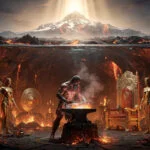
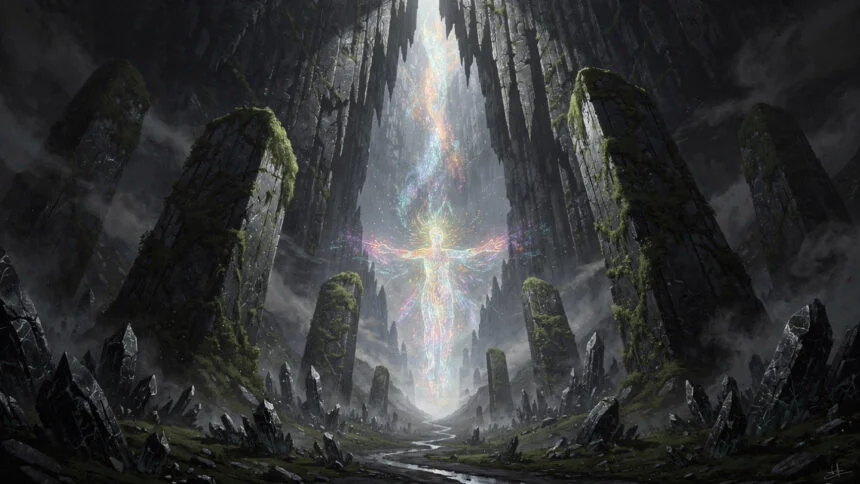
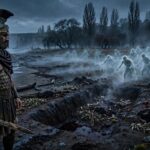
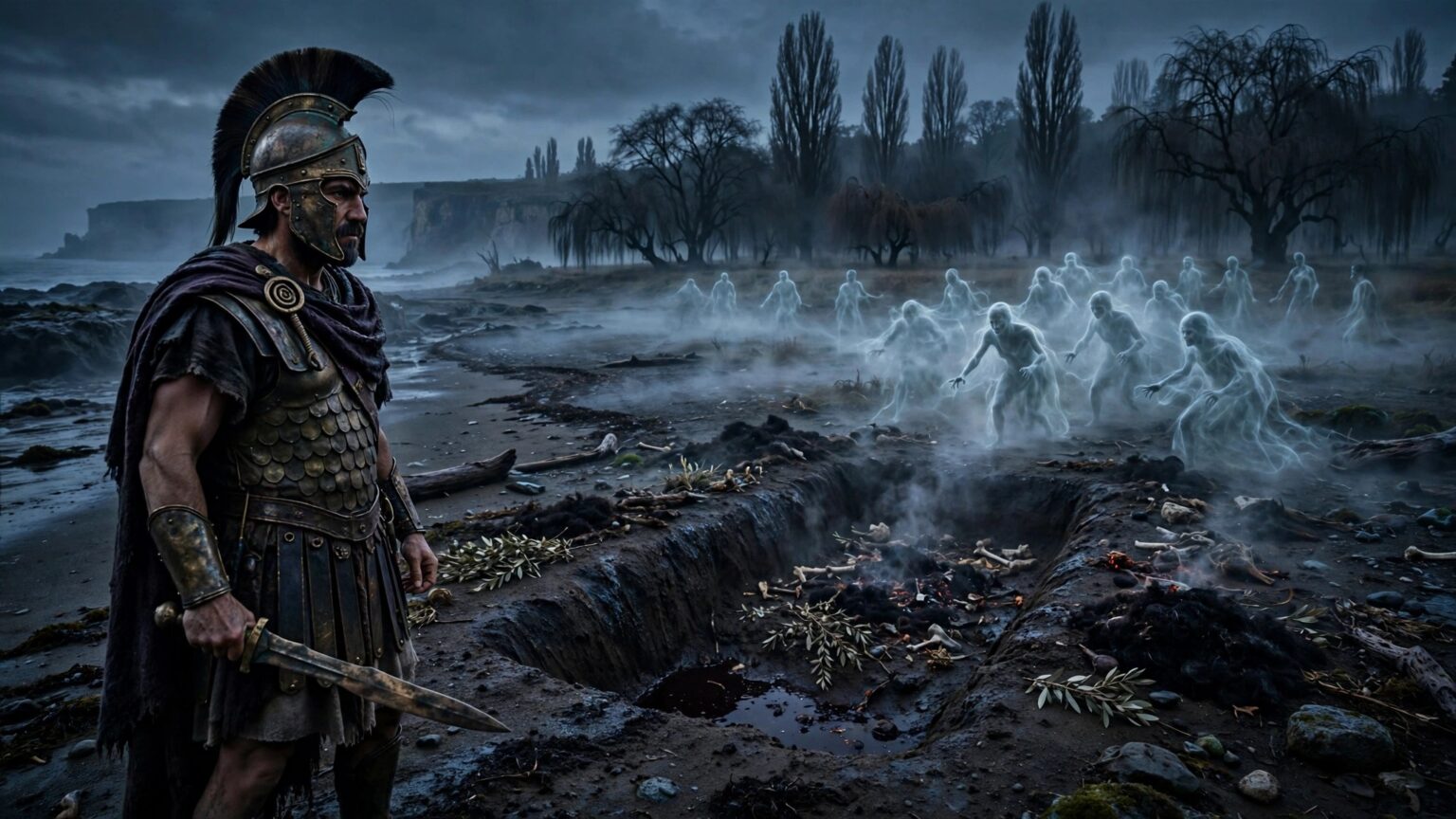
This is the most important and the least repeated fact about the most famous consultation of the dead in Western literature. Book 11 of the Odyssey, which the ancient world called the Nekuia and which every later tradition of descents to the dead has drawn on as its founding instance, does not describe Odysseus going anywhere. He reaches the edge of the world, at the place Circe has directed him to, and digs a pit. He pours offerings into it. He cuts the throats of a black ram and a black ewe and lets the blood run into the trench. Then he waits, sword drawn, while the dead come to him.
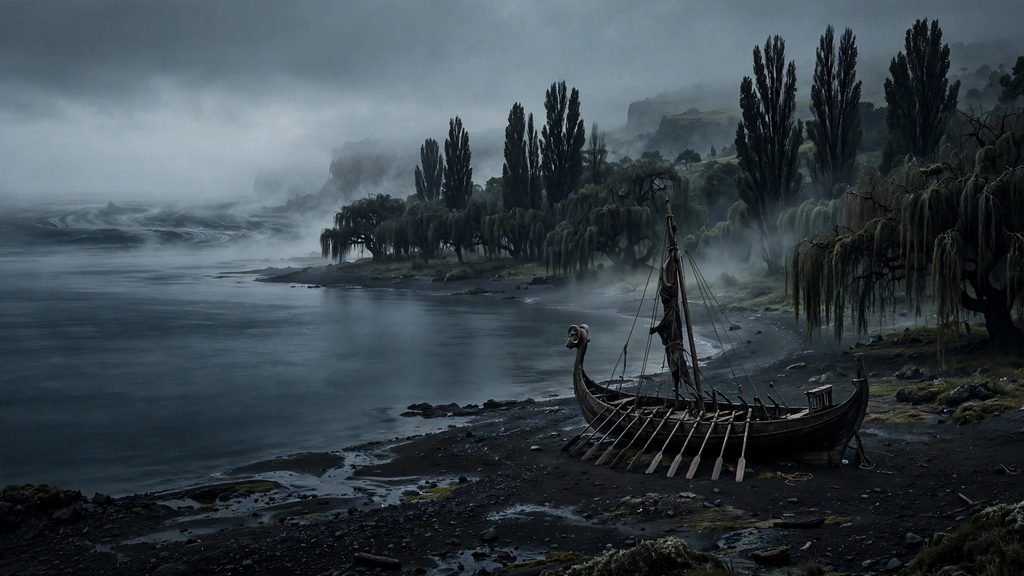
They do not take him anywhere. He does not walk through the gates of a city of the dead, cross a river by boat, or stand before a throne. He has made a place where the boundary between the living and the dead is thin enough to cross, and the dead do the crossing.
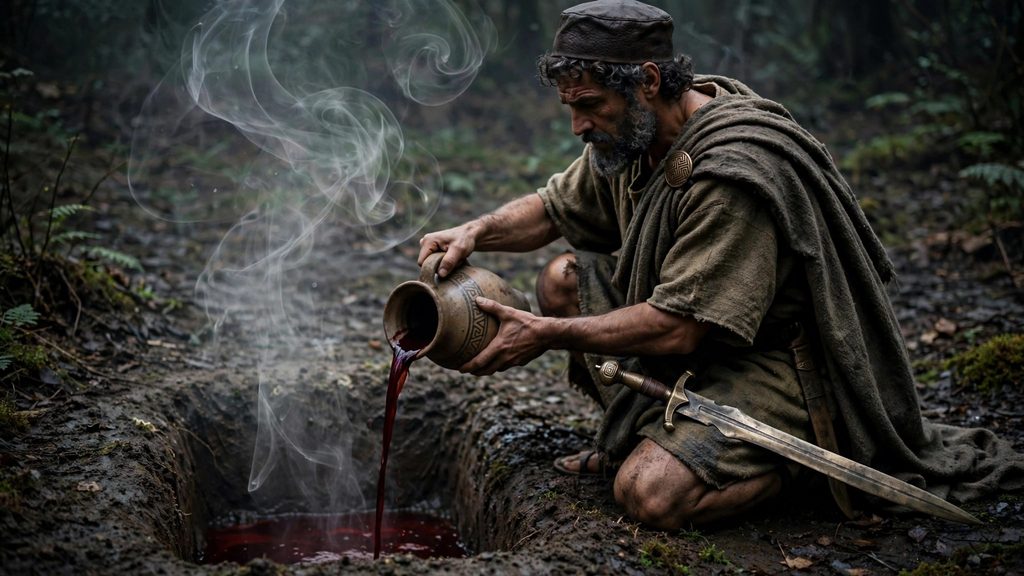
That distinction, between katabasis, the physical descent that Orpheus and Heracles and, later, Aeneas all perform, and nekyia, the summoning at the threshold that Odysseus performs, is one of the sharper edges in the Greek tradition’s treatment of the living and the dead, and popular retelling almost never preserves it. The katabasis is a heroic feat: an extraordinary being crosses a boundary that no ordinary person can cross, walks through the country of the dead, and returns. The nekuia is something else. It is available, in principle, to anyone who finds the right place, performs the right ritual, and has the patience to wait for whatever is willing to come.
Circe’s Instructions, and Why the Precision Matters
Odysseus knows exactly what to do because Circe has already told him, at the end of Book 10, before he ever leaves her island, and her instructions read less like narrative setup and more like a ritual manual: precise about location, about the order of the offerings, and about what happens once the dead start arriving.
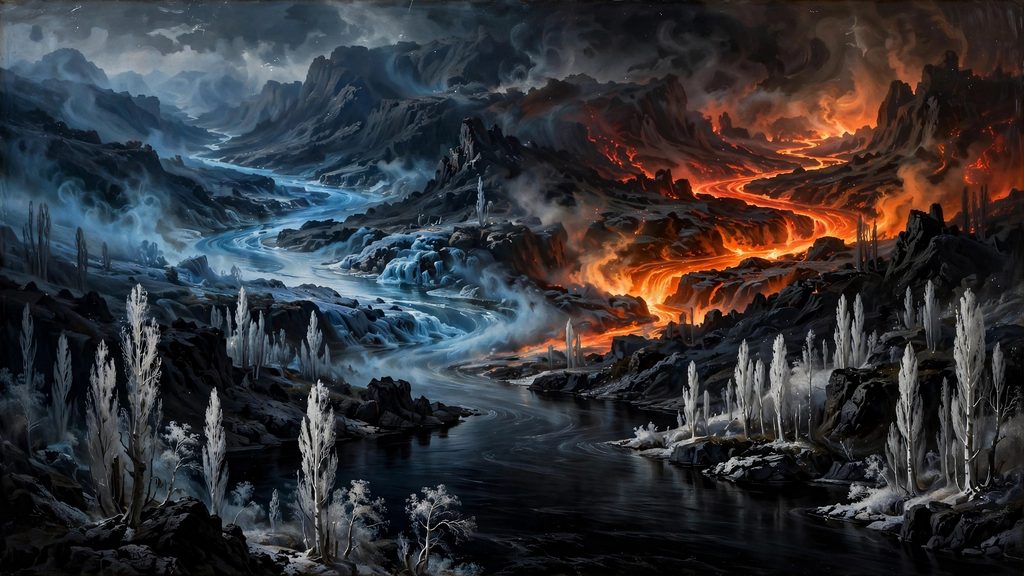
Location first. Not simply the edge of the world in some general sense, but a named place: the grove of Persephone, where poplar and willow, the trees the Greek tradition associated with mourning and the dead, grow at the point where the Pyriphlegethon, the river of fire, and the Cocytus, the river of lamentation, run into the Acheron. The geography is strange because Homer is not describing an ordinary Greek landscape. It lies at the edge of Oceanus, beyond the normal geography of Odysseus’s voyage, and the rivers belong to the imagined map of the dead. Yet the ritual performed within that landscape is startlingly concrete. There is a hole in the ground. There are animals. There are liquids, poured in a fixed order: honey mixed with milk first, then sweet wine, then water, with white barley scattered over all three before the sacrifice. There is a prayer, and a promise of further offerings once Odysseus is safely home. Only then does the blood go into the pit.

The order is not arbitrary. It moves from the sweetest and most life-associated offering to the most potent and most death-associated one, an ascending register rather than a list. And once the blood is in the trench, Odysseus has to manage what shows up. He holds his sword drawn because the crowd of shades pressing toward the blood are not being polite about it. The blood is what briefly restores their capacity for speech and memory, and they want it before Tiresias, the one shade Odysseus actually needs, has had his share. Odysseus decides who drinks and in what order, at swordpoint if necessary.
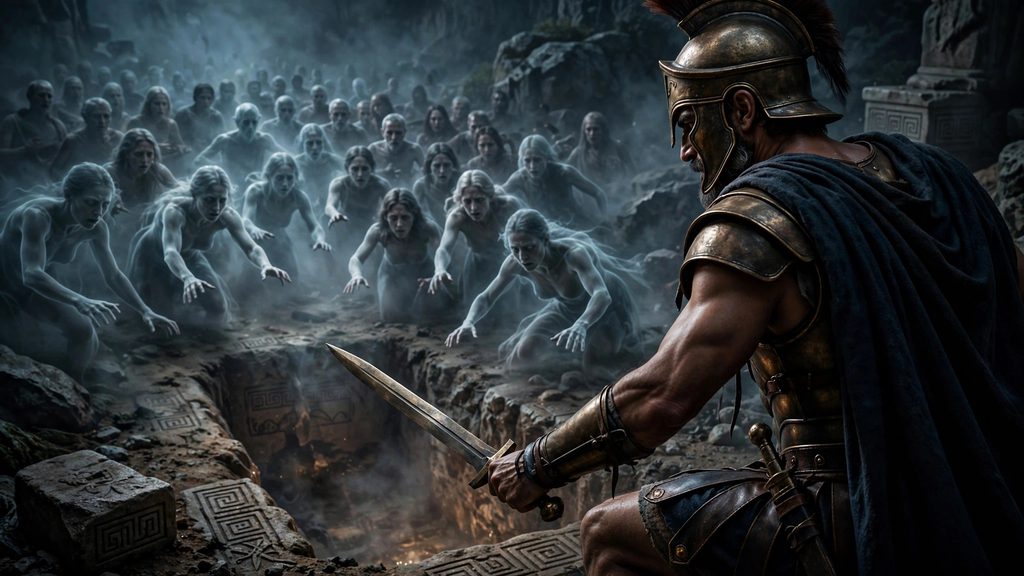
This detail is easy to read past, but it does real work: it establishes that the nekuia is not a passive experience of wisdom descending on a grateful supplicant. It is a negotiation the living person controls, against a crowd that is, in its own way, genuinely desperate.
Elpenor Comes First
The first shade Odysseus recognizes is not Tiresias. It is Elpenor, the youngest and least distinguished of his crew, who had died just before the voyage began, drunk, falling from the roof of Circe’s house and breaking his neck. The ship had already sailed before anyone realized he was missing, and his body lay unburied on the island while his shade had already reached the land of the dead ahead of everyone else.
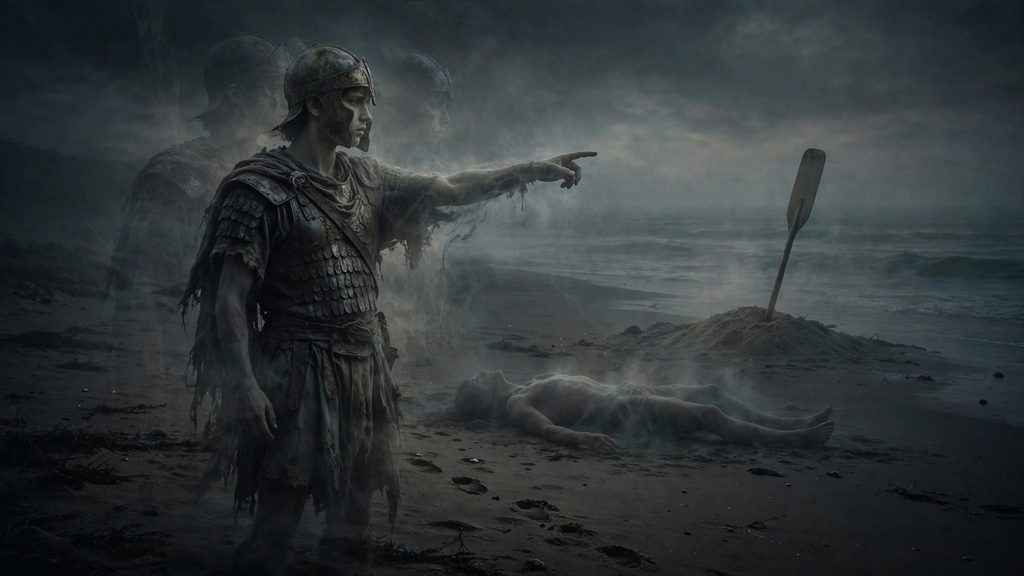
What Elpenor wants is nothing like the prophecy Odysseus has come for. He wants a burial. He asks Odysseus to sail back to Circe’s island, burn his body with his armor, raise a mound over him on the shore, and fix the oar he rowed with upright on top of it, so that anyone who passes will know a sailor lies there. It is the most ordinary request imaginable, arriving first, before anything supernatural, and it forces Odysseus to answer for an obligation from his own past before he can learn anything about his future. He promises to do it, and does.
Only after Elpenor does Anticleia come forward, and this is the scene the nekuia is remembered for. Odysseus did not know his mother had died. He left Ithaca while she was alive, and only here, at the edge of the world, does he learn otherwise, from her own shade. He reaches for her three times, and three times his arms close on nothing. Homer’s explanation is unadorned: the dead have no flesh left to hold.
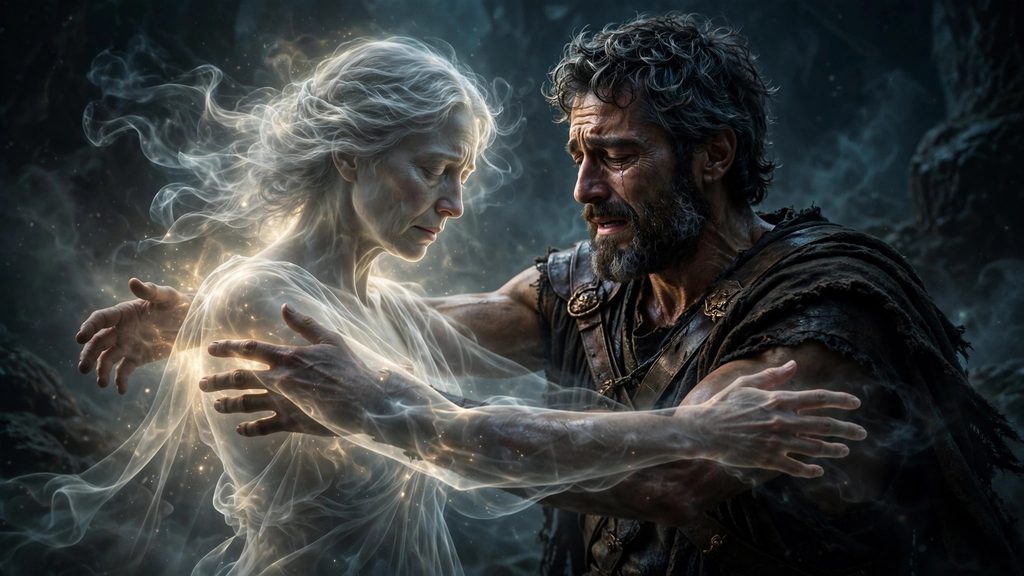
She can speak to him, tell him how his father Laertes grieves and what has happened at home, but she cannot cross the last distance between recognition and touch. The blood restores her voice. It does not restore her body. That gap, close enough to speak, too far to hold, is the emotional center of the entire episode, and it says more about what the nekuia actually offers than any of its ritual instructions do.
What the Word Means, and What the Gods Have to Do With It
Nekyia comes from nekus, corpse, and the etymology tells you what kind of ritual this is. It is not built around an abstract idea of the afterlife. It is built around the physical fact of a dead body, and the belief that the dead keep a real connection to the world they left, one that blood can briefly reactivate.
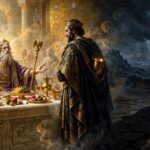
Homer’s own text names two gods directly: Odysseus prays and sacrifices to Hades and to dread Persephone, whose own transformation from abducted girl to underworld queen this site has already traced.
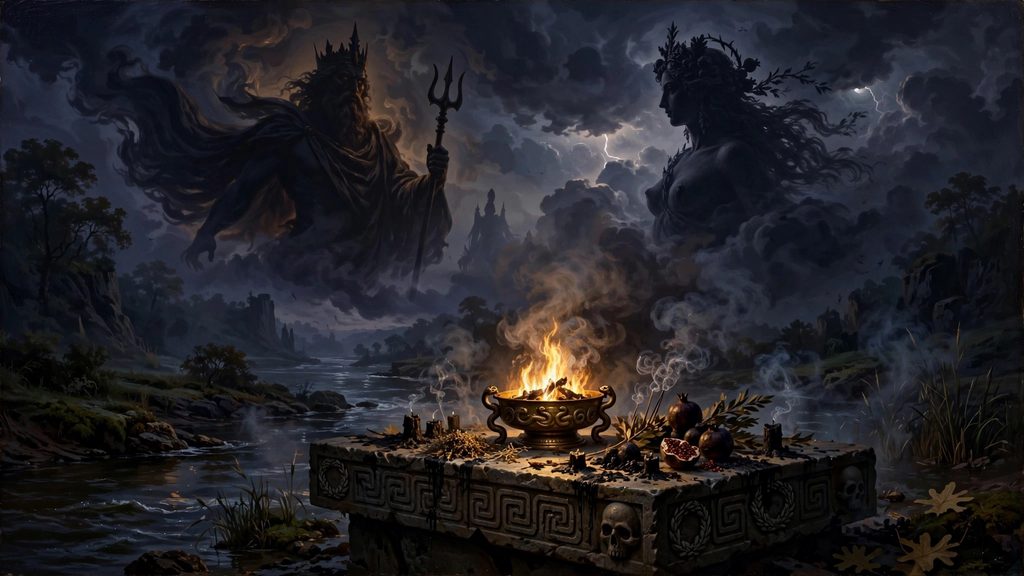
Later tradition widened the cast considerably. By the time necromancy shows up in the magical papyri and in the practice the Greeks called psychagogia, soul-leading, Hecate, goddess of the threshold, and Hermes, in his function as psychopomp, had both become fixtures of how the Greeks imagined this kind of crossing, Hermes explicitly so in the Odyssey’s own final book, where he leads the suitors’ shades down to Hades.
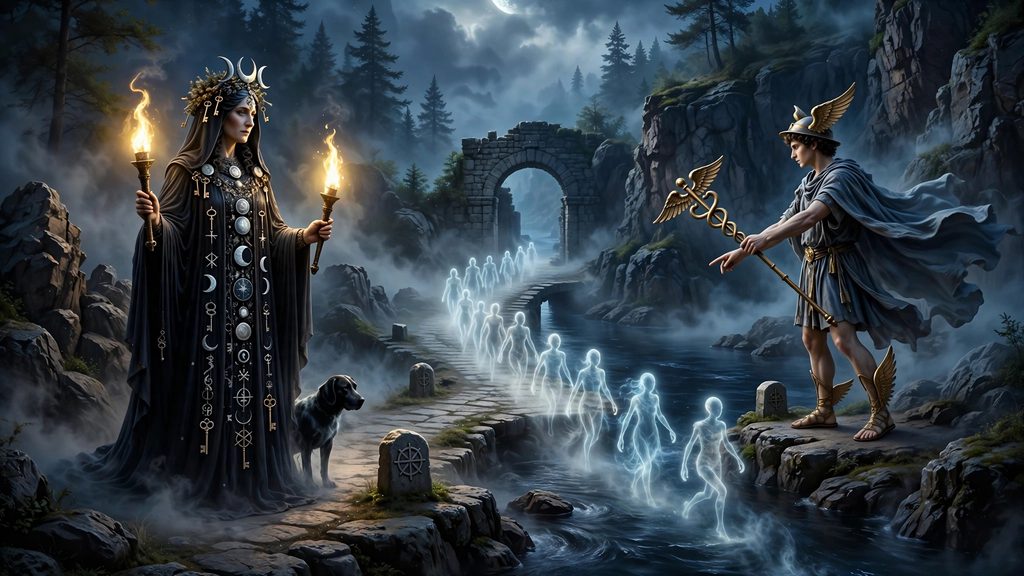
It would be tidy, but not accurate, to say all four gods jointly preside over Odysseus’s own nekuia in Book 11. What is accurate is that the ritual logic of his scene, a threshold made available, a guide managing the traffic across it, an authority whose permission the crossing requires, is exactly the logic that later attached itself to Hecate and Hermes as the tradition kept developing.
The sources also describe individual ritual specialists, sometimes called psychagogoi, who claimed this kind of soul-leading as a skill, real enough that Aeschylus wrote an entire lost play named after them. That is not proof of an organized guild with membership rules. It is enough to suggest that whatever Odysseus does at the edge of the Acheron was not purely a poet’s invention, but a heightened version of something people in the ancient world believed particular individuals could actually do.
A Distinction the Tradition Actually Kept
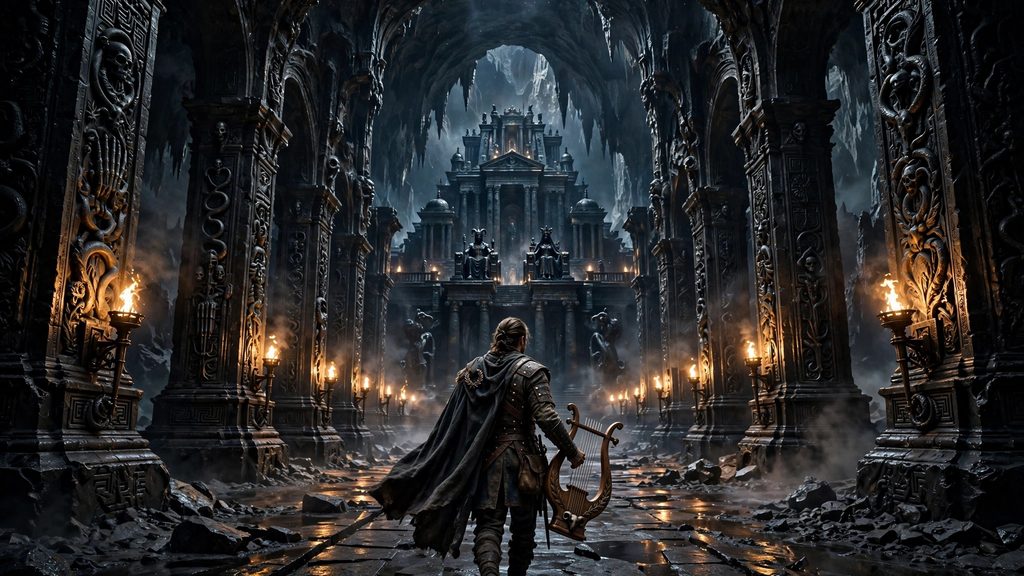
The Greek literary tradition held the line between nekuia and katabasis with more consistency than modern retellings usually credit it with. Orpheus went down and negotiated with Hades and Persephone in person, trying to bring Eurydice back with him. Heracles went down and dragged Cerberus back up by main force, one labor among twelve that redrew the boundary between the human and the impossible. Aeneas, in Virgil’s Roman reworking of the material, walks through the underworld’s entire architecture. All three cross the boundary. Odysseus performs a ritual at it and waits.
He is not even the tradition’s only example of the quieter version. Aeschylus, in the Persians of 472 BCE, wrote a nekuia that rarely gets credit for its formal originality: the Persian queen Atossa and the chorus summon the shade of the dead king Darius at his tomb, and he rises to deliver his verdict on his son Xerxes’s catastrophic invasion of Greece before descending again. No one crosses a boundary in that scene, either.
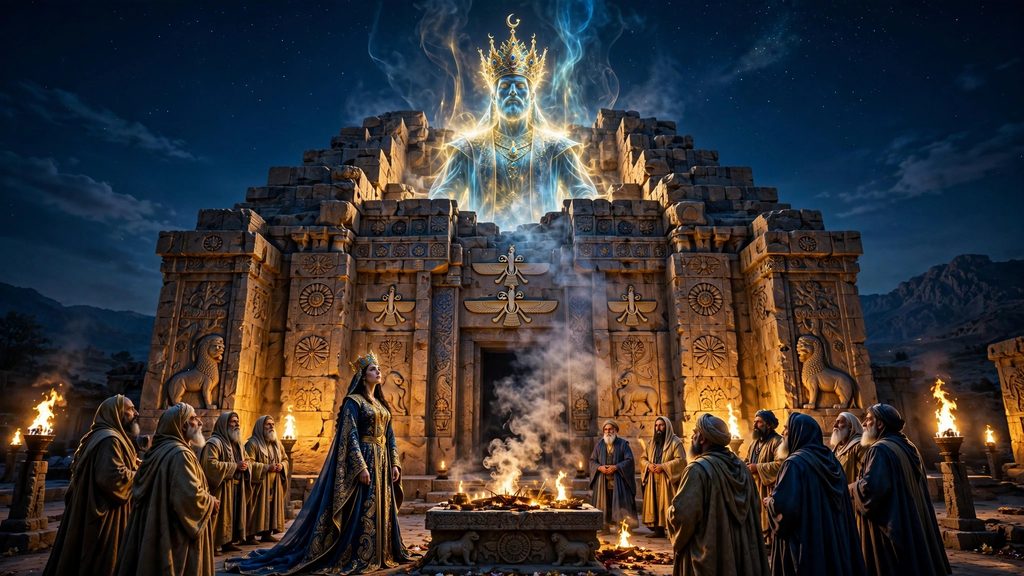
The boundary opens for as long as the ritual requires, and what is needed passes through it and no further, exactly the shape of what happens at the edge of the Acheron, transplanted from a mythic river to a Persian king’s grave.
What the Ground at Acheron Actually Gives Up
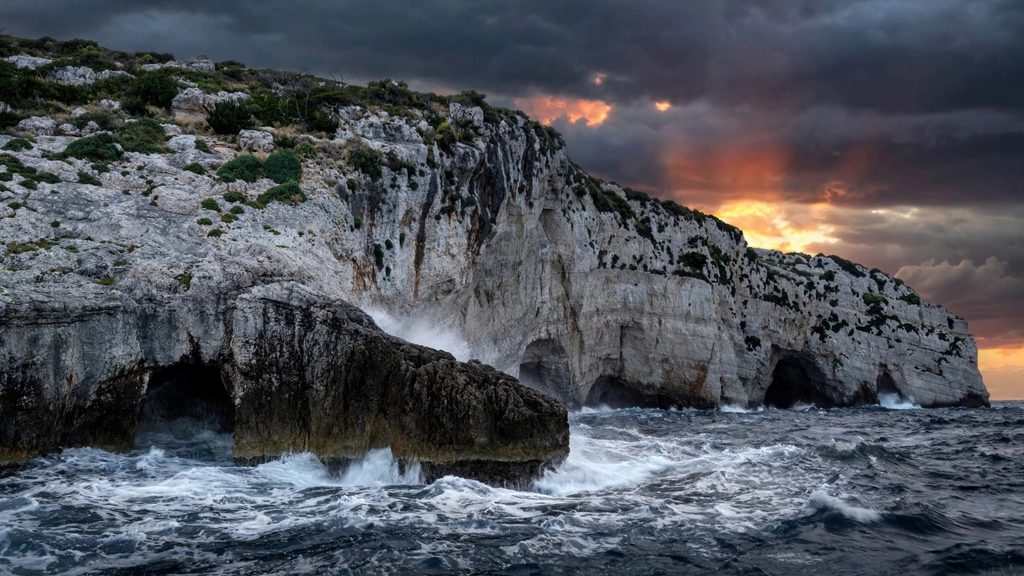
Ancient sources describe several places across the Greek and Roman world as oracles of the dead: the Acheron in Thesprotia, Lake Avernus in Campania, Heraclea Pontica on the Black Sea, and Cape Tainaron at the southern tip of the Peloponnese, a headland this site’s essay on the Mani has already identified with the region’s mythology of the dead. That list has traditionally been treated as a settled group of four, and it should not be. A 2021 study in the journal Hesperia examined the case for Tainaron specifically and found no genuine evidence, textual or archaeological, for any necromantic structure or practice there at all, arguing that the entire attribution rests on a single misread line of Plutarch. Tainaron’s fame as a gateway to Hades is real. Its status as a functioning oracle of the dead is not.
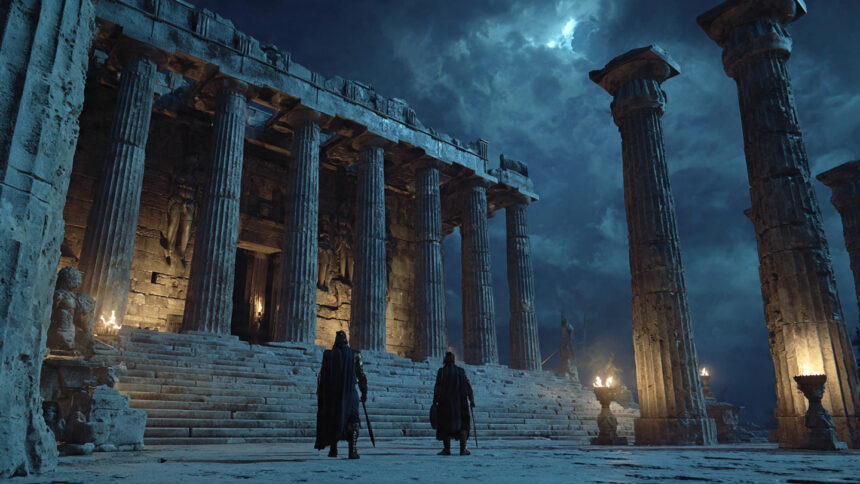
The Acheron site has its own, differently shaped problem. Herodotus gives the clearest ancient anchor for how this kind of place was actually used: Periander, the tyrant of Corinth, sent envoys to the Oracle of the Dead on the Acheron to ask his own dead wife Melissa where she had hidden a sum of money. That the tradition existed is not in serious doubt. Where its physical remains are is a genuinely open question. In 1958, the archaeologist Sotirios Dakaris identified a hilltop site near the village of Mesopotamos as the physical oracle, and the identification held for decades and still shapes how the location is presented to visitors. It has not aged well: the site’s position does not match the ancient descriptions, its ruins date no earlier than the late fourth century BCE, and objects Dakaris read as ritual apparatus look, to more recent excavators, like the tools and catapult parts of a fortified Hellenistic farmhouse. But this is not a case of one settled identification quietly replacing another.
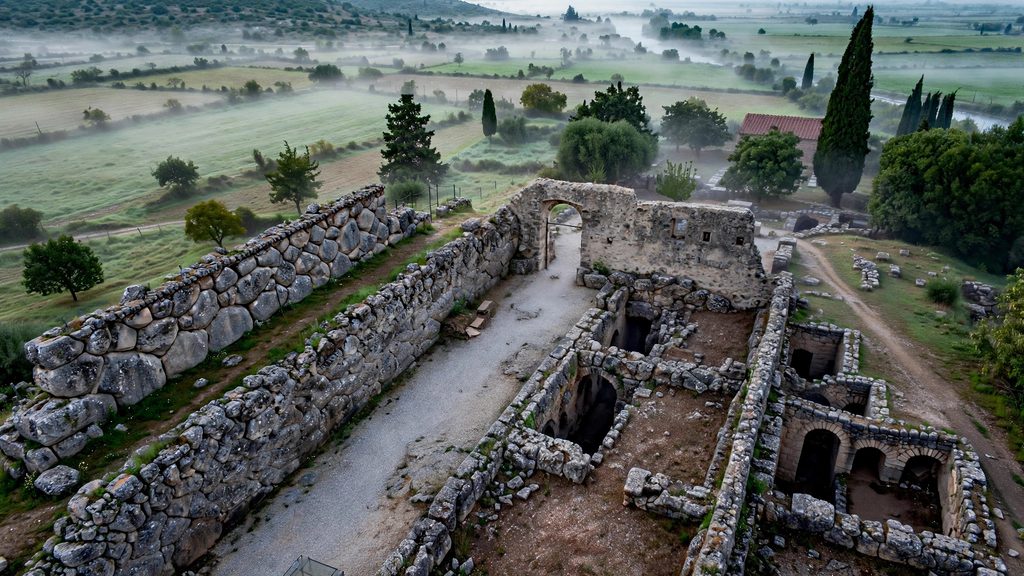
Scholarship on the site remains actively contested, with researchers weighing competing readings of the same excavation rather than converging on a single verdict. This site’s own essay on the Necromanteion of Acheron tells that fuller, more complicated story. The honest position is not that the oracle never existed, and not that the ruins at Mesopotamos are proven to be it. It is that the literary tradition and the archaeology, for now, answer two different questions.
Autumn, Winter, and the Boundary Between
The nekuia’s association with the darker half of the year is not incidental, though it is worth being precise about which festival belongs to which season. This site’s essay on the Thesmophoria has already documented the October festival at which Athenian women managed the boundary between above and below most directly: piglets buried underground months earlier, retrieved decomposed, and mixed with seed grain, a cycle of descent and return enacted with an almost literal chthonic logic, timed to the season when the earth closes over the sown fields and Persephone descends.
The Anthesteria belongs to a different month entirely. Held in February around the Dionysian wine festival, it is sometimes described as an Athenian festival of the dead, with the Keres, spirits associated with death, said to walk freely through the city for the duration before being formally expelled. That reading goes back to the classicist Jane Ellen Harrison and remains influential, but it is not uncontested: other scholars read the Keres differently, and the ancient sources themselves are thin enough to leave real room for disagreement about how literally “the dead walk the city” should be taken. What is not in question is the shape of the underlying belief, whichever festival expresses it: that certain points in the year make the boundary between living and dead less reliable than it is the rest of the time, and that a community’s rites at those points are what manage the crossing safely.
What the Dead Could Offer the Living
The value of consulting the dead was not simply access to someone who had died. It was access to a particular kind of knowledge, and the nekuia is careful about what kind belongs to whom. Tiresias, the shade Odysseus travels for, had been a prophet in life, and his knowledge of the future survives into death because that knowledge was always his own. Anticleia knows the domestic world of Ithaca and the circumstances of her own death, because that was her world. Melissa, in Herodotus’s account, knows where she hid the money, because she was the one who hid it. Death does not make every shade an oracle. It preserves, in each case, exactly what that particular person already knew.
That narrower claim is more interesting than the grander one it is often mistaken for. The dead are not valuable in the nekuia because death has made them omniscient. They are valuable because death has not erased what was theirs to know, and because the living, for a fixed and costly interval, can be made to hear it.
The Nekuia at Ordinary Scale
The nekuia’s least dramatic dimension is also its most widespread. The belief that the boundary opened not only at named oracle sites and not only for heroes performing formal rites, but for ordinary people at the graves of their own dead, on the appropriate days of the calendar, was common across the ancient world. The rite could be performed at a tomb as easily as at a river confluence at the edge of Oceanus. What Periander’s envoys did at the Acheron and what an ordinary family did at a grave marker were, at bottom, the same practice at different scales: find where the boundary runs thin, make the appropriate offering, and wait for what is on the other side to become present enough to reach.
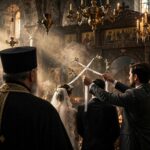
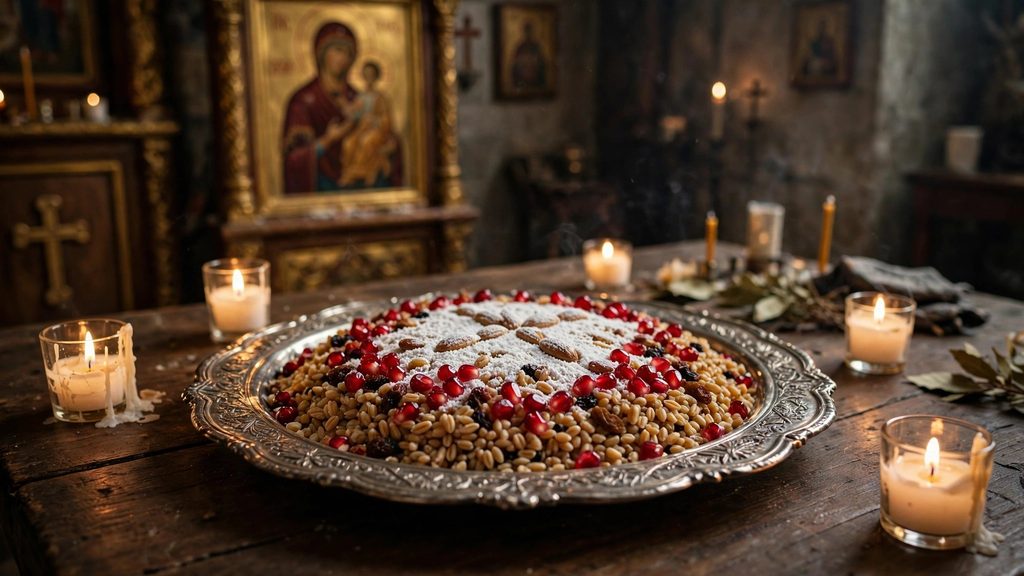
That belief did not end when the ancient rites did. Greek Orthodox cemeteries still gather families on the Saturday of the Souls to share koliva, the boiled-wheat dish whose symbolism reaches back to the same grain mythology Demeter and Persephone encode, and the prayer said there for a dead relative carries a version of the same expectation Circe’s instructions rest on: that the dead are, at that time, more reachable than they are the rest of the year.
Other cultures arrived at kindred customs by their own routes, the Day of the Dead, Samhain, the various Christian feasts for the departed, and the resemblance is real without needing to be read as one belief in disguise everywhere. What the nekuia demonstrates, on its own terms, is narrower and sturdier than a claim about all human cultures: that a particular people, at a particular river, worked out exactly what it would take to make the dead come to them, and wrote the instructions down precisely enough that we can still read them three thousand years later.
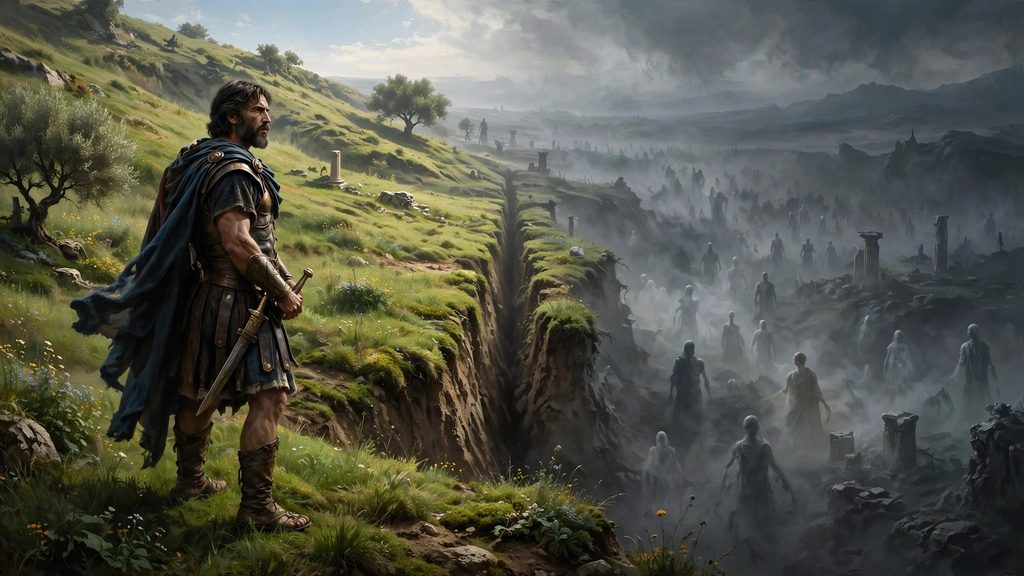
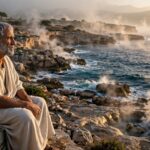
Odysseus stood at the edge of the known world and the dead came to him because he had prepared the threshold correctly, held the sword, and waited. He never crossed the boundary. He found where it ran thinnest, and let what he needed cross toward him instead.
At Olympus Estate, Tales from Olympus moves through the deeper currents of the Greek tradition. The nekuia was never really a story about entering the land of the dead. It was about learning where, in the ordinary landscape, the dead could still be reached without anyone having to go looking for them: a trench dug at the meeting point of three rivers, a farmhouse mistaken for an oracle, a grave visited on the right day in a cold month. The boundary the Greeks mapped so carefully was never very far from home.