



Homer called it “known to all.”
This single phrase, appearing in the Odyssey as a passing reference to the Argo as pasi melousa, known to everyone, celebrated by all, is the most important piece of evidence for understanding where the Argonautica sits in the Greek mythological tradition. Homer’s Odyssey calls the Argo known to all, confirming the story’s currency in the oral tradition by the eighth or seventh century BCE. When Homer was composing his own poems, the voyage of the Argo and the quest for the Golden Fleece were already so thoroughly established in the oral tradition that he could reference the ship as a cultural commonplace, the way a contemporary writer might reference a landmark that everyone already knows, requiring no introduction, no explanation, no summary.
The Argonautica was already ancient when the Trojan War was being told.

This is the structural position of the story in the tradition: not a sequel or a companion piece to the Trojan War cycle but its predecessor, the first great pan-Hellenic heroic expedition that the collective memory of the archaic Greek world preserved, the story of the first time that heroes from across the Greek world assembled under a single leader and sailed together to the edge of the known world and beyond it. The Argonaut myth originated in ancient Greek oral traditions dating back to the Bronze Age, with early literary attestations appearing in fragmentary works from the Archaic period. The story of Jason and the Golden Fleece predates the Trojan War in the mythological chronology and almost certainly predates it in the cultural memory that eventually gave the Trojan War its epics as well.
The template for what the Iliad and the Odyssey would eventually do was established by the Argonautica: a fleet assembles, heroes from every part of the Greek world join the expedition, they sail through extraordinary dangers to a destination at the edge of the known world, they face impossible tasks set by a hostile king, and they return changed by what they have undergone. The Trojan War followed this template and expanded it to a scale the Argonautica never attempted. The template itself came first.
Why It Began | The Sandal and the Prophecy
In the city of Iolcos, King Pelias seized the throne from Jason’s father. To reclaim his rightful place, Jason embarked on a quest to obtain the Golden Fleece, which was said to be in the distant land of Colchis.
The political origin of the quest is a usurpation and a prophecy, and the mechanism by which the prophecy fulfils itself is one of Greek myth’s most precise accounts of how divine intention uses human action without overriding human freedom.
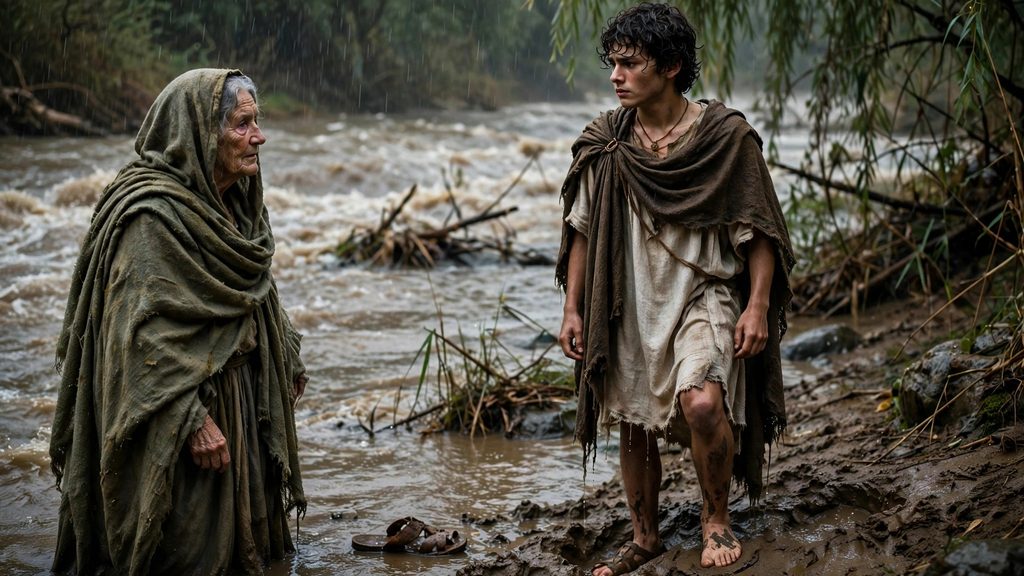
Pelias had been warned by an oracle to beware of a man wearing one sandal. He was therefore watching closely for this particular person when Jason arrived at his court, having lost one sandal while helping an old woman, who was Hera in disguise, cross a flooded river. The one-sandaled man fulfilled the oracle’s description. Pelias looked at Jason and understood immediately that this was the person he had been warned about, and his response was precisely the response that every figure in the Greek tradition who tries to prevent a prophecy gives: he sent Jason on the mission he was most confident would kill him.
The Fleece was at Colchis, at the eastern end of the Black Sea, guarded by a dragon that never slept. The sea route to get there passed through the Clashing Rocks, the Symplegades, that crushed everything that sailed between them. No ship had returned from the voyage. Pelias’s calculation was straightforward: the mission was impossible, Jason would die, and the prophecy’s threat would be neutralized by the very commission Pelias was issuing.
As Pelias had hoped, Jason agreed. Pelias thought that Jason would not survive the voyage.
Hera, who had been in the river disguised as an old woman and who had received Jason’s help when Pelias had refused to assist her in the same guise, now had her champion: the young man whose fate she had placed herself in a position to influence by a divine act of strategic positioning, described with the complete naturalism of a goddess who has been managing mortal politics for a very long time. She would guide and protect Jason through the voyage with the energy of a divine benefactor whose investment in his success had been established before the mission began.
The Crew That Assembled
The Argo’s crew is Greek myth’s most complete single catalogue of the heroic generation that preceded the Trojan War, and its composition tells you exactly what kind of story the Argonautica was designed to be.
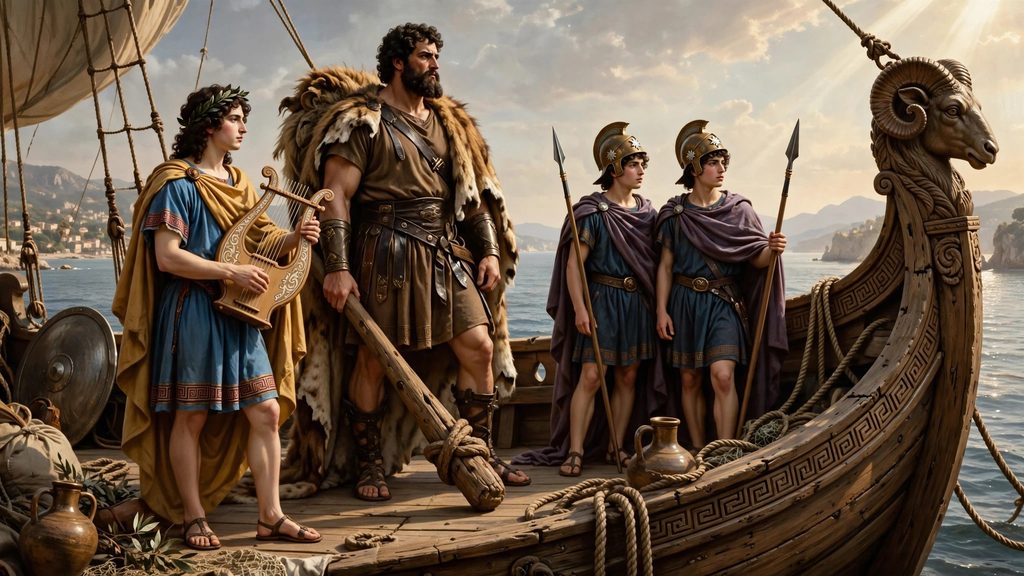
Among them were the musician Orpheus, Meleager, Peleus and Telamon, the Dioscuri, Castor and Polydeuces, and many others, including the greatest hero of them all, Heracles. Orpheus, whose own mythology this site has already documented at length, whose music could move stones and rivers, sailed as the expedition’s spiritual and musical center, his lyre providing the cultural dimension that distinguished this voyage from a simple raiding expedition. Heracles, whose complete treatment appears in the dedicated Heracles essay on this site, sailed until he was lost at Mysia searching for his companion Hylas, his departure from the crew an acknowledgment that the greatest individual hero of the age was too large a presence for a collective enterprise: the Argonautica required a crew, and Heracles was constitutionally a solo operator.
The Dioscuri, Castor and Pollux, whose alternating immortality this site has already treated in depth, brought their own twin capacities to the ship: Castor’s unmatched horsemanship and Polydeuces’s boxing, the latter proving its value in the Bebryces episode where Polydeuces fought King Amycus, who forced all strangers to box him and had never lost, and killed him, allowing the expedition to pass.
Whether the crew included a woman at all is a question the ancient tradition itself never settled, and the disagreement is worth stating plainly rather than smoothing over, because it says something real about how differently the same story could be told. Apollodorus’s Bibliotheca lists Atalanta, the great Arcadian huntress raised by a she-bear after her father exposed her at birth, among the Argonauts without qualification. Apollonius of Rhodes, whose own third-century BCE epic is the fullest surviving account of the voyage and the source this essay draws on most heavily, tells a different story entirely: Jason refused to let her join, fearing that her presence would cause discord and rivalry among the male crew. The two traditions cannot both be describing the same voyage in the same terms. What they agree on is Atalanta’s stature: whether she sailed or was turned away at the dock, both versions treat her as a hero whose capability was never in question, only her inclusion in this particular company of men who, in Apollonius’s telling at least, could not quite trust themselves around her.
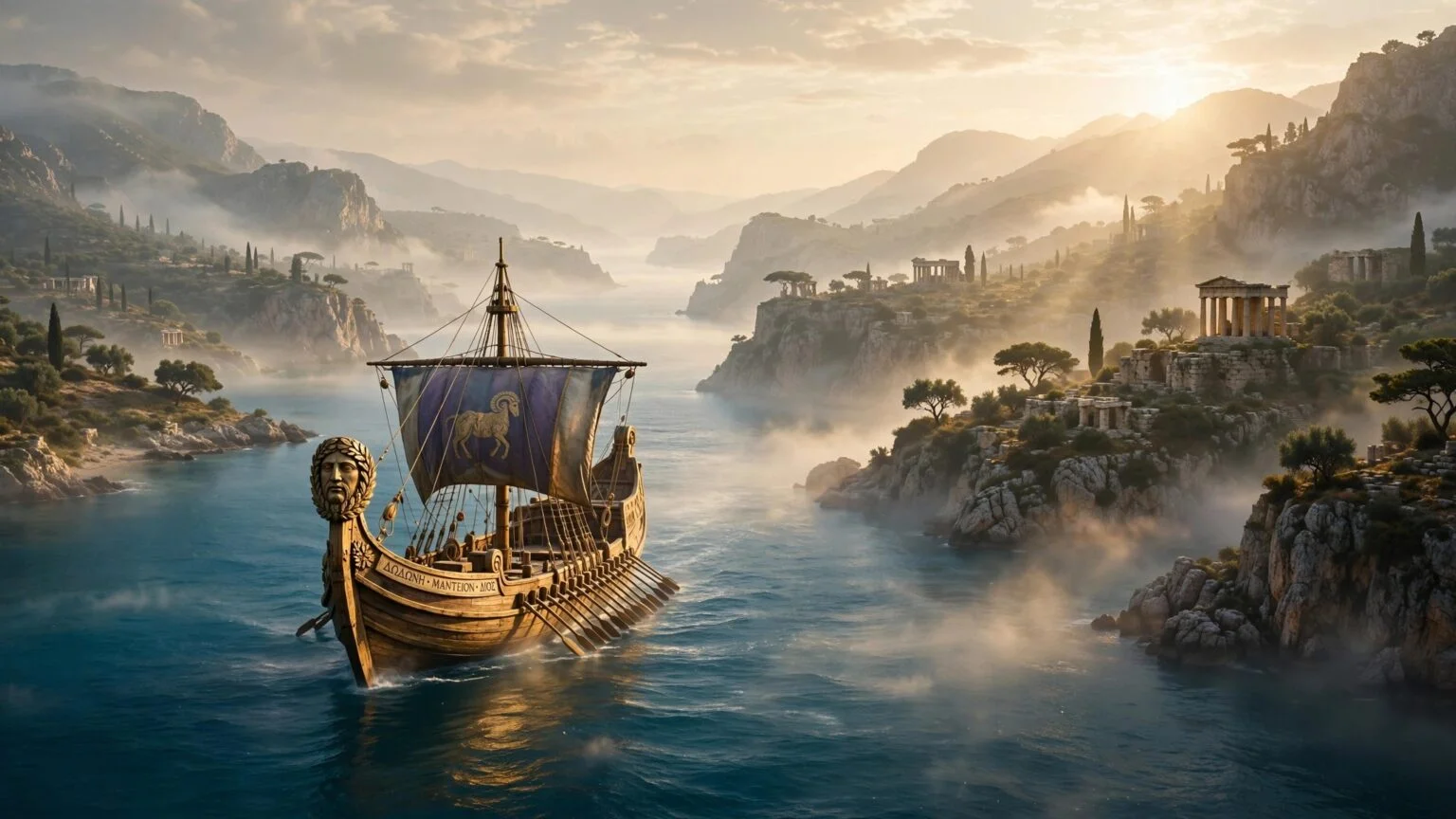
The ship itself was built from timber cut on Mount Pelion, with a speaking plank of oak from the oracle at Dodona built into its bow: the Argo could talk, could receive and transmit divine guidance, was among the first named ships in the Greek tradition and the one whose specific construction had divine oversight built literally into its structure. The ship was the oracle. The crew was the instrument. The mission was set by a prophecy that Pelias had been trying to prevent for years.
The Voyage Out | What Lay Between Iolcos and Colchis
The outward voyage is the myth’s account of what the world contained between the familiar Greek world and its known eastern edge, and each episode along the route addresses a different kind of danger or encounter that the expedition had to navigate.
Lemnos was the first significant stop, and the episode there established a note of moral complexity that the Argonautica would maintain throughout. The women of Lemnos had killed their husbands, and the story attached to this was the story of an entire community’s violent response to a sustained experience of rejection: the Lemnian men had taken Thracian concubines in preference to their wives, and the wives, led by Queen Hypsipyle, had one night killed every man on the island. The Argonauts arrived at an island of women without men, were welcomed, stayed for a year, and fathered children with the women they stayed with. The episode is Greek myth’s most sustained meditation on the relationship between male abandonment and female violence, and Jason’s eventual departure from Hypsipyle is the first of the several abandonments that structure his mythological biography.
Bebryces brought the boxing match with Amycus, whose custom of forcing travelers to box him to the death was the same pattern several of Heracles’s opponents had already established: the king whose power is maintained through the systematic killing of those who cross his territory, the specific form of territorial claim that Heracles’s own civilizing labors were designed to end. Polydeuces killed him with a single blow, and the expedition continued.
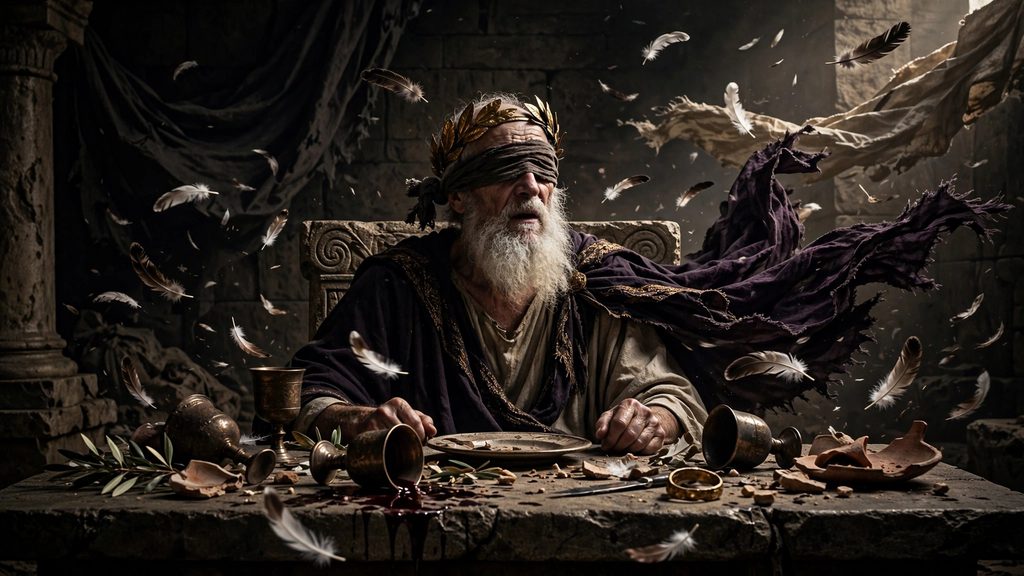
Phineus and the Harpies: the blind king Phineus, who had been given the gift of prophecy and had misused it to reveal too much of what the gods intended, was being punished by the Harpies, the wind spirits who snatched his food every time he tried to eat, leaving him starving despite an abundance of provisions. The Boreads, the sons of the north wind who were among the crew, drove the Harpies away, and Phineus repaid them with the precise, detailed route guidance through the coming dangers that served as the expedition’s navigational plan for everything that followed. The prophet who could no longer safely prophesy did so one more time, for the heroes who had freed him from his punishment.
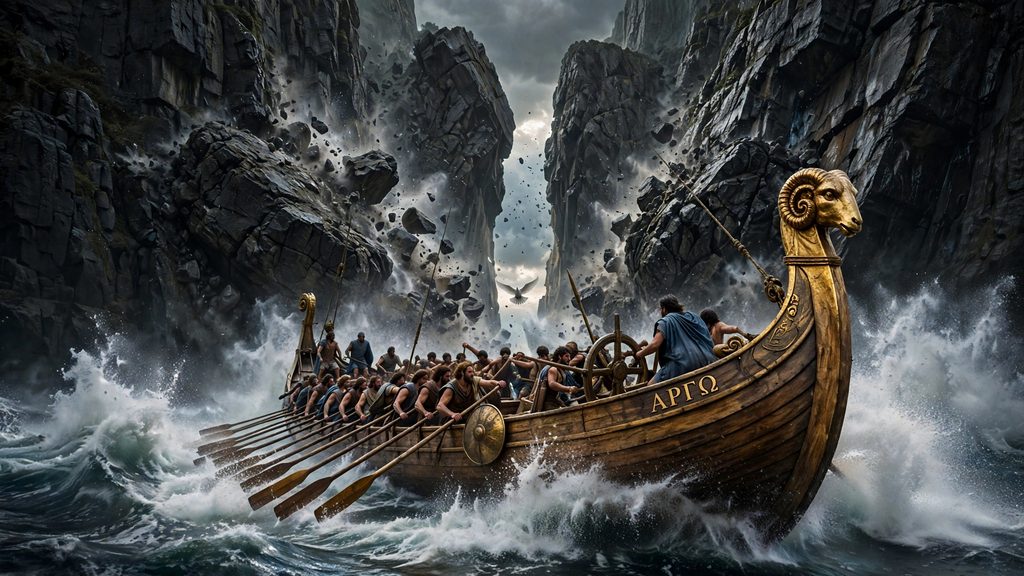
The Symplegades, the Clashing Rocks, were the geographical boundary between the known world and the eastern Black Sea beyond it, the rocks that crushed everything that passed between them by slamming together at the moment of passage. Phineus had told them to release a dove first: if the dove got through, they should row with everything they had. The dove got through with only its tail feathers caught. The Argonauts rowed, Athena pushed the stern through the moment the rocks slammed together, and the rocks caught only the tip of the Argo’s ornament at the stern. The Symplegades were fixed in place forever after. The passage through them was the expedition’s decisive act of boundary-crossing: after this, the Clashing Rocks no longer clashed, and the route to the Black Sea was permanently open. The heroes who completed the impossible crossing made it possible for everyone who came after them.
Colchis and the Impossible Tasks
The Golden Fleece was placed upon and nailed to the branch of a tree in a grove. The grove was guarded by a dragon that never slept, sent by the war god Ares.
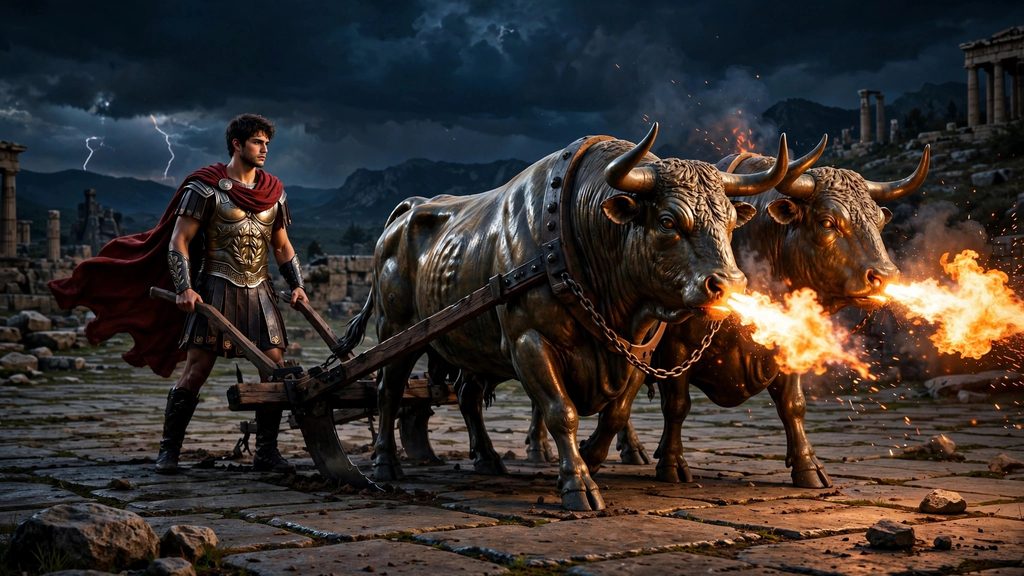
King Aeëtes of Colchis received the Argonauts with the hospitality that the protocol of xenia required, and then set Jason the tasks that the protocol of an impossible mission required: he was to yoke two fire-breathing bronze bulls, plough a field with them, plant the field with dragon’s teeth, and then fight the armed men who would spring from the planted teeth.
These tasks were impossible. The bulls breathed fire. The dragon’s teeth warriors had to be fought alone. No mortal had survived the attempt. Aeëtes designed them specifically for this outcome: according to Diodorus Siculus, the prophecy said that Aeëtes would die on the day when a foreigner steals the Golden Fleece, and this was the reason for his cruelty to foreigners. The king who set Jason the impossible tasks was acting from the same prophylactic logic as Pelias: send the dangerous stranger on the mission most likely to kill him.
Hera intervened, and the form of her intervention is the most significant narrative decision in the entire Argonautica.
Medea | The First Fully Realized Female Interiority in Western Literature
Hera goes with Athena to Aphrodite. Hera asks Aphrodite to enlist her son Eros to bewitch the maiden daughter of King Aeëtes, Medea, with Jason.
Aphrodite complied. Eros shot Medea, and she fell in love with Jason. This is the mechanism, stated plainly, of the divine management of the Argonautica’s central human relationship: Medea did not choose to love Jason. She was made to love him by a divine arrow at the request of two goddesses who needed Jason to succeed in his mission and understood that the only available instrument was the princess who knew her father’s magic.
But what Apollonius of Rhodes does in Book Three of the Argonautica, and what makes his treatment the most consequential literary achievement of the Hellenistic period, is to follow this externally imposed love into Medea’s own consciousness and describe what it feels like from the inside, with a psychological precision that no previous Greek literary tradition had attempted for a female character. The description of Medea’s emotional suffering exercised a profound influence on subsequent writers and especially on Virgil in his account of Dido and Aeneas.
Medea at night, unable to sleep, aware of what she is feeling and aware of what it will cost her to act on it: this is the scene Apollonius wrote with the interiority and the psychological realism that the Greek epic tradition before him, which had given us Achilles and Odysseus in full emotional complexity, had never quite applied to a woman thinking about desire and the consequences of acting on it. She knows that helping Jason will mean betraying her father, leaving her home, abandoning everything she has. She knows that not helping Jason will mean watching him die. She lies in her bed in Colchis and argues with herself, and the argument is one of the most accurately observed accounts in ancient literature of what it feels like to be in the grip of a desire whose consequences you can fully see and cannot stop yourself from following anyway.
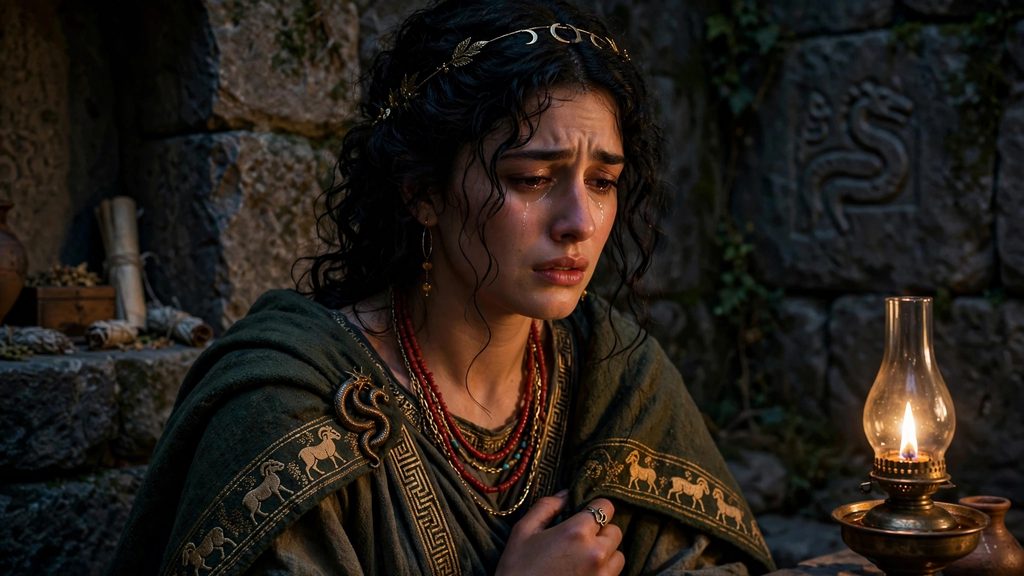
She decided to help him.
She met him secretly, gave him the ointment that would make him invulnerable for the day he had to yoke the fire-breathing bulls, told him how to handle the dragon’s teeth warriors, and extracted from him the promise of marriage as her price. Jason agreed. The promise was the transaction whose violation would eventually produce Euripides’s Medea, the most devastating play about betrayal in Western literature.
Jason debates how to approach Aeëtes. Hera plans to intervene to help the Minyans. He yoked the bulls. He ploughed the field. He planted the teeth, and when the warriors sprang from the earth, he threw a stone among them so that they fought each other over who had thrown it rather than turning their weapons on him. He completed all the tasks. Aeëtes refused to give him the Fleece anyway, planning instead to burn the Argo and kill the crew that night.

Medea, who knew her father, led Jason to the sacred grove, sang the dragon to sleep with enchantments, and Jason took the Fleece.
The Return and Its Terrible Price
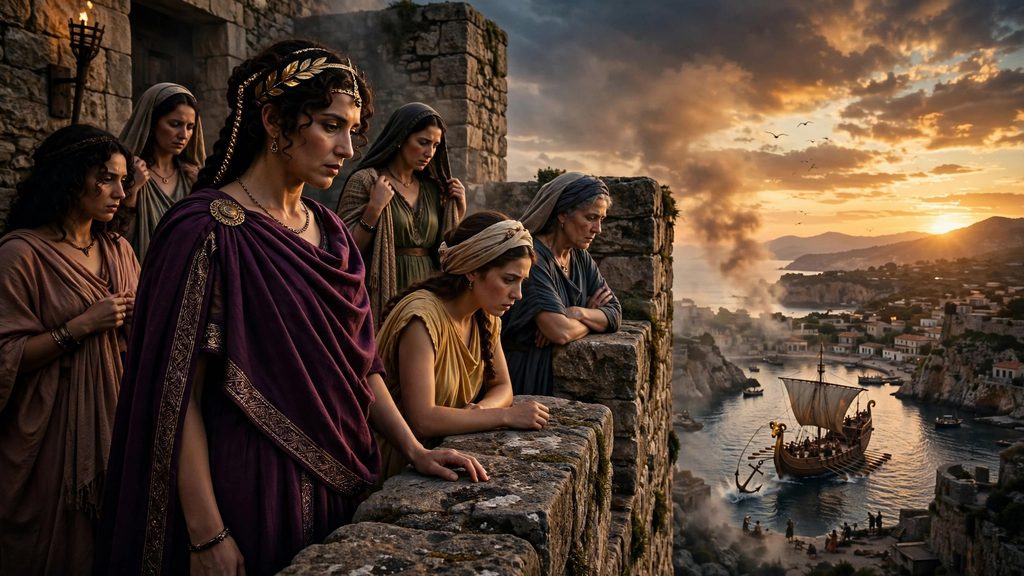
The return voyage was where the real darkness of Medea’s choice became fully legible.
According to Apollodorus, they also took along Medea’s brother Apsyrtus. When Aeëtes pursued them, they killed the child and cut him up, throwing his body into the sea piece by piece to delay Aeëtes as he stopped to retrieve the limbs.
This is the detail that the popular tradition consistently suppresses or softens, because it cannot be softened: Medea, to prevent her father from overtaking the Argo, killed her younger brother and dismembered his body, scattering the pieces behind the ship so that Aeëtes would be slowed by the need to retrieve them for burial. In some versions, Jason carried out the killing at Medea’s instigation. In others, Medea killed Apsyrtus herself. In all versions, it was Medea’s act, Medea’s decision, Medea’s price for the love that had been installed in her by a divine arrow.
The return route through Apollonius takes the Argo on an impossibly varied course, through the Danube and the Adriatic, south to Circe’s island for purification, past Scylla and Charybdis, through territories that the Odyssey would later claim as Odysseus’s own. The two voyages cross and mirror each other in the same mythological geography, the outward Argonautic journey and the returning Odyssean one occupying the same mythological sea, the same edge of the world.
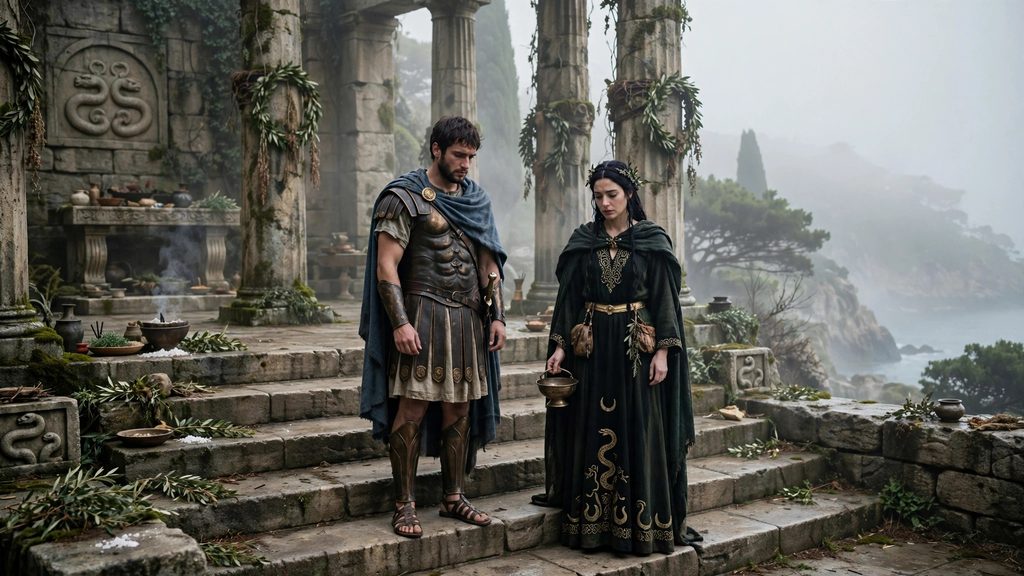
The stop at Circe’s island for purification is the myth’s own acknowledgment of what had been done: Medea and Jason required ritual cleansing before they could return to the human world, because the killing of Apsyrtus was the particular crime of kin-murder, the pollution that ritual purification was designed to address and that no amount of heroic success could simply override. The Golden Fleece in the ship’s hold did not cancel what was required to put it there.
After Colchis | What Jason Did With His Return
They arrived in Iolcos. Pelias, who had expected Jason to die in Colchis, was still on the throne. Medea, whose powers had protected Jason throughout the voyage, now deployed those powers in the service of the revenge that Hera wanted against Pelias.
She convinced Pelias’s own daughters that she could restore their aged father to youth by her magic: she demonstrated the technique by cutting up an old ram and boiling it in a cauldron with herbs, and the ram emerged as a young lamb. Pelias’s daughters, convinced, performed the same procedure on their father. Medea substituted herbs that had no restorative power. Pelias died in the cauldron.
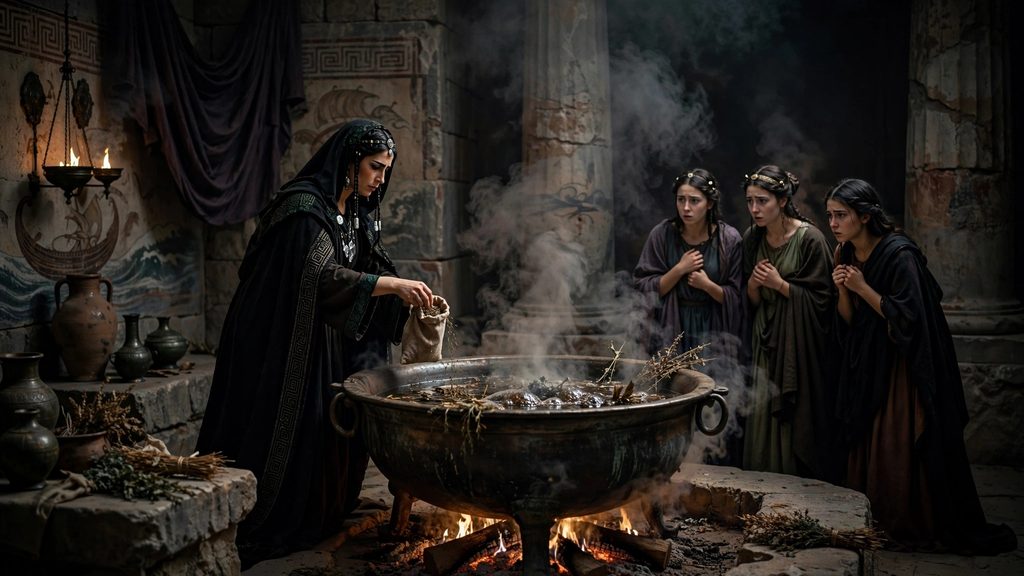
The daughters who killed their father had been manipulated by Medea using the specific power that Jason’s love had given her an occasion to exercise. The revenge on Pelias was complete. Jason and Medea went to Corinth, where the story that Euripides would tell begins.
Euripides and the End of the Promise
The Argonautica ends with the return of the Fleece. Euripides’s Medea, performed in 431 BCE, begins where the voyage ends and tells what happened to the promise Jason made in Colchis.
Jason decided to marry the daughter of the king of Corinth. Medea, who had left her home, killed her brother, betrayed her father, and committed every act of violence and magic that the voyage home had required, who had killed Pelias and seen her husband installed in a new city with the resources the Fleece had secured, learned that the man who had promised to marry her was marrying someone else.
The play that Euripides wrote about what followed is the most devastating account of betrayal in Western literature, and its power comes from the nature of what Medea was: a foreigner in a city that was not hers, without the family connection or the civic status that would have given her any recourse through normal social channels, entirely dependent on the promise Jason had made in Colchis as the single institutional structure supporting her position in the human world. When Jason broke that promise, he destroyed not simply a marriage but the entire framework within which Medea’s existence in the Greek world had any legitimate claim to recognition.
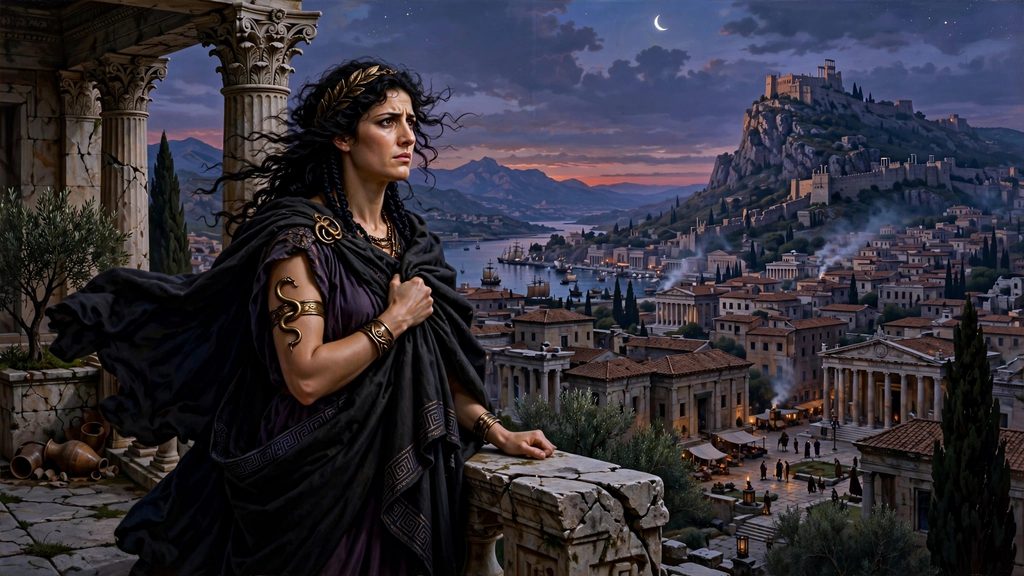
What Medea did in response has been argued about since Euripides staged it: she killed her own children to remove the thing Jason valued most. The ancient sources disagreed about whether Euripides invented this ending or drew it from an earlier tradition. What is not disputed is that Euripides’s Medea is the first extended literary portrait of a woman who chooses the most extreme available act of revenge over the most extreme available act of submission, and who does so with the full consciousness of what she is choosing, understanding every dimension of the cost.
The description of Medea’s emotional suffering exercised a profound influence on subsequent writers and especially on Virgil in his account of Dido and Aeneas. Virgil’s Dido is Medea translated into a Carthaginian queen, abandoned by her Aeneas as Medea was abandoned by her Jason, but denied even the terrible agency that Euripides gave to Medea: Dido kills herself rather than her children. The line runs from Apollonius’s Medea lying awake in Colchis through Euripides’s Medea in the burning house in Corinth through Virgil’s Dido on the pyre through every literary portrait of a woman destroyed by an abandoned promise, and it begins in Colchis, with a girl who could not sleep because a divine arrow had been shot into her and she was trying to decide what to do about it.
What the Golden Fleece Actually Was
The ancient world offered several rationalizations of the Golden Fleece’s origin that the scholarly tradition has found more interesting than the simple myth suggests.
Per Apollonius’s Argonautica, the Argo sailed back across the Black Sea but rather than return through the Straits of Bosporus, entered the mouth of the Ister River and followed it all the way to the Adriatic Sea. The geography of the voyage, however fantastical in its later elaborations, tracks a genuine Bronze Age trade route: the eastern Black Sea coast, the Caucasus, the territories beyond the Bosphorus that the Mycenaean world was actively exploring in the second millennium BCE. Colchis is in the territory of modern Georgia, and the traditions of gold panning in the rivers of the Caucasus, using sheepskins to trap the gold dust that the river current carried, have been proposed by scholars since antiquity as the historical reality behind the fleece: an actual golden sheepskin, heavy with placer gold collected from a Caucasian river, the object that gave rise to the mythological elaboration.
Whether or not this explanation is correct in its specifics, the general principle it encodes is the right one: the Argonautica preserves the memory of a genuine Bronze Age expansion of Greek commercial and exploratory reach into the eastern Black Sea world, and the Golden Fleece is the mythological form that the object of that commercial desire took in the collective memory of what was worth going to the edge of the known world to find.
The Poem That Recorded It
Apollonius of Rhodes composed the Argonautica in four books, approximately 5,835 lines, at Alexandria, most likely between roughly 270 and 245 BCE, though the exact dates of his life and career remain, like much else about him, a matter of scholarly reconstruction rather than certainty. The Argonautica is the only extant Greek epic between Homer and the later Roman Empire.
Apollonius wrote at the Alexandrian Library, at the center of the Hellenistic world’s most ambitious institutional project of literary preservation and scholarship. Later ancient testimony holds that Apollonius served as Royal Librarian under Ptolemy II Philadelphus, a tradition supported by a papyrus list of the Library’s successive heads that places him between Zenodotus and Eratosthenes, roughly in the decade after 260 BCE, though the ancient biographical sources disagree on details and modern scholars treat the reconstruction as probable rather than certain. If the tradition is accurate, the man who preserved the Argonautica was the librarian of the greatest library the ancient world produced, and the poem he wrote about the first great pan-Hellenic sea voyage was composed in the city whose own founding by Alexander was the first great pan-Hellenic land expedition.
The Argonautica that Apollonius composed drew on everything that preceded it: sources include Homer, Pindar’s Fourth Pythian Ode, Medea by Euripides, and the lost Colchian Women of Sophocles. Several Homeric conventions occur: the catalog of heroes like the Catalogue of Ships, the embroidered cloak like Achilles’s shield, the advice of Phineus like Circe’s and Tiresias’s, scenes of various kinds like the Phaeacian scenes in the Odyssey.
The poem was already in conversation with the poets who had produced Homer’s epics and Euripides’s tragedies and Pindar’s odes, was aware of what it was doing in relation to each of those predecessors, and was making deliberate literary choices about how to handle material that poets had been handling for centuries before Apollonius brought his Alexandrian scholar’s attention to bear on it. The treatment of Medea’s interiority in Book Three was his most original contribution and his most enduring one: the first attempt in extant Greek literature to render a female consciousness in the full complexity of its experience of desire, calculation, grief, and decision.
What Jason Was
Jason is the Argonautica’s most problematic figure, and the honesty with which the poem handles his inadequacy is one of its finest achievements.
He is not the greatest warrior among the Argonauts: Heracles was, before he departed. He is not the greatest intellectual: Orpheus was. He is not the greatest athlete: Polydeuces was. He is not the greatest seer: Phineus gave the crew its navigation. He is not the most powerful magician: Medea was, by an immense margin.
What Jason was, in Pindar’s formulation and in every later poet’s consistent characterization, was beautiful and persuasive: a man whose physical grace and whose way with words made people, and gods, and eventually a foreign princess want to help him. He assembled a crew of people who were better than him at everything the mission required and then led them with the skill of a person who knows how to ask for what he needs and make the asking feel like an honor to the person asked.
This is not a small skill. The Trojan War’s Agamemnon, who also led a coalition of heroes stronger than himself, failed at it repeatedly and catastrophically. Jason managed it across a voyage to the edge of the world and back, and the recognition that the specific gift of leadership, of assembling and sustaining a coalition of superior individuals for a shared purpose, was itself a form of heroism rather than simply the absence of other heroism, is one of the Argonautica’s most sophisticated contributions to Greek myth’s ongoing argument about what heroism actually was.
He failed one test. He broke his promise to Medea. Neither the myth nor Euripides ever forgave him for it.
Ultimately the Argo was abandoned and left to rot. While sleeping in its shade, an aged Jason was killed when the stern broke and crushed him.
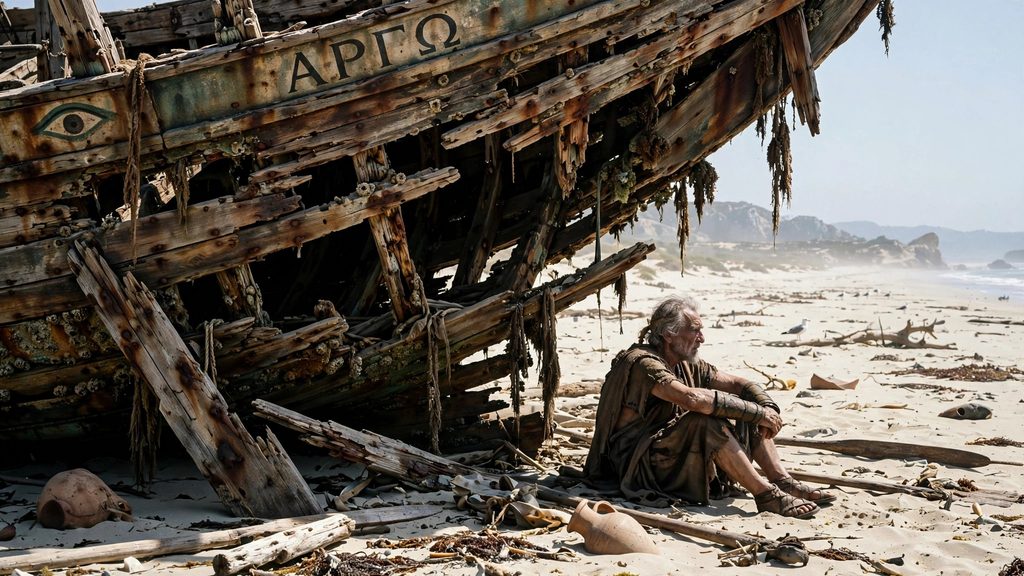
The hero who sailed on the most famous ship in the Greek tradition died under its rotting wreck, in old age, in the shade of what he had once commanded. The Argo gave him one more service at the end: a death that was not quite heroic and not quite accidental, the stern breaking over the man who had once navigated through the Clashing Rocks, the ship’s final act the final verdict on the voyage it had made possible.
The Golden Fleece, which brought him home, never returned him what he had paid for it.
At Olympus Estate, Tales from Olympus moves through the deeper currents of the Greek tradition. Homer’s Odyssey calls the Argo known to all, evidence that the voyage predated even his own epics in the Greek oral tradition. Pelias sent Jason to Colchis expecting the mission to kill him, and Hera, who owed Jason a debt from a river crossing, made sure it did not. The crew, drawn from the heroic generation before Troy, included Heracles, Orpheus, and the Dioscuri, though whether Atalanta sailed among them depends on which ancient source you trust: Apollodorus includes her, Apollonius has Jason turn her away. Medea’s love for Jason, engineered by three goddesses and an arrow from Eros, produced in Apollonius’s Book Three the first fully realized female interiority in Greek literature, a portrait that shaped Virgil’s Dido and, through Euripides, the most devastating betrayal in Western drama. The Fleece came home. What it cost to bring it never stopped being paid.