

Everyone knows about the boulder.
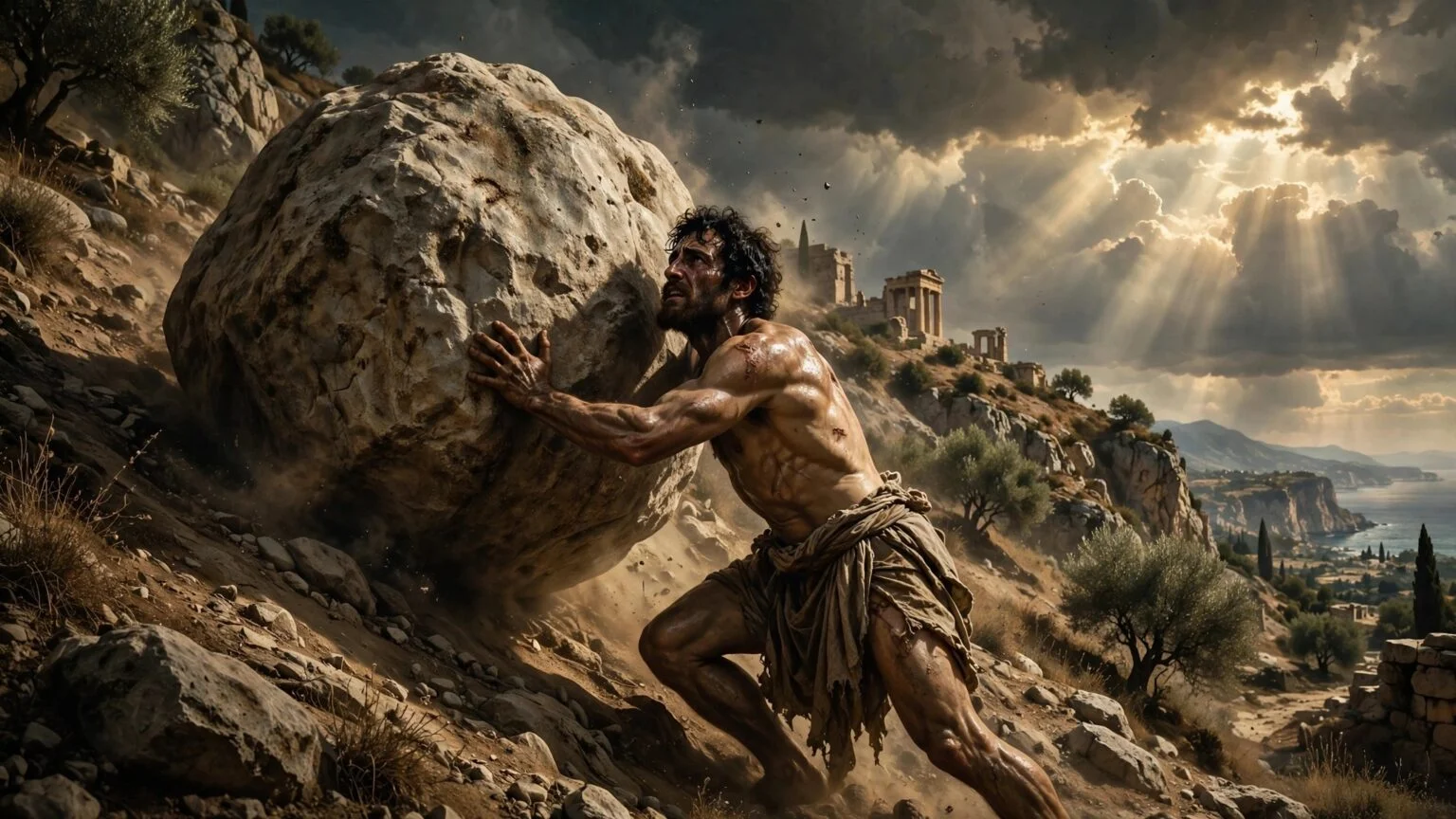
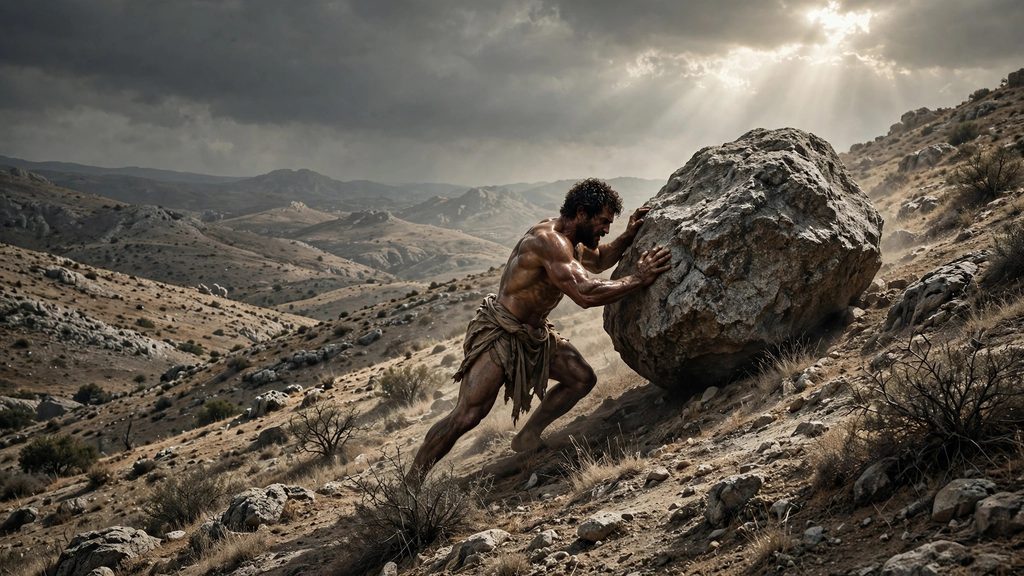
The image is one of the most recognizable in the entire Western tradition: a man pushing an enormous rock up a steep hill, watching it roll back down the moment he reaches the top, turning around and beginning again, forever. The Sisyphean task has entered the language as the standard metaphor for labor that produces no result. Albert Camus built a significant piece of his philosophical career on this image, and his conclusion, that one must imagine Sisyphus happy, became one of the more quoted lines in twentieth century philosophy.
What almost nobody knows is what Sisyphus did before the boulder.
He captured Death itself and chained it up, and while it was chained, nobody on earth could die. Not the very old, not the very ill, not the soldier with an arrow through his chest on a battlefield in front of Troy. The boulder is not a punishment for trying to be clever. It is a punishment for succeeding, twice, at something no mortal was ever supposed to succeed at even once.
Homer’s Word for Him
Before the boulder became the symbol, Sisyphus was already famous in the Greek tradition for something entirely non-symbolic: his intelligence. Homer’s own word for him, in the genealogy Glaucus recites in the sixth book of the Iliad, is kerdistos, the craftiest of men, the same line that names him father of Glaucus and grandfather of Bellerophon. It places him in direct comparison with Odysseus, whose craftiness is the defining quality of the Odyssey, examined in full elsewhere on this site, and whose metis, the specific form of cunning practical intelligence the Greek tradition distinguished from brute strength or divine favor, is his single most famous heroic attribute.
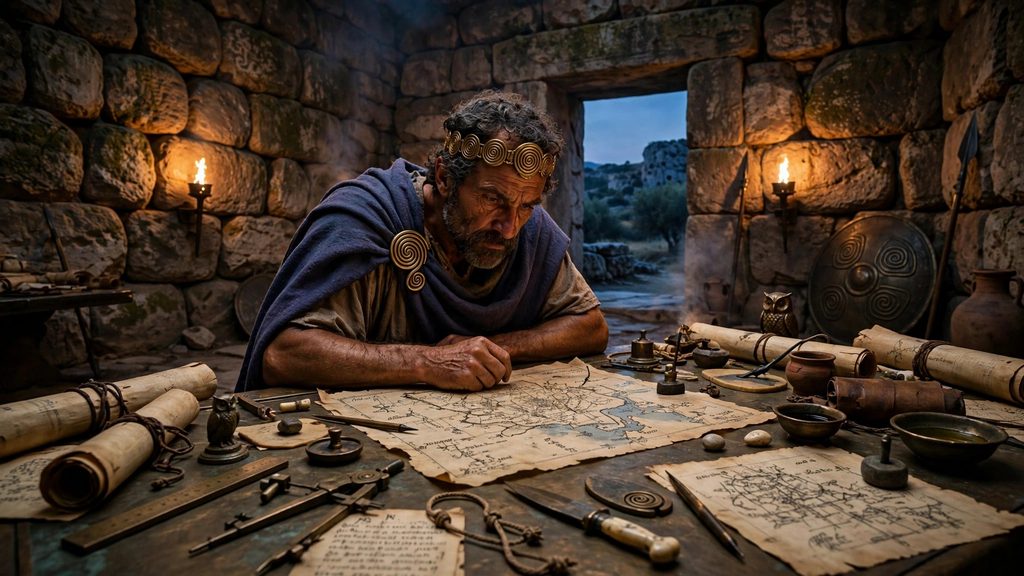
Some later mythographers pushed the comparison further than mere resemblance. A tradition preserved in Hyginus and echoed elsewhere holds that Sisyphus was Odysseus’s actual biological father, seducing Anticleia before her marriage to Laertes to test whether he could outwit the master thief Autolycus, her own father, at his own game. In this version, the craftiest man to survive the Trojan War inherited his cunning directly, by blood, from the craftiest man who ever chained Death. Whether or not the tradition is meant to be taken literally, it captures something the ancient audience clearly wanted said out loud: that Odysseus’s intelligence had a lineage, and the lineage ran through Sisyphus.
He did not fail from lack of trying to escape mortality. He succeeded. He stopped death, lived past the moment his own death was appointed, talked his way out of the underworld after he had already died and been received there, went home, and lived to a ripe old age before dying again. Only then, in the underworld for the second time, did he meet the punishment that had been waiting.
The King Who Built a City on Its Games
Before any of the death-defying episodes that made him famous, Sisyphus was already Corinth’s founding king, and he had already given the city one of its defining institutions. When the body of his nephew Melicertes washed ashore on the Isthmus, carried there by a dolphin after the boy’s mother Ino leapt into the sea with him to escape a madness Hera had inflicted on the household, Sisyphus, according to the Corinthian foundation tradition preserved in Pausanias and Pseudo-Apollodorus, recognized what he was looking at, buried the child with full honors, and founded funeral games in his memory.
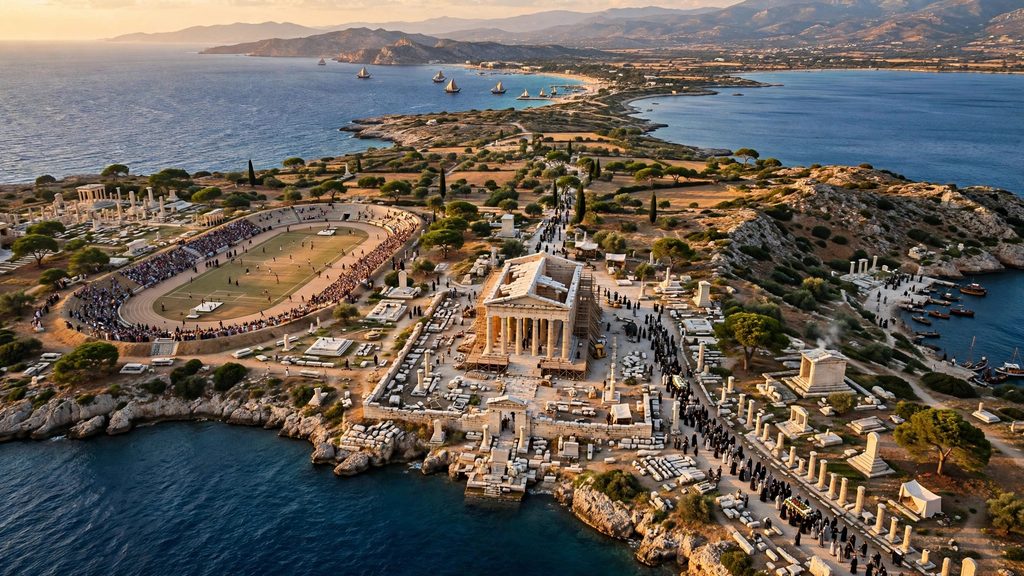
Those games became, in this same tradition, the Isthmian Games, one of the four great Panhellenic festivals of the ancient Greek world, standing alongside Olympia, Delphi, and Nemea. Not every ancient source agreed on the credit. Athenian tradition claimed Theseus as the games’ true founder instead, a rival account that served Athens’s own interests as directly as the Corinthian version served Corinth’s. What survives is not a settled fact but two cities’ competing claims to have produced one of the most important recurring gatherings in the Greek world.
The King of Corinth and His First Crime
Asopus, a river god, came to Corinth searching for his daughter Aegina, who had disappeared. Sisyphus promised to tell him what had happened to her in exchange for an eternal spring for his kingdom. Asopus agreed and created the spring. Sisyphus named Zeus as the abductor.
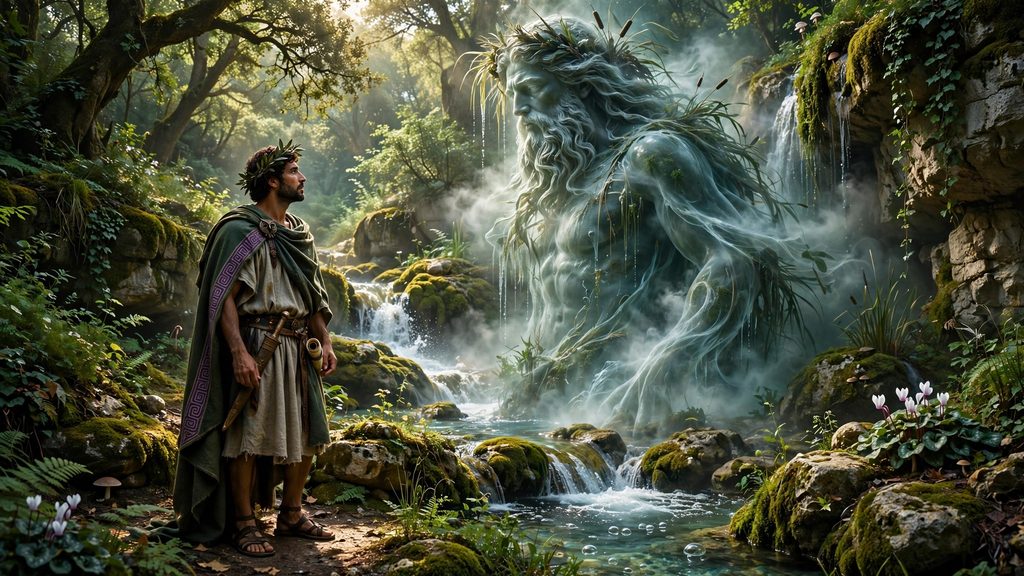
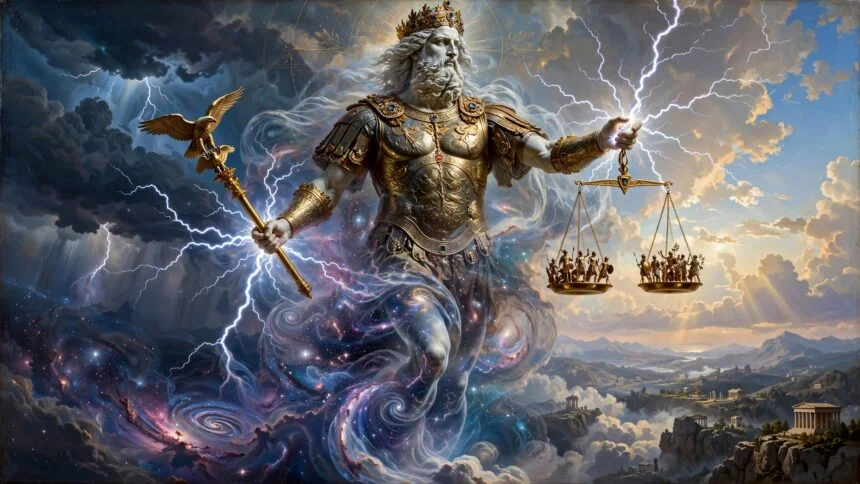
This transaction establishes the essential character of the Sisyphean intelligence before any supernatural element enters the story: he possessed information of real value, identified exactly who would pay most for it, and negotiated accordingly. That Zeus had in fact taken Aegina was not in dispute in the ancient sources. Sisyphus reported accurately. The crime was not a false accusation but a true one, the disclosure of a divine secret for personal gain, and the Olympian hierarchy responded with the fury of authority caught behaving badly and reported to precisely the wrong audience. Zeus dispatched Thanatos, Death itself, to collect Sisyphus and bring him to the underworld immediately.
The Chaining of Death
When Thanatos arrived, Sisyphus asked how the chains he carried actually worked. Thanatos, apparently never having been asked this before, agreed to demonstrate, and Sisyphus snapped the chains shut on Death instead of himself. The specific mechanism varies slightly between sources, but every version agrees on the outcome: Thanatos was chained, and the process of death was suspended entirely, for everyone, everywhere.
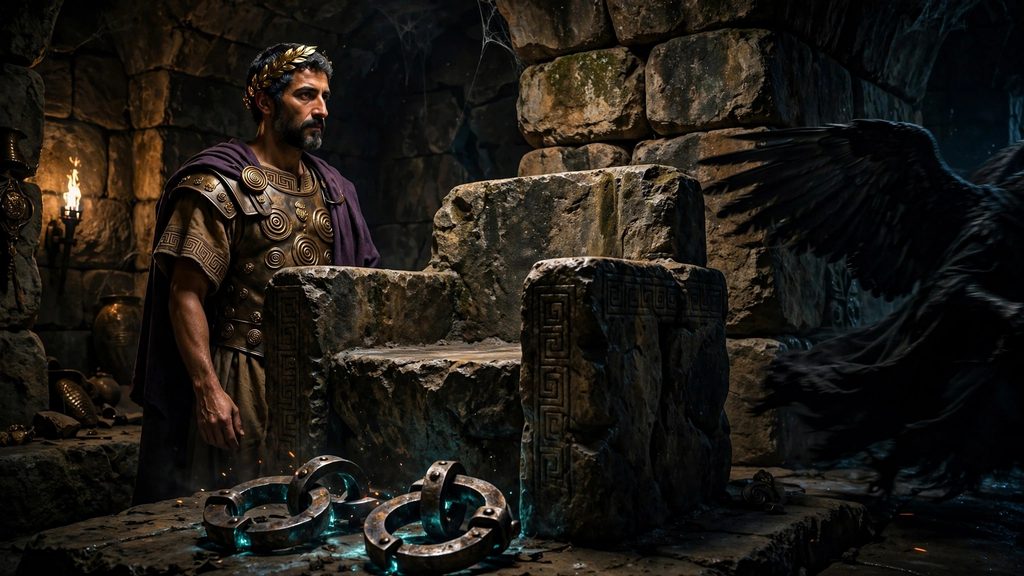
This period is not the mythological background to the real story. It is the real story, and its consequences are the Greek tradition’s most precise account of what mortality actually does for the world. The sick could not die and could not find rest. The wounded continued accumulating injury without the relief of death ever arriving. Every warrior on every battlefield in the Greek world kept fighting without any of the wounds their enemies inflicted ever becoming final. And Ares, god of war, could not tolerate what his wars had become. War without death, it turned out, was not war at all. It was meaningless violence accumulating without consequence, and Ares went to free Thanatos himself, because his own professional domain required death more urgently than any other deity’s did. The god who values death above everything else in a battle was the one who restored it to the world. Greek myth rarely states its own logic this plainly: that death is not war’s tragedy but its actual point, and that combat stripped of the genuine possibility of dying produces nothing that war is supposed to produce at all.
Ares’s own troubled relationship with what war actually required of him is examined at length elsewhere on this site, and this episode is one of the clearest illustrations of it: the god most Greeks found hardest to love was, in this particular myth, the one who understood most precisely what made warfare mean anything.
The Second Deception | Arguing His Way Out of the Underworld
Thanatos was freed. Sisyphus died and descended to the underworld, which should have ended the story, and for any other mortal it would have. But Sisyphus had instructed his wife Merope beforehand not to perform his burial rites and not to make the customary offerings to the gods of the dead, arriving in the underworld deliberately unprepared, with a grievance already assembled.
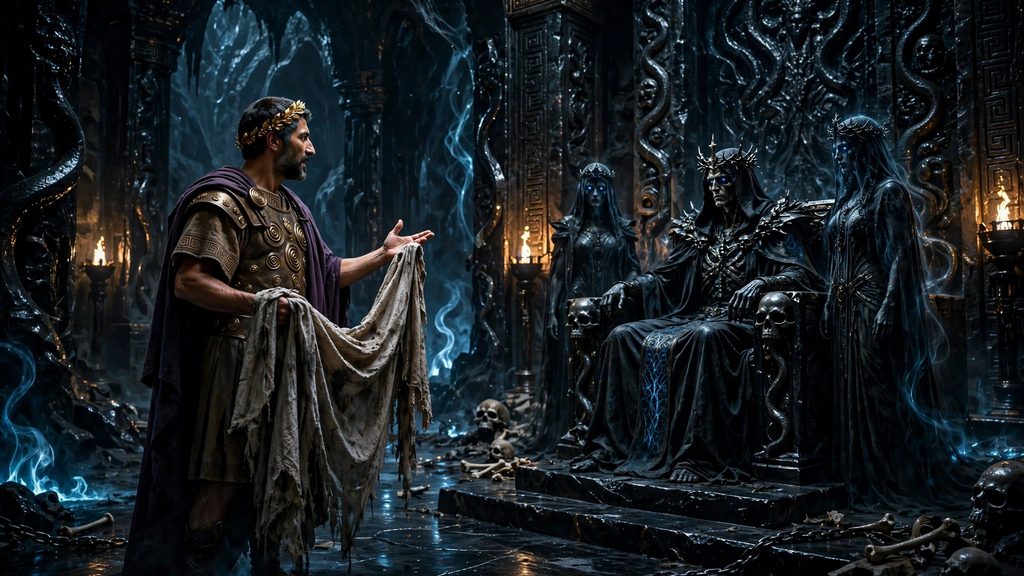
In the oldest surviving account of what happened next, preserved through the fifth century BCE mythographer Pherecydes and Aeschylus’s own lost satyr play Sisyphus the Runaway, it is Hades himself, deprived of the customary offerings his wife had withheld, who was persuaded by the trickster to let him return to the living world and correct the failure of his own funeral rites. A separate, later tradition places Persephone, Queen of the Dead, examined in full elsewhere on this site, in that same role instead, which is why modern retellings often name her as the one Sisyphus deceived. The variation is worth keeping rather than smoothing away. Either way, the mechanism is identical: Sisyphus turned the underworld’s own procedural expectations, that the dead be properly mourned and provisioned, into the exact argument that got him released from it. He went home, lived out a full second life, and died again only when age finally caught him a second time, having persuaded the ruler of the dead to open his own kingdom’s gate. Hermes eventually had to be sent to physically retrieve him, a detail the tradition preserves with the specificity of something that genuinely required that level of divine intervention: not a second death alone, but a forcible retrieval, the god of boundaries going into the living world to drag back a dead man who had simply refused to stay where dead men belong.
The Punishment and Its Precision
The boulder is not an arbitrary torture. It is the exact inverse of what Sisyphus had spent his life doing. He found the endpoint and removed it, twice, through two different mechanisms, and the universe’s most fundamental irreversible process was reversed by the single craftiest man inside it.
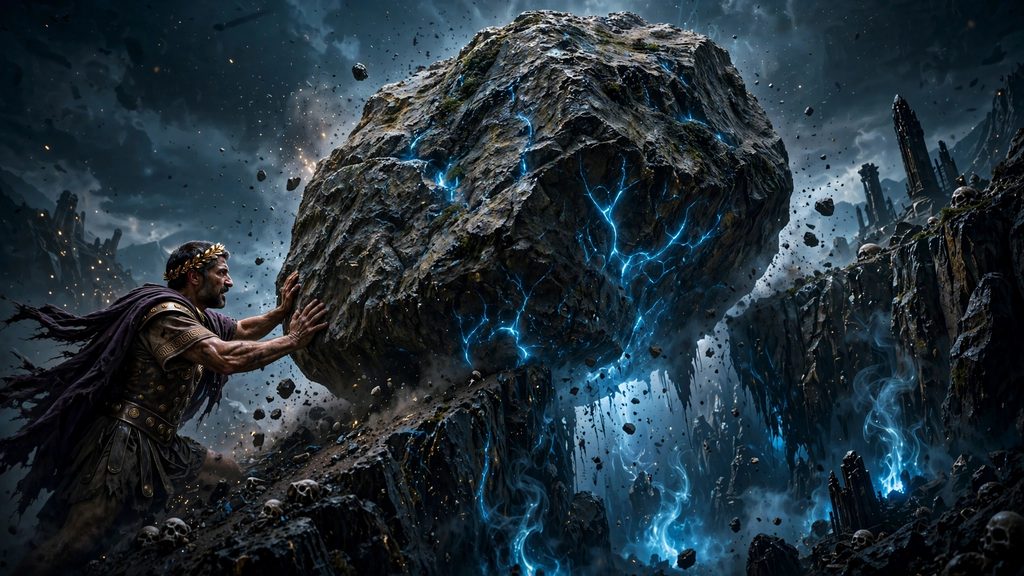
The boulder is the permanent embodiment of a process that reaches its endpoint and immediately undoes it. He reaches the top of the hill and the stone rolls back down. The completion reverses itself. The endpoint he spent his mortal life defeating has become his permanent condition, not the absence of an endpoint but an endpoint that continuously negates itself, forever, without relief. The man who stopped death was given a death that stops itself. Greek divine punishment is almost always the precise inversion of the crime it answers, and the boulder may be the most precisely calibrated example in the entire tradition.
Camus and the Question He Asked
Albert Camus’s 1942 essay The Myth of Sisyphus took the boulder and the hill and asked a question the Greek tradition never asked, because the Greek tradition was interested in the justice of the punishment, not in finding meaning inside it. Camus located the specific moment of freedom in the descent, the walk back down after the boulder has rolled, in the interval between one attempt and the next, when Sisyphus is fully conscious of his situation and has not yet resumed the labor. In that moment, Camus argued, Sisyphus is superior to his own punishment. He knows what he is doing. He knows it will not work. He chooses to do it again anyway, and the choice, however constrained, is the specific form of freedom available to a consciousness that fully understands its own condition.
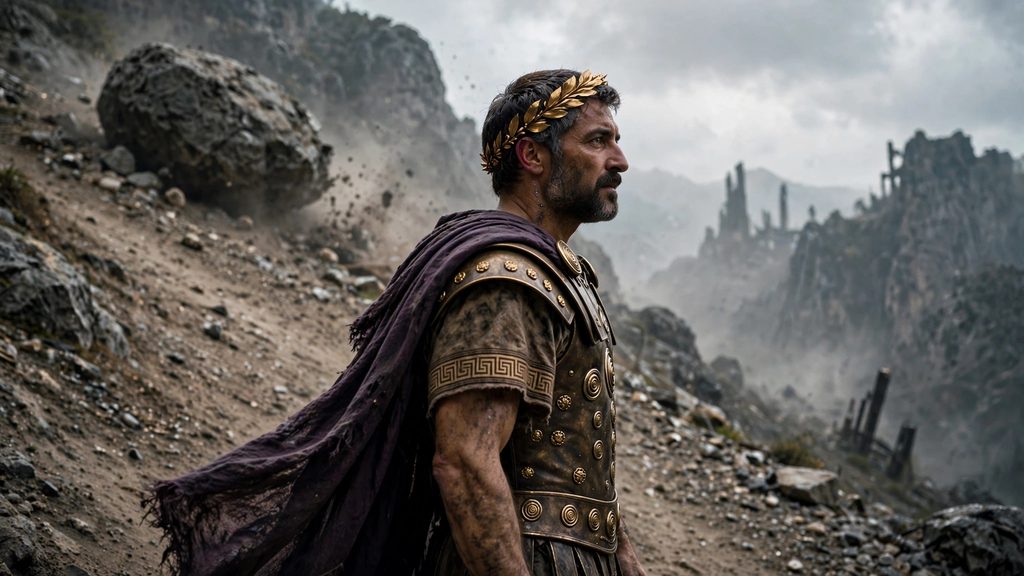
The Greek tradition would not have recognized this reading, because it was never interested in Sisyphus’s consciousness between attempts, only in what the punishment said about the consequences of refusing mortality. What the Camusian reading deliberately sets aside is the craftiness itself. The man walking down the hill in Camus’s essay is Everyman, the representative human consciousness confronting the absurd. The man walking down the hill in the Greek myth is the one man who looked at the human condition and found a way around it, twice, and lived a full second lifetime on borrowed time after each attempt. The question Camus did not ask is the one the Greek myth was actually answering all along: not whether Sisyphus is happy, but whether the escape was worth it. He stopped death. He lived twice. And then he pushed the boulder.
The Merope Question
Among the details the popular tradition consistently omits is the identity of his wife. Merope was one of the Pleiades, examined in full elsewhere on this site, the seven daughters of Atlas whose rising and setting the Greek agricultural calendar used to mark the ploughing and harvest seasons. Six of the sisters are visible to the naked eye. Merope, the dimmest, barely visible at all, was explained by the tradition as the only Pleiad who had married a mortal man rather than a god, and who hid her star in shame for it.

The woman who married the craftiest man in the world hid her light for it. The wife he instructed to leave him unburied, whose resulting omission became his pretext for walking back out of the underworld, is one of the Pleiades still, visible on autumn evenings when the cluster rises in the east: six bright stars and one dim one, the one whose husband came back from the dead twice and refused, both times, to stay where he was put.
What the Boulder Actually Is
The boulder is famous, and it deserves to be. It is one of the most precise images in the entire mythological tradition for a quality of punishment the human mind can actually receive: not pain, not deprivation, not isolation, but the endless performance of meaningful effort that produces no lasting result. What makes it specific to Sisyphus rather than a generic torture is everything he did before the boulder existed. He found the gap between a rule and its enforcement, the moment of inattention where a chain could be applied to the wrong hands, the argument precise enough to persuade the Queen of the Dead to make an exception for him alone. He was, Homer said, the craftiest of men, and craftiness is the specific kind of intelligence that finds its way around what other kinds of intelligence simply accept.
The boulder has no around. The hill has no gap in its logic. The stone rolls back not because someone was inattentive or because the mechanism contained a flaw the craftiest man alive could exploit. It rolls back because rolling back is what it does, permanently, and there is no Thanatos left to chain, no Persephone left to persuade, no wife’s omitted rites left to serve as a pretext for return. The tradition remembers Sisyphus as the symbol of the folly of trifling with humanity’s inescapable lot of mortality. He escaped that lot twice. The word inescapable is doing real theological work in that sentence, and it only becomes true, finally, at the exact moment the boulder starts rolling.
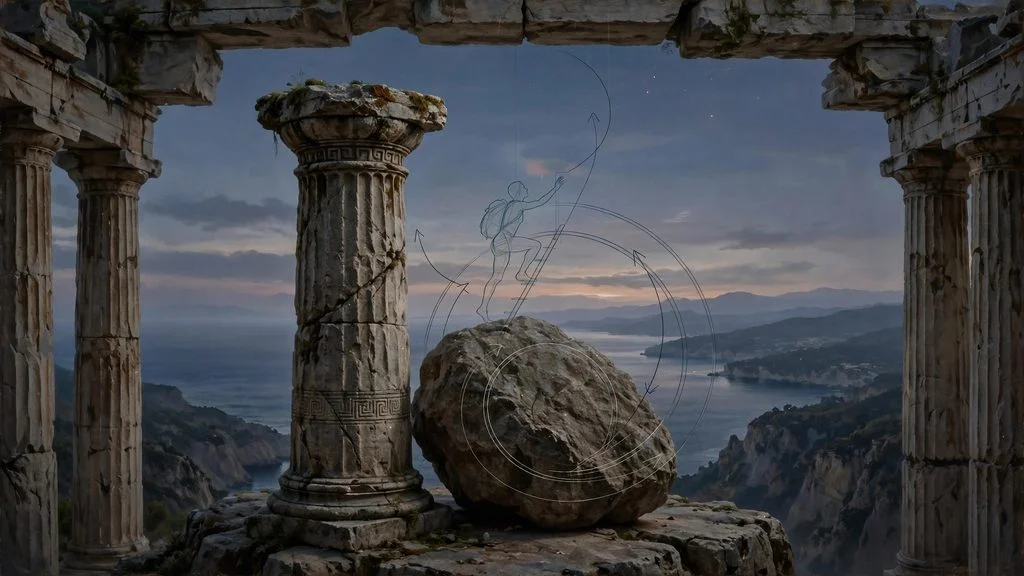
One must imagine Sisyphus happy, Camus said. The Greek tradition’s own answer to whether the escape was worth it is not a philosophical essay. It is the image of a man walking back down a hill to pick up a boulder he will push to the top again, forever, having already gotten away with more than any other mortal in the tradition ever did.
At Olympus Estate, Tales from Olympus moves through the deeper currents of the Greek tradition. Before the boulder, Corinthian tradition credited Sisyphus with founding the Isthmian Games, and Homer himself named him the craftiest of men, with some later traditions even making him Odysseus’s true father. He chained Thanatos, Death itself, halting mortality everywhere until Ares, unable to tolerate wars without casualties, freed him again. He then talked his way out of the underworld a second time, persuading Hades himself in the oldest surviving version of the story, living a full second lifetime before his actual punishment ever began. His wife Merope, one of the seven Pleiades, still hides her star in the night sky for having married him. Camus asked whether Sisyphus could be happy pushing the boulder forever. The Greek tradition was asking a harder question first: whether escaping death, twice, was worth what it finally cost him.