



The word does not mean best man.
This is the first correction worth making, because the translation reached for most often by English-speaking Greeks and by the Greek diaspora, best man, maid of honor, godparent, quietly empties the institution of what it actually does. A best man performs duties at a wedding and returns to ordinary friendship the following week. A godparent may or may not remain involved in a child’s upbringing. These are roles, assigned for an occasion and retired when the occasion ends. The koumbaros is something else, a relationship the Greek world has never treated as temporary, and the difference is not a matter of translation but of what kind of bond the word is describing.
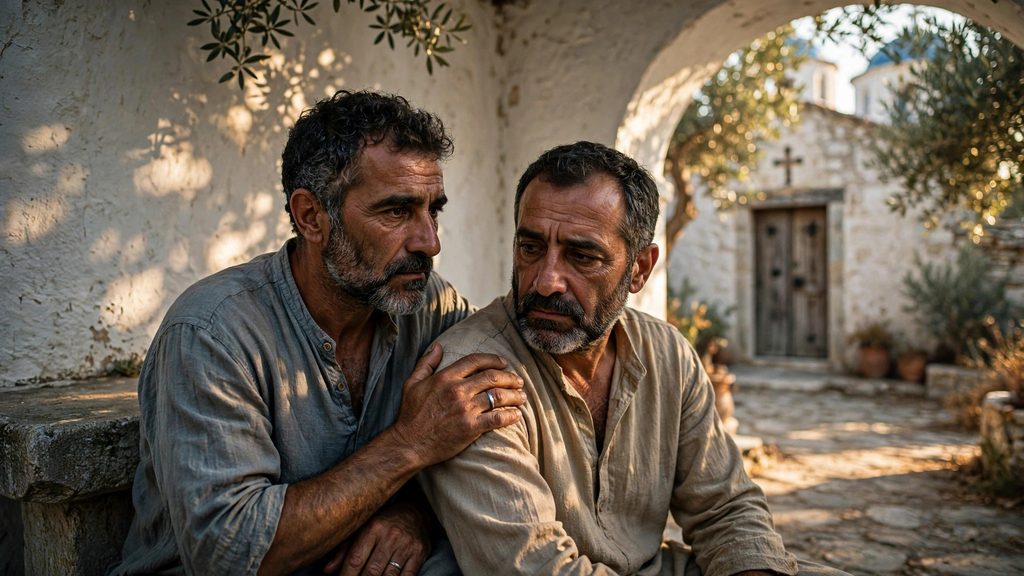
The Greek language keeps a category of relationship, syngeneia, kinship, and inside it a further category, pnevmatiki syngeneia, spiritual kinship, that does not depend on blood. The koumbaros belongs to that second category. He is not your friend in the sense that a groomsman is a friend. He is a sponsor whose standing inside the Orthodox wedding service goes well beyond an attendant’s, close enough to the couple to be entrusted with specific ritual actions, though the sacrament itself remains the priest’s to perform, not his.
A Word Venice Left Behind
The word koumbaros traces back to the Latin compater, built from cum, with, and pater, father, a co-father, a man who is a father alongside the actual father rather than in place of him. The word did not travel into Greek directly from Rome. It arrived by a more specific and more interesting route, through the Venetian compare, the form the word took in the language of the Republic that ruled large parts of the Greek world for centuries, the Ionian Islands, Crete, stretches of the Aegean under Venetian and Frankish administration in the long era after 1204. The Greek koumbaros carries, inside its own sound, the memory of that occupation, a Latin idea of co-fatherhood filtered through Venetian mouths before it settled into Greek ones and became something the Latin and Venetian worlds themselves would no longer entirely recognize.

What it became is a relationship considerably weightier than the Italian compare or the Spanish compadre it shares a root with. Those words describe a warm, respected connection. The Greek koumbaros describes a legal and sacramental status, created by the Church in a specific ceremony, carrying specific canonical consequences, and binding not two people but two entire families to each other for as long as both families exist.
What His Hands Actually Do
The Orthodox wedding service does not give the koumbaros a seat and a role to watch from. It gives him two specific physical actions, and the theology of the sacrament requires that a specific kind of person perform them, a baptized Orthodox Christian in good standing with the Church, because what is happening is not decoration but participation.
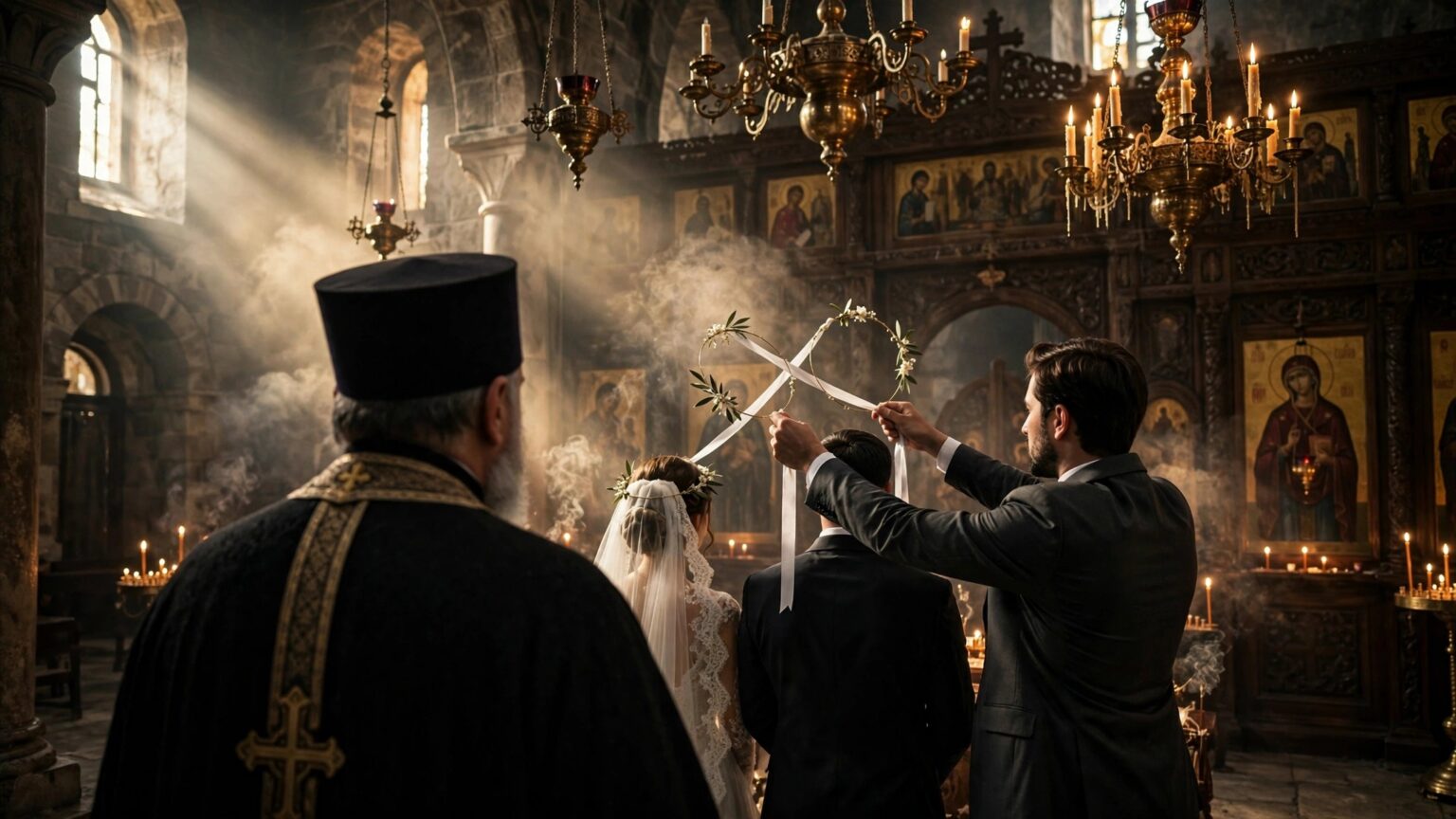
During the betrothal, the priest blesses the rings on the altar and places them on the couple’s hands, and it is the koumbaros who then moves them back and forth between bride and groom three times, in the name of the Father, the Son, and the Holy Spirit, so that each ring touches each hand before the exchange is complete. Later, in the Service of Crowning, the sacrament’s central act, the priest blesses the stefana, the paired crowns joined by a ribbon that are Orthodox marriage’s most distinctly Byzantine image, part of the Byzantine inheritance still visible across Greek life today, and sets them on the couple’s heads, and it is the koumbaros who then takes over, switching the crowns three times in the same Trinitarian rhythm, left to right and back, crowning the husband as a king of his own household and the wife as its queen. The priest performs the sacrament. The koumbaros performs the specific ritual actions the priest hands to him, and the distinction matters, because it is exactly what separates a witness from a participant without ever confusing the participant with the celebrant.
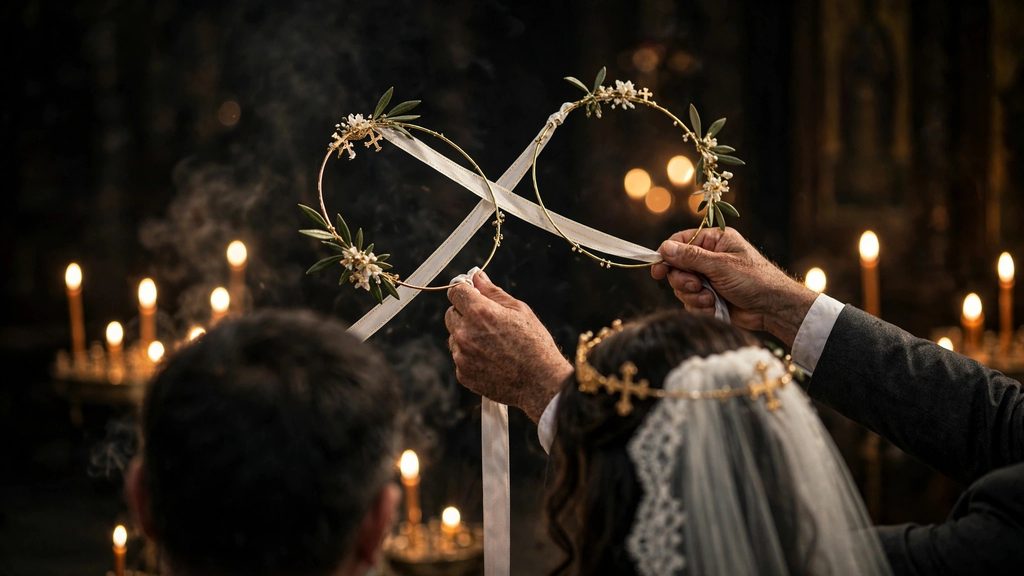
A ceremonial witness stands nearby and watches. The koumbaros stands inside the sacrament and works, his hands doing the specific movements the liturgy assigns him, close enough to the altar to matter and still, always, a layperson standing beside a priest rather than in his place, the same distinction that governs every Orthodox ritual in which laypeople participate without displacing the clergy, from this wedding to the blessing of the waters each January at Epiphany.
The Blade at the Throat
Before any of this, on the morning of the wedding, Greek custom asks something smaller and more intimate of the koumbaros, and it is the detail that explains the whole relationship better than any theological description can.
The custom is documented rather than merely remembered, though it is not documented as one single choreography. Ethnographic fieldwork on Greek Cypriot wedding practice photographs and captions the koumbaros shaving the groom directly, to the accompaniment of a dedicated wedding song, and Cretan tradition names the act outright as a symbol of trust. Cyprus’s own official heritage record gives a different version of the same island’s custom, a professional barber performing the shave while the koumbaros holds the towel and assists rather than wielding the blade himself. The versions do not agree, and the disagreement is worth keeping rather than smoothing over, because what stays constant across every account is not the exact hands on the razor but the presence of the koumbaros at the center of the ritual either way, close enough to a blade at his friend’s throat that trust, not convenience, is plainly the custom’s whole point. The bride undergoes a parallel intimacy with her own attendants, dressed, shod, and adorned in a sequence with its own songs and its own order, the two preparations running on either side of the village at the same hour, each one building toward the same church.
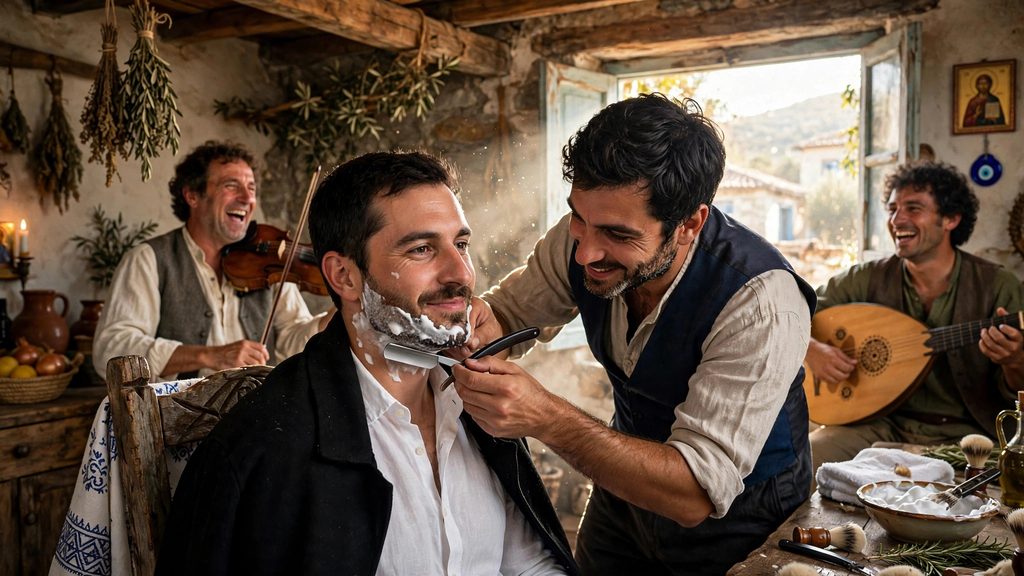
The wedding has not begun yet. The relationship it depends on has already been demonstrated.
The Second Sacrament
Greek custom, though not Church law, expects the koumbaros to return. When the couple’s first child is born, the same hands that exchanged the crowns are traditionally offered the crowns again, this time over the baptismal font, and the koumbaros becomes the nounos, the godfather, or the koumbara becomes the nouna, entering a second sacrament with the same family at the exact moment the family expands. Where the tradition holds, one person carries two separate acts of sacramental witnessing for a single household, the wedding and the first baptism, and the bond that started as a service performed for a couple becomes a service performed for a lineage.
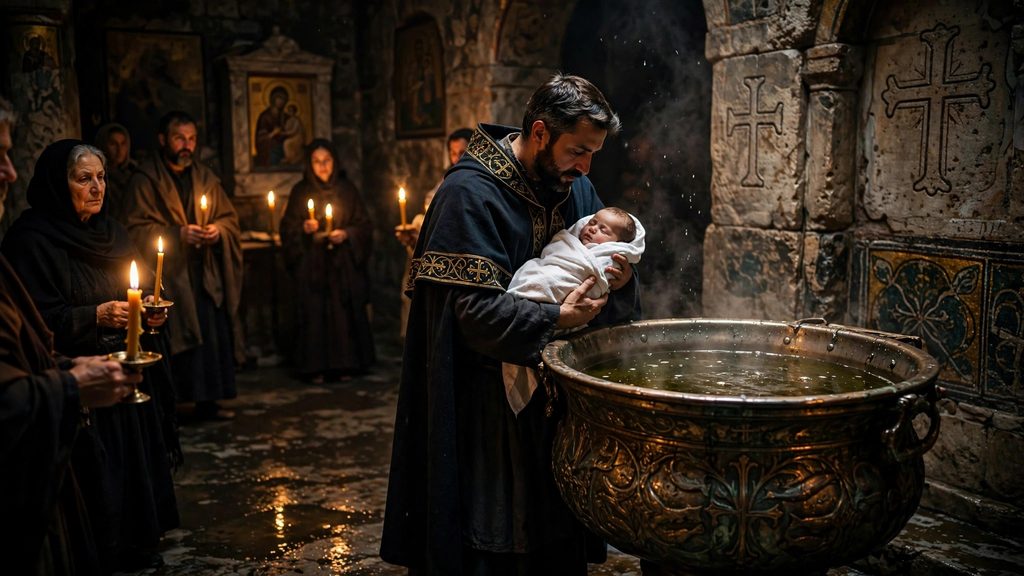
This is the structural hinge that turns koumbaros from a wedding-day appointment into a lifelong institution. A best man’s function ends when the reception ends. A koumbaros who goes on to baptize the first child has, by the Church’s own logic, entered a relationship that does not have a natural closing point, because it is now attached to two sacraments and two generations rather than one afternoon.
Two Families, Not Two People
Koumbaria, the abstract noun for the entire system this creates, was never designed to connect a sponsor to a couple. It connects the sponsor’s whole family to the couple’s whole family, a merger of two kinship networks conducted through a single ceremony and carried forward by both sides as an ongoing obligation rather than a memory of a nice day. The children of a koumbaros will, in the fullest version of the custom, regard the couple’s children as something closer than family friends. The parents on each side acquire specific forms of address and specific expectations of mutual support that Greek social life has never treated as optional niceties.
The system solved a real problem, and understanding the problem explains why it took the shape it did. Greek communities were, for most of their history, small, tightly bound to a village or a neighborhood, and organized around the extended family as the institution that did the work modern states now do through welfare systems, care for the old, support in illness, economic help in hard years, the informal insurance that comes from being owed and owing in return. That structure worked beautifully inside a family. It worked less well at the edges, for a newly married couple building a household that needed connections beyond the families they were born into, for a family that had moved to a new city or a new country and left its support network behind, for anyone whose biological family was too small or too distant to carry the weight alone. Koumbaria answered all three problems at once, by manufacturing kinship through ceremony precisely where biology had not provided it.
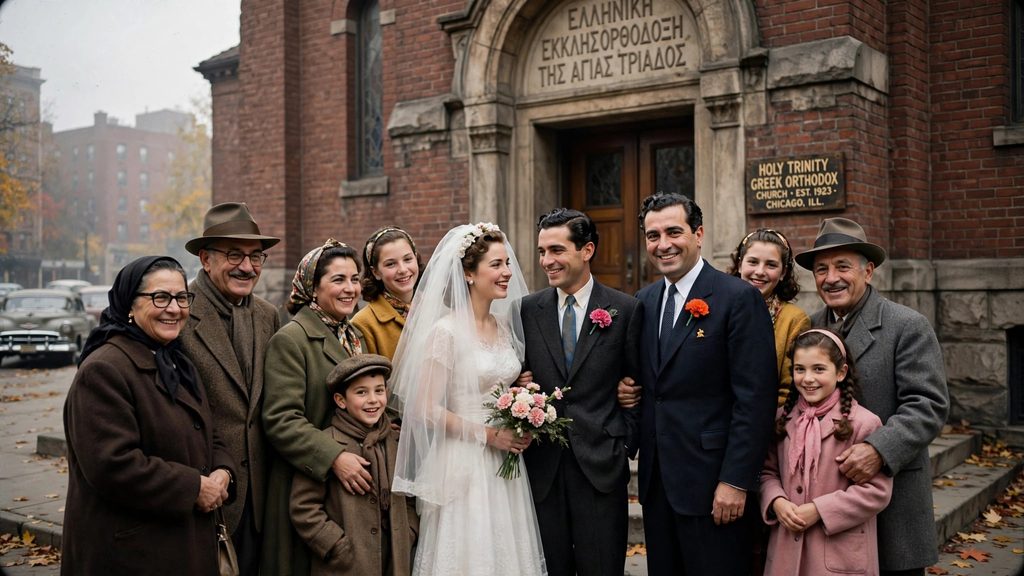
Nowhere is that function clearer than in the Greek diaspora, which is, in a sense, koumbaria’s proving ground. A family that arrived in Melbourne or Chicago or Johannesburg with a name, a language, and little else had left its kinship network behind at the dock. The koumbaros system was the mechanism available to rebuild one, a wedding sponsorship forming a bond with another Greek family already established in the new city, a baptismal sponsorship a generation later deepening it further, until the accumulated obligations of koumbaria had produced something that functioned, in practice, like the extended family the migration had severed. Communities that had nothing else in common with their old villages kept this one structure intact, because it required nothing but two families and a church, and both could always be found.
What the Koumbaros Pays For
The obligation runs in both directions, and part of it is financial, a dimension the more sentimental descriptions of koumbaria tend to leave out. In several Greek regional traditions, most documented among Pontic Greek communities, the koumbaros is expected to contribute substantially to the wedding’s cost, the stefana, the candles, sometimes the rings themselves, and this is not treated as generosity offered on a whim. It is the material proof of the seriousness of the role, the koumbaros putting resources behind the commitment the way the koumbaros’s hands put trust behind the shaving blade. The obligation does not end at the reception. It becomes a standing expectation of reciprocal presence and support at every life event that follows, understood by both families not as favors owed but as the ordinary content of the relationship they entered.
Why Spiritual Kin Cannot Marry
The clearest evidence that koumbaria is a form of kinship rather than an especially warm friendship is the one hard prohibition the Church has built around it. People joined through spiritual kinship cannot marry each other.
The canonical basis for this is precise rather than vague. Canon 53 of the Council in Trullo, convened in Constantinople in 692, addresses spiritual kinship created specifically through baptism, and it rules that a man who has sponsored a child at the font is thereafter forbidden to marry that child’s widowed mother, on the stated reasoning that spiritual relationship is greater than relationship by blood. The canon is written narrowly, about baptismal sponsorship, but because Greek custom so often makes the wedding koumbaros the same person who later baptizes the couple’s first child, the prohibition extends in practice across both roles, wedding sponsor and godparent folded into a single spiritual relative the Church treats as off limits for marriage into that family. This is not a social custom dressed up as a rule. It is ecclesiastical law, applied with the same seriousness as the rules against marrying a blood relative, because in the Church’s own understanding the koumbaros has become exactly that, a relative, created through the sacraments rather than through birth, but carrying equivalent weight.

A best man’s role has no such consequence, because it created no such kinship. The koumbaros’s role does, and the marriage prohibition is simply the Church stating plainly what the relationship already was.
Not Always Equals
It would be a mistake to read everything said so far as proof that koumbaria was always a relationship between equals. Anthropologists studying the wider family of institutions built on spiritual kinship, the same compater tradition that produced the koumbaros in Greece and the compadre across Catholic Latin America, have long distinguished between two different shapes the relationship can take. One is horizontal, a bond between families of similar standing that reinforces solidarity within a community that already regarded itself as roughly equal. The other is vertical, a family choosing a sponsor specifically because of that sponsor’s wealth, status, or influence, converting what looks like a religious friendship into something closer to patronage.
Greek koumbaria has always carried the possibility of both. A village family choosing a neighbor of similar means as koumbaros was doing something different from a family choosing the wealthiest man in the region, and both choices used the identical ceremony, the identical rings, the identical crowns. The anthropologist Margaret Kenna, whose fieldwork on Greek island communities remains the clearest scholarly account of how koumbaria actually functions, described the institution as a way of reconciling the ideal of family self-sufficiency with the practical need for cooperative ties beyond the family. That description holds for both versions of the relationship. A cooperative tie between equals and a patron’s favor extended to a poorer household are both, in the end, ties, and koumbaria gave Greek communities the same ceremonial vocabulary for creating either one.
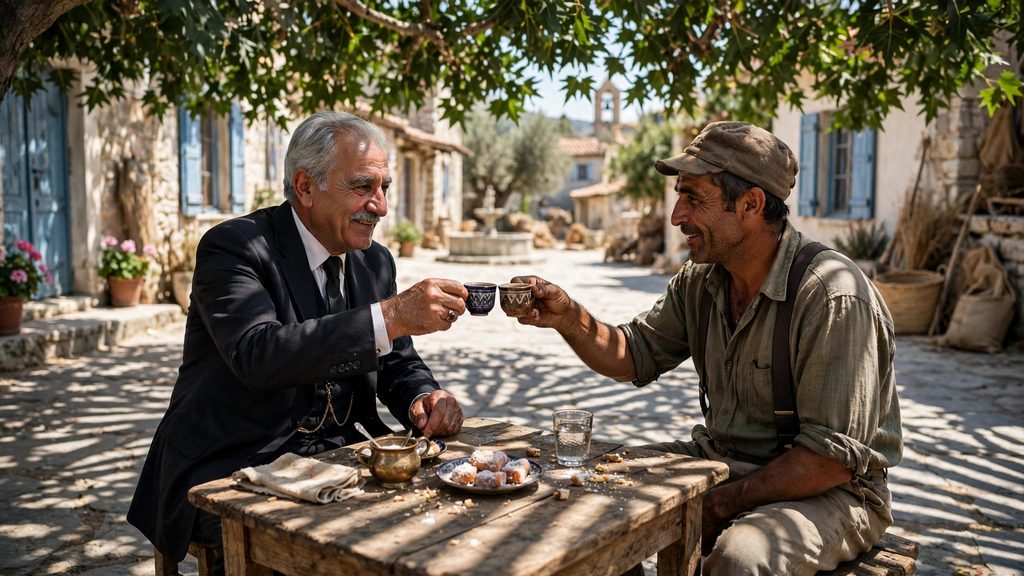
This does not make the sacred language of the ceremony hollow. It makes it flexible in a way that mattered enormously to the communities that used it. A family with no other way to reach the protection or the resources of a more powerful household could reach them through koumbaria, sanctified by the Church and binding in ways a purely economic arrangement would never have been. The relationship’s religious seriousness is exactly what made it useful for this purpose. Nobody walks away from an obligation sealed at the altar as easily as they walk away from a handshake.
A Word That Outgrew the Wedding
The formal relationship this article has described, sponsor at the wedding, sponsor at the baptism, two families bound by canon law and mutual obligation, is not the only way the word koumbaros survives in modern Greek. It has also drifted loose from the ceremony entirely and settled into everyday speech as a term of address, the way a close friend might be called brother in English without either party believing an actual sibling relationship exists. Two men who have known each other since childhood, who have never stood at each other’s weddings and sponsored nothing, may still greet each other as koumbare, the vocative form, simply because the word has become shorthand in Greek for the specific texture of closeness the real institution describes, trust, familiarity, and the sense that the other person is owed something like family loyalty even without the ceremony that would make it official.
This looser usage is not a corruption of the older meaning. It is what happens when an institution is old and central enough that its vocabulary becomes available for borrowing. The feminine koumbara has followed the same path, used between women who share the specific quality of closeness the formal role names, whether or not either has ever exchanged a ring or a crown for the other. The word carries its weight into casual speech precisely because everyone using it still understands, even half-consciously, what the real ceremony would have meant.
The Institution Today
Contemporary practice spans a real range. At one end sits the full traditional form, a single family fulfilling both the wedding sponsorship and the baptismal sponsorship and carrying the network of mutual obligation across decades and generations without much erosion. At the other end sits a lighter version, the ceremonial acts performed with full seriousness, the rings and crowns still exchanged by hands that mean it, but the older expectations of ongoing financial and social obligation observed more loosely, or not observed as a formal system at all, folded instead into an unusually close and permanent friendship, kept alive the way so much of Greek social life is kept alive, in the daily rhythms of siesta, volta, and kafeneion rather than in a formal ledger of obligations.
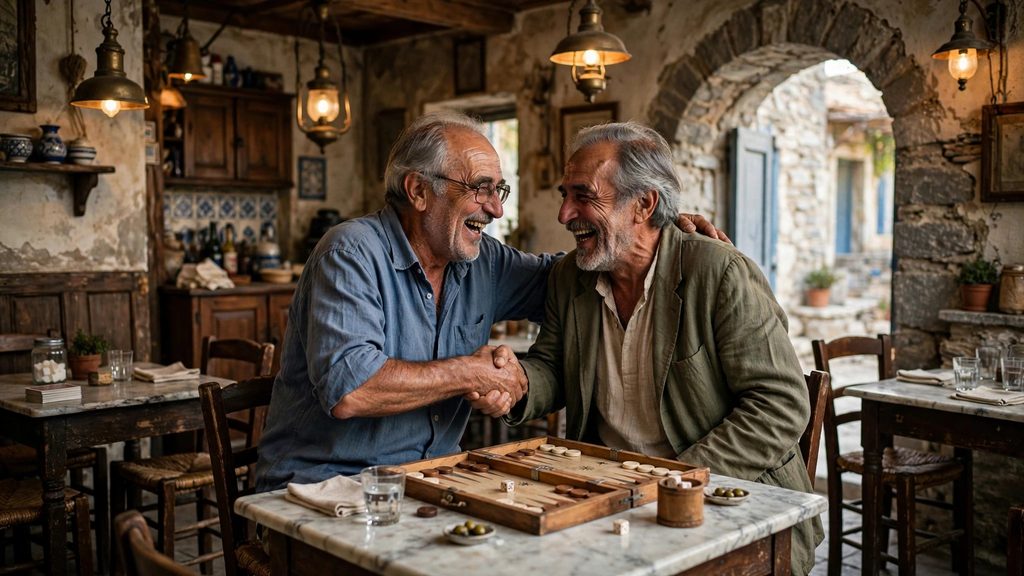
What has not moved, in either version, is the seriousness with which Greek families choose the person for the role. It is not treated as a convenience or a matter of whoever happens to be closest at the time. It is approached as one of the more consequential decisions a couple makes, because the tradition has always described the koumbaros’s ongoing function in a specific way, as someone the couple can turn to for guidance across the whole of their married life, not simply a friend who was well suited to speaking at a reception. Taken at face value rather than as ceremonial language, the description matches what the role has always demanded: someone whose closeness has already been tested, in the specific and old-fashioned way of a blade at the throat and a dress fastened before dawn, before the Church ever asked him to hold the crowns.
Whose Are You
Greek communities have long asked each other a version of the same question, whose are you, meaning which family, which village, and often enough, which koumbaros. The question assumes that a person’s identity is not fully described by biology alone, that it also includes the network of ceremonial obligation their family has built through marriages and baptisms across generations, the people who were trusted enough to hold a blade, to fasten a dress, to move a ring three times between two hands in the name of the Trinity. It is the same instinct that keeps a village turning out for its panegyri every year rather than letting the custom lapse into something read about instead of lived, the sense that belonging is built through participation, not simply inherited.
The koumbaros is not the best man. He is the person who held the crown over your head and became, in the eyes of the Church and the understanding of everyone who was in the room, your family. Somewhere down the line, when his own children marry or his own grandchildren are born, the debt runs the other way, and it will be your turn to hold the crown over them.
This is what the institution has always been for, a way of building family out of ceremony precisely where blood ran out, and it has done that work through every migration, every displacement, and every generation of Greeks who needed to construct a network of belonging in a place their grandparents had never seen, using nothing more than a church, a blessing, and the specific quality of trust that the word koumbaros has never stopped meaning.
At Olympus Estate, Greek Living explores the customs that still shape Hellenic identity today. The koumbaros traces to the Latin compater by way of Venetian rule over the Greek world, and names a bond the Orthodox Church treats as genuine kinship rather than friendship, sealed by the ring and crown exchange at the wedding, often renewed at the baptism of the couple’s first child, and protected by a canon law that forbids marriage between spiritual kin. Two families become one network through a single ceremony, an arrangement that has carried Greek communities through every migration and every generation that needed to build belonging somewhere new.