



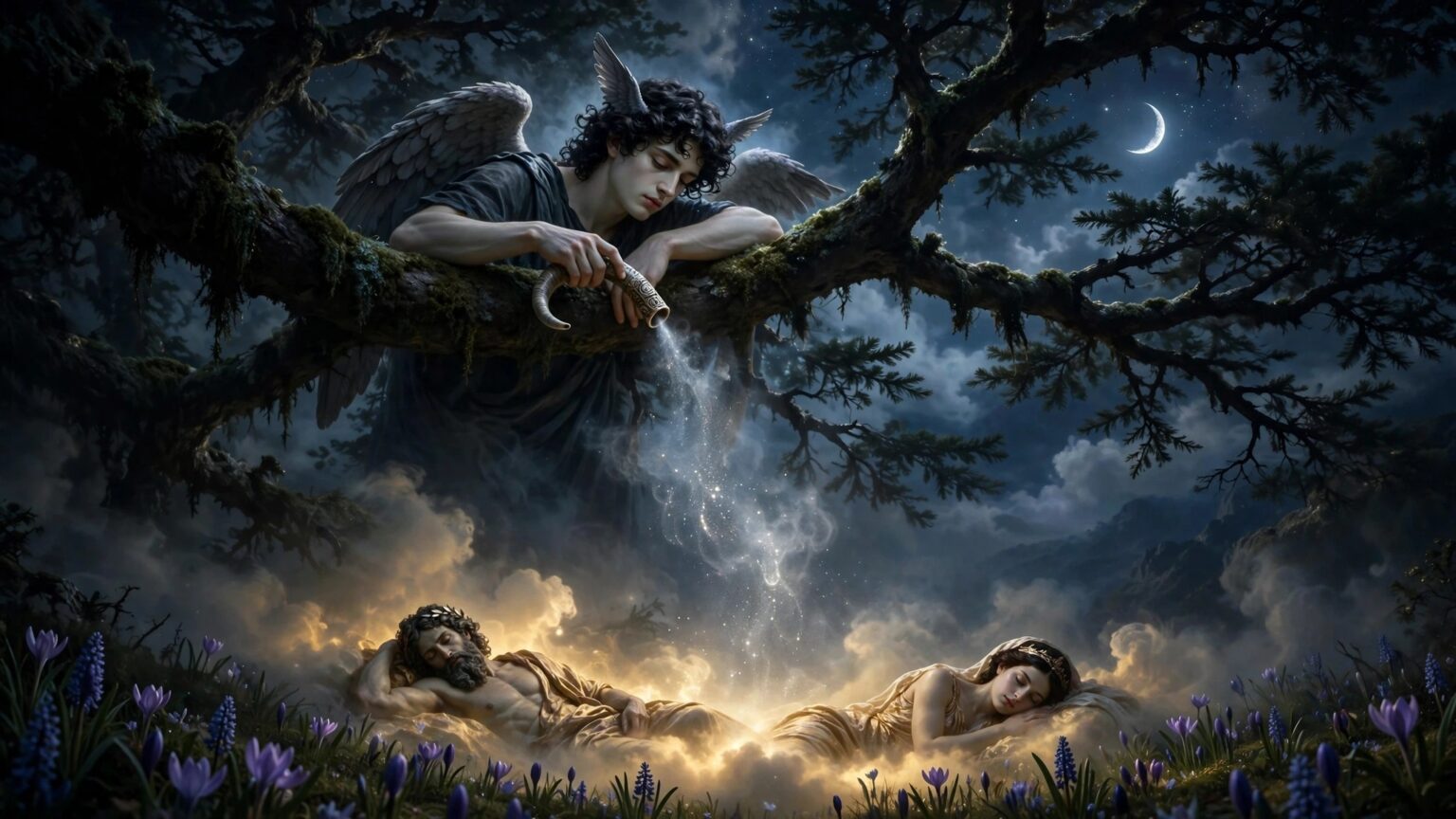
On the summit of Mount Ida, above the plain of Troy, the king of the gods lies asleep in his wife’s arms. The earth has pushed up a bed of fresh grass and flowers beneath them, and a golden cloud hides them from the world. High above, in the tallest fir on the mountain, sits a small dark bird that no mortal would look at twice.
The bird is a god. His name is Hypnos, Sleep, and he has just done the one thing that Titans, giants and rebel Olympians all failed to do. He has stopped Zeus. Not with thunder or armies or cunning machines, but by closing the eyes of the most powerful being in the cosmos. And it is the second time he has done it.
Prometheus deceived Zeus and spent ages chained to a mountain. Hera deceived him and was hung from the sky with anvils on her feet. Hypnos deceived him twice, kept the bride he asked for, and walked away untouched. To understand how, you have to start with his mother.
Child of Night | A God Born Without a Father
In Hesiod’s Theogony, the oldest Greek account of how the gods came to be, Nyx, the Night, produces a brood of children without lying with anyone. Doom, Fate and Death come from her, and Sleep, and the whole tribe of Dreams. Hypnos and Thanatos, Sleep and Death, are born together. Homer calls them twins.
Hesiod gives them a house at the edge of the underworld, where the shining sun never looks on them, and he sums up the difference between the brothers in two lines. Sleep roams quietly over the earth and the broad back of the sea and is kind to human beings. Death has a heart of iron and a pitiless spirit of bronze, and whatever he takes he holds. They are not opposites. They are the same visit, one that brings you back and one that does not.
The Greeks put this family on display. At Olympia, Pausanias saw a famous carved chest dedicated by the family of the Corinthian tyrant Cypselus. Among its scenes was a woman holding two children in her arms, one white and sleeping, the other black, both with their feet turned awkwardly. The inscription named them, and Pausanias explains the picture without hesitation. The woman is Night. The white child is Sleep. The black child is Death.
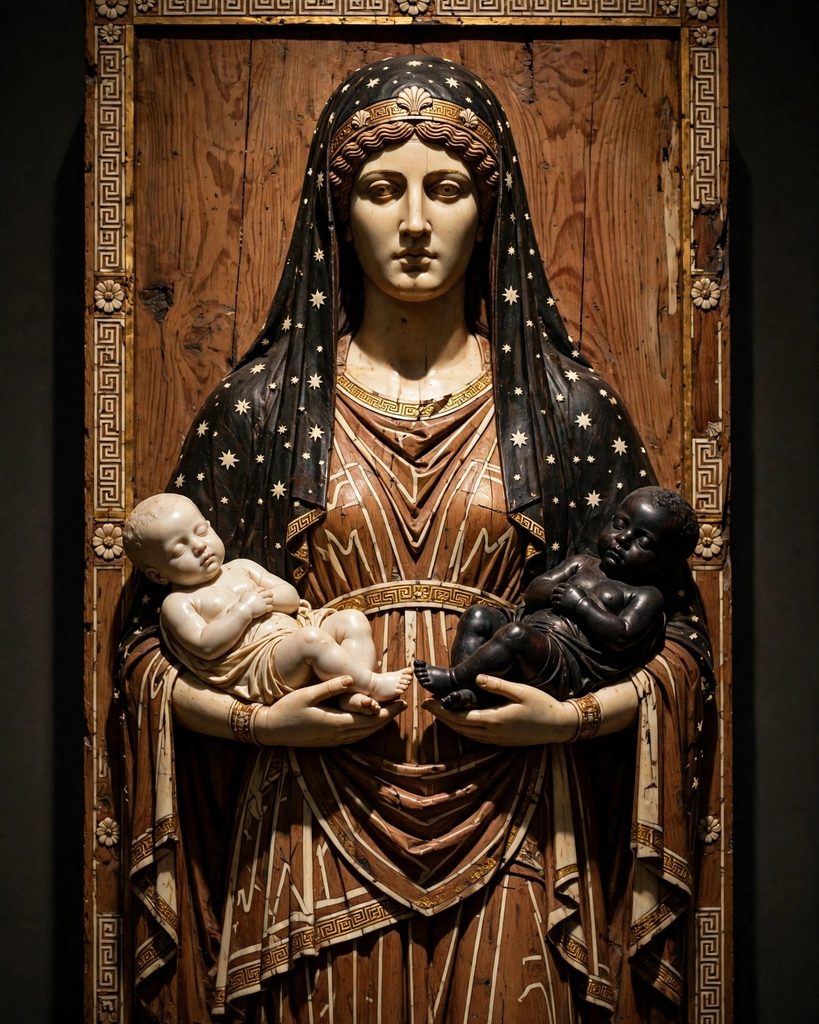
Remember that image, the two children in Night’s arms, because everything that follows depends on it. Hypnos is not an Olympian. He was never born on the mountain, never fought in the war against the Titans, never received a share of the world from Zeus. He belongs to an older family, and that family has its own rules.
The First Time | Heracles, the Storm and the Flight to Night
Homer tells the first deception as a memory, in the fourteenth book of the Iliad. Long before the Trojan War, Heracles had sacked Troy in the time of its old king Laomedon. As he sailed home, Hera, who hated him as the son of one of her husband’s affairs, asked Sleep to put Zeus under. While Zeus slept, she raised violent winds and drove Heracles’ ships far off course to the island of Kos, away from all his friends.
Zeus woke in a fury. He hurled the gods around his halls, Hypnos remembers, searching above all for him, and he would have flung him out of the sky into the sea, never to be seen again. One thing saved him. He fled to his mother. Night, Homer says, tamer of gods and men, took him in, and Zeus stopped, angry as he was, because he was afraid to do anything that would displease swift Night.
Hera did not escape so easily. In the next book of the Iliad, Zeus reminds her of the punishment she suffered for that same storm. He hung her from the sky with a golden chain around her wrists and two anvils tied to her feet, and threw any god who tried to help her down from the threshold of heaven. The goddess who planned the deception paid for it. The god who carried it out was untouchable, because he was standing in his mother’s shadow.
The Bargain on Lemnos | A Throne Refused, a Grace Accepted
Years later, with the Greeks pinned against their ships at Troy and Zeus forbidding the gods to help them, Hera needs him asleep again. She has already borrowed the embroidered band of desire from Aphrodite. Now she flies to Lemnos, the island where Hephaestus once fell from heaven, and finds Sleep there. She takes his hand and greets him as lord of all gods and all men.
Her first offer is splendid. A golden throne that can never be destroyed, made by her own son Hephaestus, with a footstool for resting his feet at feasts. Hypnos turns it down. He would gladly put any other god to sleep, he tells her, even the river Ocean from whom all the gods are sprung, but not Zeus, unless Zeus himself asks for it. He reminds her of the last time, the flight, the rage, the sea he nearly fell into.
So Hera raises her price. She offers him one of the younger Graces as his wife, Pasithea, whom he has longed for all his days. That changes everything. But Hypnos does not trust a promise from the queen of heaven. He makes her swear by the waters of the Styx, the most binding oath the gods have, with one hand on the earth and the other on the shining sea, calling as witnesses all the gods below who live with Kronos. Only when she has named every one of the Titans in her oath does he agree.
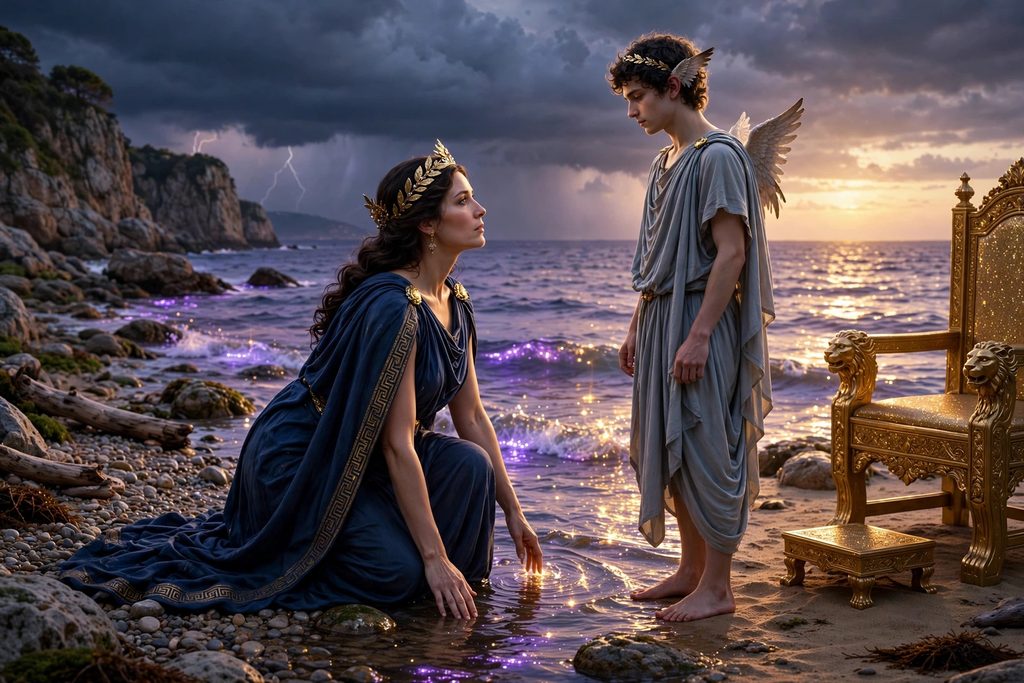
Notice what he does here. Every other figure in the Iliad either obeys Zeus or defies him and suffers. Hypnos negotiates. He knows exactly what his gift is worth, refuses the wrong payment, names the right one and has it guaranteed by the oldest powers in the universe. The gentlest god in the poem is also its sharpest dealer.
The Bird in the Fir | How Sleep Took the King of Heaven
The two of them leave Lemnos and Imbros, wrapped in mist, and cross to Mount Ida, mother of wild beasts. Before Zeus can see him, Hypnos climbs the tallest fir on the mountain, a tree that reaches through the mist into the bright upper air, and hides among its branches in the shape of a shrill bird of the mountains. The gods, Homer says, call it chalkis, and men call it kymindis.
Hera does the rest. Zeus sees her, desire floods him, and he takes her in his arms. The earth answers with fresh grass, dewy lotus, crocus and hyacinth, thick and soft enough to lift them from the ground, and a golden cloud closes over them. Then, Homer says, the father lay still on the peak of Gargaron, overcome by sleep and love.

Hypnos does not stay to admire his work. He runs straight down to the Greek ships to tell Poseidon that the moment has come, that Zeus is asleep and the earth-shaker should help the Greeks while he can. Sleep is not merely a passive gift in this scene. It is the hinge on which the whole battle turns. For one stretch of the Iliad, the war is fought in a world where the king of the gods is not watching.
When Zeus wakes at the start of the next book and sees the Trojans routed, his fury falls on Hera, not on Sleep. He threatens her, recalls the anvils and the golden chain, and she swears she had nothing to do with Poseidon’s attack. Of Hypnos he says nothing at all. As far as the poem tells us, Sleep collected his Grace and was never punished.
Why Zeus Could Not Touch Him | The Older Power of Night
Why does the god who overthrew the Titans step back from Hypnos? Homer gives the answer in one line. Zeus was afraid to displease swift Night. Night is older than he is. She was there before Kronos, before the Titans, almost before anything. The order Zeus rules was built inside a darkness that came first, and even the king of the gods knows where his authority ends. He shows the same caution elsewhere before the old powers, before the Moirai, the Fates, and before the oath of the Styx.
There is a second, quieter answer in the nature of Hypnos’s power. Force needs someone to act on. A thunderbolt is useless against a being who simply withdraws you from the world for a while and gives you back. By the time Zeus is awake enough to be angry, the thing he is angry about has already happened. Sleep does not fight you. It waits until you stop fighting, and then it is too late to object.
Sleep and Death Carry Sarpedon | The Twins at Work
Hypnos appears in the Iliad once more, and this time with his brother. In the sixteenth book, Zeus watches his own mortal son, Sarpedon, prince of the Lycians, approach the moment of his death at the hands of Patroclus. Zeus considers snatching him out of the battle alive. Hera warns him that the other gods will not approve of saving a man whose fate is fixed, and Zeus lets him die, weeping tears of blood upon the earth.
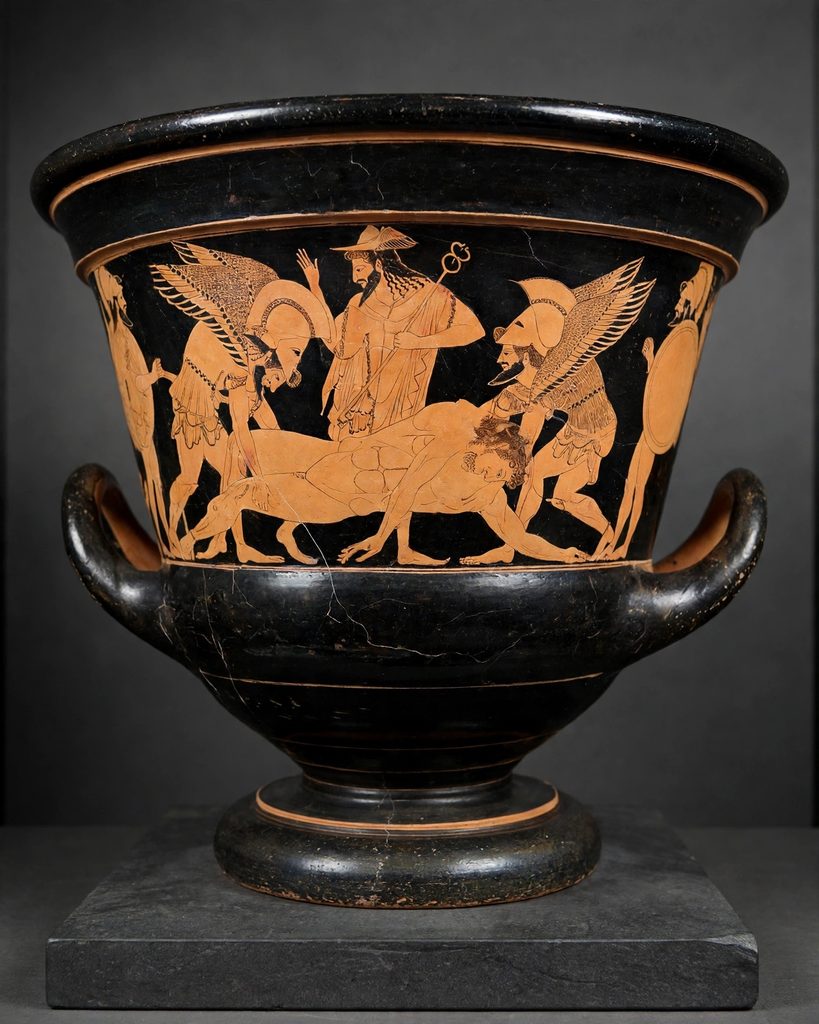
What he can do is honour the body. He sends Apollo to lift Sarpedon from the field, wash him in the river, anoint him with ambrosia and dress him in immortal clothes, and then give him to two swift escorts, Sleep and Death, the twin brothers, to carry home to the broad land of Lycia, where his people will bury him with a mound and a stone.
Around 515 BC the Athenian painter Euphronios put that moment on a great red-figure mixing bowl. Two winged warriors in armour bend over the bleeding hero and lift him between them, while Hermes stands behind watching. It is one of the masterpieces of Greek vase painting, and it gives the twins the same face and the same strength. Sleep and Death, in the Greek imagination, were never a gentle god and a cruel one. They were two brothers sharing the weight of one body.
The Other Brother | Mortals Who Cheated Death
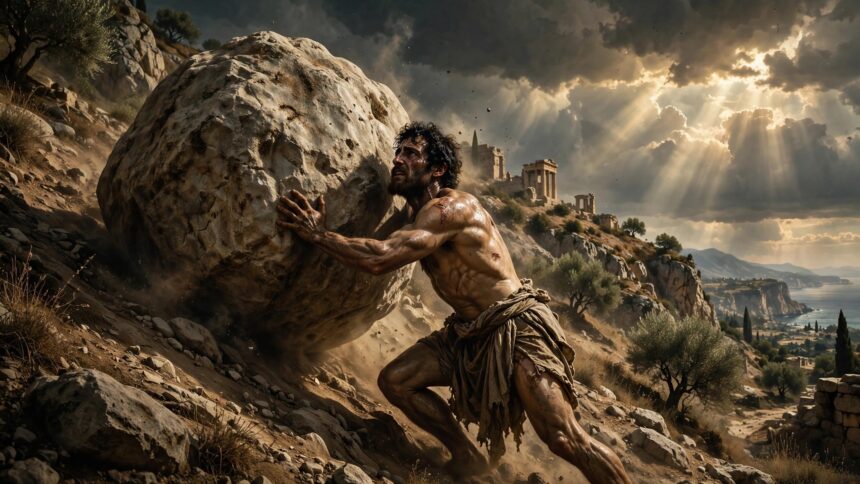
There is an irony in this family. Thanatos, the iron-hearted twin, was cheated by mortals more than once. Sisyphus tricked him into chains, so that for a while no one on earth could die. Heracles wrestled him at a graveside in Euripides’ Alcestis and dragged the dead queen back to her husband. Death, for all his iron, could be outwitted or overpowered.
Nobody outwits Sleep. Heroes stay awake for days in the myths and always lose. Even the hundred-eyed watchman Argos, who never closed all his eyes at once, was finally lulled by Hermes’ piping and stories until every eye shut. Death could be cheated by the cleverest of mortals. Sleep beat Zeus himself. The kinder brother turned out to be the one nobody could escape. The other road, the one that does not come back, is followed in Charon, the ferryman of the dead.
The House of Dreams | Ovid’s Cave and the Thousand Sons
Homer never says where Sleep lives. Hera simply finds him on Lemnos. The Roman poet Ovid, writing in the age of Augustus, built him a house, and it is one of the most beautiful passages in the Metamorphoses. In the land of the Cimmerians, where the sun never reaches, a cave runs deep into a hollow mountain. Mist and twilight fill the air. No rooster crows, no dog barks, no goose cackles, no branch moves in the wind. From the foot of the rock flows Lethe, the river of forgetting, its pebbles murmuring an invitation to sleep. Poppies and countless herbs bloom at the entrance.
Inside, on a couch of ebony covered with dark cloth, lies the god, surrounded by empty dreams in every shape, as many as ears of wheat at harvest or leaves in a forest. He has a thousand sons, Ovid says, and names three. Morpheus can copy any human being, their walk, their face, their voice. Icelos, whom mortals call Phobetor, the frightener, becomes beasts, birds and serpents. Phantasos becomes earth, rock, water and timber, everything that has no life.
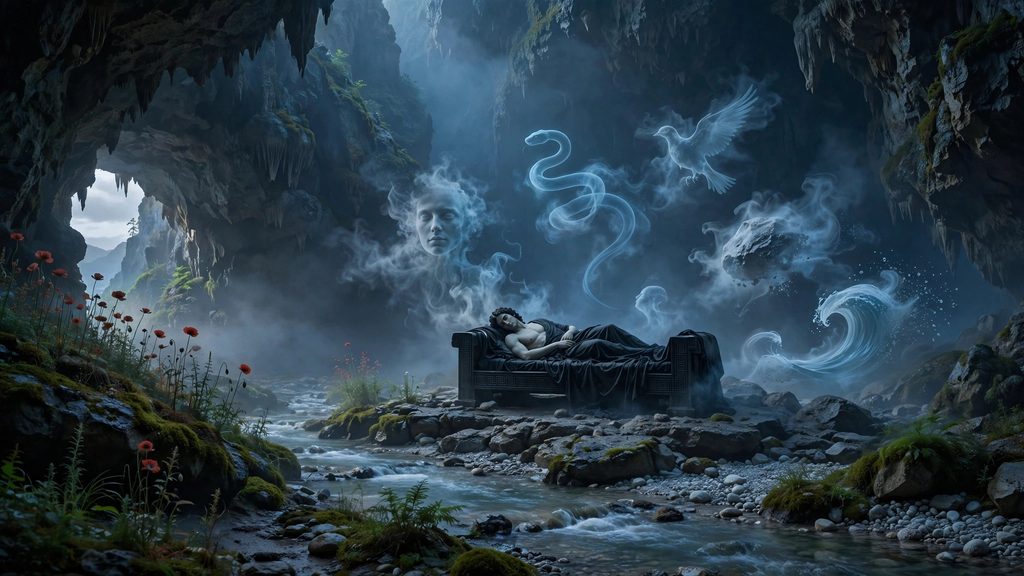
When Juno’s messenger Iris comes to the cave, she has to brush aside the dreams to reach the god, and even then the old sleeper can barely lift his heavy eyes. He sends Morpheus to do the work and sinks back into his couch at once. Ovid’s Sleep is the opposite of Homer’s sharp negotiator, too drowsy to complete a sentence. Both portraits are true. Sleep can be bargained with, and sleep can barely be woken.
Two Gates | Horn and Ivory
If dreams are Sleep’s children, can they be trusted? Penelope asks that question in the nineteenth book of the Odyssey. She has dreamed that an eagle killed her geese and then spoke to her with a man’s voice, saying he was her husband come home. Talking to a beggar who is secretly Odysseus himself, she refuses to believe it.
There are two gates of dreams, she explains, one made of horn and one of ivory. Dreams that come through the ivory gate deceive, bringing words that never come true. Dreams that come through the gate of polished horn come true for whoever sees them. The image hides a pun in Greek. Ivory, elephas, sounds like a verb meaning to cheat. Horn, keras, sounds like a verb meaning to fulfil. Homer has built a theory of dreams out of a play on words, and Penelope’s dream, of course, is from the gate of horn.
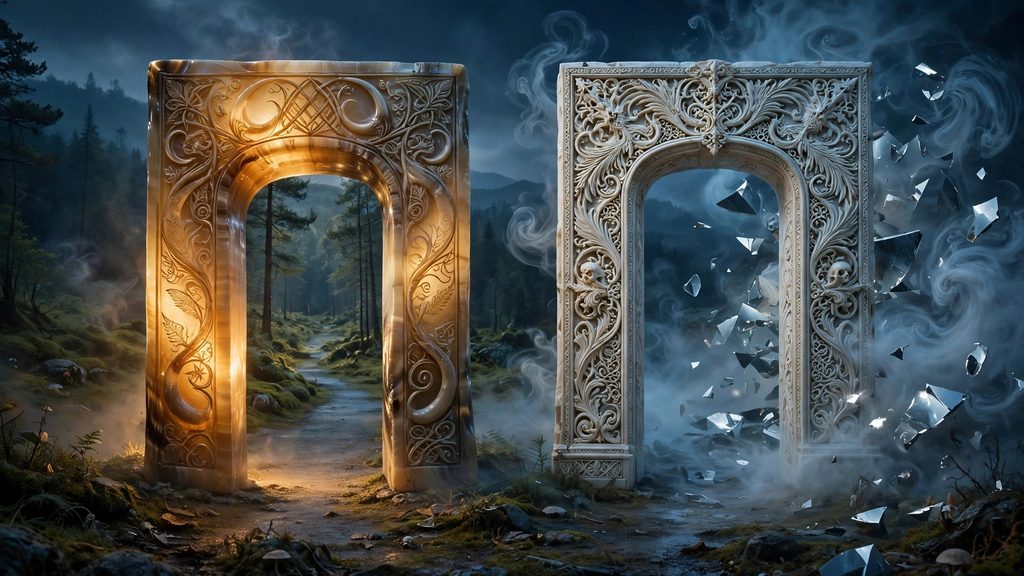
The Greeks never stopped trying to tell the two gates apart. Pilgrims slept in sanctuaries hoping for true dreams from the gods, as told in The Reluctant Seer, and physicians read dreams as signs of health. Virgil ended the sixth book of the Aeneid by sending his hero back to the upper world through the ivory gate, and readers have argued ever since about what he meant.
The God Who Loved a Sleeper | Hypnos and Endymion
Most people know Endymion as the beautiful shepherd loved by Selene, the Moon, who sank into an endless sleep so that she could visit him forever. But a lesser-known version gives the lover’s role to Sleep himself. The lyric poet Licymnius of Chios, quoted centuries later by Athenaeus, says that Hypnos fell in love with Endymion and put him to sleep with his eyes open, so that he could go on gazing into them.
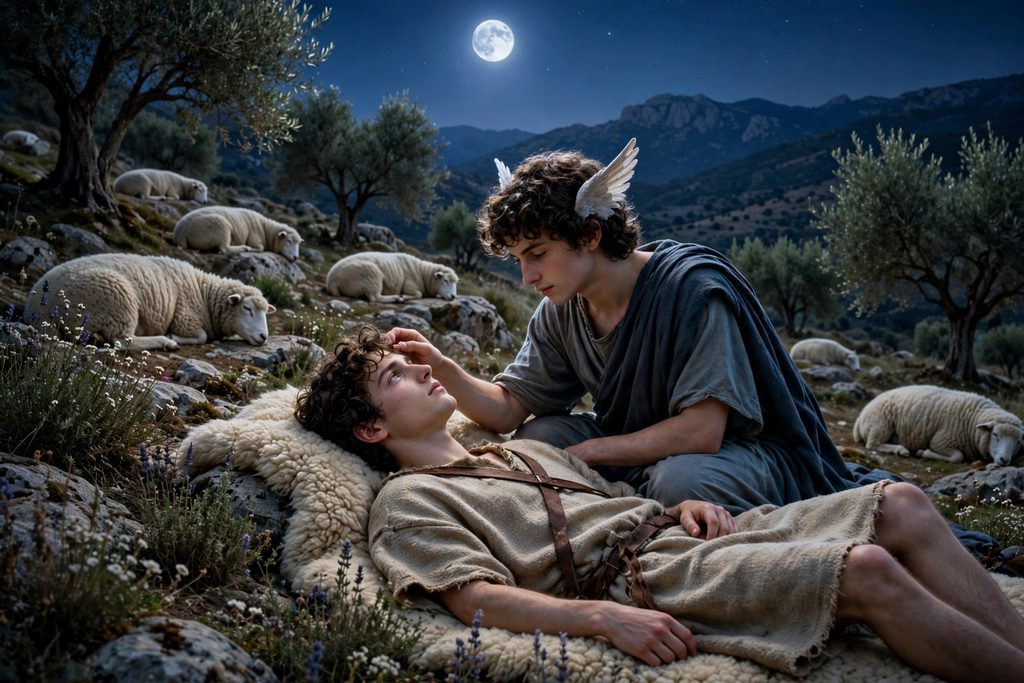
It is a strange and tender idea. The god who closes every eye in the world chose, for once, to leave a pair open, because he wanted to be seen. It may be the most intimate story told about Hypnos, and it shows a side of him the epic never needed, a god capable of longing.
Where the Greeks Honoured Sleep | Altars, Statues and a Bronze Wing
Hypnos had few temples, but he was not forgotten. At Troizen in the Argolid, Pausanias saw an altar shared by the Muses and Sleep, because, the people there said, Sleep is the god dearest to the Muses. Rest and inspiration belonged together. In Sparta, he saw images of Sleep and Death standing side by side, set up as brothers in honour of the line in the Iliad.
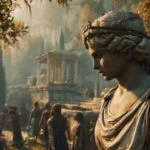
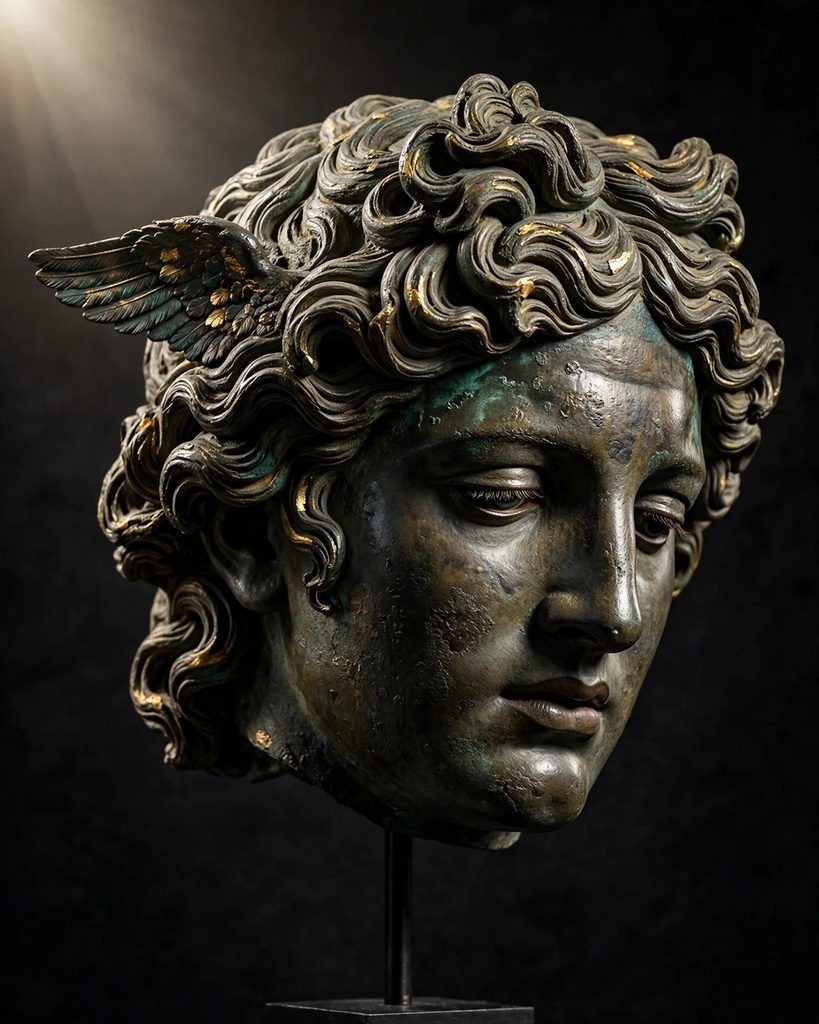
Artists gave him a recognisable face. He is a young man with wings, sometimes at his shoulders and often growing from his temples, carrying a poppy stem or a horn from which he pours drowsiness over the sleeper. A bronze head of Hypnos in the British Museum, found in Italy and copied from a Greek original, shows a single wing still springing from the side of his head, his expression calm and slightly inward, as if listening to something far away. In the Hellenistic age, sculptors fell in love with sleep itself, carving sleeping satyrs, sleeping Erotes and sleeping nymphs, bodies at their most unguarded.
Half of Every Life | What Hypnos Meant
Greek philosophers took the god seriously in their own way. Heraclitus observed that the waking share one common world, while each sleeper turns aside into a private one, and yet even sleepers, he said, are workers and collaborators in what happens in the world. Aristotle, writing about happiness in his Nicomachean Ethics, noted the old saying that for half their lives the happy are no better off than the wretched. In sleep, good and bad, fortunate and miserable, all lie equal.
That is Hypnos’s real kingdom. Half of every human life passes in it, and no wealth, virtue or power can buy an exemption. Kings and slaves close their eyes in the same way. Even Zeus does. The myths do not make Sleep a great god by giving him great deeds. They make him great by showing that nothing in the world, not even the thunderbolt, is outside his reach.
Hypnos never raised a weapon against anyone. He never needed to. He waited in a fir tree on Ida, in a cave beside the river of forgetting, in the arms of his mother Night, and when the moment came he simply closed the eyes of the most powerful being in the universe. For as long as he chose, the king of heaven stopped watching the world.
Then he collected his bride, and Zeus never laid a finger on him.
At Olympus Estate, Mythic Essays read the Greek myths closely, from the oldest sources forward. Hypnos is a child of Night born without a father in Hesiod, twin of Thanatos, shown on the chest of Cypselus as the white child sleeping in Night’s arms. He put Zeus to sleep for Hera when she drove Heracles to Kos, and escaped Zeus’s fury only by hiding with his mother, while Hera was hung from the sky with anvils on her feet. On Lemnos he refused a golden throne, demanded the Grace Pasithea, bound Hera with an oath on the Styx and the Titans, then hid in a fir on Mount Ida as a bird and closed the eyes of the king of heaven a second time, unpunished. With Death he carried Sarpedon home to Lycia, as Euphronios painted him. Ovid gave him a cave by the river Lethe and a thousand sons, among them Morpheus, Phobetor and Phantasos, Penelope named the gates of horn and ivory, Licymnius told how he loved Endymion, and Troizen honoured him at an altar beside the Muses. He rules half of every human life, and no power in the cosmos is exempt.