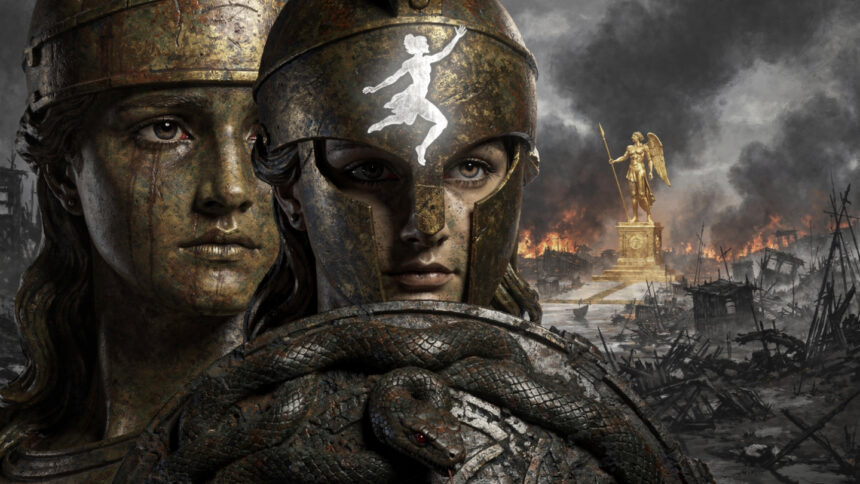






The first thing Odysseus’s men noticed was the smoke, rising through thick oak woods from the middle of an unknown island. The second was the animals. Wolves and mountain lions came down to meet them on the path, and instead of attacking they fawned and wagged their tails, the way dogs greet a master coming home from dinner. Then the men heard a woman singing inside a stone house, and the sound of a loom.
She came to the door, invited them in, and gave them a drink of cheese, barley and honey in wine. Within the hour they were pigs. Their bodies had bristles and snouts, and they grunted like pigs, but Homer is careful to add one detail. Their minds were the same as before. They knew exactly what had happened to them.
Her name was Circe, and in Book Ten of the Odyssey Homer gives her a word that no one else in the poem receives. She is polypharmakos, the woman of many drugs. Later ages called her a witch. Homer’s word is more exact, and more unsettling. Circe was the most dangerous person Odysseus met on his way home, and then she became the one who got him there.
Polypharmakos | What Homer Actually Called Her
Homer’s usual description of Circe is a formula he repeats several times. She is “fair-haired Circe, the dread goddess who speaks with a human voice”. Polypharmakos appears only once, as Odysseus climbs toward her house, and that single use is what makes it stand out. It names what she does rather than how she looks. Homer uses the word for only one other kind of person, in the Iliad, and they are the army’s doctors.
The root is pharmakon, one of the most double-edged words in Greek. It meant a drug, a medicine, a poison, a dye and a spell, all at once, because the same plant could heal in one dose and kill in another. The pharmakeia of the Greek world lived in that double meaning. Homer keeps both sides in view. Circe mixes “baneful drugs” into the men’s food, and the herb that saves Odysseus is called a “good drug”. To Homer, Circe’s power is not spells from nowhere. It is knowledge of what plants do to a body.
Even her name may carry a hint of the predator. Kirke is close to kirkos, a hawk or falcon, the bird that circles above its prey. Whether or not the link is real, it suits the woman who watched each ship arrive at her island.
Daughter of the Sun | The House of Helios
Circe is often pictured as a lone woman on a lonely island. Her family says otherwise. Homer makes her the daughter of Helios, the Sun, and of Perse, a daughter of Ocean, and the sister of Aeëtes, king of Colchis and keeper of the Golden Fleece. Later writers fill in the rest of the household, and it is one of the most formidable families in Greek myth.
Her sister Pasiphae, queen of Crete, gave birth to the Minotaur. Her niece was Medea, who helped Jason steal the Fleece from her own father and who became the most feared enchantress in Greek tragedy. In one later genealogy, preserved by Diodorus, the mother of both Circe and Medea is not Perse at all but Hecate, goddess of crossroads and night magic. The grandchildren of the Sun were the great experts in drugs and transformations of Greek myth. The two most famous enchantresses of Greek myth were women of this one family.
Aeaea | The Island Where the Sun Rises
Homer sets Circe’s island, Aeaea, at the edge of the world, “where the house of early Dawn is, and her dancing grounds, and the risings of the sun”. The name echoes Aia, the old name of her brother’s kingdom in the far east. To Greek ears it also sounds like aiai, the cry of grief, a fitting accident for an island where men lost their shapes. Later Greeks and Romans moved Aeaea west to Italy, to the headland still called Monte Circeo on the coast south of Rome, where visitors were shown her shrine and a cup said to have belonged to Odysseus.

Inside, Homer’s Circe is busy. She sings as she walks to and fro at a great loom, weaving the fine and shining cloth that only goddesses make. Weaving was the highest skill of Greek women, and Homer gives it to the goddesses he admires, to Calypso and to Helen and to Penelope. Circe turns thread into cloth, plants into drugs and men into animals. All of her work is transformation.
The tame wolves and lions at her door are the poem’s first warning. Homer says she had bewitched them with her drugs. He does not say they were once men, but the way they fawn on strangers, like dogs that remember their masters, tells the reader what the crew is about to learn.

The Cup and the Wand | Book Ten
Odysseus had split his crew in two, and lots sent Eurylochus with twenty-two men up to the house. All of them went in except Eurylochus, who suspected a trap. Circe seated the rest on chairs and couches and mixed them a drink of cheese, barley meal and yellow honey in Pramnian wine, the same mixture Homer elsewhere calls a kykeon, the barley drink of heroes and, much later, of the initiates at Eleusis. Into it she stirred her drugs, so that they would forget their homeland.
When they had drunk, she struck them with her wand and drove them into the sties. They had the heads, voices, bristles and bodies of pigs, Homer says, but their minds stayed whole, as they had been before. She threw them acorns and cornel berries, the food of pigs that root in the ground, and the men inside the pigs wept. Eurylochus ran back to the ship alone, too shocked at first to speak.

That kept mind is the cruelty of the scene, and its point. Circe does not destroy her guests. She removes their human bodies and leaves them aware of it. The pig was the humblest animal of the Greek farm and the commonest sacrifice to the earth gods, and to be turned into one was to fall from the table to the trough.
Moly | The Good Drug
Odysseus went up alone to rescue his men, and on the path he met a young man with the first beard on his lip. It was Hermes. The god pulled a plant from the ground and showed him its nature. It had a black root and a flower white as milk, and the gods called it moly. It was hard for mortal men to dig up, Hermes said, but the gods can do all things.
Hermes also gave him a plan. Circe would mix him the same kykeon, but the moly would keep it from working. When she struck him with her wand, he must draw his sword and rush at her as if to kill her. She would invite him to her bed, and he must not refuse, but first he must make her swear the great oath of the gods that she would plot no further harm against him.
Everything happened as the god foretold. The drink failed, the sword came out, and Circe fell at his knees in astonishment. Then she worked it out. You must be Odysseus, she said. Hermes always told me you would come, on your way home from Troy in a swift black ship. She swore the oath, and only then did he go to her bed.

People have hunted for moly ever since. The botanist Theophrastus, around 300 BC, said it grew near Pheneus and on Mount Cyllene in Arcadia, with a round, onion-like root, and that people used it against spells. The plant still has a page of its own in the story of the moly of Arcadia. In 1983, two neurologists, Andreas Plaitakis and Roger Duvoisin, made a modern proposal in a medical journal. Moly, they suggested, might be the snowdrop, whose bulb contains galantamine, a compound that counters the poisoning caused by anticholinergic plants such as mandrake, henbane and thorn apple. Those plants cause confusion, hallucination and loss of memory, much like forgetting your homeland. Galantamine is now prescribed for memory loss in Alzheimer’s disease. No one can prove what Homer meant, but the idea that the poem preserves real drug lore has never gone away.
Younger, Taller, More Beautiful | The Year on Aeaea
Odysseus refused to eat until his men were freed. Circe walked into the sty, rubbed each pig with a second drug, and the bristles fell away. The men stood up younger than before, Homer says, and taller and far more handsome. They clung to Odysseus and wept so loudly that the house rang, and even the goddess was moved. The same knowledge that took their bodies gave them back better than they had been.
They stayed for a year. Day after day they feasted on endless meat and sweet wine, and it was the crew, not their captain, who finally had to remind Odysseus of home. The year ended with a small tragedy. Elpenor, the youngest of the crew, “not very brave in battle and not very sound in mind”, drank too much, slept on Circe’s roof for the cool air, woke to the noise of departure and stepped straight off the edge. He broke his neck, and his ghost was the first to meet Odysseus in the land of the dead.
The Guide to the Underworld
When Odysseus begged to go home, Circe did not hold him. She told him he must first sail to the house of Hades and consult the dead prophet Tiresias, and she gave him exact instructions. Beach the ship where Ocean’s stream ends, dig a pit a forearm square, pour honey and milk, then wine, then water, sprinkle white barley, and sacrifice a ram and a black ewe. The ritual of the Nekuia, the calling up of the dead, comes to Odysseus from Circe.
When he came back to bury Elpenor, she met him with bread, meat and red wine, took him aside, and briefed him on everything that lay ahead. Stop your crew’s ears with wax against the Sirens, and if you want to hear them, have yourself tied to the mast. Sail closer to Scylla and lose six men rather than all of them to Charybdis. And on the island of Thrinacia, do not touch the cattle of the Sun. Those cattle belonged to her own father, herded by her half-sisters. The crew ignored her, ate them, and died.

No one else in the Odyssey gives Odysseus such complete and accurate advice. The goddess who turned his men into pigs became the best navigator of his voyage.
Purifier of Kin-Slayers | Circe and Medea
A generation before Odysseus, by mythical reckoning, another ship reached Circe’s shore. In Apollonius of Rhodes’s Argonautica, written in the third century BC, Jason and Medea come to her fresh from murder. To escape Colchis, Medea had helped Jason kill her own brother Apsyrtus. Zeus was angry, and only Circe could cleanse them.
Apollonius finds Circe on the shore, washing her hair in the sea after a night of bloody dreams. Around her crowd creatures that are neither beasts nor men but a jumble of limbs, like the first half-made creatures the earth produced. Jason and Medea follow her into the house and sit at the hearth in silence, the posture of suppliants. Medea hides her face. Jason plants in the floor the sword that killed Apsyrtus. Circe understands at once.
She performs the rite without a question. She holds a suckling pig above their heads, cuts its throat and wets their hands with its blood, then pours libations, burns cakes and prays to Zeus the Purifier. Only afterwards does she ask who they are. She has recognised Medea by the golden light in her eyes that marks every descendant of the Sun. Medea answers in the Colchian language, and Circe sends her away. She will not approve of her flight or her crime, she says. She has cleansed her own nephew’s killers because the rite demanded it, and she will not let them stay a night longer.

The witches of antiquity are usually painted as women outside the law. Apollonius’s Circe is the opposite. She holds the authority to wash away blood guilt, she carries out the rite exactly, and she judges her own family by a standard of her own.
Scylla and the Woodpecker | Circe in Rome
The Romans made Circe darker and more jealous. In Ovid’s Metamorphoses, written around the year 8 AD, the sea god Glaucus comes to her for a love potion to win the nymph Scylla. Circe falls for Glaucus herself and is refused. She takes her revenge on her rival, pouring poisonous herbs into the little bay where Scylla bathes, and when Scylla wades in up to her waist, her lower body becomes a pack of barking dogs. In Ovid’s version Circe created the monster she would one day warn Odysseus to avoid.
In the same book she falls in love with Picus, a young king of Latium, who stays faithful to his wife. Circe turns him into a woodpecker, and Ovid says the bird still wears the purple and gold of his royal robe. The Italian Circe of Monte Circeo also had sons there. Hesiod’s Theogony already names two sons of Circe and Odysseus, Agrius and Latinus, who ruled far away in the west, and Latinus became the ancestor the Romans claimed for the Latins.

Telegonus | The Son Who Came From the Sea
The Odyssey ends with Odysseus home on Ithaca. A lost epic, the Telegony, composed in the sixth century BC and known to us from a later summary, told what came after, and its hero was Circe’s son.
Telegonus, the son Circe bore to Odysseus after he left, grew up on Aeaea and set out to find his father. A storm drove him onto Ithaca, though he did not know where he was, and he began raiding the island’s cattle, as heroes did in strange lands. Odysseus came down to defend his herds and was killed by the son he had never seen. Later sources say the spear was tipped with the poisonous spine of a stingray. Father and son recognised each other only as Odysseus died.
In the land of the dead, Tiresias had told Odysseus that death would come to him ex halos. The Greek can mean “away from the sea” or “out of the sea”, and the prophet’s words may have meant a gentle death at home in old age. The Telegony read them the second way. Death came from the sea after all, on the tip of a spear made from a sea creature, in the hand of the son of the sea-island goddess.
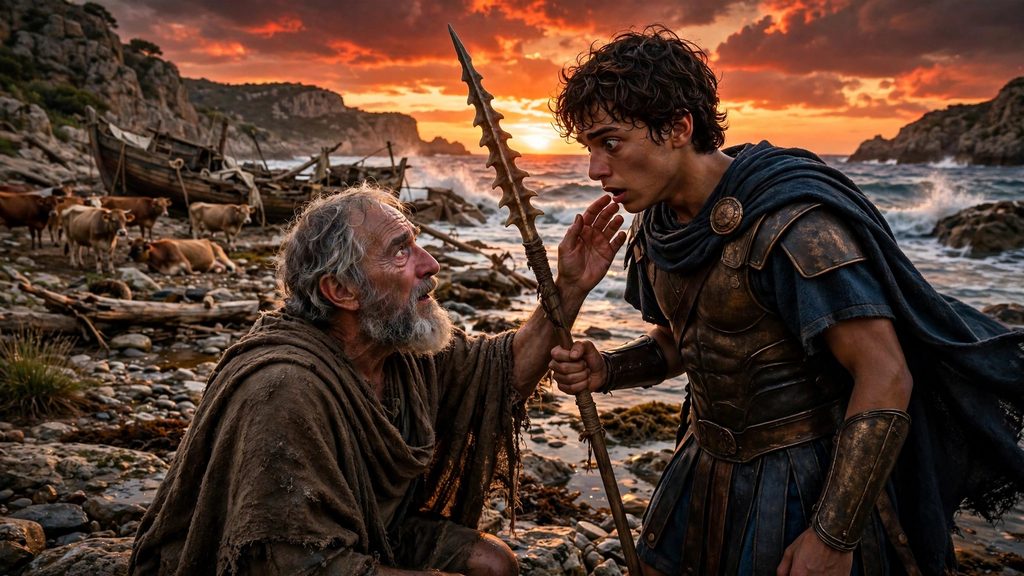
The ending is stranger still. Telegonus carried his father’s body to Aeaea, and Penelope and Telemachus went with him. Odysseus was buried on Circe’s island. Circe made Penelope and Telemachus immortal, Telegonus married Penelope, and Telemachus married Circe. The man who spent ten years struggling home ended up in her earth, while the family he struggled home to received from her the one gift he never did.
Circe Through the Ages
Each age took the Circe it needed. Homer’s is a goddess of knowledge, dangerous and generous at once. The epic cycle made her the mother of Odysseus’s killer and the keeper of his grave. Apollonius made her a priestess of purification, and Ovid a woman scorned. The nineteenth century painted her as a temptress holding out a cup, and the twenty-first gave her back her own voice.
What Circe Knew
Strip away the pigs and the wand, and Homer’s Circe is a figure of knowledge. She knows which plants take away memory and which give back strength. She knows the ritual that calls up the dead and the route past the Sirens. She knows the name of the man who will defeat her before he arrives. Her power frightened the men who met her because it was not supernatural in the way a thunderbolt is. It was the knowledge of what the earth grows, carried further than any mortal could carry it.
Later ages turned that knowledge into witchcraft and the woman into a warning. Homer chose a better word. Polypharmakos, she of many drugs, the woman who could turn a man into a pig and then make him younger and taller than before, depending on what she chose to give him.
At Olympus Estate, Mythic Essays read the Greek myths closely, from the oldest sources forward. Circe, daughter of Helios and Perse, sister of Aeëtes and Pasiphae and aunt of Medea, is called polypharmakos, she of many drugs, in Book Ten of the Odyssey, where pharmakon meant drug, medicine and poison at once. On Aeaea, the island of the Dawn, she turns Eurylochus’s men into pigs with a kykeon of cheese, barley, honey and Pramnian wine, leaving their minds intact. Hermes gives Odysseus moly, black-rooted and milk-white, which Theophrastus placed in Arcadia and two modern neurologists linked to the snowdrop and its galantamine. Circe restores the men younger and taller, hosts the crew for a year, and gives Odysseus the rite of the Nekuia and the warnings about the Sirens, Scylla, Charybdis and her father’s cattle. In the Argonautica she purifies Jason and Medea of Apsyrtus’s murder and sends her niece away. Ovid makes her the jealous maker of Scylla and of the woodpecker Picus, Hesiod names her sons Agrius and Latinus, and in the lost Telegony her son Telegonus kills Odysseus with a stingray-tipped spear before she makes Penelope and Telemachus immortal.