




Long before fireworks reached Greek skies, new beginnings were welcomed through ritual meals and symbolic offerings. Food marked thresholds. It carried prayers when words were not enough. What appears today as custom or habit still moves along channels carved in antiquity. The New Year table remains one of the clearest places where the ancient world has not fully retreated.
These are not merely recipes. They are a sacred language spoken through flavor, texture, and ritual, bridging the gap between the ancient altars and the modern dining room.
The transition from one cycle to the next is a moment of vulnerability and potential. The ancients knew this well. They understood that the threshold is a place where the boundary between the mortal and the divine grows thin. Therefore, the food placed upon the table during the Greek New Year traditions acts as a guardian. It is a form of hospitality offered not only to guests but to the unseen forces of fate. Every ingredient carries the memory of the land, the sweat of the harvest, and the whispers of a mythology that refuses to die.
The Ritual of the Rising Bread and the Legacy of Demeter
Long before the first church was built, the Greeks looked to the earth for their salvation. Demeter, the goddess of the harvest and the golden grain, was the patron of the threshold. Bread was her primary gift, a symbol of civilization and the endurance of life through the dark months of winter. On the New Year, bread remains the foundation of the feast. It is the physical manifestation of the hope that the earth will once again awaken and provide.

In many regions of Greece, the preparation of the ceremonial bread is a solemn act. The flour is sifted with a focus that mirrors the ancient grain offerings at Eleusis. There is a belief that the quality of the bread reflects the quality of the coming year. If the bread rises high and the crust is golden, the household will flourish. This is not superstition. It is an acknowledgment of the interconnectedness of human labor and natural grace. The scent of the baking bread fills the house, serving as a fragrant reminder that life persists even when the fields are brown and the mountains are capped with snow.
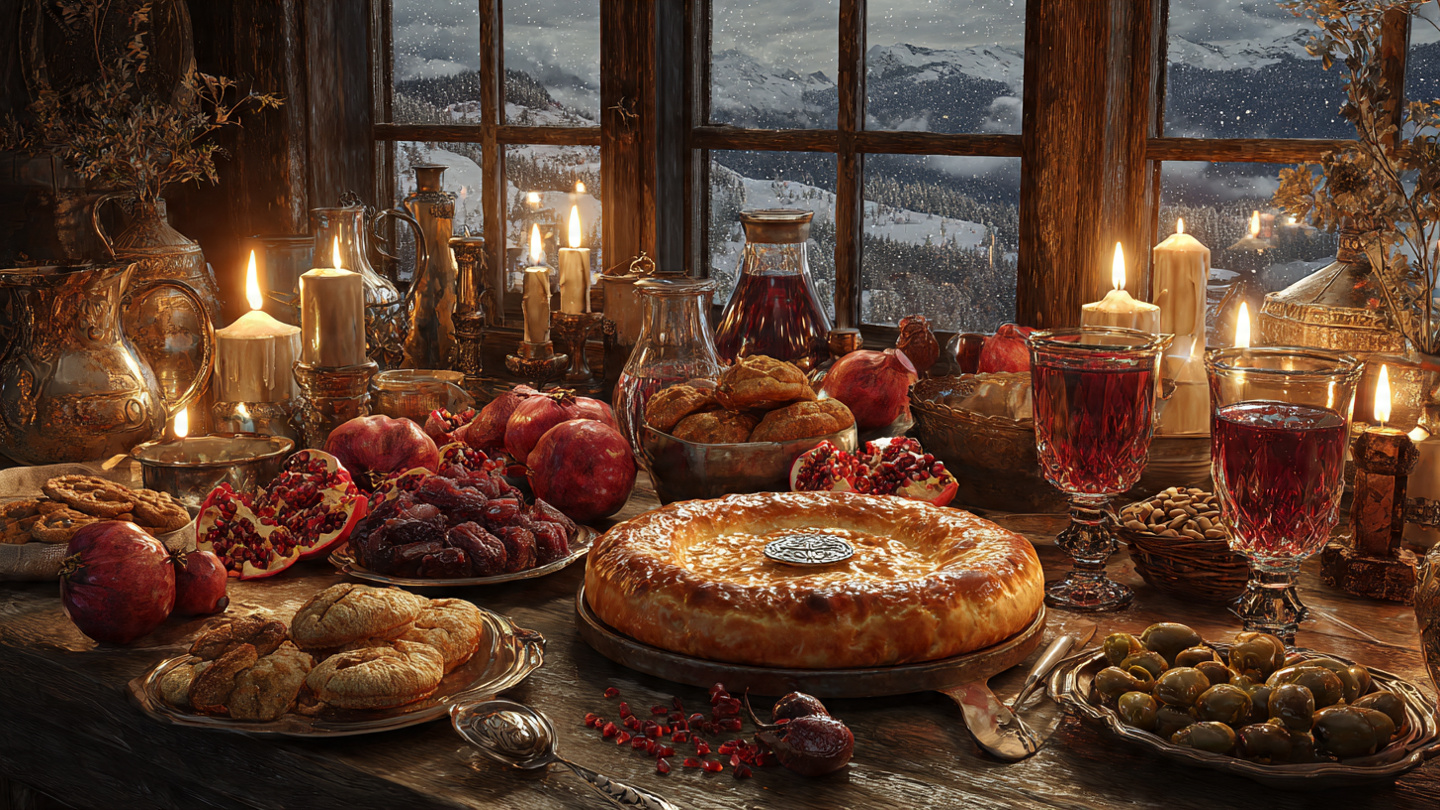
The Vasilopita is the most famous expression of this bread ritual. While it is often called a cake in modern cities, its soul remains that of the ceremonial loaf. The act of cutting the Vasilopita is perhaps the most significant social ritual of the Greek year. It is done with a hierarchy that honors the family, the community, and the spiritual world. The first slice is always for Christ or Saint Basil, the second for the house, and then the slices proceed through the members of the family from oldest to youngest. This order anchors the individual within a larger continuity. It reminds every person that they are part of a lineage that stretches back through time, protected by the hearth and the shared meal.
The Secret of the Golden Coin and the Favor of Tyche
Hidden within the crumb of the Vasilopita lies a small object that dictates the narrative of the coming months. The coin, or flouri, is the modern descendant of the ancient lot. In the sanctuaries of old, the Greeks would cast lots to understand the will of the gods or to seek the favor of Tyche, the goddess of fortune. Finding the coin is not about a sudden windfall of wealth. It is about a symbolic alignment with the rhythms of the universe.

The story goes back to Saint Basil of Caesarea, who sought to return jewelry and gold to his people after a period of heavy taxation or siege. To do so fairly, he had the treasures baked into loaves of bread and distributed them to the city. Each person found exactly what they had lost. This legend provides the moral framework for the modern ritual, but the feeling of the coin under the tooth carries a much older weight. It is the moment when the mundane act of eating becomes a brush with destiny. The person who finds the flouri is considered blessed for the year, but this blessing carries a responsibility to be a steward of that luck for the rest of the household.



In the villages surrounding Mount Olympus, the coin is sometimes accompanied by other symbols. A small piece of straw might represent the livestock, or a vine twig might represent the vineyard. This expansion of the ritual shows how deeply the symbolic foods of the new year are tied to the actual survival of the people. Each member of the family might find a different token, weaving their personal fate into the agricultural success of the estate. It is a beautiful, tactile way of reminding the modern Greek that their life is still fundamentally tied to the soil and the seasons.
The Pomegranate and the Descent of Persephone
If bread represents the survival of life, the pomegranate represents its hidden, explosive potential. No Greek threshold is complete on New Year’s morning without the sight of this ancient fruit. It is often the first thing to cross the doorway, carried by the head of the household or a child considered to be of good omen. The ritual of smashing the pomegranate against the door is a visceral act. It is loud, it is messy, and it is absolutely essential.

The fruit is a direct link to the myth of Persephone and her descent into the underworld. It is the fruit of the dead that ensures the return of the living. Its countless red seeds represent abundance, fertility, and the sheer volume of life waiting to burst forth from the winter soil. When the fruit is smashed and the seeds scatter across the marble or stone of the entrance, it is a physical prayer for a year that is equally full of life. The red juice, reminiscent of lifeblood, stains the threshold, marking the house as a place where the cycles of nature are respected and invited in.
This tradition is a testament to the endurance of Greek mythology in everyday life. Most Greeks do not spend their time debating the finer points of Hesiod, but they know that the pomegranate belongs to the door. They know that the number of seeds that scatter dictates the level of prosperity for the coming year. It is a moment of controlled chaos that interrupts the order of the holiday, a reminder that nature is wild and that its bounty requires a certain level of exuberant force to be released.
The Sweetness of Honey and the Softening of Fate
In the Greek mindset, the start of the year must be sweet. Bitterness is for the struggles of the past, but the future is approached with the taste of honey. Ancient Greece regarded honey as the food of the gods, a substance that fell from the heavens and was collected by sacred bees. It was used in libations and offerings to soften the hearts of the gods and to ensure that the words spoken by mortals were kind and effective.
On the New Year table, honey appears in the form of melomakarona and other syrup-soaked delicacies. These are not merely desserts. They are a form of culinary sympathetic magic. By consuming sweetness at the very beginning of the year, the Greeks hope to ensure that the months ahead will be free from the bitterness of grief or the sourness of conflict. The use of walnuts and sesame seeds alongside the honey adds a layer of ancient symbolism related to the brain, the intellect, and the hidden power of the seed.

The symbolic foods of the table also include the fruits of the trees that have stood for centuries. Dried figs and raisins, concentrated by the sun, represent the preservation of the summer’s energy. To eat a dried fig in January is to consume the light of August. It is a way of defying the winter, of proving that the warmth of the sun can be stored and carried through the darkest nights. This continuity of light is central to the Greek experience, where the memory of the sea and the sun is always present, even when the wind is howling through the mountain passes.
Dionysus and the Communal Cup of the Vine
Wine is the blood of the Greek landscape. From the volcanic soils of Santorini to the limestone slopes of the Peloponnese, the vine is a constant companion to the human spirit. In antiquity, Dionysus presided over the transition from the wild to the civilized, and wine was his medium. At the New Year, wine is more than a drink. It is a communal bond.
The act of sharing a bottle of wine at the table is a modern echo of the ancient symposion. It is a time for the loosening of tongues and the strengthening of ties. In many homes, a small amount of wine is poured out as a libation, a quiet nod to the ancestors and the spirits of the land. This act of giving before receiving is a core tenet of hospitality and ritual. It acknowledges that the feast is not for the living alone, but for the entire continuity of the family, past and present.

The wine of the New Year is often a robust red, reflecting the strength needed to face the coming months. As the glass is raised, the toast of Chronia Polla is not just a wish for many years, but for years that are full of meaning and health. The warmth of the wine mirrors the fire in the hearth, creating a sense of internal summer that protects the guests from the winter chill. It is the liquid gold that lubricates the wheels of fate, making the transition into the new year a smooth and joyous one.
The Table as a Sacred Landscape
When one steps into a home or an estate during this time, the arrangement of the table is the first thing that speaks. It is treated as a reflection of the surrounding landscape. It is not a cluttered or chaotic space. It is organized with a sense of purpose. The center is occupied by the bread, the fruit, and the wine, the three pillars of Mediterranean life. This arrangement turns the dining room into a sanctuary.

The food is served with a deliberate pace. There is no rush to finish. The meal is an endurance event, a slow exploration of the flavors of the region. From the salty tang of the feta to the earthy richness of the slow-cooked lamb, every dish is a chapter in the story of the land. This is the essence of Greek Living. It is the realization that the most important things in life happen around the table. It is here that stories are told, disputes are settled, and the future is imagined.
The New Year feast is the pinnacle of this philosophy. It is a time when the hospitality of the Greek host is at its most potent. A guest at the New Year table is not just someone who is being fed. They are someone who is being folded into the family ritual. They are invited to witness the smashing of the pomegranate and the cutting of the Vasilopita, becoming part of the house’s fate for the coming year. This openness is what makes the Greek winter feel so warm, despite the snow on the peaks of Olympus.
The Persistence of Ritual in a Changing World
It is easy to look at these traditions and see them as mere folklore, but that would be a mistake. In Greece, ritual is a form of technology. It is a way of managing the anxiety of the unknown and of anchoring the self in a world that is constantly shifting. The world outside may be changing with dizzying speed, but the pomegranate still smashes against the door in exactly the same way it did two centuries ago. The bread still smells of the same yeast and the same hope.
This persistence is what gives Greek culture its incredible resilience. By maintaining these symbolic foods and rituals, the Greeks ensure that they never lose their connection to the past. They carry their history in their mouths and their hands. This is why the New Year is so profound in this corner of the world. It is not a break from the past, but a continuation of it. It is a moment where the modern Greek reaches back across the millennia to shake hands with the ancient, using a slice of bread and a glass of wine as the medium.

As the morning of the New Year dawns over the Aegean, and the remains of the feast are cleared away, a sense of calm settles over the land. The rituals have been performed. The fate has been consulted. The table has been a place of blessing and shared humanity. The year is no longer a frightening void, but a path that has been blessed by the bread of Demeter and the wine of Dionysus. The hearth fire continues to burn, and the silver coin sits on the mantelpiece, a small, bright promise of the favor of the gods.
At Olympus Estate, Food and Seasonal Life traces the culinary traditions of the Greek world from the ancient harvest through the Byzantine kitchen to the contemporary table. The Vasilopita’s cutting hierarchy anchors the individual within a continuity that stretches back through time. The flouri is the modern descendant of the ancient lot cast to understand the will of Tyche. The pomegranate smashed at the threshold stains the doorway with the lifeblood of the fruit that ensured Persephone’s return. The wine is poured first as libation, acknowledging that the feast is not for the living alone. The coin sits on the mantelpiece. A small bright promise of the favor of the gods.