


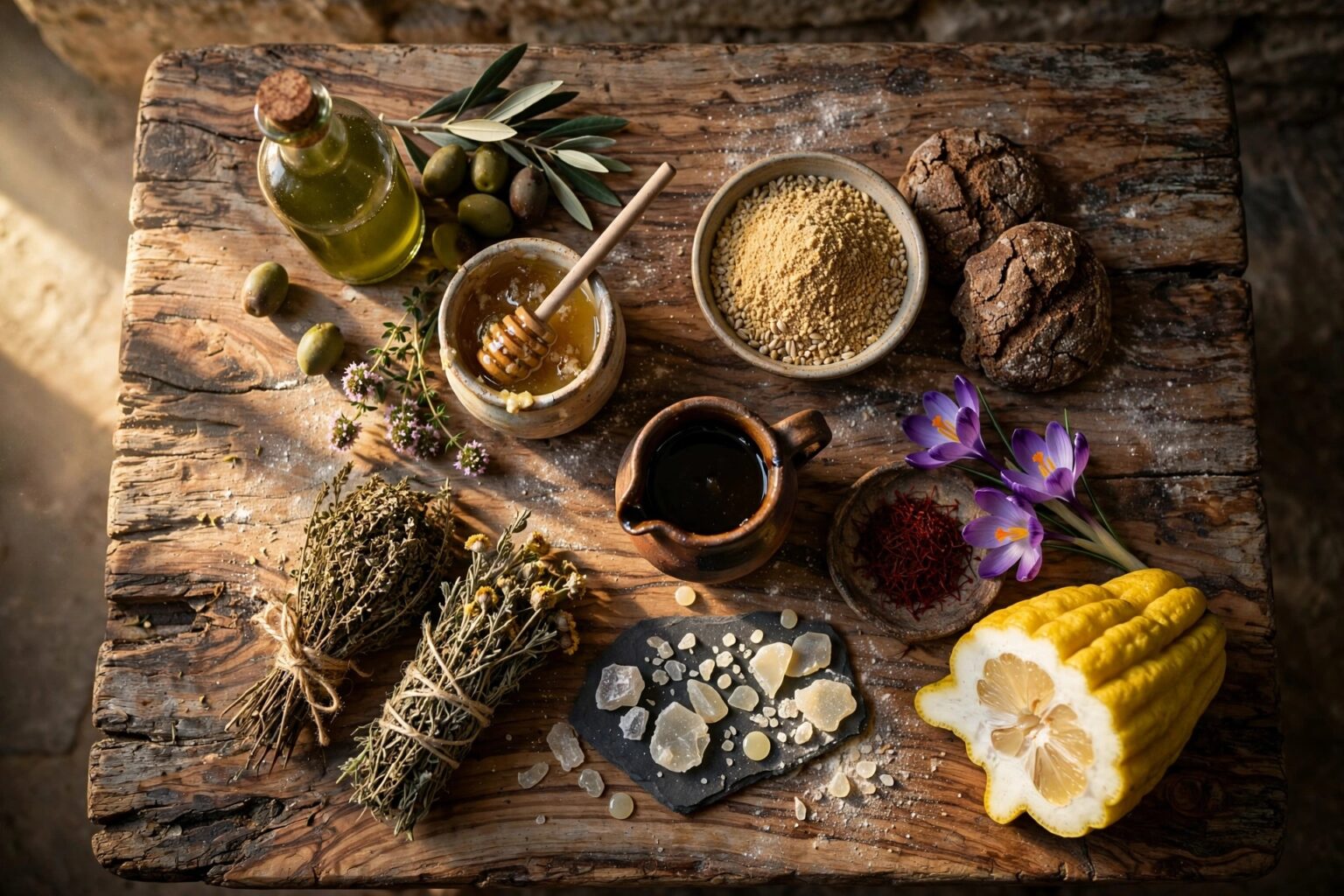
The oil comes out of the mill cloudy and green, the colour of new leaves. It smells of cut grass. On the tongue it is bitter, and a moment later it catches at the back of the throat hard enough to make you cough.
In Greece this first oil of the harvest is called agourelaio, from agouros, unripe. The ancient name was omphakinon, the oil of the omphax, the hard green olive, and the first-century physician Dioscorides, whose De Materia Medica guided Mediterranean medicine for fifteen centuries, called it the best oil there was for medical use.
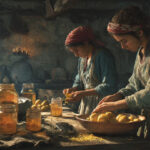
It was never cheap. Olives picked green, about three months before the main harvest, give a fraction of the oil that ripe fruit gives, so the oil of the unripe olive belonged to physicians and to households that could afford it. It went into ointments, mouth rinses for the teeth and gums, and remedies for the skin and the stomach.
In August 2026 a review in Frontiers in Pharmacology, led by Elron Zabatani of Bar-Ilan University, gathered the ancient references to this oil, in Greek, Latin, Hebrew, Aramaic and Arabic, and set them beside existing laboratory research. Oil pressed from green olives, that research shows, is richer in polyphenols, tocopherols and squalene than oil from ripe fruit, and it resists spoiling longer. The authors are careful to say this does not make the old remedies medicine today. It does explain why the old physicians paid so much for it.
Most of the Greek pantry began this way. It started as a short list of substances so potent, so strange or so hard to win from a dry land that the people who first used them reached for the gods to account for them. Athena gave the olive. Bees fed the infant Zeus. Demeter taught the grain and drank barley at Eleusis. A martyr’s death made a tree weep. A hero crossed the world for golden fruit.
Here are eight of those ingredients, what the myths said about them, what the history shows, and how to use each one in a kitchen today.
The Oil of the Unripe Olive | Athena’s Gift, Pressed Green
Athens chose its goddess with a tree. In the contest for Attica, Poseidon struck the rock of the Acropolis and a spring of salt water rose from it. Athena planted an olive. The city took the olive and the goddess with it, and the sacred tree stood on the Acropolis for centuries as her living signature. When the Persians burned the citadel in 480 BC, Herodotus reports, a fresh shoot a cubit long had sprung from the charred stump within two days. The story of that first tree is told in full in The First Sacred Olive Tree.
Agourelaio is that gift taken at its most intense. The olives are picked at the very start of the season, usually in October and November, while still green or just turning. Many come from the small Koroneiki olive of Crete and the Peloponnese, though every region presses its own early oil from its own olive varieties. They go to the mill within hours. What comes out is cloudy, deep green and startling. It smells of cut grass, artichoke and green tomato leaf. It is bitter on the tongue and it catches in the throat.
That catch has a name. In 2005 the American scientist Gary Beauchamp, who had been tasting liquid ibuprofen for an unrelated study, noticed that fresh olive oil stung the back of his throat in exactly the same place. His team isolated the compound responsible, named it oleocanthal and showed in the journal Nature that it inhibits the same inflammatory enzymes that ibuprofen does. The two molecules are not the same, and a spoonful of oil is not a painkiller. But the bite of a good agourelaio is the taste of one of the compounds that made the ancients value it.
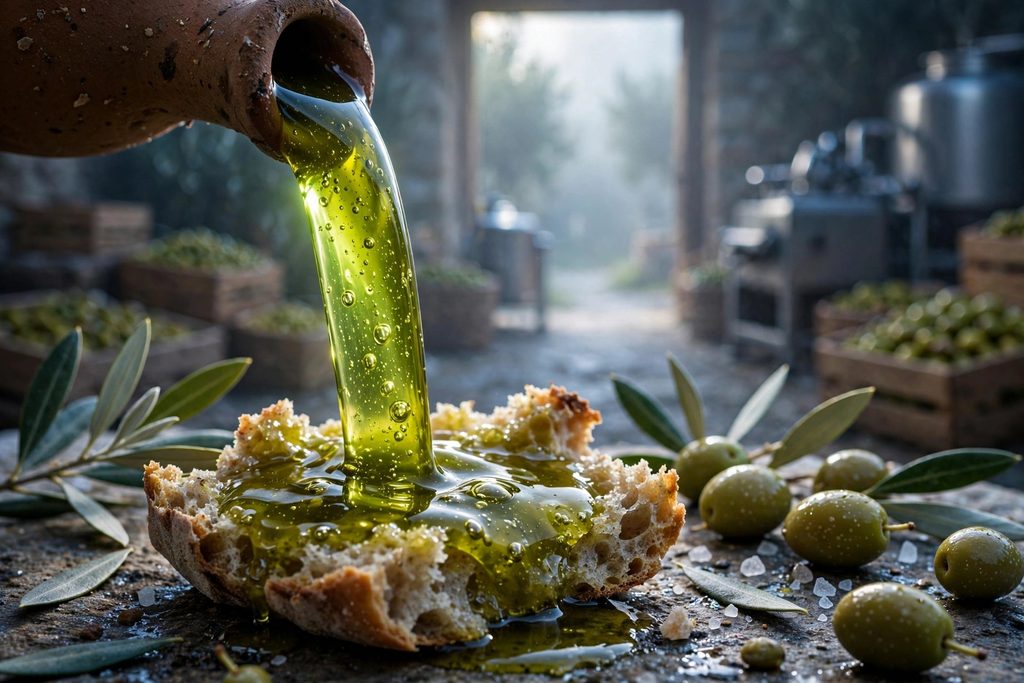
How to use it. Raw, as a finishing oil. Pour it over warm bread, boiled greens, white beans, grilled fish, a slab of feta or a barley rusk soaked with tomato. You can cook with it, but heat dulls the very aroma and bite you paid for, so save it for the plate. Buy the current harvest, check the date on the bottle, keep it dark and cool, and finish it within a few months, because the green fire softens as the oil ages. On Crete, the first oil of winter is eaten with the first oranges, a pairing explored in The Agourelaio and the Orange.
Hymettus Honey | The Food That Fed Zeus
When Rhea hid the newborn Zeus from his father in a cave on Crete, the infant was kept alive on the milk of the goat Amaltheia and on honey. Diodorus of Sicily records that bees fed him in the cave, and that Zeus later rewarded them by turning their colour to a gleaming bronze-gold. Another tradition names a nymph, Melissa, whose name simply means bee. The son of Apollo, Aristaeus, was said to have taught humankind to keep hives. The priestesses of several cults were called Melissae, and the bee runs through Greek religion as a creature of purity and order, a story told in The Melissae.
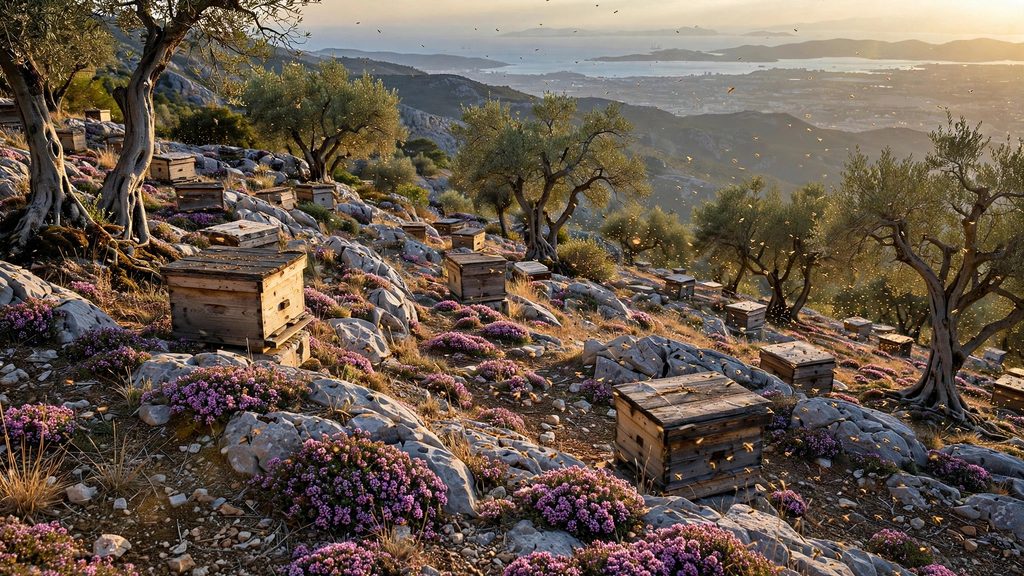
Honey even shaped how the Greeks imagined the food of the gods. The word ambrosia means immortality, but the lyric poet Ibycus, quoted centuries later by Athenaeus, described it as nine times sweeter than honey, and some modern scholars have argued that both nectar and ambrosia were first imagined as forms of honey. The nearest thing a mortal could taste was the honey of Hymettus, the limestone mountain that rises on the eastern edge of Athens, whose slopes of wild thyme gave the honey that ancient writers praised above all others. Pausanias, travelling in the second century, ranked its bee pasture as the best he knew but one.
Honey was also a drink, and an offering. In the eleventh book of the Odyssey, Odysseus digs a pit at the edge of the world of the dead and pours for the shades, first melikraton, honey mixed with milk, then sweet wine, then water, scattering white barley over all. Honey and water together made hydromeli, and left to ferment it became mead. Some scholars, the mythologist Karl Kerényi among them, believed a honey drink came before wine in the oldest worship of Dionysus. The fermented side of the ancient kitchen is explored in Krimnos, Hydromeli, and the Olive Brine.
How to use it. Look for thyme honey, thymarisio, pale gold and intensely floral, and for the darker pine and fir honeys of the mountains. Honey still comes from Hymettus in small quantities, though most Greek thyme honey now comes from Crete and the islands. Spoon it over thick yoghurt with walnuts, over fried cheese, into hot mountain tea, or onto loukoumades. Add it to warm dishes at the end, since long cooking flattens its scent. To taste what Odysseus poured, stir a spoonful into a glass of cold water. That is hydromeli at its simplest.
Barley | Demeter’s Grain and the Drink of Eleusis
When Demeter searched the earth for her stolen daughter, she came to Eleusis disguised as an old woman. In the Homeric Hymn that tells her story, the queen of Eleusis offers her red wine. The goddess refuses it and asks instead for a drink of barley meal and water mixed with pennyroyal. That drink, the kykeon, became the sacred drink of the Eleusinian Mysteries, taken by initiates at the threshold of the rites. The Eleusinians said the Rharian plain beside their sanctuary was the first field ever sown, and that Demeter sent the young Triptolemus out from there to teach the world to plough.
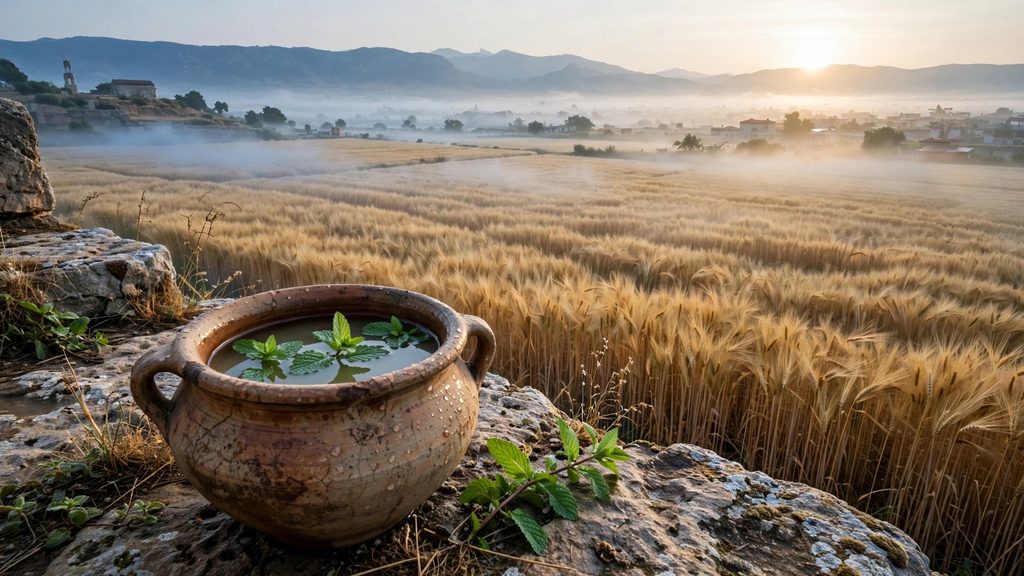
The myth chose the right grain. Barley tolerates thin soil and dry summers far better than wheat, and Greece has plenty of both. The Linear B tablets of Pylos and Knossos record barley and wheat side by side in rations and offerings more than three thousand years ago. In classical Athens the everyday staple was maza, a kneaded cake of barley meal moistened with water, milk or oil, while wheat bread, artos, was more often the food of festivals and of those who could pay for it. Earlier still, the first farmers of Neolithic Thessaly grew the hulled wheats emmer and einkorn alongside their barley.
The barley line never broke. Crete still bakes barley into hard twice-baked rusks, krithino paximadi, the base of dakos. Trahanas, the cracked-grain pasta of the mountains, carries the grain harvest through the winter, as told in Trahanas. Greek shops also sell flour labelled zea, marketed as an ancient wheat. The ancient name zeia is real, though scholars still argue over whether it meant emmer or spelt.
How to use it. Make dakos. Splash a barley rusk with water until it softens at the edges but keeps its crunch, then pile on grated ripe tomato, crumbled feta or soft mizithra, dried oregano, a few capers and a generous pour of agourelaio. Use pearl barley in soups and stews where you would use rice. For a taste of Eleusis, simmer coarse barley meal in water with a few leaves of pennyroyal or mint and a spoon of honey. It will not reveal the Mysteries, but it is the drink a goddess asked for.
Petimezi | The Sweetness of Dionysus Before Sugar
The vine came to Attica as a gift and a tragedy. Dionysus taught the farmer Icarius to make wine, and Icarius shared it with the local shepherds. They had never felt drunkenness, believed they had been poisoned, and killed him. His daughter Erigone, led to his body by their dog Maira, hanged herself in grief, and the Athenians honoured both in a festival of swinging. The grape, in Greek eyes, was never just fruit. It carried a god inside it.
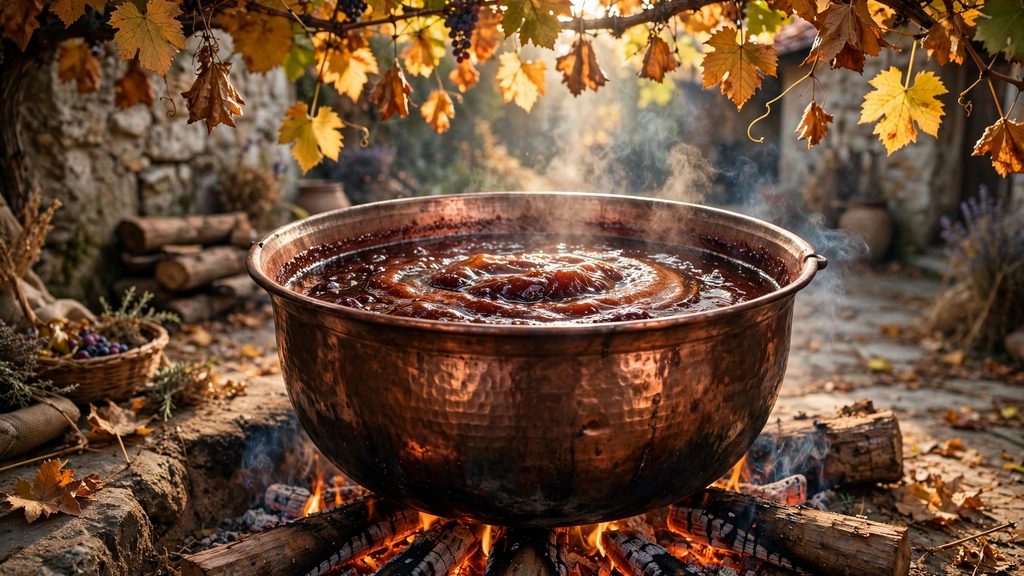
Not all of it became wine. Fresh must, boiled slowly for hours in a wide copper pan, thickens into a dark, glossy syrup the Greeks call petimezi. Ancient writers knew it as hepsema, the boiled thing, or siraion, and the Romans made the same product as sapa and defrutum. Before cane sugar reached the Mediterranean, this and honey were the sweeteners of the Greek kitchen. Villages still make it at the grape harvest in late August and September, when part of the must goes into moustalevria, a soft pudding thickened with flour, and moustokouloura, the must biscuits of autumn. That closing season of the year is the subject of Opora.
How to use it. The classic is tahini and petimezi, stirred together and spread on bread, a breakfast of the Lenten fasts that tastes like halva made in a hurry. Brush petimezi over pork or roasting pumpkin in the last minutes in the oven. Whisk it with olive oil, vinegar and mustard as a Greek answer to balsamic. Drizzle it over yoghurt or over a plate of fresh figs and walnuts. It is less sweet than honey, with a dark, raisin and mineral edge.
Mountain Herbs | Five Plants the Healers Named
Greek limestone, thin soil and long dry summers stress the plants that grow on them, and stressed aromatic plants make more essential oil. The result is a hillside pharmacy, catalogued by Theophrastus and Dioscorides and still gathered by hand. The wider story of these plants is told in Aromatic Herbs That Define Greek Cuisine. Five of them belong in every Greek pantry.
Oregano, rigani. Greek oregano, Origanum vulgare subspecies hirtum, is unusually rich in carvacrol, the compound behind its sharp, almost peppery heat. The Greeks heard in its name oros and ganos, the brightness of the mountain, a lovely etymology that linguists treat with caution. Use it dried, crushed between your palms over a village salad, grilled meat, roast potatoes, feta and almost everything else.
Thyme, thymari. This is the bee plant of Hymettus. Ancient grammarians tied its name to thyein, to burn an offering, and thyme was among the herbs that perfumed the smoke rising from Greek altars. Use it with lamb and goat, in bean stews, and in a pot of honey left to infuse.
Sage, faskomilo. Greek sage, Salvia fruticosa, was the elelisphakos of Dioscorides, used for coughs, wounds and the throat. Its modern name joins sphakos to milo, apple, after the round, edible galls that form on its stems. Greek households still brew the leaves into a tea with honey when a cold arrives. In the kitchen, lay them under pork as it roasts.
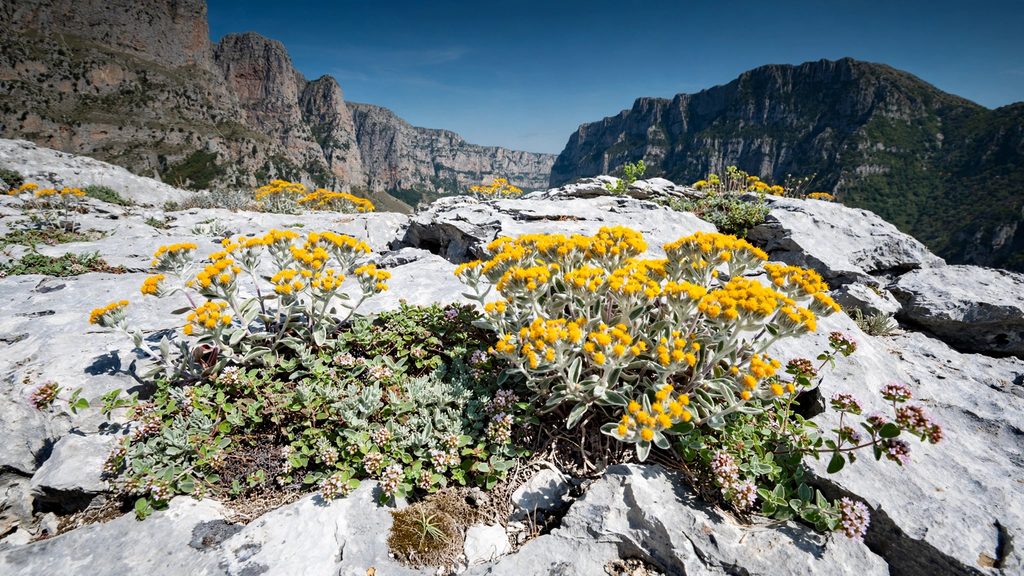
Mountain tea, tsai tou vounou. This is Sideritis, the ironwort, from sideros, iron. One ancient explanation held that it healed wounds made by iron weapons. It grows high, often above a thousand metres, on bare limestone in places like the Pindus and the Zagori villages of Epirus. Sideritis raeseri is the most widely grown, Sideritis scardica comes from the northern mountains, and Crete has its own, malotira. Simmer a small bundle for five minutes and drink it with honey and lemon through the winter.
Dittany of Crete, diktamo. Origanum dictamnus grows wild only on Crete, clinging to cliffs and gorge walls. Aristotle wrote that the wild goats of Crete, when shot with arrows, ate dittany to drive the arrowheads out of their bodies, and Virgil has Venus carry dittany from Cretan Ida to heal the wounded Aeneas. The men who climbed the cliffs to gather it were called erontades, lovers, because only love seemed reason enough to take such a risk. The goat in that story still lives in the White Mountains, as told in The Kri-Kri. Today dittany is cultivated, and it makes a soft, woolly-leaved tea.
How to keep them. Gather or buy them in early summer, when they flower and their oils peak. Hang small bunches upside down in a shaded, airy place until they crackle, then store them whole in sealed jars and crumble them only when you cook. A good dried Greek oregano should make you sneeze when you open the jar.
Saffron | The Flower in the Bed of Zeus and Hera
In the fourteenth book of the Iliad, Hera seduces Zeus on the summit of Mount Ida, and the earth answers them. Fresh grass rises beneath the pair, with dewy lotus, hyacinth and crocus, a living bed that lifts them from the ground. Homer calls the Dawn krokopeplos, saffron-robed. In Attica, the young girls who served Artemis at Brauron wore a saffron-coloured robe, the krokotos, during the rite of the Arkteia, explored in Brauron and the Arkteia. A later story made Crocus a mortal youth, beloved and accidentally killed, transformed into the flower that bears his name.
The oldest image of saffron in Greece is older than Homer by a thousand years. In the Bronze Age town of Akrotiri on Thera, buried by the great eruption, a building archaeologists call Xeste 3 holds a fresco of young women gathering crocus flowers on a rocky hillside. In the same scene a seated goddess receives the harvest from a blue monkey, with a griffin at her side. Saffron, it seems, was sacred before it was a spice. The island and its buried town are explored in Santorini Myths and Volcanic Legends.
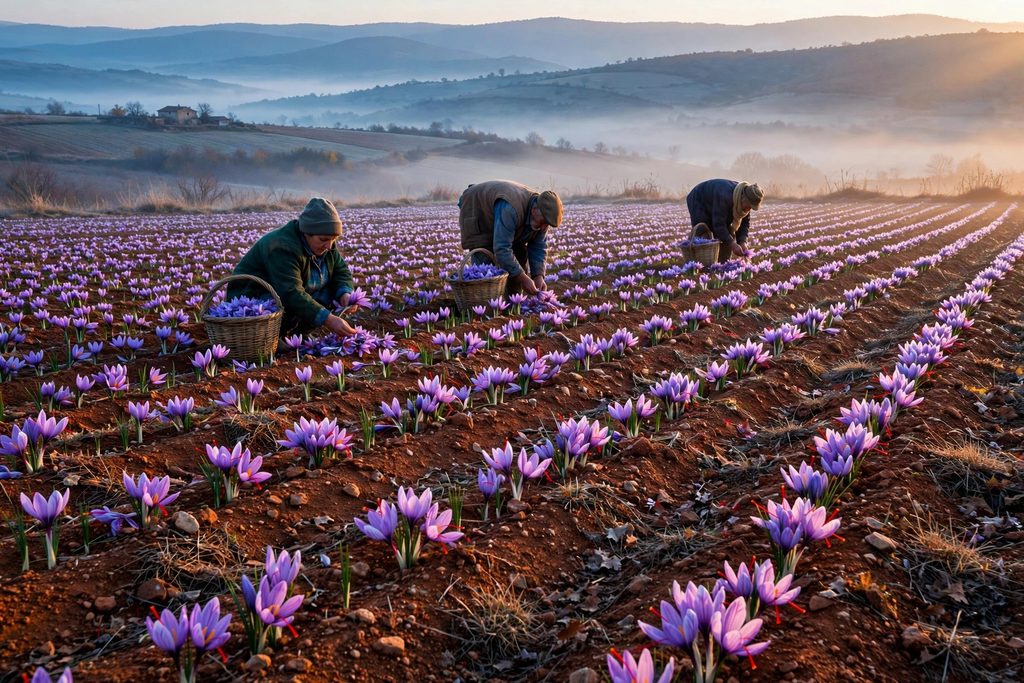
Saffron later vanished from Greek fields and returned only in the seventeenth century, carried back, by the usual account, by Greek traders from Austria to the plateau of Kozani in western Macedonia. A village there is called simply Krokos. Today Krokos Kozanis is a protected designation of origin, grown by a cooperative of local farmers. The flowers open in late October and early November. They are picked at dawn before the petals spread, and the three red stigmas of each flower are separated by hand. It takes well over a hundred thousand flowers to make a single kilo.
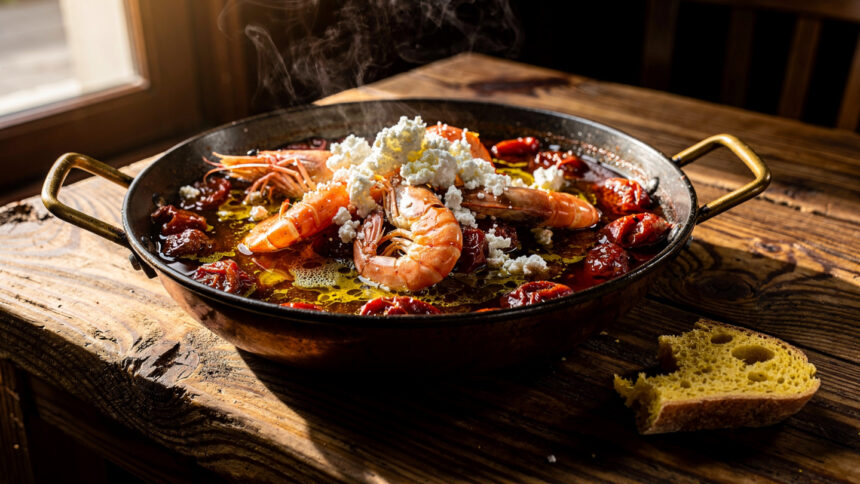
How to use it. Crumble a pinch of threads into a few spoonfuls of warm water or milk and leave it for fifteen minutes before adding it to a dish. Use it in pilaf, in fish soup, with mussels, in a tomato sauce for prawns, in semolina halva or in the dough of a festive bread. A little goes far. Too much turns bitter and medicinal.
Mastiha | The Tears of Chios
On Chios they say the trees began to weep for a saint. Isidore, an officer from Alexandria serving in the Roman fleet, was martyred on the island in the middle of the third century for refusing to give up his faith. The mastic trees of the south, the story goes, shed tears at his death and have shed them every summer since. The tears are the resin itself, drops that seep from cuts in the bark, harden in the sun and fall onto the white earth below, where the growers sweep and gather them by hand.
The legend answers a real puzzle. The mastic shrub, Pistacia lentiscus, grows all around the Mediterranean, but only the variety of southern Chios, in the cluster of villages called the Mastichochoria, yields resin in quantity and of this quality. The ancients chewed it to clean the teeth and sweeten the breath, and the Greek verb mastichan, to grind the teeth, gave English the word masticate. Under Genoese and then Ottoman rule, mastic was so valuable that its trade was a monopoly. The full history of the resin and the villages that guarded it is told in Mastiha. Mastiha Chiou is a protected designation of origin, and in 2014 UNESCO added the know-how of cultivating mastic on Chios to its list of the intangible cultural heritage of humanity.
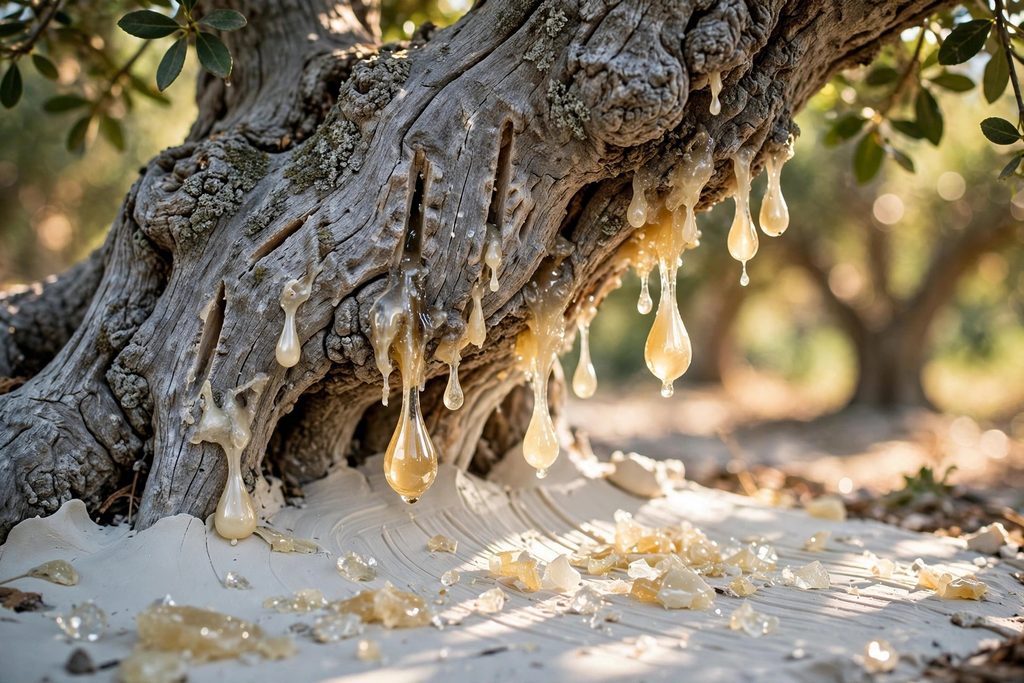
How to use it. Crush the tears in a mortar with a pinch of sugar, which keeps them from sticking, then work the powder into the dough of Easter tsoureki with mahlepi, into rice pudding or into ice cream for the stretchy, resinous kaimaki of old Greek patisseries. Try the ypovrichio, the submarine, a spoon of white mastic fondant plunged into a glass of iced water and licked slowly, one of the old-fashioned spoon sweets of the Greek kafeneio. Or pour a small glass of cold mastiha liqueur after dinner. Use it sparingly. Too much tastes of pine needles.
Citron | The Golden Fruit at the Edge of the World
At the western edge of the world, the Hesperides, daughters of the Evening, tended a garden where golden apples grew, guarded by the serpent Ladon. To fetch them was one of the labours of Heracles, the eleventh in the order Apollodorus gives, and he managed it by tricking the Titan Atlas into picking them for him. Writers ancient and modern have tried to name the fruit. Quince, orange and citron all have their champions, and the debate is followed in The Garden of the Hesperides. Botany paid the myth a compliment without settling it. A citrus fruit, in scientific terms, is a hesperidium.
The citron was the first citrus the Greeks knew. Around 300 BC, Theophrastus described the Median or Persian apple, a fruit from the east that was not eaten, but kept among clothes to protect them from moths, taken as an antidote to poison and used to sweeten the breath. Lemons and oranges came later, the lemon spreading widely only in the Middle Ages. Before them, the citron’s thick, perfumed rind was the scent of citrus in the Greek world.
Naxos kept the citron when most of Greece let it go. Its trees still grow in the Tragaea valley, and their fruit becomes a candied spoon sweet, while their leaves are distilled into kitron, the island’s protected liqueur, made at Chalki since the nineteenth century. It comes in three styles. The green is the sweetest and gentlest, the clear is drier and stronger, and the yellow is the strongest of all. The island itself is explored in Naxos.
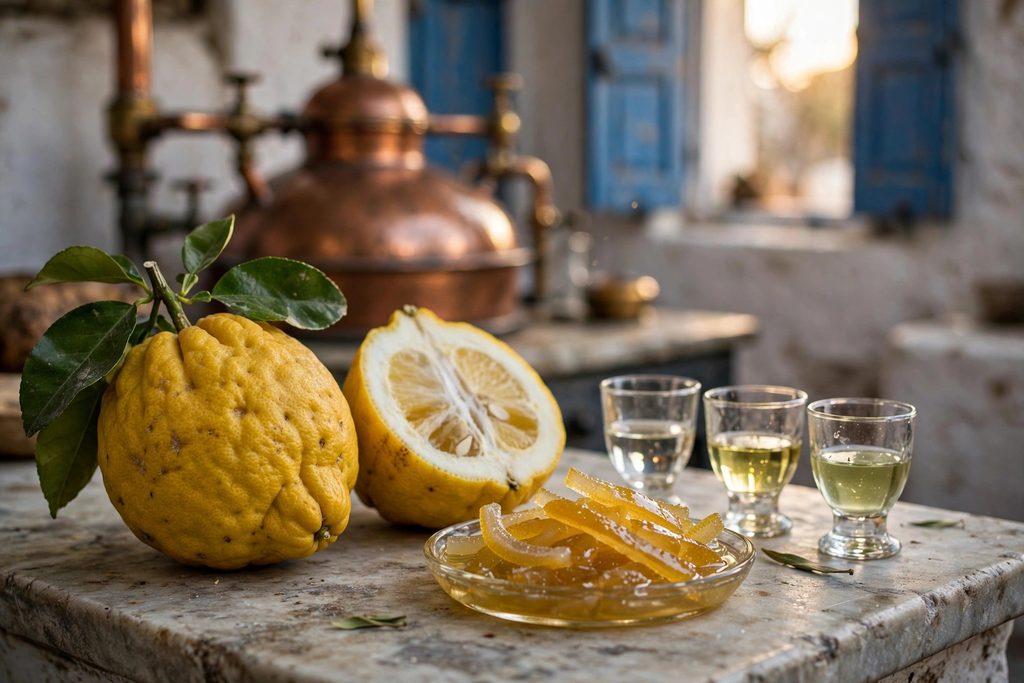
How to use it. Chop candied citron into sweet breads, cakes and Christmas biscuits. Serve kitron cold as a digestif, or spoon a little into the syrup of a semolina cake. If you ever find a fresh citron, grate the rind over yoghurt or fish and keep the fruit in a bowl in the kitchen for its scent, exactly as Theophrastus advised. Where today’s cook reaches for a lemon, the ancient cook had only this.
The Pantry Is Still Open
Look at the eight together and a pattern appears. Every one of them comes from hard ground, a dry hillside, a cliff, a thin field, a single island. Every one demands patient labour, picking olives green, robbing hives, boiling must for hours, splitting saffron flowers at dawn, scoring bark and sweeping resin from the earth. And every one belongs to a place. Hymettus. Eleusis. Chios. Kozani. Naxos.
The myths were the ancient world’s way of saying so. A goddess planted this tree, here. A saint died on this hillside, so these trees weep. Long before any food carried a protected designation of origin, the Greeks gave their best ingredients a god and an address. The story was the label. The ancient table these stories fed is set out in The Sacred Table, and the sacred places themselves are mapped in the Olympus Estate Atlas.
Every autumn the pantry fills again in the same order. The thyme honey of summer is spun and sealed. Jars of new petimezi from the grape harvest line village shelves. The saffron fields of Kozani turn violet for a few weeks. And in Crete, Messinia and Laconia, the first green olives go to the mills, still hard, still bitter, pressed within hours of picking.
Find a bottle. Pour it over bread and taste the bite at the back of your throat. Dioscorides would have known that oil at once. He called it omphakinon, the oil of the unripe fruit, and he named it because it was worth naming. The pantry of the gods never closed. It only changed its labels.
At Olympus Estate, Food and Seasonal Life follows the Greek kitchen back to the stories that first explained it. The pantry of the gods holds eight ingredients the ancients could not account for without the divine. Athena’s olive, pressed green into the oil Dioscorides ranked first for medicine. The honey of Hymettus and the bees that fed the infant Zeus. Demeter’s barley and the kykeon of Eleusis. Petimezi, the boiled must of Dionysus’ vine. Oregano, thyme, sage, mountain tea and the cliff-grown dittany of Crete. Saffron, from Homer’s bed of flowers and the Akrotiri fresco to the fields of Kozani. Mastiha, the tears of Chios. And the citron of the Hesperides, still distilled into kitron on Naxos. Each came from hard ground and patient hands, and each still waits in a Greek kitchen this autumn.