





Charon is not in Homer.
Read the eleventh book of the Odyssey and the dead come crowding up out of the dark to drink the blood Odysseus has poured into a trench. His mother is there, and Tiresias, and Achilles, who would rather be a hired hand on a poor man’s farm than king of all the dead. Minos sits in judgement. Tantalus reaches for water that drains away and Sisyphus pushes his stone. The underworld of Homer is crowded, grieving and precise. It has rivers. It has gates. It has a god who leads the souls down. What it does not have is a boat, a fare or an old man with a pole.
Hesiod’s Theogony, which names almost every power in the Greek cosmos, does not mention him either. The ferryman who became the most familiar face of Greek death, the one every schoolchild can describe, enters the record late, quietly and from below. He did not climb down into myth from the epic poets. He walked up into it from the graveside.
The River Without a Boatman | What Homer Gave the Dead
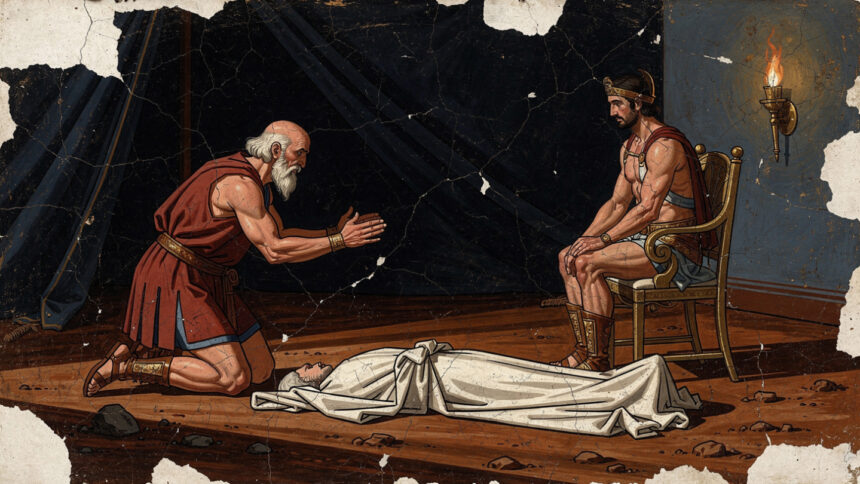
Homer’s dead do have a border to cross. In the twenty-third book of the Iliad, the ghost of Patroclus comes to Achilles in a dream and begs to be buried quickly. The other shades, he says, keep him away and will not let him join them beyond the river. Until his body is burned, he must wander outside the wide-gated house of Hades. In the Odyssey, the unburied Elpenor, who fell drunk from Circe’s roof, is the first shade to reach Odysseus, and he asks for the same thing, a pyre, a mound and his oar planted on top of it.
So the idea that the dead must cross water, and that the unburied cannot, is already Homeric. So is the guide. At the opening of the Odyssey’s last book, Hermes Psychopompos rounds up the souls of the suitors with his golden wand, and they follow him gibbering like bats in a cave, past the streams of Ocean and the White Rock, past the gates of the Sun and the land of dreams, to the meadow of asphodel. They walk. Nobody rows them anywhere.
Everything Charon would later need was already in place, the river, the boundary, the rule about burial, the escort. Charon did not invent the Greek underworld. He arrived in one that was already built, and took the one post that stood empty, the man at the water’s edge.
The Old Man in the Painting | Where Charon First Appears
The oldest words we have about him come from a lost poem. The Minyas, an epic about the hero clan of Orchomenos, survives only in quotations, and one of them reached us by way of a painting. In the second century AD the travel writer Pausanias stood at Delphi in front of the great mural of the underworld that Polygnotus had painted for the clubhouse of the Knidians some six hundred years earlier. In it he saw a boat on a river thick with reeds, and an old man at the oar. Polygnotus, he explains, followed the Minyas here, and he quotes two lines from it about the boat on which the dead embark, the one the old ferryman Charon steered.
Nobody can date the Minyas with confidence, though most scholars place it in the archaic period, after Homer. The pictures are firmer. The earliest known image of Charon ferrying souls is on an Athenian black-figure vase of around 500 BC, now in Frankfurt, where the dead ride in his boat as tiny winged figures. Within a couple of generations he had become one of the most common subjects on a very particular kind of pot.
The white-ground lekythos was a slender oil flask, painted in soft colours on a chalky white surface and made for one purpose, to be laid with the dead or left at the tomb. In the second half of the fifth century BC, Athenian painters put Charon on around a hundred of the examples that survive. The scene hardly varies. Hermes brings a woman or a young man down to the shore. Charon waits in his boat among the reeds, one hand on the pole, the other reaching out. Sometimes a small winged soul flutters overhead. The mood is quiet, almost tender, the moment of goodbye.
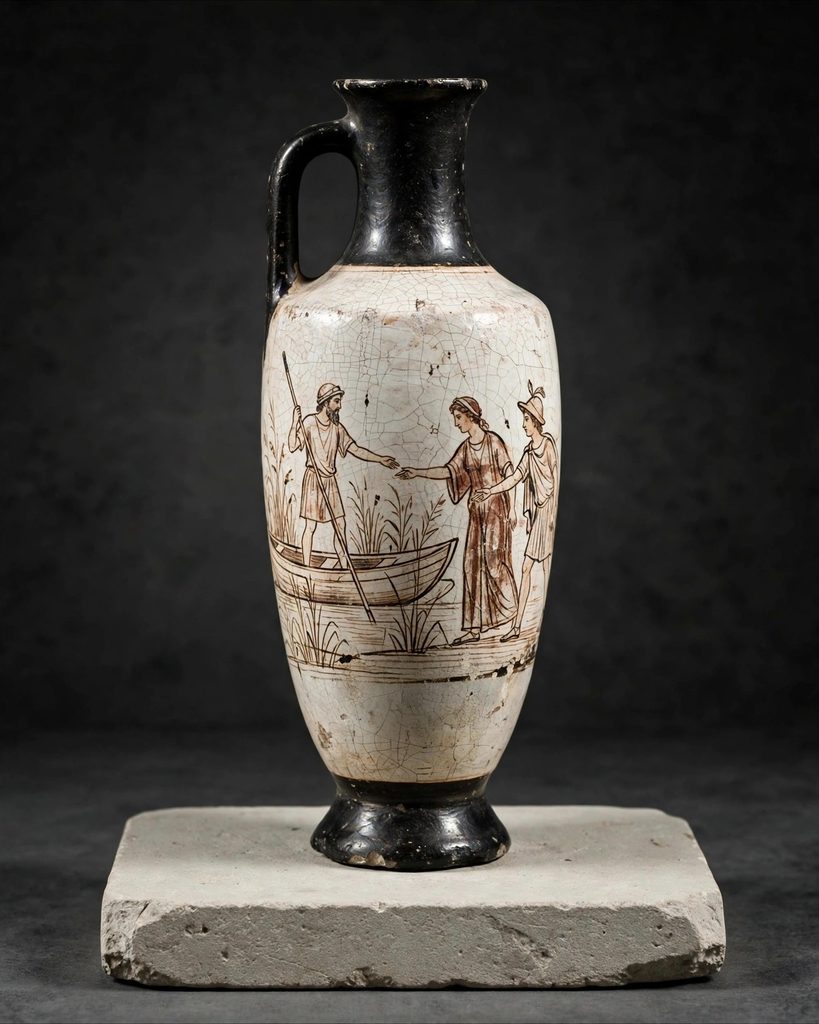
That order of events matters. Most Greek gods and monsters start in poetry and acquire cult and imagery later. Charon runs the other way. He is strongest first on the objects Athenian families chose for their own dead, and only afterwards does the stage take him up. He is a figure of burial practice who was promoted into literature.
A Working Man at the Water | What Charon Looks Like
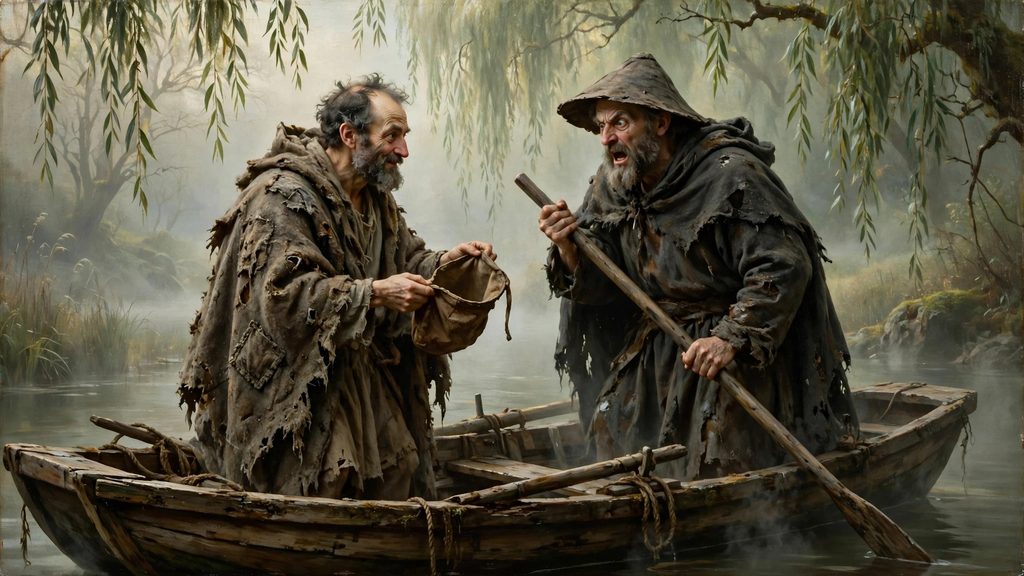
On the Athenian vases he is no monster. He is a boatman, bearded and weathered, in the short tunic, the exomis, that left one shoulder bare for labour, and often a simple felt cap. He looks like the men who worked the ferries and fishing boats of Attica, and that seems to be the point. Death, for the painters of the lekythoi, did not arrive as a horror. It arrived as a tradesman doing his job.
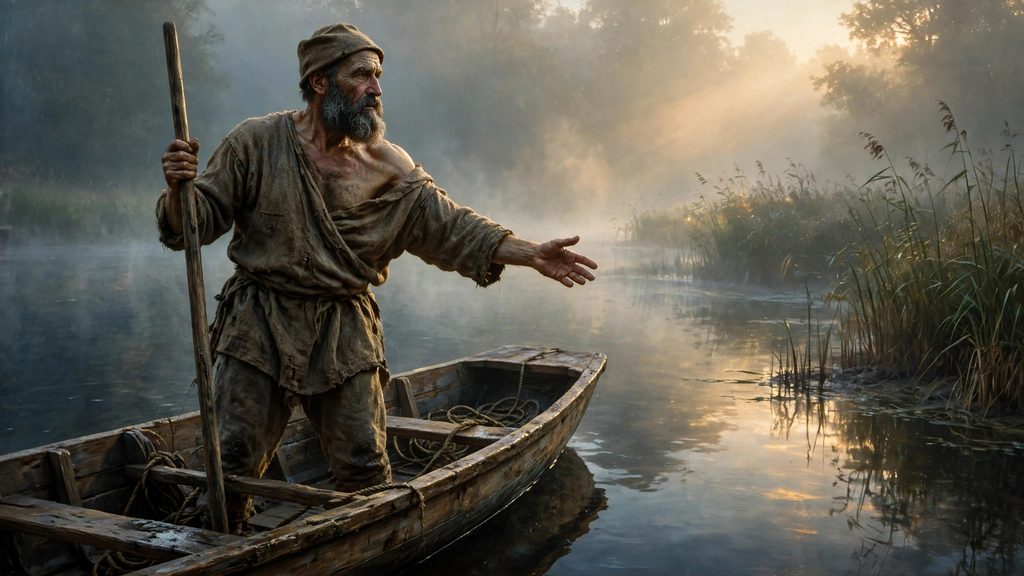
The Romans darkened him. In the sixth book of the Aeneid, Virgil gives us the portrait that would last a thousand years, a terrible ferryman in filthy squalor, a thick white beard uncombed on his chin, a dirty cloak knotted at the shoulder, and eyes that stand fixed in flame. He is old, Virgil says, but a god’s old age is green and hardy. Some scholars have linked his very name to the Greek charopos, fierce-eyed or bright-eyed, an epithet Homer gives to lions. If they are right, the burning eyes were in the name long before Virgil lit them.
Dante took that face into the Christian afterlife. In the third canto of the Inferno, Charon appears as an old man white with age, with wheels of flame around his eyes, who herds the damned into his boat and strikes any who linger with his oar. Through Dante, and through Michelangelo, who painted him swinging that oar in the Last Judgement in the Sistine Chapel, the quiet Athenian boatman became the snarling ferryman of Western art.
Which River | Acheron, Not Styx
Modern retellings almost always put Charon on the Styx. The Greeks mostly did not. In Greek sources he works the Acheron, the river of woe, or the marshy Acherusian lake into which it spreads. The Styx was something else, the river of hate by which the gods swore their unbreakable oaths. It was Virgil who blurred the waters together, and later writers followed him. Beyond the crossing, at the gates, waited Cerberus, who in Hesiod fawns on every soul that enters and devours any that tries to leave.

The Acheron is also a real river. It rises in the mountains of Epirus, runs through a deep gorge near the village of Glyki, and once spread into a marshy lake before reaching the Ionian Sea. On a low hill above that old lake stood the Necromanteion, the oracle where the living came to question the dead, though archaeologists still argue over what the excavated building there really was. Its story is explored in The Necromancy of Acheron. The river’s place among the waters the Greeks once worshipped is traced in Rivers That Were Once Gods. You can stand today in the cold green water at the springs of the Acheron and look downstream toward the plain where ancient writers placed the Acherusian lake. A real river proves nothing about a myth, but it is easy to see why the Greeks imagined a boatman here.
The Fare | What the Coin Really Was
Later Greek and Roman writers agree on the price, a single obol, the smallest silver coin in common use, worth a sixth of a drachma. Lucian, writing in the second century AD, describes relatives placing it in the mouth of the dead as the fare for the ferryman. Archaeologists call it Charon’s obol, and coins found with burials have been called the most famous grave goods of antiquity.
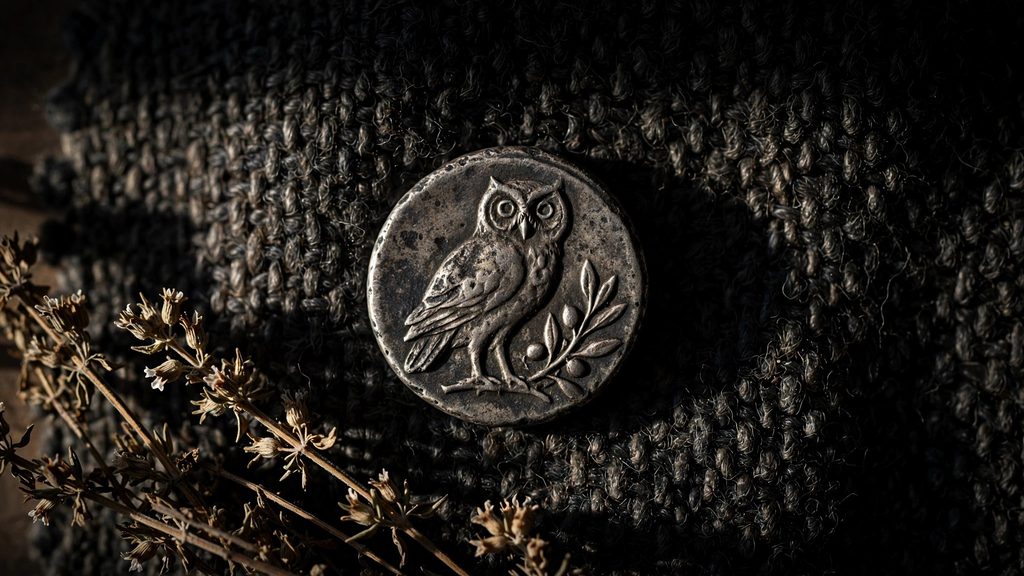
The ground tells a messier story than the books. Coins do turn up in Greek graves, sometimes in the mouth, sometimes in the hand, sometimes simply laid beside the body, and they are of many denominations, not only obols. Many graves of the same period and the same class contain no coin at all. The custom was real, but it was never universal, and some scholars think the coin began as something else, a token of passage or a last trace of property, before the ferryman story attached itself to it.
The image most people carry today, two coins resting on the eyes of the dead, belongs to later European custom rather than to the Greek texts, which put the fare in the mouth. The ancient world gave us the obol. The coins on the eyelids came from somewhere else.
A Hundred Years on the Bank | Burial, Not Money
It is often said that a soul without a coin had to wait a hundred years before Charon would take it across. The source for the hundred years is Virgil, and Virgil says something different. When Aeneas reaches the river, he sees a great crowd on the bank stretching out their hands, while the grim boatman takes some and drives others away. The Sibyl explains. The ones he refuses are the unburied. Charon may carry only those whose bones have found rest, and the rest must wander the shore for a hundred years before they are allowed to cross.
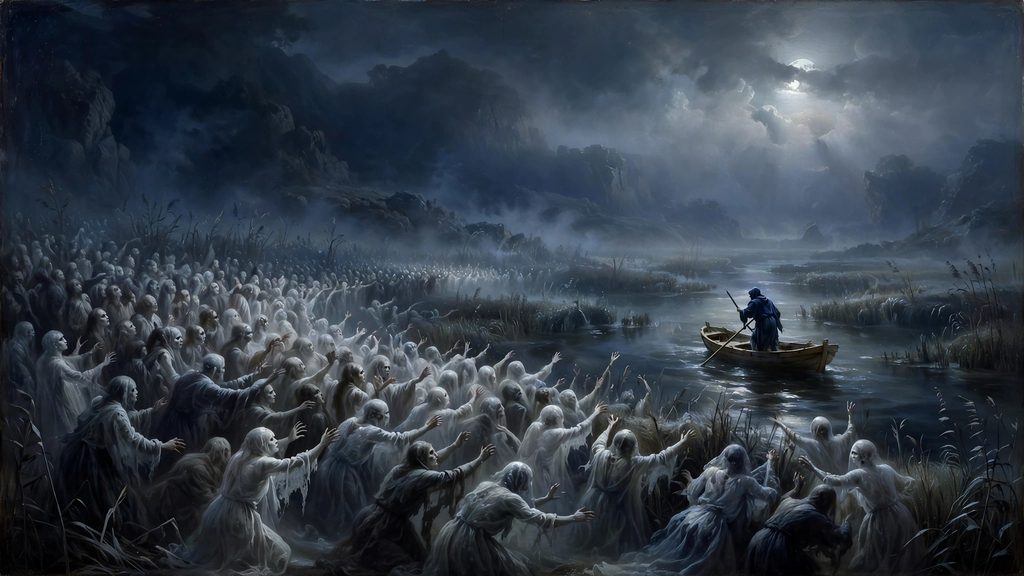
The condition is burial, not payment. Virgil never mentions a coin at all. In the same scene Aeneas meets his helmsman Palinurus, drowned and left unburied, who begs for the very thing Patroclus and Elpenor begged for in Homer. The rule is old, older than the ferryman. The dead could not cross until the living had done right by them.
That is why the coin mattered where families used it. It was never really the dead person’s money. It was placed there by the living, as one part of the rites they owed, alongside the washing, the lament, the procession and the grave. Not every family used a coin, and not every coin in a grave was meant for Charon. But where the ferryman’s fare was paid, it was the living who paid it.
Dionysus Rows Himself | Charon on the Athenian Stage
By the time the playwrights reached him, the audience knew him well. In Euripides’ Alcestis, staged in 438 BC, the dying queen sees the two-oared boat waiting in the lake and hears the ferryman of the dead calling to her with his hand on the pole, asking why she is still delaying, telling her she is holding everyone up. It is one of the most frightening moments in Greek tragedy precisely because he sounds so ordinary, a boatman impatient to cast off.
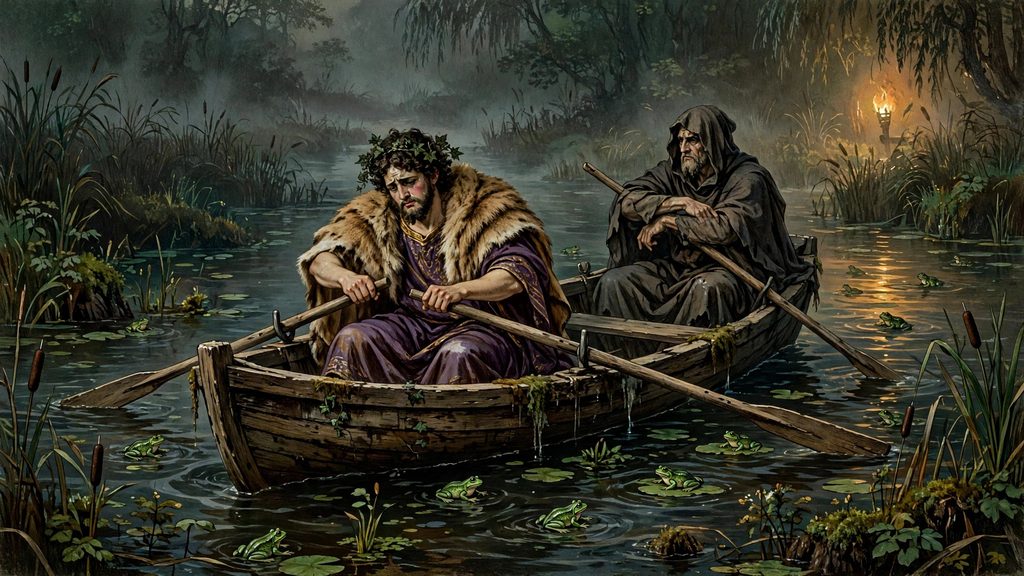
Then, in 405 BC, Aristophanes made him funny. In the Frogs, Dionysus travels down to the underworld to bring back a dead poet. Heracles, who has made the trip before, tells him the crossing costs two obols, probably a dig at the two-obol payments the city was then handing out to its poorer citizens. At the lake, Charon refuses to take Dionysus’ slave Xanthias, because he only carries slaves who fought in the recent sea battle at Arginusae, so Xanthias has to walk all the way round. Then he makes the god of wine sit down and row, while a chorus of frogs croaks brekekekex koax koax from the marsh.
The joke only works if everyone in the theatre already has the picture in their heads, the boat, the fare, the old man who takes no nonsense from anyone, god or not. The families of Athens had been laying that picture in their graves for two generations. Aristophanes could make them laugh at it because they knew it so well, and laughter at the edge of the grave is not disrespect. It is one of the ways a city lives with death.
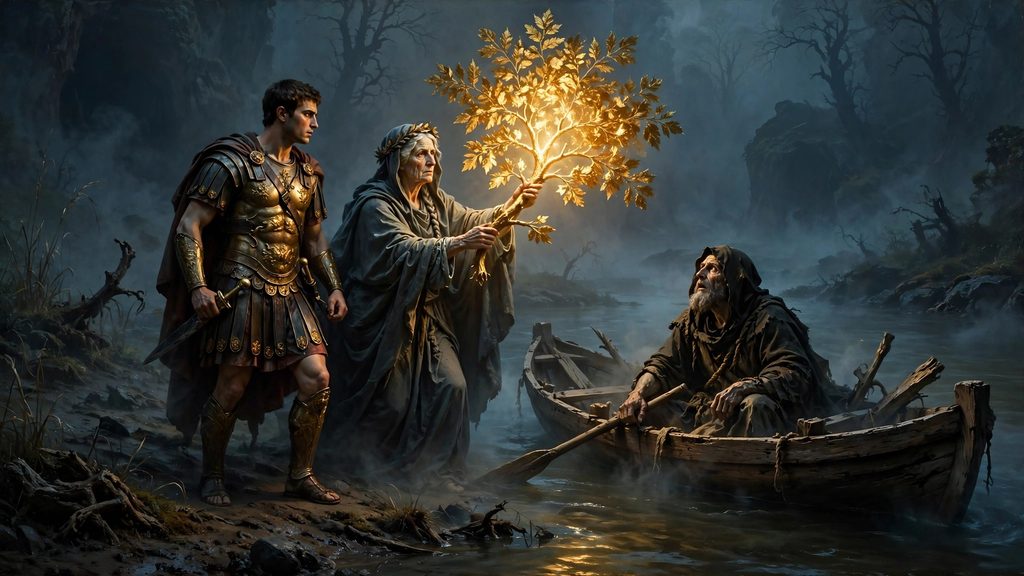
Living passengers were always the exception that proved his rules. Heracles crossed to drag Cerberus up into the light. Orpheus charmed his way over with the lyre, and in Ovid’s telling the ferryman turned him back when he tried a second time, after he had lost Eurydice. Virgil’s Aeneas could board only after the Sibyl showed Charon the golden bough, the gift owed to Persephone, and the old boat sank low in the water under the weight of a living man.
Charon Sees Gold | Lucian’s Day in the World of the Living
Five centuries later, the Syrian-Greek satirist Lucian, already known here for the first science fiction voyage, gave the ferryman a day off. In the dialogue Charon, or the Inspectors, Charon asks Hermes to show him life up above, the thing every soul in his boat weeps for losing. To get a good view, Hermes stacks mountains one on another, Ossa, Pelion, Oeta and finally Parnassus, and the two of them sit on the top looking down at the world.
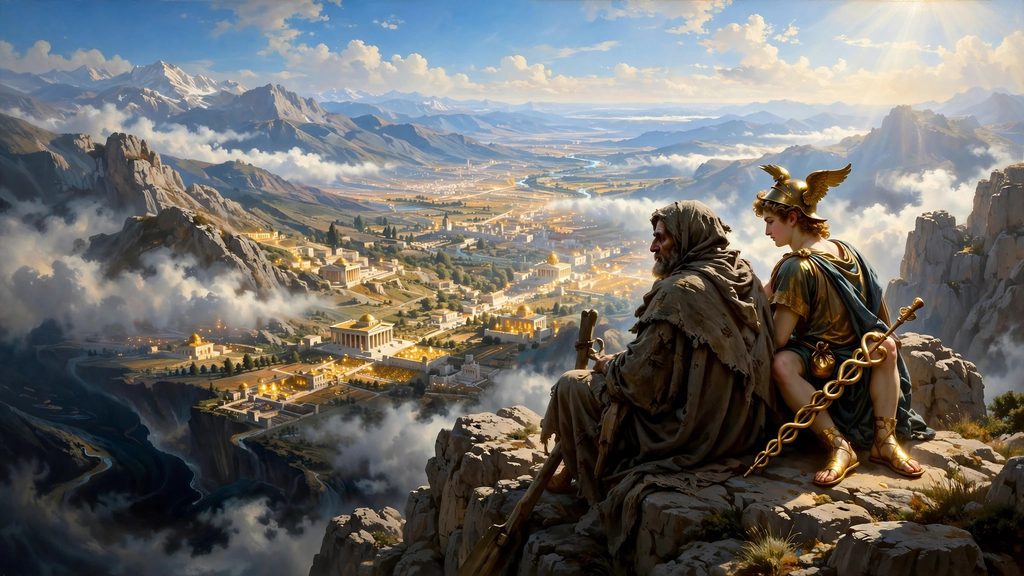
From there they watch King Croesus sending ingots to Delphi. Charon stares at the bright yellow metal and admits it is the first time he has seen it, though he is always hearing about it. Hermes explains that this is gold, the thing men sing about and fight over. Charon cannot see what is so special about a heavy yellow stone that its bearers find hard to carry. The being who meets every human at the moment all their possessions become worthless has never owned anything worth losing.
In Lucian’s Dialogues of the Dead the joke turns the other way. The Cynic philosopher Menippus arrives at the boat and calmly refuses to pay, because he has nothing, and asks the ferryman what he plans to do about it. A man who owns nothing cannot be charged. For once, Charon has no answer.
Charun | The Etruscan Demon with the Hammer
Across the sea in central Italy, the Etruscans borrowed the name and changed almost everything else. Their Charun, painted on the walls of tombs at Tarquinia and Vulci from the fourth century BC onward, is no tired boatman. He has grey or bluish skin, a hooked nose, pointed ears and sometimes snakes in his hair, and he carries a heavy hammer. He is less a ferryman than a guardian of the doors of the underworld, and he often appears in pairs, standing beside painted tomb doorways or escorting the dead on their way.
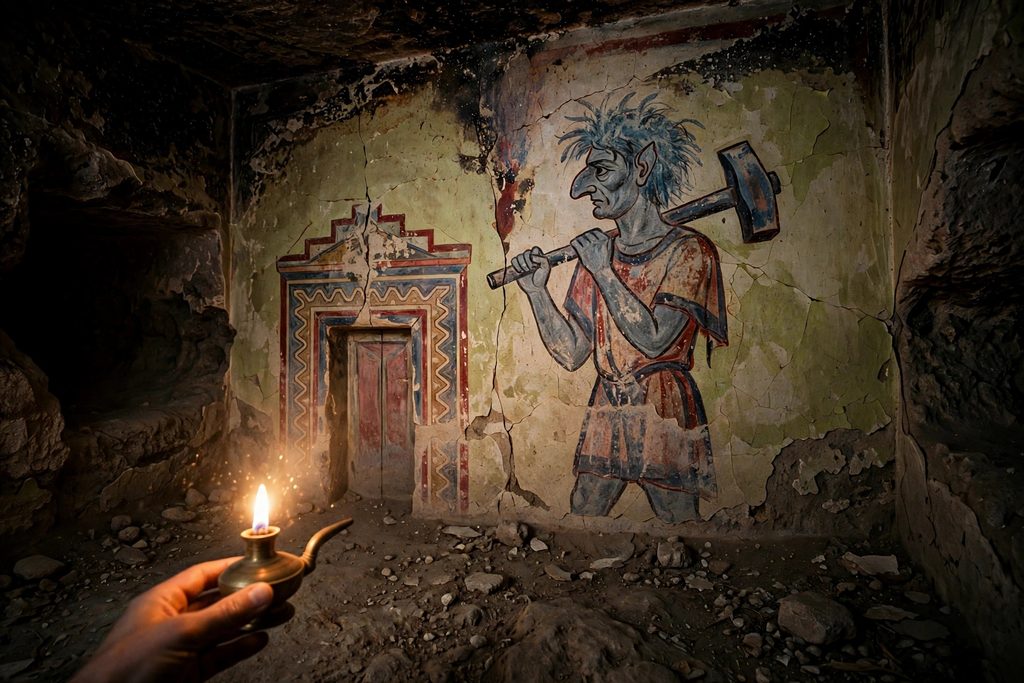
Most scholars think the Etruscans took the name from the Greeks, as they took so much else, and then gave it a face drawn from their own darker vision of death. The two figures show how one idea, a keeper at the border between the living and the dead, could become a weary working man in Athens and a hammer-wielding demon in Tarquinia. The Greek version, carried by Virgil and Dante, won the long argument. Charun vanished with the Etruscans and survives only in their painted tombs.
Charos | How the Ferryman Became Death Itself
In Greece he never left. Over the long centuries of Byzantine and Ottoman rule, the ferryman of the lekythoi turned into Charos, or Charontas, the figure who is death itself in Greek folk song. He no longer waits by a river. He rides out on a black horse to hunt, and he carries off the young, the brave and the newly married. In some of the old songs he drives the dead before him and carries the little children on his saddle.
The most famous of these songs belongs to Digenis Akritas, the hero of the Byzantine frontier. When Charos comes for him, Digenis refuses to go quietly and challenges him to wrestle on a marble threshing floor. They wrestle long and hard. In the end Charos wins, as he always does, but the hero has made him earn it. The same figure walks through the moirologia, the laments still sung over the dead in parts of Greece, nowhere more powerfully than in the Mani. Greeks still say of someone who has died that Charos took them.

It is a remarkable journey. The boatman who was missing from Homer, who first appeared as a gentle tradesman on a funeral flask, became the black rider of the village songs. The Olympian gods faded from Greek daily speech. Charon, who was never one of them, stayed.
What Paying the Ferryman Really Meant
In English, to pay the ferryman means to face a cost that cannot be avoided, the bill that comes due at the end however cleverly one has lived. It is a good phrase, but it misses what the Greeks actually did. The dead never paid. The living paid for them.
Behind the fare stood the oldest rule in Greek thinking about death, the one Patroclus spoke in the Iliad before Charon existed. The dead cannot cross until the living have buried them properly. Where a family placed an obol in the mouth, it was one more mark of that duty done. It said that someone had washed the body, sung the lament, carried it to the grave and sent it on its way with what it needed. Without the rites, a soul wandered the bank for a hundred years, in Virgil’s version. With them, it simply got into the boat.
He Was Always There
Homer sang of kings and heroes for audiences of the living. The painters of the white lekythoi worked for something more intimate, the family standing at the grave. When those families chose an image to send into the ground with their wife, their son or their mother, they did not choose Zeus or Athena or any Olympian. They chose the old man with the pole, waiting in the reeds with his hand held out.
That is why he is missing from the Iliad and the Odyssey and present on so many graves. He was never a hero’s story. He was the face of a single moment, the one every family eventually reaches, when the living have done all they can and someone they love has to cross alone.
He was always there. Homer simply had not reached the bank yet.
At Olympus Estate, Mythic Essays read the Greek myths closely, from the oldest sources forward. Charon is absent from Homer and Hesiod, whose underworld already had a river, a guide in Hermes and a rule that the unburied could not cross. He first appears in the lost epic Minyas, quoted by Pausanias from Polygnotus’ painting at Delphi, then on a black-figure vase of about 500 BC and on nearly a hundred white-ground lekythoi made for Athenian graves. He worked the Acheron rather than the Styx, took an obol that archaeology shows was never universal, and refused the unburied, not the poor, in Virgil’s hundred-year rule. Euripides made him frightening, Aristophanes made Dionysus row, Lucian showed him gold for the first time, the Etruscans turned him into hammer-bearing Charun, and Greek folk song made him Charos, death on a black horse. Through it all, the fare was paid by the living, the last duty a family owed its dead.