





Theseus was invented by Athens.
This is not a cynical claim about the inauthenticity of the myth. It is the historical and cultural process that the Theseus tradition underwent across the archaic and classical periods: a local hero of Attica, originally confined to the regional mythology of the area around Athens, was systematically developed by the Athenian political and artistic tradition into the Panhellenic hero whose myth was designed to do for Athens what the Heraclean tradition had done for Argos and the Dorian cities, which was to provide a mythological genealogy for the city’s claim to cultural and political authority.
The systematic development of the Theseus myth in the sixth and fifth centuries BCE is documented with unusual clarity in the ancient record because it coincides with the emergence of Athenian democracy and the city’s cultural program of self-assertion against the Peloponnesian tradition that Sparta represented and the older traditions of the Argolid. The decisions that the Athenian tradition made about Theseus, the choice to give him a divine paternity by Poseidon alongside the mortal paternity of Aegeus, the decision to have him travel the Isthmus road from Troezen to Athens rather than sailing the safe sea route and thereby accumulating a series of heroic deeds that deliberately parallel and rival the labors of Heracles, and the attribution to him of the synoikismos, the political unification of Attica into a single city-state, are not elements of an ancient oral tradition preserved from the Bronze Age. They are the products of the Athenian cultural program of the sixth and fifth centuries, designed to establish Theseus as the Athenian answer to Heracles.
This makes the Theseus myth more interesting, not less. Understanding that it was constructed for political purposes is understanding what the construction reveals about the city that built it and about what the city believed its identity was and what story it needed to tell about itself.
The Isthmus Road and the Deliberate Parallels
The decision to have Theseus travel to Athens from his mother’s home in Troezen by the land route around the Saronic Gulf rather than by the direct sea crossing was the decision that created the narrative opportunity that the myth exploited: the Isthmus road was the most dangerous route available, controlled by a series of bandits and monsters who preyed on travelers, and the young Theseus who chose it over the safe sea crossing was demonstrating the quality that the developing myth was designed to showcase, the willingness to seek out danger and overcome it through intelligence and courage rather than avoiding it through prudence.

The six labors of the Isthmus road, Periphetes the club-wielder at Epidaurus, Sinis the pine-bender at the Isthmus, the Crommyonian sow, Sciron the cliff-kicker, Cercyon the wrestler, and Procrustes the bed-stretcher, are structured as a deliberate set of twelve compressed into six, each echoing a labor of Heracles in the combination of the monster-encounter and the method of dispatch. Theseus kills each of the Isthmus villains with the villain’s own weapon or method: Periphetes is killed with his own club, Sinis is bent between the pines as he had bent his victims, Sciron is thrown from the cliff as he had thrown others, Procrustes is fitted to his own bed. The poetic justice of the method is the Athenian tradition’s argument about the quality of the intelligence that Theseus represents: not the overwhelming physical force of Heracles but the capacity to turn the opponent’s own strength against them.
This is the intelligence that Athens was claiming as its distinctive contribution to the Hellenic world: not the military strength of Sparta or the maritime power of Corinth but the capacity to transform the structure of any situation so that what had been a threat becomes a resource, which was the same capacity that the Athenian political tradition was claiming for democracy as the form of government that turned the competing interests of the citizen body into a collective strength.
Aegeus, Poseidon, and the Ambiguous Paternity
The structure of Theseus’s divine paternity, the night in Troezen when his mother Aethra was sent by Pittheus to lie with Aegeus and was also visited by Poseidon, so that Theseus was simultaneously the son of the Athenian king and the son of the god of the sea, is the mythological construction that served the political claim Athens was making about its relationship to the Aegean sea.
The dual paternity was not an embarrassment to the tradition but a deliberate theological position: Theseus was the hero through whom Athens claimed both the legitimate dynastic succession from the Erechtheid kings who had ruled Attica from the beginning and the divine patronage of Poseidon, the god whose domain was the sea that Athens increasingly depended on for its commercial and military power. The Theseus who was simultaneously Aegeus’s heir and Poseidon’s son was the hero through whom Athens was asserting that the city’s maritime power was divinely sanctioned rather than merely opportunistically developed.
The Aegeus subplot, the old king waiting on the Acropolis for the return of the ship and throwing himself into the sea when he saw the black sails that Theseus had forgotten to change to white, is the narrative that explains how Aegeus died and how Theseus became king, and it also functions as the aetiological explanation of the Aegean Sea’s name: the sea named for the king who drowned in it when his son forgot to change the sails is the kind of geographical etymology that the Greek mythological tradition consistently produced for the most significant features of the landscape.
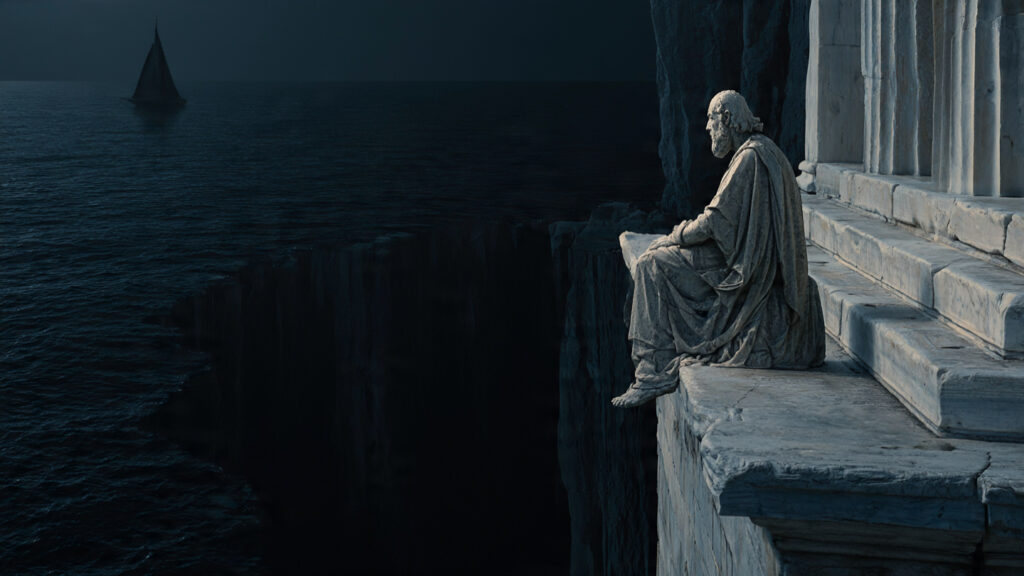
The forgetting of the sails is the element of the myth that the ancient tradition did not resolve into a comfortable moral: Theseus’s success in Crete is immediately followed by his father’s death as a direct consequence of Theseus’s forgetfulness, and the tradition did not soften this. The hero who overcomes every deliberate obstacle is destroyed by a careless oversight, and the destruction is not his but his father’s, which may be the myth’s most precise statement about the cost of the heroic life to the people who love the hero and wait for him at home.
The Minotaur and Its Cretan Context
The Minotaur myth, which is the element of the Theseus tradition most widely known and most widely reduced to its surface narrative of hero and monster, carries a set of cultural and historical resonances whose full complexity the reduction to heroic adventure consistently fails to convey.
The Minotaur was the offspring of Pasiphae, the wife of Minos, and a white bull that Poseidon had sent to Minos for sacrifice and that Minos had kept rather than sacrificed, thereby offending the god who sent it. Poseidon’s revenge was the revenge of making Pasiphae fall in love with the bull, and the offspring of that union was the Minotaur: the bull-headed man, the creature that was the living monument to a king’s failure to honor his obligation to the divine. The Minotaur in this reading is not simply a monster to be defeated: it is the consequence of a royal failure, and its confinement in the labyrinth that Daedalus built for Minos was the confinement of the evidence of that failure within a structure designed to prevent anyone from seeing it.
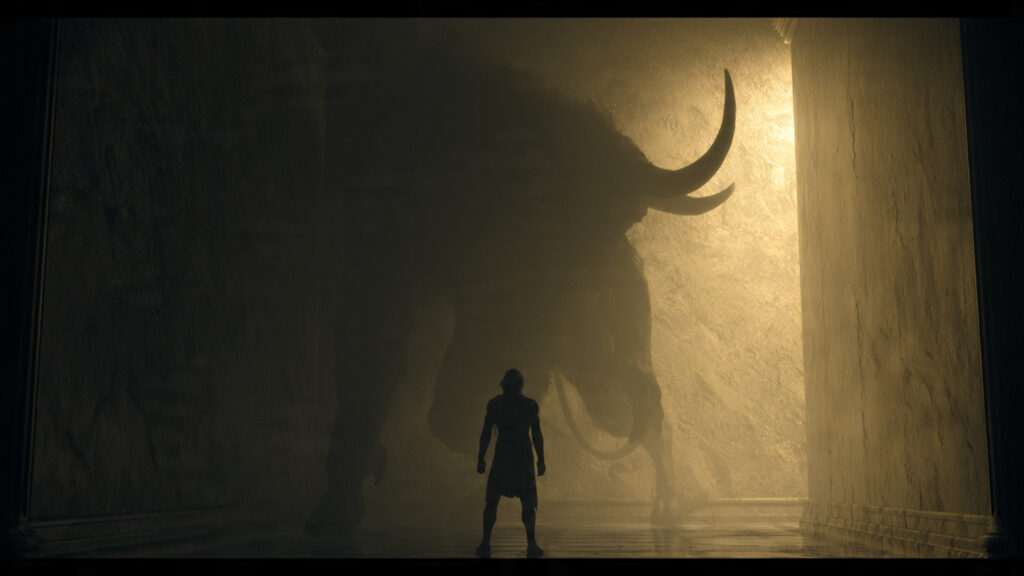
The tribute of Athenian youths, seven young men and seven young women sent to Crete every seven or nine years to be fed to the Minotaur, is the political subordination that the myth encodes as the background against which Theseus’s heroism operates. The historical accuracy of this tribute, whether Athens was genuinely in a position of political or economic dependency relative to Minoan Crete in the Bronze Age, is a question that the current archaeology cannot definitively resolve but that the myth’s structure clearly encodes as a political rather than purely religious relationship. The youths sent to Crete are not sacrificed in a sanctuary: they are consumed by a monster that is itself the product of royal failure. The myth is encoding an understanding of what the relationship between Athens and Crete represented.
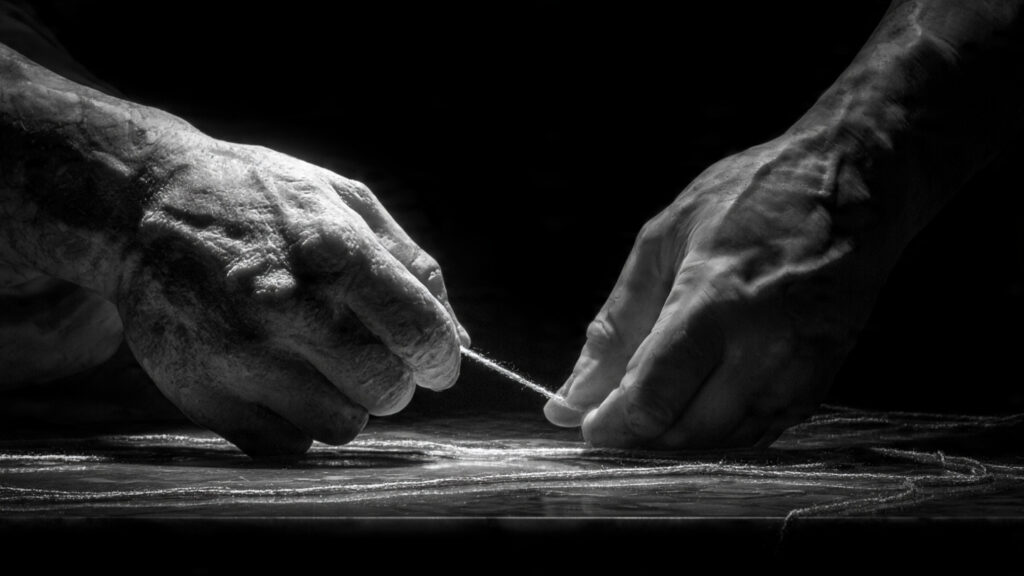
Ariadne’s thread is the gift that makes the labyrinth survivable: not a weapon or a divine armor but a piece of string whose function is to allow the hero to remember the path he has taken so that he can retrace it. The intelligence of the thread is the intelligence of navigation through complex systems by maintaining a record of the path: the labyrinth is conquerable not by power but by the cognitive capacity to maintain spatial orientation in a space designed to destroy it. The Minotaur, once Theseus reaches it in the labyrinth’s center, is defeated by physical combat. But reaching the center and returning from it requires the thread. The myth is arguing that the combination of the navigational intelligence and the physical capacity is what the hero needs, and that neither alone is sufficient.
Ariadne and What Theseus Did to Her
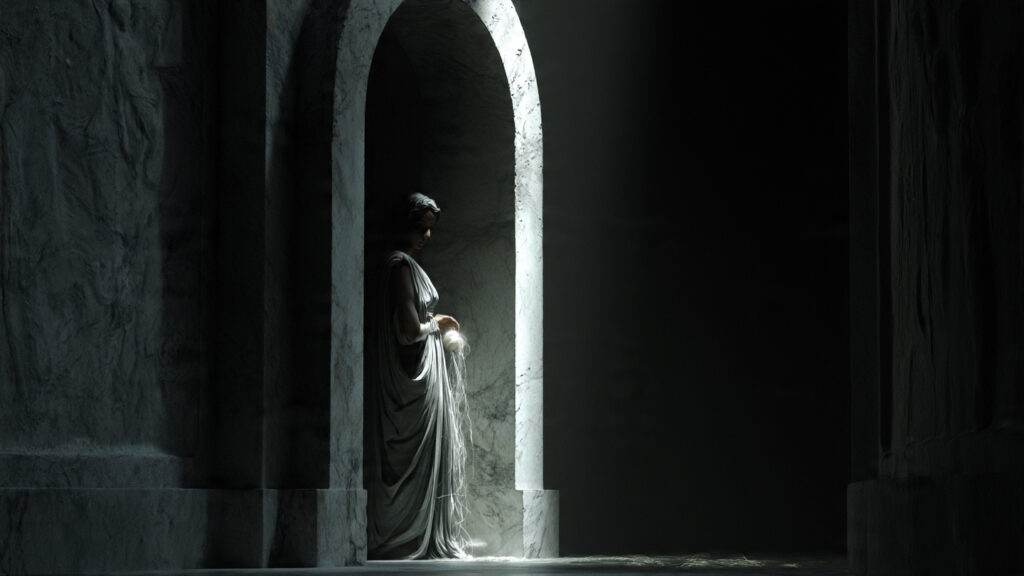
The abandonment of Ariadne on Naxos is the element of the Theseus tradition that the heroic reading of the myth most consistently minimizes, and its minimization is the consistent index of how much the reading is doing to protect the hero from the implications of his own behavior.
Ariadne had given Theseus the thread that made his survival and return possible. She had betrayed her father’s household and her brother’s secret for him. She had left Crete with him on the understanding, explicit in most ancient versions, that Theseus had promised to marry her. He left her sleeping on Naxos and sailed for Athens without her.
The ancient tradition offered competing explanations for the abandonment: that Dionysus appeared to Theseus in a dream and demanded Ariadne for himself, that Theseus forgot her in the excitement of the departure, that he left her deliberately because he preferred another woman, or that the gods drove him off the island before he could return for her. The multiplicity of explanations is the collective memory’s acknowledgment that no single explanation was fully satisfactory, which is the indirect acknowledgment within the mythos that the abandonment was not a satisfactory act.
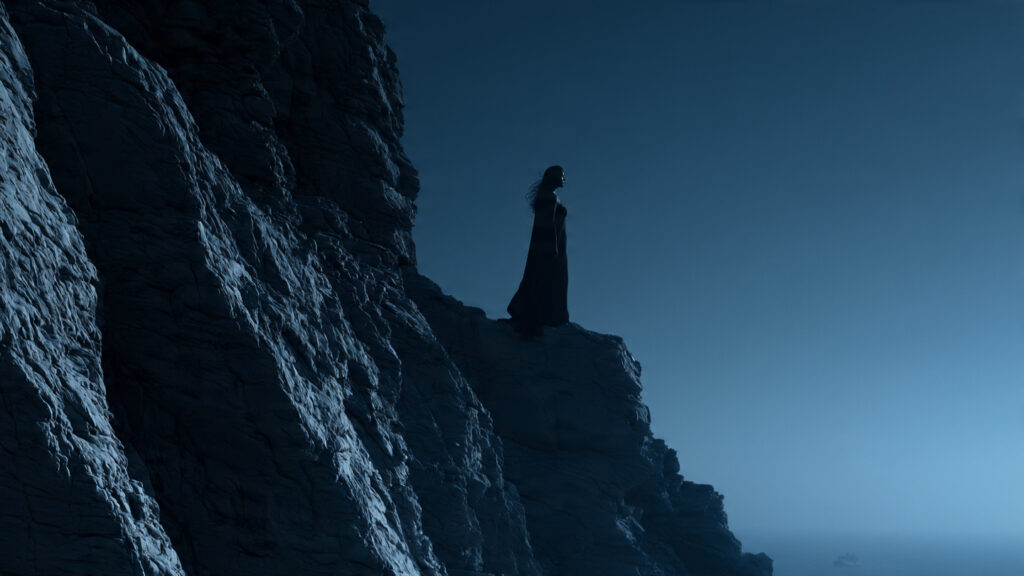
The version in which Dionysus claims Ariadne as his own is the version that does most to redeem Theseus from the consequences of what he did: if a god commanded it, the hero was not fully responsible. The version in which Theseus simply forgot, or preferred someone else, is the version that treats Ariadne’s situation with the most honesty: the woman who made the hero’s success possible was abandoned when the success was complete, and the various divine explanations are the tradition’s attempts to find an exit from the discomfort of what the story without them would mean.
That Ariadne went on to become Dionysus’s wife and to receive a happier existence than the one she would have had as Theseus’s queen is the mythological consolation that the tradition offered: the abandonment produced a better outcome than the fulfillment of the promise would have. Whether the audience of that tradition found this consolation adequate is not recorded.
The Synoikismos and the Political Theseus
The attribution to Theseus of the synoikismos, the political unification of the separate communities of Attica into a single polis centered on Athens, is the political claim that the Athenian tradition built into the Theseus myth in the period of the city’s emergence as a major political power.
Thucydides, in his account of the Pentecontaetia, treats the synoikismos as a historical event attributed to Theseus and notes that the Athenians still celebrated the Synoikia, the festival commemorating the unification, in his own time. Whether Thucydides believed in a historical Theseus who performed this unification is less clear than that he treated the synoikismos itself as a historical process whose mythological attribution to Theseus was the form in which the Athenian tradition preserved the memory of a genuine political development.
The political Theseus, the king who persuades or compels the independent communities of Attica to surrender their local councils and local sanctuaries and consolidate around Athens as the single political center, is the political template for the kind of leadership that Athens claimed to model for the Greek world: the leadership that produces unity not through conquest but through persuasion, that creates a political community not by destroying the local identities of its constituents but by redirecting their political loyalty toward the common center.
This is the claim that Plutarch develops in his Life of Theseus, the most extended ancient account of the complete Theseus tradition and the text through which most of the myth’s details have reached the modern world: Plutarch’s Theseus is the hero who earned his authority first through physical courage and then through political wisdom, who treated the unified Athenians as free citizens rather than as subjects, and who eventually instituted a form of popular government that made him the mythological ancestor of the Athenian democracy that the fifth century would develop into the most discussed political system in the ancient world.
The Ship of Theseus
The philosophical problem that the Theseus tradition contributed to Western intellectual history was not the labyrinth or the Minotaur but the ship: the Athenians preserved the ship in which Theseus returned from Crete, replacing the planks as they rotted over the centuries, until the ship that was preserved in the harbor was a ship in which no original plank remained. This object generated the philosophical question that has borne the ship’s name ever since: if every component of an object has been replaced, is the object still the same object?
Plutarch mentions the ship in his Life of Theseus as an example of the problem of identity across change that the philosophers of change and persistence had been debating, and the problem that the Ship of Theseus poses is not a trivial one: it is the problem that bears on the identity of living organisms whose cells are continuously replaced, on the identity of political institutions whose members change across generations, and on the identity of the cultural heritages that the Theseus myth itself embodies, which are the heritages that have been maintained by continuously replacing the content of the stories while preserving the claim that the stories are the same stories.
The Athenians who maintained the Ship of Theseus in the harbor were maintaining the claim that the connection to the heroic past was materially continuous even as the material connection was continuously renewed. The philosophical problem that the maintenance generated was the consequence of taking that claim seriously enough to ask what it actually meant: if the ship is materially continuous because its form has been continuously maintained even as its matter was continuously replaced, then the ship whose form has been preserved is the same ship, and the question of identity is a question about form rather than matter. If the ship is the matter and the matter has all been replaced, then there is no original ship remaining and the harbor contains only the most recent version of the ship, not the ship itself.
The myth of Theseus has been the Ship of Theseus for three thousand years: continuously maintained by replacing the content of the stories while preserving the claim that the hero is the same hero and the heritage is the same heritage. Whether the Theseus who was a local hero of Attica in the Bronze Age and the Theseus who was the mythological founder of Athenian democracy in the fifth century BCE are the same Theseus is the question that the Ship of Theseus would have us ask about the myth itself.
At Olympus Estate, Mythic Essays moves through the deeper currents of the Greek tradition. Theseus was invented by Athens, and Athens invented him as a mirror of what it wanted to be: brave enough to enter the labyrinth, intelligent enough to use the thread, powerful enough to unify Attica, and democratic enough to govern what it had unified. The abandonment of Ariadne is also in the mirror. The best mirrors show everything.