


Consider what it means for a language to be three thousand years old and still alive.
Not preserved in manuscripts. Not reconstructed by scholars working from stone inscriptions. Not studied as a dead language that requires specialists to read and interpret. Alive, in the full sense of the word: spoken by children learning it from their parents, used in arguments and jokes and love letters and political speeches, evolving in the continuous unstoppable way of all living things, generating new slang and absorbing new words and dropping old ones with the casual indifference of a language that has been doing this long enough to know it will survive the change.
Greek is that language.
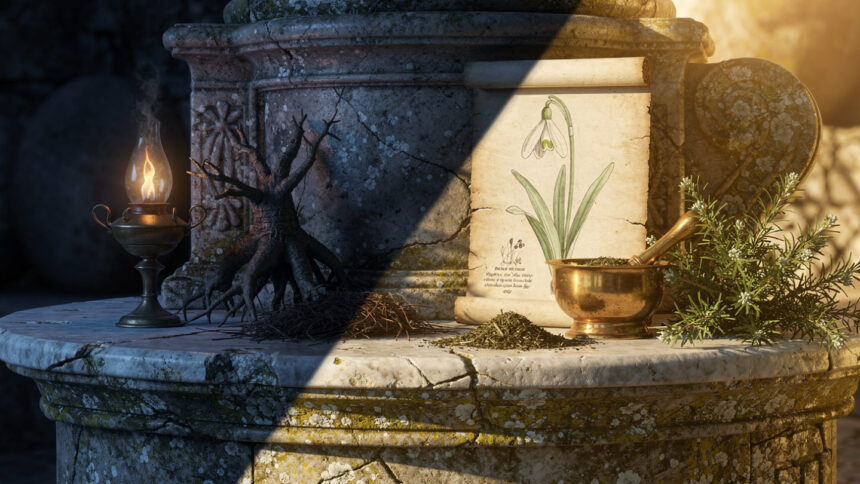
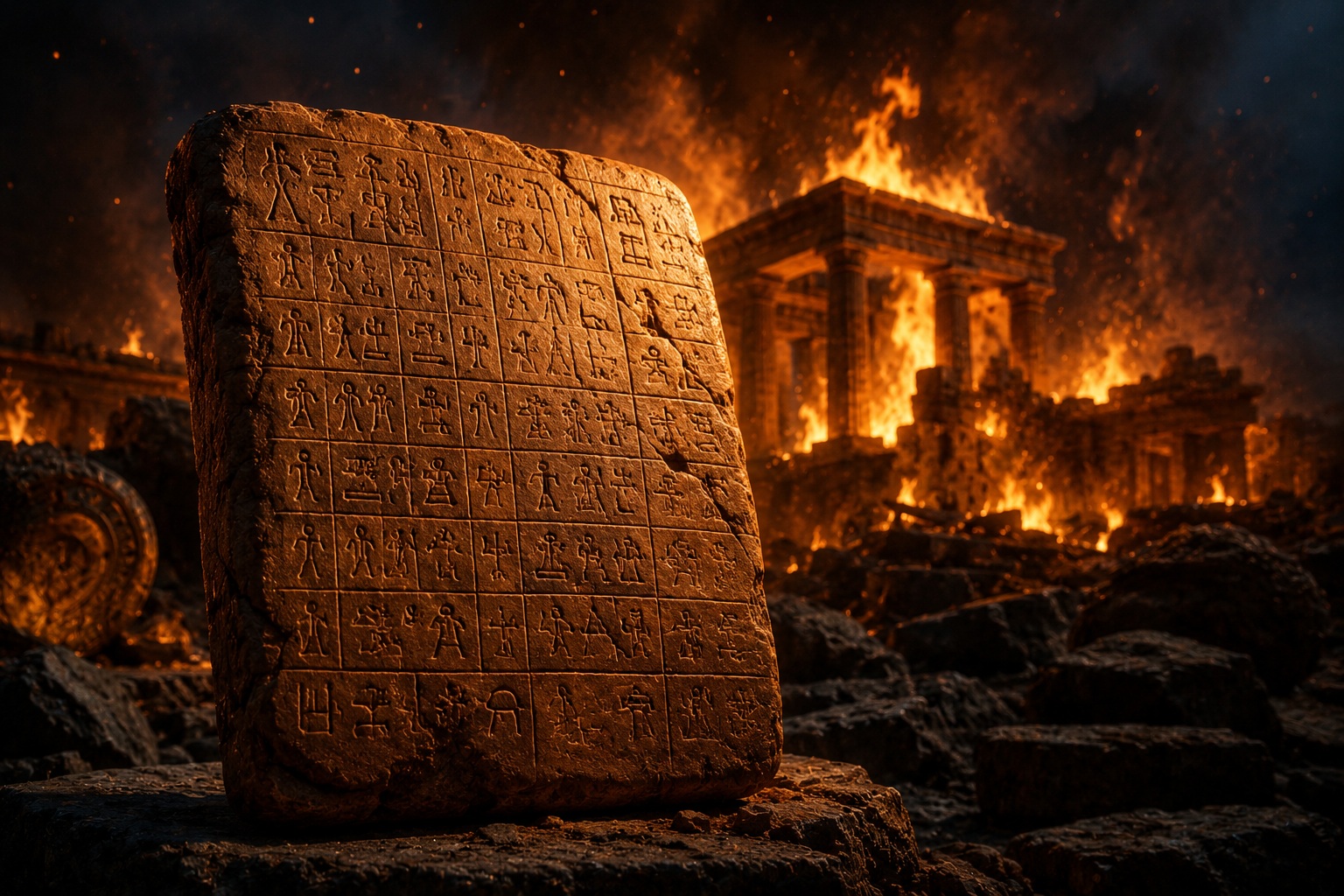
The earliest written evidence of Greek is a clay tablet found in Messenia, dated to somewhere between 1450 and 1350 BCE, inscribed in a script called Linear B that took linguists until 1952 to decode. The language recorded on that tablet is not the same as the Greek spoken in Athens today. But it is recognisably, demonstrably, structurally Greek: the ancestor of Classical Greek by a lineage as clear as the lineage between a great-grandmother and the great-grandchildren who cannot understand her letters but share her bone structure.
Three and a half thousand years of continuous spoken transmission. The Bronze Age collapse that wiped out every other literate civilisation of the eastern Mediterranean. The silence of centuries when the script was lost and the palaces were ash and the record went dark. The re-emergence in a new alphabet with new dialects and a new literature so extraordinary that everything that came before it was eclipsed. The spread across the known world in the wake of a Macedonian king who died at thirty-two having conquered everything within reach. The absorption into a Roman empire that, in a remarkable act of cultural submission, chose to communicate with its eastern subjects in the conquered language rather than its own. The transformation by the rise of Christianity, whose central texts were written in Greek and whose largest institution, the Byzantine Empire, preserved and transmitted the language for a thousand years after Rome fell. The centuries under Ottoman rule when Greek survived not through official sanction but through the church, through the family, through the tenacious refusal of a people to let go of the thing that most completely distinguished them from everyone else.
And then, at the end of all of this, a war over its own grammar.
This is the story of the most durable language in Western history, and of what it took to keep it alive.
The First Word
The clay tablet from Messenia does not say anything poetic.
It records an inventory. Livestock, possibly, or grain allocations, the kind of administrative accounting that the Mycenaean palace bureaucracies used Linear B to manage. The tablet was baked hard by the fire that destroyed the palace that housed it, which is why it survived when everything else burned. It is one of the great ironies of the ancient record that destruction so often preserves what survival would have worn away.
Linear B was a syllabic script: each symbol represented a syllable rather than a single sound, which made it less flexible than an alphabet but functional for the purposes the Mycenaean administrators needed. It had been adapted from an earlier script called Linear A, used by the Minoan civilisation of Crete, which has never been deciphered because the language it recorded was not Greek and has no known descendant. Linear A went silent when Minoan civilisation ended. Linear B went silent when Mycenaean civilisation collapsed.
But the language it had recorded did not go with it.
This is the crucial point that distinguishes the survival of Greek from the extinction of the languages around it. When the Bronze Age collapsed at the end of the twelfth century BCE, in a catastrophe whose causes are still debated across half a century of scholarship, every major palace civilisation of the eastern Mediterranean fell: the Hittites, the Egyptians at their full power, the Ugaritic traders, the Mycenaean Greeks. The physical infrastructure of these cultures was destroyed or drastically reduced. The administrative systems that had required and maintained literacy were disrupted. The scripts went unused and then forgotten.
In most cases, the language went with the script. Linear A records a language we cannot read because no one has spoken it for three thousand years and left us nothing to translate from. Ugaritic became extinct. The languages of several other Bronze Age cultures simply stopped being transmitted.
Greek continued to be spoken, around cooking fires and in fishing boats and in the family arrangements of a society that had lost its palaces but not its people. The script was lost. The language was not. The spoken tongue kept moving through the generations that followed the Bronze Age collapse in the way that all spoken languages move: imperfectly, organically, accumulating changes in pronunciation and vocabulary and usage, but never breaking the chain of transmission that makes a language what it is.
When the Greeks re-emerged into literacy in the eighth century BCE, they brought with them a new script, the alphabet adapted from Phoenician trading contacts, and a spoken language that bore the marks of four dark centuries of change. What they wrote in that alphabet, the Homeric poems, the lyric poets, the beginnings of philosophy and history and drama, was a language that had already survived its first near-death experience.
The Dialects and What They Meant
The Greek that emerged from the dark centuries was not one language but several.
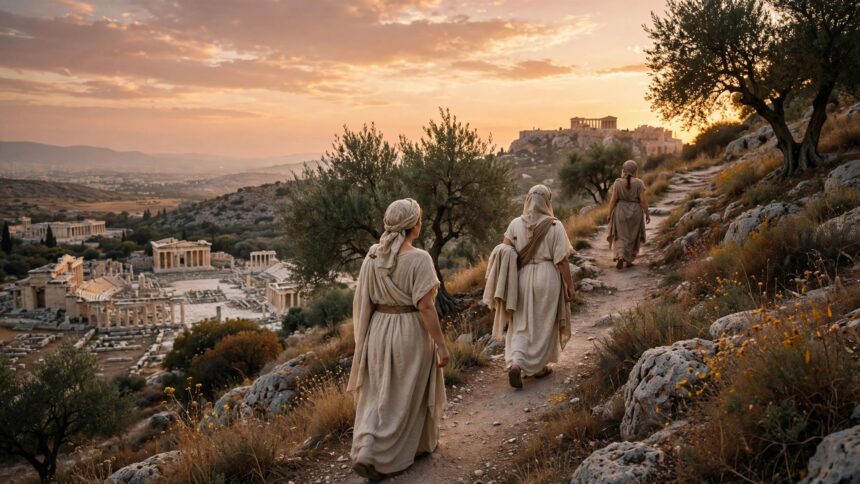
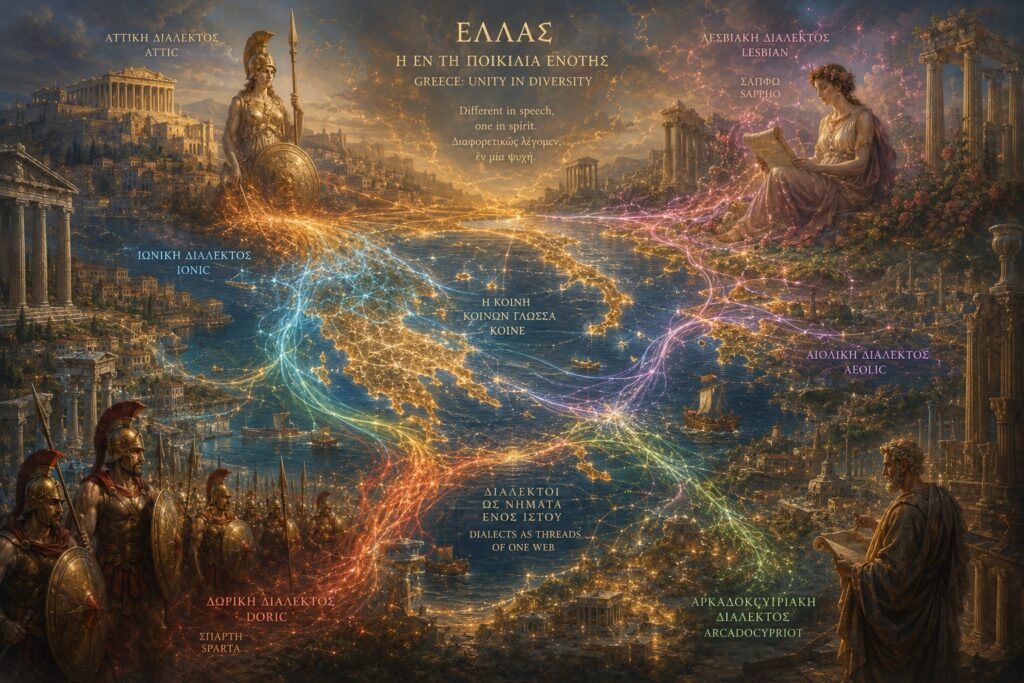
Attic, the dialect of Athens, which would eventually become the dominant literary form. Ionic, spoken in the coastal cities of Asia Minor and used by Herodotus and the early natural philosophers. Doric, the dialect of Sparta and the Peloponnese and the Greek colonies of southern Italy and Sicily. Aeolic, spoken in Lesbos and the surrounding regions, the language of Sappho. Arcado-Cypriot, the dialect that had preserved the most features of Mycenaean Greek, as though in a linguistic pocket of the Peloponnese the Bronze Age had not entirely ended.
These were not merely accents or regional variations. They were genuinely distinct forms of Greek, with different vocabulary, different phonology, different grammatical forms. A speaker of Doric and a speaker of Attic could understand each other, but the differences were real enough that comic playwrights in Athens could produce laughs simply by having a Spartan character speak.
The diversity was a form of resilience. When a language exists in a single standard form, it is vulnerable in a way that a distributed network is not. The Greek dialects spread across dozens of city-states and hundreds of communities meant that no single catastrophe, no single conquest, no single administrative decision could silence the language entirely. You would have had to extinguish every community simultaneously, and the Mediterranean is too large and the Greeks too widely distributed for that to have been possible.
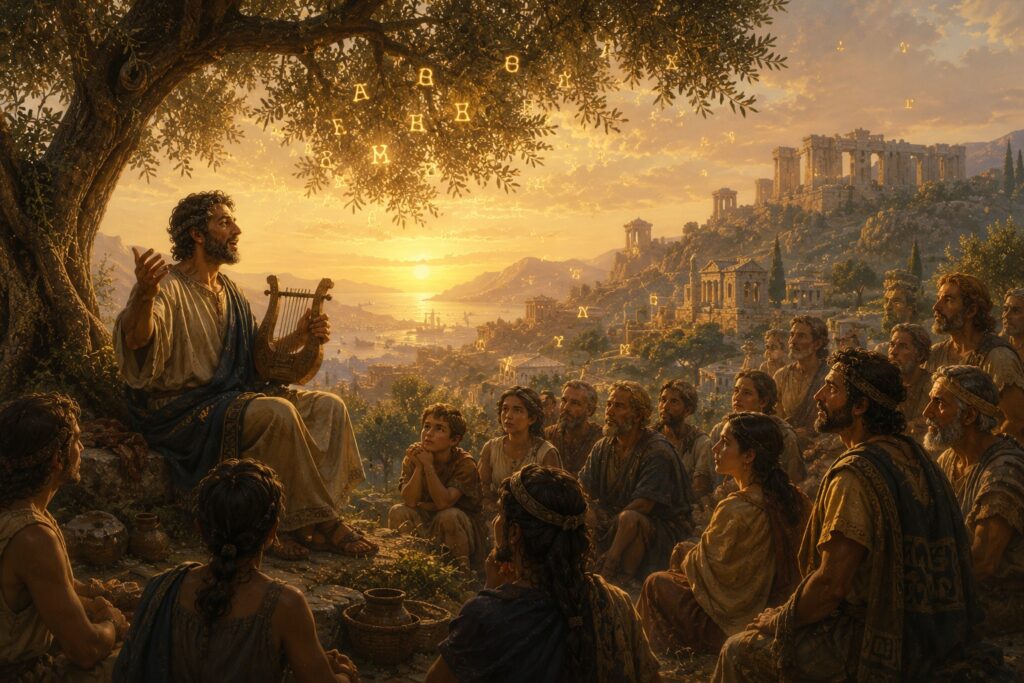
What unified them was not political control but cultural production. The Homeric poems were composed in a literary dialect that no Greek community actually spoke in daily life but that all educated Greeks recognised and revered. The tragedies of Athens were performed at festivals that drew visitors from across the Greek world. The philosophical texts of Plato and Aristotle circulated to communities that had never set foot in Athens. The shared culture was carried in the shared language, and the shared language was maintained by the shared culture, and between them they constituted something that no empire had created and no empire could simply dissolve.
What Alexander Did to Greek
In 334 BCE, Alexander of Macedon crossed the Hellespont with approximately forty thousand soldiers and began the campaign that would take him to the edge of India. He died in Babylon eleven years later having conquered the largest empire the world had yet seen. What he did to the Greek language in those eleven years was arguably more consequential than anything he did to the political geography of the ancient world.
The dialect his army spoke, and that his administration used, was a form of Greek called Koine: the common dialect, derived primarily from Attic but smoothed and simplified by contact with the other dialects that the army and its associated populations brought together. When Alexander’s conquest ended, Koine Greek went with it: not as an imposition exactly, but as the language of power, of commerce, of intellectual life, of everything that the Hellenistic world wanted to participate in.
From Egypt to the fringes of India, across the entire arc of what had been the Persian Empire and the territories beyond it, Koine Greek became the language that educated people needed to know. Not because anyone was forcing them to learn it but because learning it was access: to the libraries of Alexandria, to the philosophical schools of Athens and Alexandria and Pergamon, to the commercial networks that moved goods across the new Hellenistic world, to the intellectual tradition that was producing advances in mathematics and astronomy and medicine and philosophy at a rate that no other tradition was matching.

The New Testament was written in Koine Greek, not because its authors were scholars of the classical tradition but because Koine Greek was the language that the widest possible audience across the eastern Mediterranean could read. When Paul wrote his letters to the communities in Corinth and Thessaloniki and Galatia, he was writing in the common language of a world that Greek culture had shaped. The message of Christianity was carried to its first global audience in a language that owed its global reach to the military campaigns of a man who died three and a half centuries before Christianity existed.
This is one of the great structural ironies of Western history: the language that carried the foundational texts of the world’s largest religion into being was not the language of the religion’s founder, not the language of the territory where it began, but the language of a conquest that preceded it by generations, a conquest whose religious implications nobody at the time could have foreseen.
Rome Did Not Kill Greek
This is the part of the story that most surprises people who assume that the Roman conquest of the Greek world was a cultural as well as a political event.
It was not.
The Romans conquered Greece militarily in 146 BCE, incorporating it into the empire as a province. They did not conquer it linguistically or culturally. The educated Roman elite learned Greek as a matter of course, in the same way that European elites of a later period learned French: not because they were forced to but because the language carried the culture they most admired. Cicero wrote in Latin and thought in both. Marcus Aurelius, the Roman emperor who wrote the Meditations, wrote them in Greek. The Roman Empire, when it communicated with its eastern provinces, did so in Greek rather than Latin, because Greek was the language those populations understood and because Rome was pragmatic enough to value communication over linguistic imperialism.
What this meant for the survival of Greek was enormous. The language did not simply persist as the private tongue of a conquered people maintaining a remnant identity. It functioned as the administrative and intellectual language of half of the most powerful empire in the world. When Constantine moved the imperial capital from Rome to Constantinople in 330 CE, Greek became definitively the language of the empire’s heart. Latin gradually receded in the east. Greek continued.
The Byzantine Empire, which is what historians call the eastern Roman Empire from roughly the fourth to the fifteenth century, was a Greek-speaking state that endured for over a thousand years after the western empire fell. For those thousand years, through the Arab conquests that reduced Byzantine territory to a fraction of its former extent, through the Crusades that occasionally sacked Constantinople and always threatened it, through the long decline of a civilization that had once spanned three continents, the Greek language was not merely surviving. It was governing. It was the language of law, of theology, of philosophy, of the cultural continuity that connected the Byzantine present to the classical past.
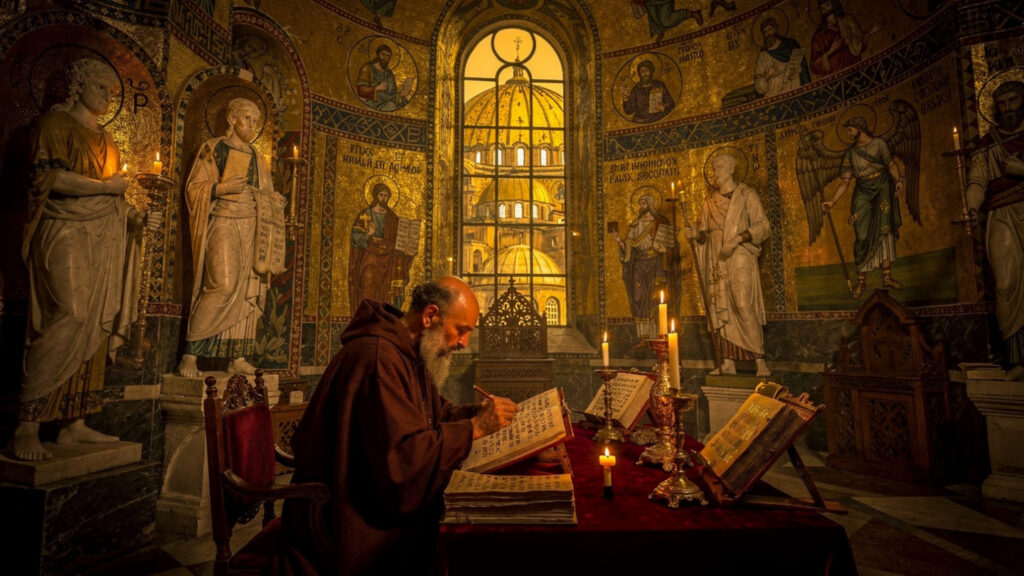
The great Church Fathers who formulated Christian theology wrote in Greek. The texts of Plato and Aristotle were preserved in Byzantine monasteries and libraries while Western Europe had largely forgotten them. The scholars who fled Constantinople before and after its fall in 1453 brought Greek manuscripts with them to Italy, and those manuscripts, landing in a Renaissance that was hungry for exactly this kind of intellectual inheritance, helped ignite the recovery of classical knowledge that reshaped European intellectual life.
Greek did not merely survive the fall of its empire. It handed the next civilization the tools it needed to begin.
Under the Ottomans | The Church as Language Keeper
In 1453, the Ottoman Sultan Mehmet II took Constantinople, ending eleven hundred years of Byzantine rule. The last Roman emperor died in the fighting. The Patriarch of Constantinople survived.
This distinction matters more than it might appear to.
The Ottoman administrative system organised its non-Muslim subjects into millets, communities defined by their religious affiliation and governed largely through their own religious leadership. The Greeks were the Rum millet, the Roman community, and their religious leader was the Patriarch of Constantinople. The Patriarch, installed by Mehmet II within days of the city’s fall, became the civil as well as the spiritual authority of the Greek community within the empire.
The church became the institution through which Greek identity, and with it the Greek language, was maintained for the following four centuries. Greek was the language of the liturgy, the language of education in the church schools that were the only Greek educational institutions available, the language of the commercial networks that Greek merchants maintained across the Ottoman world and beyond. It was not the language of official power, but it was the language of the community’s interior life, and that is the space in which languages survive when external circumstances are hostile.
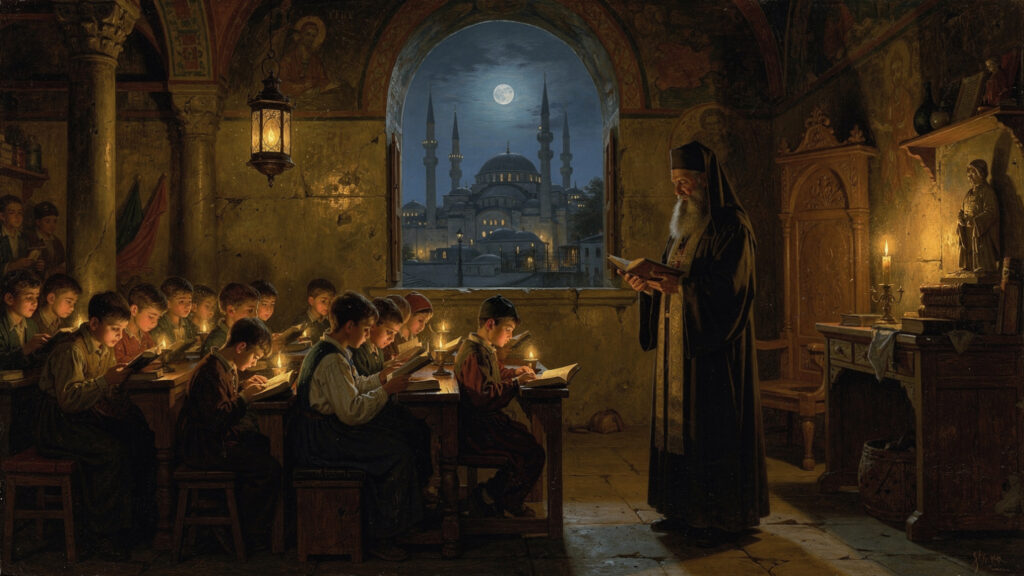
The Phanariots, the Greek aristocratic families who lived in the Phanar district of Constantinople and who gradually acquired influence in the Ottoman administration, maintained Greek as the language of their cultural life while operating in Turkish and other languages as the political situation required. Their schools, their printing presses, their intellectual connections to the Greek diaspora in Venice and Vienna and Odessa, kept the literate tradition of the language alive through the centuries when the possibility of a Greek state was a distant aspiration rather than an imminent reality.
Greek did not merely survive the Ottoman centuries. It emerged from them with its literary tradition intact, its spoken forms evolved but continuous, its identity as the language of a people and a civilisation unambiguous.
The War Over Grammar
The Greek state, established in the 1820s after the independence revolution, inherited the language along with everything else. What it did not inherit was agreement about which version of Greek it should use.
The problem was real and the stakes were genuinely high.
The spoken Greek of the independence era, the Greek that farmers and sailors and merchants and revolutionary fighters actually used in daily life, was demotiki, the demotic language: the direct descendant of Byzantine Greek as it had evolved through centuries of Ottoman rule, full of Turkish loanwords and Slavic influences and the accumulated changes of a language being transmitted through spoken rather than literary channels. It was vivid, flexible, and natural. It was also, to the scholars and intellectuals who had been educated in the classical tradition, embarrassingly distant from the Greek of Plato and Thucydides.
The alternative was katharevousa, the purified language: an artificial construct that attempted to split the difference between the spoken vernacular and the ancient literary forms, retaining ancient grammatical structures, purging foreign loanwords, and producing a language that nobody had ever actually spoken but that looked more respectable on the page of a state document than the living tongue of the street.
The newly formed Greek state chose katharevousa for official use. The decision was understandable. This was a young nation trying to establish its legitimacy as the heir to the classical civilisation that all of educated Europe admired. Using the sophisticated grammar and vocabulary of ancient Greek was a way of saying: we are the continuation of that tradition, and our independence is the restoration of something the world should value.
The consequences were severe. Children were educated in a language that was not their mother tongue. Official documents were written in a form that ordinary people could not easily read. The literary and the living were separated for over a century, producing a situation in which educated Greeks wrote one language and spoke another, and the gap between them was not a spectrum but an ideological battlefield.
In 1901, riots erupted in Athens when a translation of the Gospels into demotic Greek was published. The riots resulted in deaths. The question of which version of Greek the Gospels should be read in produced violence in the streets of the capital of a democratic state in the twentieth century. If you want evidence that a language is alive, that the people who speak it care about it at a level that goes beyond convenience or preference, this is it.
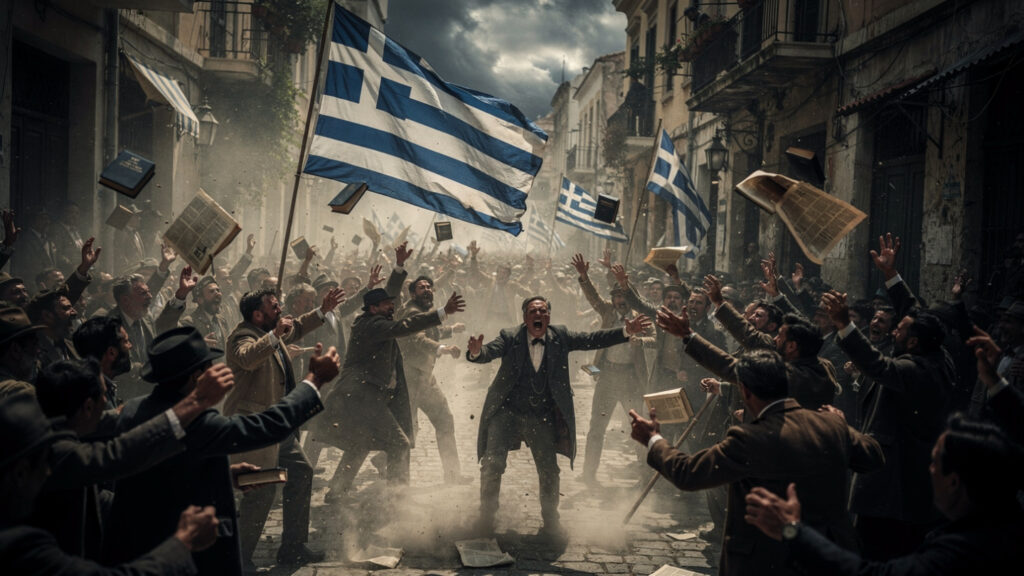
In 1976, the Greek government officially adopted demotic Greek as the national language. The diglossia that had divided written and spoken Greek for over a century ended. Children could be educated in the language they spoke at home. The gap between the literary and the living was finally closed.
It had taken a hundred and fifty years of argument, including riots, including literary battles whose participants treated the question of a noun’s declension with the intensity of a religious schism, to resolve it. The resolution was, in the end, what it had always been going to be: the living language won, because living languages always win. They are carried in mouths, not in grammar books.
What Greek Gave the World
Stand back from the survival story for a moment and consider what Greek being alive, rather than extinct, has meant for everything else.
The vocabulary of science in every European language is largely Greek. Physics, mathematics, astronomy, biology, chemistry, psychology, philosophy, democracy, politics, theatre, poetry, tragedy, comedy: these are not simply words borrowed from Greek. They are Greek frameworks of thought, translated into other languages but retaining the conceptual architecture that Greek provided. When an English speaker says the word crisis, they are using a Greek word that means the moment of decision, the turning point, the instant when a condition must resolve one way or the other. The Greek understanding of what a crisis is, embedded in the structure of the word, has been transmitted without interruption into twenty-first century usage.
This is what it means for a language to be old and alive simultaneously. The living Greek of a child learning to read in Athens today contains, in its vocabulary and its grammar and its ways of structuring thought, direct connections to the language that Heraclitus used to describe the logos, that Sophocles used to give Oedipus his terrible clarity, that Paul of Tarsus used to write to the Corinthians, that Byzantine theologians used to argue about the nature of God, that the scholars fleeing Constantinople used to bring classical learning back to a Europe that had forgotten it.
Three and a half thousand years of continuous transmission, and not a single moment when the chain was broken. Not the Bronze Age collapse. Not the Roman conquest. Not the Ottoman centuries. Not even the war over its own grammar, which came closest of all to breaking something essential by dividing the living language from the literate tradition and asking a people to inhabit two versions of their own tongue simultaneously.
Greek is not just a language that survived. It is the language whose survival made possible, more than any other single factor, the intellectual continuity between the ancient world and the modern one.
Why It Survived When Others Did Not
This is the question that linguistics and history together only partially answer.
Latin is dead as a spoken language, surviving in its daughters, Italian and French and Spanish and Portuguese and Romanian, but not as itself. Sanskrit survived in religious use but not as a vernacular. Sumerian, Akkadian, Etruscan: gone. Linear A: unreadable. The languages of the Bronze Age cultures that fell alongside Mycenaean Greece: silent.
Greek survived for reasons that are structural, cultural, and contingent.
Structurally, the decision to adapt the Phoenician alphabet in the eighth century BCE gave Greek a script flexible enough to represent the language accurately and simple enough to be learned without the years of specialist training that cuneiform or hieroglyphics required. A language that more people can read is harder to kill.
Culturally, the Greek literary tradition produced works of such exceptional quality and influence that every subsequent civilisation that encountered them wanted to possess them. Rome valued Greek enough to keep it alive in the eastern empire. Christianity adopted it as the language of its foundational texts. The Renaissance recovered it and made it the basis of humanist education. Each of these encounters gave the language a new context in which it was not merely tolerated but actively cultivated.
Contingently, the church. The Orthodox Church’s use of Greek in its liturgy, its administration, its schools, through four centuries of Ottoman rule, was the single most important institutional factor in the language’s survival. Languages need institutions as well as speakers. The Patriarch of Constantinople, installed by Mehmet II within days of the city’s fall, provided the institutional continuity that kept Greek alive as a literate tradition as well as a spoken one.
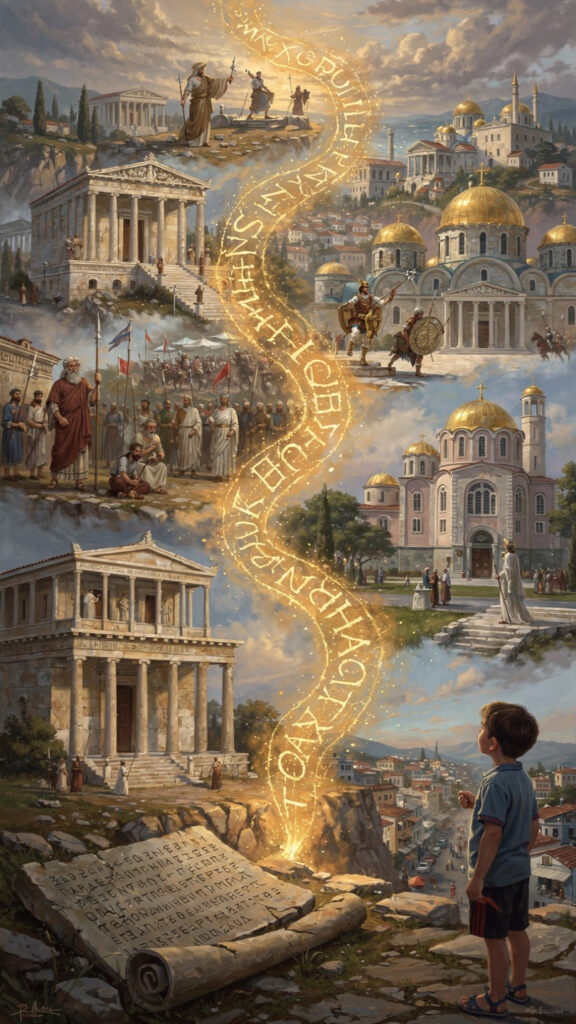
And underneath all of it, the most fundamental reason of all: the people who spoke Greek did not want to stop. They carried it through the Bronze Age collapse in their mouths. They carried it through the Ottoman centuries in their churches and their schools and their family conversations. They fought riots in the streets of Athens over which version of it deserved to be called official.
A language that people fight to preserve is a language that knows its own value. Greek has known its own value for three and a half thousand years.
From Alpha and Beta
The word lexicon comes from the Greek lexikon, from lexis, meaning speech, from legein, meaning to speak.
The word alphabet comes from alpha and beta, the first two letters of the Greek alphabet, which took their names from the Phoenician letters the Greeks adapted in the eighth century BCE: aleph and bet.
The word nostalgia was coined in the seventeenth century from two Greek words: nostos, the return home, and algos, pain. The Greeks had a word for the pain of wanting to return to a home you have left, and that word entered the vocabulary of a language that did not yet exist at the time the Greeks were first using nostos to describe Odysseus’s homecoming.
Every time an English speaker uses the word crisis or democracy or history or theatre or catastrophe or echo or music or phenomenon, they are speaking a language that carries Greek inside it, in the foundations, in the load-bearing structures, in the parts that hold everything else up.
Greek did not simply survive three thousand years. It built the house that most of Western thought has been living in ever since. The survival was not a passive act of endurance. It was an active, continuous, sometimes violent insistence on the part of millions of people across dozens of generations that this particular way of arranging sounds and meanings and thoughts was worth preserving, worth fighting for, worth dying for in the streets of Athens over the question of a translation.
The language that refused to die is still alive.
It is making new words right now, in the mouths of children who do not know they are speaking something three and a half thousand years old, and who would not particularly care if they did, because living languages do not require their speakers to be conscious of their own continuity.
They just require their speakers to keep speaking.
At Olympus Estate, Cultural Chronicles traces the practices and institutions that defined Greek civilization from the inside. The earliest written Greek is a Linear B tablet from Messenia dated between 1450 and 1350 BCE. The script was lost in the Bronze Age collapse and not decoded until 1952. The language survived anyway, spoken through the dark centuries without a writing system, re-emerging in a new alphabet with a literature so extraordinary it eclipsed everything before it. Greek absorbed Rome, transmitted Christianity, outlasted Byzantium, and survived Ottoman rule through the church and the family. Then, in the nineteenth and twentieth centuries, it fought a war over its own grammar. It is still alive. Children are learning it from their parents today.