

There is a place on the western edge of Lesbos where trees have stood for roughly twenty million years without growing a single new leaf. They do not decay. They do not bend in the wind. They have become something the original forest could never have imagined for itself: permanent.
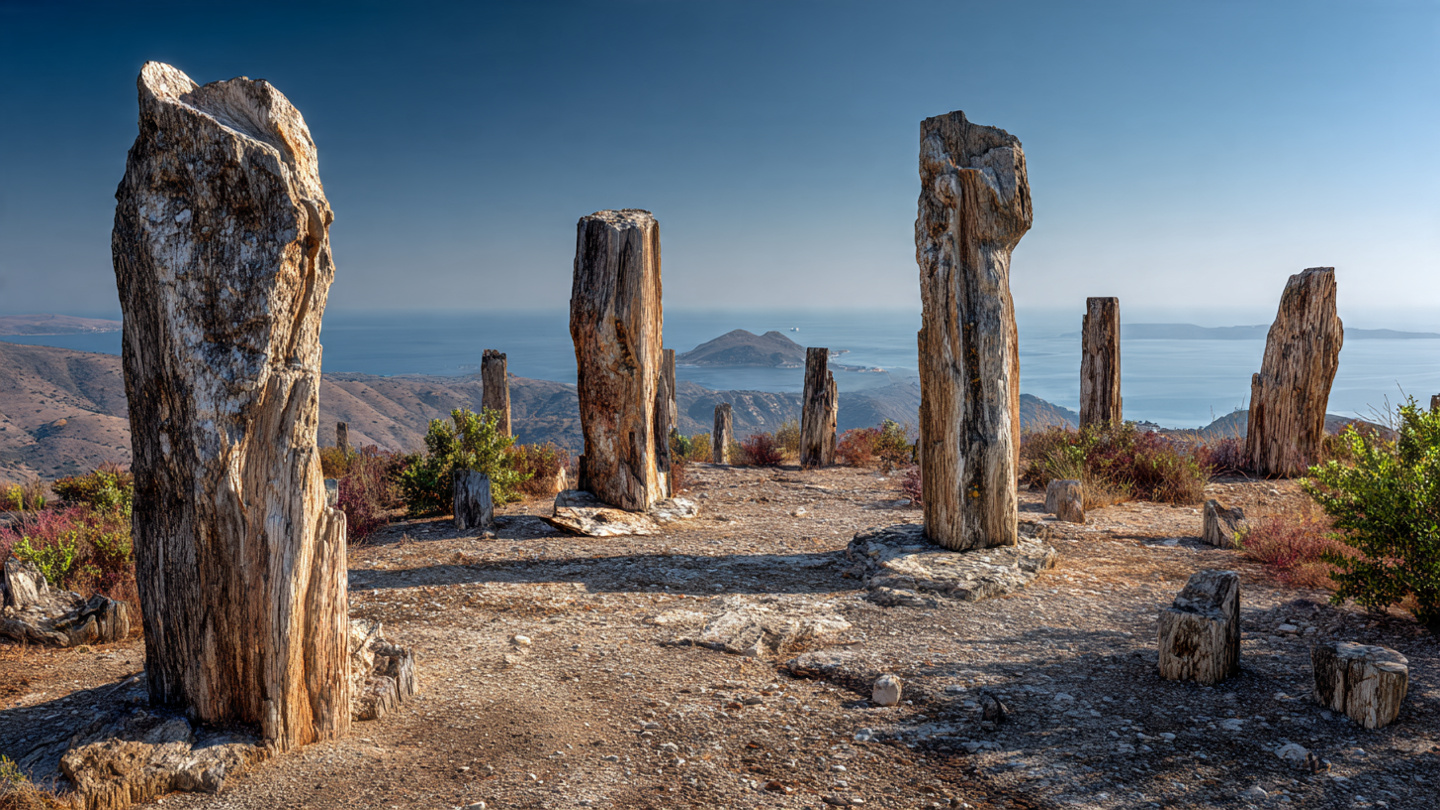
The Petrified Forest stretches toward the Aegean Sea near Sigri, its trunks rising from the earth like weathered columns shaped by volcanic ash and long seasons of erosion. The air holds the scent of salt and dry earth, and the distant outline of Mount Ordymnos settles the horizon with a steady presence. Travelers arriving from Mytilene, the sheltered coves near Sigri, or the inland paths of Eressos often describe the sense of entering a landscape where myth and geology share the same breath, each shaping the other in ways that remain visible even now.
What Actually Happened Here
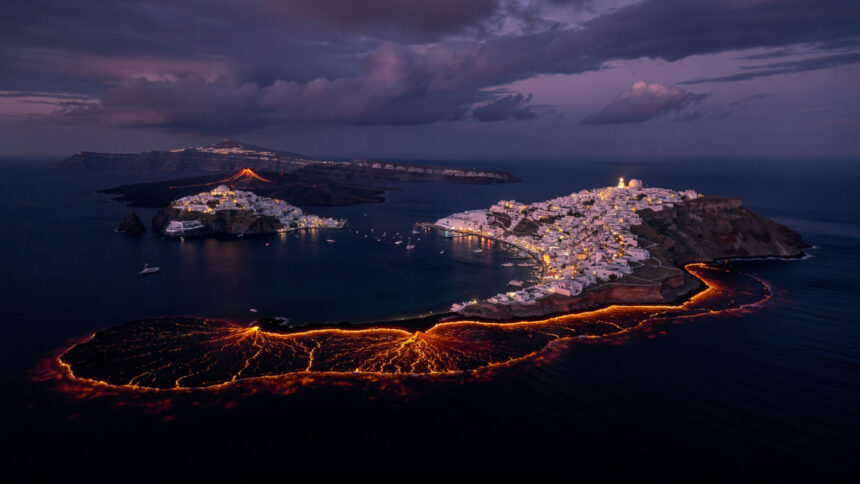
Millions of years ago, eruptions from the volcanic arc that once linked Lesbos, Chios, and the coast of Asia Minor covered the region in deep layers of ash. This was not a single catastrophic event but a sustained volcanic period, repeated burials of an entire subtropical forest under successive ashfalls thick enough to seal organic material away from the oxygen and decay that would normally have reduced it to nothing within a few centuries.
The forest that stood here before the eruptions bore almost no resemblance to the arid island landscape that surrounds the petrified trunks today. Fossil evidence recovered from the site identifies sequoia relatives, palms, and cinnamon trees among the species entombed in the ash, a subtropical woodland that would not survive a single modern summer on Lesbos. The climate itself changed as thoroughly as the trees did. What the ash preserved was not simply a forest but a record of an entirely different Aegean, one warmer and wetter than anything the historical Greeks who later walked past the stone trunks ever experienced.
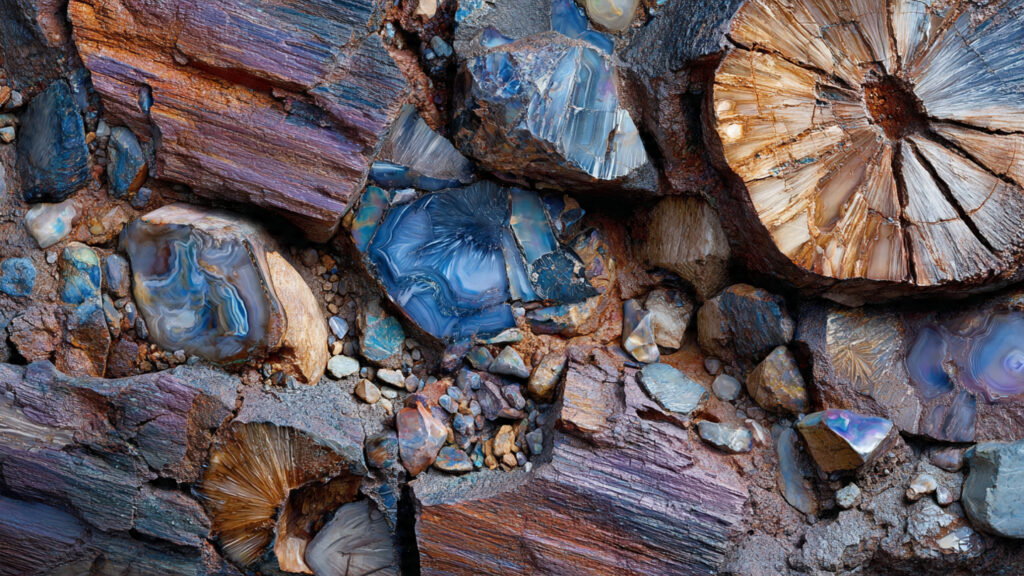
Instead, rainwater carried dissolved silica down through the buried trunks, and over an immense span of time the silica gradually replaced the original plant fiber, cell by cell, with such precision that the rings, the bark texture, and the branching patterns of the original trees survived the transformation intact. The wood became stone without losing the shape of having once been wood. Some trunks lie half-buried like fallen guardians, while others stand upright at something close to their original growing position, their surfaces marked with the colors of iron and manganese that leached through the silica during fossilization. The surrounding terrain, shaped by the same volcanic forces that formed Nisyros and Santorini, holds scattered fragments of opalized branches that catch the afternoon light with quiet brilliance.
This is, by any measure, one of the most significant fossilized forests in the world, rare not for the existence of petrified wood, which occurs in pockets across several continents, but for the scale and the completeness of preservation, entire standing trunks with root systems still attached to the ground they grew in, a fossilized ecosystem rather than scattered fossilized fragments. UNESCO recognized the site as a Global Geopark, and ongoing excavation continues to uncover additional trunks buried beneath the surface, suggesting the visible forest represents only a portion of what the ash actually preserved.
A Battlefield Read Into Stone
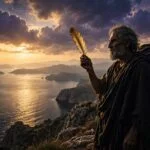
For ancient visitors, sailors from Rhodes navigating the strait, shepherds from Kalloni moving flocks along the inland paths, pilgrims traveling toward the sanctuary at Mesa, the sight of an entire forest turned to stone would have demanded an explanation that geology alone could not yet provide. They did not have the vocabulary of silica replacement or volcanic ash deposition. What they had was myth, and myth supplied an answer suited to the scale of what they were looking at.
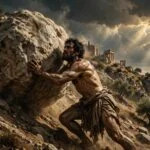
The forest appeared as a battlefield frozen in time, a place where the earth had once risen in upheaval violent enough to leave a permanent scar. Along the coasts and mountain paths of Lesbos, the story attached to these trunks became one of the Titanomachy, the ten-year war between the Olympian gods and the elder Titans, the conflict that the Hesiodic tradition describes as shaking the roots of the earth and the depths of the sea, a war fought with such force that it reshaped the physical world in its passing.

The trunks resembled the bodies of giants struck down mid-stride. The scattered stone fragments evoked the weapons hurled across the sky in that war, boulders and mountain peaks torn loose and thrown by both sides according to the Hesiodic account. The mineral veins running through the petrified wood, the streaks of iron-red and manganese-black, suggested to the ancient eye the lingering presence of the fire that had supposedly scorched the earth itself during the conflict. The silence of the forest, broken only by the wind moving through stone branches that could no longer rustle, seemed to hold the memory of that upheaval the way a battlefield holds the memory of what happened on it long after the armies have gone.
Why This Reading Made Sense
This is not an isolated case of myth grafted arbitrarily onto geology. It follows a pattern visible across the Greek mythological landscape, where physically dramatic or inexplicable terrain consistently became the site of divine or Titanic action. The cliffs of Thera were linked to the anger of Poseidon. The caves of Crete sheltered the infancy of Zeus, hidden from a father who devoured his children. Volcanic and seismic activity across the Aegean was attributed again and again to the buried, restless presence of defeated Titans and giants straining beneath the earth.
The ancients were reading the land as a record of divine action because the land genuinely was the record of something, just not the something they believed. The volcanic forces that actually petrified the forest of Lesbos are part of the same tectonic and volcanic system that produced the genuinely catastrophic eruptions at Thera and Nisyros, the same system that makes the entire Aegean a landscape of real, recorded geological violence. The myth was wrong about the mechanism and right about the magnitude. Something immense and destructive had happened here. The Titanomachy was the explanation available to a culture that needed one and did not yet have access to plate tectonics or radiometric dating.
This is, in a sense, the most honest kind of myth-making: not invention from nothing, but interpretation of real, visible, undeniable evidence through the only explanatory framework available. The petrified trees did not need embellishment to seem impossible. They simply needed a story large enough to match them. It is worth noting that the ancients were, in their own way, closer to the truth than a purely skeptical modern reading gives them credit for. They insisted that something of tremendous scale and violence had shaped this specific stretch of coastline, and they were right. The volcanic system beneath the Aegean did not politely confine itself to a single island or a single era. It remains active today, and the same forces that built the petrified forest are geologically continuous with the forces that could, in principle, act again.
Standing in the Forest Now
Walking the paths near Sigri today, the trunks rise from the earth with the same calm authority they presented to travelers two thousand years ago, except now the authority comes with an explanation that has finally caught up to the scale of the thing being explained. The surrounding hills carry the scent of thyme, pine resin, and sea spray, an inhabited, living landscape wrapped around a forest that stopped living twenty million years before the first human walked past it.
The nearby museum at Sigri houses some of the most complete standing trunks recovered from the wider site, including specimens too fragile to leave exposed to the elements, and provides the geological account that the ancient travelers lacked. Visiting both the museum and the open-air site in sequence produces an unusual effect: the scientific explanation does not diminish the sense of encountering something impossible. If anything, understanding the actual mechanism, the ash, the silica, the twenty million years, makes the scale of what happened here harder to hold in the mind rather than easier, precisely because it is no longer a story but a fact.
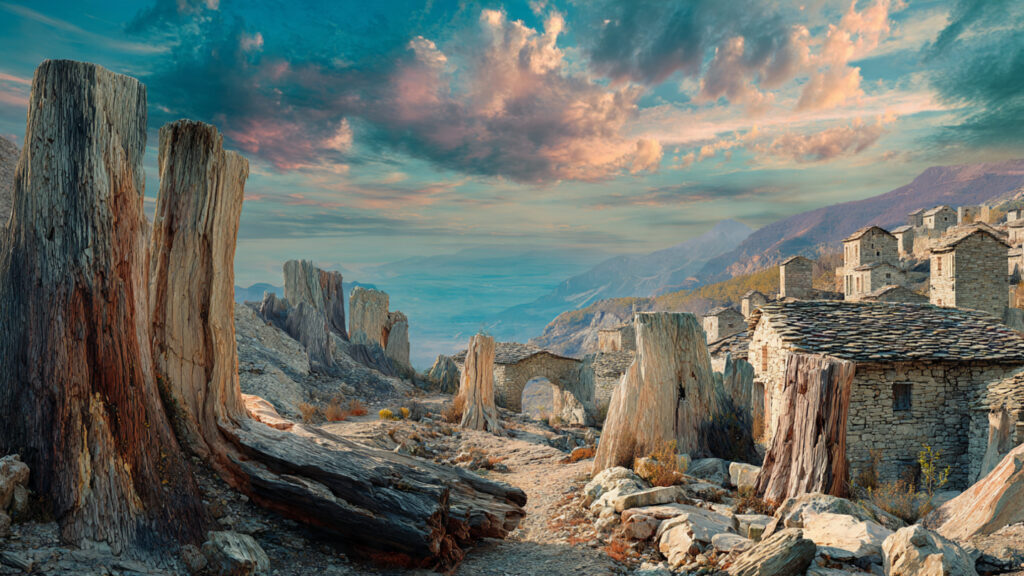
The forest encourages, even now, a slower pace than the rest of the island. There is something in standing among trees that have achieved a kind of permanence no living tree will ever have, that forces a recalibration of ordinary time. The light catches the opalized branches the same way it caught them for the shepherds of Kalloni and the pilgrims of Mesa, and for a moment the explanatory framework matters less than the simple fact that has not changed regardless of which century is doing the looking: something enormous happened here, and the ground remembers it, and it has not let go.
At Olympus Estate, Sacred Geography explores the places across Greece where landscape and myth read as a single text. The Petrified Forest of Lesbos is one of the world’s most complete fossilized ecosystems, an entire ancient subtropical woodland turned to stone by repeated volcanic ash burial and twenty million years of silica replacement. Ancient travelers read its fallen, mineral-streaked trunks as the frozen battlefield of the Titanomachy, the war between gods and Titans that shook the roots of the earth. The myth misunderstood the mechanism. It did not misunderstand the scale, and the volcanic system responsible remains active in the Aegean today.