
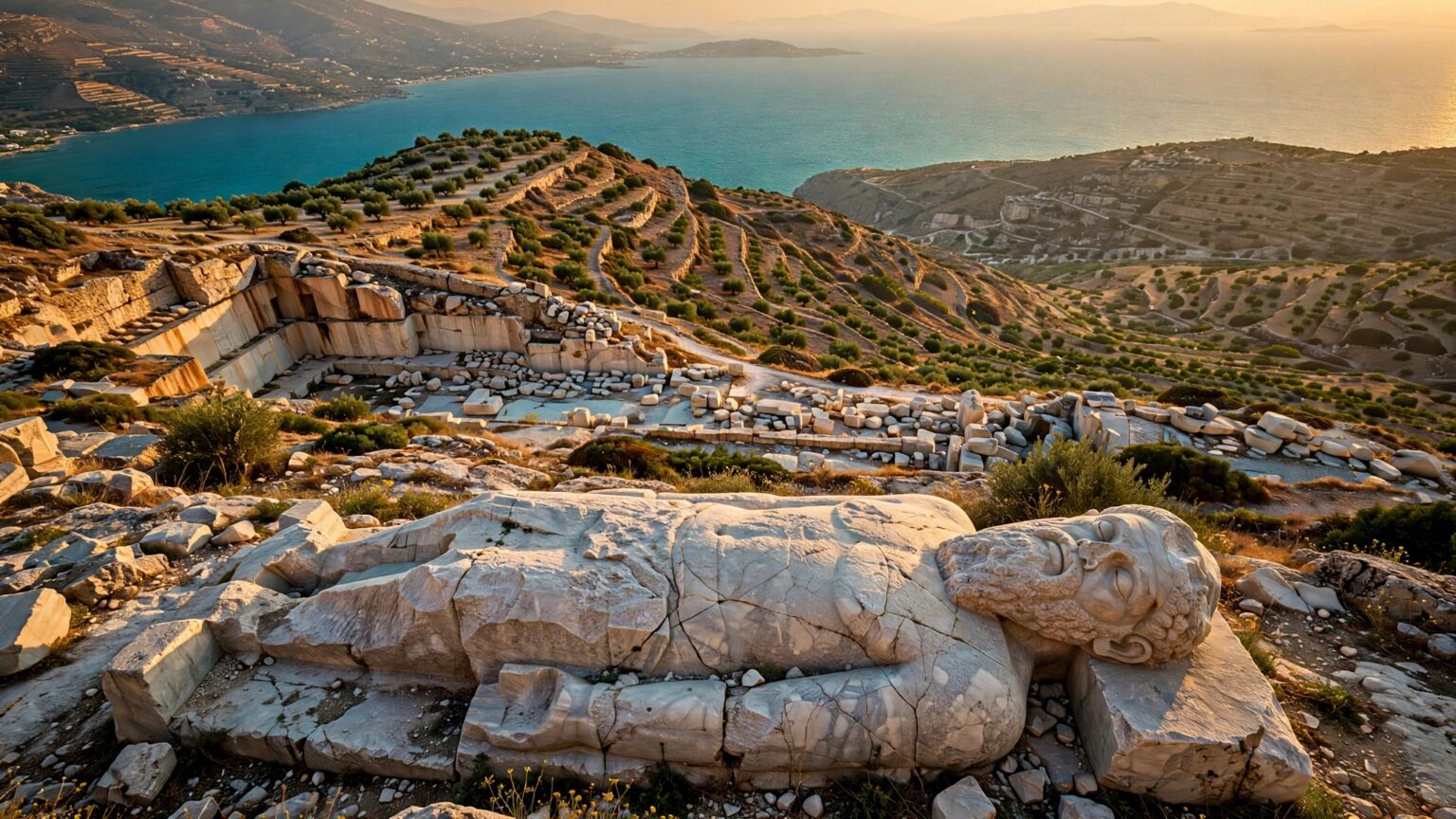
A giant lies on his back above the sea, looking at nothing, exactly as he has been lying for roughly twenty-six centuries.
He is eleven meters long, weighs an estimated eighty tonnes, and was meant to stand. The sculptors who began him in the ancient quarry above the village of Apollonas, on the northern tip of Naxos, cut him free from the cliff on three of his four sides, blocked in the rough planes of a beard and a face and the long, heavy lines of a body that was almost certainly meant to represent Dionysus, the god the island claimed as its own, and then they stopped. Nobody knows precisely why. A crack in the marble, perhaps, discovered too late to abandon the labor but soon enough to abandon the ambition. Or a war. Or a change of patron, of money, of political weather, in an Aegean world where any of these could end a project overnight. He has been waiting on his back in the open air since before Athens built the Parthenon, visible from the coastal road, free to visit, entirely unfinished.
This single object tells you almost everything about what Naxos actually is, once you stop treating it as a quieter, cheaper alternative to Santorini and Mykonos and start treating it as the island it has always been: the largest of the Cyclades, the most fertile, the most architecturally and mythologically ambitious, and the one whose history is written, again and again, in the specific grammar of projects begun at colossal scale and then, for reasons that are not always recorded, abandoned mid-gesture. A temple door standing alone with no temple behind it. A giant lying on his back with no quarry road finished to move him. A goddess’s wine country grown out of the grief of an abandoned bride.
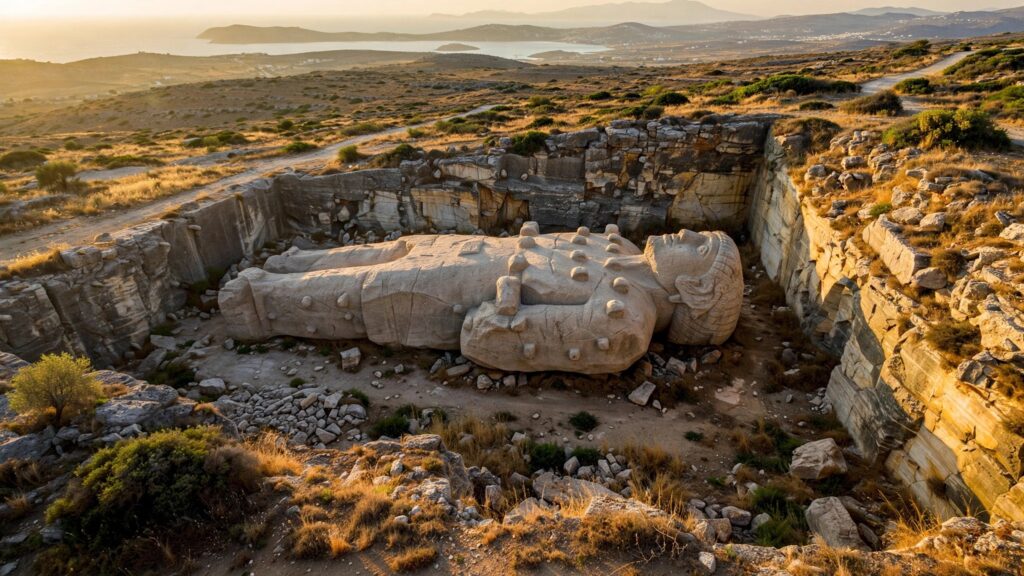
Naxos does not finish things quietly. It leaves the evidence of its own reach lying in the open, for anyone willing to drive the hill roads to go and look at it.
What the Sea Carries You Toward First
Approach Naxos by ferry, the way almost everyone still does, and the island announces itself before the harbor does. On the small islet of Palatia, connected to the town by a narrow causeway, a single marble doorway stands against the sky with nothing on either side of it: the Portara, the Great Door, six meters high, built from four blocks of Naxian marble each weighing roughly twenty tonnes, framing sea and sunset and absolutely nothing else.
Tradition holds, and the official signage on the island still says, that it was meant to be the entrance to a monumental temple of Apollo, begun around 530 BCE under the tyrant Lygdamis, its orientation aimed deliberately at Delos, Apollo’s own mythical birthplace, visible across the water in clear weather. This is the majority scholarly position, but it is worth being honest that it is not the only one. The temple’s site sits directly beside the same islet where local tradition places Dionysus’s discovery of the sleeping, abandoned Ariadne, and a minority of archaeologists and historians have argued, pointing partly to numismatic evidence, coins from this same period on Naxos carry far more Dionysian imagery than Apolline, that the unfinished temple may have been intended for the wine god instead, or possibly for both gods sharing the same sanctuary across different festival calendars. No inscription survives to settle the question, and it likely never will be settled definitively. What is certain is only that Naxos, at the height of its late sixth-century power, began building something enormous enough to rival any temple on the Greek mainland, and never finished it.
The stone was hauled from the quarries at Apollonas and Flerio, ten kilometers distant, an immense engineering undertaking in itself. Small rough protrusions called bosses still stud the marble blocks today, the anchor points where ropes were fixed for lifting the stone into place, never chiseled smooth because the building they were meant to finish was never completed. Lygdamis himself had come to power around 545 BCE with the direct backing of Peisistratos of Athens, a reciprocal alliance between two ambitious tyrants: Lygdamis had earlier helped Peisistratos land his own mercenary force at Marathon to reclaim the Athenian tyranny, and Peisistratos repaid the favor by helping install Lygdamis on Naxos in turn. It was under this decade of confident, externally backed rule that Naxos became briefly the dominant naval power in the Cyclades, wealthy and secure enough to plan a temple on this scale in the first place. The security did not last. In 524 BCE, a Spartan military expedition intervened directly against Lygdamis and ended his tyranny, and with his fall the funding and the political will behind the temple appear to have collapsed in the same stroke.
Whatever faint possibility remained of the project ever being revived was extinguished for good a generation later. In 490 BCE, the Persian fleet under Datis and Artaphernes, sailing toward Marathon with the exiled Athenian tyrant Hippias aboard, made Naxos its very first target in the Aegean, in direct retaliation for an earlier failed Persian-backed siege of the island in 499 BCE that had helped spark the Ionian Revolt. The Persians burned the settlements. The population fled into the mountains or was enslaved. Any Naxian ambition of finishing a temple built to rival the great sanctuaries of the Greek mainland ended, definitively, in the smoke of that landing, in the same campaign season that would end, weeks later, on the plain at Marathon itself.
The Portara survived the centuries that followed for a reason that has nothing to do with reverence. When the Venetian nobleman Marco Sanudo conquered Naxos in 1207 and needed building stone for the fortress that would become the island’s new center of power, the abandoned temple site became, in practical terms, the most convenient quarry on the island. Its marble was systematically stripped and hauled into Chora to build the Kastro and the mansions of the Venetian ruling families. The Portara survived this scavenging for the same reason it had never been finished: its blocks, at twenty tonnes apiece, were simply too massive for medieval builders to move. The lintel that proved too heavy for sixth-century Naxians to topple safely proved equally too heavy for thirteenth-century Venetians to cart away. What stands on Palatia today is not a preserved ruin. It is the part of the ancient temple that two entirely different civilizations, seventeen centuries apart, each independently failed to dismantle.
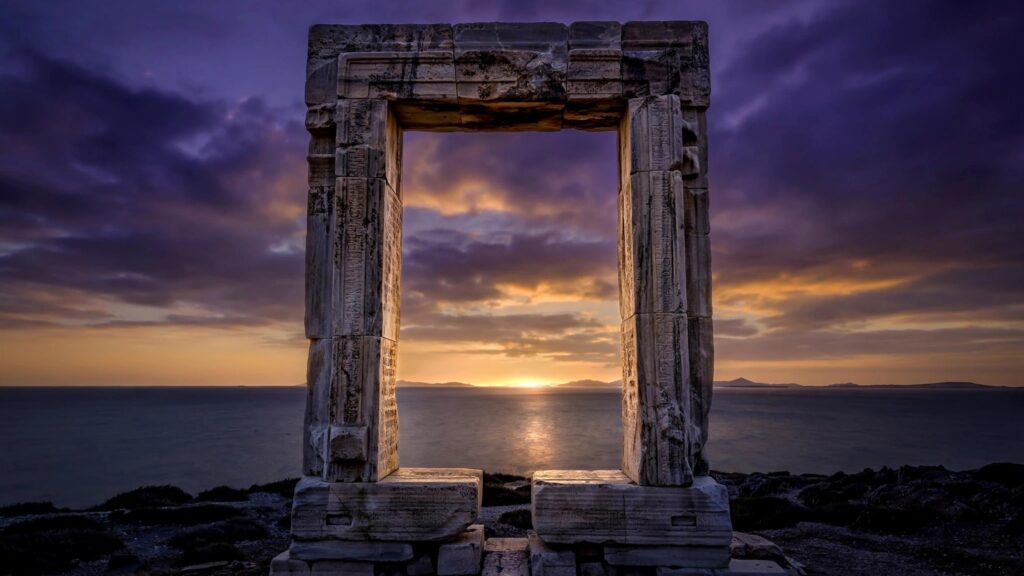
The islet itself is called Palatia, the palace, from a medieval folk tradition that placed here the residence of Ariadne, the Cretan princess whose story the island has claimed as its own for longer than anyone can document.
Two Ariadnes, and Why Naxos Needed Both
The story that every visitor arrives already half-knowing is simple enough on the surface. Ariadne, daughter of King Minos of Crete, gave Theseus the thread that let him escape the labyrinth after killing the Minotaur. Fleeing Crete together, the pair stopped on Naxos to rest. While Ariadne slept on the beach beside Palatia, Theseus sailed away without her. Dionysus, the wine god whom local tradition insisted had been born and raised on this island, found her, fell in love with her, and married her, and their union became, in Naxian telling, the founding act of the island’s own fertility, the divine guarantee behind every vine on its slopes.
What most retellings flatten into a single romantic arc was, in the island’s own ancient literary tradition, something more interesting: at least two distinct and contradictory cult traditions running in parallel. One Ariadne was abandoned by Theseus and died on Naxos, and the rites the Naxians performed in her memory were ceremonies of mourning, sorrowful, focused entirely on her grief and her death. A separate, second Ariadne was Dionysus‘s triumphant divine bride, and the rites attached to her were hymns of celebration. Ancient commentators on the island’s own literary fragments wrestled openly with the contradiction, some proposing that there had simply been two different women named Ariadne, others treating the duality as the natural shape of a fertility myth that required both a death and a marriage to make sense of the agricultural cycle it was ultimately describing.
The most distinctly Naxian version of the story, preserved in local literary fragments and recorded by the historian Diodorus Siculus, adds a detail that no romantic retelling keeps: Theseus did not abandon Ariadne out of cruelty or indifference. He left because Dionysus appeared to him in a dream, threatening him directly, and Theseus, in genuine fear of the god’s wrath, fled the island alone rather than risk Dionysus’s anger by keeping her. This is not a small variation. It removes Theseus’s betrayal as the story’s emotional center and replaces it with something the island clearly preferred to tell about itself: that Dionysus’s claim on Naxos, and on the woman who would become his wife, was strong enough to make a Greek hero flee in terror rather than contest it. The union that followed, in the same local tradition, produced three children, Oinopion, whose name means wine-drinker, Staphylos, grape, and Evanthe, lovely flower, the wine god’s marriage to a mortal woman rendered, quite literally, into the island’s own agricultural vocabulary.
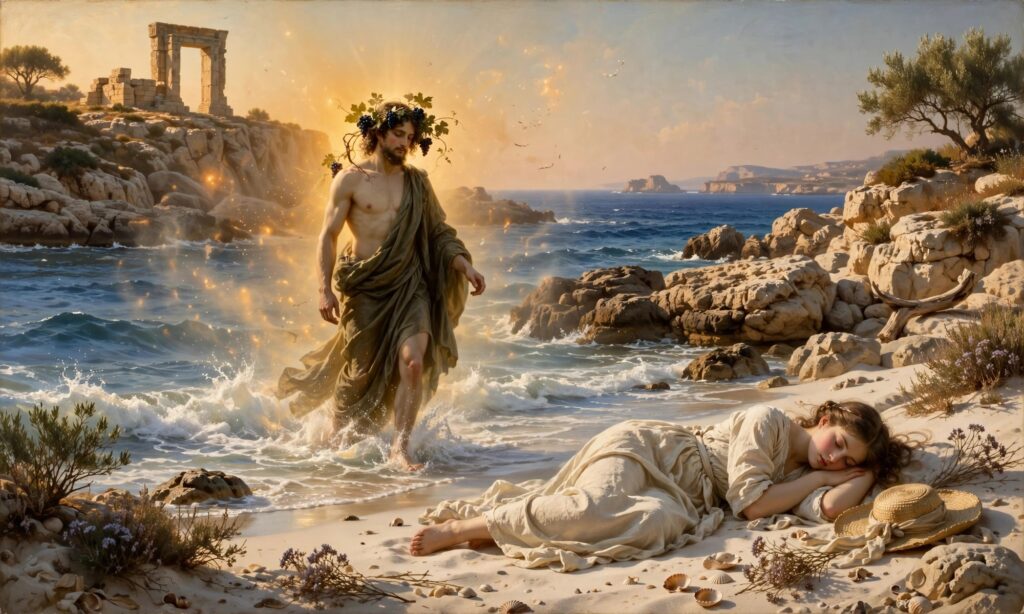
This is why Naxos, alone among the Cyclades, built its entire later identity around being the wine god’s true home rather than merely a stage in someone else’s myth. Dionysus, in the island’s own telling, was born and raised here, hidden from a danger the sources do not always specify, and he repaid the island that sheltered him by making its soil exceptionally fertile, the deepest agricultural justification any Greek community ever gave itself for the quality of its own vineyards.
The Temple That Predates the Parthenon
Ten kilometers south of Chora, in the fertile agricultural valley near the village of Ano Sangri, the Temple of Demeter at Gyroulas sits on a low hill overlooking olive groves and the slopes of Mount Zas, and it is, by any honest architectural reckoning, one of the more historically consequential small buildings in the Aegean world.
Built around 530 BCE, almost exactly contemporary with the Portara’s abandoned temple and constructed, like it, entirely from Naxian marble, the sanctuary at Sangri was dedicated to Demeter and her daughter Persephone, with clear evidence of an associated cult of Apollo as well. Architecturally, it and a related Naxian sanctuary at Iria are considered direct forerunners of the Parthenon, anticipating, nearly a century early, structural and proportional ideas that Athens would later make world-famous on the Acropolis. The site beneath it had served religious purposes since the late Mycenaean period, the open-air worship of nature deities on this exact hill stretching back to at least the eighth century BCE before the marble temple was ever built.
The temple’s survival into the present is, in its own way, as improbable as the Portara’s. After the decline of its pagan use, it was converted in the early Christian period into a basilica, demolished and rebuilt as a smaller three-aisled church, and likely abandoned for good after the brutal Aegean pirate raids of the ninth century, after which its marble, like the Portara’s, was plundered for centuries by Venetian and Ottoman builders seeking ready-cut stone. Its remains were first identified by the Greek archaeologist Nikolaos Kontoleon in 1949, and properly excavated and studied from 1976 onward by Vassilis Lambrinoudakis of the University of Athens and Gottfried Gruben of the Technical University of Munich, whose partnership made the discovery that gives the site its particular, almost miraculous quality today: the majority of the temple’s original architectural blocks, some sixteen hundred individually measured pieces, had never left the immediate area at all. They had simply been buried in the earth around the site or built directly into the walls of the ruined Byzantine chapel that replaced the temple, waiting in plain sight for archaeologists who finally knew to look for them there. The small chapel itself, dedicated to Saint John, was carefully relocated nearby in 1977 to allow the reconstruction work to proceed. The partial restoration visible today, white Naxian marble columns rising again against the green valley and the dark mass of Mount Zas behind them, uses a genuine majority of original ancient stone rather than modern replacement, a degree of authenticity that very few reconstructed ancient buildings in Greece can claim.
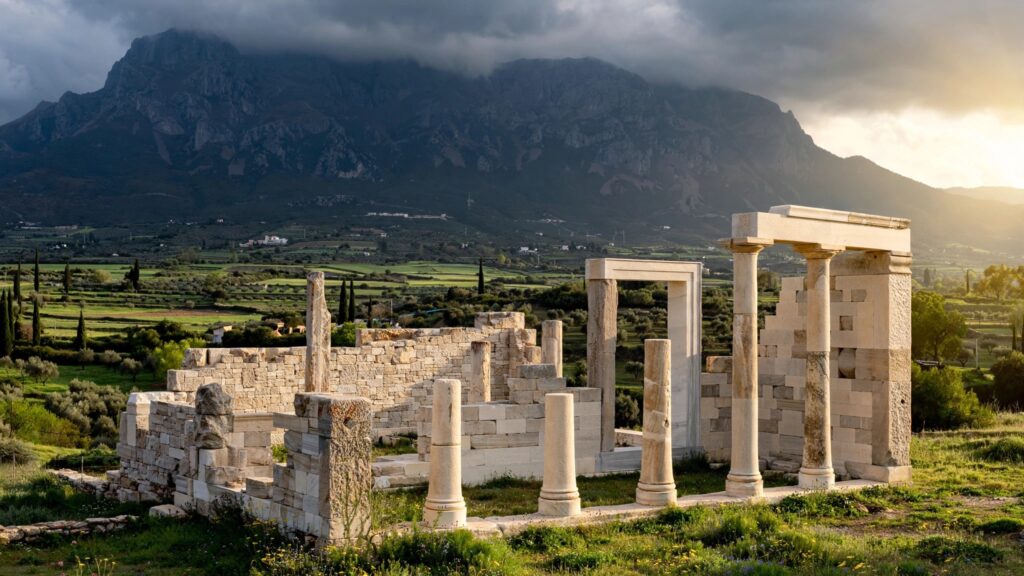
The small museum beside the site, opened in 2001 and internationally recognized for the sensitivity of its architecture, holds the temple’s surviving sculptural fragments, including a votive column carved in the shape of a kouros, alongside the recovered furnishings of the Byzantine church that briefly stood on the same sacred ground.
The Quarries That Carved the Ancient World
Naxian marble built the Portara and the Sangri temple, and it traveled considerably further than that. Naxos was, alongside Paros, one of the two principal marble-producing islands of the entire Cycladic world, and its stone, prized for its particular crystalline brightness, was exported across the Aegean for use in temples, votive offerings, and sculpture from the Archaic period onward, including a now-fragmentary colossal dedication, the Colossus of the Naxians, a roughly nine-meter, twenty-five-tonne statue quarried at Melanes and shipped to the sanctuary at Delos, where its base still bears an inscription proudly naming the Naxians as its donors, a public advertisement of the island’s wealth delivered to every other Greek city whose delegations passed through the most sacred sanctuary in the Aegean.
What the island kept for itself, rather than exporting, is what makes a visit to its interior unlike anything available on most other Cycladic islands: the unfinished giants, left exactly where their carvers set down their tools.
At Flerio, in an olive grove between the villages of Melanes and Kinidaros, two over-life-size kouroi lie roughly four hundred meters apart, cut free from the surrounding rock but with their feet never finished, each more than five meters long without its base. At Apollonas, the larger and more famous giant, the one this article opened with, rests in the open quarry above the village, his back marked with the original lifting holes that ancient quarrymen cut to insert wooden beams for hauling stone of this scale, a detail visible nowhere else with this clarity and that lets a visitor today read the actual mechanics of how an eighty-tonne object was meant to be moved before the project was abandoned partway through.
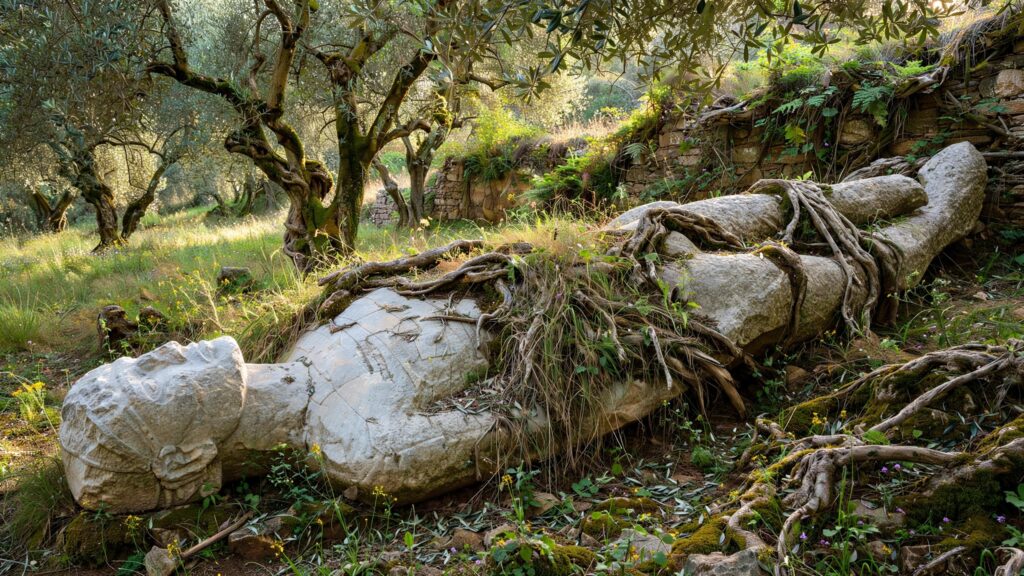
These were not failed minor commissions. They represent, collectively, some of the largest free-standing sculptures the Archaic Greek world ever attempted, and their incompletion across multiple separate sites tells you something genuinely significant about Naxos in this period: an island wealthy enough, and ambitious enough, to repeatedly commission sculpture and architecture at a scale that exceeded what its political stability could reliably sustain to completion. The Portara, the Sangri temple’s eventual ruin, and the sleeping giants at Flerio and Apollonas are not three unrelated curiosities. They are the same historical pattern, recorded in stone at three different locations: extraordinary reach, interrupted first by Spartan intervention against a fallen tyrant and then, a generation later, by a Persian fleet on its way to Marathon.
The Castle Built From the Temple’s Bones
Marco Sanudo’s Kastro, rising above Chora and still the dominant architectural presence in the island’s main town, completes the loop that the Portara’s history began.
Sanudo, a Venetian nobleman who arrived after the Fourth Crusade’s fracturing of Byzantine authority across the Aegean, established the Duchy of the Archipelago on Naxos in 1207 and ruled it, along with his successors, for the following three and a half centuries, an extraordinary span of continuous Catholic, Venetian feudal governance over a Greek Orthodox island population. The fortress he built, pentagonal in plan with three gates, the largest known as the Trani Porta, was constructed in part from spolia, recycled ancient material, taken directly from the abandoned temple at the Portara, the same twenty-tonne-block sanctuary whose ambition had outrun sixth-century Naxian politics now providing the raw material for a thirteenth-century feudal lord’s own architectural ambition.
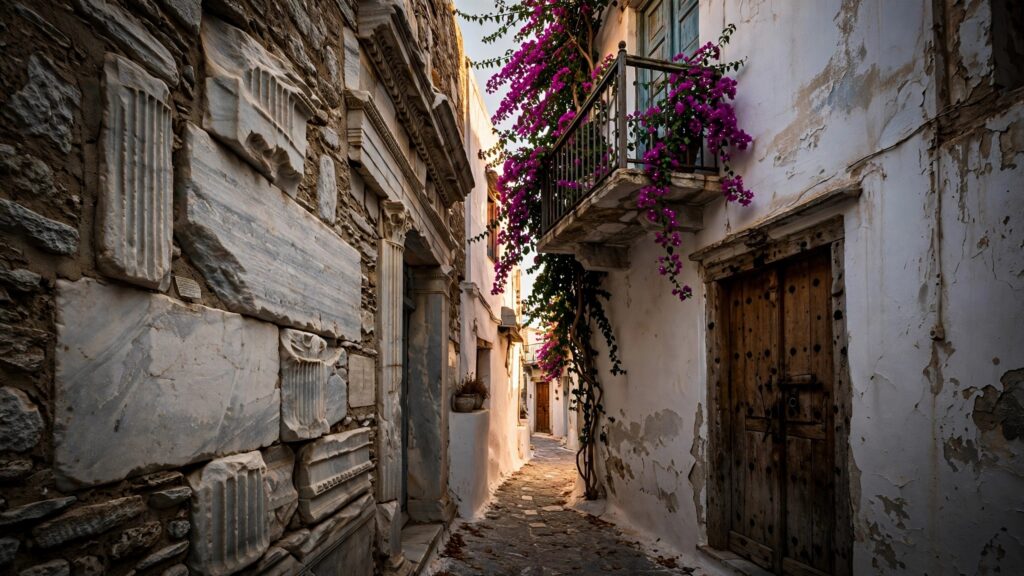
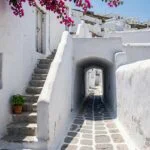
The Kastro today still houses the Catholic cathedral of the diocese that Sanudo’s dynasty established, a scattering of Venetian noble mansions whose family names remain attached to specific doorways and coats of arms, and the island’s Archaeological Museum, fittingly installed in the former ducal palace itself, where the marble figurines, Mycenaean pottery, and early Cycladic material on display sit under the same roofline that Venetian rule once governed from. Naxian society under the Duchy was explicitly feudal and tiered, the ruling Catholic families occupying the Kastro itself while the Orthodox Greek population lived below and around it in the Bourgos district, a division of social geography whose narrow lanes and bougainvillea-covered walls still structure how the old town reads today.
Where to Actually Spend the Days
The practical shape of a serious Naxos visit divides naturally into the town, the interior, and the north, and each rewards a different kind of attention.
Chora itself, walkable entirely on foot, holds the Portara, the Kastro, and the labyrinthine Old Market lanes between them, dense with small tavernas and craft shops occupying buildings whose lower storeys are considerably older than their current commercial use suggests. The Archaeological Museum at the top of the Kastro deserves the better part of a morning, not an afternoon footnote, particularly for its Cycladic figurine collection and its Mycenaean finds.
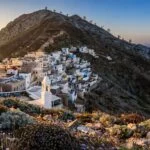
The interior requires a vehicle, and rewards the effort considerably. The Tragea valley, a vast and unbroken olive grove threaded with Byzantine churches, the painted, frescoed interior of Panagia Drosiani among the most significant, climbs toward the marble-built village of Apiranthos, whose streets are paved and faced almost entirely in local stone in a way that makes the whole settlement feel like an extension of the quarries above it rather than a separate place built from imported material. Mount Zas, the highest point in the Cyclades at just over a thousand meters and named directly for Zeus, who Naxian tradition held was raised in hiding on this island away from his father Kronos, offers a serious half-day hike to a summit with views across the entire archipelago.
The north demands the better part of a full day on its own: the drive to Apollonas takes close to an hour each way along a winding but genuinely beautiful coastal road, and the giant in his quarry rewards the journey on arrival in a way that photographs consistently undersell, the actual scale of the thing only becoming apparent when you stand beside his carved feet.
What the Island Feeds You
Naxos is the most agriculturally self-sufficient island in the Cyclades, and its food culture reflects a depth of local production that the more famous, more arid islands of the group cannot match.
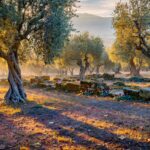
The cheese tradition alone justifies a dedicated visit: graviera Naxou, the island’s own protected hard cheese made from cow’s milk, alongside softer local productions including the fresh, unsalted xinotyri and the mild arseniko, are produced from herds grazing the same fertile valleys that fed Demeter’s ancient cult. Naxian potatoes, grown in the rich agricultural plain around the Tragea and Sangri, are widely regarded across Greece as among the finest in the country, and appear, simply boiled or roasted with island olive oil, on nearly every taverna table.
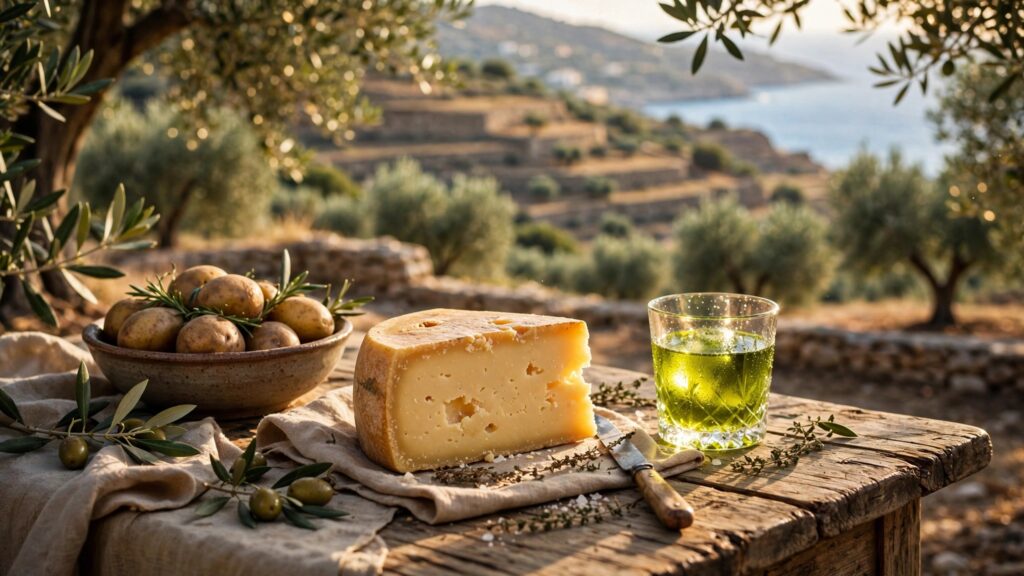
Kitron, the island’s distinctive liqueur distilled from the leaves of a citron variety cultivated almost nowhere else, comes in three traditional strengths and colors, the green the driest, the yellow lightly sweetened, the clear the most intensely citrus-forward, and functions on Naxos the way mastiha liqueur functions on Chios or tsipouro functions further north: the local digestif that no other island can genuinely replicate, because no other island grows quite the same citron in quite the same soil.
What Naxos Is Actually Asking You to See
Santorini gives you a single, overwhelming view and asks you to photograph it. Naxos gives you a sleeping giant, a door with no building behind it, a goddess’s temple rebuilt almost entirely from stones that had been hiding in a ruined chapel’s own walls, and a castle built from a sanctuary’s bones, and asks you to understand what all of it has in common.
What it has in common is ambition that consistently outran the political moment available to finish it, a tyrant toppled by Spartan spears, a temple abandoned in the smoke of a Persian landing on its way to Marathon, recorded honestly rather than disguised, left lying in olive groves and open quarries rather than tidied away. The island never pretended its great projects were completed. It simply kept living around them, growing wine and cheese and citrons in the valleys between one unfinished monument and the next, for two and a half thousand years, and it is, for exactly this reason, one of the most honest historical landscapes anywhere in the Aegean.
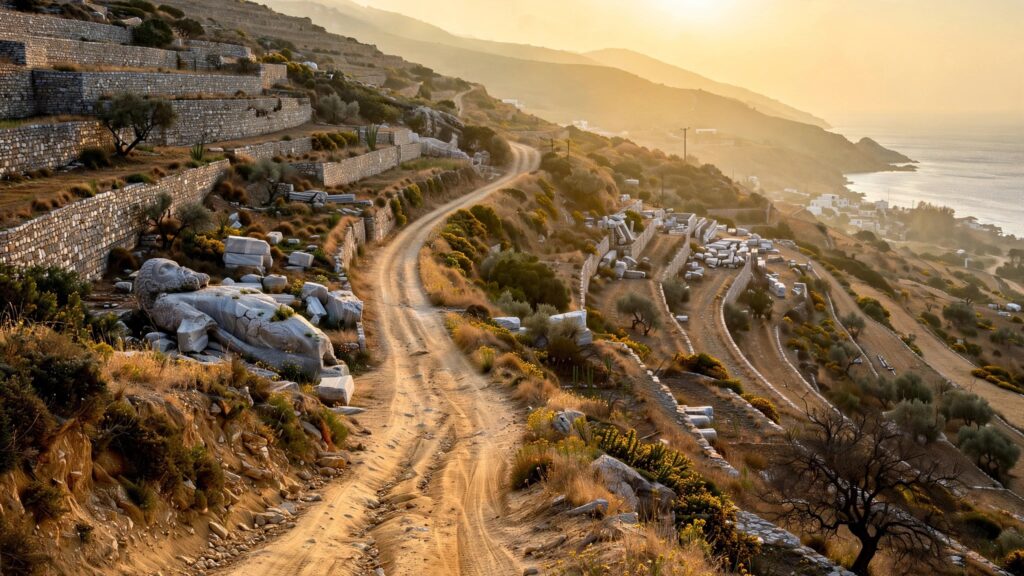
The giant at Apollonas is still on his back. He is not going anywhere. Go and stand beside his feet, and understand that the gap between what Naxos attempted and what Naxos finished is not a flaw in the story.
It is the story.
At Olympus Estate, Wanderlust Greece looks for the places where Greece is most completely and most honestly itself. Naxos, the largest of the Cyclades, is written in unfinished monuments: the Portara, a temple door with no temple behind it, likely begun for Apollo though a genuine minority of scholars argue for Dionysus instead. There are the sleeping giants at Flerio and Apollonas, some of the largest sculptures the Archaic Greek world ever attempted and never completed. And there is the Temple of Demeter at Gyroulas, a direct architectural forerunner of the Parthenon rebuilt almost entirely from its own original stones, found buried and hiding inside the walls of the ruined chapel that replaced it. The tyrant Lygdamis began the great temple around 530 BCE with Athenian backing, was overthrown by Sparta in 524 BCE, and whatever hope remained of finishing it ended for good in 490 BCE, when the Persian fleet bound for Marathon burned Naxos first. The island never finished what it started. It simply kept living around the evidence, for two and a half thousand years.