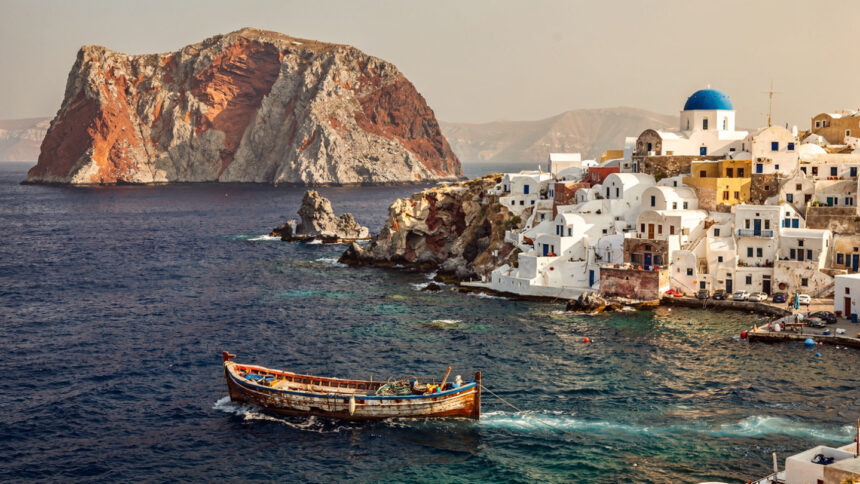


The palace at Knossos is three kilometers south of Heraklion, on a low hill above the Kairatos river valley.
That geographical fact is the first thing to understand before you arrive, because the site’s position was not chosen for convenience or for proximity to the modern city that grew up beside it. The Minoans chose this hill because the hill was defensible, the valley below it was fertile, the position commanded the approach routes from the coast, and the site had already been inhabited for six thousand years before the palace was built. Knossos was an old place before the palace existed. The hill already carried the accumulated weight of Neolithic and Early Bronze Age communities in its soil when the first palatial construction began around 1900 BCE, and that accumulation is part of what the site communicates to the visitor who approaches it with the time to understand what they are entering.
The palace is not a ruin in the conventional sense. It is a reconstruction: Arthur Evans, who excavated the site beginning in 1900, used reinforced concrete to stabilize and rebuild the multi-storey sections, commissioned reproductions of the frescoes to be installed in the reconstructed rooms, and rebuilt columns, stairways, and roofline elements based on his interpretation of the available evidence. The result is a site that communicates the scale and character of the original complex with a vividness that no unrestored ruin achieves, and a site that incorporates Evans’s interpretations into its physical fabric in ways that are now difficult to separate from the original evidence.
The dedicated Knossos Throne Room essay in this collection addresses the Evans reconstruction problem in full. For the visitor planning their day, the practical consequence is this: what you walk through at Knossos is both the Bronze Age palace and Evans’s twentieth-century engagement with it, the two inseparable, and the most honest way to experience the site is to hold both simultaneously rather than to pretend you are encountering the unmediated ancient world.
Before You Arrive | What to Read and When to Go
The Minoan civilization article in this collection gives the full archaeological and historical context for the Knossos visit. Reading it before arriving will transform what you see from an impressive collection of old stones into the material evidence of a sophisticated and still partially mysterious civilization whose writing remains undeciphered and whose social structure, religious beliefs, and political organization are all subjects of ongoing scholarly debate.
For the mythological dimension, the Theseus article in this collection develops the Labyrinth and Minotaur tradition in its full complexity: the myth of Pasiphae and the white bull, the commission of the Labyrinth to Daedalus, the Athenian tribute, Ariadne’s thread, and the relationship between the palace’s genuine architectural complexity and the mythological tradition of an inescapable maze. The palace did not contain a literal labyrinth in the sense of a designed maze. The palace was itself the source of the labyrinth idea, and the visitor who has read the myth with sufficient attention will find the palace’s actual organization more interesting than any designed maze could be.
The best time to visit Knossos is the early morning, and the best months are May, June, and September. In July and August the site operates at maximum visitor density with coach tours arriving from the Heraklion hotels throughout the morning, and the combination of the crowds and the Cretan summer heat reduces the quality of the experience substantially. Arriving at opening, which is 8:00 AM in the summer season, gives approximately ninety minutes before the first wave of coach tours arrives.
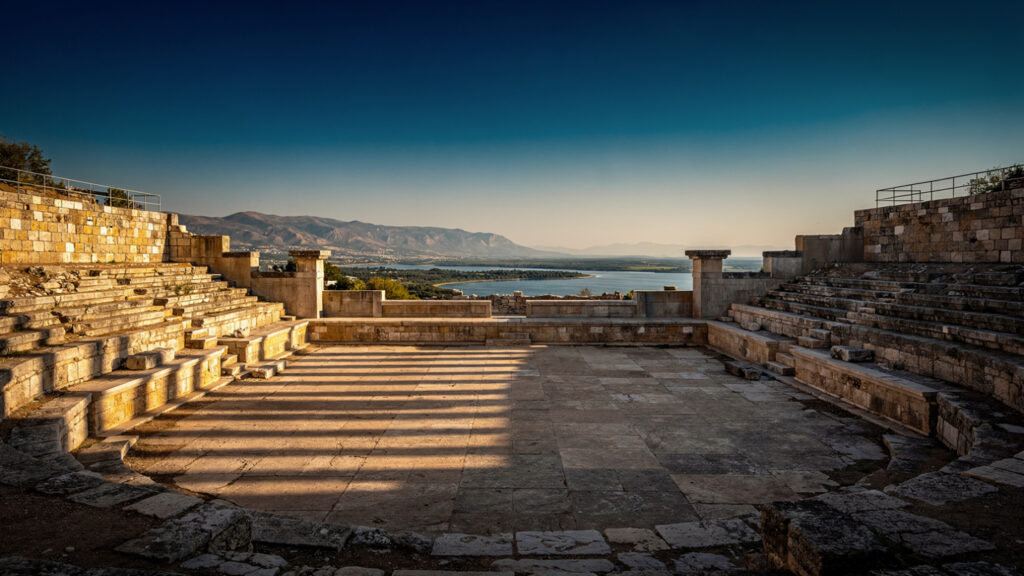
The combined ticket that includes the Heraklion Archaeological Museum is the correct ticket to buy. The original frescoes, the Phaistos Disc, the gold jewelry, and the full range of the portable objects from the Knossos excavation are in the museum rather than at the site, and the site visit is substantially enriched by the museum visit and substantially impoverished without it.
The Approach | West Court and Royal Road
The approach to the palace from the modern site entrance takes you through the West Court, the large paved area that the Minoans used for the public-facing functions of the palace complex: the gatherings, the processions, and whatever ceremonial activities the west facade of the palace organized.
The west facade itself, even in its reconstructed form, communicates the visual statement the palace was making to the person approaching it from the valley below: the multi-storey structure with its distinctive red columns, visible from a distance, announced a building whose scale and deliberate visual character set it apart from the surrounding landscape. The red columns are not original: they are Evans’s reconstruction of the Minoan column type that the fresco evidence and the Akrotiri archaeological parallels document, tapered downward from capital to base in the inversion of the structural logic that the wooden column’s taper-down convention represented.
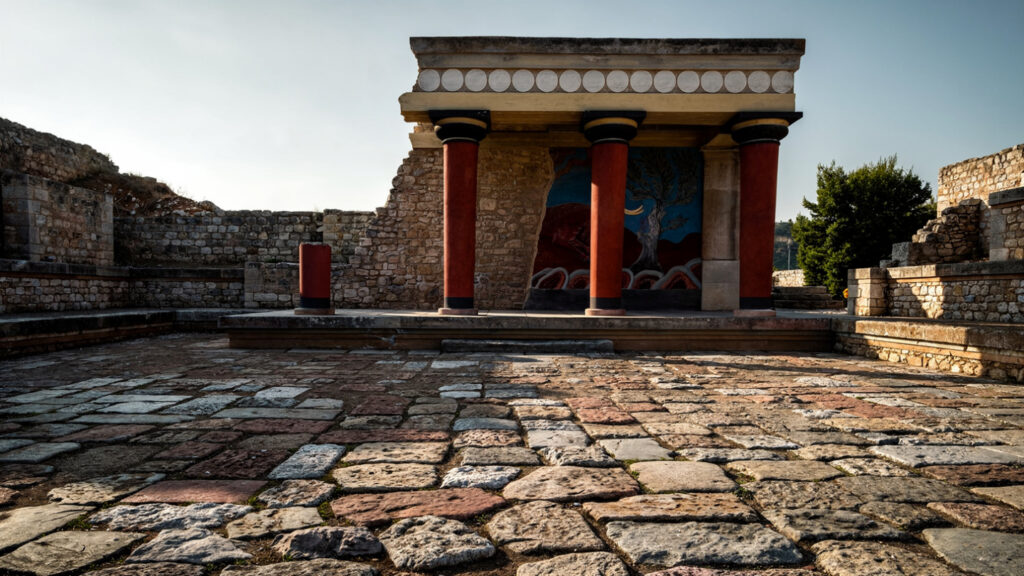
The Royal Road that leads from the West Court toward the palace entrance is the oldest paved road in Europe, a fact that requires a moment’s attention: the paving beneath your feet was laid approximately 3,500 years ago, in the period when the palace was at its most active, and the road carried the traffic of the Minoan administrative and commercial economy between the palace and the surrounding settlements. Walking it with this fact in mind is walking the material continuity between the Bronze Age and the present in its most literal available form.
The West Magazines and What They Document
The long storage rooms, the magazines, that line the western section of the palace are the most direct available encounter with the character of the Minoan palatial economy, and they deserve more attention than most visitors give them.
The pithoi, the enormous earthenware storage jars whose remnants stand in the magazines, were the primary storage technology of the Minoan palace system: vessels capable of holding hundreds of liters of olive oil, wine, and grain, arranged in the magazine rooms that the palace’s west wing dedicated to the storage function. The scale of the storage capacity that the west wing magazines represent, combined with the Linear A tablet records that the excavation recovered from the palace’s administrative areas, gives the clearest picture available of the palatial economy as a redistributive system: surplus agricultural production from the surrounding region was brought to the palace, stored in the magazines, and redistributed through the palace’s administrative mechanism.
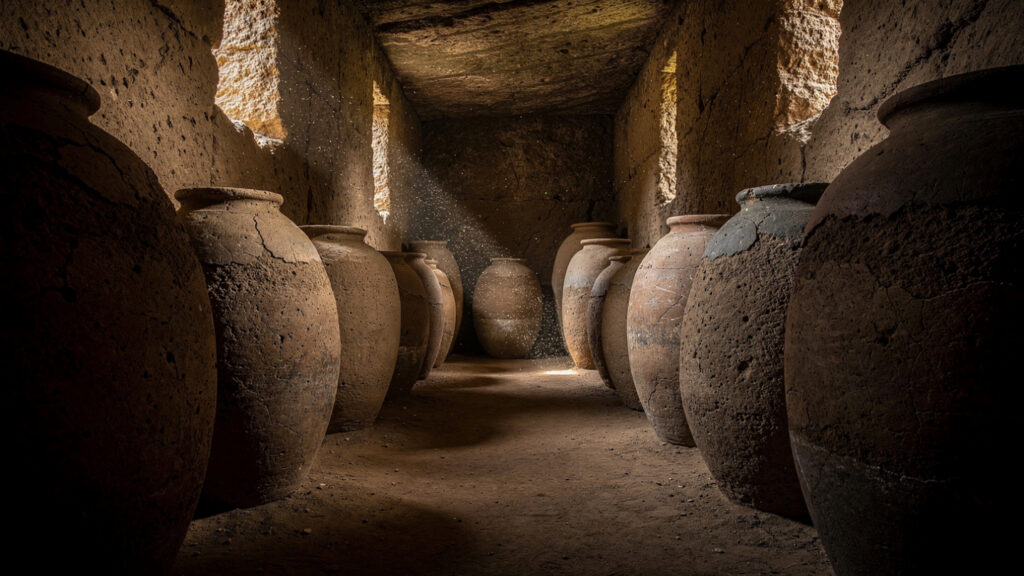
The quantity of olive oil that the magazines could hold has been calculated from the pithoi’s combined capacity, and the number is large enough to have supplied the palace and its dependent communities through periods of shortage: the palace as a buffer against agricultural volatility, as the institution that maintained the community’s food security through its control of the storage and redistribution system. The wealth the magazines represent was not luxury wealth in the decorative sense. It was subsistence wealth, the accumulated surplus that made the civilization’s continuity possible through bad harvest years.
The Central Court and the Bull
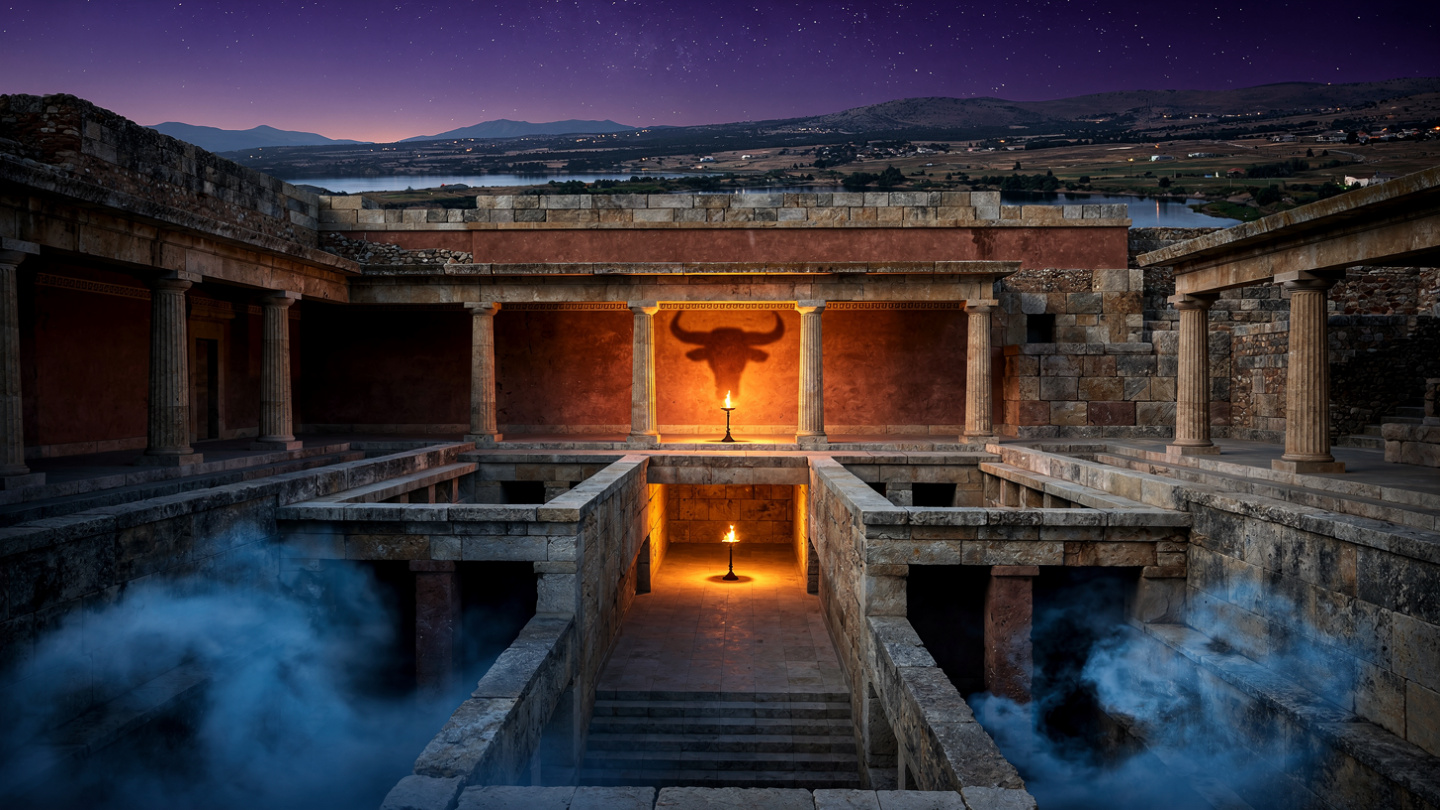
The Central Court, the large rectangular paved area around which the entire palace complex is organized, is the space that most directly confronts the visitor with the question of what the palace was for.
The court is oriented on a north-south axis, a deliberate architectural decision that governed the relationship between the built complex and the seasonal movement of light across the Cretan sky. The surrounding buildings rise on all four sides, enclosing the courtyard in the arrangement that made the court a controlled environment rather than simply an open space: the light, the shade, the acoustic quality, and the sightlines were all determined by the surrounding architecture’s relationship to the court.
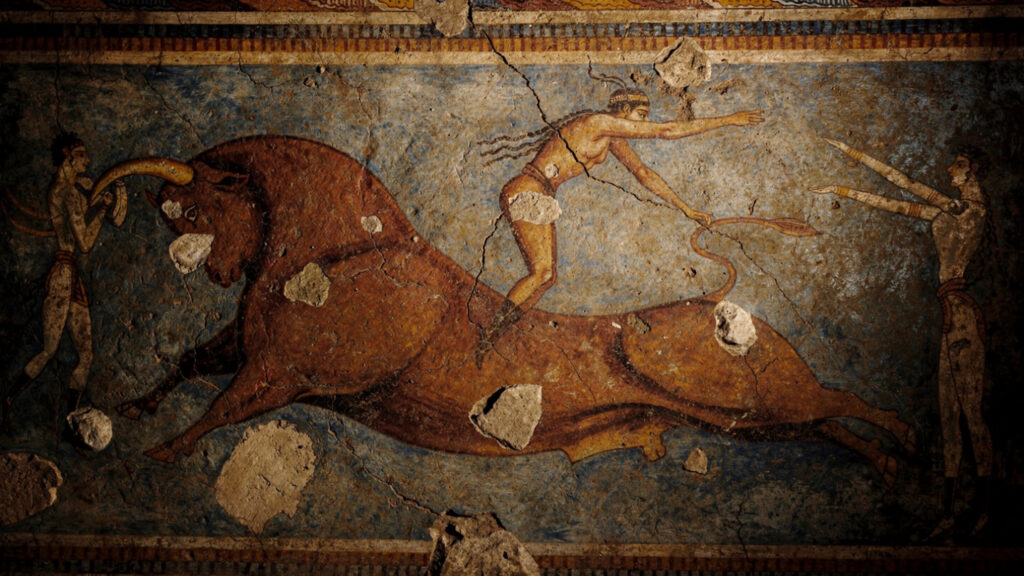
The bull-leaping activity that the frescoes document was almost certainly performed in the Central Court or in an associated space: the athletic tradition of grasping the bull’s horns and vaulting over its back, which appears in the Knossos frescoes with sufficient consistency and specificity to represent a genuine practiced activity rather than a symbolic representation, required exactly the kind of controlled enclosed space that the Central Court provided. The Minoan civilization article in this collection addresses the scholarly debate about whether the bull-leaping was ritual, athletic, or both, and the argument that the palace’s Central Court architecture was calibrated to the bull-leaping activity rather than the activity being incidental to the court’s design.
Standing in the Central Court in the early morning before the visitors fill it is the most complete available encounter with the palace’s spatial logic: the surrounding buildings in their Evans-reconstructed form, the quality of the Cretan morning light in the enclosed courtyard, and the silence of the space before the day’s traffic arrives are together the closest available approach to what the court’s designers intended the space to feel like.
The Throne Room
The Throne Room sits to the west of the Central Court, accessible through an anteroom that functions as the transitional space between the open public courtyard and the enclosed ceremonial chamber.
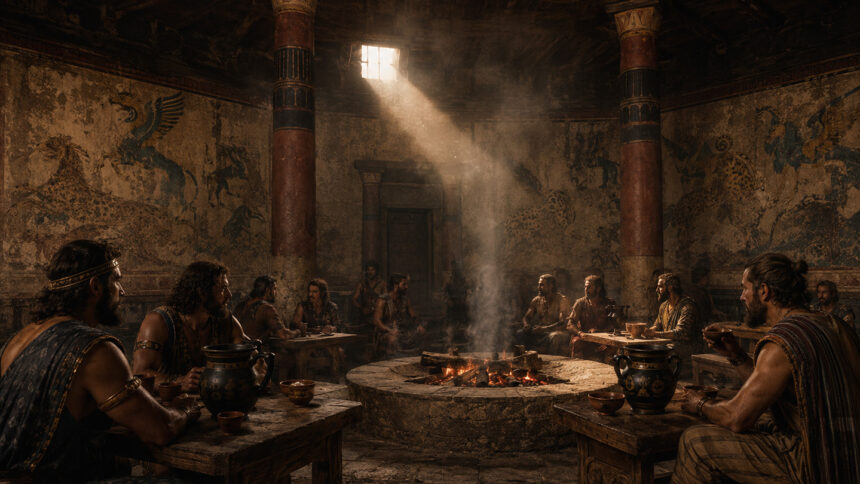
The throne itself is made of gypsum, not marble, which is the first detail that the dedicated Knossos Throne Room essay in this collection develops: gypsum rather than marble because the room was made for use rather than for posterity, by craftsmen who cared more about the quality of the surface in the light of that room than about whether it would survive for three and a half thousand years. It has survived. It is the oldest throne in Europe still in position in the room designed around it.
The griffin frescoes that flank the throne, recumbent figures facing the room rather than the throne, are Evans’s reproductions of fragmentary originals now in the Heraklion Archaeological Museum. The wingless form of these griffins, unusual in Aegean iconography, produces a stillness that the winged form would not: the space does not suggest movement or action. It suggests something seated and waiting.
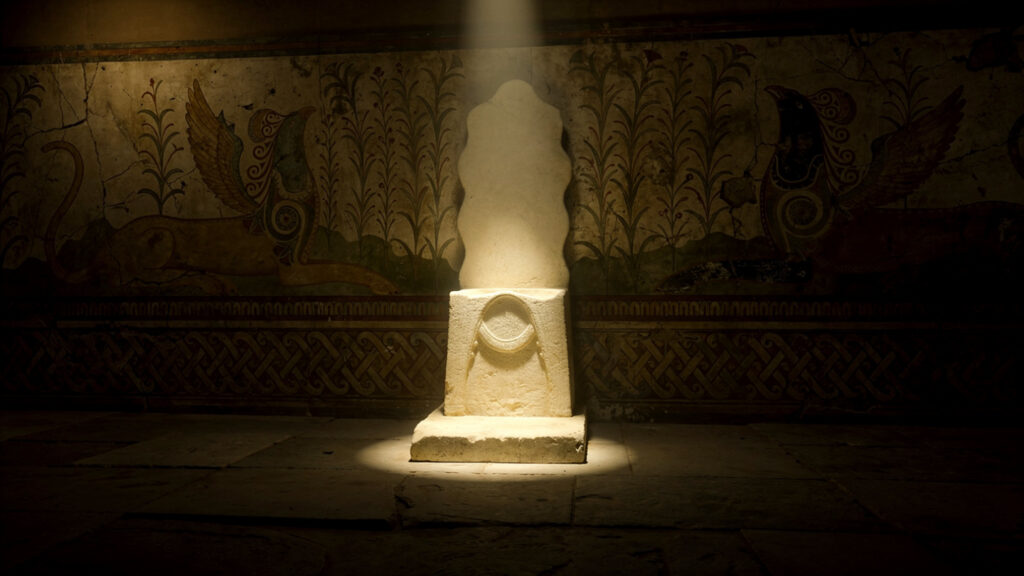
The debate about who sat in the throne, a Minoan priest-king, a high priestess serving as the earthly representative of a Minoan goddess, or a later Mycenaean administrator using the Minoan ceremonial framework for their own purposes, is the primary unresolved question about the room. The throne sits in its alcove on the north wall with the griffins on either side, and the identity of whoever sat in it remains the room’s governing mystery.
Allow yourself time in the Throne Room. It is the smallest and the most specifically designed space in the palace complex, and its quality of enclosure and deliberate light management rewards a longer stay than the standard visit allows.
The East Wing | Apartments, Frescoes, and Drainage
The East Wing of the palace, which descended into the hillside in a multi-storey section whose partial reconstruction Evans undertook using concrete, contains the spaces that the palace tradition has most consistently designated as domestic and administrative: the Hall of the Double Axes, the Queen’s Megaron, the workshops, and the drainage system whose complexity is among the most direct available evidence for the Minoans’ specifically sophisticated engineering.
The drainage system at Knossos was a genuine engineering achievement of the Bronze Age: terracotta pipes fitted with parabolic cross-sections that the hydraulic engineering tradition recognizes as designed to maintain self-cleaning flow velocity rather than simply to channel water passively. This design detail, the parabolic section that increases flow velocity in the pipe’s center to prevent sediment accumulation, is the design detail that makes the Knossos drainage system significant beyond the general observation that the Minoans had indoor plumbing. They had indoor plumbing designed by engineers who understood fluid dynamics.
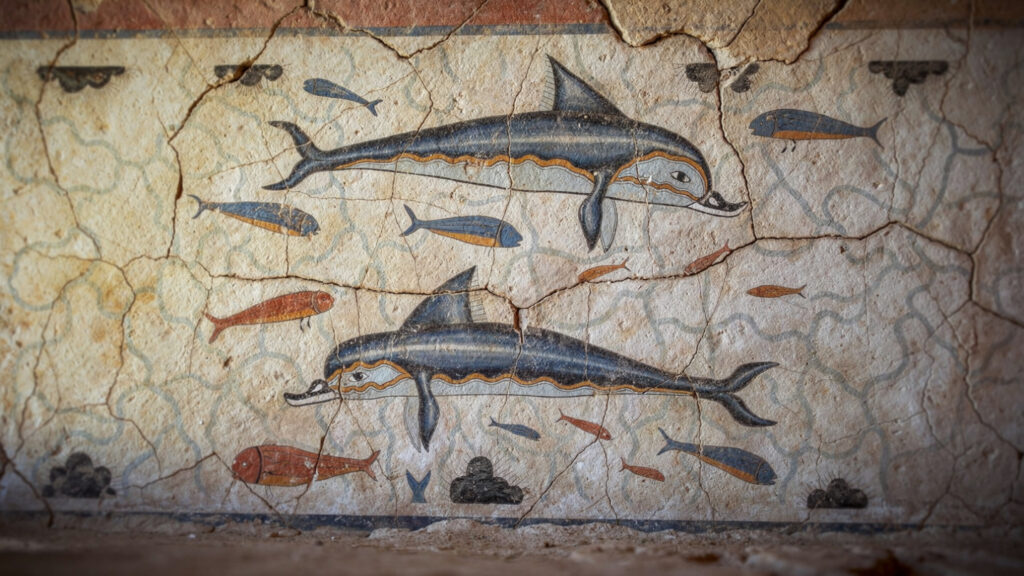
The Queen’s Megaron’s Dolphin Fresco, even in its reproduced form, is worth examining for the quality of the naturalistic observation it represents: the dolphins in the fresco move through the water in the way that dolphins in the Aegean actually move, with the curvature of their bodies in the turn and the quality of their color against the water that the Minoan artist’s close observation of the real animal produced. The fresco is not decorative in the sense of being purely ornamental. It is observational art, the record of someone who had watched dolphins and rendered what they saw with the attention that only sustained close observation produces.
The Heraklion Archaeological Museum
The Heraklion Archaeological Museum, in the center of Heraklion approximately twenty minutes from the Knossos site by bus or taxi, is the essential second half of the Knossos visit and in some respects the more important half.
The museum holds the original frescoes that Evans’s reproductions at the site were based on: the Prince of the Lilies, the Ladies in Blue, the Bull-Leaping fresco, and the Saffron Gatherer are the images that the Knossos visit is preparing the visitor to understand, and seeing the originals in the museum after seeing the reconstructed palace context is the sequence that produces the fullest comprehension of both.
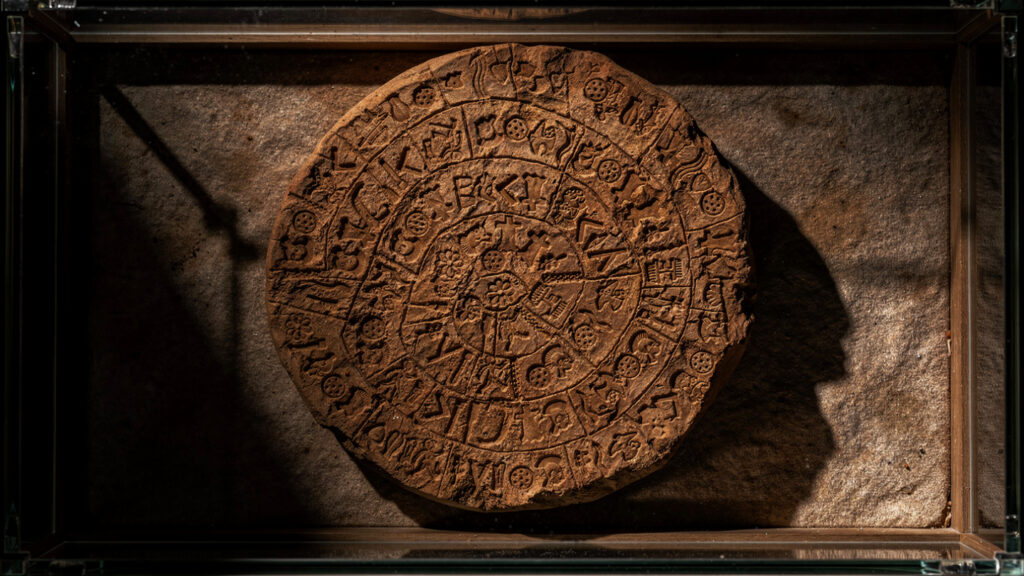
The Phaistos Disc, the fired clay disc with its still-undeciphered spiral inscription of pictographic symbols, is in the museum’s collection and is among the most discussed single objects in the archaeology of the Bronze Age Mediterranean: a document of approximately 1700 BCE whose content and purpose remain unknown because the script used to write it has not been deciphered and appears in no other ancient context. The disc is small, approximately 16 centimeters in diameter, and the visitor who has read about it without seeing it may be surprised by how immediate and alive it looks in the museum case: the individual impression of each symbol, pressed into the clay with a separate seal rather than inscribed with a stylus, gives the disc a quality of deliberate individual attention that three and a half thousand years have not reduced.
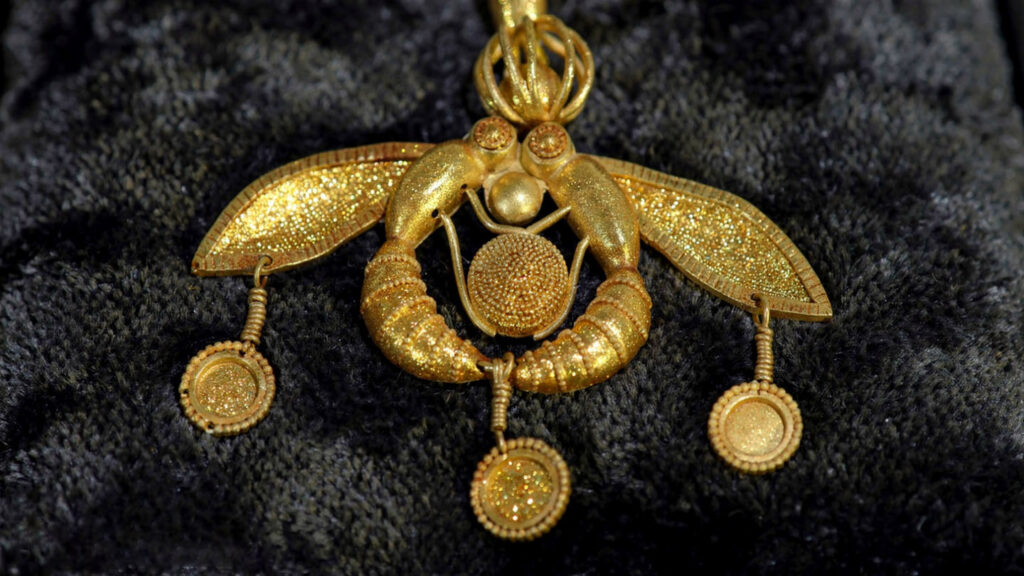
The Minoan gold jewelry in the museum collection, particularly the Aegina Treasure pieces and the objects from the Minoan palace contexts, documents the quality of Minoan goldsmithing: granulation and filigree techniques applied with a precision that the ancient world would not achieve again until the Hellenistic period. The bees pendant from Chryssolakkos, two bees flanking a honeycomb disc in gold granulation of extraordinary delicacy, is the single object that most immediately communicates the Minoan artistic tradition’s combination of close natural observation and technical mastery.
Allow two to three hours in the museum. The collection is large and the chronological arrangement requires some orientation: the prehistoric galleries on the ground floor are the galleries organized around the Minoan material, and the Knossos-rooms are identified in the museum’s floor plan.
Heraklion | The Venetian Layer
The city of Heraklion that surrounds the museum and the Knossos road carries the layering of a city that was significant to every Mediterranean power that governed it: Minoan in its Bronze Age origins, Roman in its classical period infrastructure, Arab in the period of Arab piracy and the ninth-century Arab occupation that gave the city its fortification, and Venetian in the period of Venetian rule from the thirteenth to the seventeenth century that gave the city its current historic center.
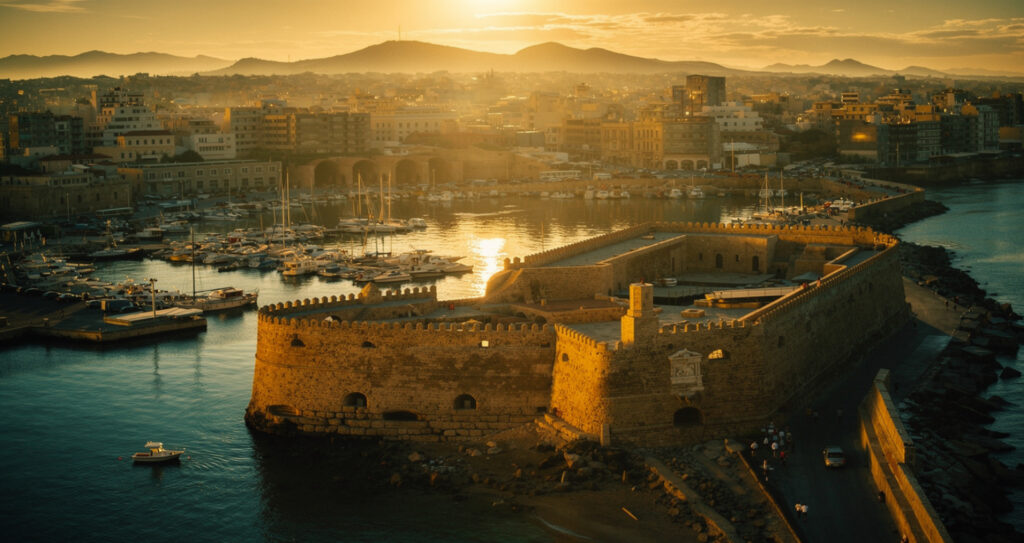
The Venetian layer is the one most immediately visible in the city’s architecture: the Koules fortress at the harbor entrance, the lion of Saint Mark carved above the gates of the old city, the Morosini Fountain in the central Lion Square, and the Venetian Loggia near the archaeological museum are all survivals of the four centuries of Venetian administration that made Heraklion, then called Candia, one of the most strategically important cities in the eastern Mediterranean.
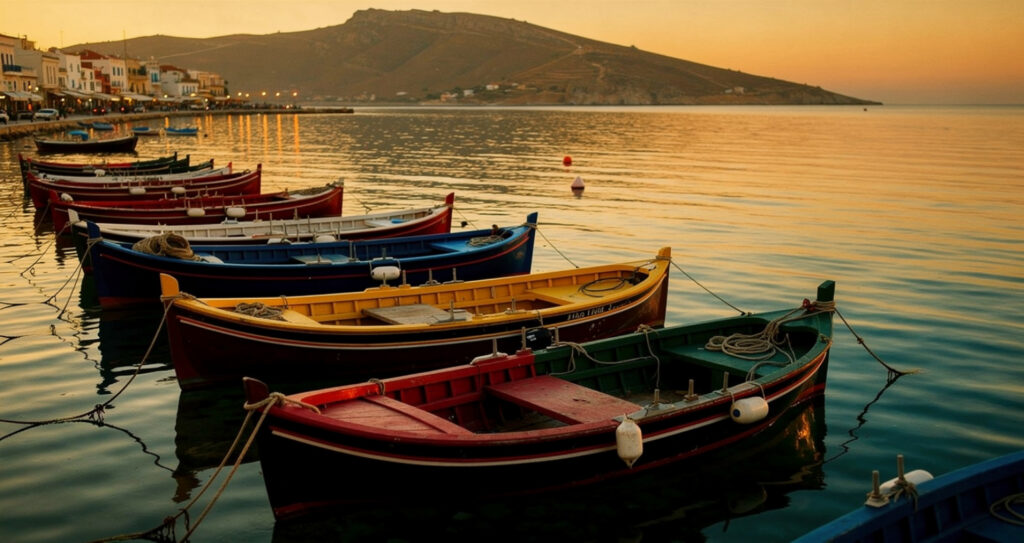
The harbor walk from the Koules fortress along the old harbor front, in the early evening when the day’s heat has dropped and the fishing boats are returning, is the Heraklion experience that most completely captures the quality of a Mediterranean port city whose layers of history are visible simultaneously in the same streetscape: the Venetian fortress and the Byzantine church and the Ottoman mosque and the modern cafe all present in the same harbor front that the Minoan ships of three and a half thousand years ago would have approached from the sea.
Practical Information
Knossos is open daily, year-round, with reduced hours in winter. The summer opening is 8:00 AM to 8:00 PM. The combined Knossos and Heraklion Archaeological Museum ticket represents better value than the separate tickets and commits you to the museum visit that the Knossos experience requires.
From Heraklion city center, bus 2 runs from the central bus station near the harbor to the Knossos site approximately every thirty minutes in the summer season. Taxis from the city center take approximately ten minutes. There is parking at the site, and arriving by car in the early morning before the coaches from the resort hotels begin their runs gives the best combination of parking availability and visitor density.
The site has limited shade, and the Cretan summer sun at full strength is intense. Arriving early, wearing a hat, and carrying water are the practical requirements that the standard visitor advice consistently gives for good reason.
The audio guide available at the site is worth hiring: the Knossos site’s complexity, with multiple significant areas distributed across a large footprint, benefits from the narrative structure that the audio guide imposes on the visit, particularly for the visitor who has not read extensively about the site before arriving.
At Olympus Estate, Wanderlust Greece guides you across the sacred and storied terrain of the Hellenic world. The throne at Knossos is made of gypsum, is three and a half thousand years old, and is still in the room designed around it. The frescoes in the Heraklion museum were painted by people who watched dolphins in the Aegean and recorded what they saw. The Linear A tablets from the palace storage rooms have not yet been deciphered. What the palace was and what it meant remains partially unknown. Go and stand in the Central Court in the early morning and let the knowledge of what is known and what is not be present simultaneously. That is the Knossos visit at its best.