For approximately a thousand years, the most important address in the Western world was a hillside on the southern slope of Mount Parnassus in central Greece, six hundred metres above a plain that extended south toward the sea.
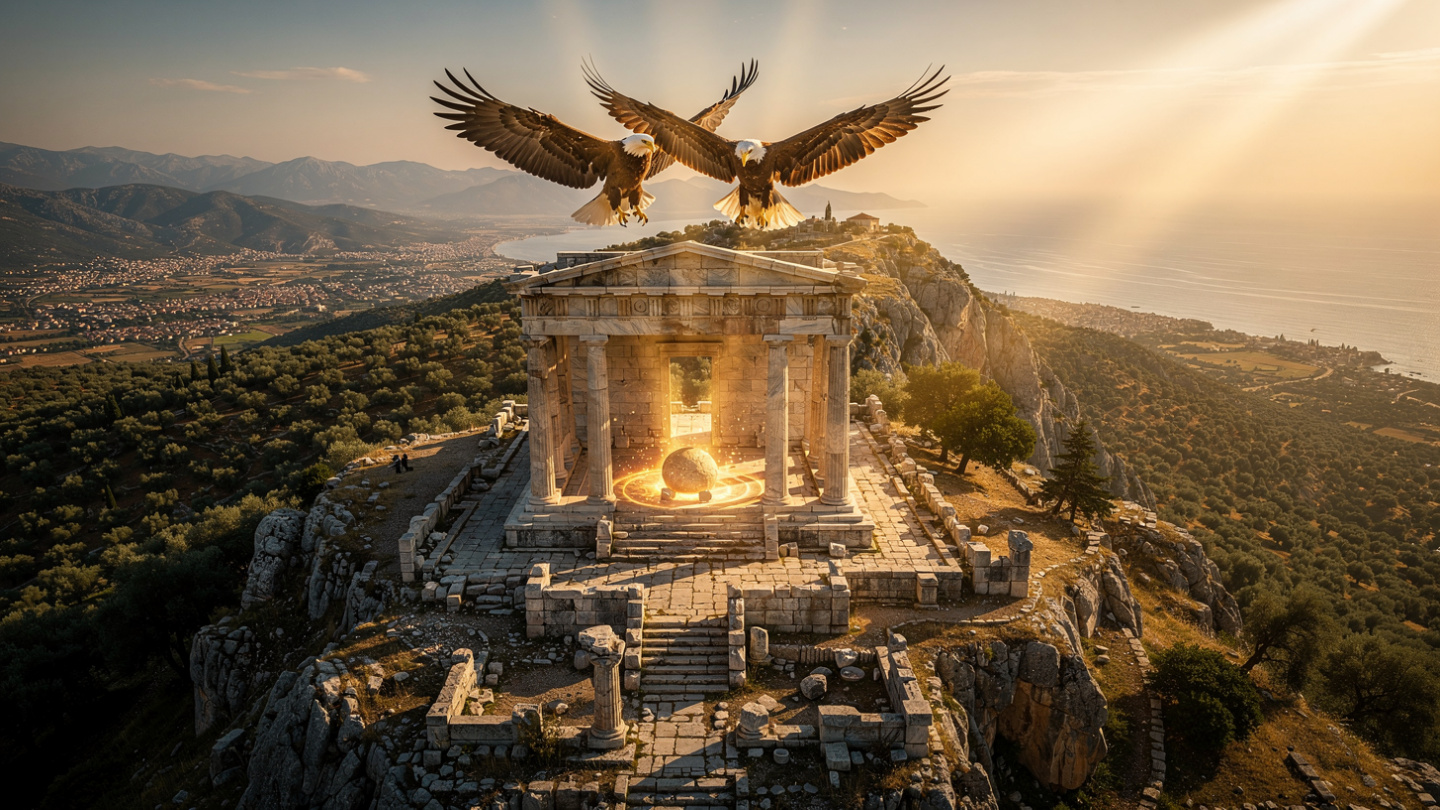
Not Athens. Not Rome. Not Babylon or Jerusalem or Alexandria. A sanctuary carved into a limestone escarpment above a gorge, where two eagles sent by Zeus from opposite ends of the earth had met in flight and marked the spot as the centre of the world.
Delphi.
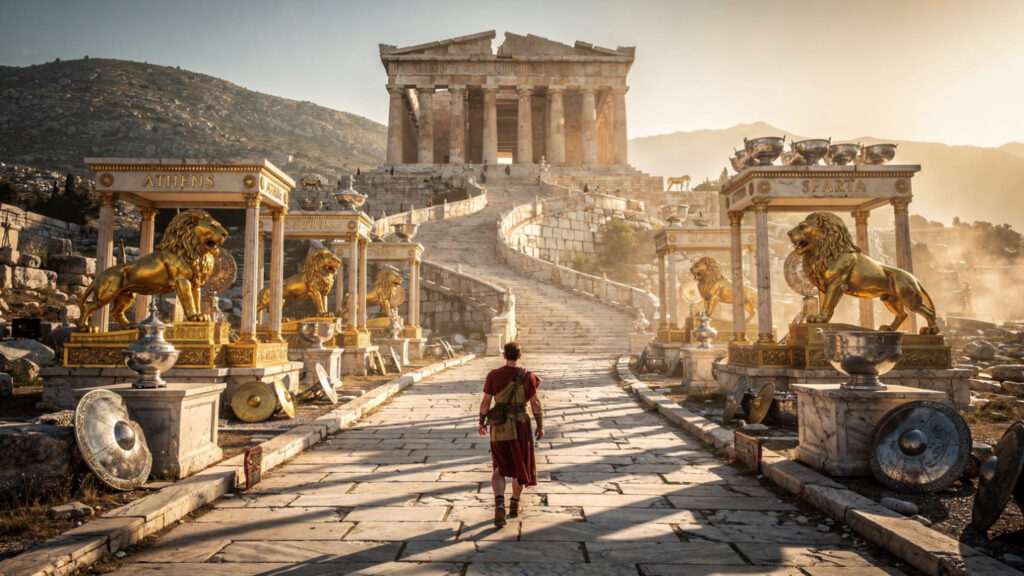
Every Greek city-state that founded a colony sent an embassy to Delphi first. Every king who planned a military campaign sought Delphi’s counsel before committing his forces. Every political crisis of sufficient magnitude eventually produced a delegation climbing the Sacred Way to the Temple of Apollo, bearing the elaborate gifts whose quality signalled the seriousness of what they were about to ask. Croesus of Lydia sent solid gold lions and a silver mixing bowl. The Athenians sent the spoils of Marathon. The Spartans sent the shields taken at Plataia. The offerings that accumulated in the sanctuary treasuries over eight centuries of operation constituted the largest concentration of dedicated wealth in the ancient Mediterranean world, and they were there because the information the sanctuary provided was considered worth more than gold.
Which it often was.
This is the article about what Delphi was, what happened inside the Temple of Apollo, what the geology of the site reveals about the oracle’s physical mechanism, and what the experience of standing in that landscape does to a person who arrives with sufficient preparation to understand what they are standing in.
Why Here | The Geology Before the Mythology
The mythology says that Zeus sent two eagles from opposite ends of the earth, they flew toward each other at equal speed, and they crossed above Delphi. The point of crossing was marked with the omphalos, the navel stone, because it was the centre.
The geology says something equally precise and considerably more interesting.
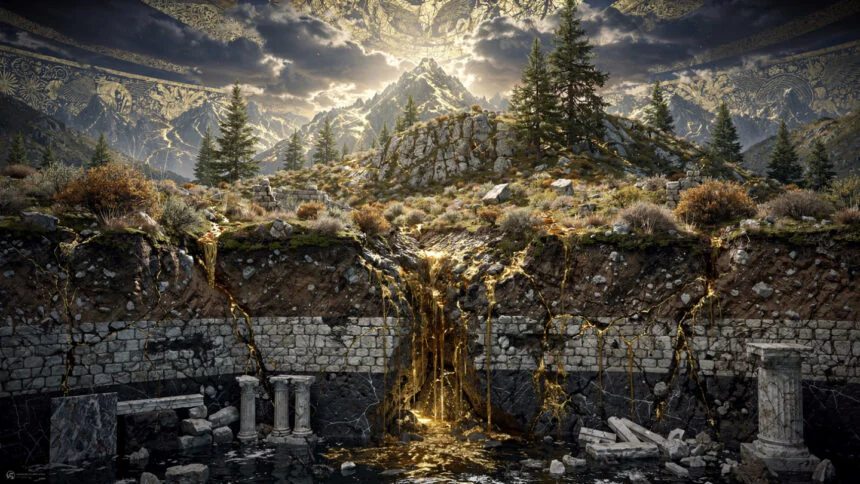
Delphi sits at the intersection of two geological fault systems: the Delphi fault zone, running roughly east-west, and a conjugate swarm of northwest-southeast fractures called the Kerna fault. These two fault systems cross directly beneath the Temple of Apollo. At their intersection, ground water rises through fractures in the underlying bituminous limestone, and as the water passes through the limestone, it carries with it dissolved hydrocarbon gases.
In 2001, a research team led by geologist Jelle de Boer of Wesleyan University and archaeologist John Hale of the University of Louisville published their findings in the journal Geology: ethane, methane, and ethylene had been detected in spring water samples from the Delphi site, originating from the bituminous limestone formations below. The presence of ethylene was particularly significant. In low concentrations, ethylene produces a state of euphoria and altered consciousness: the person under its influence remains lucid and responsive but speaks strangely, may become agitated, and often cannot remember what happened after the effects wear off. The team worked with toxicologist Henry Spiller, whose research on hydrocarbon inhalation confirmed that the symptoms ethylene produces in light doses match Plutarch’s descriptions of the Pythia’s trance with remarkable precision. Ethylene even smells sweet, which Plutarch had noted as a characteristic of the pneuma, the breath that rose from the earth in the adyton.
The scholarly debate has not been fully resolved. A 2006 reappraisal by geologists at the National Institute of Geophysics and Volcanology in Rome argued that the geological environment at Delphi is not capable of producing ethylene in concentrations sufficient to induce the effects described, and that some researchers had used ancient sources selectively to support a predetermined conclusion. The debate between the de Boer-Hale team and subsequent investigators is ongoing and genuinely unresolved, which is itself the most honest thing that can be said about the oracle: the mechanism by which the Pythia achieved her altered state remains, as it was in antiquity, a question with multiple plausible answers and no single demonstrably correct one.
What the geology confirms beyond debate is that the ancient sources who described a chasm in the floor of the adyton from which vapours arose were not inventing a detail for dramatic effect. There were gases. There were faults. There was a spring beneath the temple. The physical infrastructure of the oracle’s function was real.

What happened in the adyton was not pure theatre. And it was not purely pharmacological. It was both, and the ancient world’s inability to separate those two things may have been, in its way, a more accurate account of what was happening than either a purely religious or a purely scientific explanation achieves.
Before Apollo | The Earth That Was Already Sacred
Delphi was sacred before Apollo arrived.
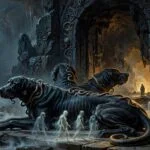
The literary tradition and the archaeological record agree on this. The site’s earliest documented sacred function is associated with Gaia, the earth goddess, and with the serpent Python who guarded the oracular chasm in her name. The transition from Gaia’s oracle to Apollo’s, described in the Homeric Hymn to Apollo, involves the young god travelling to Delphi, killing the Python, and claiming the site as his own.
The myth encodes a historical process. When the Olympian religious order, with its sky gods and its emphasis on clarity, reason, and the articulation of divine will in comprehensible form, displaced the older chthonic tradition of earth-based oracles, Delphi was the site where that displacement was most dramatically staged. The Python’s body, rotting beneath the temple and producing the pneuma that the Pythia inhaled, was mythology’s explanation for what the geology was actually producing: gases rising through faults in the earth, the chthonic world speaking through the body of the Earth’s defeated guardian into the mouth of Apollo’s chosen vessel.
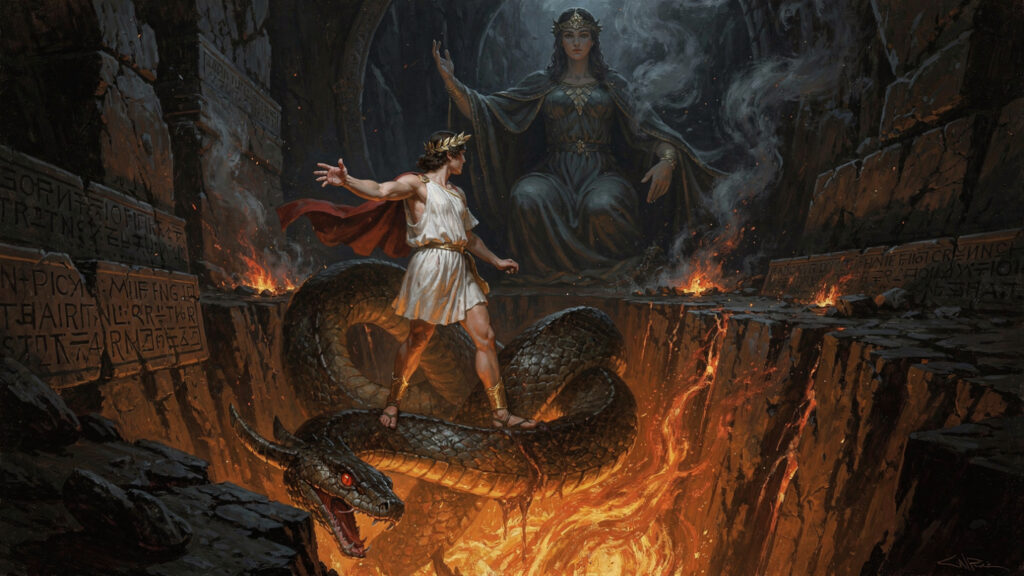
The name Pythia, the title of the oracle, preserves the myth: she is named for the Python that Apollo killed, and the pneuma she inhales is the breath of the creature whose death gave the sanctuary to the new god.
The site was therefore, from its very structure, an oracle that operated at the boundary between two orders of existence: the chthonic, the earth-based, the dark and pre-Olympian, and the Olympian, the sky-turned, the articulate and the clear. The Pythia sat in the underground adyton, below the floor of the temple, inhaling the rising gases of the earth, and spoke in the name of the god of clarity and light.
This paradox is not a contradiction in the mythology. It is the mythology’s most precise theological claim: that clarity about the future requires descent into the dark, that the god of reason operates through the medium of the earth’s deep mystery, that the oracle can only speak because the earth below her is still breathing.
The Pythia | What She Was and What She Was Not
Every account of Delphi eventually arrives at the woman on the tripod, and almost every popular account gets her substantially wrong.
The Pythia was not a frail young virgin descending into hysteria under the influence of hallucinogens. This image, which became standard in later Roman period accounts and has been reproduced in modern retellings, does not match the evidence of the sources closest to the oracle’s period of greatest activity.
Plutarch, who served as a priest at Delphi for the final decades of his life and who knew the institution from the inside, describes two distinct types of oracular trance. The more common was a state of benign altered consciousness: the Pythia remained seated on her tripod, responded to questions, spoke in words that required interpretation by the priests, and emerged from the session without apparent distress. The second, rarer state was more dramatic: violent agitation, incomprehensible speech, and physical exhaustion. Plutarch attributes the dramatic sessions to occasions when the Pythia entered the adyton on days that were not auspicious, when the signs before the session indicated that the conditions were not right, and he notes that the Pythia who suffered the most extreme episode in his memory died shortly afterward.
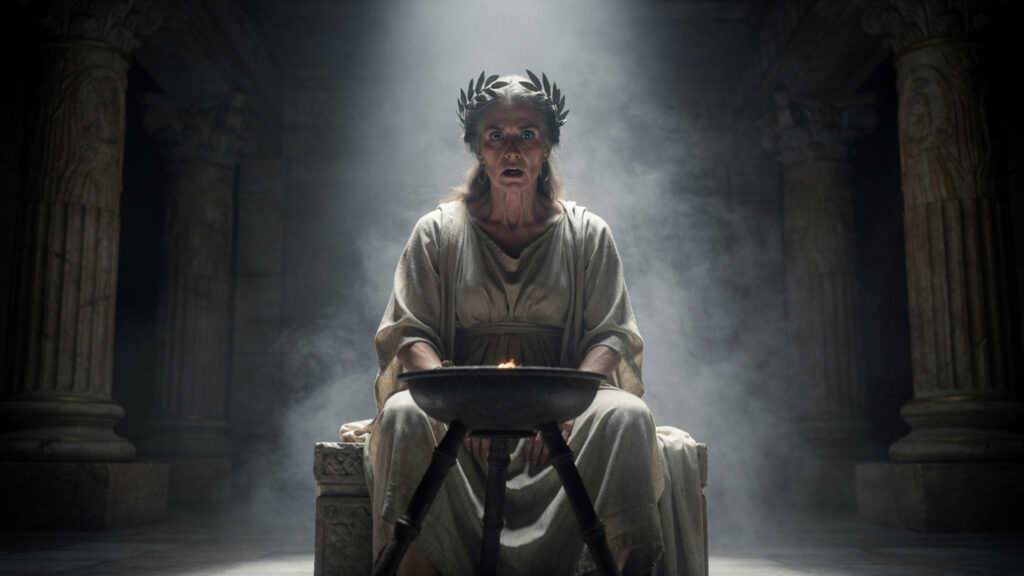
This detail is important. The oracle operated on a strict protocol precisely because the experience was understood to carry genuine physical risk. The oracle was available for consultation on only the seventh day of each month, for nine months of the year, the three winter months being closed. Before each session, a goat was sacrificed and its reaction observed: if the goat trembled appropriately when sprinkled with cold water, the signs were auspicious and the session proceeded. If not, it did not. The protocol was not superstition. It was a quality control mechanism developed over centuries of institutional experience with what happened when the session proceeded under unfavourable conditions.
At the height of the oracle’s popularity, there was more than one Pythia: the demand for consultations had grown to the point that a single woman could not serve all the petitioners, and a second and sometimes a third Pythia was available. This institutional scaling reveals something important about how the ancient world understood the oracle’s function. The Pythia was not a unique individual with a personal gift for prophecy. She was an official whose role was defined by the position, the training, the protocol, and the physical and spiritual conditions of the adyton. The gift belonged to the place and the procedure. The woman was the vessel.
Plutarch says that the Pythia was selected from a good family but not necessarily an elite one, suggesting that personal qualities rather than status determined the selection. She was required to be of good character and to live a life of ritual purity. After her selection she was given extensive training in the procedures of the sanctuary and in the interpretive framework that the priests would use to translate her utterances into the verse oracles delivered to petitioners.
The Oracle as Geopolitical Institution
The most consistently underappreciated aspect of the Delphic oracle is the sophistication of its political function.
For eight centuries, from approximately the eighth century BCE through the Roman imperial period, Delphi operated as the most significant geopolitical intelligence and advisory institution in the ancient world. This is not mythological language. It is a description of what the oracle actually did: it gathered information, synthesised it, and provided advice of sufficient quality that the most powerful states and individuals in the Mediterranean world considered it worth consulting before major decisions.
The consultation process was itself an information-gathering mechanism. Every delegation that arrived at Delphi brought its question, and every question was a piece of geopolitical intelligence. Where was a city planning to found a colony? What conflict was a king preparing for? What internal crisis was a city-state trying to resolve? The priests of Apollo, who interpreted the Pythia’s utterances and formulated the verse oracles delivered to petitioners, had access to the political intelligence that every delegation’s question contained, and they had it from delegations arriving from every significant state in the Greek world and beyond.
The famous ambiguity of Delphic oracles, “if Croesus crosses the Halys, he will destroy a great empire,” which proved true but referred to Croesus’s own empire rather than Persia’s, is often presented as evidence of the oracle’s manipulative cleverness or its protective hedging. It is also evidence of something more interesting: the oracle’s consistent refusal to simplify complex situations for the convenience of those who wanted simple answers. The ambiguity was not evasion. It was honesty about what the future actually is: undetermined in its specifics even when the general tendency of events is perceivable.
The oracles that shaped the most significant decisions of the ancient world were not the ambiguous ones. They were the specific, actionable recommendations that the sanctuary provided on colonial foundations, religious practice, and political organisation. The colonisation of the western Mediterranean, the network of Greek settlements from Sicily to southern France to the coast of Spain, was substantially coordinated through Delphi. Almost every major colonial foundation was preceded by a Delphic consultation, and the oracle’s recommendations about where to settle, what local deities to honour, and what relationships to maintain with indigenous populations reflected the information that decades of consultations from merchants and explorers had provided.
Delphi was, in functional terms, the ancient world’s most effective intelligence synthesis operation, operating under the cover of divine authority.
The Sacred Way | What You Walk When You Visit
The physical approach to the sanctuary has not changed in its fundamental structure since the fifth century BCE. You walk up.
The Sacred Way begins at the site’s lower entrance, near the museum, and ascends through the sanctuary in a series of switchbacks and straight sections that take approximately thirty to forty-five minutes at a comfortable pace. This walking pace was deliberate in the ancient design: the ascent required the petitioner to slow to the speed of the sacred, to separate physically from the ordinary world of the plain below, to arrive at the temple having already undergone a transition.
Along the Sacred Way, the treasury buildings of the ancient city-states crowd both sides of the path. These are small temple-like structures in which each state stored its accumulated offerings to Apollo, the dedications that expressed both gratitude for favourable oracles and the competitive desire to be seen as generous at the sanctuary where everyone who mattered came to be seen. The Treasury of the Athenians, built in the Doric order from Pentelic marble, is the best preserved and the most visited: it was reconstructed from its fallen blocks in 1906 and stands essentially complete, a small but perfectly executed building whose proportions communicate, as the great classical buildings always communicate, more authority than their size would suggest.
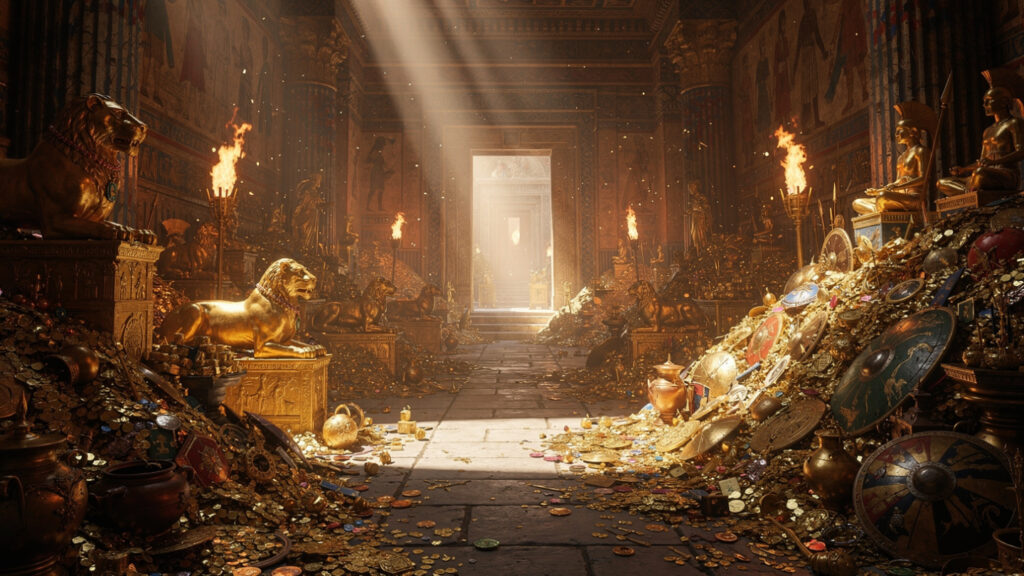
The treasury buildings are the Panhellenic scoreboard: each one announces the wealth and the piety and the political ambitions of the state that built it, and they are arranged along the path in a spatial argument about which states mattered most in the sanctuary’s political world. Reading the Sacred Way as you ascend it is reading the political history of the classical Greek world inscribed in marble.
The Temple of Apollo, when you reach it, is more ruin than reconstruction: the columns of the fourth-century BCE temple, the third temple on this site, stand in an incomplete colonnade above the remains of the adyton below. The view from the temple terrace, south across the valley of the Pleistos River to the olive groves extending toward the sea, is one of the finest in Greece: a view that has been the view from this spot for twenty-five centuries of human visitation. The petitioners who climbed the Sacred Way saw this view when they arrived at the temple. The same light, the same olive trees, the same valley curving toward the distant coast.

The theatre, above the temple, seated five thousand and provided the venue for the Pythian Games, the second most prestigious Panhellenic athletic and musical competition after the Olympics. The stadium, further above the theatre, held seven thousand spectators for the footraces and the longer athletic events. The scale of the installation communicates what the site was: not a remote hermitage but a major Panhellenic institution requiring infrastructure for the accommodation and entertainment of thousands of visitors, the management of enormous quantities of dedicated wealth, and the smooth operation of a consultation process that the ancient world depended on.
The Castalian Spring | Where Purification Began
Before any petitioner could enter the sanctuary, they were required to purify themselves at the Castalian Spring: a natural spring issuing from the Phaedriades cliff face, the two great vertical rock walls that frame the sanctuary from above and whose name means the shining ones, for the quality of the light they reflect at dawn and dusk.

The spring is still flowing. It issues from the rock between the two cliffs at the point where the ancient sacred road approached the sanctuary from the east. The water is cold from the limestone it passes through, clear, fast-moving. The niches cut into the rock face for ritual washing are still visible.
The Castalian Spring was sacred to the Muses, and poets who drank from it were understood to receive inspiration. This association was not separate from the oracle’s function: Apollo was the god of the Muses as well as the god of prophecy, and the spring that purified petitioners before their consultation with his oracle was also the spring that inspired the poets who composed the verse oracles in which the Pythia’s utterances were delivered back to those petitioners.
The water, the purification, the inspiration, the prophecy, the verse: Delphi understood all of these as expressions of the same divine intelligence operating through different media.
Stand at the Castalian Spring before you enter the sanctuary. Let the cold water run over your hands and look up at the Phaedriades cliffs above you. The shining ones are exactly that in the morning light: the pale limestone catching the low sun and throwing it back into the valley in a quality of reflected light that is to this site and this cliff face.
The ancients built their sanctuary at the base of rocks that shine. They were paying attention.
The Museum | What the Site Gave Up
The Delphi Archaeological Museum, at the lower end of the sanctuary, holds the objects that the site produced across eight centuries of consecrated use, and it contains several of the most significant works in the history of ancient Greek art.
The Charioteer of Delphi, cast in bronze in approximately 477 BCE, is the museum’s defining object: a young man of extraordinary presence, his long garment falling in vertical folds that suggest stillness while the figure communicates contained energy, his eyes of glass and onyx looking with an intensity that twenty-five centuries have not reduced. He was dedicated at Delphi following a chariot victory in the Pythian Games, and the quality of his making reflects the seriousness with which a Panhellenic sanctuary was understood to require the finest available work.

The Omphalos, the navel stone, is in the museum: a carved marble object of dome-like form, its surface decorated with a net-like pattern representing the woolen agrenon that covered the original stone. The object you stand before is not a mythological prop. It is the stone that marked the centre of the world for a civilisation that organised its geography around it. Its presence in a museum case does not diminish that. It deepens it.
The bronze bull, the silver bull, the massive chryselephantine figures whose ivory fragments survive: these are the remnants of the greatest concentration of dedicated wealth in the ancient world, and they are in this museum rather than in the ground because enough survived the various episodes of sanctuary looting, including Sulla’s removal of significant treasure to Rome in 86 BCE, to provide a representative sample of what the sanctuary once contained.
Allow two hours for the museum. It substantially changes how you experience the archaeological site, and the correct order is museum first, site second: go into the landscape with the objects already in your mind, and the empty bases and the fallen columns will be populated by what you saw in the glass cases.
Practical Notes
Delphi is 180 kilometres northwest of Athens: approximately two and a half hours by car on the E65 motorway toward Lamia and then northwest toward Itea. The bus service from Athens’s Liosion terminal runs several times daily and takes approximately three hours.
The site and museum are open year-round, with reduced hours in winter. Both charge entrance fees, and a combined ticket covers both. The summer heat on the exposed terraces of the Sacred Way can be extreme by midday: arrive when the site opens, complete your visit by noon, and return to the mountain village of Arachova, six kilometres to the east on the Parnassus road, for lunch in the shade of its steep stone lanes.
Arachova itself is worth a visit that goes beyond lunch: a mountain town of genuine character whose traditional weaving, local wine from the Arachova vineyards, and winter ski resort infrastructure above the Parnassus snowfields give it a completeness of identity that most site-adjacent towns lack. In winter, Arachova is fuller and livelier than Delphi’s low season would suggest: the ski resort draws Athenians on weekends, and the town’s restaurants and shops serve a local clientele rather than a tourist one.
The village of Galaxidi, forty-five kilometres south on the Gulf of Corinth, is the most rewarding place to spend the night before or after a Delphi visit: a small neoclassical port town whose nineteenth-century merchant houses face a harbour of considerable beauty, with fish tavernas on the waterfront and a quality of evening quiet that makes the preceding day’s encounter with the oracle’s philosophical weight settle properly.
The World’s Centre is Still Here
The oracle closed in the late fourth century CE, silenced by the Edict of Thessalonica, which made Christianity the state religion of the Roman Empire and the consultation of pagan oracles illegal.
The tradition attributes the final silence to an exchange. Julian the Apostate, the last pagan emperor, sent a messenger to Delphi in 362 CE to ask whether the oracle could be revived. The Pythia’s response, preserved by the historian Philostorgius, was among the last things she is recorded as saying: tell the king that the fair-wrought hall has fallen to the ground. No longer does Phoebus have a chamber, nor a prophetic laurel, nor a spring that speaks. The water of speech even is quenched.

It is either the most beautifully phrased admission of defeat in the history of religion or a piece of theological precision: the oracle acknowledging, in the form of a final oracle, that the conditions for its operation no longer existed.
The springs still flow. The faults are still there. The gases still percolate through the bituminous limestone toward the surface. The Phaedriades cliffs still catch the morning light and throw it back into the valley as they have for the eight centuries the sanctuary operated. What is gone is the institutional framework that converted the place’s physical properties into the most consequential advisory service in the ancient world: the priests, the protocol, the question-preparation, the interpretive tradition, the verse-making, the Panhellenic legitimacy that made a Delphic oracle worth the journey and the expense.
Stand in the adyton, the sunken space below the temple floor where the Pythia sat above the fissure that is now dry. The rock is still there. The fault is still there. The view from the temple terrace south toward the olive-silver plain is still there.

Delphi gave the ancient world its centre. The centre is still here.
What the ancient world did with it is your inheritance, and walking the Sacred Way is the most direct available encounter with what that inheritance actually is: not a text or a museum collection or a philosophical tradition, but a hillside on the southern slope of Parnassus, six hundred metres above a plain that extends to the sea, where for a thousand years the most consequential questions in the Western world were brought to be asked.
Where to Stay Near Delphi
Find your stay at the threshold of the ancient world. This interactive map highlights nearby accommodations so you can explore Delphi’s sacred landscape with ease.
At Olympus Estate, Wanderlust Greece explores the places where Greek civilisation expressed itself most fully. Delphi was not simply the most sacred site in ancient Greece. It was the address where the ancient world went to think about what it was doing. The mountain is still there. The question is still available.