


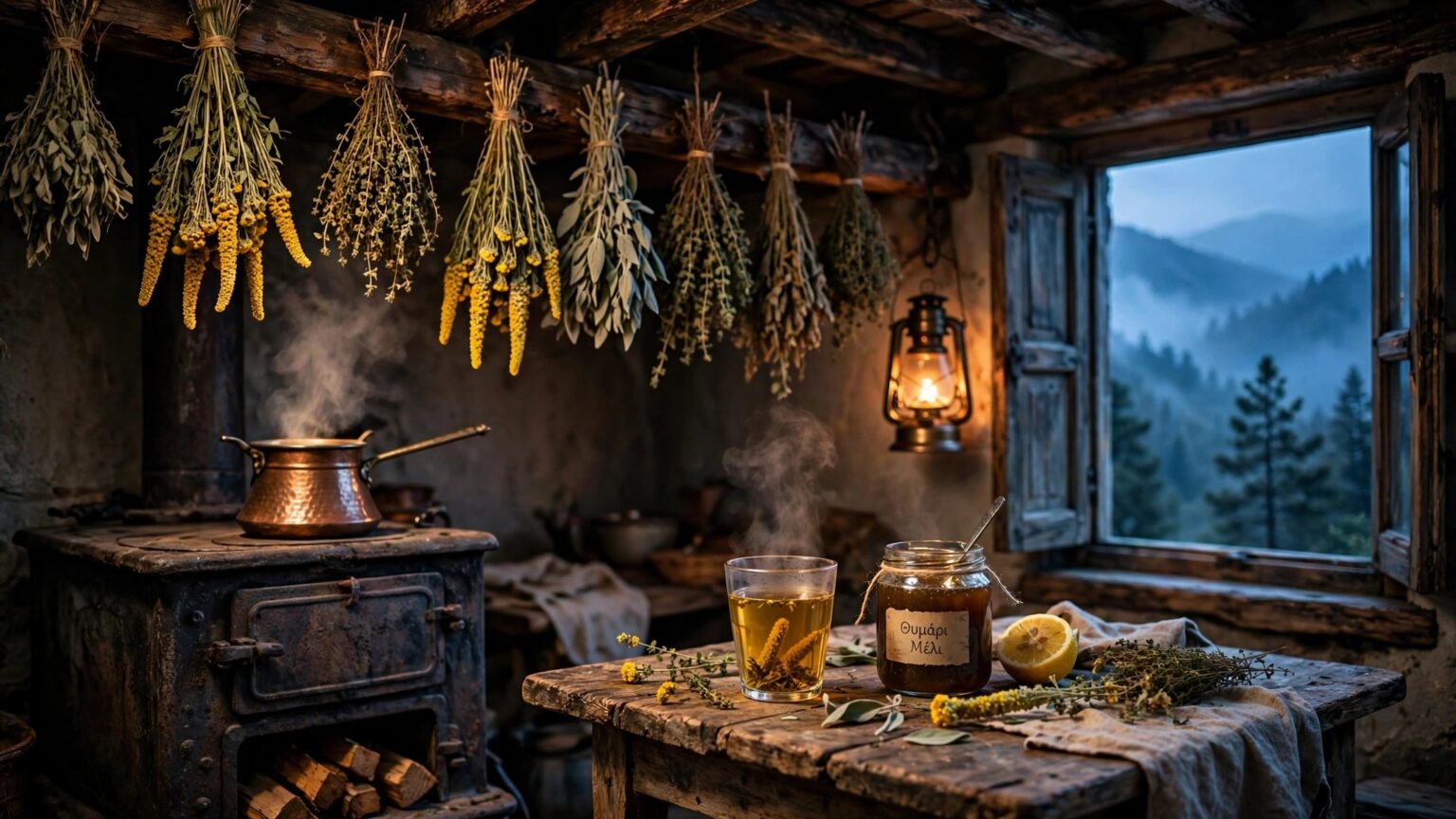
In a Greek mountain village in October, you can tell the season from the kitchen ceiling. Bundles of dried stems hang upside down from the beams, grey-green and gold, tied with string in July and left to rustle all summer in the shade. When the first cold rain comes and somebody in the house starts to cough, a grandmother reaches up, snaps off a handful, and puts a pot on the stove.
Mountain tea, oregano, thyme, sage, and on Crete, dittany. These are the herbs of the Greek autumn cabinet, gathered on the mountains in summer and used through the cold months. Greek writers were describing most of them more than two thousand years ago, and Greek households have never stopped using them.
This is the story of that cabinet, where it came from, what each herb was used for, what modern science can and cannot confirm, and how to keep one yourself. It is not a promise that a cup of tea will protect you from the flu. It is something more interesting, a living pharmacy that has been tested on ordinary families every winter for twenty-five centuries.
Where the Cabinet Began | Theophrastus, Dioscorides and the Hillside
Greek plant medicine has a paper trail. Around 300 BC, Theophrastus, Aristotle’s successor at the Lyceum in Athens, wrote his Enquiry into Plants, the first systematic botany in Europe. Its ninth book deals with the juices and healing powers of plants, and it describes the root-cutters and drug-sellers who climbed the mountains of Greece to gather them, along with the rituals and superstitions some of them followed while digging.
Three and a half centuries later, Dioscorides, a Greek physician from Anazarbus in Asia Minor who may have served with the Roman army, wrote De Materia Medica, a practical guide to about six hundred plants and their uses. It became the most copied medical book in Europe and the Islamic world for more than fifteen hundred years. A famous illustrated copy made in Constantinople around 512 AD for the princess Juliana Anicia, now in Vienna, still shows the herbs painted leaf by leaf, many of them plants that grow on Greek hillsides today.

From the Byzantine monasteries that copied these texts, the knowledge passed into village practice, the territory of the women who knew which plant to pick on which slope and when. The wider story of these plants, their gods and their dangers, is told in Pharmakeia and Aromatic Herbs That Define Greek Cuisine. Here we follow five of them into the autumn kitchen.
Mountain Tea | The Ironwort of the High Slopes
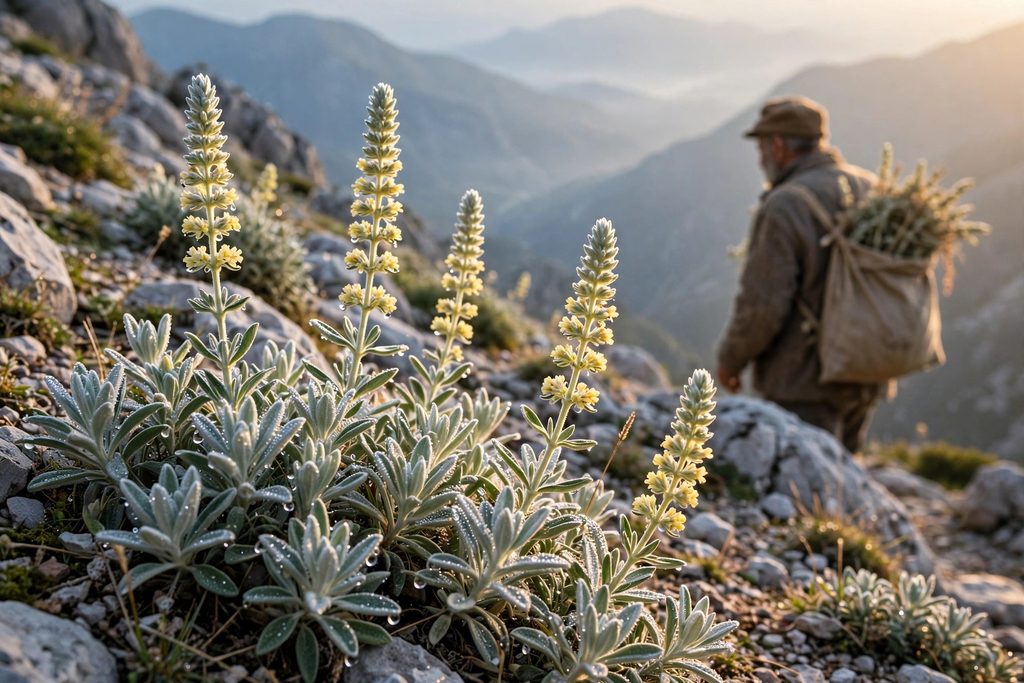
Every Greek knows tsai tou vounou, the mountain tea. Botanists know it as Sideritis, a genus of woolly, silver-leaved plants with spikes of small yellow flowers that grow on bare limestone, often above a thousand metres. The name comes from sideros, iron. Dioscorides describes plants called sideritis as wound herbs, and one ancient explanation held that they healed injuries made by iron weapons.
Greece has several species, and each region swears by its own. Sideritis scardica grows on the mountains of the north and is often sold as Olympus tea, after the mountain of the gods. Sideritis raeseri is the species most widely cultivated today. Sideritis clandestina grows in the Peloponnese, and Crete has its own, Sideritis syriaca, which the islanders call malotira. Shepherds and mountain villagers have drunk all of them for generations, and in many Greek homes a pot of mountain tea is simply what you drink when the weather turns.
Here the village habit has official backing. In 2016 the European Medicines Agency published an EU herbal monograph on Sideritis herba, covering exactly those four Greek species. On the strength of long-standing use, it recognises mountain tea as a traditional herbal medicine for relieving cough associated with a cold and for mild stomach and gut discomfort, for adults. Laboratory studies have also found the plant rich in antioxidant compounds. That is not a cure for anything, but it is rare recognition for a village tea.
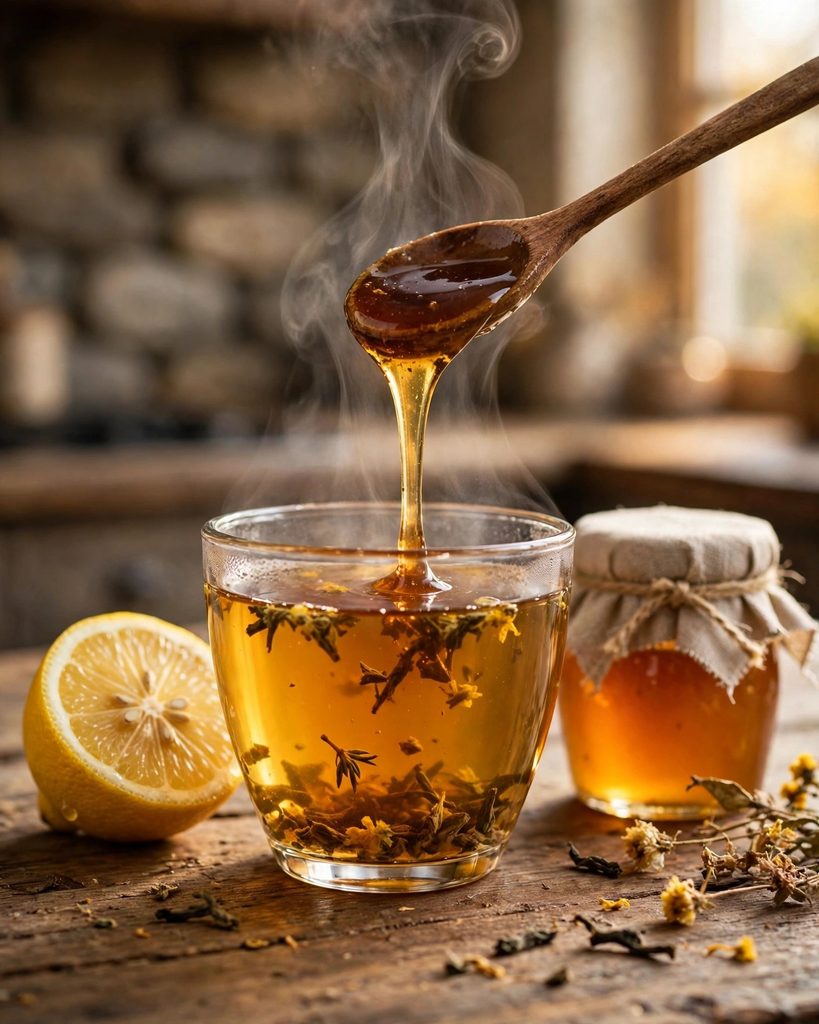
How to brew it. Break two or three dried stems, with their leaves and flowers, into a small pot of water. Most Greek households bring it to the boil and simmer for three to five minutes, then let it stand a few minutes more. Strain, and drink it plain or with a spoon of thyme honey and a slice of lemon. It tastes gentle, slightly floral and earthy, nothing like the bitterness people expect from a medicine.
Oregano | The Brightness of the Mountain
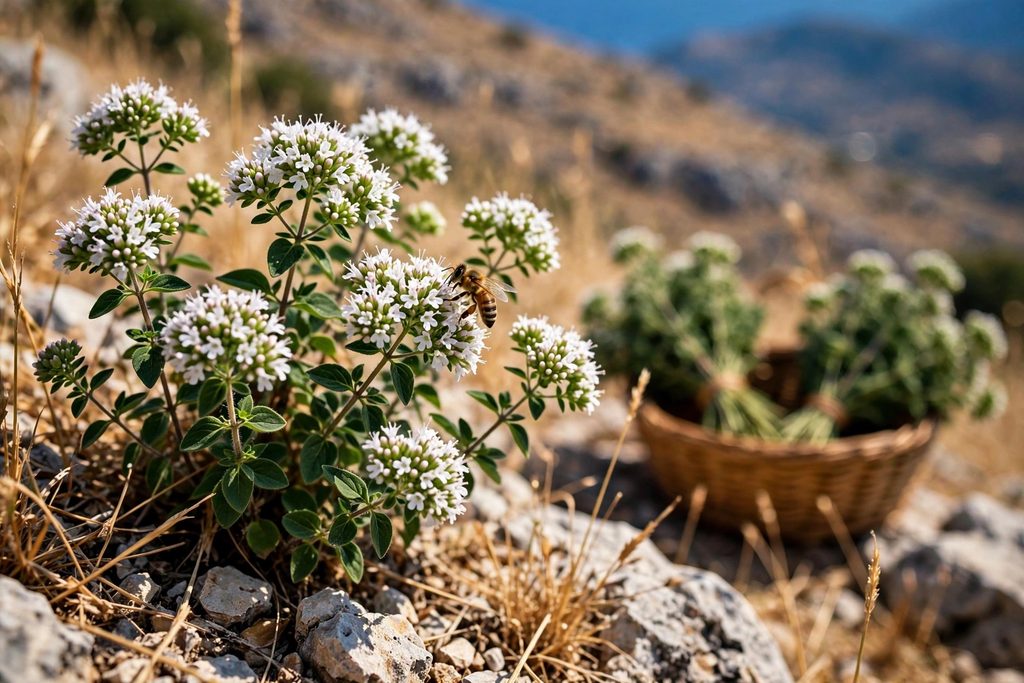
Greek oregano, Origanum vulgare subspecies hirtum, is one of the most pungent oreganos in the world. Its essential oil is unusually rich in carvacrol, the compound that gives the herb its sharp, almost peppery bite. The ancient Greeks heard in the name origanon the words oros, mountain, and ganos, brightness or joy, the joy of the mountain. Linguists treat that etymology with caution, but the image has stuck, and anyone who has smelled a sun-baked hillside of wild oregano in July will understand why.
Dioscorides recommended origanon among other things for coughs and digestion. Modern science is interested above all in its oil. In laboratory studies, oregano oil and carvacrol kill a wide range of bacteria and fungi in the dish, which is why researchers keep investigating them. What has not been shown is that drinking oregano tea prevents or cures infections in people. The honest summary is a strong herb, a promising compound and far more test-tube results than clinical trials.
How to use it. In the autumn kitchen, oregano is used generously in food and occasionally as a strong tea. Pour just-boiled water over a heaped teaspoon of dried Greek oregano, cover and steep for five to ten minutes. The infusion is bitter and warming, best with honey and lemon. Concentrated oregano essential oil is a different thing altogether. It can irritate the mouth and stomach, should never be swallowed undiluted, and is best avoided in pregnancy and by anyone taking blood-thinning medicines unless a doctor agrees.
Thyme | The Herb of Smoke and Honey
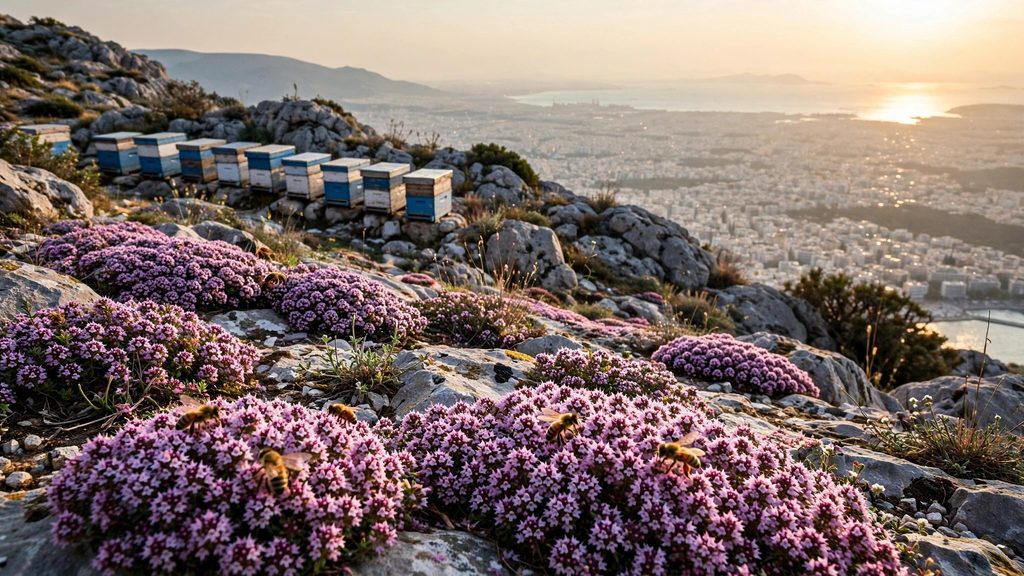
Thyme carries the oldest religious association of the five. Ancient grammarians linked its name, thymon, to thyein, to burn an offering, and the fragrant smoke of thyme rose from Greek altars long before anyone made tea from it. It is also the bee plant of Mount Hymettus, whose honey the ancient world praised above all others, as told in The Melissae and The Pantry of the Gods.
The chemistry took its name from the plant. Thymol, the antiseptic compound that gives thyme its sharp, medicinal smell, was first isolated in the eighteenth century and named after the herb that had carried it all along. Thyme is one of the best-supported herbs in this cabinet. The European Medicines Agency recognises thyme as a traditional herbal medicine used as an expectorant for cough associated with a cold, and a thyme and ivy syrup has been tested with good results against the coughing of acute bronchitis in a German clinical trial.
One popular story needs correcting. Many websites say thyme sprang from the tears of Helen of Troy. The ancient story belongs to a different plant. Pliny the Elder says it was helenium, probably elecampane, that grew where Helen’s tears fell, and the bitter yellow flower of that legend has its own article in Tears of Helen.
How to brew it. Pour just-boiled water over a teaspoon of dried thyme, cover and steep for about eight minutes, so the volatile oils stay in the cup instead of the steam. Strain and add honey and lemon. Many Greek households mix thyme with mountain tea in the same pot.
Sage | Greek Sage and the Apples on Its Branches
The sage of the Greek hillside is not quite the sage of northern gardens. Greek sage, Salvia fruticosa, has soft, grey, often three-lobed leaves and a fresh, camphor-like scent. In antiquity it was elelisphakos, and Dioscorides prescribed it in several forms, including sage boiled in wine, for coughs, wounds and complaints of the kidneys and bladder.
Its modern Greek name, faskomilo, joins the old word sphakos to milo, apple. The apples are real. Small insects provoke round, juicy galls on the stems, and in parts of Greece these little sage apples were picked and eaten, or candied in syrup. Nothing about this plant is quite ordinary.
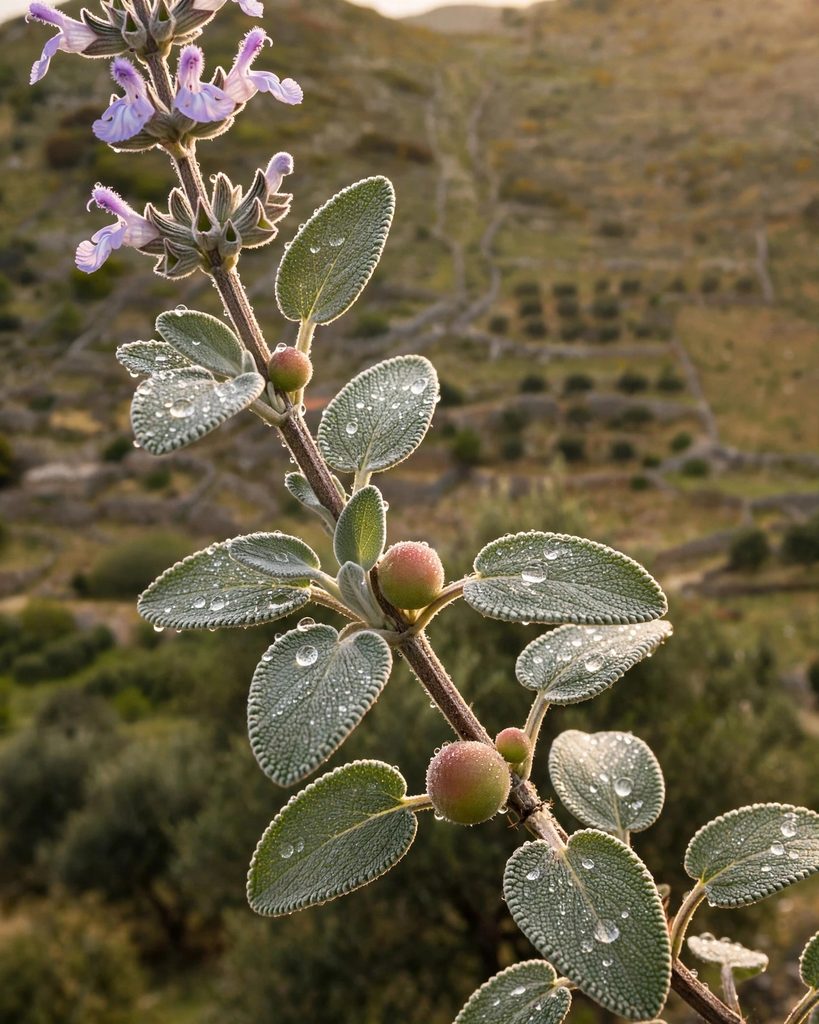
Sage tea is the Greek household’s remedy for a sore throat, drunk warm or used as a gargle, and that use has formal recognition. European herbal assessors list three-lobed sage leaf for inflammations of the mouth and throat and for mild indigestion, alongside the familiar common sage. Small clinical studies with sage extracts have also reported modest improvements in memory and attention, which echoes the old belief that sage sharpened the mind. Those trials are small and the results preliminary, but they are worth knowing.
How to brew it. Steep four or five dried leaves in just-boiled water, covered, for five to ten minutes. For a sore throat, let it cool a little and gargle before drinking. Sage contains thujone, especially the common garden species, so enjoy it in ordinary amounts, avoid strong sage teas for long periods, and skip it during pregnancy and breastfeeding.
Dittany and Malotira | Crete’s Two Mountain Medicines
Crete has a cabinet of its own, and two herbs stand at the top of it. The first is dittany, Origanum dictamnus, a small plant with round, woolly, silver leaves that grows wild only on Crete, clinging to cliffs and gorge walls. Its ancient reputation was extraordinary. Theophrastus and Aristotle both repeat the belief that the wild goats of Crete, when wounded by arrows, ate dittany to drive the arrowheads out of their bodies, and Virgil has Venus bring dittany from Cretan Ida to heal Aeneas. The goats in that story still live in the White Mountains, as told in The Kri-Kri.
Gathering wild dittany meant hanging from ropes on sheer rock, and the men who did it were called erontades, lovers, because only love seemed a good enough reason to take the risk. Today most dittany on the market is cultivated, much of it in villages south of Heraklion, and the wild plant is protected. Cretans drink it as a soothing tea for the stomach and for colds. Its rarer cousins and their protection are explored in Whispers of the Earth.
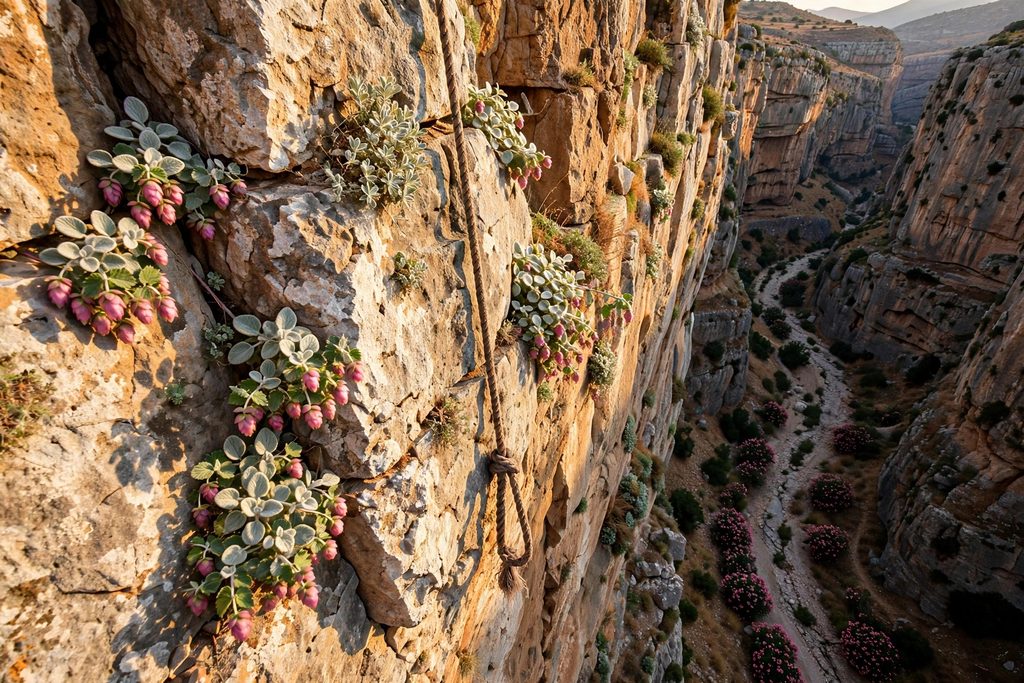
The second is malotira, Sideritis syriaca, the Cretan mountain tea, gathered on the high plateaus and drunk by shepherds through the cold months on the mountain. It is one of the four species named in the European monograph, and on Crete it is less a remedy than a daily drink, offered to visitors in mountain villages the way coffee is offered elsewhere.
Honey | The Medicine That Sweetens the Others
Almost every cup in the Greek autumn cabinet ends with a spoon of honey, and here the science is surprisingly kind. A Cochrane review, the gold standard for summarising medical evidence, concluded in 2018 that honey probably relieves cough in children better than no treatment and about as well as some common cough medicines. Thyme honey from the Greek mountains, dark gold and intensely aromatic, is the classic choice.
One rule matters more than any other in this article. Never give honey to a baby under twelve months old, because of the risk of infant botulism. For everyone else, a spoon of good honey stirred into a warm herbal tea is one of the oldest and safest comforts there is.
The Autumn Cabinet | How a Greek Kitchen Prepares for Winter
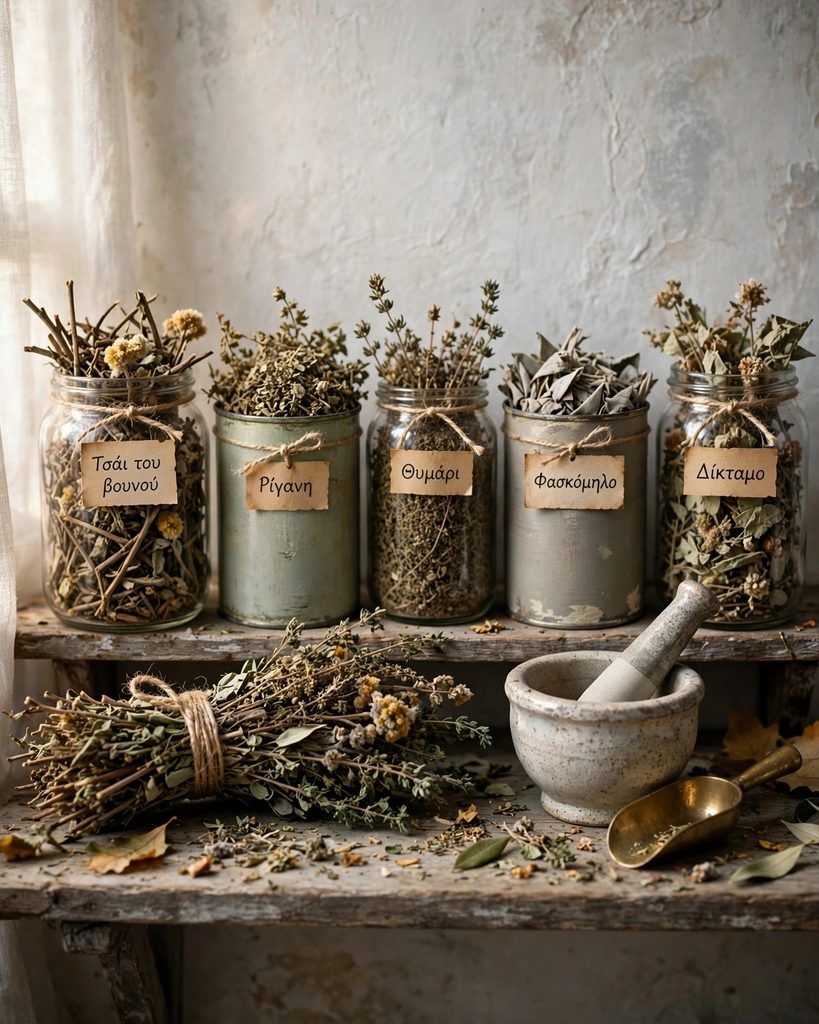
The cabinet is built in summer. Herbs are gathered in June and July when they flower and their aromatic oils are strongest, ideally in the morning after the dew has dried. They are tied in small bunches and hung upside down in a shaded, airy room, out of direct sun, until the stems snap cleanly. Then they go into tins or glass jars, whole, to be crumbled only when used. Old village houses were built for this, with cool storerooms and beams for hanging, as explored in Architecture of the Greek Countryside.
By October the shelf is full. Mountain tea comes out with the first cold evening, thyme and sage when a throat starts to scratch, oregano in the cooking pot every day. The herbs are mixed and varied less by rule than by taste and habit, and every family has its own blend. Wild greens and other healing plants, like the dandelion, join them on the table as the rains bring the hillsides back to life.
The Greek Autumn Herbal Cabinet | A Quick Guide
What Science Can and Cannot Say
It is tempting to say that modern science has proved the grandmothers right. The truth is more interesting and more modest. European regulators recognise mountain tea, thyme and sage as traditional herbal medicines for coughs, sore throats and mild digestive complaints, on the basis of long, safe use rather than large clinical trials. Laboratory research confirms that these plants contain active compounds, from carvacrol and thymol to antioxidants. Honey has good evidence for easing cough. None of these herbs has been shown to prevent flu or other serious infections.
So treat the autumn cabinet for what it is, a source of comfort, warmth and gentle relief for everyday colds, and a link to plant knowledge that Greek families have passed down without a break for more than two thousand years. See a doctor for a fever that does not settle, a cough that lasts more than a week or breathing that gets harder, and check with a pharmacist before using herbs alongside prescription medicines, in pregnancy or for young children. On Ikaria, where herbal teas are part of the daily routine of some of the longest-lived people in Europe, nobody treats them as a miracle either. They simply drink them, every day, as part of a whole way of living.
The Mountain Still Grows Them
Theophrastus described the root-cutters climbing the slopes. Dioscorides wrote down what they found. Byzantine monks copied his pages and painted the leaves. Shepherds on Crete and in the Pindus drank mountain tea through the cold nights, and grandmothers hung the summer’s harvest from the beams.
The herbs are still there, on the same limestone, flowering in the same July heat. This autumn, buy a bundle of mountain tea, a jar of thyme honey and a little dried sage. Put a pot on the stove when the first cold evening comes. You will be doing what Greek households have done every winter for two thousand years.
At Olympus Estate, Wellness and Renewal looks for the Greek ideas about health that still hold up today. The autumn pharmacy runs from Theophrastus’s Enquiry into Plants and Dioscorides’s De Materia Medica, copied in the painted Vienna manuscript of around 512 AD, to the herbs that hang from Greek kitchen beams today. Mountain tea, the ironwort Sideritis of the high limestone, now carries an EU herbal monograph for coughs with colds and mild stomach complaints. Greek oregano is rich in carvacrol, thyme gave its name to thymol and is recognised as a traditional expectorant, and Greek sage, with its edible apples, soothes sore throats. Crete adds dittany, the cliff herb of the wounded goats, and malotira, the shepherds’ tea. Honey ties the cabinet together and has real evidence for easing coughs, never for babies under one. None of it is a cure for serious illness, but together these plants form one of the longest unbroken traditions of plant knowledge in Europe.