

The wind in the White Mountains carries the sharpness of sun-baked limestone and crushed mountain tea, moving through a vertical landscape where the earth seems to have been forced upward rather than laid down. Within these folds of stone, a shadow moves with a surefootedness that has nothing to do with luck. This is the agrimi, the wild one, known outside Crete as the Kri-Kri goat. Watching it navigate a cliff face is watching a piece of Minoan iconography still in motion three and a half thousand years later. The Kri-Kri is not simply Cretan wildlife. It is a living continuity, present through every regime that has tried and failed to fully claim these peaks.
The Kri-Kri occupies the terrain where human footprints give out into scree, and its persistence there is not incidental. The goat marks the point where the human and the wild in Crete have always met and separated again: a survival that is both biological and symbolic, one that has outlasted the Bronze Age collapse, the Venetian occupation, and the punishing winters of the high mountains. Its continued presence in the Samaria Gorge is a reminder that some parts of this island were never meant to be fully reachable.
The Ancestral Hoofbeats of the Aegean
Capra aegagrus cretica traces to the deep migrations of the Neolithic. Roughly eight thousand years ago, the first seafaring farmers brought goats to Crete from the Near East, animals descended from the same early domesticated stock that produced goats across the eastern Mediterranean. These were lean, watchful creatures rather than the heavy-set livestock familiar today, and once they reached Crete’s shores they did something their mainland relatives did not: they returned to the wild, climbing into the Lefka Ori and choosing the mountain over the pen.
In the palaces of Knossos and Phaistos, Minoan artists rendered the Kri-Kri as an emblem of vitality. It appears on seals and pottery, horns swept back like the sails of a ship, the body caught mid-leap. For the Minoans, the goat was more than a source of meat: it was an inhabitant of the sacred heights, associated with the goddess of the mountains, a living bridge between the cultivated valley below and the divine peak above. The animal represented the untamed half of a civilization otherwise organized around cultivation and balance.

Archaeological finds suggest the agrimi held a central place in ritual life: its horns turn up in religious contexts and, in some interpretations, as material for composite bows built by hunters who understood the speed of what they were pursuing. The continuity is genuinely striking. The same animal that a Minoan hunter once tracked now looks down on a hiker in the Samaria Gorge, still seeking the highest ledge at midday, still moving without sound. It is one of the rare cases of a living antiquity that has never needed a museum case.
The Vertical Architecture of Survival

Understanding the Kri-Kri means understanding the physics of the cliff face it lives on. Its split, leather-padded hooves grip smooth limestone with a precision that borders on adhesion, and the animal shows no apparent fear of the drop beneath it: a Kri-Kri can stand on a ledge no wider than a human palm and look down a thousand meters without hesitation. This surefootedness is its primary defense. Where most animals flee a threat horizontally, the Kri-Kri runs upward.
Its coat, the color of dry earth and sun-bleached scrub, functions as camouflage against the terrain it inhabits. In summer, males develop a dark stripe across the shoulders and a beard that gives them an unmistakably senior bearing among the herd. The horns are the most striking feature: great scimitar curves that can approach a meter in length, functioning simultaneously as tools of hierarchy and instruments of defense within a social order as rigid as the rock the animals stand on.

In high summer, the goats retreat to the summits, where the air is thinner and cooler, and survive on mountain herbs that would poison less adapted animals: the prickly shrubs and aromatic greens characteristic of the Cretan highlands. Find a place where they have bedded down and the air still carries the scent of musk and wild oregano. In a real sense, they are the land itself given a pulse.
The Sanctuary of the Iron Gates
The twentieth century nearly ended the agrimi. During the Second World War, the mountains became a refuge for resistance fighters, and the goats became their primary source of meat during years when hunger was constant. Their numbers collapsed. By the early 1960s, fewer than two hundred remained, and extinction looked less like a risk than an approaching certainty.
The establishment of the Samaria National Park in 1962 changed that trajectory. It was an act of cultural reclamation as much as ecological policy: the decision that an island without the agrimi would have lost something of itself. The gorge, sixteen kilometers long and closed at its narrowest point by the cliffs known as the Iron Gates, became the animal’s last stronghold. The strategy worked. The population recovered, protected by the sheer verticality of the canyon walls that had always been the species’ natural defense.

Today the gorge holds UNESCO Biosphere Reserve status, and the law protects it accordingly. The protection remains fragile, though, and the greatest present threat is not the rifle but the domestic goat. Hybridization threatens to dilute the Kri-Kri’s genetic line: if the wild population interbreeds freely with the farm goats that range the foothills, the traits that define the agrimi, its size, its speed, its instinct for the high cliffs, could be lost within a few generations. Conservationists work continuously to keep the wild bloodline distinct.
Living Rhythms of the Samaria Gorge
For the traveler, an encounter with a Kri-Kri is never guaranteed. It rewards the person willing to stay still. Most hikers move through the gorge watching their footing rather than the ridgelines above, and miss the movement entirely. The goats are practiced at invisibility: they stand motionless against a rock face and watch the human procession pass with a detached, appraising intelligence. They do not beg. They do not seek attention. They simply continue existing in a parallel register of stone and sky.
In the abandoned village of Samaria, roughly halfway through the trek, a handful of goats have grown accustomed to people passing through. They linger near the old stone houses, hooves clicking against threshing floors abandoned decades ago. Look closely and there is a genuine depth in their amber eyes, something that reads less like curiosity than appraisal: you are not being observed as a tourist but as a temporary visitor in a territory that has belonged to them for eight thousand years.

The village itself belongs to a different era now, but for the agrimi it is simply more terrain. They climb the crumbling walls and rest in doorways where families once lived, the transition from human settlement back to wild ground now essentially complete. It is a clear illustration of how thoroughly the Cretan landscape absorbs the work of previous generations and returns it to the mountain.
The Spirit of the Fouriariko
In the local dialect of the mountain villages, people call the Kri-Kri fouriariko, a word that resists direct translation. It carries the sense of something swift, something that belongs to open air, something that cannot be caught, and it functions less as description than as a term of respect. Cretans have long recognized something of themselves in the goat: both share a history of fierce independence, and both have survived by retreating into the mountains whenever the world below became too dangerous to remain in.
The connection surfaces in the island’s music and poetry as well. In the mantinades, the rhyming couplets of Crete, the agrimi often stands in as a metaphor for a lover who is difficult to reach, or for a spirit that refuses to be broken. To lose the goat would mean losing a fragment of the Cretan language itself: it is a living vocabulary of freedom.

The preservation of the Kri-Kri is therefore a cultural obligation as much as a conservation one. It is not only about biodiversity. It is about keeping intact a piece of the Cretan imagination: as long as the agrimi still leaps across the gorge, the Minoan images of it remain more than art history, and the old associations with Pan and the mountain goddesses stay tethered to something still living rather than becoming purely literary.
Islets of the Silent Sentinels
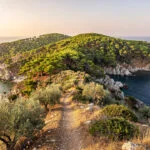
The Samaria Gorge is the best-known habitat, but the Kri-Kri also survives on a handful of uninhabited islets off Crete’s coast, among them Dia and Thodorou. These islands function as genetic reservoirs: isolated from the domestic herds of the mainland, the goats there live entirely apart, drawing water from hidden springs and feeding on the hardy scrub that tolerates the salt air. Their isolation is precisely what makes them valuable, a safeguard against any catastrophe that might strike the main island’s population.

Visiting these islets is a different experience altogether: no trails, no crowds, only the sound of the sea and the occasional rattle of a stone dislodged by a goat crossing a ridge. On Thodorou, the goats share the terrain with ancient ruins and rare birds, and everything that survives there has had to adapt to genuinely exposed conditions. The goats here are warier still, their instincts sharpened by the solitude around them.
These islands mark the outer edge of where Cretan wildlife persists with almost no human interference. A male Kri-Kri silhouetted against the Aegean is one of the more striking sights available anywhere on the island: proof that some corners of this world still function without needing us to manage them.
Continuity in the High Peaks
The story of the Kri-Kri is a story about resilience, running from the holds of Neolithic ships to the frescoes of Bronze Age palaces, through the deprivations of war, and into the modern era of conservation policy. It is a cycle of near-loss and recovery rather than a straight line, and the goat has become, in the process, a genuine emblem of the rugged character of the island.
The animal’s future remains tied to human restraint. Its survival depends on people leaving the high places largely alone and respecting a vertical world that was never built for us. The Kri-Kri asks for very little: the quiet of the cliffs and the integrity of the mountain air. In exchange, it offers something increasingly rare, a direct, unbroken connection to a version of Crete that predates every civilization that has since claimed the island.
The next time you find yourself on a trail in Crete, stop and look up toward the ridgeline. Most of the time you will see only stone and heat. But wait long enough, in enough silence, and you may see a shadow move, or hear the faint clatter of a dislodged pebble falling into the gorge below. In that moment, you will know the wild character of this island is still there, watching from somewhere just out of reach.

The mountain belongs to whatever can climb it without a path. The agrimi remains its true owner, a presence in the limestone that reminds the visitor how much of this island’s oldest character has survived intact. As long as the White Mountains stand, the wild goat will remain: a living bridge between the ancient character of Crete and whatever comes after it.
At Olympus Estate, Wanderlust Greece guides you across the sacred and storied terrain of the Hellenic world. The Kri-Kri goat arrived on Neolithic ships eight thousand years ago and climbed into the Lefka Ori, choosing the mountain over the shepherd’s crook. Minoan artists painted them on seals and pottery, horns swept back like the sails of a ship, bodies caught mid-leap. By the early 1960s fewer than two hundred remained. The establishment of the Samaria National Park in 1962 was an act of cultural reclamation as much as ecological conservation. Fouriariko: something swift, something that belongs to the open air, something that cannot be caught. In the mantinades, the agrimi is a frequent metaphor for a lover who is hard to reach or a spirit that refuses to be broken. The goat is the tether that keeps the present connected to the deep time of the Aegean. As long as the White Mountains stand, the wild goat will remain.