




Santorini is not an island that happens to have a volcanic history.
Santorini is the volcano, and the island is what the volcano left behind.
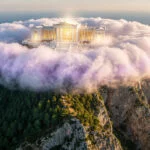
The visual character that makes Santorini the most immediately recognizable island in the Aegean, the curved caldera walls rising from the sea, the cliff-face villages perched at the rim’s edge, the depth and color of the caldera’s enclosed water, the multi-colored beaches whose black and red and white correspond to different geological periods and different mineral compositions of the volcanic deposit, is entirely the product of what happened approximately 3,600 years ago when the volcano underwent one of the most significant eruptions in human history.
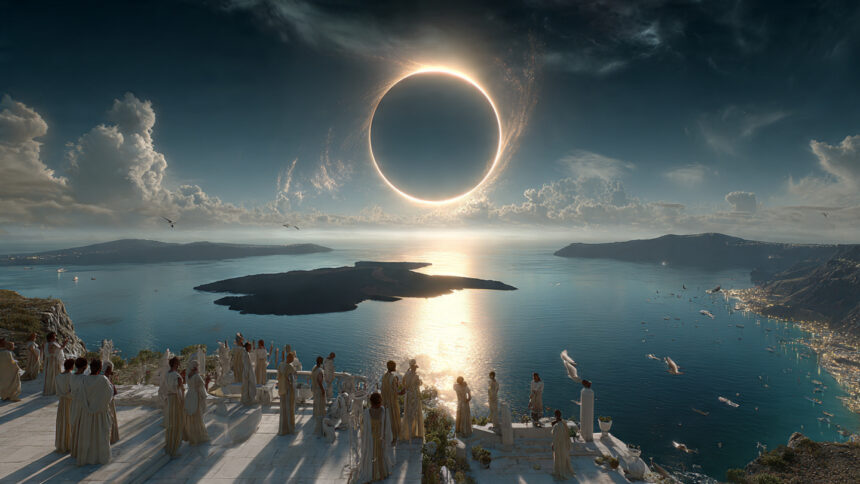
Before the eruption, the island was roughly circular: a volcanic cone rising from the Aegean in the configuration that the two surviving fragments, the main island of Thera and the smaller island of Therasia to the northwest, preserve the outline of. The eruption collapsed the center of the island into the emptied magma chamber below, and the sea rushed into the resulting caldera. What the visitor sees from the caldera rim when they look down at the enclosed water and across at the opposite caldera wall is looking at the interior of the collapsed volcanic cone: the water is where the magma was, the caldera walls are the inner faces of what was once a mountain, and the two small volcanic islands at the caldera’s center, Palea Kammeni and Nea Kammeni, are the cones that have been building from the caldera floor through subsequent eruptions since the original collapse.
The mythology of Santorini is the mythology that this landscape generated in the imagination of the people who encountered it. To understand the myths, it is necessary to understand the geology. To understand the geology, it is necessary to stand on the caldera rim at the moment when the sun drops behind the western sea and the quality of the caldera’s light becomes what it becomes in that moment, which is the light that has generated the mythology.
The Geological Record and Its Scale
The Thera eruption is classified as a Plinian eruption, the category of volcanic event characterized by the sustained discharge of a high-energy column of ash and gas that can reach the stratosphere and disperse volcanic material across continental distances.
The scale of the Thera eruption remains a subject of ongoing research, with estimates of its volcanic explosivity index ranging from VEI 6 to VEI 7 on the scale that measures eruptions by their total volume of ejected material. At VEI 7, the Thera eruption would have been comparable in scale to the Tambora eruption of 1815, whose atmospheric effects reduced global temperatures sufficiently to produce the Year Without a Summer across the northern hemisphere. The climatic consequences of the Thera eruption and their potential role in the disruption of the Bronze Age Mediterranean civilizations, particularly the Minoan civilization of Crete whose palace-based economy depended on the agricultural surpluses that a stable climate produced, have been the subject of sustained scholarly investigation.
The dating of the eruption has been one of the most contested questions in Bronze Age Mediterranean archaeology: the traditional archaeological dating, based on the ceramic evidence from the Akrotiri site and from Egyptian records, placed the eruption around 1500 BCE, while the radiocarbon dating of organic material from the volcanic deposit consistently produces dates approximately one to two centuries earlier, in the range of 1600 to 1650 BCE. The discrepancy between the two dating methods has not been resolved and remains one of the more interesting open questions in the archaeology of the ancient Mediterranean.
The tsunami that the caldera collapse and the explosive eruption generated would have been one of the largest in the Mediterranean’s recorded history: the combination of the caldera’s sudden formation, which displaced an enormous volume of water, and the explosive eruption’s atmospheric shock wave would have produced wave trains of significant height moving across the Aegean in all directions. The consequences for the Cretan coast, which faces the Aegean across approximately 120 kilometers of open water from the Thera caldera, would have been severe, and the relationship between the tsunami and the simultaneous abandonment of the Minoan palace centers that the archaeological record documents around 1450 BCE has been the subject of continuing scholarly investigation without definitive resolution.
Akrotiri | The City the Eruption Preserved
The site of Akrotiri, on the southwestern coast of Santorini near the caldera rim, is the archaeological encounter with the Thera eruption’s most directly human dimension: the Bronze Age city whose population evacuated before the eruption and whose buildings were subsequently buried under the volcanic deposit in the condition they were in at the moment of the evacuation.
The absence of human remains from the site is the most significant single fact about Akrotiri: the population left. The abandonment was not sudden death but organized departure, which means the people of Akrotiri had warning of what was coming, sufficient warning to take their portable valuables and their animals and go, and they went. Where they went is not known: no Akrotiri refugee population has been identified in the archaeological record of the surrounding islands or the Cretan mainland, and the fate of the city’s approximately 30,000 to 40,000 inhabitants is one of the Bronze Age Aegean’s most complete mysteries.
What they left behind was a city in the condition of having been recently evacuated rather than suddenly destroyed: the buildings were intact, the domestic pottery and the furniture were in their normal positions, and the frescoes on the walls were in the condition they were in when the owners last saw them. The volcanic deposit that subsequently covered the city preserved it in this condition for approximately 3,500 years until Spyridon Marinatos began excavating the site in 1967.
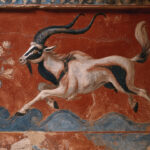
The frescoes of Akrotiri are the most visually immediate encounter with the Bronze Age Aegean civilization that any archaeological site in the Aegean provides: the Spring Fresco with its swallows and lilies, the Flotilla Fresco with its fleet of Minoan-influenced vessels sailing between coastal settlements, the Boxing Children Fresco, and the Fisherman Frescoes with their abundant catches are windows into the daily and ceremonial life of a community that was sophisticated, prosperous, and deeply engaged with the natural world that surrounded it.

The site is not Minoan in the strict sense that Knossos is Minoan: it represents the Cycladic culture of Thera, which was heavily influenced by and in close contact with Minoan Crete without being a Minoan colony. The description of Akrotiri as the Minoan Pompeii is the comparison that is most frequently made and that most usefully conveys the preservation quality of the site: the volcanic burial that preserved the city in its everyday condition is directly comparable to Vesuvius’s burial of Pompeii in 79 CE. The Pompeii comparison should not be stretched to include the suggestion that Akrotiri was a Minoan city in the way that Pompeii was a Roman city: the culture of Akrotiri was the culture of the Cycladic Bronze Age in its most developed form, shaped by but not identical to the Minoan culture of Crete.
The protective canopy over the excavated site was completed in 2012 and covers approximately 7,000 square meters of the excavated city, allowing visitors to walk through the excavated streets on elevated walkways above the original ground level and to see the buildings in their excavated condition. The original frescoes are in the Museum of Prehistoric Thera in Fira: the site visit should be followed by the museum visit rather than substituted for it, because the frescoes in the museum are the original objects and the site visit is the encounter with the architectural context that the frescoes inhabited.
The Mythology of the Island’s Origin
The founding mythology of Santorini was the myth of Kalliste, the most beautiful, the name that the ancient tradition gave the island before it acquired the Latinized Venetian name Santorini, derived from Santa Irini, Saint Irene.
The Argonautica of Apollonius of Rhodes, the third century BCE epic of the Argonaut expedition, preserves the founding myth of Thera in one of its most complete ancient forms: the Argonaut Euphemos, a son of Poseidon, received a clod of earth from the Libyan god Triton during the Argonauts’ passage through the Mediterranean, and was instructed in a dream to throw it into the sea. He threw it into the Aegean, and from it grew the island of Kalliste, which the Argonaut tradition preserved as the ancestral homeland of the founders of Thera. The colonization narrative embedded in this myth is the myth of Thera’s Dorian Greek foundation, which the ancient tradition placed in the eleventh or tenth century BCE and which the archaeological record of the island confirms as the establishment of the Dorian Greek community that built the ancient city of Thera on the island’s southeastern ridge.

Poseidon’s association with Thera, which the Argonautica myth encodes through the divine parentage of Euphemos and the Triton clod-of-earth tradition, reflects the ancient world’s consistent association of the god of the sea with the seismic and volcanic forces that the Greeks understood as manifestations of the same divine power: Poseidon was the Earthshaker, the god whose activity beneath the earth produced the earthquakes and volcanic eruptions that the ancient world could not otherwise explain, and the island that had been produced by the most dramatic volcanic eruption in the human memory of the Aegean was the island that belonged most naturally to his domain.
The myth that the gods produced the island from the sea is the mythological encoding of the geological reality: the island was produced from beneath the sea by volcanic activity, and the Aegean observer who encountered the island’s dramatic caldera landscape would have required a story about divine creation to account for what they were seeing. The myth provided the story. The geology provided the thing.
The Atlantis Hypothesis and Its Problems
The identification of Santorini’s Thera eruption with Plato’s account of Atlantis is the theory that has attracted more popular attention than any other single claim about Santorini’s mythological significance, and it is a theory that deserves honest engagement rather than either enthusiastic endorsement or dismissive rejection.
Plato’s Atlantis narrative appears in two dialogues, the Timaeus and the Critias, both composed in approximately 360 BCE. In the Timaeus, the Egyptian priest Sonchis tells Solon that a great island civilization beyond the Pillars of Heracles, the Strait of Gibraltar, was destroyed nine thousand years before Solon’s time in a single catastrophic day and night. The civilization was called Atlantis, it was the dominant naval power of the ancient world, and its destruction involved both military defeat by an early Athens and subsequent submersion beneath the sea.
The geographical placement, beyond the Pillars of Heracles in the Atlantic Ocean, is the first and most serious problem with the Thera identification: Santorini is in the Aegean, not in the Atlantic, and the ancient world’s geographical knowledge was sufficient to distinguish the two. The nine-thousand-year timeframe, which would place the Atlantis catastrophe at approximately 9600 BCE, is the second problem: there is no archaeological evidence for a complex urban civilization anywhere in the world at this date, and the Thera eruption at approximately 1600 BCE is nine thousand years too recent. The military dimension of the Atlantis story, the conquest of the Mediterranean world and the defeat by a proto-Athenian military force, has no correspondence in the Akrotiri archaeological record.
The most probable scholarly reading of the Atlantis narrative is the reading that most classical scholars have consistently maintained: the Timaeus and Critias Atlantis is a Platonic philosophical construction, a thought experiment about the nature of an ideal military and imperial power and its inevitable defeat by the virtuous city, not a historical account of a real civilization. Plato was writing philosophy using historical and geographical elements as the material of the construction, as he does in other dialogues, and the detail of Atlantis’s location beyond the Pillars of Heracles places it beyond the range of any information that the Greek world of Plato’s time could have verified or contradicted.
The elements of correspondence between the Akrotiri culture and Plato’s description, the advanced architecture, the sophisticated infrastructure, the island civilization with significant maritime reach, are elements that correspond to most prosperous Bronze Age Aegean civilizations rather than specifically to Akrotiri, and the correspondence is insufficient to distinguish Akrotiri from Minoan Crete, from Mycenaean Greece, or from the Bronze Age palace cultures of Anatolia as the real-world referent of the Platonic construction.

What can be said honestly is this: the Thera eruption was a catastrophic event of sufficient scale to have influenced the cultural memory of the Bronze Age Mediterranean world, and the possibility that the memory of that catastrophe reached the Egyptian priestly tradition that Plato’s Solon consulted is not impossible. The Atlantis narrative that Plato constructed from whatever material he was working with bears some general resemblance to what is known of the Thera eruption and the Akrotiri culture. The identification of Santorini as Atlantis is a hypothesis that the ancient evidence does not support and that the classical scholarship has generally declined to endorse.
The mystery is real. The theory is interesting. The evidence does not confirm it.
Hephaestus and the Forge Beneath the Sea
The mythology that the ancient Greek tradition developed for the volcanic phenomena of the Aegean was the mythology of Hephaestus, the divine blacksmith whose forge was located beneath the earth in the volcanic sites of the Aegean and the Mediterranean.
Hephaestus was the Olympian whose domain was fire in its most controlled and most creative form: the fire of the forge that transformed raw metal into the divine weapons and the divine objects that the Olympian order required. Zeus’s thunderbolts, Achilles‘ armor, the net that trapped Ares and Aphrodite, Pandora herself: all of these were Hephaestean creations, produced in the forge beneath the earth whose activity produced the volcanic phenomena that the ancient world observed and encoded as the sound and heat of divine manufacturing.

The association of Lemnos in the northern Aegean with Hephaestus as the forge island most directly linked to his cult is the tradition that the island’s genuine volcanic character, its hot springs and its sulfurous emissions, supported in the ancient world’s experience. But the volcanic character of the entire Aegean arc, of which Santorini is the most dramatically expressed example, was the broader landscape of the Hephaestean mythology: the submarine eruptions and the volcanic islands and the hot springs and the sulfur vents that the Aegean arc produces along the geological boundary between the African and Eurasian tectonic plates were all, in the ancient understanding, evidence of the forge’s activity beneath the earth.
The Santorini experience of descending into the caldera by boat to the hot springs of Palea Kammeni, where the iron-rich water discolors the sea around the volcanic vents and the sulfur smell of the submarine activity is present in the air, is the experience that the ancient world would have read as the most direct available encounter with the divine forge’s heat and exhaust. The visitor who bathes in the hot springs today is bathing in the product of the same geological activity that the Hephaestus mythology was encoding, and the steam and the sulfur and the warmth of the water are the same steam and sulfur and warmth that the ancient world smelled and felt in the same place.
The Wine of the Volcanic Soil
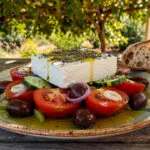
The Assyrtiko grape, which the volcanic soil of Santorini produces in conditions that no other wine region in the Aegean can replicate, is the living agricultural legacy of the same geological event that destroyed the Bronze Age city of Akrotiri and generated the mythological traditions that the island carries.
The Santorini volcanic soil is primarily pumice and volcanic ash from the Thera eruption and its subsequent volcanic activity, with a mineral composition that is low in organic matter but rich in the trace elements that the volcanic deposit contributes. The Assyrtiko vine, whose training in the basket form called kouloura protects the grape clusters from the island’s strong summer winds while concentrating the vine’s moisture in the root system that penetrates deep into the pumice below, produces a grape with a combination of high acidity, high sugar content, and the mineral character that the volcanic soil’s contribution gives to any plant that grows in it.
The wine that results is the most distinctive white wine of the Aegean: the acidity that makes Assyrtiko age well, the minerality that the pumice soil contributes, and the aromatic profile that the Santorini growing conditions produce give the wine a character that the Assyrtiko planted elsewhere in Greece approximates but does not replicate. The island’s wine production is limited by the conditions that produce it: the volcanic soil, the wind, the absence of phylloxera, which has never reached the island because the volcanic soil prevents the root louse’s survival, and the kouloura training that the local winemaking tradition developed for these conditions.

The major Santorini wineries, Santo Wines above the caldera at Pyrgos, Venetsanos on the caldera’s edge, and the smaller family operations distributed across the island’s agricultural interior, offer the visitor the encounter with the volcanic viticulture that the wine’s character derives from. The wine tasted on the island, particularly the Nykteri style that is harvested at night to preserve the grape’s acidity in the summer heat and aged in oak to develop complexity, is the wine in its most complete expression, before the voyage that export imposes on it.
The Caldera Experience
The caldera of Santorini is the geological feature that organizes the visitor’s experience of the island’s landscape, and the ways of encountering it, on foot along the rim from Fira to Oia, from the water by boat to the volcanic islets at the center, and from the cliff-face villages whose position on the caldera’s edge gives the view that has made Santorini globally recognizable, are three different encounters with the same geological feature.
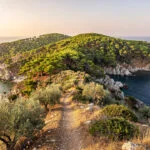
The Fira to Oia path along the caldera rim, approximately 10 kilometers of walking on a combination of paved path and rough volcanic rock, is the encounter with the caldera at the scale of human movement: the walk takes approximately three to four hours without stopping, passes through the villages of Firostefani and Imerovigli above Fira, and reaches Oia through the sequence of views that the caldera’s curved shape produces as the walker moves along its edge. The quality of this walk in the early morning, before the midday heat and before the tourist density of the path builds, is the quality that the photographs of the caldera rim are attempting to capture: the combination of the whitewashed architecture and the caldera’s geological drama and the Aegean light in the morning hours.
The boat excursion to Nea Kammeni and Palea Kammeni is the encounter with the caldera from the water, which is the encounter that gives the caldera’s scale its most legible form: the caldera walls visible from the water are the inner faces of the collapsed volcanic cone, and the height of those walls, approximately 300 meters above the water in the highest sections near Oia, is the measure of the depth of the magma chamber whose collapse created the caldera. Standing on the deck of the excursion boat at the caldera’s center and looking up at the rim where Fira and Oia are visible as white settlements at the cliff edge is the single most concentrated available encounter with the geological event that made the island what it is.
The sunset from the Oia castle, the northwestern point of the island that faces directly into the setting sun over the open Aegean, is the Santorini experience that the island’s global reputation is primarily organized around, and the reputation is accurate: the combination of the setting sun’s light on the caldera walls, the reflected light on the caldera water, and the quality of the Aegean air at this latitude in the summer months produces a visual effect that is genuine and not overstated in the accounts that have made it globally famous. The crowd that assembles at the castle for the sunset is large in July and August, and the visitor who wants the experience without the density should seek the caldera rim south of Fira where the same light falls on the same walls without the Oia concentration.
At Olympus Estate, Wanderlust Greece guides you across the sacred and storied terrain of the Hellenic world. Santorini is not an island that happens to be volcanic. The volcano is the island, and the myths are what the volcano generated in the imagination of every civilization that encountered it. The caldera is the emptied magma chamber. The walls are the inside of the collapsed cone. The water is where the mountain was. Stand on the rim at the moment when the sun drops behind the western sea. The light that follows is the light that generated the mythology. It still does.