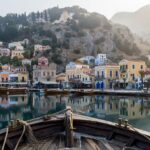
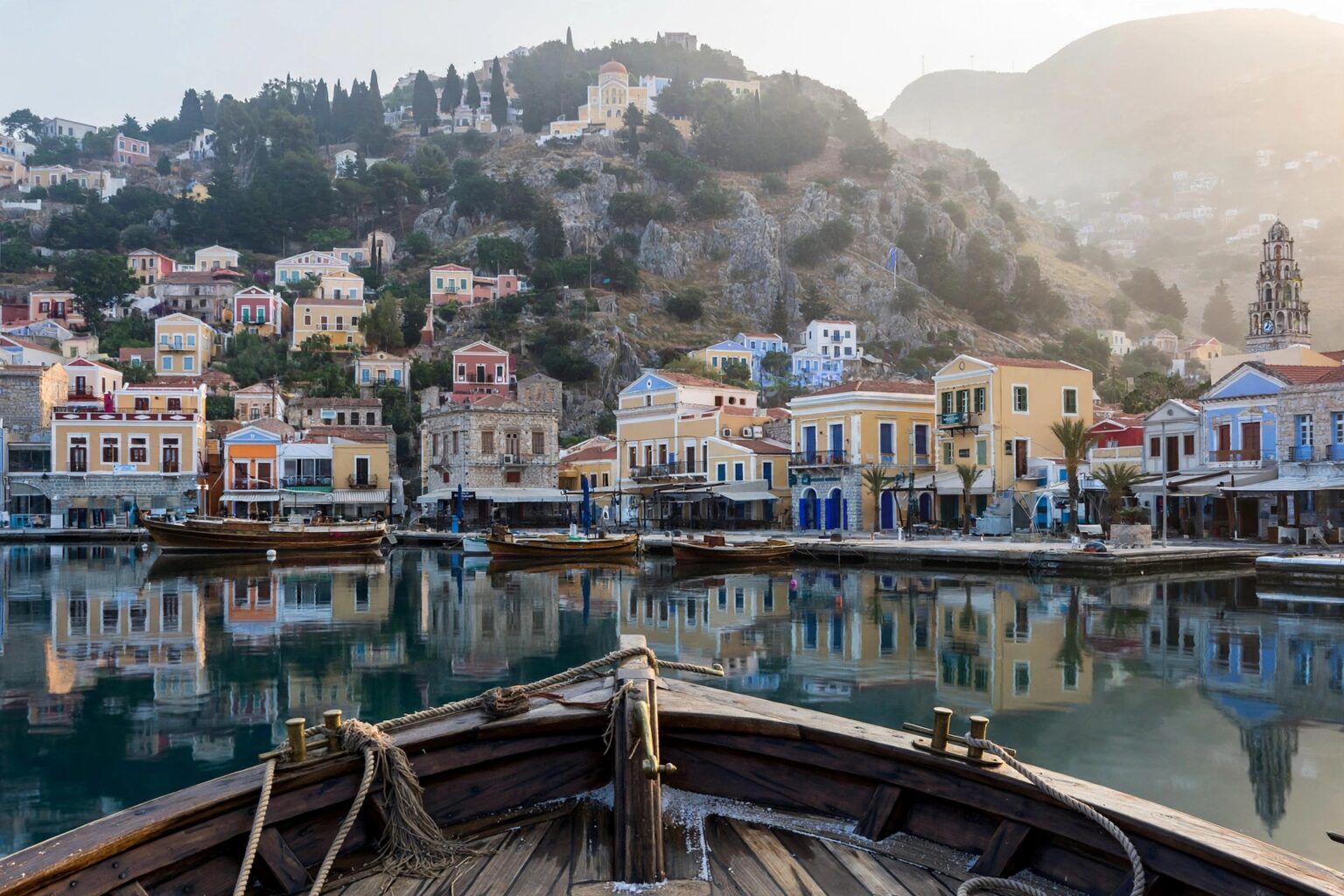
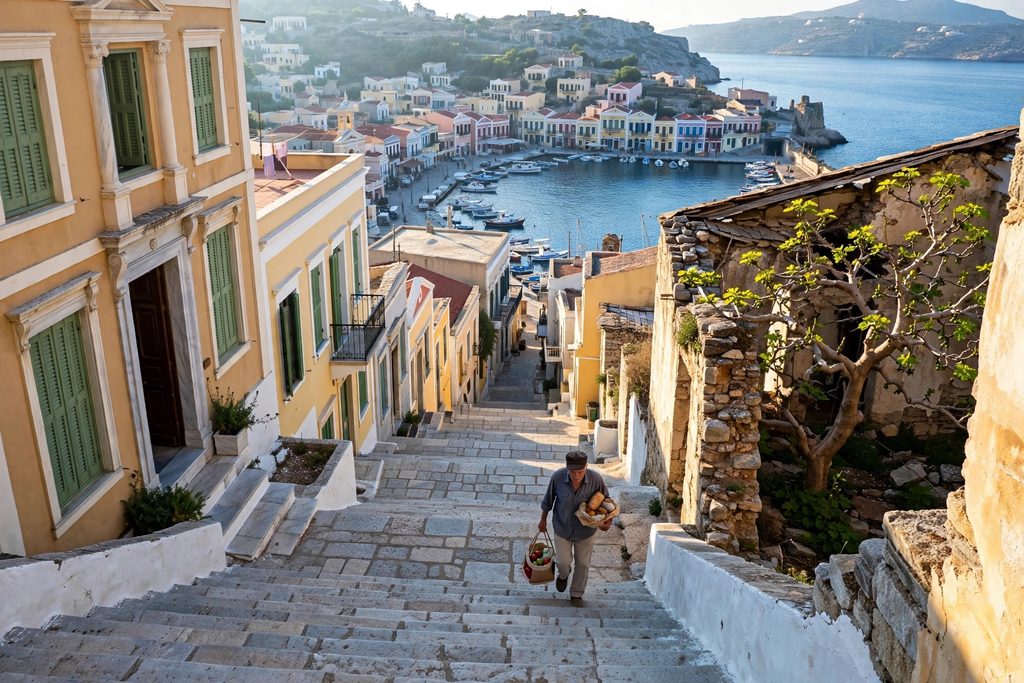
The boat from Rhodes rounds the last grey headland and there it is, a steep amphitheatre of ochre, cream, terracotta, rose and pale blue, climbing from the waterline almost to the ridge. Hundreds of houses, each with its triangular pediment turned toward the sea like a face at a window. Not one of them seems out of place. Nothing modern breaks the line.
On deck, in a dozen languages, people say the same thing. It looks like a stage set. Too complete, too symmetrical, too carefully painted to be a working town.
The instinct is half right. Gialos was built to be looked at. Its audience was the sea, the passing ships and the merchant houses of the eastern Mediterranean, and the message it was built to send was simple. This island is rich. In the second half of the nineteenth century it was. Symi, a dry, rocky island of the Dodecanese twenty-four kilometres north of Rhodes, lived on two trades, building ships and diving for sponges. At the height of the second it sent out what island histories call the largest sponge fleet in the world, and its population passed twenty-two thousand.
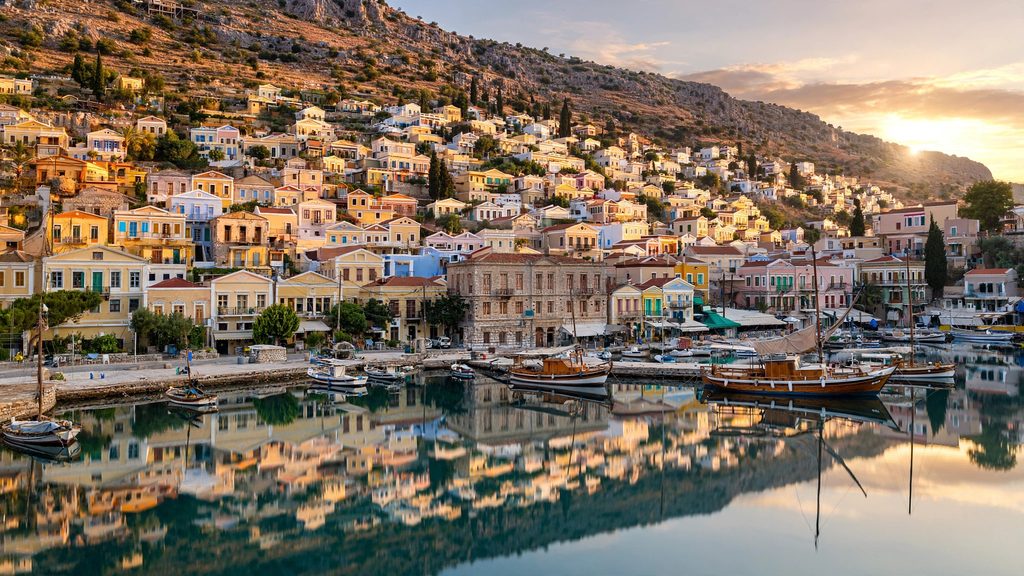
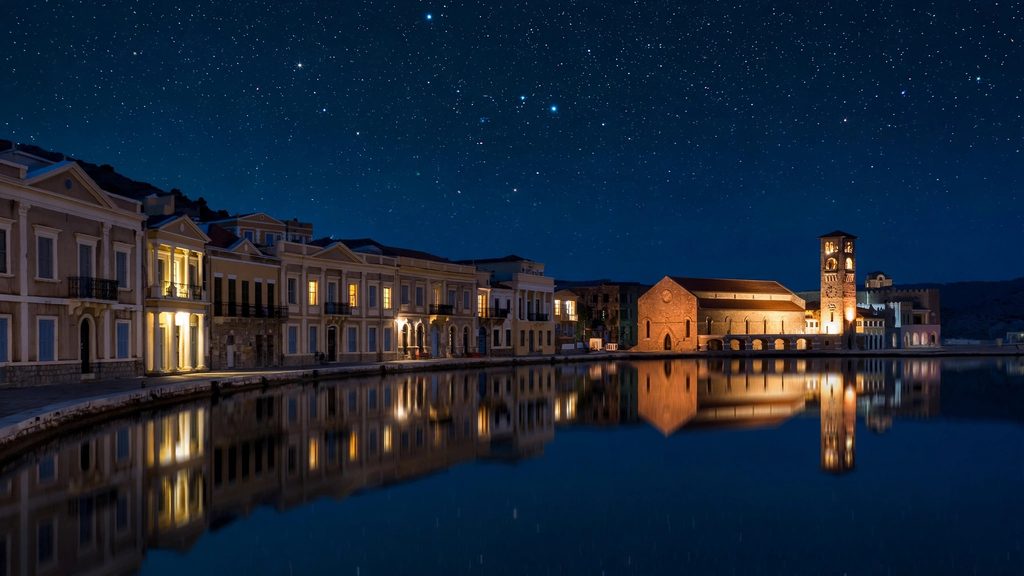
The 2021 census counted 2,603 permanent residents across the whole municipality. The mansions are still standing because good stone outlasts the economies that pay for it. Walk the quay on a January evening and you can count the lit windows. That gap, between the town the sea built and the town that remains, is the real subject of Symi.
An Island Named for a Nymph | Homer, Nireus and the Graces
Symi’s story starts long before the mansions. Later Greek tradition said the island took its name from Syme, a nymph carried here by Poseidon, who bore him a son named Chthonius, the island’s first ruler. Older names survive alongside hers. Symi was once called Aigli, the radiant one, and Metapontis. A local tradition holds that the Charites, the three Graces who attend Aphrodite, were born here.
Homer knew the island. In the Catalogue of Ships in the second book of the Iliad, Syme sends three ships to Troy under Nireus, son of King Charopus and Aglaia, a mother who shares her name with one of the Graces. Nireus, Homer says, was the most beautiful man who came to Ilion of all the Greeks after Achilles. Then, with a poet’s cruelty, he adds that Nireus was a weakling and that few men followed him.
After those lines Nireus disappears from the poem. Three ships, one beautiful man, no deeds anywhere in the long story of the Trojan War. It is a strangely fitting introduction for an island whose greatest monument would one day be its appearance.
Classical history gives Symi one more moment. In 411 BC, in the last phase of the Peloponnesian War, a Spartan fleet caught an Athenian squadron in the waters off the island and defeated it, a clash Thucydides records in his eighth book. Then the ancient sources fall quiet. For most of antiquity Symi lived in the shadow of Rhodes, its small, steep, waterless neighbour across the strait.
Shipwrights Before Sponges | The Knights, the Sultan and the Old Privileges
The wealth began with wood and skill. An island with scarce fresh water and very little flat land has to look outward, and Symi did. Its shipwrights became known across the eastern Aegean for light, fast vessels, and the bay of Charani, on the north side of the harbor, has been a boatyard for generations. You can still find a hull on the slipway there, ribbed and unfinished, the oldest trade on the island continuing at the scale of one boat at a time.
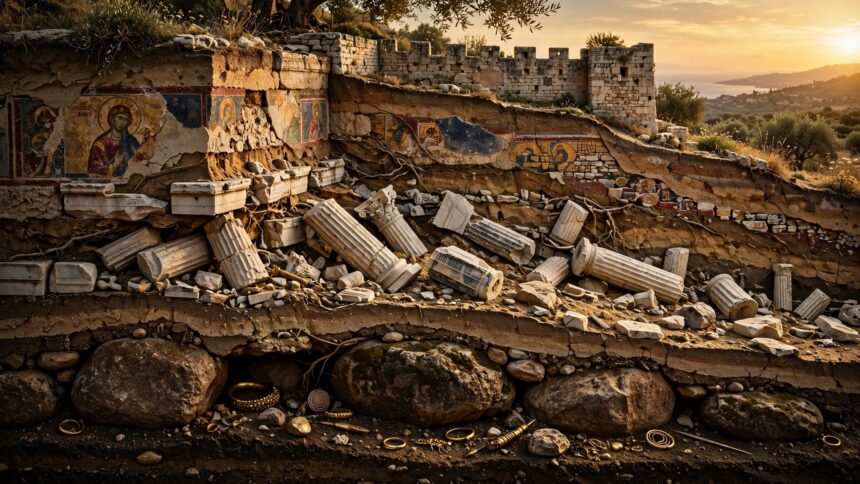
In 1309 the Knights of St John, newly installed on Rhodes, took Symi as well. They raised a castle on the ancient acropolis above the harbor, the Kastro that still crowns the upper town. When Suleiman the Magnificent captured Rhodes in 1522, Symi submitted to the Ottomans and was rewarded for it. The island kept a large measure of self-government, paid a light tribute and was left free to build, trade and dive. Island tradition says part of that tribute was paid in sponges.
Those privileges were the foundation of everything that followed. Through the eighteenth and nineteenth centuries, Symian ships carried cargoes between Ottoman and European ports, and Symian divers worked the seabed of the eastern Mediterranean. In 1821 the island joined the Greek War of Independence. The treaties that created the Greek state in 1830 handed it back to the Sultan. Symi went on doing what it did best, and the harbor began to fill with money.
The Stone That Carried Men Down | Skandalopetra and the Naked Divers
Before any machine, a sponge was taken by a man with a stone.
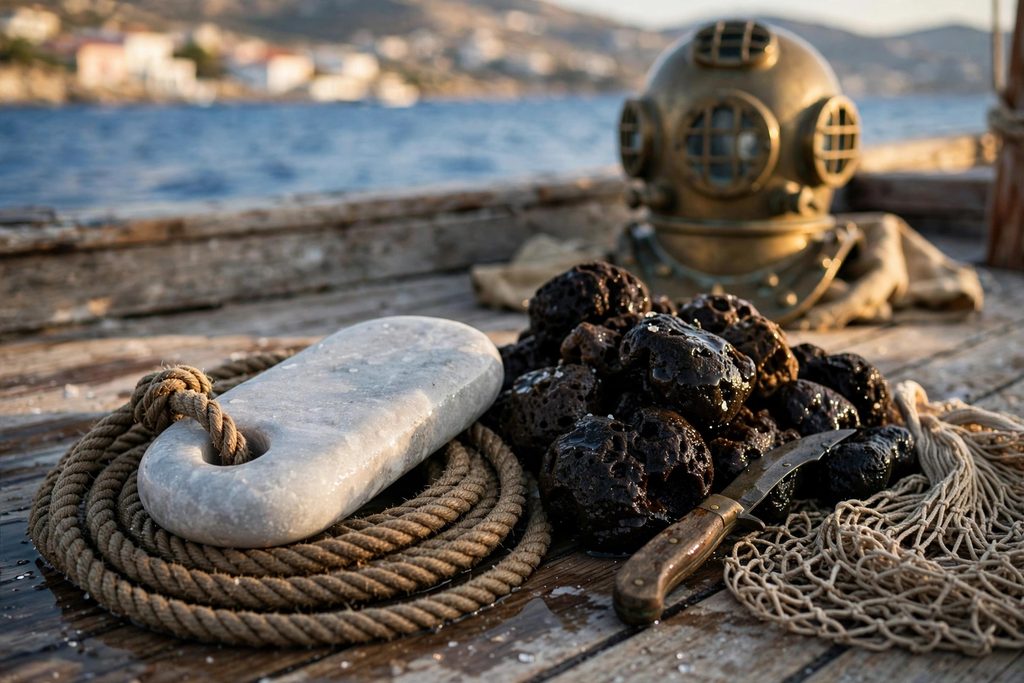
The stone is the skandalopetra. It is a flat slab of marble or granite, usually between eight and fourteen kilograms, polished smooth, rounded at the edges and bored through at one end for a rope. The diver stood on the side of the boat, filled his lungs and went over holding it out in front of him. Tilting it one way or the other, he steered his fall like a man steering with a rudder. The stone took him down fast, and speed mattered, because every second spent descending was a second stolen from the work on the bottom.
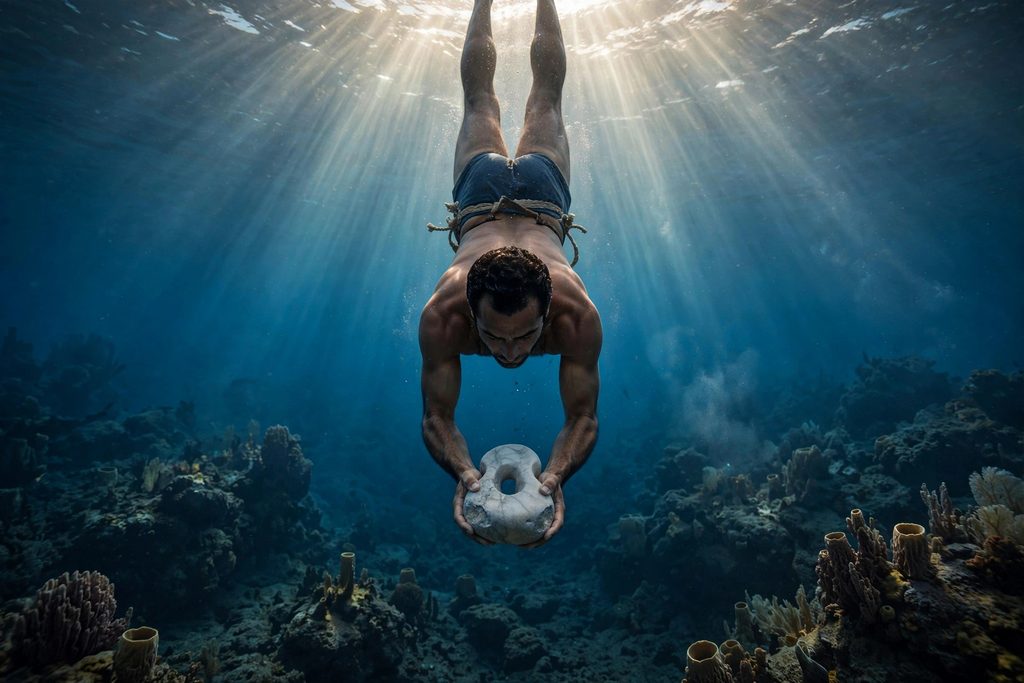
On the seabed he cut sponges from the rock with a knife or tore them loose by hand and pushed them into a net. When his breath was spent he tugged the line, and the men in the boat hauled him up, stone and all. The best divers worked at thirty, forty, fifty metres and more. They stayed down a minute or two and repeated the descent again and again through the working day, season after season, until their ears and lungs gave out.
It was brutal work, and it was never safe. A naked diver could drown, burst an eardrum or black out on the way up, and men who made deep dive after deep dive through a long day could still be struck by a form of decompression illness. But every danger was bounded by a single breath of surface air. The trade had its dead, and the families of Symi knew their names. The losses were counted in individuals, not in generations.
Then the machine arrived.
The Machine | How the Diving Suit Came to Nimborios
Symi tells the story of its arrival with a name and a place. Fotis Mastoridis, a Symian seaman serving on an English ship, watched salvage divers at work in hard-hat suits at the Cape of Good Hope. He came home convinced the equipment could change his island and brought a suit back with him. Island tradition dates its first demonstration to 1863, and other accounts place it a few years later.
The divers were wary of the brass helmet, the heavy canvas and the air hose that tied a man to a hand pump on deck. So the first person to go down, the island remembers, was a woman, Mastoridis’s wife Eugenia, born Mavriou and known on Symi as Kyra Fotena. Local accounts say she was three months pregnant, that she descended to around fifteen metres, and that she came back up with a stone from the bottom as proof. Some versions set the demonstration in the bay of Nimborios, west of the harbor, others in Gialos itself. After that, no man on Symi could call the suit too dangerous to try. In 2023 the island commissioned a statue in her memory for the harbor.
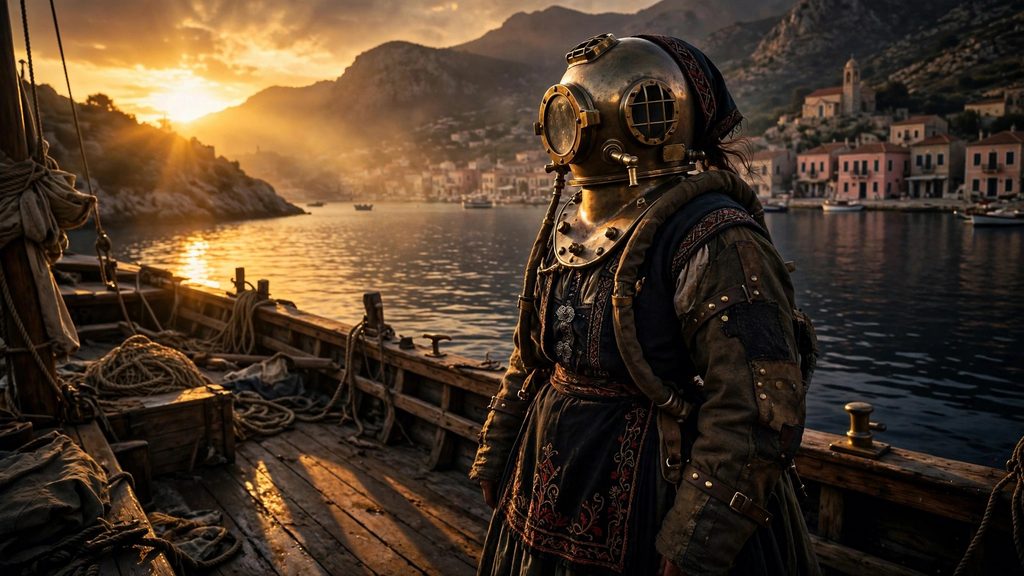
The divers simply called it the machine, and it changed the economics of the trade overnight. A suited diver did not have to come up after a minute. He could walk the sponge beds for long stretches, choose the best specimens and send up a catch no naked diver could match. Yields rose, the fleet grew and money poured into Gialos. Many of the grand houses you see from the ferry belong to these decades.
The equipment was considered safe to about forty-five metres. The divers went deeper, because deeper meant untouched beds and finer sponges, and the crews were paid by the catch. And they came up quickly, because nobody had told them not to. In the 1860s the physiology of decompression was barely understood anywhere in the world. On the sponge boats of the Dodecanese it was not understood at all.
Air breathed under pressure loads the blood and tissues with nitrogen. Bring the body up too fast and the gas comes out as bubbles, in the joints, in the spine, in the brain. Doctors would eventually call it caisson disease, and divers would call it the bends. On Symi it was simply the sickness that came with the machine. Young men surfaced, complained of pain and were dead within hours. Others lived, paralysed from the waist down, and spent the rest of their lives on the harbor front watching the boats go out without them.
The figures are terrible even where they are uncertain. A French naval doctor who studied suited sponge divers in 1867 recorded ten deaths among twenty-four men. Later estimates run to around ten thousand dead across the Mediterranean sponge fleets in the first fifty years of the machine, and the true number will never be known. The men knew the risk. The money was too good and the alternatives were too few, and the brass helmets kept going over the side.
Stathis Chatzis and the Anchor of the Regina Margherita
The naked divers never vanished entirely, and one of them made the most famous dive in the history of the trade.
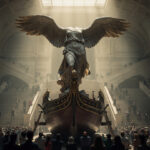
In July 1913 the Italian battleship Regina Margherita lost an anchor in deep water off Karpathos. The navy’s own divers could not reach it. A Symian sponge diver named Stathis Chatzis was brought in. Over three days he made repeated dives on a single breath, riding a skandalopetra into the dark, and on one of them he reached the anchor and secured a line to it.
Accounts of the depth vary, from around seventy-five to eighty-eight metres, but none of them describes a number a human being should survive. On the deepest attempt he was under for well over three minutes and surfaced barely conscious, blood running from his nose. The Italian navy rewarded him, by the usual account with a medal and free passage on Italian ships for life. Competitive freedivers, with every advantage of training and equipment, would not reach comparable depths until the late 1960s. Chatzis did it as a day’s work.
The House of Petridis and the Money That Came Home
A sponge torn from the rock is not yet money. It has to be cleaned, trimmed, graded, packed and sold, and Symi learned to control the whole chain. The boats sailed each spring for the grounds off North Africa, above all the Libyan coast around Benghazi, and stayed away until autumn. The catch came home to be processed on the quays and was sold onward through Syros, the great Greek trading port of the age, to the shops of Western Europe.
At the top of this chain stood the merchant houses, and island histories give pride of place to one of them, the house of the Sons of Nikitas Petridis, trading abroad as Petrides Brothers, with offices in Syros, Piraeus, Paris and London. Those histories credit the family with the Petrideio school, the clock tower raised at the harbor in 1881 and several of the neoclassical buildings around the old administrative centre. The clock tower has since become the emblem of Gialos, the first thing every camera points at.
This is the oldest pattern in the Greek merchant world. Money earned elsewhere comes home as stone. It built the mansions and bridges of the Zagori villages in Epirus, raised by emigrant traders who never stopped thinking of their mountains, and it built the captains’ houses of Hydra, paid for by the sea. On Symi it took a form all its own.
The houses follow the neoclassical style that spread through the Greek world after independence, with pediments, pilasters, tall shuttered windows and marble doorframes, but they were built by island craftsmen and shaped to the slope. Each one steps up the hill so that its pediment stands clear of its neighbour below and every family gets its view of the water. Inside the courtyards, floors of black and white sea pebbles are laid in patterns of stars, ships and waves. From the water the town reads as a single composition. Up close it breaks into separate ambitions, a doorway here, a balcony there, each built by a family that wanted to be seen.
How the Silence Arrived
No single blow ended Symi’s prosperity. It came apart in stages over about eighty years, and each stage took something the island could not replace.
Steam came first. Symi’s shipyards built wooden sailing vessels, and by the last decades of the nineteenth century steamships were taking over the routes those vessels had served. The demand for Symian hulls began to fall away.
Then came Italy. In 1912, during its war with the Ottoman Empire, Italy occupied the Dodecanese. The islanders declared their independence and hoped for union with Greece. Instead the occupation hardened into colonial rule, confirmed by treaty in 1923, and it lasted thirty-one years. Italian rule cut Symi off from the Anatolian coast a few kilometres to the east, which had supplied much of its food, timber and trade, and island histories record restrictions on sponge fishing during the First World War. The Greek defeat in Asia Minor in 1922 closed that coast to the Greek world for good.
Families began to leave, for Rhodes and Piraeus, for Egypt, for America and later Australia. Dodecanese divers carried their trade across the Atlantic and built a new sponge town at Tarpon Springs in Florida. The men who had gone abroad during the hard years did not all come back, and the decline that began then never reversed.
After the Second World War, cheap synthetic sponges took over the household market that had once kept hundreds of boats at sea. Later in the century, outbreaks of disease swept the sponge beds of the eastern Mediterranean. A few divers still work from the Dodecanese. The trade that built Gialos survives as a craft, a museum display and a basket of sponges outside a harbor shop.
The Surrender Signed on the Harbor
The war reached Symi in 1943. After Italy’s armistice in September, British forces moved into the Dodecanese, and in October the Germans took Symi. In July 1944 a raiding force of the British Special Boat Service and the Greek Sacred Band landed on the island, overwhelmed the garrison, destroyed its boats and stores, and withdrew with their prisoners as planned. Through those years the islanders went hungry, and many escaped by caique to the Turkish coast and spent the rest of the war as refugees.
Then, on 8 May 1945, the day Germany’s surrender took effect across Europe, Symi received its strangest distinction. The local surrender of the German forces in the Dodecanese was signed here, in Gialos, by General Otto Wagner before the British Brigadier James Moffat. A small island almost emptied of its people became the place where the German occupation of the islands formally ended. Gialos has never let the date be forgotten.
British administration followed, and in 1948 the Dodecanese were formally united with Greece. The island that had joined the revolution of 1821 had waited a hundred and twenty-seven years to become Greek in law. By then its population had collapsed. Houses in the upper town stood empty, roofs fell in, and Symi went quiet for a generation.
That quiet is what saved it. With no money to tear anything down and no pressure to build anything new, the town survived intact until it was protected as a traditional settlement. Restoration now follows strict heritage rules overseen by the archaeological service. Many of the houses brought back to life in recent decades were restored by returning Symians, by Greeks from Athens and Rhodes, and by foreigners who fell for the harbor from a ferry deck, exactly as the builders intended.
Five Hundred Steps to Chorio
Gialos is the stage. Chorio, the upper town, is where the island lived before the stage was built, and the stairway between them is the best way to understand both.
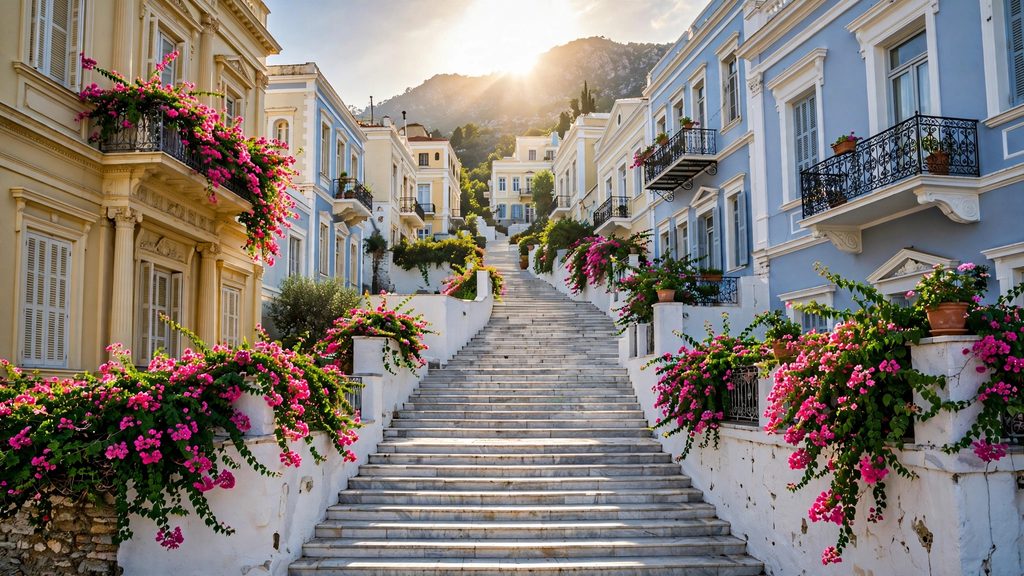
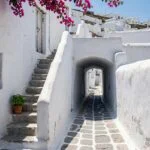
The Kali Strata, the good road, climbs from the back of the harbor in roughly five hundred broad stone steps. Nobody agrees on the exact count, and after the first two hundred nobody cares. Mansions line the way, some restored in ochre and cream with green shutters, others roofless, with fig trees growing up through what used to be their floors. Here and there a date is cut into a marble lintel, a family announcing the year it arrived.
Chorio is older and tighter, a maze of lanes and stairways packed around the Kastro of the Knights. Windmills line the ridge. A small museum in the upper town keeps finds from the island’s ancient past alongside its later history, and the churches still ring the hours across the roofs.
At the top, look down. From the ridge the theatre of the harbor becomes a plan. You can see how the town was composed, house by house, to face the water, and you can see how much of it still stands empty. The view that looks like a stage set from the ferry looks, from up here, like a census.
Panormitis | The Monastery Where the Sea Delivers the Mail
On the island’s south coast, at the end of a deep and sheltered bay, the Monastery of the Archangel Michael Panormitis is the reason many Greeks know Symi at all. The Archangel of Panormitis is a protector of sailors throughout the Dodecanese, and the monastery ranks among the great pilgrimage sites of the Aegean, alongside the cave of the Apocalypse on Patmos.
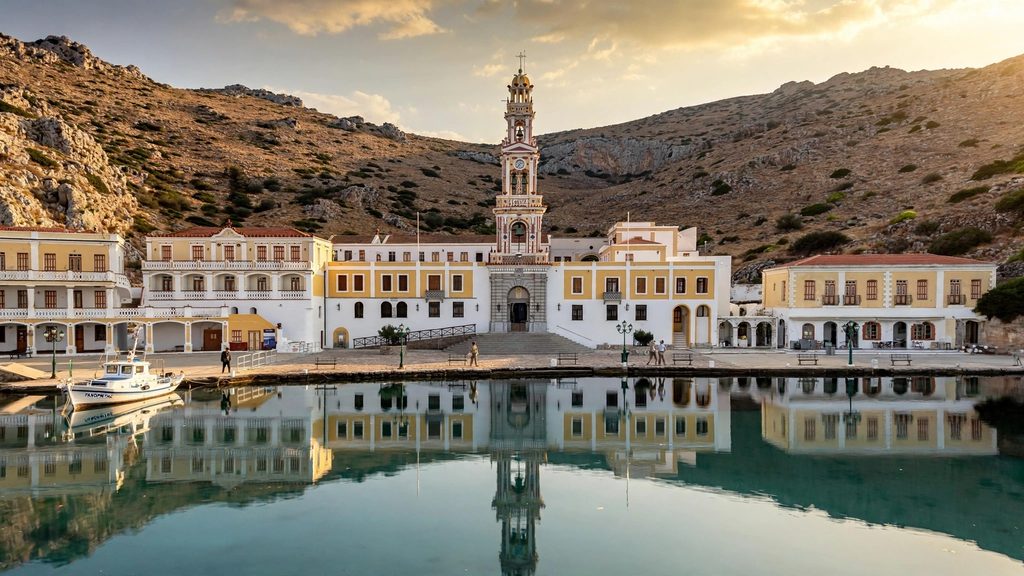
The present church dates from 1783, its interior painted a decade later. At its heart is the silver-covered icon of the Archangel, and the island tells that the icon was found here, carried away to another church, and kept returning to Panormitis of its own accord until the people accepted that it had chosen its home. Above the gate rises a tall, ornate bell tower of the early twentieth century, the first thing a sailor sees on entering the bay.
The monastery’s most beautiful custom involves bottles. People who cannot make the journey write their prayers and the names of the living and the dead, seal them in a bottle with a little incense and an offering, and throw it into the sea from any port or ship, asking the Archangel to guide it home. The bottles drift into the bay or are caught in fishermen’s nets off Symi. The monks open them, honour the requests and write back to say they arrived. The monastery keeps offerings that have reached it this way from across the world and across generations.
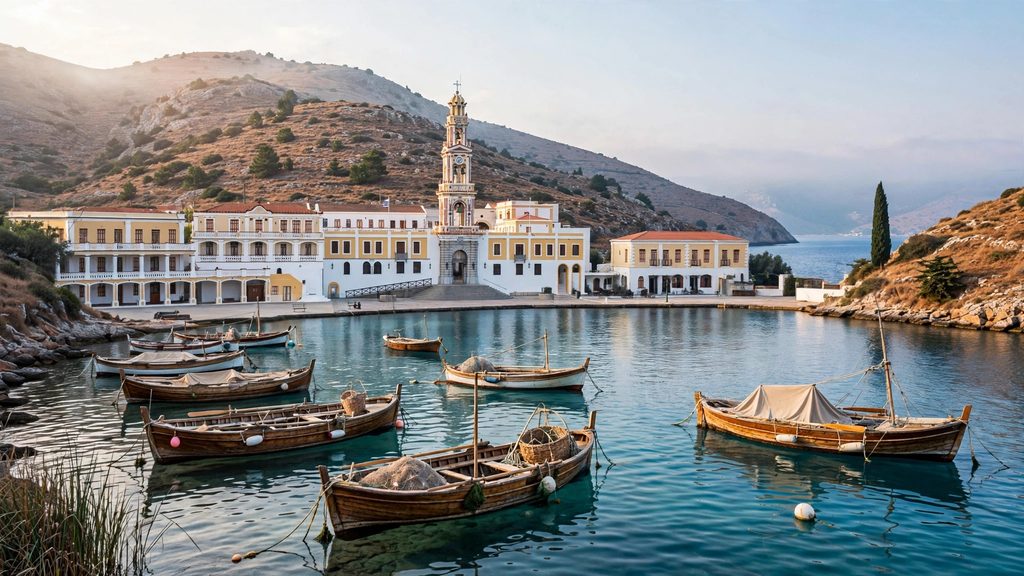
It is hard to think of a more Symian piece of faith. The sea that took so many of the island’s divers is trusted, here, to carry its letters. On 8 November, the feast of the Archangels, the guest rooms fill and the bay fills with boats, and the island briefly holds something like the crowd its harbor was built for.
How to See Symi Properly
Getting there. Fast boats from Rhodes take around an hour, conventional ferries a little longer, and some services call at Panormitis on the way. Schedules change with the season, so check the current timetable before you plan. Day-trip boats leave from the waterfront by Mandraki harbor, where the Colossus once stood. Symi also has ferry connections with Piraeus and other Dodecanese islands, more in summer than in winter, so it fits easily into a longer route alongside Nisyros or Karpathos. If Rhodes is your base, our Rhodes island guide covers the rest.
Stay the night. Most visitors come for the day, arriving mid-morning and leaving in the late afternoon. That is a mistake worth avoiding. The harbor before the first boat and after the last one is a different place, quiet, lit low, returned to the people who live there. That is when you hear what a town built for twenty thousand sounds like with two and a half thousand in it.
Climb early. Take the Kali Strata soon after sunrise. The island has little shade, and by midday in July and August the stone throws back the heat. Wear shoes with grip, because the stone has been polished by two centuries of feet, and carry water. The morning light falls straight onto the facades, which is how the builders meant the harbor to be seen.
Choose your season. May, June, September and October are the best months, warm sea and bearable walking. Winter Symi is beautiful and very quiet, with reduced ferries and many places closed. Our guides to Greece in the off-season and to life on a Greek island year-round are honest about both sides of that.
Eat the shrimp. The island’s signature dish is the Symi shrimp, tiny, sweet and fried whole, eaten shell and all with a squeeze of lemon. Order a plate on the quay and a glass of cold white wine, and you will understand why people miss the last boat.
Buy one good sponge. The harbor shops sell natural sponges, and several double as small museums of the trade, with old suits, helmets and photographs. Ask where a sponge was harvested, because not all of them are local, and buy one well rather than a bag of souvenirs. The nautical museum in Gialos is worth an hour for the diving equipment alone.
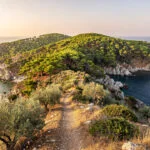
Find the bays. In season, taxi boats run from the harbor to coves that are hard to reach by land, such as Agios Georgios Dysalona beneath its sheer cliff, Nanou and Marathounda. Walk out to Nimborios as well, where the first diving suit went into the water, and swim where, by one version of the story, Kyra Fotena went down. For the wider map of sacred and mythic places across Greece, open the Olympus Estate Atlas.
What the Harbor Keeps
Gialos is not a reconstruction and not a heritage theme park. Nobody designed it for visitors. It is what remains when an economy that built in stone stops existing and the stone goes on standing.
What it keeps, without anyone deciding it should, is a ratio. Houses for more than twenty thousand people. Lights for two and a half thousand. The grandeur that the sea paid for and the silence that followed when the sea stopped paying.
Most of the divers have no names in the record. Eugenia Mastoridou, Fotis Mastoridis, Stathis Chatzis, a handful among thousands. The young men who came up paralysed have no monument. The merchant families have their names on a school and a clock, and even those are fading from the island’s memory. The work itself is everywhere. It is in every pediment and every marble step.
A sponge cut from the rock at forty metres in 1875, sent up by a young man breathing pumped air who might never walk again, cleaned on the quay, shipped through Syros and sold in a shop in Paris or London. The money from that sale is in the house you are looking at from the ferry as you come into the harbor.
The diver is not there. The money is still in the stone.
At Olympus Estate, Greek Islands is where we look past the postcard to the history that made each island what it is. Symi began as a nymph’s name and a line in Homer, sent three ships to Troy under the most beautiful man in the Greek army, lived for centuries on fast boats and hard bargains, and then gave the sea its divers in exchange for a harbor of painted mansions. The skandalopetra, the brass helmet, the bottle drifting toward Panormitis and the surrender signed on the quay in 1945 all belong to the same story. It is the story of an island that built for the crowd it once had and still keeps every house ready for it.