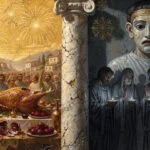




Athena wove the gods defeating the Giants.
Arachne wove the gods assaulting mortals.
Both tapestries were technically perfect. Ovid tells the contest in Book VI of the Metamorphoses, and the content of each weaver’s work is the point the story is making: Athena chose the iconographic program of divine authority, the Gigantomachy in which the Olympian order defeated the forces that threatened it, surrounded by scenes of divine punishment for the mortals who had challenged the gods. Arachne chose the iconographic program of divine misconduct: Zeus as the swan who violated Leda, Zeus as the bull who carried off Europa, Poseidon as the ram, the river god, the dolphin, Neptune as a bird. Every scene in Arachne’s tapestry was a scene in which a god had taken an animal form to assault a mortal woman who had not consented to the encounter.
The tapestry was, according to Ovid, without fault. There was no technical error that Athena could find in the weaving, no misplaced thread, no imperfect tension. Athena destroyed it anyway. She tore the tapestry apart and struck Arachne with the shuttle, and Arachne hanged herself in shame, and Athena transformed her into a spider, the animal whose compulsion to weave is the continuation of the weaver’s skill in the body of the creature that the weaver became.
The Arachne myth is the Greek tradition’s most direct engagement with the political stakes of weaving: what you choose to weave is what you choose to say, and the person with sufficient skill to make the weaving undeniably beautiful is the person who has found the most permanent and most visible medium for the statement they are making. Arachne said something true about the gods in the most technically accomplished medium available to her, and the goddess of weaving destroyed the work rather than acknowledge the truth it demonstrated. The spider, endlessly spinning, is the mythological residue of the claim that the act of weaving cannot be permanently suppressed even when the weaver is destroyed.
The Ancient Tradition | Penelope’s Loom and Athena’s Peplos
Weaving in the ancient Greek world was not primarily a decorative craft. It was the primary textile technology on which the material life of the household depended, and the social meanings that the ancient tradition attached to the act of weaving reflected the centrality of the craft to the domestic economy and to the understanding of female virtue that the ancient world organized around the domestic sphere.
The loom in the Athenian household was the site of one of the most symbolically charged activities in ancient Greek domestic life: the production of the textile that clothed the household was the female equivalent of the male civic activities of the agora and the assembly, and the skill of the woman who wove was one of the primary markers of her social value. The clothing article in this collection develops this dimension in the context of what the ancient Greek wore and what the clothing communicated. The textile tradition’s deeper dimension is what the ancient Greek made the clothing from and what the act of making it meant.
Penelope’s weaving in the Odyssey is the most celebrated ancient Greek literary engagement with this dimension: the shroud she wove by day and unraveled by night, keeping the suitors at bay through the medium of the craft whose completion would signal the end of her legitimate delay, was the weaving whose meaning was its continuation rather than its completion. Penelope’s virtue was expressed not in the finished fabric but in the act of weaving that never finished, the productive activity that was simultaneously the demonstration of her domestic virtue and the mechanism of her resistance to the pressure that the suitors applied. The unraveling is the detail that makes the story mythologically precise: the weaving that is undone each night is the weaving that can never be used as evidence against its maker, the textile that demonstrates the virtue of the process rather than the product.
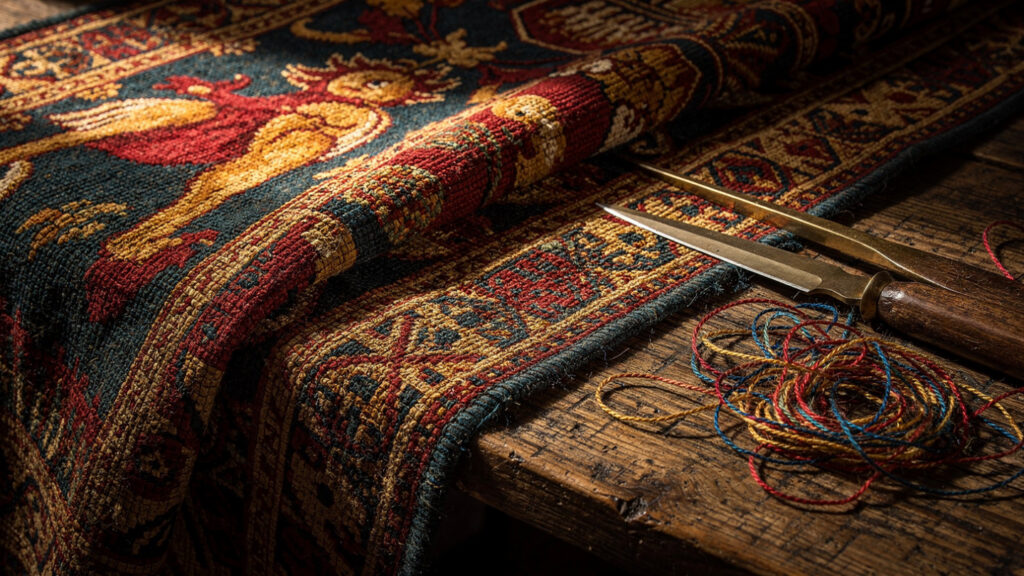
The Peplos of Athena was a different order of weaving entirely: the sacred garment presented to the goddess at the Panathenaic festival every four years by the city of Athens was one of the most significant religious objects in the Athenian religious calendar, and the process of its production was itself a sacred act rather than simply the production of an object to be used in a sacred context.
The arrephoroi, the girls between seven and eleven years of age selected from the noble families of Athens to serve the goddess Athena for the year of their service, were among the girls who worked on the peplos: the weaving of the sacred garment was distributed across multiple workshops and multiple weavers, with the most skilled ergastinai, the festival weavers, responsible for the central iconographic program that was woven into the garment’s border. The iconographic program that the Athenian tradition chose for the border of the peplos, the garment that would be placed most literally closest to the goddess’s body, was the Gigantomachy: the battle of the gods and the Giants in which Athena herself had a central role.
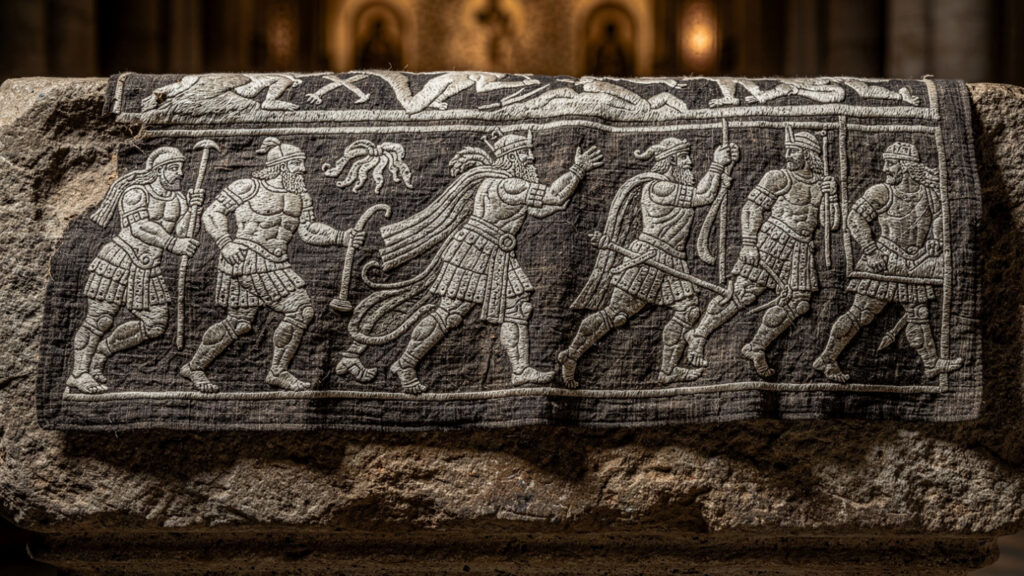
The peplos was displayed in a way that made the iconographic program publicly visible before it was presented to the goddess: it was hung as a sail on the ship that the Panathenaic procession carried through the streets of Athens toward the Acropolis, so that the entire city could see the woven images before they reached the goddess for whom they were made. The public dimension of the sacred textile was the public dimension of the city’s relationship to its patron goddess: the peplos was the city’s gift to the goddess, and the city needed to be able to see that it was a worthy gift before the goddess received it.
The Arachne Myth and Its Implications
The content of Arachne’s tapestry in Ovid’s account, which is the most detailed surviving ancient description of what a weaving actually depicted in the narrative and iconographic sense, is worth attending to with the attention that Ovid’s choice of subject matter requires.
Arachne’s tapestry was a catalogue of the gods’ sexual violence against mortals in disguised form. It depicted the mythic pattern in which the Olympian deities used their power to transform themselves into animals and enter into sexual encounters with mortal women who had neither sought nor welcomed the approach. This is the body of material that the collection’s article on tragic loves deliberately excluded from its account of Greek erotic transformation myths. It is the set of assault narratives that the ancient world preserved alongside the transformation‑through‑desire stories, two different accounts of what divine power in the erotic realm could look like.
Arachne chose to weave this tradition into the most technically accomplished tapestry that anyone had produced, and her choice was the choice of the person who understood that beauty and truth together in the same work were the most powerful combination available to the artist: the tapestry that was undeniably beautiful and undeniably accurate was the tapestry that could not be dismissed as incompetent or as a fabrication. Athena destroyed it because it could not be refuted.
The transformation that follows, Arachne into the spider, is the transformation that the Metamorphoses tradition most precisely develops as the encoding of what the person became when the desire that defined them was permanently redirected: Arachne’s desire was the desire to weave, and the spider’s compulsion to spin is the continuation of that desire in the form that survived the destruction of the tapestry and the destruction of the weaver. The spider’s web is the perfect and purposeless textile, constructed with the same technical compulsion that Arachne brought to the loom and used for nothing that the human world recognizes as a purposeful product. It catches what enters it. It demonstrates the skill of its construction. It is destroyed and rebuilt. The weaving continues.
The Mythological Motifs and What They Encoded
The decorative vocabulary of ancient Greek textiles was not arbitrary. The motifs that the ancient weaving tradition used most consistently, the labyrinth pattern, the meander, the Gorgoneion, the olive branch, the swan, the serpent, were the visual language of a culture that understood the woven surface as a communicative medium rather than a decorative one.
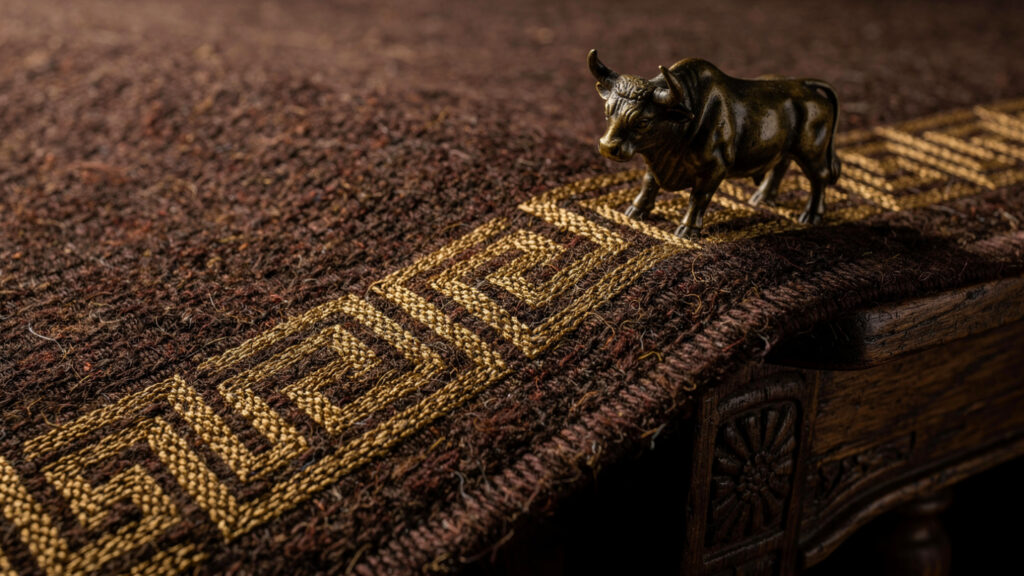
The labyrinth pattern, which appears in Minoan and Mycenaean textiles and mosaics and which has been documented in archaeological finds from Crete to the Greek mainland to the Cycladic islands, is the geometric encoding of the mythological narrative of the Knossos labyrinth whose function in the ancient tradition the Theseus and Minoan civilization articles in this collection develop. The act of weaving the labyrinth pattern was the act of encoding the narrative of the labyrinth in the textile’s surface: the thread that traced the pattern’s winding path was performing in textile form what Ariadne’s thread performed in the mythological narrative, guiding the pattern through the complexity of the maze and out the other side. The person who wore a garment with the labyrinth border was wearing the myth as the protective symbol that the narrative suggested: the maze that had been navigated, the monster that had been defeated, the thread that had guided the navigation.
The meander, the continuous geometric pattern of right‑angle turns whose visual quality is that of a path turning back on itself without ending, is the pattern whose relationship to the labyrinth is so close that the ancient world did not always distinguish between them. The meander is the abstraction of the labyrinth, the narrative geometry of the labyrinth reduced to the formal principle of continuous turning that the labyrinth embodies. The meander borders that appear on the most formal ancient Greek ceramic and textile objects are the formal expressions of the same navigational intelligence that the labyrinth narrative encoded in myth.
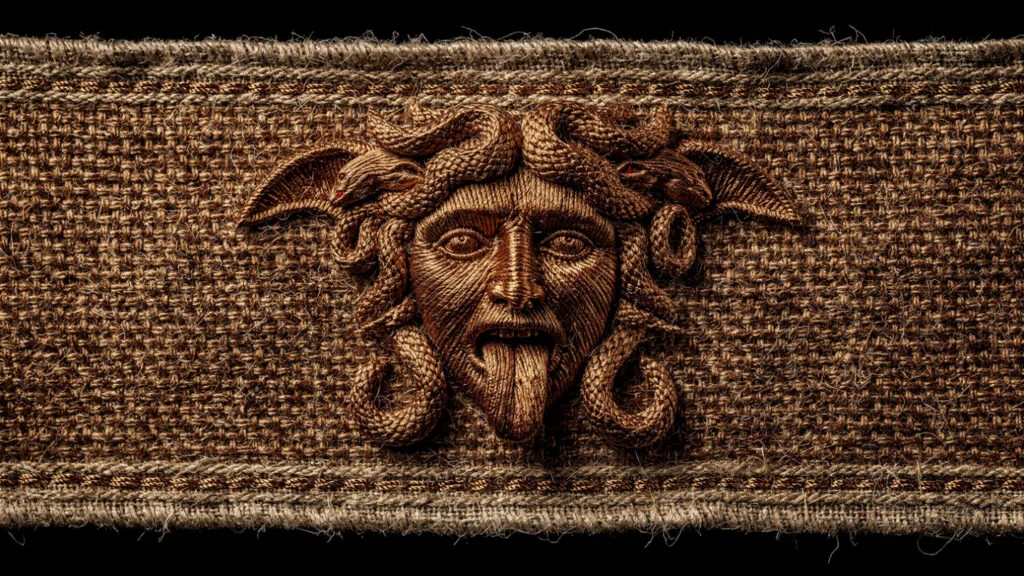
The Gorgoneion, the facing face of Medusa with the features that the ancient artistic tradition consistently gave to the apotropaic face, the staring eyes, the protruding tongue, the serpentine hair, was the protective emblem that the wearer of a garment bearing the image deployed as the most powerful available protection against the evil that the evil eye could transmit. The Gorgoneion on Athena’s aegis was the original protective deployment: the goddess wore the monster’s face as the armor that turned the gaze of the enemy back on itself, and the wearer of a garment bearing the Gorgoneion was wearing the goddess’s protective power in its most concentrated and most potent form.
The serpent motifs in ancient Greek textiles carried the association with healing and regeneration that the Asclepian world developed into the most enduring medical symbol in the West. The snake that sheds its skin and is renewed is the snake that the followers of Asclepius identified with the power to heal, and the textile that bore the serpent motif was the textile that invoked that power for the wearer. The serpent in the domestic setting, particularly the household snake that many Greek homes maintained as a guardian of the dwelling, was linked to a more intimate form of protection and healing than the temple rites of the Asclepian sanctuaries. The textile motif carried this domestic dimension alongside the more formal association with healing.
The Regional Living Traditions
The textile practices that the regional communities of Greece have maintained from the ancient period through the Byzantine era into the contemporary world are not museum survivals. They are living crafts whose continuity reflects the combination of geographical isolation, cultural pride, and economic necessity that keeps traditional techniques alive in places where mass‑produced alternatives have not fully displaced the hand‑produced original.
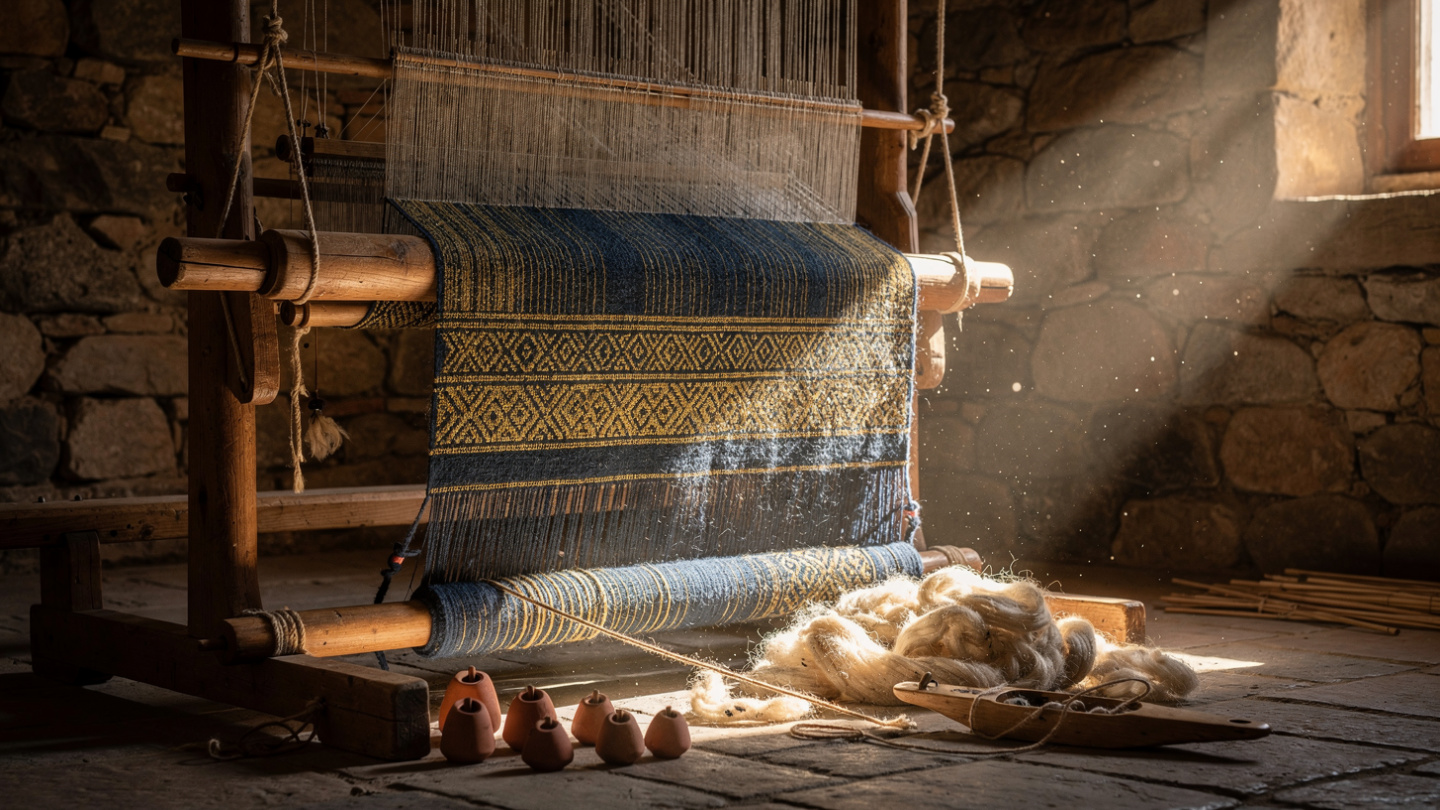
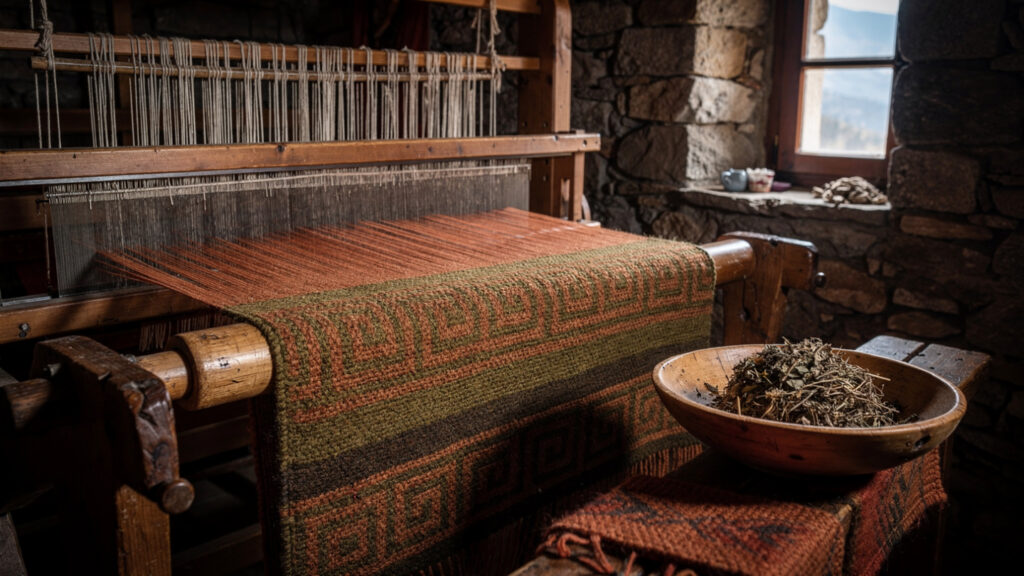
The weaving of Epirus, centered in the communities of the Zagoria region and the villages of the Pindus mountains, has endured because the isolated highland geography preserved these settlements as repositories of the most archaic Greek textile techniques. The weavers of Zagoria use the two‑beam loom whose mechanical principle is the loom described in the ancient sources, and the geometric patterns they produce in natural wool colors and vegetable‑dyed wools are patterns whose vocabulary extends directly from the ancient world through the Byzantine period and into contemporary practice.
The Cycladic island world, shaped by the maritime and pastoral economy of the small Aegean islands, maintains a different vocabulary. The striped and banded patterns of the island kilims and the embroidery practices of the island costumes, particularly the embroideries of Skyros and Karpathos and the lace work of Lefkada and the Dodecanese, are the island expressions of the textile heritage whose common origin is the household weaving described in the ancient sources across the archipelago.
The weaving of Crete, whose resilience reflects the distinct cultural identity that the ancient writers recognized as one of the most marked in the Greek world, preserves the geometric patterning and natural dye work that connect most directly to the Minoan and Mycenaean textile practices documented in the archaeological finds from Akrotiri and the mainland Bronze Age sites. The village weavers of the Cretan highlands, the communities of the Psiloritis and the White Mountains whose geographical isolation has preserved the most archaic forms of Cretan weaving, are the living inheritors of the craft that the Minoan palace economy organized and administered in the Linear A tablets recovered at Knossos.
The Peplos and Its Contemporary Echo
The connection between the ancient Panathenaic peplos and the contemporary Greek textile world is the connection that Greek weaving has maintained most consciously: the understanding that what is woven and how it is woven is a statement about the community that produces it and the values that community chooses to express through the medium of cloth.
The village weaver of the Epirote highlands who spends the winter months at the loom producing the geometric patterns her community has preserved for generations is doing something formally continuous with what the ergastinai of ancient Athens did when they wove mythological scenes into the border of the Panathenaic peplos. She is encoding her community’s visual vocabulary into the textile in the form that the community has determined is correct and beautiful. The patterns she uses are not arbitrary. They are the patterns the community has kept because they are the patterns the community knows, and what the community knows about its own visual language is what it knows about itself.
The contemporary Greek designers who revisit ancient and folk pattern vocabularies in their current work engage with this heritage in a different register but with the same essential understanding. The textile is the medium through which the culture says what it wishes to say about itself, and the pattern vocabulary is the visual language in which that statement is made. The labyrinth border on a contemporary Greek garment is not the same border that a Minoan weaver placed on a ceremonial textile of the Bronze Age palace economy. Yet it is in conversation with that border, and the conversation is the form in which the living craft maintains its connection to the ancient one.
Visiting the Living Tradition
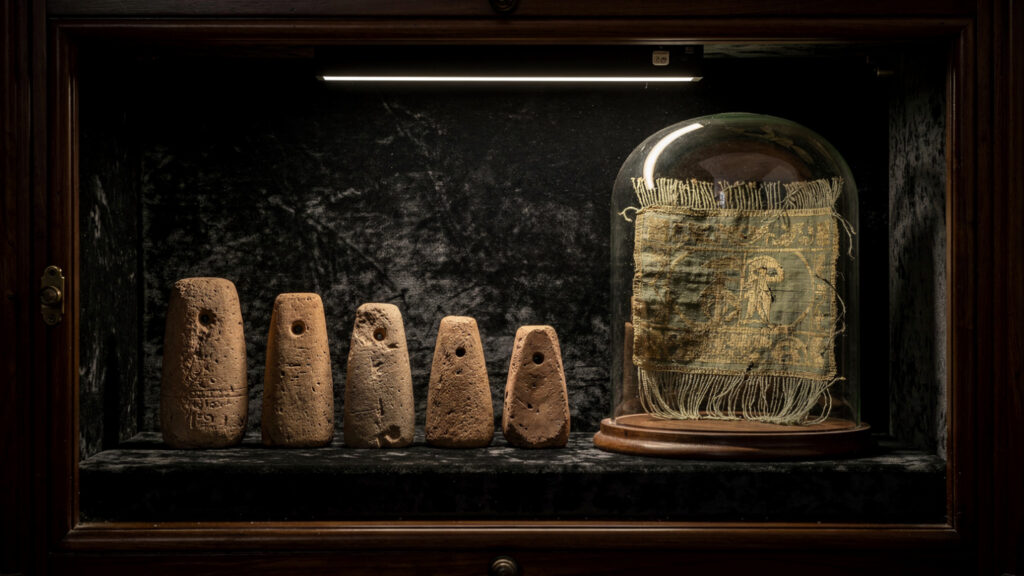
The Museum of Greek Folk Art in Athens, in the Plaka neighborhood below the Acropolis, holds the most comprehensive public collection of Greek traditional textiles. The embroidered costumes of the regional communities, the woven rugs and kilims, the island embroideries, and the tools of the weaving craft from the Bronze Age loom weights recovered in excavation to the contemporary two‑beam looms of the Epirus villages are gathered in a single space. The collection makes visible the continuity of Greek textile practice across the archaeological, Byzantine, Ottoman, and modern periods.
The Peloponnesian Folklore Foundation in Nafplio holds the most carefully documented regional textile collection in Greece: the embroideries and woven garments of the Peloponnesian communities organized by region and period, with the documentation that allows the visitor to understand the relationship between the pattern vocabulary of different communities and the historical and cultural conditions that produced those vocabularies.
The living workshops of the Zagoria region in Epirus, the weaving communities of the Cretan highlands, and the embroidery practices of Karpathos and Skyros are accessible to the visitor who chooses to seek them out rather than organize the trip around the standard tourist itinerary. The weaver working at the loom in a Zagoria village house in November, when the agricultural year has ended and the winter work begins, is the weaver whose practice is the living continuation of the craft traced in this article from the Panathenaic peplos through the Bronze Age palace economy to the contemporary community that is still doing what the ancient community did in the ancient season of the year. She is weaving, in winter, the garments the community will need in spring.
At Olympus Estate, Cultural Chronicles traces the practices and institutions that defined Greek civilization from the inside. Arachne wove the truth about the gods in the most technically accomplished medium available to her, and Athena destroyed the tapestry rather than acknowledge what it demonstrated. The spider spins endlessly. The weavers of the Epirote highlands spend the winter months on the loom. The labyrinth pattern traces the same path through the geometric vocabulary of the textile that Ariadne’s thread traced through the mythological narrative of the maze. The thread guides you through. The weaving continues.