


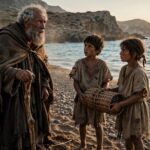

In the early weeks of spring, the island of Kythira shifts almost imperceptibly from winter stillness into movement. The low hills release the layered scent of wild herbs warming in the sun, and along stone terraces and scattered farmsteads, wooden hives appear at the edges of fields. What looks, at first glance, like ordinary agricultural practice is in fact the last visible thread of one of the oldest religious associations in the Greek world, the belief that bees were not simply useful insects but intermediaries between the human and the divine, and that the women who tended them were not merely farmers but priestesses.
The Greeks called these women the Melissae, the bee-women, and their association with sanctuary, prophecy, and the gods runs through Greek religion from its earliest mythological layer to its most famous institution of prophetic authority.
The Nymph Who Gave the Bees Their Name
The word melissa, bee, carries its own myth of origin. In one Cretan tradition, Melissa was a nymph, daughter of King Melisseus of Crete, who discovered how to harvest honey from wild hives and was credited with teaching the practice to others. In the version most closely tied to the cave sanctuaries of Crete, Melissa and her sister Amalthea were entrusted with the infant Zeus, hidden from his father Kronos in a cave on Mount Ida or Mount Dikte. Amalthea, in most accounts a goat, nursed the infant god with her milk. Melissa fed him honey.
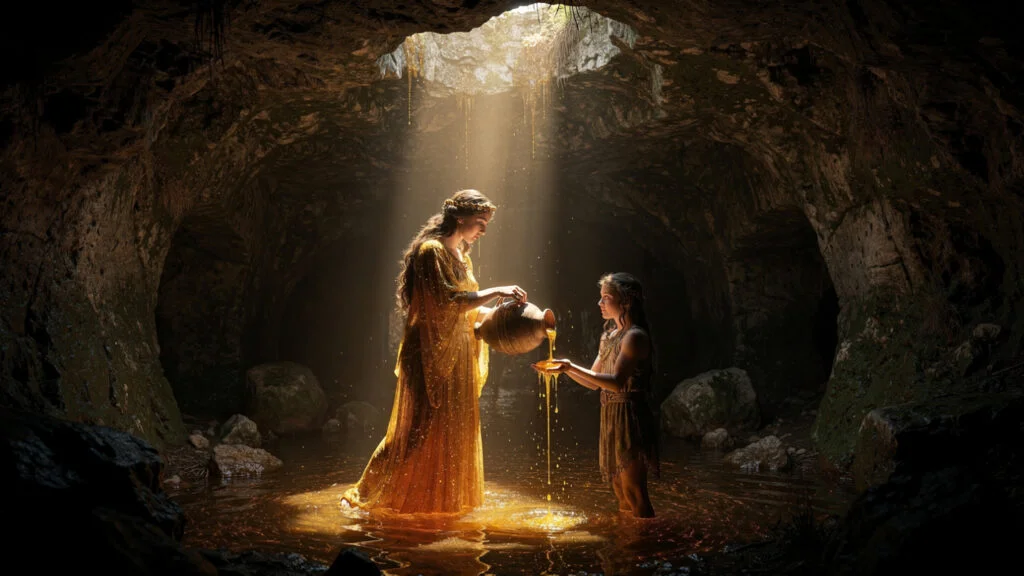
This detail is not incidental. In a mythology built around the consumption and withholding of children, Kronos devouring his own offspring to prevent the prophecy of his overthrow, the infant who would become the king of the gods survived on the two substances the Greek world considered closest to the sacred: milk and honey, the nourishment of the cave rather than the table, gathered rather than cultivated, taken directly from the wild order of the world rather than produced by human labor. Zeus was raised not by a goddess but by a bee.
Later tradition rewarded Melissa, or punished her, depending on the version, by transforming her into the first bee, granting bees the gift of producing honey while also giving them the sting that would forever associate their gift with the possibility of harm. The Greeks understood this duality as essential to the bee’s nature: a creature capable of producing the sweetest substance known to them while remaining armed, disciplined, and entirely unsentimental in its defense of what it had made.
The Bee Priestesses of Demeter and the Delphic Oracle
The mythic Melissa gave her name to an entire category of religious functionary. At several major sanctuaries across the Greek world, priestesses serving particular goddesses were known formally as Melissae, and the title was not honorific decoration. It described a specific religious role rooted in the perceived qualities of the bee itself: chastity, since bees were widely believed in antiquity to reproduce without male involvement, industriousness without excess, and a form of collective discipline that placed the needs of the community above any individual member.
At the sanctuary of Demeter, where the mysteries of agricultural fertility and the cycle of death and renewal were enacted, the priestesses who served the goddess carried this title, linking the bee’s tireless cultivation of nectar into honey with Demeter’s own governance of the harvest. The connection was not poetic flourish. Both goddess and insect performed the same fundamental labor, transforming what the land offered into the substance that sustained the community through the lean months, and both demanded, from those who served them, the same discipline of restraint.

The most consequential use of the title belonged to Delphi. The Pythia, the prophetic priestess of Apollo whose utterances were treated as the direct voice of the god, was associated in several ancient sources with the bee, and the sanctuary itself preserved traditions describing its earliest oracular structure as having been built by bees, of beeswax and feathers, before the more familiar architecture of stone took its place. Pindar, writing in the early fifth century BCE, refers to the Delphic priestess in language that draws directly on the imagery of the bee, and later writers continued the association, treating the prophetic voice itself as something gathered the way a bee gathers nectar, drawn from many sources and concentrated into a single, potent utterance.
This is the deeper logic beneath the comparison. The Pythia, like the bee, did not generate her pronouncements from nothing. She gathered them, through trance and ritual preparation, from a source beyond herself, the vapors of the earth in the ancient accounts, and delivered them in concentrated form to those who came seeking guidance. The bee gathering nectar across a hillside of a hundred different flowers and returning it as a single substance was, to the Greek mind, performing in miniature exactly what the oracle performed on behalf of the god.
The Order of the Hive
What gave the bee this religious authority in the first place was something any Greek farmer could observe directly. A hive in full spring motion reveals a form of organization that is both precise and deeply restrained. Each bee follows a role shaped by the requirements of the colony: foragers track the bloom cycles of the surrounding landscape, others process what is brought in, and the continuous work of construction proceeds without interruption or waste. Nothing in the hive exceeds what the colony requires.
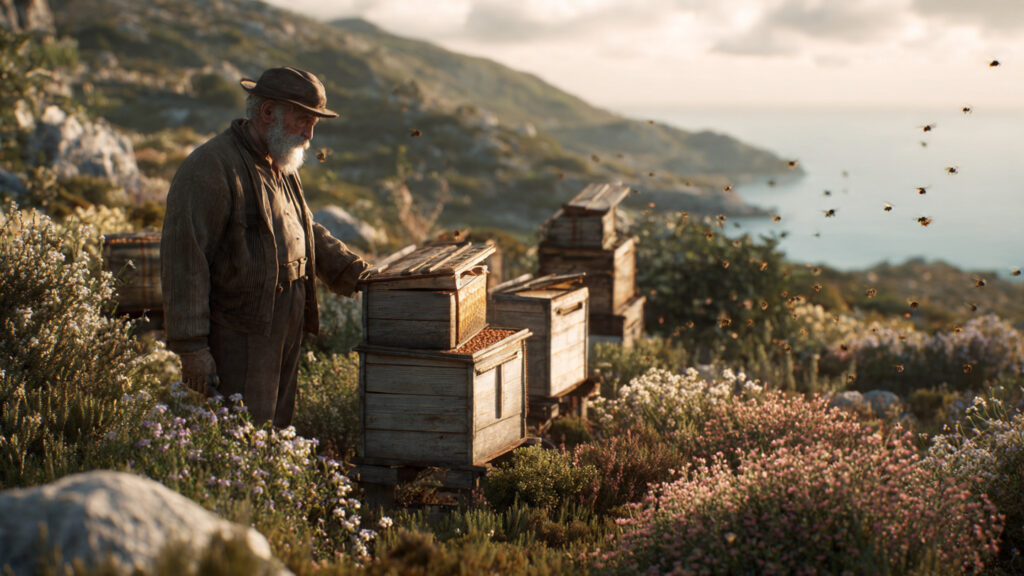
The honeycomb’s hexagonal geometry drew direct philosophical attention. Aristotle, in his writings on natural history, noted the mathematical precision of its construction, and later philosophers returned to it repeatedly as an example of order emerging from the disciplined, repeated action of many individuals without any single directing intelligence imposing the form from outside. The structure achieves the minimum material for the maximum storage volume with the greatest possible stability, a feat of unconscious engineering that ancient and modern observers alike have found difficult to fully explain.
To a culture that had not yet separated natural philosophy from religion, a structure this precise, produced by creatures this small, operating without any visible authority directing them, was not merely impressive. It was evidence. The bee seemed to demonstrate that order did not require a king giving commands, that discipline could be collective and self-sustaining, and that something resembling divine law might already be operating in the visible world, available to be observed by anyone willing to watch a hive closely enough.
Honey on Kythira
This is the tradition carried, mostly unspoken now, into the spring fields of Kythira. The island sits at the crossing point of the Aegean and Ionian currents, between the southern Peloponnese and the northwestern edge of Crete, and its limestone hillsides, gorges, and salt-exposed coastal terraces support a sequence of flowering plants beginning in late winter: thyme, sage, rockrose, lavender, and the small yellow flowers of broom, each opening in turn and passing its particular character into the honey gathered from it.
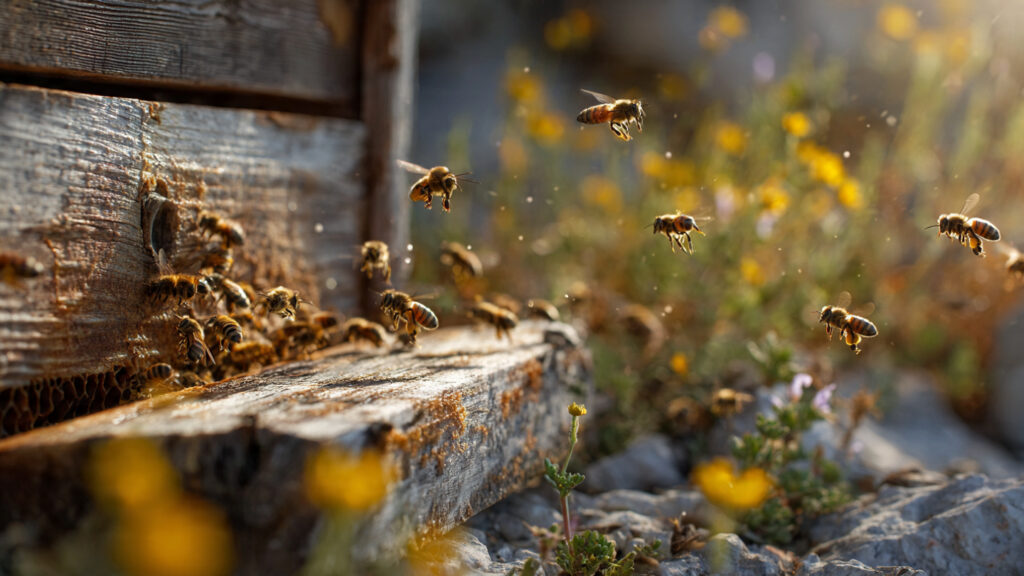
Honey drawn in the first weeks of bloom, before summer heat concentrates the nectar and darkens the color, has a freshness that later harvests do not replicate. The early spring honey of Kythira, light in color and sharp with aromatic resin, carries the mineral signature of the island’s limestone in the same way the celebrated honey of Mount Hymettus near Athens has, since antiquity, carried the specific character of the thyme that covers those hillsides. In both cases the honey is inseparable from the land that produced the plants from which it was gathered, a record of place that no industrial process can replicate or fake.
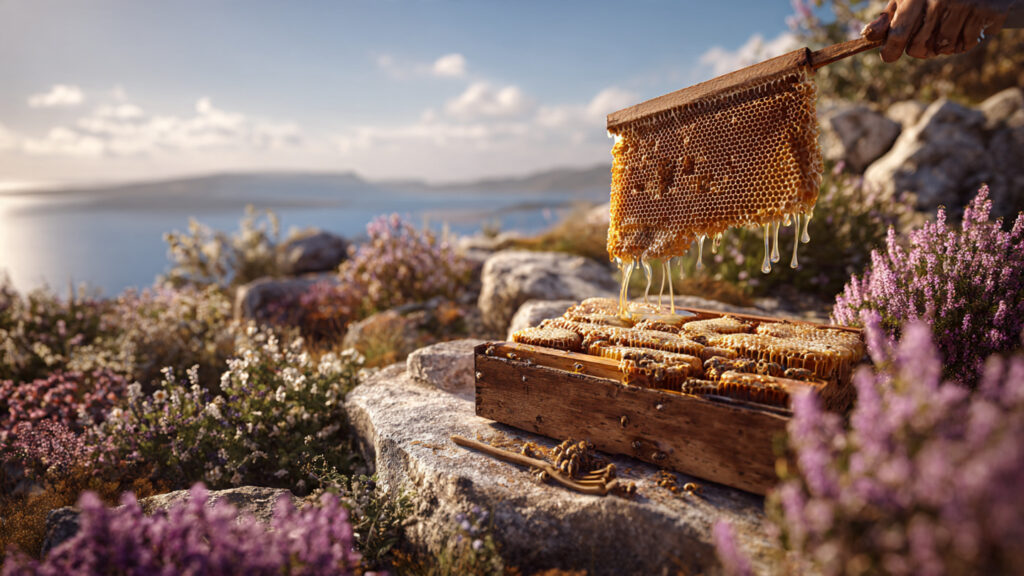
The beekeepers who tend these hives today are not priestesses of Demeter, and the comparison would likely make most of them uncomfortable. But the discipline the work requires, the close, unhurried attention to a colony’s signs of strength or stress, the restraint not to harvest more than the bees can spare before a cold spell, the patience to let the hive’s own order dictate the calendar rather than imposing one from outside, is recognizably the same discipline the ancient sources attributed to the bee itself and asked, in turn, of anyone who served it.
What the Bee Still Teaches
The Melissae are gone. The bee oracle at Delphi gave way to the more familiar tripod and trance long before the sanctuary reached the height of its fame, and the priestesses who once carried the title at Demeter’s sanctuaries left no surviving record beyond their name. What remains is the bee itself, still building the same hexagonal structure Aristotle examined, still gathering across the same kind of hillside that fed the honey of Hymettus and feeds the honey of Kythira now, still operating according to a discipline that requires no enforcement because every member of the colony carries it without exception.

The ancient Greeks looked at this and saw something worth naming as sacred: not the honey itself, sweet as it was, but the order that produced it, an order achieved without a ruler, sustained without ceremony, and visible to anyone patient enough to stand at the entrance of a hive in early spring and watch it work.
At Olympus Estate, Mythic Essays traces the deeper currents of Greek myth. The Melissae, the bee-priestesses of Demeter and the bee imagery long associated with the Delphic oracle, reflect an ancient belief that bees occupied a unique position between the human and divine worlds. The nymph Melissa fed honey to the infant Zeus in his cave on Crete. The discipline she represents is still visible each spring in the hives of Kythira, where honey continues to carry, in taste and color, the record of the island that produced it.