




The horiatiki is not a salad in the sense that the contemporary food culture uses the word.
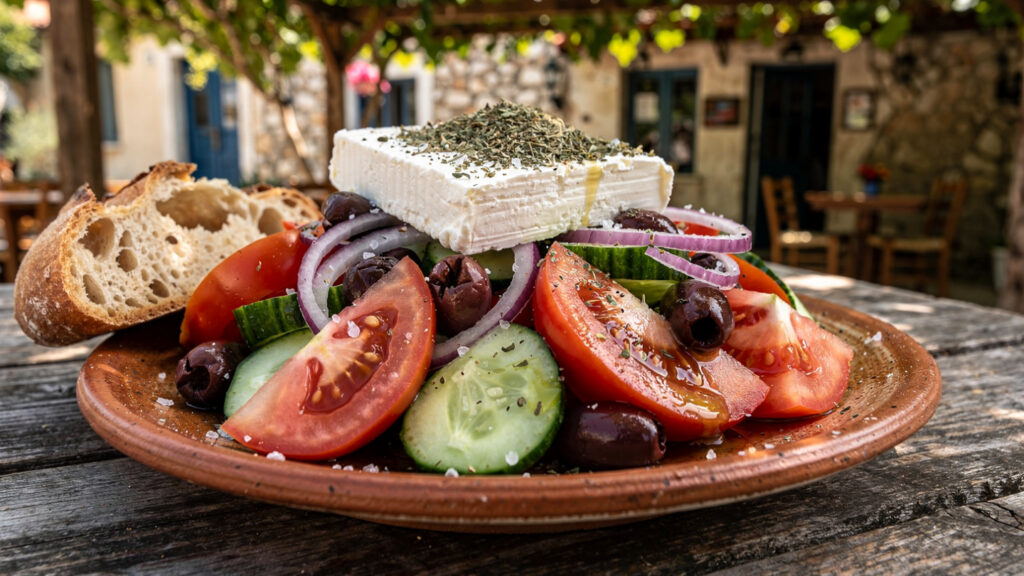
A salad, in the modern understanding, is a dressed preparation of mixed vegetables or greens, assembled for a meal and consumed as a component of it. The horiatiki, the village salad that is the most eaten food in Greece in the summer months, is something more specific: a combination of four primary ingredients, ripe tomatoes, cucumber, onion, and Kalamata olives, dressed with olive oil and dried oregano, with a block of feta placed on top uncrumbled and uncut, the whole eaten with bread directly from the plate. It is the summer meal, not a component of it, in every village and every taverna from Macedonia to Crete when the tomatoes are at their August peak.
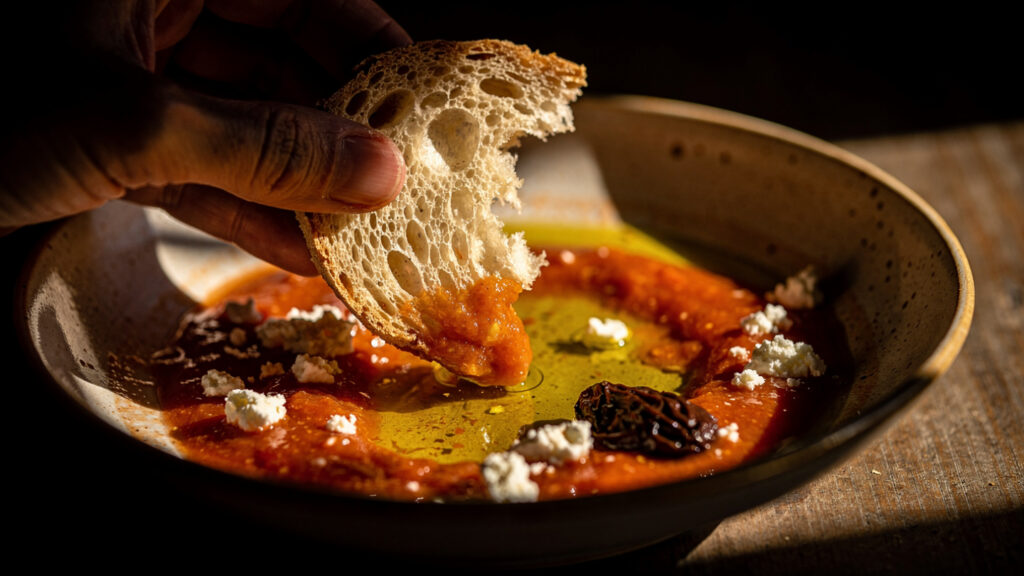
The block of feta on top is the detail that identifies the horiatiki as a cultural object rather than a generic salad. It is not crumbled because crumbling would distribute the cheese through the other ingredients in a way that the tradition does not intend. It sits on top so that the person eating it can cut whatever quantity they want into the portion they take on the fork at any given moment, the ratio of cheese to tomato and olive to each bite being a personal decision made at the table rather than predetermined by the preparation. The olive oil that dresses the tomatoes gathers in the bowl’s base as the salad is eaten and becomes the liquid that the bread is dipped into at the end. The bread at the end is not optional.
This is not a recipe that requires a recipe. It requires August tomatoes, good Kalamata olives, feta that has been made from sheep’s milk in the traditional way, extra virgin olive oil of sufficient quality that its flavor is present in the finished preparation, and dried oregano from the Greek mountains where the herb grows in the climatic conditions that concentrate its aromatic oils. With those ingredients, the assembly takes three minutes and produces something that cannot be improved by technique.
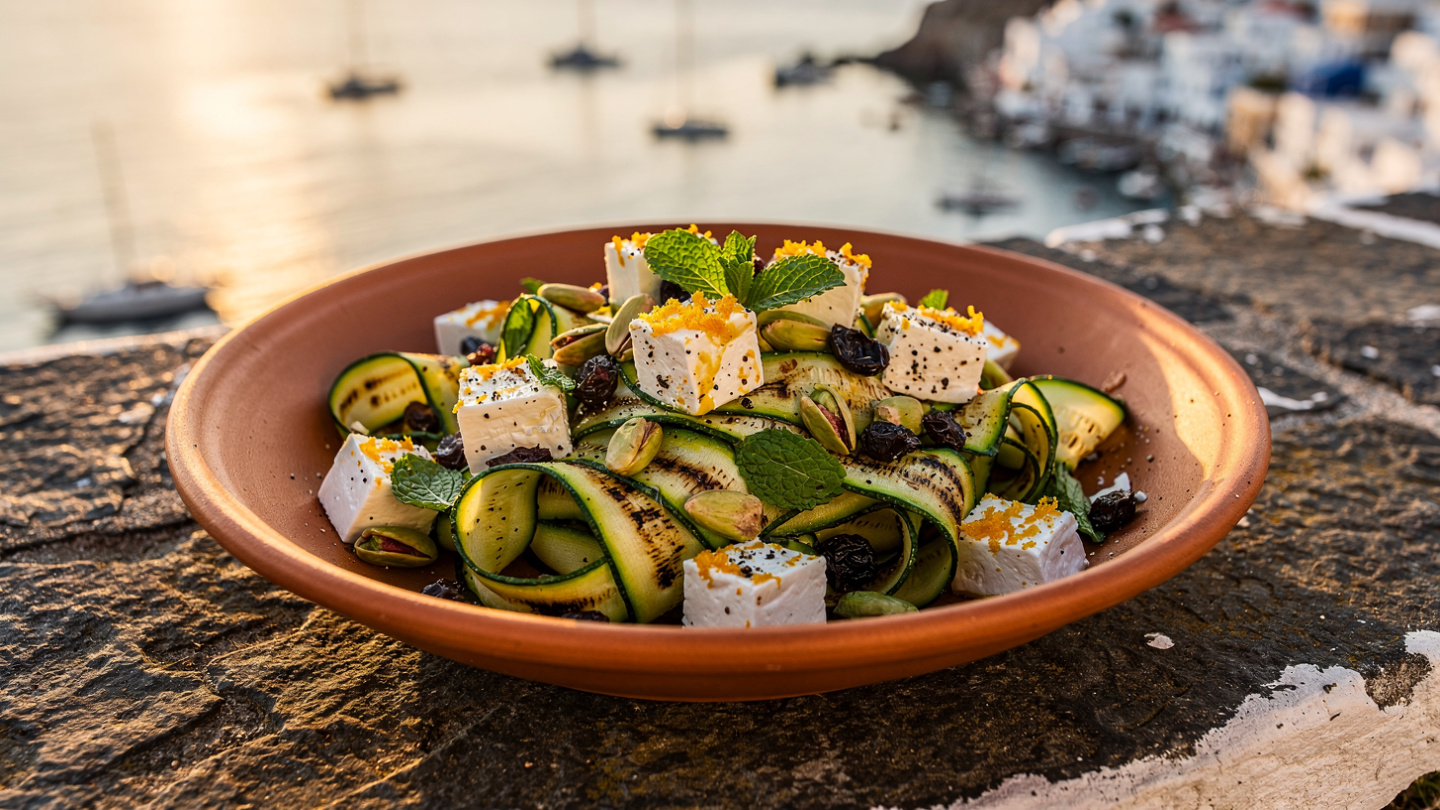
The second salad in this article operates in a different register: the marinated feta, which is not the horiatiki’s centerpiece block but a preserved cheese preparation in its own right, combined with zucchini, pistachios, raisins, fresh mint, and the zest of an orange in a preparation that takes the Greek cheese tradition’s most fundamental technique, preservation in olive oil with aromatics, and develops it into a summer salad of considerable sophistication.
The Horiatiki | What It Requires
The horiatiki‘s quality is entirely determined by the quality of its primary ingredient, the tomato, which is why it is a summer dish in Greece and not a year-round one, and why the version made in January from supermarket tomatoes in any country outside Greece is not the same dish.
The tomatoes that the Greek summer table uses, the large, irregular, deeply red varieties that the Cycladic and mainland Greek sunshine produces by the end of July, have a combination of sweetness, acidity, and flesh density that the controlled-environment tomato cannot replicate. The sugar content is higher because the plant has spent more time in sun. The water content is lower because the Greek summer’s dryness concentrates the flesh. The acidity is balanced against the sugar in a way that neither the under-ripe nor the over-ripe tomato achieves. A ripe August Greek tomato eaten with nothing on it is already the best the ingredient can be, and the horiatiki is the preparation that treats this fact with the respect it deserves: as few additions as possible, each one serving a function.
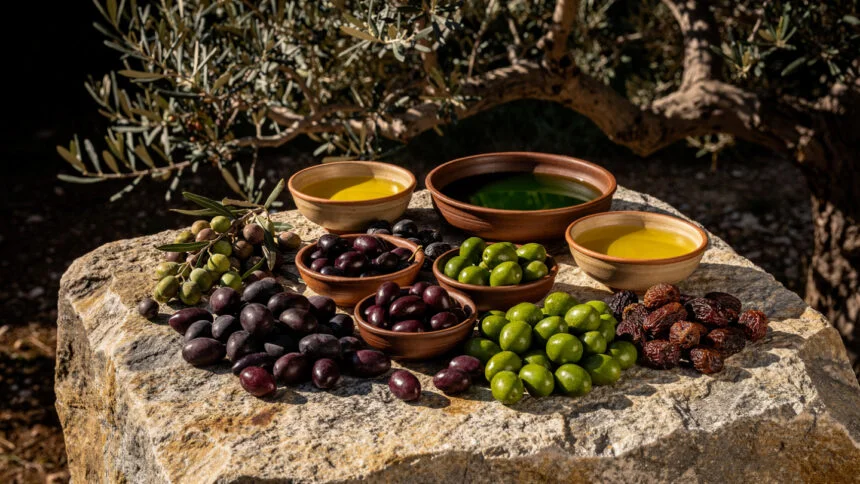
The cucumber should be the thin-skinned variety rather than the thick-skinned greenhouse cucumber: less watery, with a more concentrated flavor and a skin that does not require removal. The onion should be red, sliced thin enough that its sharpness softens in the olive oil without disappearing entirely. The Kalamata olive, the elongated dark olive from the olive groves of the southern Peloponnese, is the only olive the traditional horiatiki uses: its brininess and the fruity quality of its cured flesh are the flavors the dish is built around, and substituting a different olive produces a different salad.
The feta is a PDO product, which means that the name feta can only legally be applied to cheese made from sheep’s milk, or sheep’s milk combined with up to 30 percent goat’s milk, produced in regions of Greece, including Macedonia, Thrace, Epirus, Thessaly, Central Mainland Greece, the Peloponnese, and Lesbos, according to traditional methods. The PDO designation was confirmed by the European Court of Justice in 2005 after a legal challenge from Danish and German producers who had been making feta-style cheese with cow’s milk outside Greece. The distinction matters in the horiatiki because the sheep’s milk feta has a flavor, saltier, more acidic, and more complex in its fatty acid profile than cow’s milk cheese, that the dish is designed around.
The olive oil should be extra virgin and should be Greek. This is not nationalism in food form: it is the recognition that the olive oils of Greece, particularly those of the Peloponnese, Crete, and Lesbos, have a character suited to the horiatiki in a way that oils from other traditions do not. A Peloponnesian Koroneiki oil, peppery and grassy and present, dresses a Greek salad correctly. A mild Italian olive oil disappears into the tomato juice. The oil should be present enough to taste.
The dried oregano should come from wild Greek mountain oregano rather than the cultivated variety. The two plants have the same species name, Origanum vulgare, but the flavor concentration in the wild mountain variety, produced by the plant’s adaptation to the stress of dry, rocky, high-altitude terrain, is considerably more intense. Greek mountain oregano rubbed between the fingers before it hits the salad releases an aromatic intensity that the cultivated variety does not reach.
Horiatiki for four
4 large ripe tomatoes, cut into irregular wedges 1 medium cucumber, sliced into half-rounds 1 small red onion, sliced thin 1 cup Kalamata olives, unpitted 200g feta, in a single block 4 tablespoons extra virgin olive oil 1 teaspoon dried Greek mountain oregano Sea salt, to taste Crusty bread, to serve
Arrange the tomatoes in a wide bowl or on a plate. Add the cucumber, onion, and olives. Pour the olive oil over everything. Crumble the salt over the surface. Place the block of feta on top. Scatter the oregano over the feta and the vegetables. Bring to the table exactly as it is and eat with bread.
There is no step between the assembly and the table. The oil will pool in the base of the bowl as the meal progresses. That is the bread course.
The Marinated Feta | A Preserved Cheese Preparation
The practice of preserving cheese in olive oil with herbs and aromatics is one of the oldest continuous techniques in the Greek culinary tradition, predating the written recipe by several millennia and documented in the archaeological record of the Bronze Age Aegean in the form of the oil storage jars, the pithoi, that the palace economies used to hold the olive oil that the cheese preservation requires.
The marinated feta in this recipe is not a convenience shortcut or a modern invention. It is the contemporary expression of a preservation practice that Greek households used to extend the life of fresh cheese through the summer months, when the milk production of the sheep and goats was at its highest and the cheese that could not be consumed immediately needed to be held in a stable condition for the weeks ahead. Olive oil, which does not support bacterial growth and which communicates its flavor to whatever is submerged in it across the days and weeks of preservation, was the medium. The aromatics, herbs, black pepper, and in some traditions, dried chili and garlic, were the flavorings that developed in the oil alongside the cheese flavor and produced something more complex than either ingredient separately.
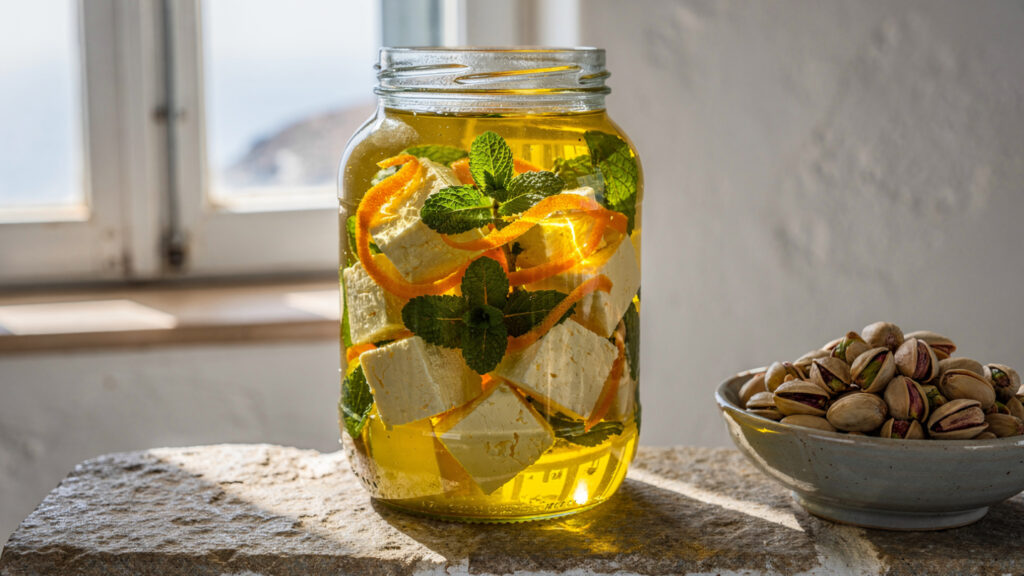
The orange zest in this recipe is the element that connects the preparation most directly to the Cycladic flavor palette: the eastern Mediterranean’s use of citrus zest with cheese and olive oil is documented in the culinary traditions of the islands where citrus cultivation and olive cultivation have coexisted since the Venetian period and in some cases since antiquity. The orange’s zest, which carries the aromatic oils of the peel without the juice’s acidity, lifts the richness of the feta and the olive oil without the sharpness that lemon juice would introduce.
The pistachios are an eastern Mediterranean nut whose cultivation in the Greek world is documented from the classical period: Theophrastus mentions the pistachio tree in his botanical writings, and the nut’s presence in the eastern Aegean, particularly in the Aegina variety that Greek pistachio cultivation has made internationally recognized, places it within the Cycladic and island Greek table as a legitimate ingredient with deep regional roots.
The raisins, the small dried Corinthian currant that the Ionian Islands produced in quantities that made the Venetian trade network wealthy and that Zakynthos exported under the name Zante currant, add the concentrated sweetness that dried fruit introduces to a savory preparation: not sugary in the way that adding sugar would be, but the sweetness of fruit whose water content has been removed and whose sugar has been concentrated by the sun. This combination of savory cheese, herbaceous olive oil, citrus, nut, and dried fruit is the Cycladic flavor matrix at its most characteristic: the table that the Greek islands have set in summer for centuries, assembled from what the landscape and the sea trade routes made available.
Marinated feta with zucchini, pistachios, and orange
Begin the night before.
For the marinated feta: 200g feta, cut into 2cm cubes A generous handful of fresh mint leaves Freshly ground black pepper, several turns Zest of 1 orange Extra virgin olive oil, enough to submerge the feta
Place the feta cubes in a clean jar. Add the mint leaves, black pepper, and orange zest. Pour olive oil over everything until the cheese is fully submerged. Seal the jar and refrigerate overnight, or for up to three days. The oil will take on the flavor of the mint and the orange zest, and the feta will absorb the oil’s aromatics in return.
For the salad: 2 medium zucchini 1 teaspoon sea salt ½ cup roasted salted pistachios ¼ cup dried raisins or Corinthian currants 1 tablespoon of the marinating oil Fresh mint leaves, for finishing Additional orange zest, for finishing
Using a vegetable peeler, draw the blade along the length of each zucchini to produce long, thin ribbons. Toss the ribbons with the salt in a bowl and leave for ten minutes: the salt draws excess moisture from the zucchini and softens the ribbons slightly, making them more receptive to the marinating oil.
Drain any liquid that has collected in the bowl. Add the pistachios and raisins and toss to combine. Remove the feta from the jar, leaving the mint leaves behind in the oil, and place the cubes over the zucchini mixture. Drizzle one tablespoon of the marinating oil over everything. Toss gently, taking care not to break the feta cubes.
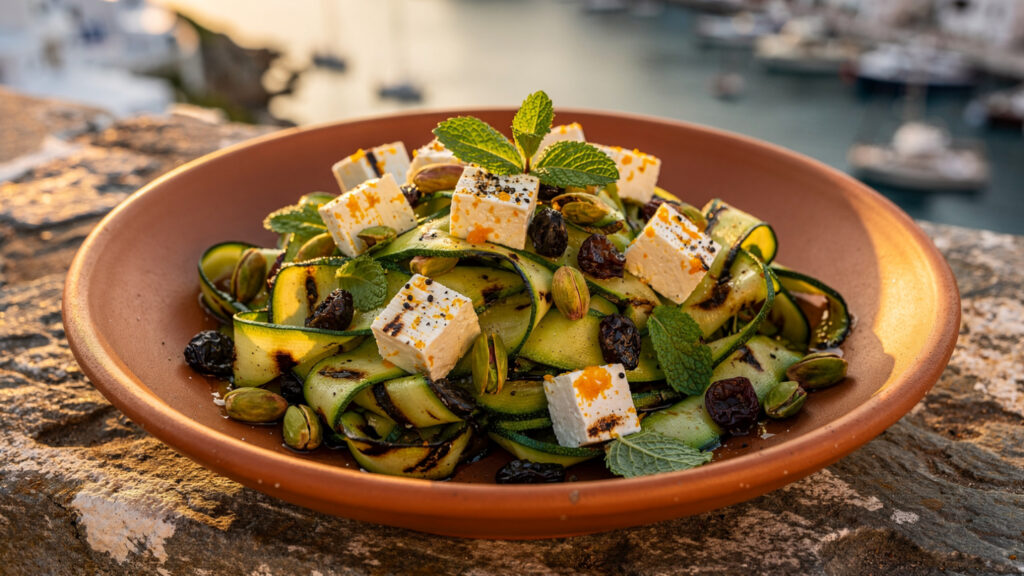
Transfer to a serving plate or a wide shallow bowl. Finish with fresh mint leaves and a little additional orange zest over the surface. Serve at room temperature or slightly chilled.
The salad is complete when assembled and is best eaten within two hours of dressing. The zucchini ribbons will continue to soften as they sit in the oil and salt, which changes their texture from tender-firm to fully soft across that window of time. Both textures are good. The earlier version is more structured. The later version is more melded.
What the Two Salads Share
The horiatiki and the marinated feta salad are not similar preparations. They are different in their complexity, their assembly time, their flavor profile, and the cultural context that produced them.
What they share is the organizing principle of the Greek summer table: the best ingredient available at this moment, prepared with the minimum intervention required to express its quality, dressed with olive oil of sufficient character to be a flavor in its own right rather than a neutral carrier, and finished with the dried herbs or the fresh aromatics that the Greek landscape produces in abundance in the months when the sun is at its fullest.
The horiatiki takes three minutes to assemble and is not improved by additional effort. The marinated feta requires a night of preparation and rewards it. Both require ingredients rather than generic substitutes. Both are dishes that make no sense in winter and are some of the best things the Greek table produces in August.
The bread that the horiatiki ends with and the pistachios that the marinated feta includes are both, in their different ways, the same gesture: the thing on the table that allows the meal to continue past the point where the primary ingredients have been eaten, because the olive oil pooled in the base of the horiatiki bowl and the oil left in the salad after the feta and zucchini are gone are too good to leave.
At Olympus Estate, Food and Seasonal Life traces Greek cuisine as a living calendar, from the August tomato that makes the horiatiki what it is to the overnight marination that turns feta into something the Greek islands have been making since before the first recipe was written down. The summer table does not need much. It needs the right things.