

The Greeks had a word for what a family reunion is trying to be.
Oikos. It is usually translated as household, but the translation is inadequate. The Oikos was not the building. It was the living continuity of a family across generations, the physical property, the ancestral objects, the obligations of kinship, the shared memory that connected the living to the dead and the present to the past. It was tended by Hestia, the goddess who had no mythology because she was the condition that made all other activity possible: the stable fire at the centre, the warmth that the family organised itself around, the presence that made a collection of individuals into a household.
Hestia was the first-born of Kronos and Rhea, and she was the first offering at every sacrifice and the last. She received the first and last portions because the fire that she embodied opened the ritual and closed it. Nothing that the Greek world considered significant began or ended without her acknowledgement.
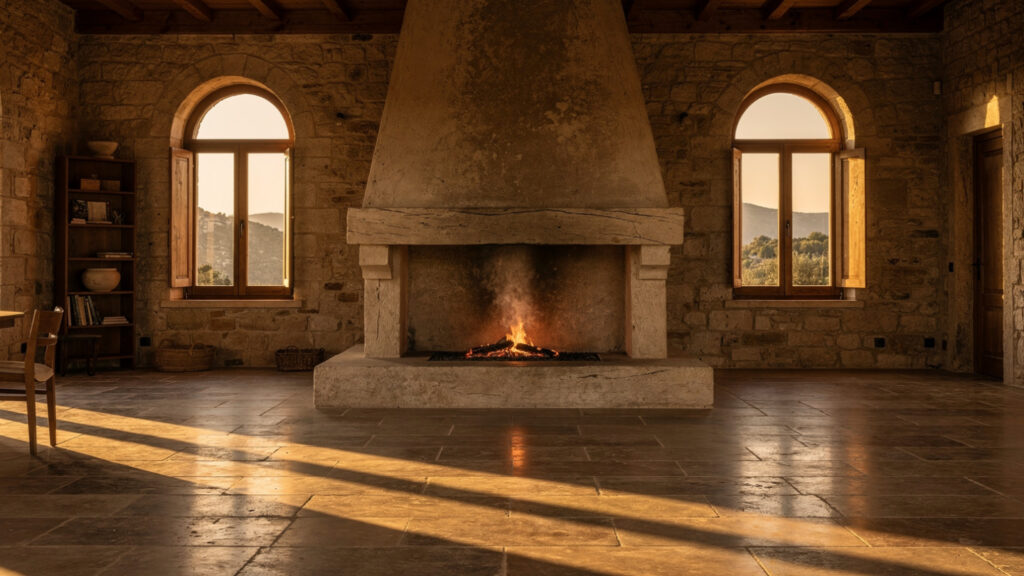
A Greek estate, entered by three generations for a week or two of shared life, is a contemporary Oikos in the most literal available sense: a fire that multiple generations gather around, a space whose proportions and materials and arrangement carry the intelligence of a building tradition that understood how families actually live together, a landscape that returns the people inside it to the quality of time and attention that ordinary life, distributed across separate addresses and separate schedules, does not make available.
This is not a romantic claim about Greece. It is a description of what the physical experience of a well-chosen Greek estate actually produces in the people who inhabit it properly.
What the Building Provides
The Greek domestic architectural tradition, from the Zagori mansion to the Cycladic courtyard house to the Ionian villa, was built around an understanding of how generational and domestic life required space.
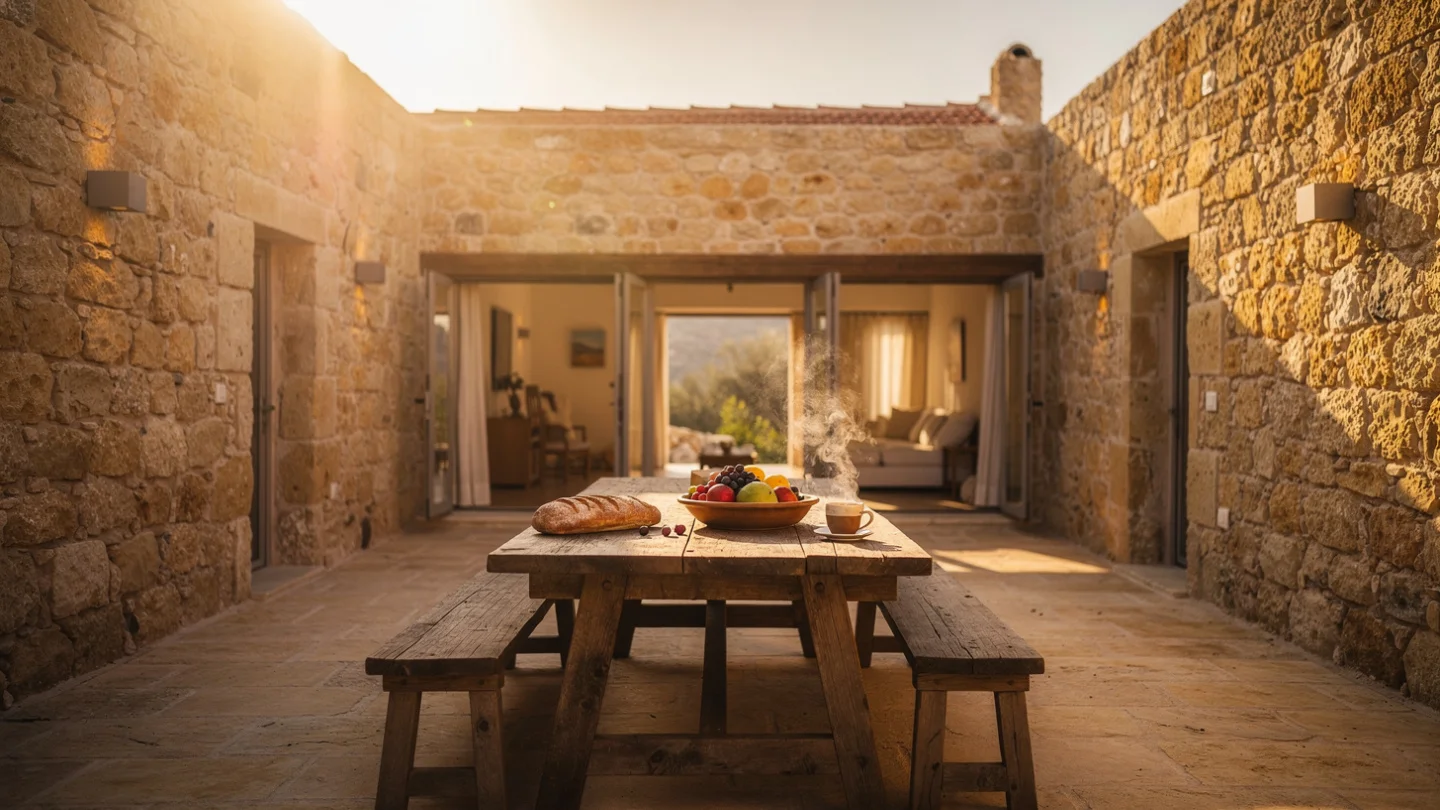
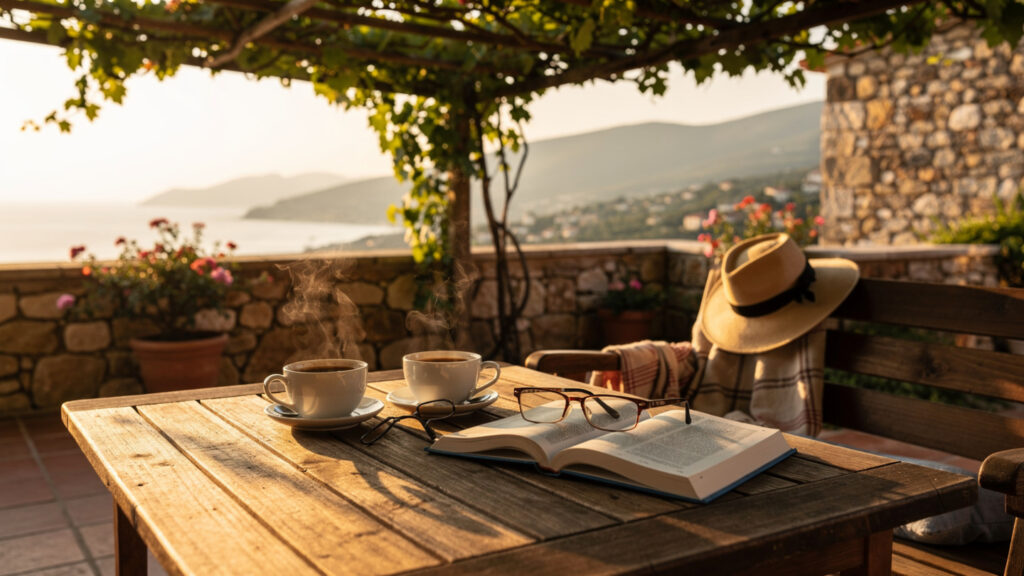
A courtyard at the centre. Rooms that open to it and to each other, so that the household is porous in its interior even when it is closed to the exterior. Thick stone walls that maintain temperature without mechanical intervention. A large kitchen, a central hearth or its modern equivalent, placed where the household’s social gravity naturally accumulates. Exterior spaces, terraces and gardens and shaded pergolas, that extend the domestic interior into the landscape and allow the household to live outside without leaving the property.
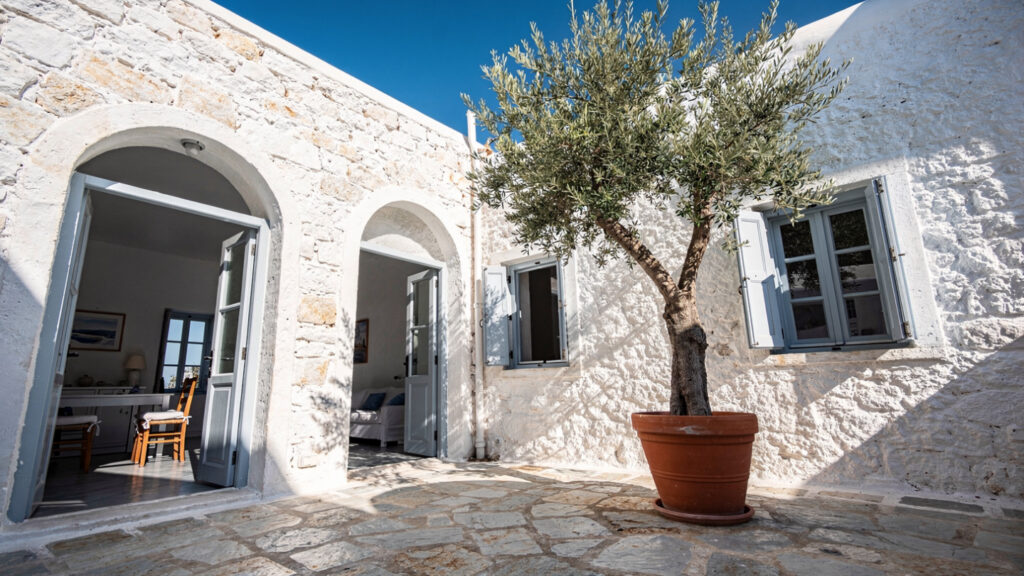
These are not luxury features. They are the architectural solutions that the building tradition developed for the problem of how multiple generations sharing a space maintain both proximity and independence, both communal warmth and individual privacy. The grandparent who needs quiet in the afternoon and the teenager who needs freedom in the evening can coexist in a property whose rooms are organised around a courtyard precisely because the courtyard holds them in relation to each other without requiring continuous interaction.
The qualities to prioritise in a multigenerational Greek estate are these. Ground-floor sleeping accommodation that does not require stair navigation, for the members of the household whose morning requires access to the garden without negotiating a flight of steps at six in the morning. A kitchen large enough for three simultaneous cooks, because the meal that the family prepares together is the Oikos functioning at its most complete. A pool with a shallow area and a secure boundary, because the youngest members of the household will spend most of the daylight hours in or near it. And multiple outdoor spaces at different distances from the main living area, so that the family can be simultaneously together and separate, present to each other across the property without being in each other’s rooms.
The Greek estate tradition produces these qualities naturally. It was not designed for luxury tourism. It was designed for the social reality of a family living together across multiple generations, and that social reality is unchanged.
The Table and What Happens Around It
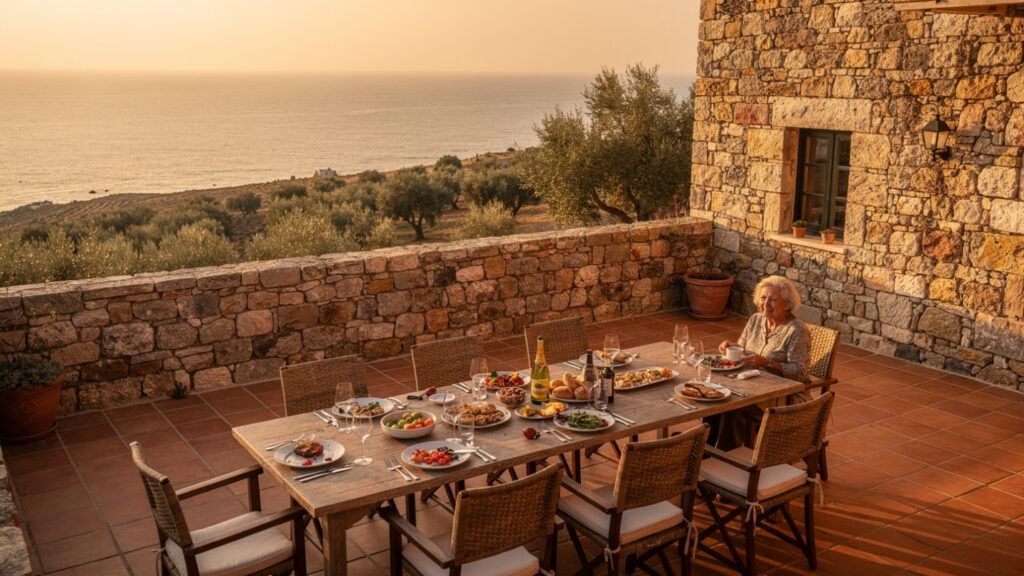
The most important square metre of any multigenerational Greek estate is the outdoor dining table.
This is where the Oikos reconstitutes itself each evening. Where the grandmother and the five-year-old occupy adjacent chairs without the intermediary structures of separate mealtimes and separate dietary requirements that urban life imposes. Where the conversation moves between the adults and the children in the way that Greek table culture has always moved: without the formal separation of children’s topics and adults’ topics, without the assumption that children require a different register of engagement from the one the adults are using, with the understanding that the shared table is the primary space of transmission, the place where what the family knows about itself is passed from one generation to the next.
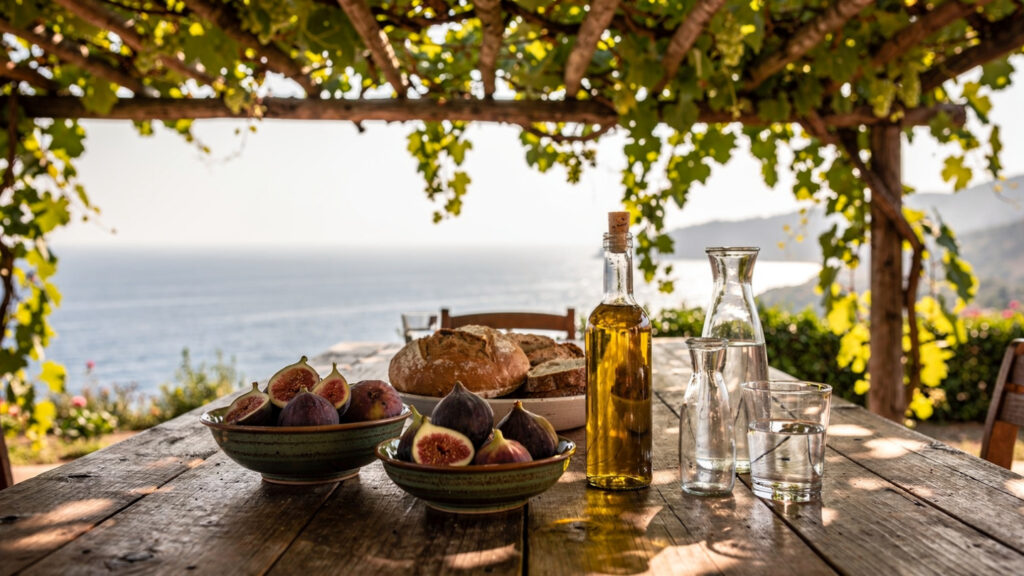
The Greek culinary tradition supports this specifically. The mezze structure, multiple small dishes arriving across the duration of the meal rather than a single serving timed to a schedule, keeps the table active for two hours rather than forty-five minutes. Each new dish resets the conversation. Each refill of the wine or the water extends the shared time without requiring anyone to extend an effort. The meal does not end because the food is finished. It ends because the last conversation has reached its natural conclusion, which is a different and considerably later event.
A private chef for one or two evenings during the stay is worth considering not as a luxury but as a cultural encounter: a local cook who knows the dishes of the region, who can teach the family how to make spanakopita from the phyllo up or how to slow-roast a whole lamb in the way that the village oven was designed for, who carries in their knowledge the culinary geography of the place the family is inhabiting. The children who learn to roll phyllo dough under instruction are learning a physical skill that carries cultural memory inside it. They will remember it in a way they will not remember the beach club.
Crete | Scale and Depth for Every Generation
Crete is the first recommendation for multigenerational Greek travel for a reason that has nothing to do with its most famous feature.
The island is large enough to contain a week of genuine variety without any member of the household feeling they have been taken somewhere designed for someone else. The elders who want the Palace of Knossos at a measured pace and a private guide who does not rush can have that morning while the teenagers have the gorge. The children who want the shallow, clear water of the south coast beaches can have an afternoon while the parents explore the Venetian harbour of Chania with the grandparents who have been talking about its architecture since the flight. The island holds all of these simultaneously and they do not require coordination beyond the shared evening at the table.
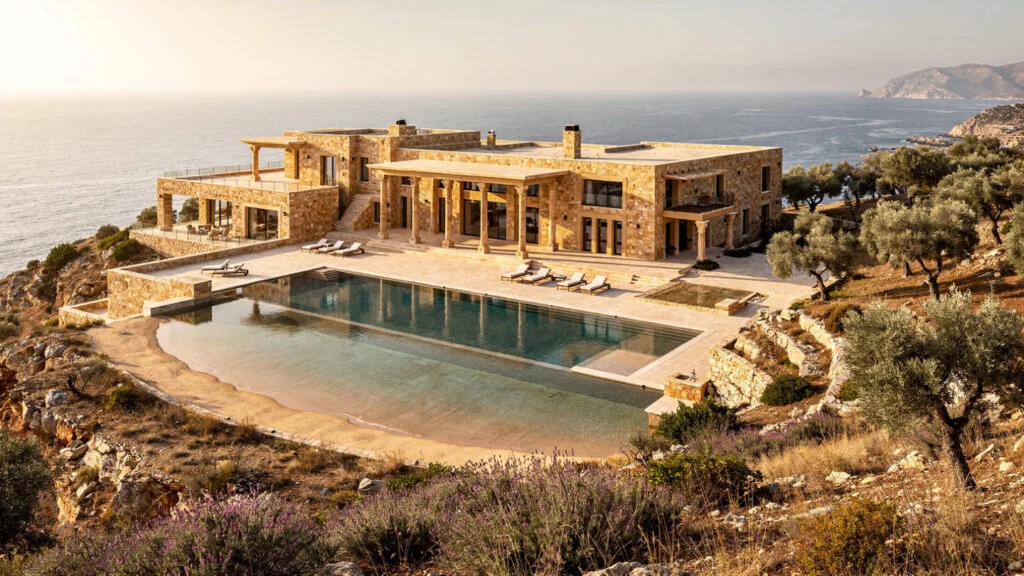
The Minoan civilisation that Crete preserves in its archaeological record has a quality that older visitors and children respond to simultaneously: it was domestic in its monumental expression. The Palace of Knossos was not a defensive fortress or a temple complex in the deterring, reverential sense. It was a working civic space built around human activity, with a sophistication of domestic comfort, running water, drainage, light wells, that communicates across four thousand years to anyone who has recently thought about how a building should be organised for the people inside it. The child who runs their hand along a Minoan fresco and the grandparent who reads the site’s spatial organisation as a blueprint for civilised domestic life are having, at different registers of understanding, the same encounter.
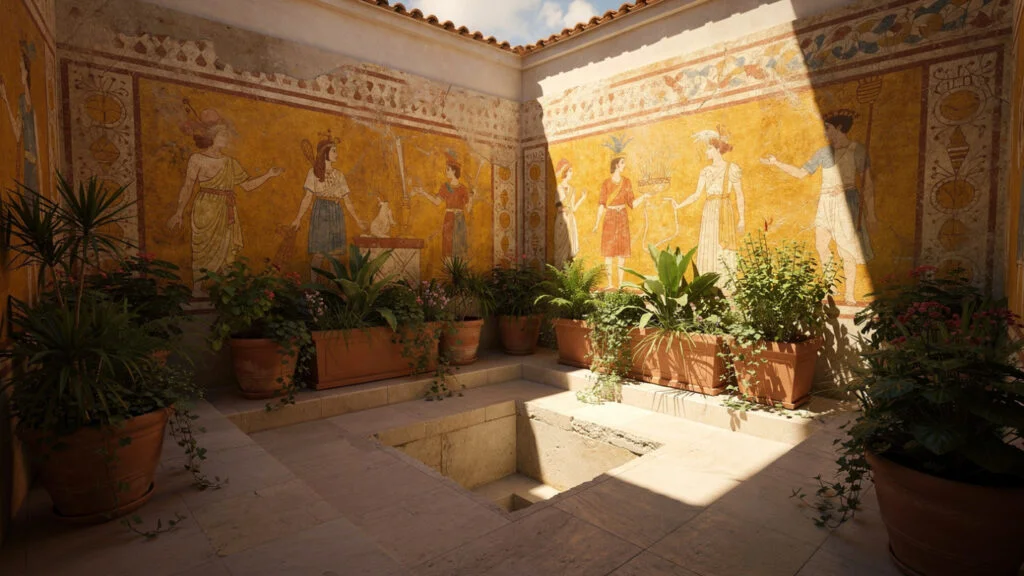
The luxury villa stock on Crete runs from the restored Venetian mansion in the old quarters of Chania to the large contemporary estate with private coastline on the eastern tip of the island. The properties whose architecture engages genuinely with the Cretan vernacular, stone walls, internal courtyards, terraces oriented toward the sea, tend to produce the quality of inhabitation that the Oikos requires: the sense of having arrived somewhere with its own character rather than somewhere that was built to accommodate someone else’s expectations.
The Ionian Islands | Gentler Terrain, Equal Depth
The Ionian Islands present a different Greek landscape from the volcanic drama of the Cyclades or the mountainous intensity of Crete: greener, softer in its gradients, influenced by four centuries of Venetian governance in ways visible in the architecture and the food and the quality of the light through the olive trees in late afternoon.
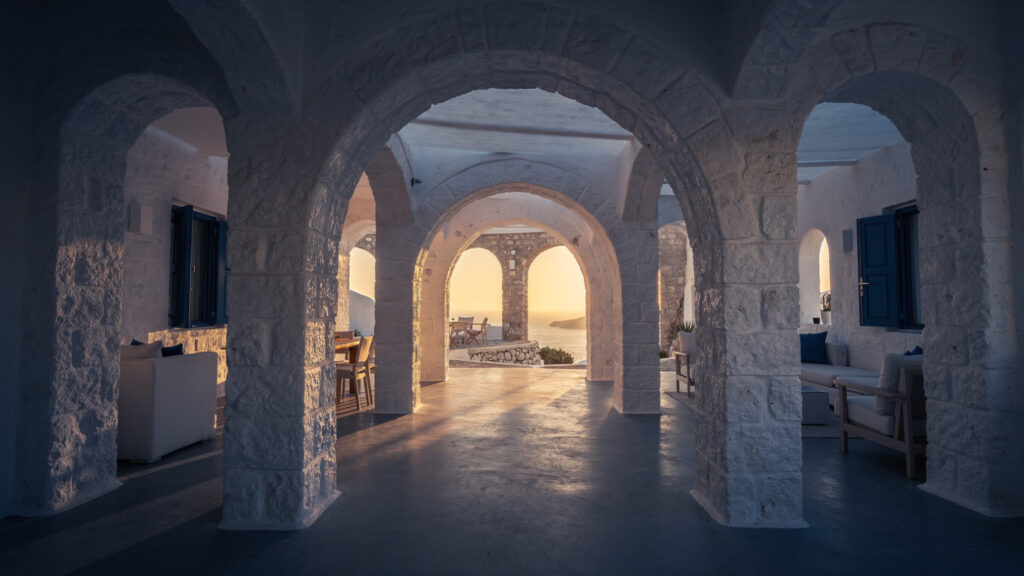
Corfu is the most accessible entry point, with an international airport that accepts direct flights from most European cities and a ferry connection to the mainland that adds a scenic option for families arriving by road. The UNESCO-listed old town of Corfu is genuinely walkable at the pace that the oldest and youngest members of the family set: its Venetian arcades and Byzantine churches and French-era esplanade constitute a historical layer cake that can be engaged at any depth from architectural appreciation to ice cream procurement without either activity interrupting the other.
The villa tradition on Corfu tends toward the Venetian estate model: large gardens, covered loggias, the sense of a property that was built to be the primary residence of a family of substance rather than a seasonal retreat. These buildings have the gravity of places that have been continuously inhabited, and that quality communicates itself to every member of a household who spends more than two nights inside them.
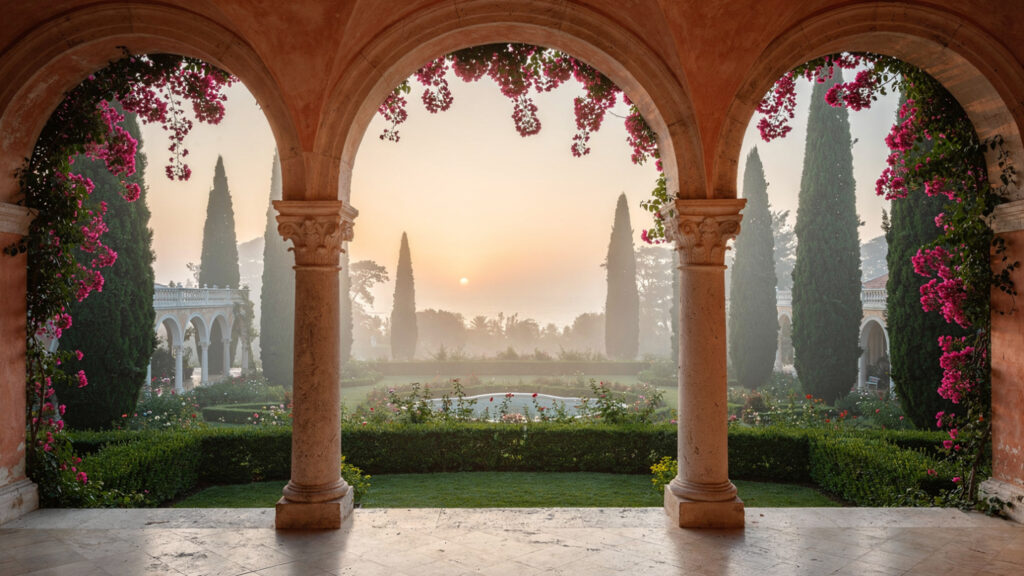
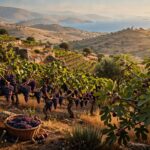
Kefalonia and Lefkada offer similar qualities with fewer visitors and terrain that rewards the family willing to go beyond the obvious locations. The vineyards, the underground lake at Melissani, the Venetian castle above Assos in its setting of extraordinary beauty: these are places that the family who finds them outside the peak summer weeks will have largely to themselves, which is the condition under which the Oikos best reconstitutes itself.
What the Week Actually Contains
The multigenerational Greek estate week does not require programming to justify itself. The estate is already the programme.
Morning coffee on the terrace at whatever hour each generation’s biology produces them is not a scheduled event. It is the quiet form of togetherness that the Oikos managed before the day’s activity claimed its members. The grandmother who rises at six and the teenager who appears at ten occupy the same terrace at different hours, and the coffee cups and the bowl of fruit and the bread from the village bakery that connects their mornings constitute a continuity of shared life that the separate hotel rooms of organised family tourism cannot produce.
The afternoon siesta is not an indulgence for the elders and an inconvenience for the active. It is the Greek day’s built-in structure for allowing a house to breathe: the quiet hours when the stone walls release their absorbed heat into the interior, when the household disperses to its several rooms and its several books and its several forms of rest, and when the reunion of the evening table has enough distance from the morning’s togetherness to feel like an arrival rather than a continuation.
The late evening, when the light on the water has turned to copper and the family has been at the table for an hour and the children are starting to fall asleep in their chairs and the grandparents are finishing the last of the local wine: this is the Oikos at its most complete. Hestia’s fire does not need to be lit explicitly. It is already burning in the quality of attention that people give each other when they have been living in the same building for a week without the interruption of separate schedules and separate rooms and separate cities.
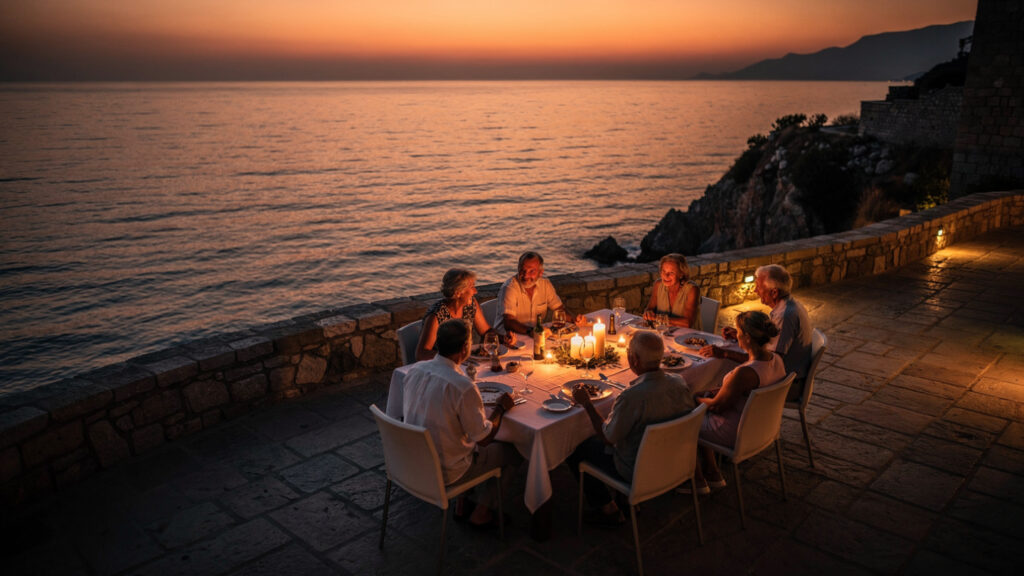
The Greek estate provides the space. The family provides the rest.
Practical Notes
Booking a Greek estate for a multigenerational group requires more lead time than the summer calendar rewards. The properties whose architecture and grounds most fully serve this purpose, stone-built, courtyard-organised, with genuine outdoor space and a kitchen that accommodates collective cooking, are sought for July and August well before January of the same year. May, June, and September offer the same properties at lower occupancy and often lower prices, with the benefit of weather that allows the outdoor life the estate was designed for without the intensity of the August heat.
A property manager or local concierge who knows the estate and the surrounding region is worth engaging from the beginning rather than as an afterthought. They hold the knowledge that makes the difference between a family finding the right baker and the right beach and the right private guide and a family navigating these decisions on arrival without local intelligence.
The multigenerational group should agree before arriving on one principle that the Greek tradition enforced structurally: the shared evening meal is the non-negotiable anchor of the day. Everything else, the excursions, the separate activities, the private time, the afternoon sleep, can be organised around individual preferences. The table at seven or eight or nine in the evening is where the Oikos reassembles itself and where the day becomes a shared possession rather than a parallel series of individual experiences.
Hestia required no temples because she was already present in the fire that every household maintained. She requires nothing more of the contemporary multigenerational Greek estate than the continued tending of the same fire.
At Olympus Estate, Greek Living traces the domestic and daily traditions of the Hellenic world from the ancient household to the contemporary table. Hestia had no mythology because she was the condition that made all other activity possible. She received the first and last portion at every sacrifice because the fire opened the ritual and closed it. The courtyard house was not a luxury form. It was the solution to the problem of how multiple generations sharing a space maintain both proximity and independence. The meal does not end because the food is finished. It ends because the last conversation has reached its natural conclusion. The children who learn to roll phyllo dough are learning a physical skill that carries cultural memory inside it. They will remember it in a way they will not remember the beach club. Hestia requires nothing more of the contemporary multigenerational Greek estate than the continued tending of the same fire.