
For most of its history, the easiest way to travel from Olympos to the capital of its own island was to leave by sea. You walked down the mountain to the little harbour of Diafani, took a boat around the coast, and arrived in Pigadia hours later. The alternative was the mule paths over the mountains of Karpathos, which were worse. Until the end of the 1970s there was no road at all. Electricity arrived around 1980. The twenty-kilometre road south to Spoa, the link that finally tied the village to the rest of the island, was only fully paved in the early 2010s.
That isolation explains almost everything that makes Olympos famous. The dress that many older women still wear on an ordinary weekday. The speech that other Greeks find hard to follow. The windmills along the ridge, the shared bread ovens, the festivals that empty Baltimore and Athens of their Karpathian families every August. And above all the custom that has earned the village its reputation as one of the last matriarchal societies in Europe, a phrase that is half true and more interesting in its true half than in its exaggerated one.
In Olympos the family house went to the first daughter. That single rule, and the long absences of the men who could not inherit, shaped a village where women held the homes, kept the traditions and, for decades at a time, ran daily life while their husbands and brothers worked on the other side of the world.
A Village That Climbed the Mountain | Vrykous and the Pirates
Northern Karpathos was settled long before Olympos existed. In antiquity a Doric city called Vrykous stood on the northwest coast near today’s Avlona, one of the three ancient cities of the island. Parts of its walls, some tombs and the remains of early Christian churches still survive at the place now called Vroukounta, a walk of an hour or so from the Avlona plateau.
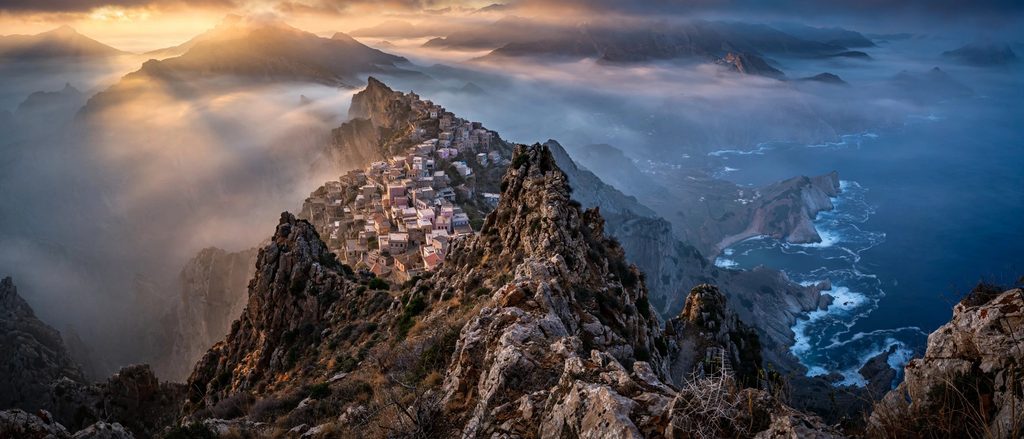
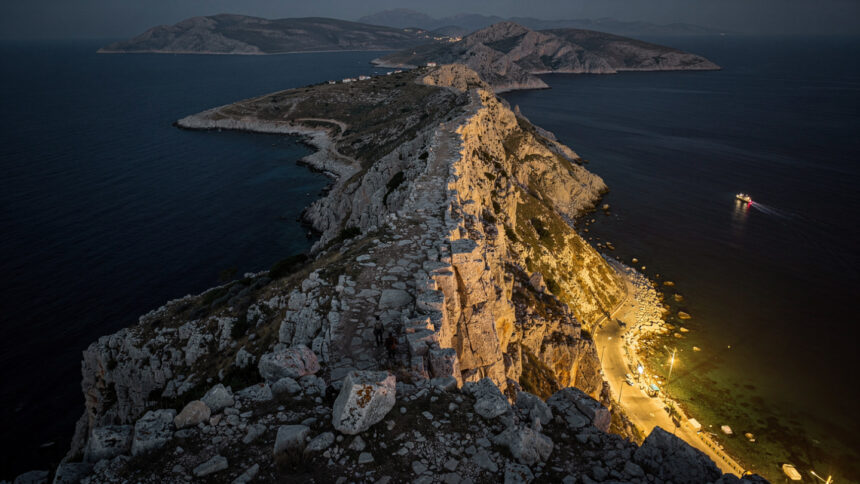
Local tradition says Olympos was founded when the people of that coast gave up on it. Between roughly the seventh and ninth centuries, raids by Arab fleets and pirates made life by the sea in the eastern Mediterranean dangerous across hundreds of islands, and on Karpathos the coastal families moved inland and uphill. They built on a narrow ridge between two peaks, high enough to watch the sea and far enough from it to make a raid hard work. The date cannot be fixed precisely, but the logic is visible to anyone who stands in the village today. Olympos was not built to welcome the sea. It was built to survive it.
The villagers named it after the mountain it stands on, and they still use an older form of the name, Elympos. Over the following centuries Karpathos passed from Byzantine rule to Venetian lords, then to the Ottomans, then to Italy in 1912, and finally to Greece in 1948. Each new administration reached the coast easily, as it did on neighbouring islands such as Nisyros. Few of them made much difference up on the ridge.
No Road Until the Late 1970s | How the Isolation Worked
It is easy to romanticise a village without a road. The reality was harder. Supplies came up from Diafani on mules. Illness meant a long journey. The south of the island, where the capital, the doctors and later the airport were, was a day’s trip away. When the first rough track finally reached Olympos at the end of the 1970s, it was a dirt road that remained difficult for decades, and the people of the north still often preferred the boat.
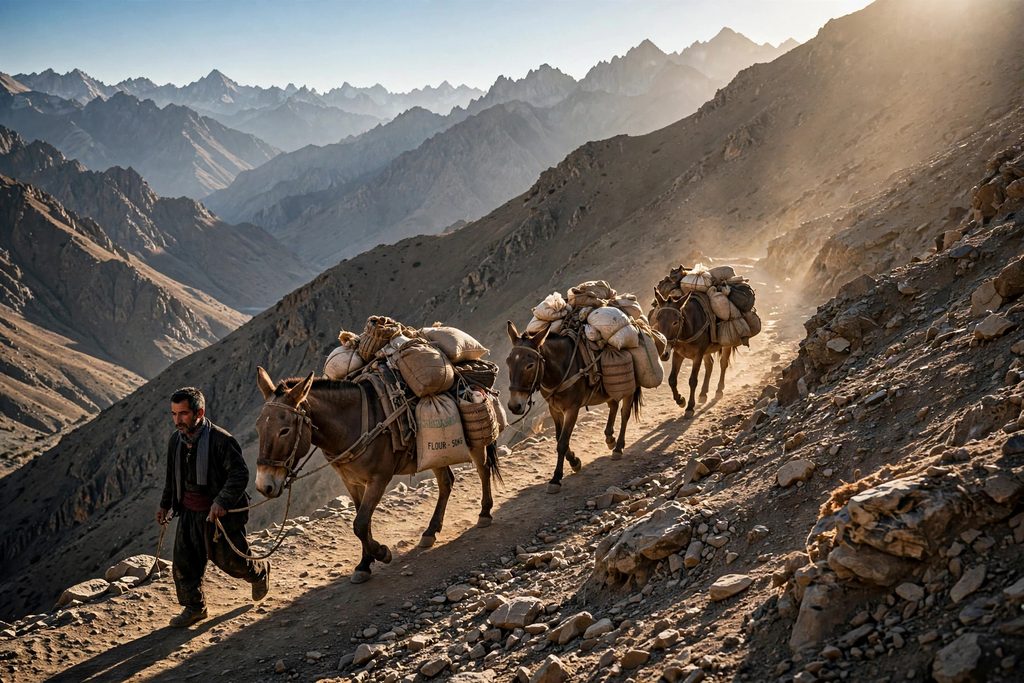
The same distance protected things that disappeared elsewhere. Across most of Greece, the decades after the Second World War brought roads, buses, radio and the pull of Athens, and with them the quiet abandonment of regional dress, local speech and village customs. In Olympos those pressures arrived late and slowly. By the time the asphalt came, the village had spent more than a thousand years becoming entirely itself, and it had already learned how to stay that way while most of its young people lived elsewhere.
The House Goes to the Daughter | The Kanakares of Karpathos
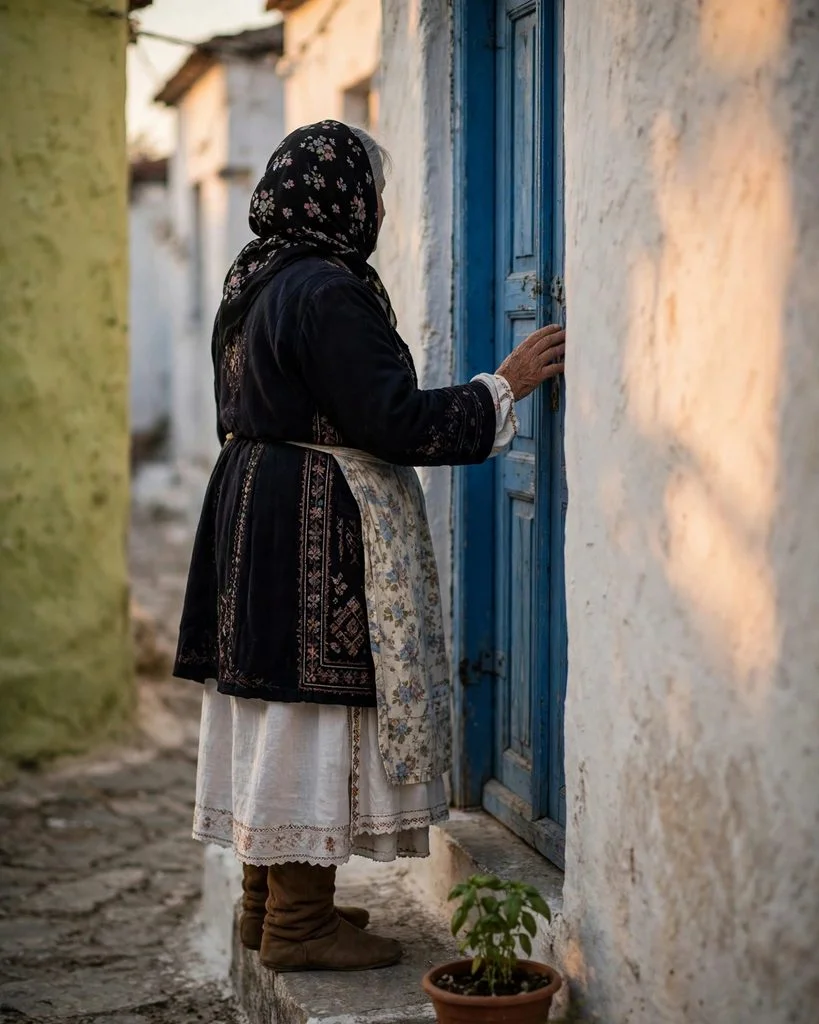
The custom at the centre of Olympos’s reputation is often described as “the daughter inherits, not the son.” That is not quite what happened. Karpathos followed a system of inheritance by birth order on both sides of the family. The father’s property passed to the firstborn son. The mother’s property, which included the family house, passed to the firstborn daughter, who also took on the duty of caring for her parents in old age. The two heirs were known as the kanakaris and the kanakara. Like most customary law it was applied with variations from family to family and loosened over the twentieth century, but its outline is clear.
The rule existed to keep land together. “If you live on an island the land is limited,” as the Oxford anthropologist Renée Hirschon has put it, and dividing fields among every child for a few generations would have left no one with enough to live on. Hirschon has also pointed out that the preference for sons found on the Greek mainland simply does not apply in the Aegean islands. On Karpathos the house followed the female line, and when a first daughter married, her husband moved in with her.
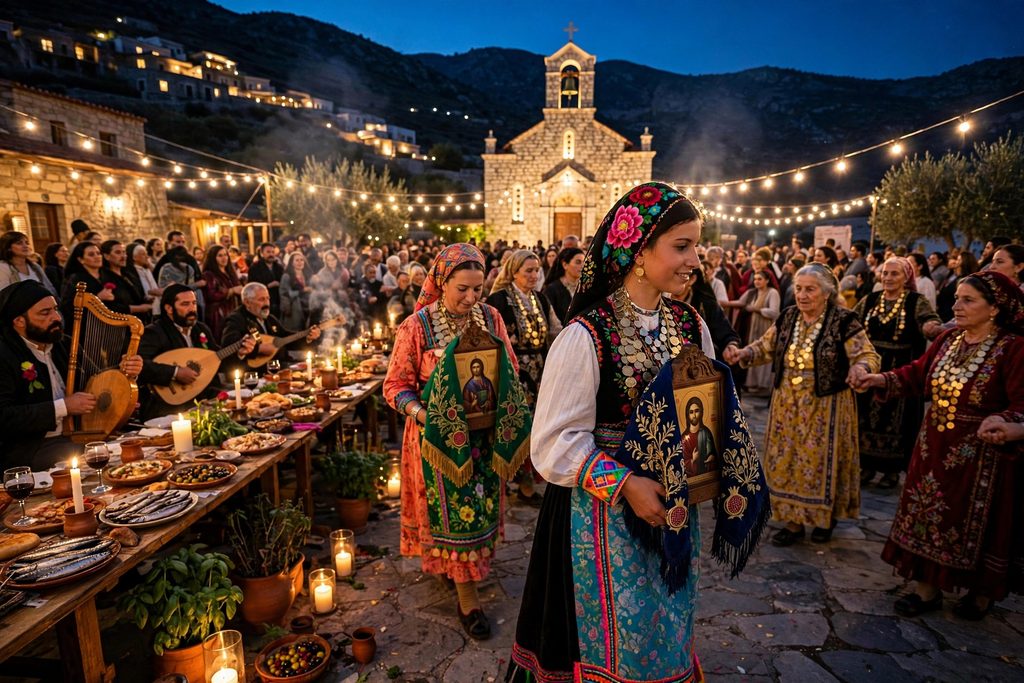
The kanakara was visible at a glance. On feast days she wore the kolaina, a chain of gold coins that covered the chest, gathered over generations from English sovereigns, Turkish pounds, French francs and Venetian gold. She wore it from girlhood until her wedding, and then it went into a chest to wait for her own first daughter. The double row of gold coins on the festive costume of Olympos today is the descendant of that inheritance worn in public.
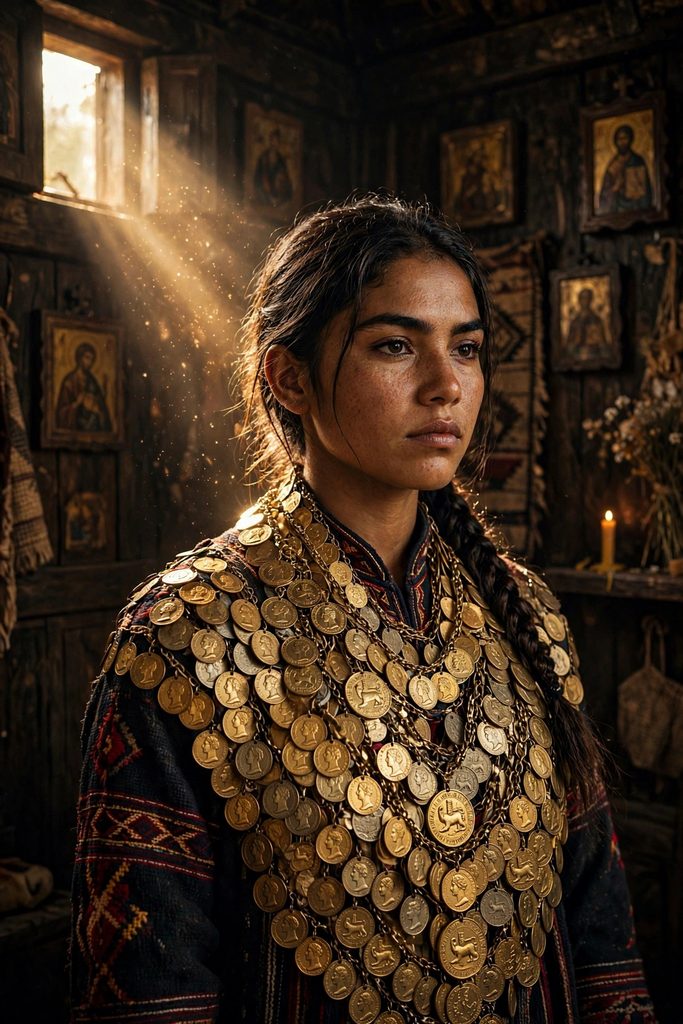
The system was not kind to everyone. Younger daughters without a dowry often stayed unmarried and worked for their older sisters. Younger sons inherited little or nothing, and for them the answer was to leave. This is where the matriarchy label goes wrong. Women in Olympos did not govern the village in any formal sense. The priests, the village council and the coffee house belonged to men. What the women held was the house, and with it the continuity of the family, and when the men left in large numbers that turned out to matter more than any office.
While the Men Were Away | Baltimore, Athens and the Long Absence
The men of Karpathos had been leaving for generations, to Asia Minor, to mainland Greece and to the other islands. From the 1960s the movement became a flood, and a remarkable number of Olymbites went to the United States, above all to Baltimore, where a Karpathian community still keeps its own associations and its own festivals. Others went to Athens, Piraeus and Rhodes. Some returned after a few years, some after decades, and some only in summer.
While they were gone, the women who held the houses also held everything else that a household involved. They worked the terraces, kept the animals, managed the money sent home, raised children whose fathers they might see once every few years, and kept the calendar of feasts and memorials that tied the families to one another. Olympos was not a village run by women as a matter of principle. It was a village where the inheritance rule had already put the women in the houses, and history then emptied the houses of men.
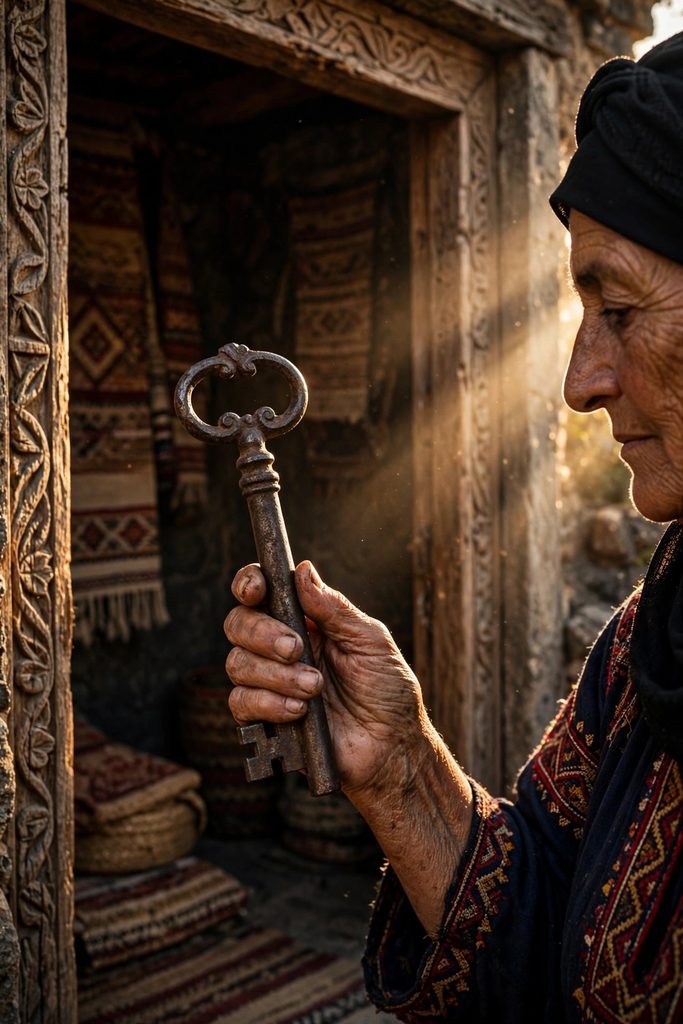
The pattern will be familiar to anyone who knows the mountain villages of the mainland. In Zagori and across Epirus, men left to trade and build abroad for years at a time while their families kept the stone villages alive. Olympos added its own twist. Here the house the absent man was working to support did not belong to him at all.
The Dress Worn on an Ordinary Weekday
What strikes most visitors first is the clothing. Many older women in Olympos have worn the traditional dress all their lives, not as a costume for festivals but as what they put on in the morning. The everyday version is a white gown with hand-embroidered borders, a dark embroidered coat, a flowered apron and a dark headscarf printed with small flowers. On the feet go stivania, soft boots of goat leather made by hand in the village and worth several hundred euros a pair.
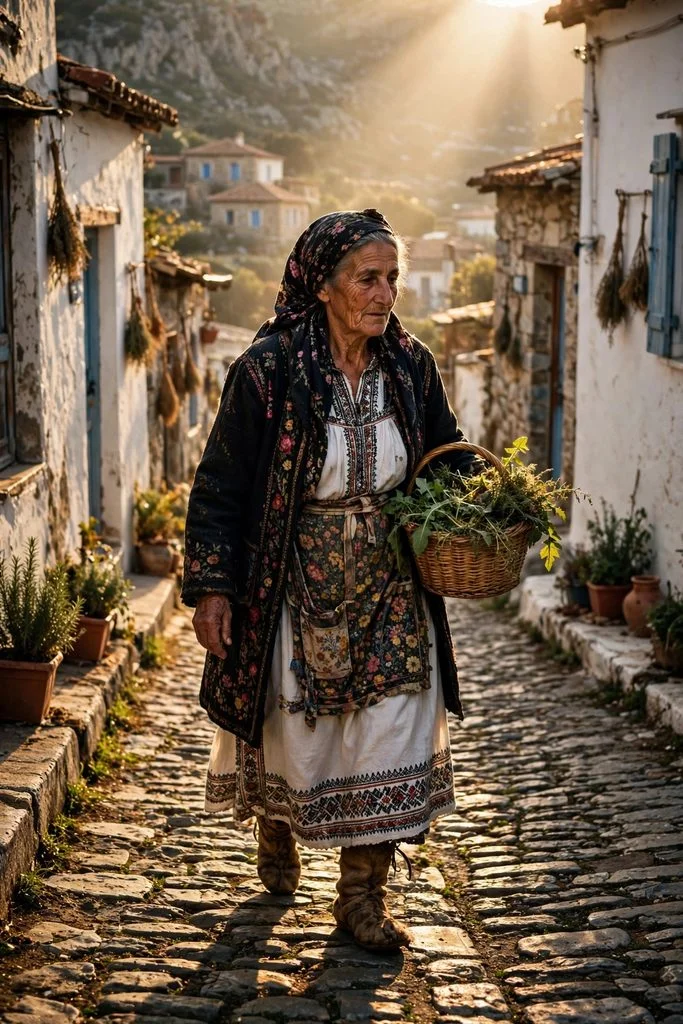
For feasts and weddings the colours brighten and the gold comes out. The dress was traditionally part of a bride’s dowry, made and embroidered at home, and it is one of the few regional costumes in Greece still worn by the people it belongs to rather than by dance troupes. That is changing. Most younger women now wear it for celebrations, and the village shoemakers who still make stivania by hand are few.
Elympos and Its Speech | What the Dialect Really Preserves
Almost every account of Olympos says its people speak a form of ancient Doric Greek. The truth is more modest and still remarkable. The speech of Olympos belongs to the dialects of Karpathos and the southeastern Aegean, a family of Greek that kept features the standard language lost, among them old pronunciations and a vocabulary full of words that sound strange to an Athenian ear. Older villagers use it most fully. A Greek visitor will usually understand the gist and miss a good deal of the detail.
The Doric claim rests on real history, since ancient Karpathos was Doric and so was Vrykous, but the line from ancient Doric to modern village speech is far less direct than the popular version suggests. The one living form of Greek that descends clearly from Doric is Tsakonian, spoken in a few villages of the eastern Peloponnese and rooted in the speech of ancient Laconia. Olympos preserves something different. It is a medieval island Greek, kept unusually intact by distance, with layers older than its neighbours, and it is fading with the generation that speaks it best.
Windmills, Ovens and Makarounes
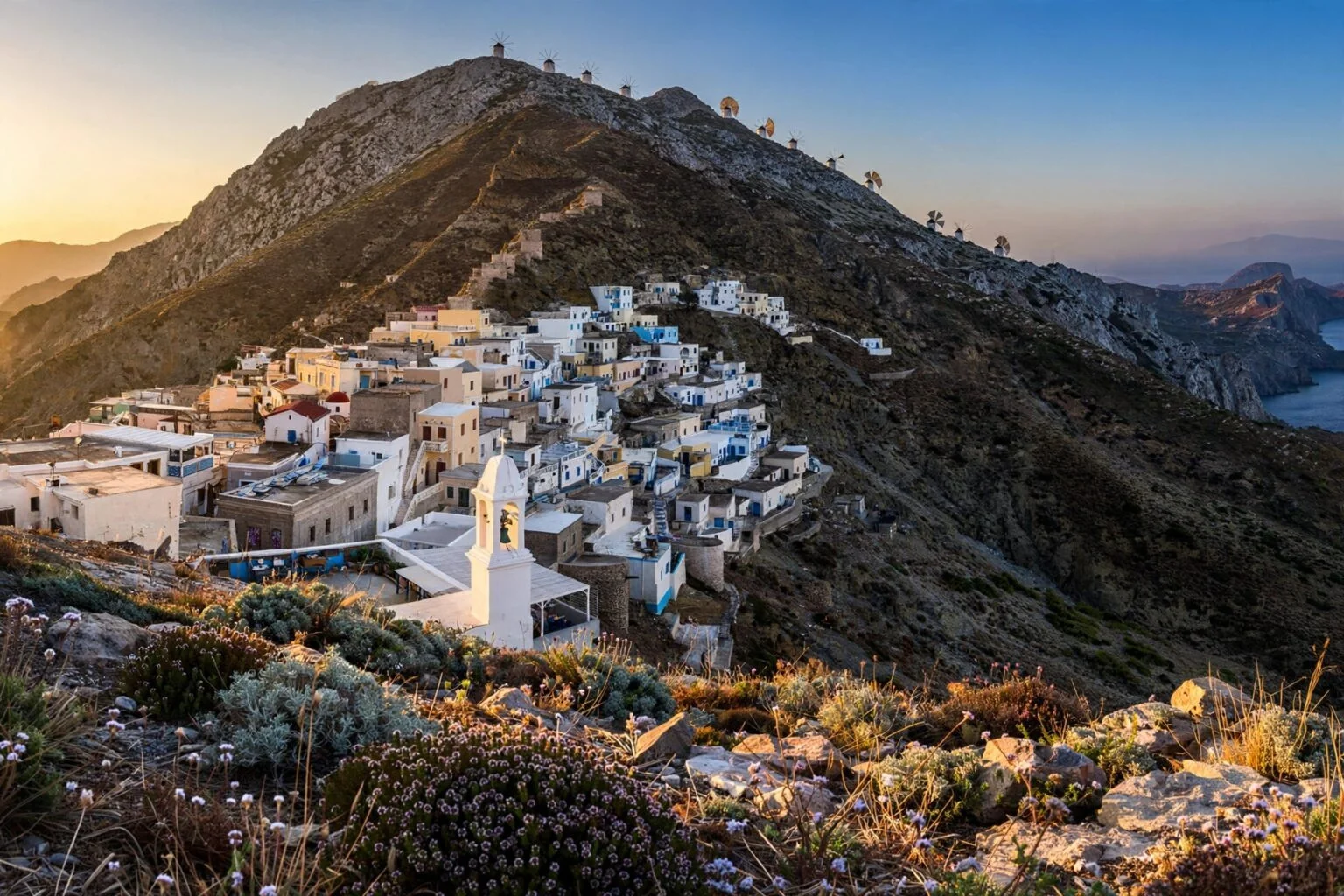
The ridge above the village carries one of the great windmill landscapes of the Aegean. More than seventy mills, large and small, once stood along the high ground, turned by the wind that rarely stops on this part of the island. Olympos ground grain for much of northern Karpathos and was among the island’s largest flour producers until a few decades ago. Most of the mills have lost their sails and serve as storerooms or stand in ruins, but a handful have been restored and still turn.
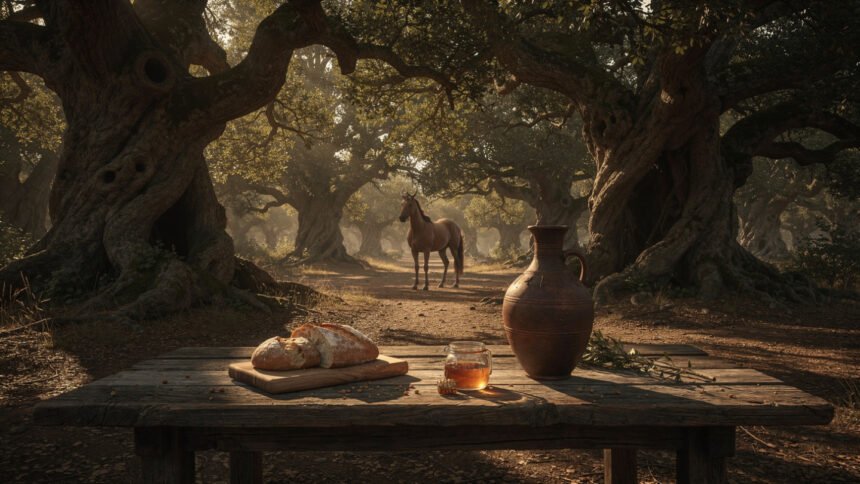
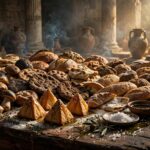
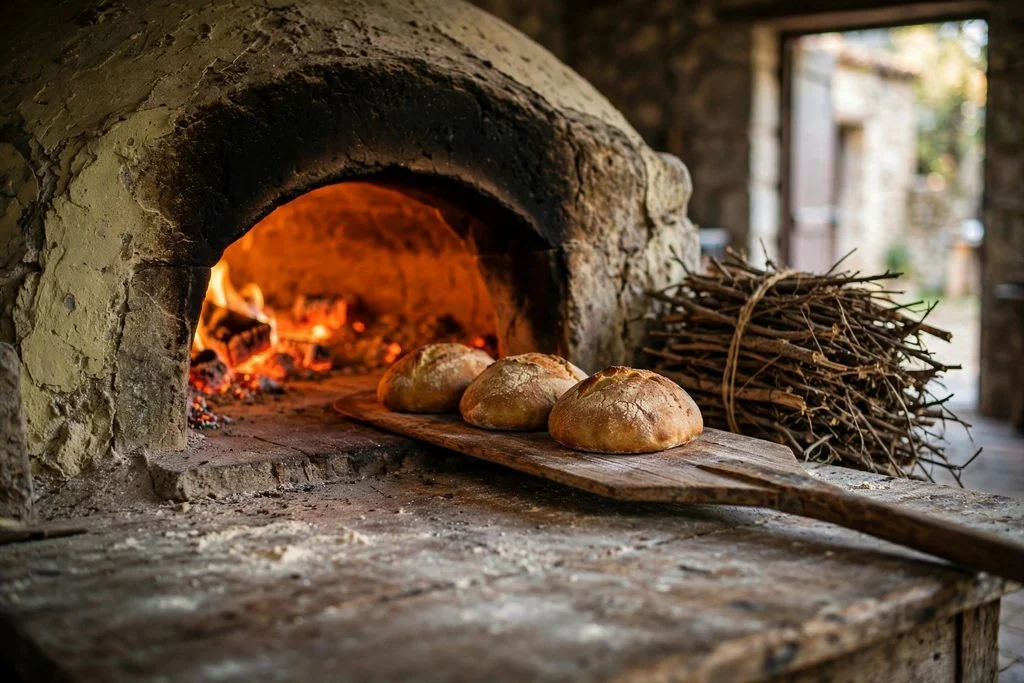
The flour went to communal wood-fired ovens scattered through the lanes and shared between families. Several are still in use, and an afternoon spent in the village may well include the smell of bread coming out of one of them. Bread here belongs to the same long Greek habit of the household loaf that runs from the barley breads of antiquity to the blessed loaves of the village church.
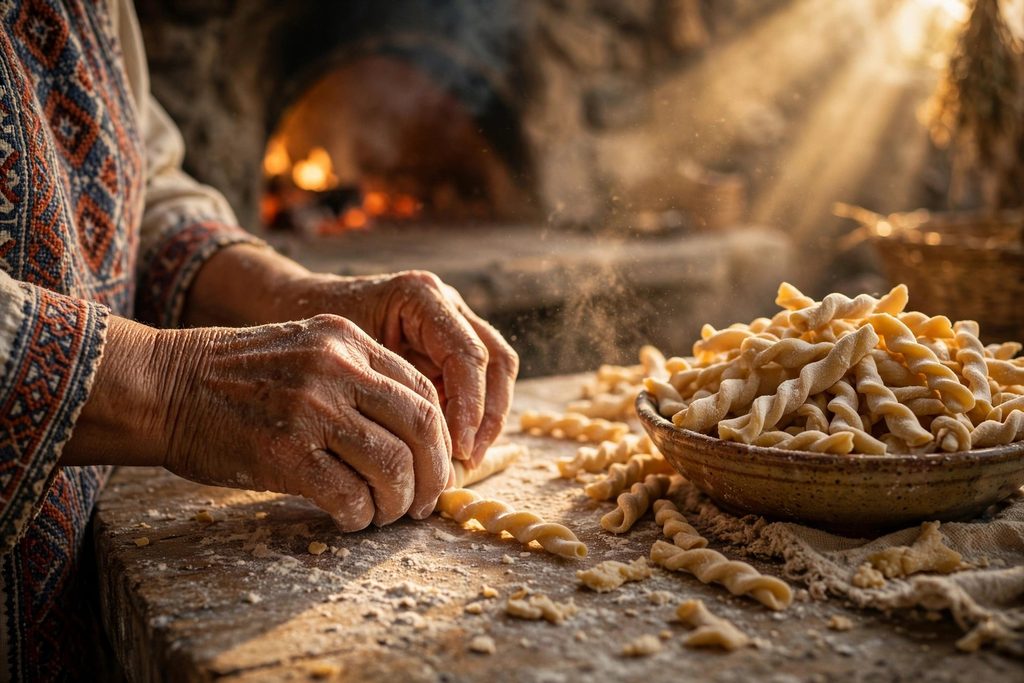
The dish to order is makarounes, short handmade pasta of flour and water rolled by hand, boiled and served with onions fried until sweet and a generous grating of local cheese. It is plain food made from what the village grew, and it tastes exactly of that. The tavernas also serve local cheeses, wild greens from the hills and the honey of the thyme-covered slopes.
Easter Tuesday and the Fifteenth of August
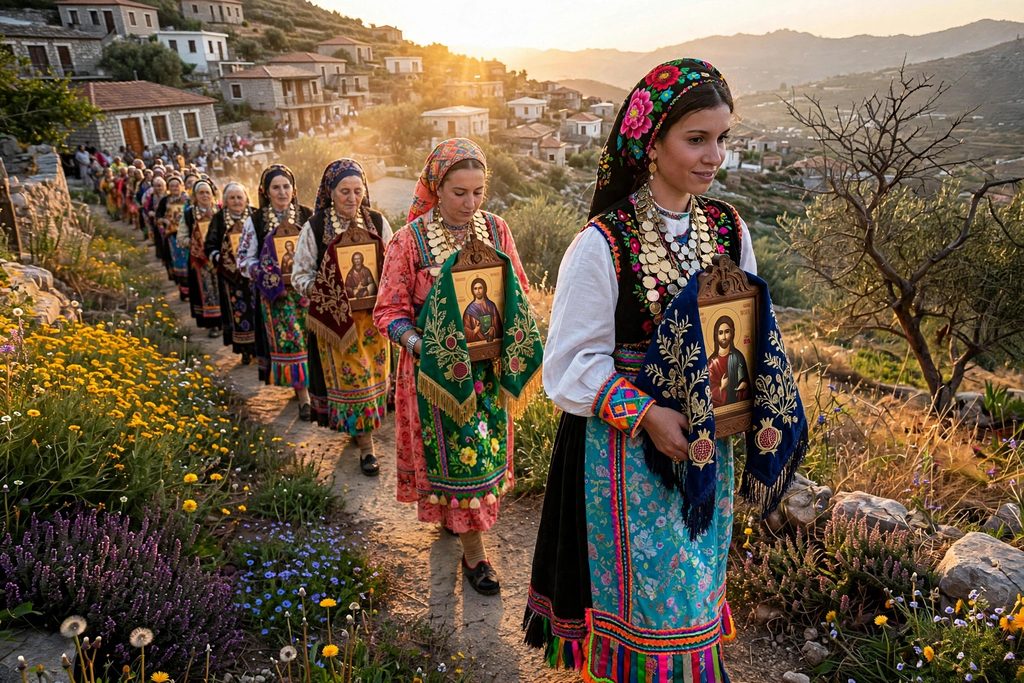
Olympos keeps the great feasts of the Orthodox year in its own way. During Holy Week the women decorate the Epitaphios and place in the church photographs of those who died during the past year, then let their hair down and mourn, a ritual of grief with roots as deep as the laments of the Mani. On the Tuesday after Easter the icons are carried in procession from the church to the cemetery, followed by women in their festival dress, and the dead are remembered among their graves. It is one of the most photographed moments in the Greek year and one of the least performed. It is done for the families, not for the cameras.
The Fifteenth of August, the Dormition of the Virgin, is the biggest night of the summer. In the small square in front of the church of the Panagia, the musicians play the Kato Choro, a slow and serious dance. The men sit at long tables with sprigs of basil in their lapels, singing to the lyra and the laouto, trading improvised couplets called mantinades. After dark the women in full festive dress join the dance, which moves slowly round the square for hours. Two weeks later, at the end of August, families walk or sail to the chapel of Saint John at Vroukounta for a panigyri that lasts two days and nights, with dancing until dawn and sleep on mattresses under the sky.
This is when the diaspora comes home. Families from Baltimore, Athens and Rhodes open the shuttered houses, and for a few weeks Olympos is the village it was before the emigration, crowded, loud and full of children. Weddings, which traditionally last three days and involve the whole village, are often timed for the summer for the same reason.
Getting There | The Road, the Boat and the Night After the Day-Trippers
Karpathos lies between Crete and Rhodes, with flights from Athens and Rhodes and ferries linking it to Piraeus, Crete and Rhodes. From Pigadia, allow around an hour to an hour and a half to drive north to Olympos on a mountain road that is now paved all the way but still narrow and winding. The landscape changes as you go, from the beaches and resorts of the south to the bare, wind-scoured hills of the north.
The older approach is still the better one. In summer, excursion boats usually run from Pigadia up the east coast to Diafani, and from the harbour a winding road climbs eight kilometres to the village, with buses timed to meet the boats. It is the route the villagers used for centuries, and it shows you what the founders understood. From the sea, Olympos is almost invisible. From Olympos, the sea is everywhere.
Boat timetables and bus connections change with the season, so check them locally before you rely on them. Stay the night if you can. By late afternoon the day visitors are gone, the lanes empty, and the village returns to its own rhythm. Walkers can drive on to the Avlona plateau, the northernmost point the road reaches, and follow the path down to Vroukounta, an hour or so each way, to see the ruins of the ancient city the founders left behind.
What the Road Brought
In 1947 about 1,200 people lived in Olympos. The 2021 census counted 200, and in winter, according to those who live there, the year-round population falls to around sixty. The village school has a handful of pupils. Tourism, which became the main source of income in the 2000s, keeps the tavernas and the craft shops open, and the road that brings the visitors is also the road that takes the young people away. It is the same arithmetic that shapes year-round life on any small Greek island, only sharper.
None of this is a reason to treat Olympos as a museum or to arrive with pity. It is a living place that has outlasted pirates, empires and a century of emigration, and it has done so largely on its own terms. The dress is still worn, the ovens still bake, the icons still go to the cemetery on Easter Tuesday, and every August the square fills again. What has changed is the scale. The traditions are carried by fewer and older hands, and the question for the next generation is whether a way of life built by isolation can survive without it.
Go with respect. Ask before photographing anyone and accept a refusal without argument, eat in the family tavernas and buy what is made in the village. Treat Easter Tuesday as what it is, an act of remembrance rather than a show.
And resist the urge to call Olympos a place that time forgot. Time did not forget it. It left its marks on the road, on the shuttered houses and on the lives of the young people who now come home mostly in summer. What endured was not isolation alone. It was the work of people who kept returning to the same houses, the same ovens and the same calendar of feasts.
In Olympos the house went to the daughter. What she inherited was larger than a building. It was the duty of keeping a family tied to a place, and through that place to its own memory, and on a ridge above the Aegean that duty is still being carried.
At Olympus Estate, Greek Islands goes past the beaches to the places where island life still runs on its own rules, and Olympos on Karpathos is one of the most complete. Founded, by local tradition, when the people of the ancient Doric city of Vrykous fled pirate raids for a ridge between two peaks, the village had no road until the late 1970s, no electricity until around 1980 and no fully paved link south until the early 2010s. Its inheritance custom gave the father’s property to the firstborn son and the mother’s property and the family house to the firstborn daughter, the kanakara, who wore the family’s gold coins until her wedding and took in her husband under her own roof. Younger sons emigrated, from the 1960s above all to Baltimore, and for decades the women who held the houses also ran daily life. Many older women still wear the embroidered dress and goat-leather stivania every day, the speech of Elympos keeps old island features that are fading with its eldest speakers, more than seventy windmills crown the ridge and the communal ovens still bake. Easter Tuesday sends the icons to the cemetery, the Fifteenth of August fills the square with the slow Kato Choro and the diaspora returns each summer to a village whose winter population has fallen to a few dozen. What the first daughter inherited there was never only a house but the duty of keeping a family tied to its place.