



The word means scorching.
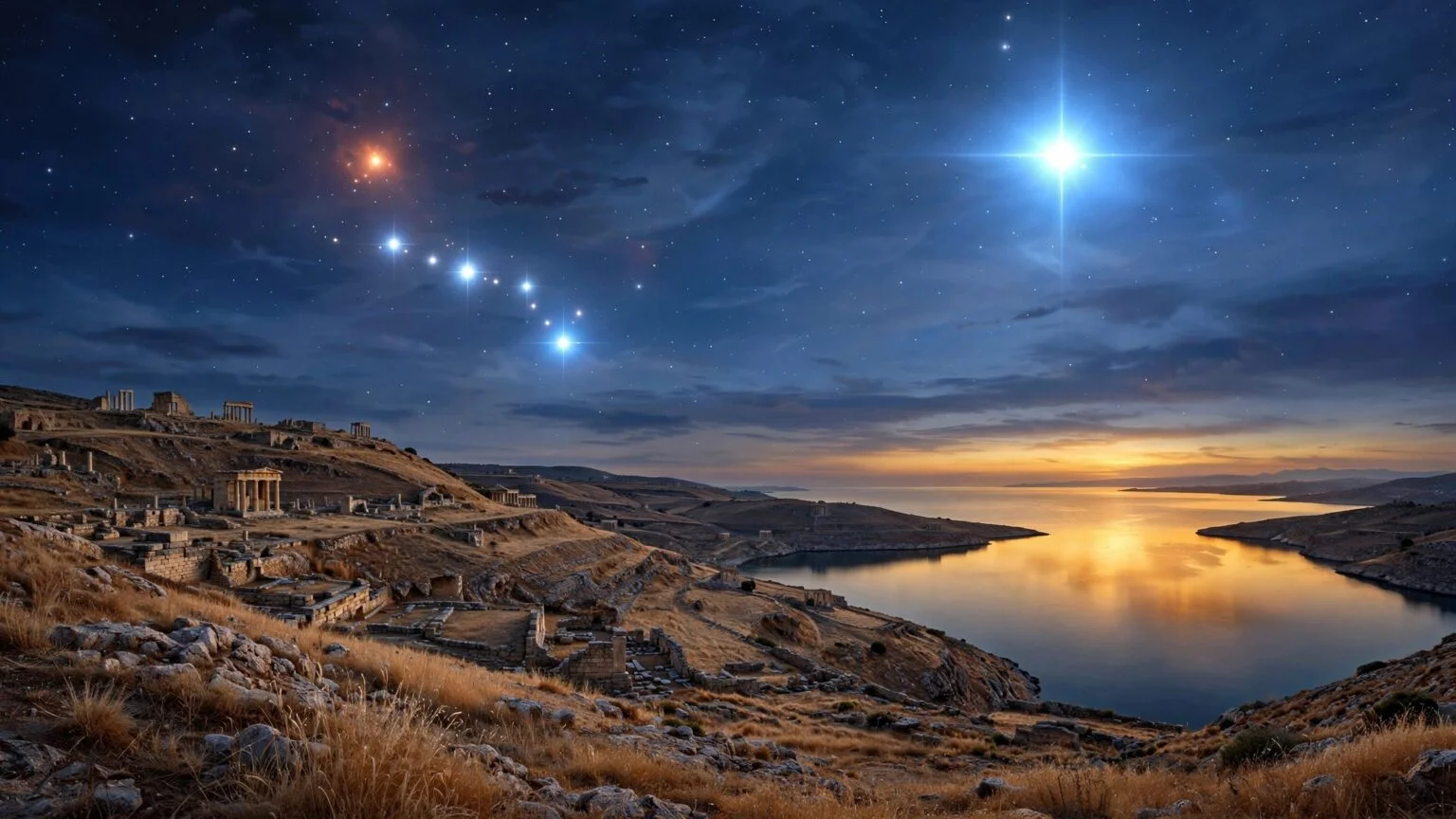
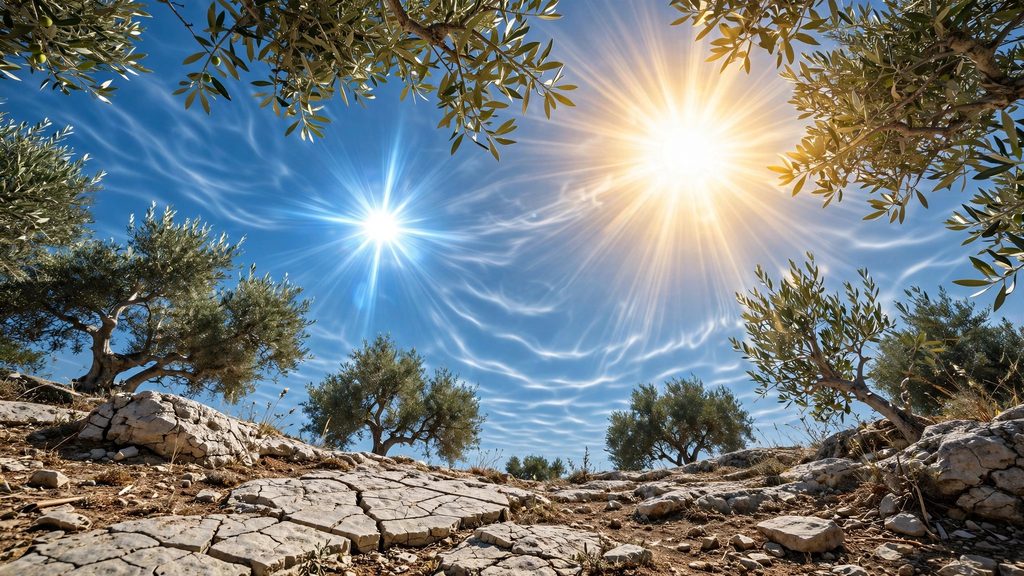
The Greeks who named the brightest star in the night sky did not name it for its beauty, its position, or its mythological associations. They named it for what it did to the air in the weeks when it rose with the sun: it scorched. The Greek word Seirios, the root of our Sirius, meant scorching or glowing, and the heat that descended on the Aegean world in late July and August was not, in the Greek understanding, simply the consequence of the sun’s position in the ecliptic. It was the combined effect of two fires burning simultaneously in the sky, the sun’s ordinary blaze compounded by the added intensity of the Dog Star rising alongside it.
The Greeks believed the Dog Star’s brilliance intensified the summer sun.
This belief was not superstition in the modern dismissive sense. It was an empirical observation stripped of its causal complexity and reassembled as myth, which is precisely what mythology does with the most important natural events: it takes the observable, names it, and gives the named thing a biography so that future generations can recognize when it is happening again and what it means for the crops, the livestock, the sailors, and the human body that has to endure it. Sirius rose with the sun in late July. The hottest days of the year coincided with its rising. The connection was obvious, the name was exact, and the mythology that built itself around the star’s own quality gave the ancient Greeks the vocabulary for talking about the most dangerous season of the year.
We are in that season now. The Meltemi is softening. The light is beginning its shift toward the autumn character. The Dog Star is moving away from the sun and will soon reappear in the predawn sky, marking the end of the Dog Days the same way its heliacal rising marked their beginning.
Here is what the Greeks built around this season, and what they understood the sky to be saying when the heat was at its worst.
Sirius and the Calendar Written in Stars
The agricultural and navigational calendar of the ancient Greek world was an astronomical calendar: the rising and setting of particular stars and constellations at fixed moments in the year marked the transitions between seasons and indicated the appropriate times for planting, harvesting, sailing, and resting. This was not a calendar of abstract astronomical data. It was a practical guide to living in the Mediterranean landscape, encoded in the appearances of the stars and transmitted through the poetic tradition rather than through official records.
Homer’s Iliad already carries the star’s dread reputation, generations before Hesiod put it to practical use. Watching Achilles bear down on Troy in the poem’s final book, Priam sees him blazing across the plain and compares him directly to the star: it rises late in the dark, liquid sky, brightest of all the stars, and men call it Orion’s Dog. It shines most brilliant of all, but it is wrought as a sign of evil, and brings much fever upon wretched mortals. The comparison is not decorative. Homer reaches for Sirius specifically because his audience already understood, without any explanation needed, that this particular brilliance meant danger.
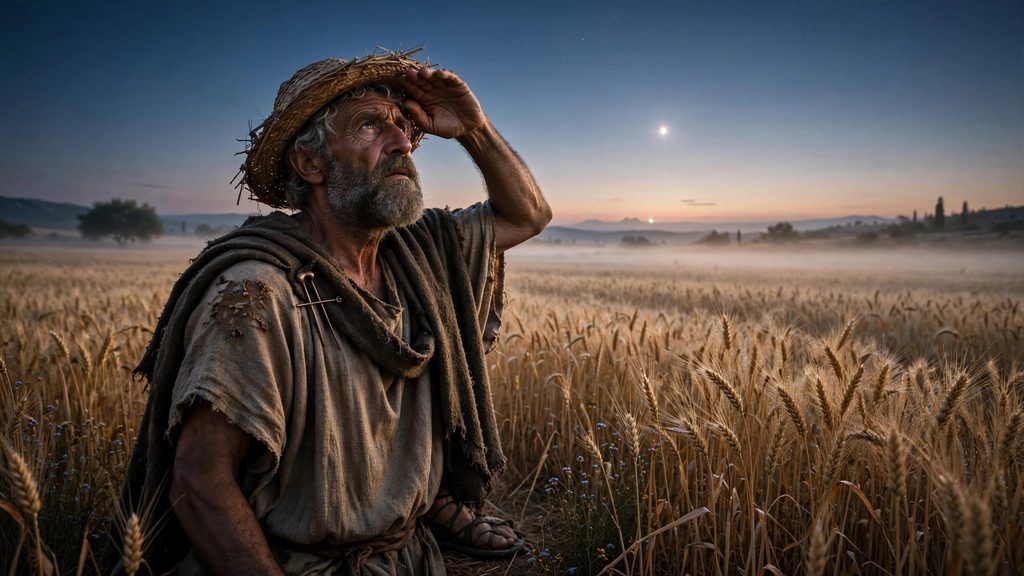
Hesiod’s Works and Days, composed in the seventh century BCE and the most complete surviving account of the Greek agricultural year, is the primary source for understanding how the star calendar worked in practice, a poet whose other great surviving structure, the Five Ages of Man, this site has already examined in its own right. In Works and Days, Hesiod warns of the heliacal rising of both Orion and the Dog Star Sirius, marking the onset of intense summer heat and advising farmers to avoid laborious work, thus linking the mythic duo to practical astronomical observations.
The warning Hesiod gives for the Dog Days is precise and physical: when the Dog Star rises, its heat falls not only on crops and livestock but on human bodies, and the human body in the Dog Days is a body at risk. He writes that when Zeus sends the Dog Star to shine, it brings feverish heat to feeble mortals, advising caution for sailors and farmers during this time.
Feverish heat to feeble mortals. The Greeks understood the Dog Days not as a period of manageable discomfort but as a genuine threat to physical and mental health. Hellenistic astrology connected these days with heat, drought, sudden thunderstorms, lethargy, fever, mad dogs, and bad luck. The madness of dogs, who bit and spread disease in the heat of late summer, was directly associated with the Dog Star’s period of dominance, and the connection was considered not metaphorical but causal: Sirius’s fire maddened dogs the way it fevered humans. The Romans inherited the same fear under their own name for it, the dies caniculares, the days of the little dog, and Virgil warned that when Sirius rises it brings drought and plague to frail mortals, the same anxiety carried forward into Latin almost unchanged.
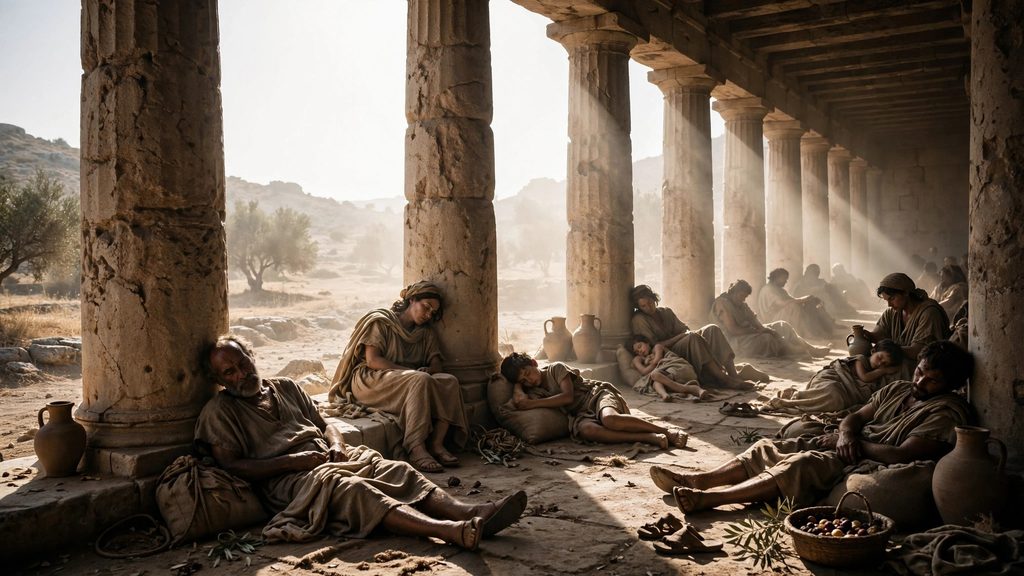
The period covered forty days, traditionally reckoned from July 3 to August 11, coinciding with the heliacal rising of Sirius. In late August, as these words are written, the Dog Days are ending. The star that caused them is completing its retreat from the predawn sky. The heat that remains is the heat’s last assertion rather than its peak, and the particular quality of late August light in the Aegean, lower than July’s, more orange, less purely white, is the light of a season that has passed its maximum and is beginning to soften toward what comes next.
Orion and the Dog That Follows Him
According to Greek mythology, Sirius was the dog of the hunter Orion, and the ancient Romans placed the star in the constellation Canis Major, Latin for Greater Dog.
The myth of Orion is the myth of the most magnificent hunter the mortal world produced, the son of Poseidon and the giant Euryale, whose hunting gifts were so extraordinary that he could walk on water and whose death came, as the deaths of mythological figures defined by a single spectacular ability tend to come, from the one vulnerability that his gift could not protect him against.
Orion’s death varies between sources: Artemis killed him, either accidentally in an archery contest or deliberately after he assaulted either her or one of her nymphs. In another version, a scorpion killed him, sent by Gaia after Orion boasted he would kill every animal on earth. In the version most closely connected to the astronomical tradition, both Orion and the scorpion were catasterized: placed among the stars as constellations on opposite sides of the sky, so that Orion sets in the west as the Scorpius constellation rises in the east, the hunter forever fleeing the creature that killed him, the chase continuing across the dome of the sky in the same sequence it had played out on earth.
His dog follows him. Sirius trails after Orion in the sky as a loyal dog trails its hunter: the two rise in proximity, move together across the winter sky in the northern hemisphere’s night, and set together. Orion was pursuing the Pleiades, the seven sisters whose own myth this site has told in full elsewhere, when he was killed, and the sky preserves that pursuit in its permanent arrangement: the Pleiades cluster, the seven daughters of Atlas, move ahead of Orion who moves ahead of the dog, the entire chase frozen into the stellar positions that the Greek imagination had read as mythology rather than astronomy.
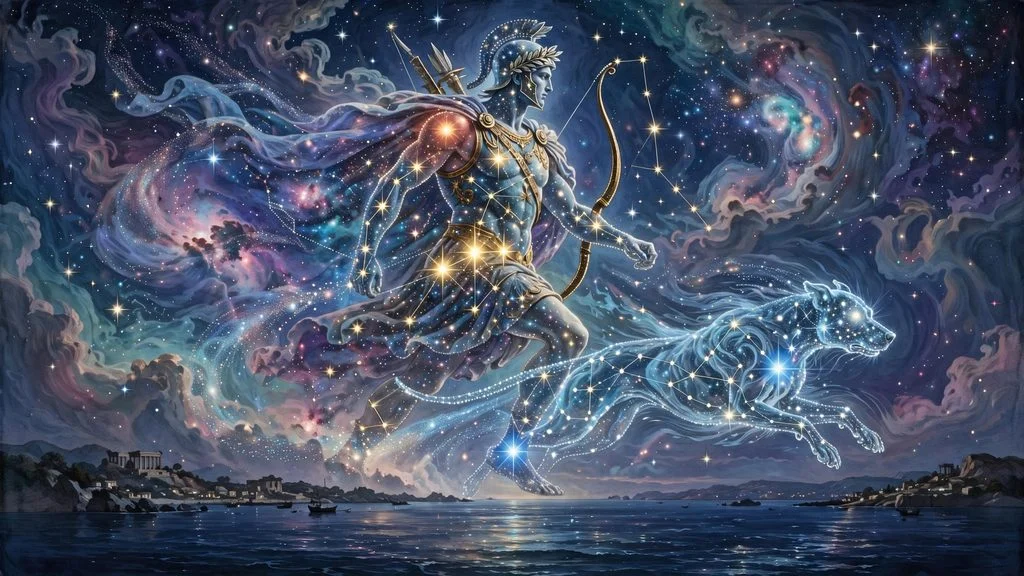
The Dog Star that announces the summer’s most dangerous weeks is the dog of the hunter whose death was caused by his own excess of power. This mythological connection, between the star that scorches and the hunter who chased what he should not have chased, is the Greek imagination’s most precise encoding of the summer’s lesson: that the season at its peak is the season of what happens when force exceeds its appropriate limits, and that the consequence of that excess is heat, fever, drought, and the particular dangers of the Dog Days.
The Other Dog | Laelaps and the Impossible Chase
The astronomical tradition had a second, more complex story for what the Dog Star represented, one that adds a philosophical dimension to the mythological reading of the summer sky.
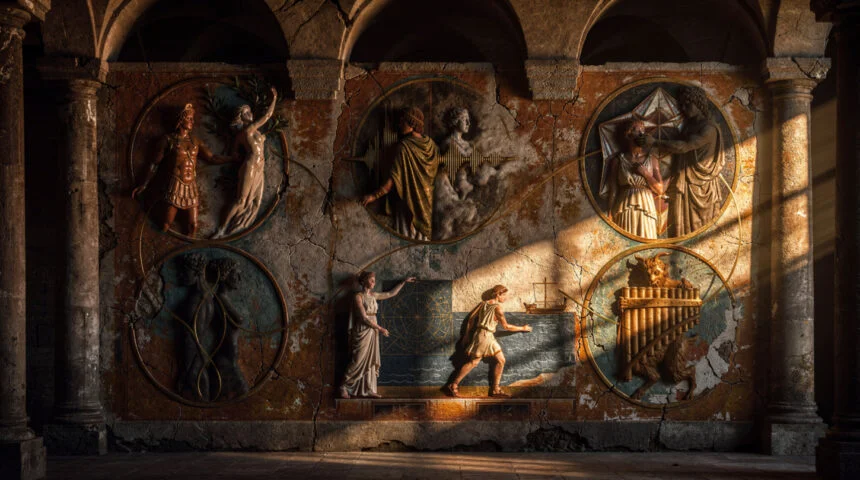
Apollodorus, in the Bibliotheca, recounts the story of Laelaps, the swift hound who never failed to catch what she was hunting. Cephalus decided to lend the hound to hunt the Teumessian fox, who could never be caught. The inextricable chase went on until Zeus, whose own name and nature this site has examined at length elsewhere, perplexed by their contradictory fates, turned both to stone and cast them into the stars as the constellations Canis Major, Laelaps, and Canis Minor, the Teumessian fox.
The dog that catches everything and the fox that nothing can catch: Zeus resolved the logical paradox of two contradictory fates by freezing both parties at the moment of their contradiction and placing them in the sky, where the pursuit continues but the moment of resolution never arrives. The Dog Star is the dog who always catches its prey, pursuing through the summer sky the fox who can never be caught, and the heat of the Dog Days is the heat of that unresolvable chase, the friction of two contradictory certainties pressing against each other in the July and August sky.
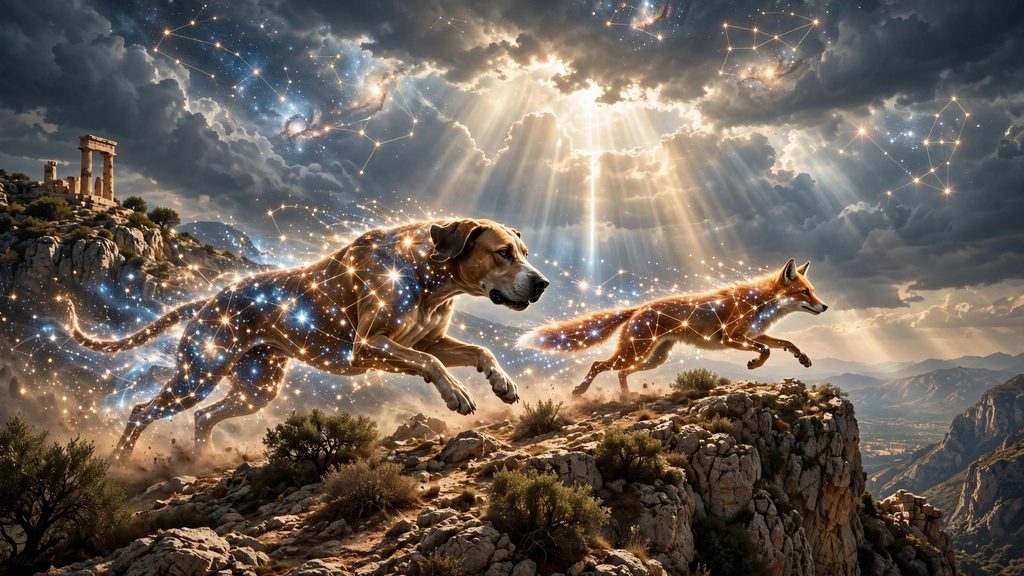
This myth is the Greek world’s mythological treatment of logical paradox, told in the form of a dog and a fox and the father of gods who could find no better solution than to promote the problem to a permanent stellar feature. The summer heat is not simply the sun’s intensity or the Dog Star’s added fire. It is the heat of an unresolvable argument that Zeus himself could not settle, still running across the same sky it has always been running across, generating the same friction it has always generated.
Aristaeus and the Wind That Was Sent to Cool the Fire
The tradition did not only describe the Dog Star’s heat. In at least one surviving account, it also describes what the Greeks believed had once been done about it, and the story ties Sirius directly to the wind that opens and closes this very essay.
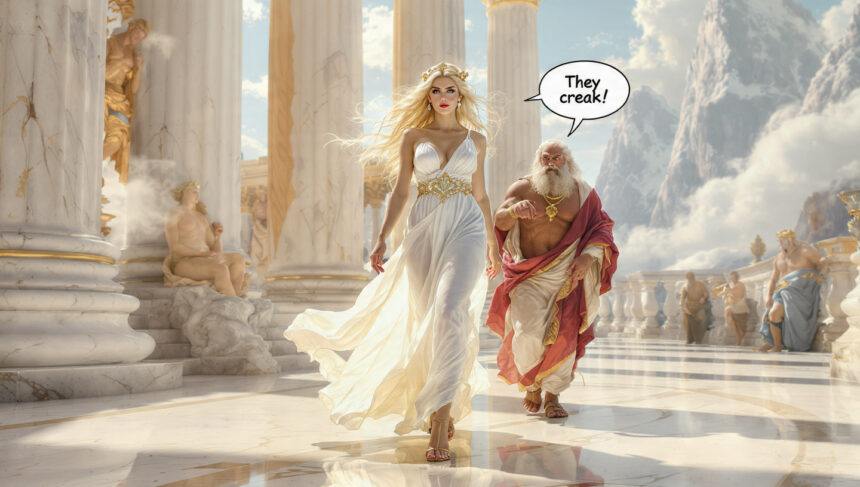
Apollonius of Rhodes, in the Argonautica, preserves a local Aegean tradition in which Sirius’s scorching once became so severe that it threatened the islands outright. Sirius was burning the Minoan islands from the sky, and no remedy could be found for the affliction until Zeus himself instructed that Aristaeus be sent for. Aristaeus, acting on his father Apollo’s guidance, went to the island of Ceos and made ritual offerings on the mountains to the Dog Star and to Zeus himself. In answer, Zeus sent the Etesian winds to blow and cool the earth for forty days, and the Rhodians and islanders of the region observed a yearly rite from that day forward in his honor, watching for the star’s rising and calling on the wind to return.
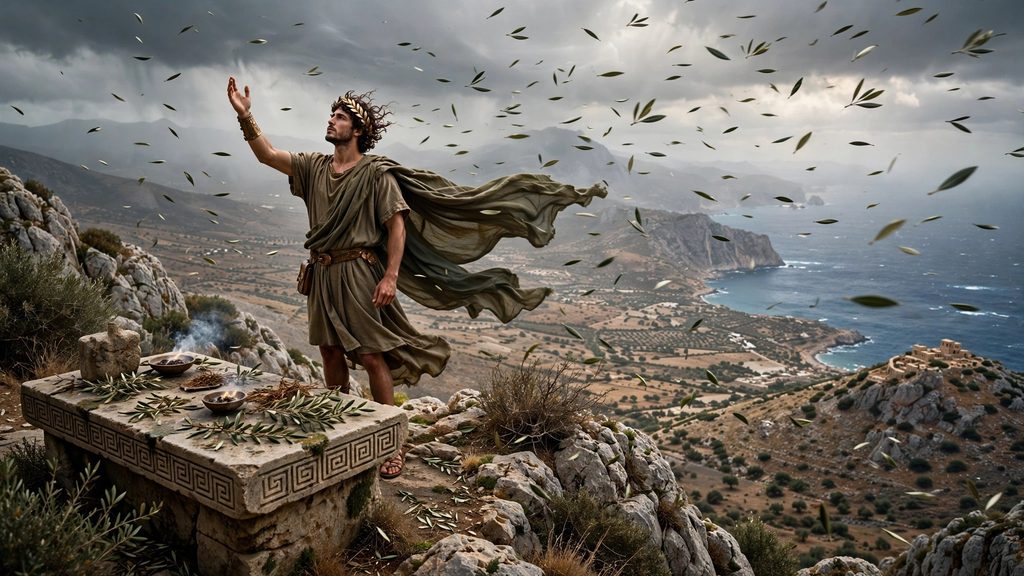
The Etesian winds are the same winds still known today as the Meltemi, the north wind that breaks the stillness of the Aegean summer and makes the heat survivable. The myth is, in effect, the ancient explanation for the very relief this essay describes in its opening and its close: the wind that is now softening as August ends was once, in the Argonautica’s telling, a divine remedy prescribed directly against the Dog Star’s fire, requested by a hero, granted by Zeus, and repeated every year since as a fixed feature of the Aegean calendar. The Greeks did not simply endure the Dog Days. They kept a myth on hand that explained why the relief always eventually came.
Phaethon and What Extreme Heat Means
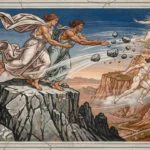
The myth of Phaethon, treated in depth in the dedicated essay on this site, has its most direct seasonal relevance in late summer, when the landscape of the Aegean shows exactly what Phaethon’s failed attempt to drive the solar chariot is mythologically supposed to have produced.
The scorched earth, the deserts, the charred skin of the people of Africa who were burned black by the sun’s uncontrolled passage: these are the mythological explanations for the visible features of the late summer Mediterranean landscape. The August hillsides of the Peloponnese and Attica, bleached white or burnt yellow by three months of sun without rain, are the landscape that Phaethon’s ride produced. The bare limestone of the Cyclades, the cracked earth of the Argive plain, the particular color of the Mani’s stones at the end of a dry season: all of these are the afterimage of a catastrophic mishandling of the sun’s daily route.
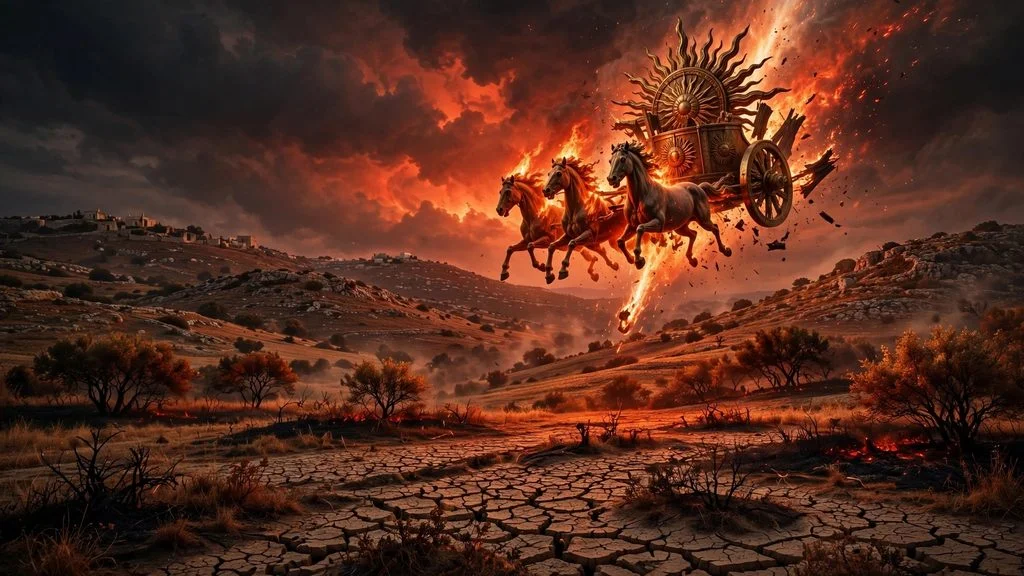
The myth encodes a genuine seasonal truth in mythological form: the summer’s heat, at its most extreme, looks like the consequence of a process that has gone out of control. The sun that should be governed, measured, steady in its daily traverse, seems in August to be burning with a ferocity that the proper management of the solar chariot would not have permitted. The landscape that the Aegean traveler walks through in late August is the landscape that looks, to the mythological eye, like it has been scorched by something that was not supposed to come this close.
This is the real utility of the Phaethon myth as a seasonal story rather than only as a philosophical one: it gives the extreme heat of late summer a narrative explanation that acknowledges the heat’s quality of excess, its feeling of having exceeded what should be possible. The heat of August in the Aegean is the heat of something that has outrun its proper limits, and the myth gave ancient Greek farmers and sailors the vocabulary to say: this is what excess looks like, and this is why the system of divine management exists, so that what Phaethon accidentally caused does not become permanent.
Helios in August | The Chariot at Its Furthest Reach
In August, the sun is not at its highest. It is beginning its retreat toward the equinox, its arc across the sky becoming noticeably lower day by day, its light taking the first hints of the amber quality that September will develop fully. The ancient Greek understanding of this transition was theological rather than astronomical: the sun god’s chariot was turning, completing the outermost arc of its summer passage, beginning the descent toward the autumn arrangement of the year.
This turning is the moment that the Helios mythology this site has already told makes most legible. The god who missed the world’s division because he stopped to watch Athena’s birth, who received Rhodes in compensation when it rose from the sea, whose daily route structured the entire visible world from east to west: in late August, that route is visibly changing. The light that was directly overhead in July is now approaching from a lower angle. The shadows that were shortest at the summer solstice are lengthening. The particular quality of the Aegean August light is about to shift permanently toward its autumn register.
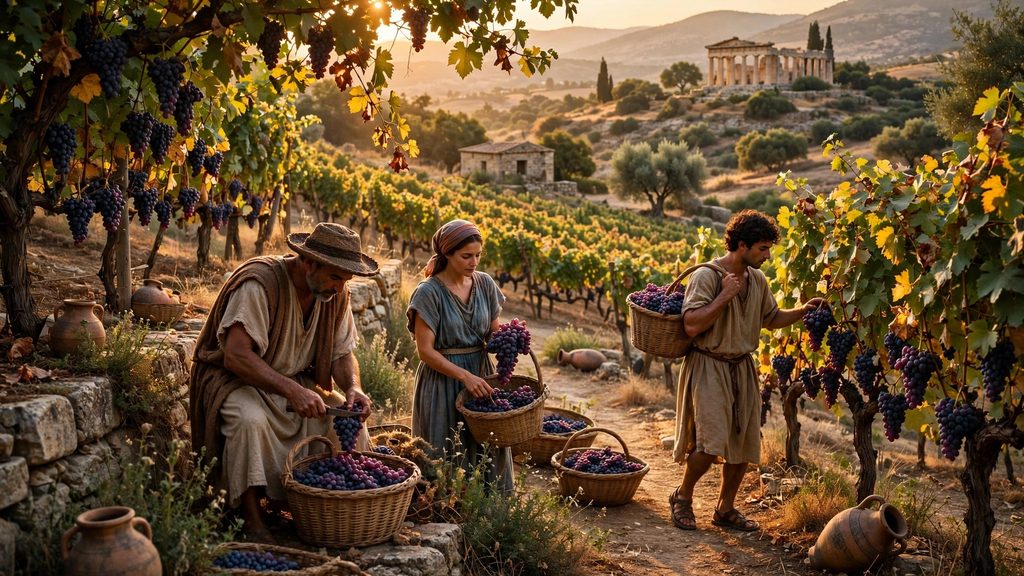
The farmers that Hesiod addressed in Works and Days understood this shift through the stars. He writes: when Orion and Sirius are come into mid-heaven and rosy-fingered Eos sees Arcturus, then cut off all the grape-clusters. The grape harvest, one of the most significant events in the agricultural calendar, was timed to the stars: specifically, to the moment when Orion and Sirius had moved to their mid-heaven positions and Arcturus had made its heliacal rising. The astronomical events gave the calendar its precision, and the mythology that surrounded those events gave the calendar its emotional and religious weight.
What Late August Actually Means
Late August in the Aegean is a distinct seasonal experience that the mythology described with more accuracy than the weather forecast.
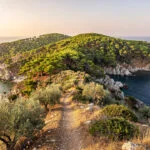
The Meltemi is weakening. The north wind that drove the sea into whitecaps through July and early August is becoming intermittent rather than daily, its periods of calm longer, its periods of strength shorter. The sea surface, which spent the summer being continuously agitated, is settling into the long, rolling swells of the transition between summer and autumn that make the Aegean’s September waters the most beautiful swimming of the year.
The light is changing. Not dramatically, not yet with the full amber quality of September, but perceptibly: the noon sun is lower than it was three weeks ago, the shadows at the same hour are longer, and the particular quality of the late afternoon, when the sun has moved past its daily zenith and the Aegean catches it at an oblique angle that turns the water from turquoise to deep gold, is a quality that July does not have and that late August begins to produce.

The heat is still present but no longer absolute. The Dog Days are ending. Sirius is completing its forty-day alignment with the sun and preparing to reappear in the predawn sky as a separate, visible object. When Sirius reappears before dawn, the Dog Days are officially over. The Aegean knows this before the star makes its first reappearance: the quality of the air changes, the nights cool earlier, the morning mist on the water appears for the first time since May.
The ancient Egyptians five thousand years ago noticed Sirius’s heliacal rising, when it was visible just before sunrise, just prior to the annual flooding of the Nile. What the Nile’s flooding was to Egypt, the end of the Dog Days was to the Aegean: the signal that the most dangerous and most demanding season had passed its peak and was beginning to release its hold.
Orion is still in the sky. The dog that follows him is still the brightest star. The fox it can never catch is still ahead of both of them. Zeus never found a better solution than turning the whole impossible chase into a permanent stellar feature, and the sky above the Aegean in late August is still that sky, still running the same chase, still generating the same heat.
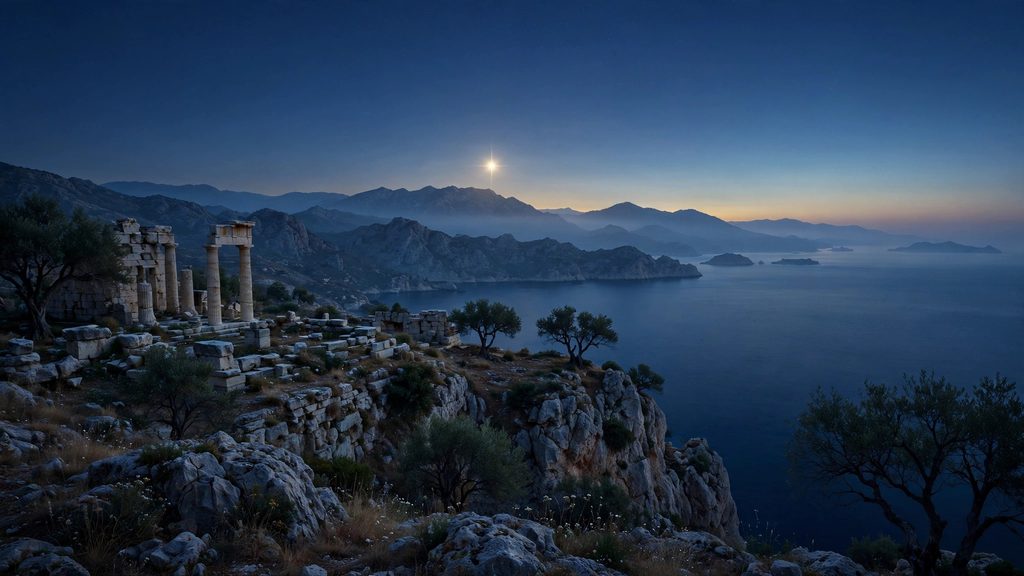
It is ending now. The grape harvest is coming. Eos will see Arcturus at dawn.
At Olympus Estate, Tales from Olympus moves through the deeper currents of the Greek tradition. Sirius, Seirios, meant scorching, and its heliacal rising in late July marked the forty days the Greeks and Romans both feared, warned of already in Homer’s Iliad and codified by Hesiod as a season of feverish heat to feeble mortals. Sirius was Orion’s dog, following the hunter whose own excess killed him, and in Apollodorus’s telling a second, stranger dog named Laelaps chases an uncatchable fox forever across the same sky, a paradox Zeus resolved only by freezing it into stars. Apollonius of Rhodes preserves the oldest link of all: a myth in which Aristaeus won the Etesian winds, the same Meltemi that cools the Aegean today, as Zeus’s own remedy against the Dog Star’s fire. The heat is ending now. The star that caused it is completing its retreat.